


 Claim Ownership
Funnel Reboot
Subscribed: 10Played: 45
Subscribe

© Creative Commons Attribution-NonCommercial-NoDerivatives 4.0
Description
A show giving you better insight into your funnel, so your marketing can be even better. New content biweekly, geared for analytically-minded marketers.
226 Episodes
Reverse

Social media platforms can serve as both vibrant marketplaces and spaces for genuine social interaction, where consumers feel valued, while businesses boost engagement and sales. This picture may not look anything like the reality of social media that you see, but our guest will remind you that things haven't always been this way. A short glance back of the Internet shows that in the year 2000 the Internet's governing body actually had looked at using a citizen model to allow individuals who use the internet to kind of come together as a social contract and to decide how they would be able to vote on changes to the internet - and at their peak 158,000 people were on the voting rolls. This was a radical global experiment in direct democracy. That model didn't take off, partly because to be a voting member, Internet users everywhere would have to (at least temporarily) upload some Identification - and most weren't willing to share that kind of data. What happened instead was the rise of social networks owned by a handful of companies, who conditioned us sellers to post promoted content with attention-grabbing messages because that could be used by the algorithms to keep buyers on the platforms. And I've got to call out how , as buyers, we're also complicit because we now give those platforms way more data than the Internet governing body ever asked for. How ironic. But our guest maintains that it's in our ability to regain our equilibrium. While we're all collectively responsible for how we communicate, marketers can be an ideal catalyst of change. We can make content that prioritizes authentic interaction over consumerism, be it on the current platforms or ones yet to exist. We should remember the saying of the American philosopher Thomas Paine: "We have it in our power to begin the world over again." My guest has been leveraging social media to grow audiences and income since MySpace was around. In that 20 year timespan, she has leveraged her social media knowledge both by working for sports organizations and corporations like AT&T, iHeart Radio and DirecTV to running the agency Next Step Social that does this for health and wellness brands. She's also a speaker and a podcaster. She lives in Colorado with her husband and daughters. Let's go now to speak with Katie Brinkley Chapters/Timestamps 00:00 Introduction 03:01 Meet Katie Brinkley 04:01 What Community Means 06:03 Attention Economy Shift 08:58 Audio Beats AI 10:40 Discovery On Rented Land 11:48 Four Post Strategy 16:10 Platform Culture Matters 17:35 Metrics True Fans 19:47 Beyond Consumption Mindset 23:35 Katie Origin Story 28:03 Burnout And Conversation 32:16 Audit Your Feed 33:29 Where To Find Katie 34:00 Closing Thoughts Links to everything mentioned in the show are on the Funnel Reboot site's page for this episode.
Episode 229 We need to talk about what's been happening with the use of AI on Google and Meta's ad platforms. A few years ago, we were surgeons. We had the scalpel. We chose the exact keywords, the specific bid modifiers, the precise placements. Now? Google and Meta are basically telling us, "Hey, don't worry your pretty little human head about it. Just give us your credit card, a few grainy images, and a vague 'goal,' and we'll take it from here." Performance Max (PMax) and Advantage+ are the ultimate "Trust Me, Bro" of the marketing world. They've turned "manual control" into a dirty word. They want us to believe that the algorithm knows our customer better than we do—even though that same algorithm once tried to sell me a pair of shoes I bought three weeks ago. The platforms are no longer just tools; they're aggressive backseat drivers. Google is constantly "recommending" that you switch to Broad Match (conveniently spending your budget faster). Meta is hiding the "Manual" button behind three layers of "Are you sure? This is less efficient!" warnings. The "Auto-apply" Trap: If you don't uncheck a box buried in a sub-menu, the platform will literally change your strategy while you're sleeping. They aren't optimizing for our ROI; they're optimizing for their inventory. It's getting a little ridiculous. It feels like we're being slowly evicted from our own accounts. AI is a great engine, but it's a terrible pilot. It has no "common sense." Media buyers aren't here to fight the machine; but they are there to keep the machine from driving a brand off a cliff. After gaining her B.A. from Butler University and working in B2B, she had her first brush with digital channels like SEO and paid search and saw how they could drive business better than traditional methods. That came as a pleasant surprise, given how her sales role relied totally on making cold calls. Bringing that sales-focused grit to DTC, and honing her digital expertise over the last 14 years, she now serves as its CEO. When she's away from agency business, she is likely to be spending time with her husband & two sons, often at Wrigley Field catching a ball game. Let's go to Chicago, to meet Lyndsey Maddox Timestamp Chapters 00:00 Intro 02:05 Lyndsey on whether experts still matter 04:51 PMax Leads and Nuance 09:55 Honest Forecasting with Clients 15:41 Humans in the Loop 24:22 Agency Size and Fit 30:00 Connecting with Lyndsey Links to everything mentioned in the show are on the Funnel Reboot site's page for this episode.
How do you amplify a message when you can't lean on traditional justifications like "because we'll make a profit out of this"? In the for-profit world, the justification for marketing spend is straightforward: you put money in to get more money out. But how do you amplify a message when you can't lean on traditional bottom-line justifications? For non-profits, associations, and social enterprises, the "profit motive" is replaced by a mission, yet the fundamental challenge remains identical—you must find and keep your "customers," whether they are donors, members, or beneficiaries. Marketing in the non-profit sector isn't just about "pulling heartstrings"; it is about solving a business problem using the same tools as the private sector. Whether you are a plumber looking for a lead or a foundation looking for a donor, revenue is the common denominator that keeps the lights on. In this episode, we explore how organizations can move beyond "waiting to be found" by using paid traffic as an accelerant. We will dive into why Mission-Based organizations should look at paid Traffic. Specifically The Google Ad Grant program. Whether you are a for-profit marketer looking to apply your skills to a "3-dimensional" cause or a non-profit leader ready to fill your funnel, it's time to stop treating marketing as an afterthought and start treating it as a vital utility. Our guest is a marketing consultant who supports both for-profit and non-profit local service organizations. Through his agency, Harvest Demand, he blends smart digital strategies with practical storytelling to help these organizations grow. He also brings experience in search and AI optimization, as well as leveraging digital advertising, including managing ad grants for non-profits. In other words, Sean's all about making a real impact for a variety of organizations. Let's talk with Sean Moher. Timestamps/chapters: 00:00 Intro 01:41 Sean defines the Nonprofit Landscape 02:24 What Is Marketing Without Profit? "Finding and Keeping Customers" 03:13 The 3-Party Value Exchange: Mission-Based Value Beyond Transactions 07:06 Emotion vs. Action: Telling Stories That Still Drive Donations 08:02 Measurement Reality Check: Analytics, Funnels & the Awareness Gap 10:39 Why Paid Traffic Matters: Stop Waiting to Be Found 11:34 Google Ad Grant 101: $10K/Month in Search Ads (and Why It's Not Magic) 14:01 Rules, "Loopholes" & Eligibility: What You Can (and Can't) Advertise 15:54 Grant Limitations & Strategy: CPC Caps, Leftover Inventory & Testing in Parallel 18:20 AI as a Utility: Faster Research, Better Campaigns & Knowing Your Donor Avatar 23:34 Doing Pro Bono the Smart Way: Aligning with Interests, Boards & Real Impact 26:28 Where to Find Sean + Final Takeaways Links to everything mentioned in the show are on the Funnel Reboot site's page for this episode.
Episode 226 Positioning is an element that's so foundational to Marketing, it's taught in every introductory class alongside the "Four Ps" of marketing. Positioning is meant to describe the choices a brand makes to maximize how the market sees it. Positioning is very powerful because it can set perceptions that drive customer loyalty, strong demand, and the willingness to pay a premium price. But if all this is true, then why is the landscape littered with examples of where brands have flopped—cases where brand positioning actually caused a product to fail? Take Microsoft Zune: Because how people thought of MP3 players had already been set by Apple Colgate Frozen Entrees: Sure, both food and toothpaste enter our mouths, but other TV dinner brands don't plant the taste of toothpaste in your head. Harley-Davidson's "Legendary" Cologne: People buy a fragrance for the impression they want to leave, not one whose name evokes burned rubber and gasoline. Cosmopolitan Yogurt: There are plenty of brands in the dairy aisle. People didn't think a fashion brand belonged there Frito-Lay Lemonade: Marketing a salty snack and chasing it with a "Thirst-quenching drink" strikes people as a cynical cash grab The reason these brands flopped is they tried positioning themselves on a competitor's turf. The correct way to position yourself is to start with customer needs and work outward from there. To do this right, we've got to flip the traditional concept on its head. Instead of positioning, the author we're talking with today says we must deposition our brands. He is the founder and chief strategy officer of brand strategy firm Fazer. Over three decades, he has led strategy for Fortune 500 companies as well as venture-backed disruptors. His work has been featured in the New York times Forbes and MIT technology review. Let's go now to New York City to speak with Todd Irwin. Links to everything mentioned in the show are on the Funnel Reboot site's page for this episode.
Episode 225 At the time I'm recording this it's a new year. This is a typical time when people plan what they're going to achieve fitness-wise, financially and professionally. If you're working on that last one and wonder about what marketing reads you should try, I have some marketing books that could do just the thing. There are Five in all. - Let's dive right in. Links to everything mentioned in the show are on the Funnel Reboot site's page for this episode.
Thinking up a new product and commercializing it is not easy. All products face Financial, Technological and of course Competitive market barriers. But doing this in the field of Healthcare is not like any other industry. In healthcare, there exist extra regulatory hurdles that make product innovation even more difficult. Before every medical device is introduced, they must find academics who will research them and publish articles that are heavily scrutinized by peers. Then they have to endure clinical screening before receiving government approval, which applies tight restrictions on what you can say about the product and how it's used. After they enter most markets, the products must be coded so insurers will reimburse patients who use them. So if you have a health or medical technology product, how can you market it when you face all these limits?" For the first time here, the mic will be in somebody else's hands. That person is Cindy Grabowski, founder of Mind Grove, a US-based training platform built specifically for MedTech professionals. Have to disclose that I have no affiliation with Mind Grove, other than giving them a no-charge review of the marketing course on their platform. Anyway, she turned the tables on me to hear me answer how you can market in the Healthcare space with so many constraints. As I present my points on healthcare marketing, listen for tips on: Building your digital assets throughout your product's lifecycle Setting up campaigns on digital channels without breeching privacy Engaging your patient population to create your content for you Getting buy-in from decision-makers on upgrades to your marketing program. So give this unique talk I have with Cindy a listen - I imagine even if you aren't in Healthcare Marketing, you'll come away with better ideas on how to overcome your own constraints. Let's go hear how we can navigate around constraints. Timestamp Chapters: 00:00 Introducing Cindy Grabowsky 01:07 Glenn takes a turn as guest on the show 03:09 What we'll cover in Healthcare Marketing 04:33 The Big Question: Why is Healthcare so hard? 06:38 Leveraging Data in Healthcare Marketing 09:56 Case Study: EndoGastric Solutions 17:27 Optimizing Digital Presence and Compliance 33:57 Skills for measuring, managing Healthcare Marketing Links to everything mentioned in the show are on the Funnel Reboot site's page for this episode.

The world we inhabit today is, in countless ways, an extended echo of breakthroughs made by two extraordinary cultures that came from a compact corner of the mediterranean between the 4th century BCE to the 2nd century of the current era. I'm talking about Greece and Rome, whose influence on contemporary language, thought, and culture is so deeply woven into the modern world that we navigate it every day without noticing. Taking just language, be it English, French, Spanish or Italian, they all use words with origins that tie back to ancient law, institutions, arts and sciences. The concepts they gave linguistic expression to are stitched into everything that comes out of our mouths. You'll hear a passionate discussion today by two guys who both did an undergrad in classics. But you won't need to know anything about this to get great marketing lessons from today's talk. Believe it or not, the ancients can teach us a fair bit about marketing! Our guest's undergraduate courses taken at the University of Oxford in Classical Greek Language and Literature inspired him to write the book we're discussing today. He is a trainer, author, strategist, and lecturer who applies Storytelling, Behavioural Economics, and insight-driven thinking to brands and communications. Serving as a Course Director for several professional institutes, he also delivers TEDx talks and has spoken on stages around the world. His clients span organizations such as the BBC, Panasonic, Nokia, The Royal Albert Hall, and the UK National Health Service. An accomplished writer, he has published several award-winning books, including The Storytelling Book, which has sold 40,000 copies. His seventh book, The Classical Marketing Book, is being released in North America at the start of 2026. Let's go to the UK to speak with Anthony 'Tas' Tasgal. Chapters Timestamps 0:00:00 Introducing Tas Tasgal 0:02:48 How Ancient Cultures Inform Modern Marketing Today 0:06:29 Uncovering Marketing Power in Word Origins 0:10:26 Using Ancient Myths for Market Segmentation 0:13:33 Connecting Behavioral Economics with Storytelling Power 0:17:21 Strategies to Avoid Marketing's 'Junk Folder' 0:21:52 Crafting Persuasive Frames with Historical Stories 0:26:43 The Power and Peril of Condensed Language 0:30:53 Mastering Persuasion with Ethos, Logos, and Pathos 0:34:48 Satire and Timeless Human Patterns in Marketing 0:37:57 Tapping into Ancient Wisdom for Modern Marketing Links to everything mentioned in the show are on the Funnel Reboot site's page for this episode.
We often hear marketers talk about how vital their work is to sales. What we don't hear nearly as often is the reverse: how essential sales is to a well-functioning marketing team. If marketing creates the content, sales provides the context. And that context is what makes campaigns relevant, credible, and grounded in the real world. Sales teams feed marketing the on-the-ground truth—what prospects are actually saying, how they react to new pricing, and how they interpret a company's positioning in different segments. That's especially clear when a business serving the SMB market tries to move upmarket. Sales hears almost immediately how enterprise buyers perceive the brand, revealing the gaps marketing must close for the company to compete at that level. It's a live feedback loop marketers can't get anywhere else. Bridging those gaps requires real collaboration—sitting in on each other's meetings, sharing insights early, and recognizing that both functions are cogs in the same revenue engine. Their shared job is to keep that engine running smoothly. Our guest today understands that better than most. He's a fractional leader of revenue and go-to-market teams, and host of the Revenue Problem Solvers Podcast, where leaders drop the script and speak candidly about what it really takes to build growth teams. He's known for diagnosing the true cause of weak team performance - something he knows well from playing intervarsity sports. He gets frontline performing again too, using a coach's tone to get them back on track. And he doesn't restrict this just to his day-job, this Southwestern Ontario native spends his weekends behind the bench as a minor hockey coach. Let's go talk with Karl Ortmanns. Links to everything mentioned in the show are on the Funnel Reboot site's page for this episode.
Is your Brand truly memorable? Would a person who bought from you a year ago be able to recall your name or say what they found compelling about you? The reality is that a lot of brands are instantly forgettable. You don't have to wallow in a world of Meh - you can turn your brand into something memorable - we're going to hear a process that's been codified in a book that came out in 2025 called BrandJitsu. . Listen in as we delve into the book's process, which begins not with a funnel but with a Loop we've got to Embrace. We'll hear how to plumb the depths of our brand by thinking of it as an Iceberg. Lastly, we'll drill into a brand's DNA to find out how we can spread its unique outlook. Our guest was tired of working with brands that felt like they were screaming into the void, so he designed a process that let customers feel, remember, and advocate for a brand. He honed his methodology as a creative director, and founded the brand agency called Make More Creative to help brands that had this problem solve it outright. He is also Host of TheRebelRebelPodcast and Speaker and mentor for the Canadian Trade Accelerator Program. Let's go to Calgary Alberta to speak with Michael Dargie. Links to everything mentioned in the show are on the Funnel Reboot site's page for this episode.
Here's a question a lot of us are asking ourselves today. How do marketers build genuine, durable trust when the cost of generating massive volumes of AI content is basically zero? How can you argue for making humanly-crafted content in small quantities When it's so easy to have AI pump it out in big quantities? The hard truth is that humans are wired to notice what other humans do. Meaningful communication with buyers contains elements that just don't scale - this takes more than a trivial amount of work. But that is precisely why you need to do them. A new book came out in 2025, called Human Centered Marketing: How to Connect with Audiences in the Age of AI. Even though Gen AI that's all around looks set to marginalize content marketing, this book predicts that AI's knock-on effects will bring old retro practices back into vogue. If Wired Magazine were to meme it using their Wired/Tired/Expired phrasing, it might say that Humans Interacting with no machines = Expired Machines Monopolizing Interactions = Tired Human-Human interaction via Machine = Wired The book also argues that marketing & communications folks have to make different types of content for segments of the buyer journey, all held to different goals and different time horizons. Don't dump random content on social channels. Like instruments in a score, your pieces need to work together—not add noise. It also said being Human-Centered extends to where and how we use our messages. Our leaders have to go to trade shows, make podcasts, meet people, and have real conversations. Trust grows when customers feel seen and heard. The author of the book is by day, a speaker and is currently Head of Lifecycle Marketing at Canva. By night, she's a Singer, actor, and fitness fiend. Let's go to Northern California to talk with Ashley Faus. Links to everything mentioned in the show are on the Funnel Reboot site's page for this episode.
Up to the 18th century, making and trading things was harder than it needed to be. You had to deal with a bewildering patchwork of local constants and norms. It was actually the French Revolution & administrators who came out of it that started to codify how we measure things. The standards they adopted were ultimately formalized in 1875 at a Convention whose name you may recognize, the Metre - or should I say Meter - Convention. The Standard set at the convention spread beyond France to most of Europe, removing friction in commerce and everyday life. Engineers could spec parts to the same tolerances; pharmacists could dose reliably across borders; food producers could print consistent nutritional labels; shipbuilders and container makers could agree on common dimensions; and architects and builders could order materials that matched on site. Over decades that shared language of measurement turned local guesswork into dependable infrastructure for industry, science and trade. Today, About 95% of the world's population lives in countries that have officially adopted the metric system. "Metric" in that sense solved disagreement about how much — it replaced local guesswork with a shared language of measurement so engineers, traders and regulators could trust one another. Businesses face the same problem today — only the units have changed. Instead of metres and kilograms, modern organizations trade in clicks, sessions, impressions, cost, conversions and revenue. These are the metrics that power decisions, budgets and boardroom arguments. If one team's "conversion" counts form submissions, another's counts purchase intents, and a third's counts paid signups, you get the same mess Europe lived with before standardization: wasted effort, mistrust, and bad decisions. That's why the digital-era equivalent of adopting the metric system matters: a single, governed vocabulary of business metrics (clear definitions, lineage, owners and calculational rules). Give everyone the same definition of "revenue," "LTV," or "ROAS" — and the same ability to trace where those numbers came from — and you turn noisy arguments into aligned action. In short: standardize the units, restore trust in the numbers, and your dashboards start to behave like the modern factories that metrication once enabled for Europe. Turn to how many marketing teams are now constrained by the disparate marketing measures we have - it's the choke-point preventing us from sharing dashboards between groups, asking bigger questions, and getting full bang for money spent on our analytics infrastructures. If we're going to keep our sanity, we must get on with Metricizing our metrics. Going down a path where business metrics are treated as standardized units opens up possibilities as big as the Metric System opened up for our global economy. Our guest is a Proud Swiss-Canadian, technologist and entrepreneur. In 2001 he co-founded analytics software company Klipfolio, one of whose products aims to address metric management. Note that I'm having him on today to give his personal perspective - there's no sponsor or affiliate relationship here. When he's not working in or talking about analytics, you'll find him cycling in the city we both call home. Let's go talk to Allan Wille. For links to people, products or concepts mentioned, visit the Funnel Reboot site's page for show #219.

For any professional, life often presents unexpected challenges that test our resilience and strength. The Ottawa-based marketer we'll hear from today, has had an extraordinary journey, For those born with congenital heart defects like Danny Covey's, surgery isn't an if, it's not even a when, it a HOW MANY. Without undergoing them, they have no hope of living to adulthood, Danny has had eight of these life-threatening operations. But throughout all that, he's displayed unwavering courage. His emotional and physical scars have shaped him, but they have also given him insights that he shares in his book, "Scar Tissue." And whether your difficult situations have come on the operating table or in the workplace, you'll appreciate the unique perspective Danny brings. Let's get ready to reevaluate our perception of weaknesses and why they might be strengths…with Danny Covey. Links to everything mentioned in the show are on the Funnel Reboot site's page for this episode.

One of the best known events in the modern Olympics is the High jump. Since its dawn in 1896 all jumpers used the same technique. They would run towards the bar, then begin their vault by putting one leg over, or trying to go head-first over the bar. But someone came to the 1968 Mexico City games, who couldn't win on physicality, but who did have a hack no one had thought of. That person was 21 year old American Dick Fosbury, who you wouldn't find anything notable looking back at his track career. Back in high school he'd struggled to master all the motions used in the high jump; and coaches noted how little he practiced; when time came for track meet qualifiers, his jumps came up short. But when he got to University for civil engineering, he began to experiment with other ways of jumping. In his studies he learned that our ability to jump is limited by our centre of gravity. Lifting our whole body over a bar at the same time demands that we raise our centre of gravity to that same height. So Fosbury analyzed to see if there was a way to get a human over the bar one part at a time, which temporarily moves our whole centre of gravity to somewhere below us, even below the bar. That means that without jumping any higher, we can clear a higher bar - it's playing a trick on physics. Fosbury used the technique selectively for 2 seasons because his coach still went by the tried-and-true technique, and the heights he cleared got higher & higher. It wasn't until a month before Mexico City that he secured him a spot on Team USA. The Olympics was the first moment where everyone saw Fosbury's new backflip maneuver - the press coined it the Fosbury Flop. Everyone also noticed his performance - he didn't miss a jump right up to the metal round. I bet as international competitors watched him advance while they hit the bar must have felt pretty disarmed by that flop. The bar was raised in the finals to 2.24M or 7 ft 4¼ in, higher than at any games before. Fosbury missed on his first two attempts, but cleared on his third, winning the Olympic gold medal and broke the Olympic record Ever since, this back-first technique has been the obvious way every jumper has used. Fosbury's style so clearly solved the high jump problem, we don't even question it. Lots of problems seem unsolvable until an obvious solution is posed. It's a phenomena today's guest commonly sees on websites. Her recently-launched book puts it this way: "The solutions we implemented may seem obvious in hindsight, but the problems and opportunities remained hidden until we analyzed their data in depth-and that's the point!" Our guest has spent 25 years teaching digital marketing strategy and analytics at business schools and consulting to companies whose websites generate hundreds of millions of dollars. She is the author of "42 Rules for a Website That Wins" and came out in 2025 with "Website Wealth: A Business Leader's Guide to Driving Real Value from your Analytics". Let's go to Northern California to speak with Philippa Gamse. Links to everything mentioned in the show are on the Funnel Reboot site's page for episode 216.

Artificial General Intelligence is a term that most of us have heard, a good number of us know how its defined, and some claim to know what it will mean for the average marketer. Here's what OpenAI's Sam Altman said "It will mean that 95% of what marketers use agencies, strategists, and creative professionals for today will easily, nearly instantly and at almost no cost be handled by the AI." What nobody knows for sure is when it will be here. Some said that GPT5 would herald the dawn of artificial general intelligence. This episode is airing In mid-2025, and GPT5 has come out…and it is not widely believed to have AGI. Our guest says AGI is a long way off, and more importantly, that it might not be the sought-for milestone we need for AI to be a revolutionary force in our lifetimes. Today's guest takes us through what it will take for AGI to truly arrive. We also talk about public vs private models, Mixture of Experts (MoE) models, the Branches of AI like Foundational vs generative, Agents and Agentic Workflows. Today's guest graduated from DePaul with an MBA, has headed the AI/Analytics groups at (EY) Ernst & Young, Gartner, CSL Behring and now at the Hackett Group. He has written several books and is here to talk about his 5th which came out in 2025. So let's go to Chicago now to speak about "The Path to AGI" with its author. Let's welcome back for the 4th time on this show, more times than anyone else, John Thompson. Links to everything mentioned in the show are on the Funnel Reboot site's page for this episode.

Hey, Glenn here. It's the middle of summer when I'm recording this; a time we don a pair of shades, a beach towel and a good book. Funnel Reboot usually shares talks with marketing book authors, but for this show I'm going to share some reads that go a little farther afield. Come along with me through six books that are all amazing. The subjects range between business, humanities, technology and science fiction. Chapter Timestamps 0:00:00 Intro 00:01:44 The Discoverers 00:12:43 Blindsight 00:19:05 How Big Things Get Done 00:24:12 Private Truths, Public Lies 00:27:41 Seveneves 00:30:01 Other SF recommendations 00:31:00 Earth Abides 00:34:57 conclusion Links to everything mentioned in the show are on the Funnel Reboot site's page for this episode, #214.
Sometimes, to reach a solution, we must take unfamiliar paths. In the early 1940s, a brilliant mathematician named Abraham Wald left his homeland in Hungary fleeing the spectre of war. He moved to the United States, and became part of a team at Columbia University tasked in 1942 with an aspect of the war where the Allies were losing badly to the Nazis. It involved the many Allied planes that would leave from England but never return to their bases, having been shot down somewhere over Europe. These B‑17 and B‑24 bombers had 10-man crews, weighed up to 30-32 tonnes, had wingspans of 100-110 feet, and were defended by machine guns planted along the plane's entire length. Despite all this, they would lose planes every day, presumably because they'd taken enemy fire and either crashed during their campaign or as they headed back over the English Channel. Wald's team had to determine how to minimize bomber losses. They had been poring over aircraft returning from missions, mapping out the distribution of bullet holes across their fuselages. Their plan seemed logical — reinforce the areas with the most damage. But Wald saw what others missed. Wald realized their sample set of data represented the survivors — the aircraft that had taken hits and still managed to return safely. There were other planes they weren't examining, ones at the bottom of the channel or in occupied territory, that didn't make it back. This lack of data could be biasing them to look at the problem backward. The planes they couldn't sample could have been struck in areas that were more critical. Maybe the fact they were hit in those vulnerable spots was the reason behind them crashing and that the lack of damage in those spots on the surviving bombers simply meant they'd been lucky! the returning planes weren't the rule, they were the exception. Having flipped the problem around, the planes received reinforcements where the damage must be catastrophic, and from them on many more B17s and B24s completed their missions, helping the allies to victory in Europe. Some people call what Wald showed intuition, but that's not what saved the allied bombers. Even though his approach seemed counterintuitive, data guided Wald to the solution. This is Funnel Reboot, the podcast for analytically-minded marketers. Today's episode goes outside our comfort zone, showing statistical tools in the hopes we'll get a bit more comfortable using them. Our guest today is someone who uses the same kind of critical reasoning - and statistics - to make sense of their product marketing problems. He is both someone who implements analytics tools, having configured over 500 sites, and one who posts prolifically about what he's learned. He has also taught analytics at several New York colleges, and speaks at regional MeasureCamp events. After earning his MBA from Pennsylvania Western University, he spent about 20 years in corporate analytics. Then in 2017 with the support of his wife and three daughters, he set up his own firm, Albany Analytics. Listen now as he teaches you some tools that might help in your own marketing programs. Let's now go hear from Ateeq Ahmad. Note: Links to everything mentioned in the show are on the Funnel Reboot site's page for this episode.

We as consumers do a lot of things just because the people around us are doing them. For proof, look no further than some historical examples—from the 17th-century tulip bulb craze in Holland to doomsday cults and prepper movements in the lead-up to Y2K. Buying fads such as pet rocks, fidget spinners, Beanie Babies, and NFTs all show how easily prevailing thoughts influence individual behavior. The science behind this is well understood. The evolutionary drive to fit in with our peers is very strong. When a group of people's purchases are plotted as a histogram, we always see the majority of them clumped near the centre - we see it so often we came up with a term for it - the Bell curve. So even when people think they are expressing themselves, showing individuality by their brand choices, they are only veering slightly away from the norm. Hey, Glenn here—welcome to Funnel Reboot. Our guest today—who I really do think has positively impacted marketers' careers—argues that marketers are just as susceptible to conformity as consumers are. We get caught up in prevailing marketing practices when doing our job, while ignoring better marketing options. That's a recipe for mediocre results. Our guest is the author of three marketing books and the co-founder of an eight year old digital agency that has attracted clients whose annual spend ranges from thousands to millions of dollars. What does he credit for this marketing success? The time he's spent on the edges of the Bell curve - doing things that most of us view as too far outside of our comfort zone. And he says to be a better marketer, you too should reject the orthodoxy of conventional marketing. Unorthodox is the name of his latest book, and I'm glad to welcome back for a second time, Gil Gildner. All people, products and concepts mentioned are available on the Funnel Reboot site's shownotes page.
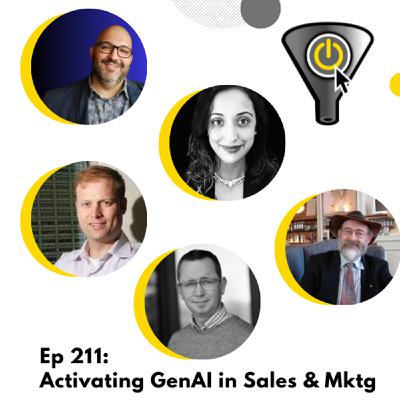
Most of the leading AI companies tell us how wonderful their technology will make our lives. In a recent post put out by OpenAI's head, Sam Altman called The Gentle Singularity, he says "We will figure out new things to do and new things to want...Expectations will go up, but capabilities will go up equally quickly, and we'll all get better stuff. We will build ever-more-wonderful things for each other." Of course, these new things need to be marketed and sold. Sam has good news there too, saying: "Generally speaking, the ability for one person to get much more done in 2030 than they could in 2020 will be a striking change" This all sounds wonderful; it's used so heavily by Silicon Valley, it's been given the title of Effective Accelerationism. It's essential thesis is that AI will cause progress all by itself. So we should just let it take over? Are we willing to bet our livelihoods on that? Where we are here in 2025, it's a challenge to do sales and marketing work using AI. Very few know how to run entire functions with Generative AI, which is why Sam qualified his 2030 prediction by saying that "many people will figure out how to benefit from [AI]" by then. How do we unlock AI's activation in customer acquisition? How do we get out of the starters blocks? I had the chance to moderate a panel discussion on "Gen AI Activation in Marketing & Sales" at an amazing event hosted by UC Labs and TCC Canada - please get the links to each of them in the shownotes. The panel featured myself, Lubabah Bakht, Gary Amaral, Jim Cain, Peter MacKinnon, and Brett Serjeantson, zig zagging through everything from day-to-day challenges to legal and privacy concerns to the lack of skills barring our progress. I count myself fortunate to not only share a panel with these experts, but for being able to call them friends. And now, please listen to these experts on Activating generative AI in marketing and sales. Links to everything mentioned in the show are on the Funnel Reboot site's page for this episode.
Since July 1st, 2023, the world of web analytics has undergone a seismic shift—and if you're still reeling from the transition to Google Analytics 4, you're not alone. In this episode, we unpack what many are calling the 'Armageddon' of digital measurement. You'll hear why GA4 isn't just a new version of an old tool, but a completely different ecosystem In human years, GA4 is still a toddler. But it is growing rapidly and some are giving it a chance to mature. Many marketers took their licks in the forced transitioning to GA4 and there are still some raw emotions about how this tool was rolled out. But our guest says that even though change is hard, he guest believes GA4 is the change we didn't know we needed. Our guest grew up in the New York tri-state area, which gave him two passions. The first one is hockey and watching people grow up playing the game they love - he's a lifelong Islanders fan. Working in Manhattan, he also worked a lot with numbers. Over time, he morphed from analyzing financial data to analyzing digital marketing, in tools like Google Analytics And Adobe Analytics. He built this expertise at industries giants like American Express travel and entertainment's NBC Universal. Wanting to use these skills without the constraints of being in a big corporation, he went independent and relocated to Las Vegas, where he now gives all kinds of companies insights into their analytics data. Let's go talk to Neil Shapiro. See Shownotes page for all people and products mentioned in the episode.
Episode 209 When it comes to initiatives humans undertake, we only need to look at a few to see how they can fail spectacularly. One example: The iconic Sydney Opera House came from a competition won by a young Danish Architect. The board who'd commissioned him to build it was told it would be completed by 1963, but things were so chaotic and so behind schedule, he had to be fired. It is truly a marvel of design, but it's a posterchild for poor projects because it didn't open until 1973. Another example: Out of a desire to research high-energy particles and potentially solve the fundamental of physics, the US Government set out to build the Superconducting Super Collider (SSC). A site in Texas was chosen, but after 6 years they had only tunneled a fraction of the 88 kilometres, when the project was cancelled at a cost of $2B. A last example: In 1998 NASA's Mars Climate Observer travelled about 200M miles and was about to start researching the red planet. But the software setting its orbital altitude had been given imperial units instead of metric. This error in the code made it come in too steep, destroying the $328M probe. These failures are so huge, it's bound to bring out our inner cynic. It's natural to pose questions of those leading the projects, like: "what were they thinking?" I don't scoff at the people who headed these projects, because I experienced something in my youth that showed me how humans sabotage missions. When I was 15 I attended a camp that took us through exercises to cultivate teamwork. I thought I knew what teamwork was; I was not prepared for what awaited. Two twenty-something Senior Counselors named Leo & Bob were in charge of it. We left the camp which was in rural New York State and drove in a van a few hours away. The van crossed into Pennsylvania, left the highway for a sideroad, then onto a dirt road and finally to a clearing somewhere in the backwoods. It was early afternoon by the time Leo dropped us off, leaving 4 of us and Bob to calmly walk for about 30 minutes, and we stopped to relax in a clearing in the forest. At that point, Bob stood facing us and told us about this simple exercise we were about to do. He said, 'you are stranded in a forest a few miles from a stationary van which contains food and medical provisions. You have to locate the help, which will signal its location by a horn-blast every 15 minutes until sundown. You'll succeed in your mission if you reach the van by then. He didn't tell us what would happen if we didn't. All of this seemed doable, until Bob said one of your team is incapacitated due an injury.' and then he closed his eyes, fell to the ground, and didn't say a word. I's hard to be to say what the next couple of hours was like, as we tried to find the van, carrying this 180lb man through the brush. Suddenly, it became important to recall the way we'd come, or how to lash branches together to form a stretcher, or whom among us should decide which way we should go. Each time we heard the horn, we felt a bit more exhausted and acted a bit more panicked, knowing that the horn-blasts would stop and we'd resort to screaming in the dark. The way we interacted with each other in every way, from rational to tense to hysterical. At several points in the day, I was convinced we'd never get to the van. But by some miracle we reached the van just before sunset. Each of us had time during the trip back to reflect on how we worked as a team. I no longer wonder why people have difficulty collaborating on projects, especially as the stakes get higher. My guest also believes it's our fault that projects fail as they do, and she's got principles she teaches that make everyone clear on the task we're all undertaking, significantly improving odds of success. She is founder and CEO of Spring2 Innovation, is an award-winning design thinking and innovation expert, as well as a TEDx and TEC/Vistage speaker. With over 25 years of experience, she has driven innovation in telecommunications, application development, program management, and IT, helping public and private organizations shape strategy, drive change, and launch new products and services. Let's go now to speak with Nilufer Erdebil. Chapter Timestamps 0:00:00 Intro 00:06:38 Welcome Nilufer 00:10:16 Poor design in showers and on projects 00:20:12 customers' unspoken needs 00:25:07 PSA 00:25:40 Devoting more of our time to communicating 00:28:49 Mistakes stemming from bad Workflows 00:37:39 Is our UX as disorienting to customers as a foreign language? 00:43:12 AI's potential role 00:47:55 About Nilufer, book Links to everything mentioned in the show are on the Funnel Reboot site's page for this episode.

Comments

Download from Google Play

Download from App Store
 United States