


 Claim Ownership
The Literary Deep Dive
Subscribed: 1Played: 1
Subscribe
© University Teaching Edition
Description
The Literary Deep Dive brings classic literature to life with precise, engaging analysis. Each book receives a dedicated series that breaks down themes, characters, symbols, and context, perfect for students studying for exams or readers seeking a more profound understanding. Hosted by the creator of University Teaching Edition. New episodes every Wednesday.
25 Episodes
Reverse
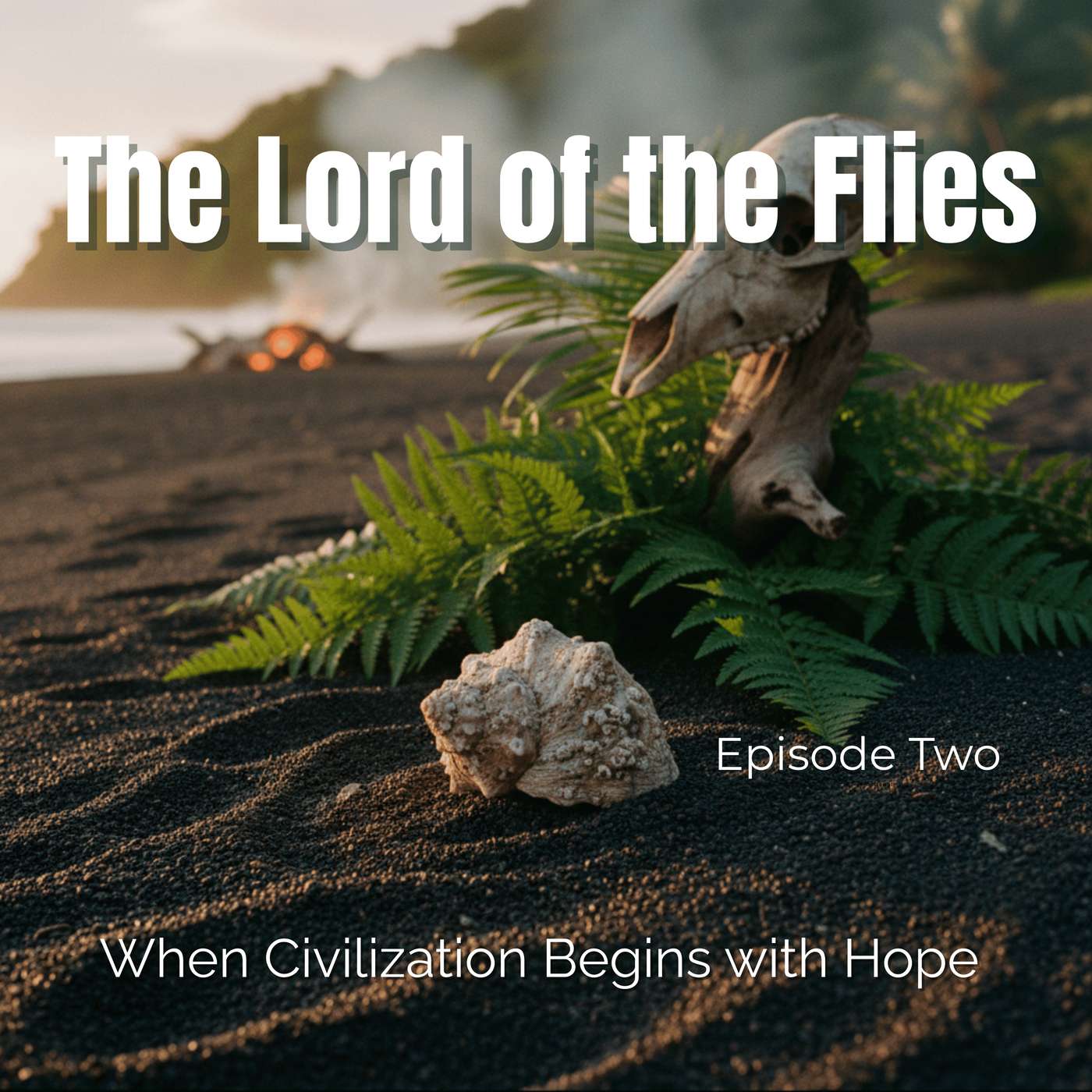
"The boy with fair hair lowered himself down... All around him, the long scar smashed into the jungle." That word scar tells you everything. Before any character speaks, before we know these boys' names, Golding shows us that civilization has already wounded paradise.In Episode 2 of our deep dive into "Lord of the Flies," we step onto the island with Ralph and Piggy as they discover the conch shell that will become democracy's fragile symbol. We watch the election that makes Ralph chief and humiliates Jack. We meet Simon, the mystical truth-teller nobody understands, and witness the littluns' nightmares create a beast that doesn't exist—yet.You'll discover why Piggy, the most intelligent person on the island, is doomed from the first assembly. Why Jack can't kill the first pig but promises "next time." Why democracy requires citizens who can choose boring responsibility over exciting indulgence, and what happens when they can't. We'll unpack Golding's masterful use of symbolism: the conch, Piggy's glasses, the scarred mountain, and the mulberry-marked boy who dies in the first fire and is never mentioned again.From Ralph's desperate shelter-building to Jack's obsessive hunting, from collective amnesia about a child's death to the beast spreading through whispered fear, we'll trace how civilization begins with genuine hope and show you the cracks that will destroy everything. This isn't ancient history. This is every time we choose the charismatic leader offering simple answers over the competent leader telling hard truths.

What happens when a decorated WWII veteran loses faith in humanity? William Golding witnessed the Holocaust, commanded troops at D-Day, and returned home convinced that "man produces evil as a bee produces honey." In this first episode of our four-part deep dive into "Lord of the Flies," we explore how the horrors of World War II shattered centuries of optimistic thinking about human progress and drove Golding to write one of literature's darkest visions of human nature.We'll examine Golding's transformation from an idealistic young teacher who believed in civilization's power to a haunted veteran who saw the beast inside every human heart. You'll discover why this 1954 novel was a direct assault on Victorian England's cherished beliefs, how it inverted R.M. Ballantyne's "The Coral Island," and why its central question remains urgent today: Are we really as civilized as we believe ourselves to be?From the concentration camps to contemporary politics, from mob psychology to social media pile-ons, we'll trace how Golding's insights about civilization's fragility prove devastatingly accurate seventy years later. This isn't just literary analysis—it's a mirror held up to human nature itself, asking what we might become when the structures holding us in place disappear.
Moby Dick surfaces. In the final episode of our series, we witness the confrontation Ahab has sought across all the oceans of the world and the catastrophe it brings.Three days of battle. Boats crushed by the whale's jaws. Men drowned, were broken, or were killed by an animal that fights back with terrifying intelligence. Ahab was dragged into the depths by his own harpoon line, the hemp prophecy fulfilled. The Pequod herself rammed and sank, thirty men pulled down in her whirlpool. And one survivor, Ishmael, floating alone on a coffin, waiting for a rescue that almost doesn't come.Then we trace the novel's extraordinary afterlife. How Melville died forgotten, his masterpiece out of print. How World War I shattered the optimism that had rejected his dark vision. How twentieth-century readers found in Moby Dick exactly what they needed: a book that told the truth about obsession, leadership, and the void.This is the story of a book that had to die to live. And why it still matters today.
The hunt consumes everything. In Episode 3 of our Moby Dick series, we reach the heart of the novel, where obsession becomes contagion and doom becomes inevitable.We witness Starbuck's agonizing moral crisis as the first mate realizes his captain is leading them to destruction. He holds a loaded musket while Ahab sleeps, knowing one shot could save thirty lives. He can't pull the trigger. Why? What does his failure teach us about the gap between knowing the right thing and doing it?We meet Pip, a young Black sailor whose terrifying abandonment in the Pacific Ocean left him floating alone in infinite water, shattered his mind, and transformed him into a holy fool who speaks prophecy no one heeds.We examine the famous "Whiteness of the Whale" chapter and its meditation on meaninglessness. And we watch as ship after ship warns Ahab to turn back, each warning ignored, each exit refused.This is where Moby Dick becomes a study in how disasters happen gradually, then suddenly, with everyone watching.
"Call me Ishmael." Three of the most famous words in literature and the beginning of a journey into obsession, friendship, and doom. In Episode 2 of our Moby Dick series, we open the novel and meet its unforgettable characters.We follow Ishmael, a young man fleeing his own depression, as he arrives in New Bedford seeking a whaling ship. We watch him form one of literature's most remarkable friendships with Queequeg, a tattooed Pacific Islander, a bond that challenges everything 1850s America believed about race and civilization.We board the Pequod and meet its diverse crew: Starbuck, the conflicted first mate; Stubb, the fatalistic joker; and harpooners from three continents. And we finally encounter Captain Ahab himself, as he reveals his true purpose is not profit but revenge against the white whale that took his leg.This episode examines toxic leadership, the psychology of following, and what happens when one man's vendetta becomes everyone's death sentence.
Herman Melville wrote what would become America's greatest novel and died in obscurity, his obituary misspelling his name. In this first episode of our four-part Moby Dick series, we explore the dramatic life that shaped this masterpiece: Melville's privileged childhood shattered by his father's bankruptcy and death, his desperate turn to the sea, his years hunting whales in the Pacific, and his brief literary fame followed by crushing failure.We dive deep into the brutal, dangerous world of 1840s whaling, an industry that lit the lamps of the world and killed one in five of its workers. And we examine the significant themes that make Moby Dick essential reading for anyone who's ever wondered what happens when obsession consumes a soul, when leaders stop caring about their followers, and when the universe seems indifferent to human suffering.This is the story of a genius the world wasn't ready for and a book that had to wait decades for resurrection.
In the final episode of our Their Eyes Were Watching God series, we come full circle to Janie's return to Eatonville and her conversation with Pheoby that frames the entire novel. We explore what Janie brings back from her journey, not just memories, but wisdom about living authentically. We trace the novel's journey from dismissal and obscurity to canonical status, examining why it was rejected in 1937 and why Alice Walker's 1975 resurrection changed everything. We discuss why the novel is still challenged in schools today, its influence on generations of writers, and what contemporary readers can learn from Janie's courage to reach for her horizon despite the risks. This is about more than one woman's story; it's about the power of claiming your own voice and defining yourself on your own terms.
In Episode 3 of our Their Eyes Were Watching God series, we reach the emotional heart of the novel. We meet Tea Cake Woods and explore what makes his relationship with Janie fundamentally different from her previous marriages—partnership, pleasure, and mutual respect alongside an honest examination of their imperfections. We follow them to the Everglades, where Janie finally lives authentically, then face the hurricane that destroys everything. We witness Tea Cake's rabies, Janie's impossible choice, and the meaning of loving someone completely while still choosing survival. This is where Hurston refuses easy answers and shows us that authentic living doesn't guarantee happy endings—but it's still worth the risk.
In Episode 2 of our Their Eyes Were Watching God series, we explore Janie Crawford's journey from the pear tree revelation to her marriages with Logan Killicks and Joe Starks. We examine how Hurston uses a frame narrative to give Janie control of her own story, why Nanny's vision of protection becomes a prison, and what it means to lose your voice for twenty years. Through detailed analysis of these relationships, we discover the difference between security and selfhood, between status and an authentic life, and why splitting yourself between who you are and who you're allowed to be is both a survival strategy and a slow death. This is the story of learning that love without autonomy isn't really love at all.
In the first episode of our four-part series on Zora Neale Hurston's Their Eyes Were Watching God, we explore how a novel dismissed in 1937 became a cornerstone of American literature. We examine Hurston's radical childhood in Eatonville, the first all-Black incorporated town in America her anthropological training, and why her choice to write in authentic Black Southern dialect sparked fierce debate. We unpack the significant themes that make this novel essential: the voice search, the balance between love and autonomy, the tension between individual authenticity and community belonging, and what it means to reach for your own horizon. This is the story of how one writer refused to perform respectability and instead created art that honored her culture exactly as it was.
Welcome to the final episode of our journey through Arthur Miller's The Crucible, where we witness one man's redemption and explore why this 1953 play remains urgently relevant in 2025. In Act Four, we enter the Salem jail on a cold autumn morning. Abigail has fled with Parris's money, exposing the fraud at the heart of the witch hunt. Danforth refuses to postpone the executions because doing so would admit doubt, and institutional reputation has become more important than human life. Reverend Hale, transformed by guilt, begs the condemned to lie and save themselves, but Elizabeth Proctor understands: "I think that be the Devil's argument." We witness the play's emotional heart: John and Elizabeth's final conversation, where she asks his forgiveness for her coldness and he rediscovers his goodness. We watch Proctor initially agree to confess, then refuse when Danforth demands the confession be displayed publicly. "It's my name!" Proctor sobs. "How may I live without my name?" He rips apart the confession, opting for integrity over survival. Then we step back to examine the play's extraordinary legacy. Why did a play that flopped in 1953 become one of the most-performed American dramas worldwide? We explore major adaptations of the 1996 film starring Daniel Day-Lewis, stage productions that connect the play to contemporary politics, and international performances in countries experiencing their own witch hunts. We examine the beautiful irony: The Crucible, a play about censorship, is itself one of America's most frequently banned books. School boards that try to censor the play for "promoting rebellion against authority" inadvertently demonstrate Miller's point about the dangers posed by an authority that fears being questioned. Most importantly, we explore why this play matters now. We live in an age of social media pile-ons, political polarization, and ideological purity tests. The pattern Miller identified—accusation without evidence, denial as proof of guilt, institutions protecting themselves, binary thinking that allows no nuance repeats constantly. Salem is everywhere. The Crucible shows us that honesty comes at a cost, that institutions put their own safety first, that hysteria requires only fear and the permission of authority, and that bravery is often not rewarded. But it also shows us what redemption looks like: Proctor dies, but he dies whole, honest, and himself at last. Whether you're a student, educator, or someone trying to navigate our current moment of political and cultural division, this episode offers Miller's final challenge: when the witch hunt comes, what will you do?
Welcome back to The Literary Deep Dive. This is Episode 3 of our four-part exploration of Arthur Miller's The Crucible, and this is where everything accelerates toward tragedy. Today, we cover Acts Two and Three, the heart of the play, where the witch hunt spreads through Salem, and the court reveals that truth has become irrelevant. We enter the cold, tense Proctor household eight days after the accusations began, where John and Elizabeth's marriage crumbles under the weight of his adultery and her inability to forgive. Then we witness Elizabeth's arrest when Abigail frames her using Mary Warren's poppet and a self-inflicted stab wound. Act Three takes us into the Salem courtroom, where Deputy Governor Danforth presides with absolute certainty that he's doing God's work. We watch Proctor bring Mary Warren to testify that the girls are lying. We see Abigail's brilliant performance as she and the other girls pretend to be attacked by Mary's spirit. And we witness Proctor's desperate sacrifice, confessing his adultery publicly to expose Abigail's motive, only to have Elizabeth lie to protect his reputation, not knowing he's already confessed. We'll analyze Danforth's terrifying line: "A person is either with this court, or he must be counted against it; there be no road between." We'll explore how the burden of proof gets reversed, how denial becomes evidence of guilt, and how institutions protect themselves by refusing to admit error. We'll see Mary Warren break under pressure and turn on Proctor to save herself. This episode examines the mechanics of injustice, how good intentions, institutional momentum, and fear combine to produce systematic evil. We'll connect these 1692 dynamics to McCarthy's hearings, to contemporary cancel culture, and to political polarization, where "you're with us or against us" leaves no room for nuance. Whether you're studying this play for class or trying to understand how communities abandon justice, this episode reveals Miller's most powerful insights about courage, cowardice, and the terrible cost of truth.
Welcome back to The Literary Deep Dive. This is Episode 2 of our four-part exploration of Arthur Miller's The Crucible. Today we enter the play itself, walking through Act One on the morning after everything changed. We meet Reverend Parris, a frightened minister more concerned with his reputation than truth. We encounter Abigail Williams, a beautiful seventeen-year-old with "an endless capacity for dissembling" who will stop at nothing to get what she wants. We watch Thomas and Ann Putnam, bitter and grieving, eager to blame witchcraft for their losses. We witness John Proctor's entrance—a farmer carrying the guilt of adultery, respected in Salem but regarding himself as a fraud. We see the tension between Proctor and Abigail, the dangerous electricity of their past affair that will ignite into community-wide destruction. Then Reverend Hale arrives with his books and expertise, eager to prove his knowledge of witchcraft. And in the chaos of his examination, Abigail sees her escape: blame someone else. Tituba, the enslaved woman from Barbados, becomes the first accused. Then the girls begin screaming names—Sarah Good, Sarah Osborne, Bridget Bishop—and the witch hunt explodes. We'll analyze Miller's brilliant use of historical language, his precise character development, and his step-by-step demonstration of how hysteria begins. We'll see that it doesn't require evil masterminds—just frightened people, ambitious people, and grieving people, all given permission by authority to accuse others. Whether you're reading along with us or encountering The Crucible for the first time through this podcast, you'll understand exactly how Miller constructs his warning: how quickly fear becomes contagious, how easily accusation replaces evidence, and how the powerless discover they can gain power by naming names.
Begin your journey through Arthur Miller's masterpiece with Episode 1 of The Literary Deep Dive's exploration of The Crucible. Host Richard Backus from University Teaching Edition reveals why Miller risked everything to write this devastating play about the Salem witch trials—and how he used 1692 to expose the witch hunts happening in 1950s America.Discover how a young playwright who survived the Great Depression became America's most celebrated dramatist, then deliberately made himself a target by challenging McCarthyism at its peak. Explore the four enduring themes that make The Crucible essential reading: the conflict between integrity and survival, the mechanics of mass hysteria, the corruption of authority, and the devastating price of truth.This episode examines both historical contexts—Salem in 1692 and McCarthy's America in 1952—showing how fear transforms communities and why this 72-year-old play remains urgently relevant today. Whether you're studying the play for school, revisiting a classic, or discovering it for the first time, this deep dive illuminates why The Crucible still shakes audiences and asks the most difficult question: when everyone around you is lying, what does it cost to tell the truth?Part 1 of 4 in The Literary Deep Dive series on The Crucible.
In this final episode of our Fahrenheit 451 series, we step back from the novel's plot to explore its profound impact on literature, culture, and contemporary life.We examine Bradbury's place in the dystopian tradition alongside Orwell's 1984 and Huxley's Brave New World, exploring what makes Fahrenheit 451 unique: it's distinctly American, it depicts tyranny chosen by the people rather than imposed from above, and it ends with hope rather than despair. We'll trace the novel's influence on later works from The Handmaid's Tale to The Hunger Games.We'll discuss the major adaptations: François Truffaut's haunting 1966 film and HBO's 2018 version starring Michael B. Jordan and Michael Shannon. What works in each? What gets lost in translation?Then comes the beautiful irony: Fahrenheit 451, a book about censorship, is itself one of America's most frequently banned and challenged books. We'll explore the "Bal-Hi" edition scandal, where a censored version was published for schools without Bradbury's knowledge—making it a book about censorship that was literally censored.
"The Sieve and the Sand" and "Burning Bright." We'll explore the meaning of "The Sieve and the Sand," Montag's desperate struggle to read and understand books, even as comprehension slips through his grasp like sand through a sieve. We'll witness the unforgettable subway scene where Montag tries to read the Bible while "Denham's Dentifrice" advertisements assault his concentration.We meet Professor Faber, the former English teacher living in hiding, who explains what makes books essential: quality of information, leisure to digest it, and freedom to act on what you've learned. Together, they devise a desperate plan of resistance, connected by a tiny earpiece that allows Faber to guide Montag.
We meet Montag on the night his carefully constructed life begins to unravel. He's a fireman who burns books for a living, and he loves his work until he encounters Clarisse McClellan, a seventeen-year-old girl who asks him a simple, devastating question: "Are you happy?"In this episode, we'll analyze Bradbury's stunning opening ("It was a pleasure to burn"), examine Montag's encounters with Clarisse and what she represents, explore the chilling creation of the Mechanical Hound, and witness the old woman who chooses to burn with her books rather than live without them. We'll also meet Mildred, Montag's wife, and see the emptiness of their marriage, a relationship destroyed by addiction to the "parlor walls" and an overdose that no one remembers.We'll conclude with Captain Beatty's seductive sermon on why books were banned not by government force, but by popular demand. His argument is sophisticated and dangerous, revealing why censorship often comes wrapped in the language of protection and compassion.
In this opening episode, we explore the life of Ray Bradbury, a self-educated writer who spent his formative years in public libraries and grew up to write one of America's most prophetic warnings about censorship and conformity. We'll examine the paranoid atmosphere of 1950s McCarthy-era America that shaped Bradbury's vision and discover why he wrote this novel in a library basement, surrounded by the very books his protagonist would burn.We'll unpack the novel's major themes: censorship and intellectual freedom, the power of literature, the dangers of conformity, the role of technology in society, and the promise of rebirth and transformation. We'll also explore why this book—written over seventy years ago—remains urgently relevant in our age of algorithm-driven content, social media echo chambers, and declining reading rates.
Discover how different critical lenses reveal new dimensions of meaning in The Outsiders. In this final episode, we explore multiple analytical approaches that deepen understanding and appreciation of Hinton's achievement. Learn how formalist analysis examines how literary elements work together, how historical criticism connects the novel to its 1960s context, and how psychological reading explores unconscious motivations and emotional dynamics.We examine the civil rights movement's influence, the economic conditions shaping class conflict, the emergence of youth culture, and the intellectual currents of the era. Through psychological analysis, we explore attachment theory, identity formation, trauma response, and the unconscious patterns driving character behavior.Whether you're preparing research papers, studying for advanced literature courses, or seeking sophisticated engagement with literary texts, this episode provides frameworks for comprehensive analysis that reveal why The Outsiders rewards multiple interpretative approaches and maintains its canonical status.
Explore the rich symbolic landscape of The Outsiders and discover how S.E. Hinton transforms concrete objects into vehicles for exploring abstract ideas about identity, belonging, and social justice. In this episode, we examine how hair symbolizes both pride and vulnerability, how sunsets represent shared humanity across class boundaries, and how the abandoned church functions as a sanctuary and a moral testing ground.Learn how fire operates as both destruction and purification, how books represent intellectual pathways beyond economic circumstances, and how weapons symbolize the constant threat facing working-class youth. We analyze how these symbols evolve throughout the narrative, connect to form meaning networks, and support multiple interpretative approaches.Whether you're writing about symbolism, teaching literary analysis, or deepening your appreciation of Hinton's artistry, this episode reveals the layers of meaning that transform a compelling story into enduring literature.

Comments

Download from Google Play

Download from App Store
 United States