


 Claim Ownership
Decision Desk HQ Podcast
Subscribed: 2Played: 40
Subscribe

© Decision Desk HQ
Description
Every day is Election Day. Our weekly show talks votes, polls, trends, campaigns, and more. A show by election nerds for fellow election nerds, novices, and everyone in between.
decisiondeskhq.substack.com
decisiondeskhq.substack.com
20 Episodes
Reverse

In recent months, one growing political narrative is the extent to which President Donald Trump has lost ground with young men. In the 2024 election, Trump lost among 18-29 year olds as a whole, but he did better than in his past elections. His improvement among young men especially stood out because he actually carried the group as a whole, according to some studies. The explanations for Trump’s performance have ranged from negative economic views among young people to Trump’s embrace of podcasters to connect with voters.Yet recent research suggests young men have soured on Trump. One study from the left-leaning Speaking with American Men Project found that Trump’s standing among young men has declined. But is Trump losing more ground among young men than among other groups? Decision Desk HQ Chief Elections Analyst Geoffrey Skelley was joined by Mary Radcliffe, head of research at FiftyPlusOne, to talk about Trump’s approval among young men and more broadly. She recently found that Trump’s decline among young men was not necessarily outsized compared to other groups, most notably among women.The conversation began with Mary’s article and the narrative surrounding Trump’s standing with young men. They explored the difficulties of actually ascertaining the views of this particular subgroup and the small amount of reliable polling that’s available to study young men’s attitudes. They then discussed the reality that Trump’s approval has fallen across the broad, including a similar rate of decline in attitudes toward him among both men and women. They followed this by looking at changes in Trump’s approval among groups that played an important role in his winning 2024 coalition, including independents and Latinos. Trump’s declining approval on his handling of different issues likely plays into the growing dissatisfaction toward his presidency across different groups. Lastly, they talked about broader trends in Trump’s approval and what they could mean for the 2026 midterms. This is a public episode. If you would like to discuss this with other subscribers or get access to bonus episodes, visit decisiondeskhq.substack.com

It’s easy to focus on the high-profile elections happening this November. But many voters will have myriad downballot races to consider, too, including two important local offices: prosecutor and sheriff. These officials play a pivotal role in implementing policing and criminal justice policies. But they also matter to immigration, as shown by recent disagreements over collaboration between local law enforcement and ICE. In 2026, there are roughly 2,400 elections for prosecutor and sheriff, which means a large share of the nation’s 3,100+ counties and county-equivalents will vote on at least one of these offices.To explore these under-the-radar elections, Decision Desk HQ Chief Elections Analyst Geoffrey Skelley was joined by Daniel Nichanian, founder and editor-in-chief of the digital publication Bolts. Nichanian and the Bolts team cover local elections and institutions that affect American politics, with a particular focus on criminal justice, policing, voting rights, and democracy. Nichanian recently put together a great guide covering which states have prosecutor and/or sheriff elections on the ballot this year, and an overview of some of the biggest races and issues at play.The conversation started with an overview of why these office are important and challenging to cover. They then discussed sheriff elections within the context of cooperation with ICE, a highly-contested debate in more Democratic-leaning places, and then the wider implications of sheriff elections for policing. Then the chat turned to prosecutors and the conflict between more reform-minded and more conservative proponents within the criminal justice system. These debates do not always wear straightforward partisan labels in the way that, say, a U.S. Senate election does. This is a public episode. If you would like to discuss this with other subscribers or get access to bonus episodes, visit decisiondeskhq.substack.com

A big part of the 2026 midterms is the race for the U.S. Senate, where Republicans hold a 53-47 majority. Because Vice President JD Vance can break a 50-50 tie in the GOP’s favor, Democrats must gain four seats for party control to shift. Of the races that could decide control, many will turn on the performances of high-profile women candidates. Those contests include Alaska, where Democrats’ chances of flipping the seat rest on the shoulders of former Rep. Mary Peltola, and Iowa, where the GOP’s odds of retaining the seat depend on Rep. Ashley Hinson’s political acumen. Other races will not be competitive in November, but the favored party could nominate a woman candidate who could change the look and feel of the Senate. For instance, Rep. Julia Letlow is challenging Sen. Bill Cassidy in Louisiana’s Republican primary, while an open-seat race in Illinois features two Democratic women contenders, Lt. Gov. Juliana Stratton and Rep. Robin Kelly.To explore what’s happening in these races, Decision Desk Chief Elections Analyst Geoffrey Skelley was joined on the podcast by Grace Panetta from The 19th News. As a politics reporter for The 19th, Panetta covers candidates, issues, voters, and everything else happening on the campaign trail. Panetta has written extensively about many of these Senate races, so she was the perfect person to chat with about the role women candidates are playing in the 2026 election cycle.The conversation first focused on seats that will likely have competitive elections in November and could help decide control of the Senate. These contests include Republican-held seats that are on the ballot in Maine, Alaska, Iowa, and Texas, as well as a Democratic-held seat in Michigan. The discussion then turned to seats that are safer for one party but that have interesting primaries, including Minnesota, Illinois, and Louisiana. We hope you enjoy the conversation! This is a public episode. If you would like to discuss this with other subscribers or get access to bonus episodes, visit decisiondeskhq.substack.com

In this week’s podcast, we dug into polling, which is such a huge part of the conversation around elections. Beyond knowing who is in the lead and by how much, surveys can help us understand what issues are driving voters and what people think about the parties and their leaders. However, individual polls are subject to different forms of error that can affect their results. And pollsters can sometimes encounter challenges — think of 2016 and Donald Trump, white working class voters, and the Midwest — that can produce widespread, systematic error. So, the election community likes to track how well pollsters perform individually and as a whole.To explore this topic, we welcomed Silver Bulletin Senior Election Analyst Eli McKown-Dawson and DDHQ Director of Data Science Scott Tranter onto the podcast. We focused mainly on McKown-Dawson’s new analysis of how the polls performed in the 2025 elections and recent trends in polling error published on Silver Bulletin. We talked about what might have led to some sizable polling misses in New Jersey and Virginia, what goes into polling error and polling bias (the statistical form of bias), the choice by some pollsters to weight their samples by recalled vote, and what all this could mean for polling in the 2026 midterms.Subscribe now This is a public episode. If you would like to discuss this with other subscribers or get access to bonus episodes, visit decisiondeskhq.substack.com

This week, the Decision Desk HQ podcast examined the messy state of affairs in the U.S. House of Representatives. There, Republicans hold just a 218-213 majority (with four vacancies), an edge so thin that GOP absences have at times left Democrats with more voting members on the House floor than Republicans. These trying governing circumstances have only made life more difficult for Speaker Mike Johnson, who has regularly had to navigate internal conflicts within the House GOP conference, all while having only a slim majority.To dig into this topic, DDHQ Chief Elections Analyst Geoffrey Skelley was joined by Joshua Huder, a senior fellow at The Government Affairs Institute at Georgetown University. Huder has expansive expertise in the internal procedures, politics, and institutional makeup of the House — and how they have changed over time. Huder also his own Substack newsletter, Seat of Democracy, where he explores congressional politics, past and present. And he hosts the Georgetown GAI’s podcast, Congress, Two Beers In.The two discussed the challenges Speaker Johnson has faced, including the revolts from his left and right flank in the House GOP conference. More broadly, they examined the anti-establishment surges that have affected the politics of both parties, and how this trend has clashed with the top-down nature of the House’s legislative process. They also explored the impact of discharge petitions to push forward legislation, and how this tool to circumvent leadership has grown in use. All of this discussion included Huder’s deep knowledge of the House’s evolution as an institution, which enabled him to make comparisons with how the House functioned in the past that can help us understand today’s political situation. This is a public episode. If you would like to discuss this with other subscribers or get access to bonus episodes, visit decisiondeskhq.substack.com

Welcome to the official midterm year of 2026! Looking ahead to what could happen this November, the podcast zoomed in on the electoral situations in Minnesota and Virginia. To do this, Chief Elections Analyst Geoffrey Skelley was joined by J. Miles Coleman, the Associate Editor of Sabato’s Crystal Ball, a nonpartisan political newsletter produced by the University of Virginia Center for Politics. The two led off with the big news in Minnesota, where Democratic Gov. Tim Walz decided to abandon his campaign for a third term in the face of an ongoing crisis regarding government fraud. With the 2024 Democratic nominee for vice president out of the race, it looks like Democratic Sen. Amy Klobuchar may run, and her strong electoral track record might make her an imposing candidate for Democrats. From there, they reviewed some of Miles’s recent findings about the 2025 Virginia election that suggest voters of color who backed President Donald Trump in 2024 may have been more likely to stay home in 2025 than other voters around the state. They then turned to Virginia’s involvement in the national redistricting battle. Virginia’s state legislature is about to take up a constitutional amendment that would potentially allow the Democratic-led body to redistrict the state’s congressional districts. What will that entail and what kind of gerrymander could Democrats draw if they succeed?Subscribe now This is a public episode. If you would like to discuss this with other subscribers or get access to bonus episodes, visit decisiondeskhq.substack.com

Happy New Year! With electoral politics briefly paused for the holiday season, Decision Desk HQ decided to do something a little different for this podcast episode. Chief Elections Analyst Geoffrey Skelley took a spin in the time machine, going back more than 100 years to look at the electoral career of Jeannette Rankin of Montana, the first woman ever elected to Congress.Rankin initially made her name as a women’s suffrage advocate before winning a seat in the U.S. House of Representatives in 1916 — four years before the 19th Amendment fully gave women the vote across the entire country. Having made history as the first woman elected to Congress, she then became famous (or infamous) for voting against American entry into both world wars. Rankin served only two terms separated by more than two decades, but happened to be in the House each time the nation declared war in the 20th century.Yet a major reason why Rankin had such a long hiatus was due to mid-decade redistricting, a subject very much on our minds in the 2026 election cycle. Rankin had been elected as one of Montana’s two at-large representatives, but after the 1916 election the state legislature split the state into two single-member districts. She had to decide what electoral path to trod in 1918, eventually mounting a failed bid for U.S. Senate. It would be another 22 years before she won a place back in Congress in 1940. We explore Rankin’s fascinating electoral trajectory in this special holiday episode of the DDHQ podcast. This is a public episode. If you would like to discuss this with other subscribers or get access to bonus episodes, visit decisiondeskhq.substack.com

It’s been a busy couple of months since we began the DDHQ Podcast. But heading into the holiday period, we decided to focus our last regular podcast of 2025 on the 36 gubernatorial contests that will be on the ballot in 2026! To explore this rich topic, DDHQ Chief Elections Analyst Geoffrey Skelley was joined by Jessica Taylor from The Cook Political Report with Amy Walter. Jessica is the Senate and Governors Editor for Cook, so she was the ideal person to dig into all the gubernatorial action happening in 2026.We discussed the overall governor picture, where Republicans hold a slight majority of seats nationally. But with it being President Trump’s second midterm, Democrats hope to capture a majority of governorships for the first time since before 2010. They have a path, including targeting GOP-held toss-ups in Nevada and Georgia. But Republicans will have a shot at flipping Democratic-held seats in red-leaning Kansas and purple Michigan and Wisconsin. All told, it turns out that red-leaning states like Iowa might prove critical to deciding which party holds more top state executive posts after the 2026 election.Subscribe now This is a public episode. If you would like to discuss this with other subscribers or get access to bonus episodes, visit decisiondeskhq.substack.com

Everything is bigger in Texas, including the candidate filing deadline for the state’s 2026 primaries. To help unravel what happened around Texas’s Dec. 8 filing date and what to look ahead to in 2026, Decision Desk HQ Chief Elections Analyst Geoffrey Skelley was joined by Gabby Birenbaum, the Washington Correspondent for The Texas Tribune. We dug into many of Texas’s key primaries that will take place on March 3, the potential runoffs that could happen on May 26, and the potential November ramifications of those nomination contests.There was too much to talk about, really. In the state’s marquee Senate race, Democratic Rep. Jasmine Crockett launched her candidacy while former Rep. Colin Allred dropped down to run for a seat in the House. Meanwhile, deadline day confirmed the three-way primary for the Republican Senate nomination involving Sen. John Cornyn, state Attorney General Ken Paxton, and Rep. Wesley Hunt. Plus, other would-be candidates like Democratic Rep. Marc Veasey also made last-minute changes to their 2026 plans. We also discussed some of the other recent events that will affect Texas’s 2026 electoral picture. Last week, President Donald Trump pardoned conservative Democratic Rep. Henry Cuellar, who had faced charges of bribery, money laundering, and conspiracy. Then the U.S. Supreme Court ruled that Texas’s newly-drawn congressional map would remain in place for the 2026 election, giving Republicans an opportunity to add as many five seats to their tally in Texas. This is a public episode. If you would like to discuss this with other subscribers or get access to bonus episodes, visit decisiondeskhq.substack.com

On Tuesday, the special election in Tennessee’s 7th Congressional District drew the attention of election watchers everywhere. Naturally, then, the race in the Volunteer State vacuumed up our attention for this week’s podcast! Republican Matt Van Epps defeated Democrat Aftyn Behn by 9 percentage points, 54%-45%, to keep the 7th District in Republican hands. However, that still represented a 13-point swing to the left from the 2024 election, when President Donald Trump carried the seat by 22 points, 60%-38%.With the calendar about to turn to 2026, this special election served as a appetizer for next year’s midterm contests. To help unpack what happened in Tennessee and what it could say about the larger electoral situation, Decision Desk HQ Chief Elections Analyst Geoffrey Skelley spoke with Jacob Rubashkin, deputy editor of Inside Elections. They explored the special election’s high turnout, the district’s swing to the left from 2024, the higher levels of spending from outside groups, and how the result fits into broader special election trends since Trump took office. They then discussed what all of this could mean for next year’s U.S. House elections. This is a public episode. If you would like to discuss this with other subscribers or get access to bonus episodes, visit decisiondeskhq.substack.com

One of the leading stories this year has been mid-decade redistricting ahead of the 2026 midterms. Earlier this year, President Donald Trump began encouraging Republican-run states to create more favorable congressional maps for the GOP, starting with Texas. Democrats have responded with their own redistricting moves, including a redraw in California via the voter-approved Proposition 50. This week, the redistricting saga encountered its latest twist when a federal judicial panel blocked Texas’s new map, ruling it an illegal racial gerrymander — a decision that Texas Republicans have appealed to the U.S. Supreme Court.To review the redistricting drama we’ve seen so far in 2025, DDHQ Chief Elections Analyst Geoffrey Skelley spoke with Nathaniel Rakich, managing editor for Votebeat. We examined the overall redistricting picture, including how it compares to mid-decade redistricting historically and how the new lines may affect the 2026 midterm chances for each party. We then took a detailed tour of the six states that have implemented new maps, including a look the main changes in each state and the political winners and losers in each remap. This is a public episode. If you would like to discuss this with other subscribers or get access to bonus episodes, visit decisiondeskhq.substack.com

With the 2025 election in the rearview mirror, Decision Desk HQ wanted to take a look at polling. After all, public opinion surveys play an important role in trying to understand how Americans feel about politics and how they plan to vote in elections. DDHQ tracks many major topics with our own polling averages, such as presidential job approval. To plunge into the polls, DDHQ Chief Elections Analyst Geoffrey Skelley spoke with two cofounders of FiftyPlusOne, a polling aggregation website built by a group of FiveThirtyEight alumni: Mary Radcliffe, FiftyPlusOne’s head of research, and G. Elliott Morris, head of analytics and author of the Strength in Numbers Substack.We talked about FiftyPlusOne’s work and why polling is vital in a democratic society. We explored the challenges involved in polling aggregation, what happened with polling in 2025, and what pollsters need to watch out for in the future. The rich conversation even includes discussion of a poll that Mary and Elliott helped conduct ahead of the 2025 election and the curiously simple text message that improved their response rate among young voters. This is a public episode. If you would like to discuss this with other subscribers or get access to bonus episodes, visit decisiondeskhq.substack.com

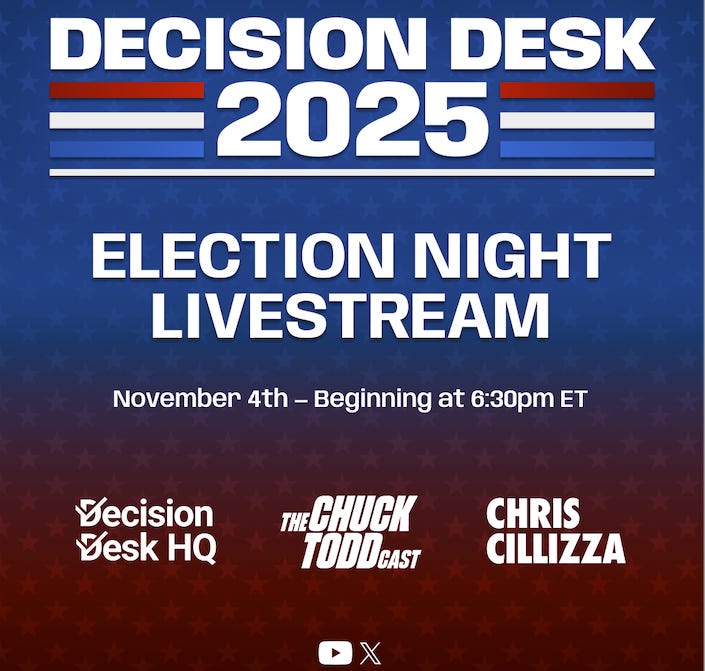
The 2025 election is in the books! Decision Desk HQ had all the results and a livestream to cover the vote as it came in. But now it’s time to start making sense of what happened and what it could mean moving forward. To do that, DDHQ Chief Elections Analyst Geoffrey Skelley welcomed two of his DDHQ colleagues, Director of Data Science Michael Pruser and Data Scientist Zachary Donnini, to discuss their initial takeaways from the 2025 contests.The crew examined the broad pro-Democratic swing that occurred across most of the country. Almost every locality in Virginia swung left as Democrats cruised to double-digit wins for governor and lieutenant governor, and they even managed to win the attorney general’s race despite their nominee’s various problems. In New Jersey, Democrats rebounded from big GOP gains in 2024 to restore their large margins in many ethnically and racially diverse communities in North Jersey. And in New York City, Zohran Mamdani won the mayor’s race by turning out his core supporters and winning over many rank-and-file Democrats. This is a public episode. If you would like to discuss this with other subscribers or get access to bonus episodes, visit decisiondeskhq.substack.com
Besides the statewide contests in New Jersey and Virginia, there is another very high-profile office on the ballot next week: New York City mayor! To talk about this contest, DDHQ Chief Elections Analyst Geoffrey Skelley welcomed Michael Lange onto the podcast. Lange is a writer, researcher, strategist, political organizer, and expert on New York City politics. He writes about NYC on his Substack, The Narrative Wars, and has produced many interesting analyses of the Big Apple electorate that are well worth your time.We talked about where the race stands, as state Assemblymember Zohran Mamdani holds a double-digit polling lead over former Gov. Andrew Cuomo, with Republican Curtis Sliwa running in third. We also examined the NYC electorate, including “the Commie Corridor” and the “Archie Bunker” vote, and how the candidates have sought to expand their coalitions. We also delved into turnout, as this election could see the largest number of raw votes in a mayoral race since the 1989 and 1993 clashes between Democrat David Dinkins and Republican Rudy Giuliani. This is a public episode. If you would like to discuss this with other subscribers or get access to bonus episodes, visit decisiondeskhq.substack.com

Don’t look now, but New Jersey may have the closest race for governor on the ballot anywhere this November. To dig into this race, Steve Kornacki was kind enough to lend the Decision Desk HQ Podcast his Garden State expertise. Kornacki is NBC News’s Chief Data Analyst and a national political correspondent, but he actually got his start in political journalism covering New Jersey!We examined where the race stands between Democrat Mikie Sherrill and Republican Jack Ciattarelli, then got into a map-rich discussion of recent electoral trends in New Jersey. The state took a big swing to the right in the 2024 presidential race, especially in denser, more ethnically and racially diverse parts of North Jersey. How much Ciattarelli can build on those shifts will help determine just how close this race is — and whether he can pull off an upset in less than two weeks.You can find more from Decision Desk HQ on our Substack, where you can sign up for our free newsletters and other content! https://decisiondeskhq.substack.com/welcome This is a public episode. If you would like to discuss this with other subscribers or get access to bonus episodes, visit decisiondeskhq.substack.com

Virginia’s attorney general’s election has been at the center of political coverage in recent days after it came to light that Democratic nominee Jay Jones sent a series of violence-laden texts in 2022. To dig into the Virginia situation, DDHQ Chief Elections Analyst Geoffrey Skelley was joined by Kyle Kondik, Managing Editor of the Sabato’s Crystal Ball newsletter at the University of Virginia Center for Politics. We talked about where things stand in the gubernatorial and lieutenant governor races, then examined how Jones’s scandal could affect the attorney general contest. Notably, the same party has swept all three offices in four straight state elections (2009, 2013, 2017, 2021), and Democrats appear to have an edge in the governor and LG contests. However, Jones’s problems may help incumbent Republican Attorney General Jason Miyares win, even if his ticket-mates fall to their Democratic opponents. This is a public episode. If you would like to discuss this with other subscribers or get access to bonus episodes, visit decisiondeskhq.substack.com

For our first episode of the new Decision Desk HQ Podcast, DDHQ Chief Elections Analyst Geoffrey Skelley and DDHQ founder Brandon Finnigan took a look at the 2026 Senate elections. This episode serves as an excellent primer for understanding the lay of the land in the Senate and why Republicans currently appear to have the upper hand in the race to control Congress’s upper chamber. This is a public episode. If you would like to discuss this with other subscribers or get access to bonus episodes, visit decisiondeskhq.substack.com

NewsNation anchor and national correspondent Leland Vittert joined Geoffrey Skelley (Decision Desk HQ) and Chris Cillizza (author of the “So What” Substack) for a conversation about Vittert’s new book, Born Lucky: A Dedicated Father, A Grateful Son, And My Journey with Autism. The book recounts Vittert’s life growing up, how he made his way as a journalist, and his father’s pivotal role in helping Vittert acquire the tools to navigate the sometimes unforgiving world around him.To start, we discussed Vittert’s experiences surrounding the 2020 presidential election. Most notably, we examined the time he went viral over a combative interview with a spokesperson for President Donald Trump’s campaign, and the fallout from that encounter for his career at Fox News. We then delved into Vittert’s life growing up with what we now know is autism, his work as a journalist, and the important part his father played in getting him to this point.The book is now available! You can read more about it here. Leland Vittert is the host of On Balance with Leland Vittert and serves as NewsNation’s Chief Washington Anchor. A veteran journalist, Vittert joined NewsNation in May 2021, where he has been pivotal in covering national affairs and delivering special reports across the network’s primetime weeknight newscasts. Before joining NewsNation, Vittert worked for Fox News from 2010 to 2021, starting as a foreign correspondent based in Jerusalem and later anchor and correspondent in Washington.Subscribe below and get DDHQ’s election coverage in your inbox, including The Bellwether newsletter and our polling memo! This is a public episode. If you would like to discuss this with other subscribers or get access to bonus episodes, visit decisiondeskhq.substack.com

Chris Cillizza, who runs So What on Substack, was kind enough to invite DDHQ Chief Elections Analyst Geoffrey Skelley on for a Substack Live conversation. They covered redistricting, the House and Senate pictures ahead of the 2026 midterms, and presidential approval, among other things. This was the first of what will surely be many conversations now that DDHQ is on Substack! This is a public episode. If you would like to discuss this with other subscribers or get access to bonus episodes, visit decisiondeskhq.substack.com

Dear reader,Welcome to the Decision Desk HQ Substack, home to The Bellwether, our weekly newsletter devoted to the ins and outs of electoral politics. DDHQ readers will receive leading analysis of elections and expanded content offerings, so please subscribe!You can also click here to find out more about Decision Desk HQ’s work as a leading election results provider. Thank you for reading, and we hope you continue caucusing with us!Thank you for being a part of the DDHQ-verse,Geoffrey SkelleyChief Elections Analyst, DDHQ This is a public episode. If you would like to discuss this with other subscribers or get access to bonus episodes, visit decisiondeskhq.substack.com
Comments


Download from Google Play

Download from App Store
 United States