


 Claim Ownership
Welcome to Supply-Chain360, your all-in-one source for actual insights into the world of SCM!
Subscribed: 0Played: 0
Subscribe

© SupplyChain360 @ 2025
Description
Here, we explore the latest innovations, technologies, and strategies transforming the global supply chain landscape.
From BANI to generative AI and automation to sustainability and risk management, our content covers everything you need to stay ahead in the dynamic world of SCM & Logistics.
Whether you're a professional, a student, or just curious about supply chains, tune in for in-depth discussions, expert interviews, and actionable tips to optimize your operations - or just learn something new.
21 Episodes
Reverse
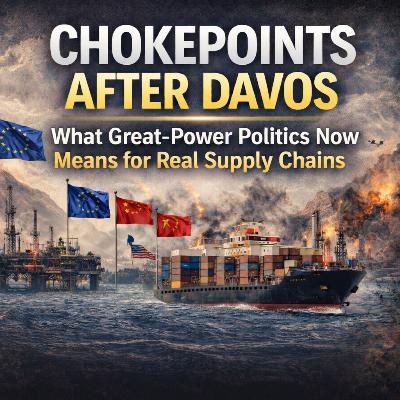
In this episode, I follow up on Davos 2026 by shifting from speeches and symbolism to the physical realities of global supply chains. The focus is on chokepoints: the Red Sea, Suez, Hormuz, and Taiwan, and on what happens when great-power politics starts to narrow the corridors, systems, and dependencies that modern industries rely on.I look at how recent developments have moved from rhetoric into operating conditions: fragile reopenings, renewed disruptions, and rising uncertainty around routes, energy, shipping, and trade policy. From a pharma and healthcare perspective, the key point is that even when medicines are not shipped directly through a disrupted chokepoint, the upstream systems they depend on still are, whether through energy-intensive inputs, chemical feedstocks, freight capacity, or supplier stability.This episode is about how leaders should think about chokepoints not as distant geopolitical stories, but as very real constraints on cost, replenishment reliability, and network resilience. If you work in supply chain, risk, or executive decision-making, this is an invitation to identify where your system narrows, and what levers you still control before the next disruption hits.

In this episode, I look at Davos 2026 not as a media show, but as a live stress test of the global order.From Merz’ “age of great powers” narrative to Trump’s tariff threats, Greenland remarks, and pressure over U.S. bonds, Davos made one thing clear: the world is being run more openly as a great-power game again, and middle powers, especially in Europe, are caught in the squeeze.I translate this into the language of pharma and healthcare supply chains.We explore how tariffs, sanctions, export controls, dollar dependence, and critical infrastructure decisions (plants, APIs, IT, banks) create structural exposure for your network.Using examples from pharma, automotive, and banking, I show how the same pattern repeats across industries: highly regulated, high-stakes systems built on a few geopolitical chokepoints.Finally, I outline what a “middle-power supply chain strategy” could look like in practice: rethinking your exposure map, identifying a few structural dependencies you can actually change, and giving geopolitical risk a real home in your governance.If you’re responsible for supply chain, risk, or corporate strategy in a BANI world, this episode is an invitation to move beyond headline reactions and start managing a deliberate great-power risk portfolio.Connect with me on LinkedIn: Ralph Leyendecker | LinkedIn
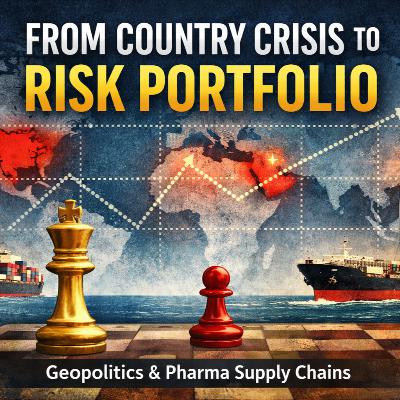
In this episode, I move beyond “one crisis at a time” and look at geopolitics through the lens of a risk portfolio for pharma and med-tech supply chains. Starting from recent events like Venezuela, the Red Sea, Taiwan, and Europe’s energy debate, I sketch a simple way to map exposure versus geopolitical fragility – not as a theoretical exercise, but as a practical tool for network and governance decisions.I talk about what leaders can actually control: where buffers sit, how contracts handle sanctions and export controls, how decision rights are set, and which trade lanes are treated as “single points of failure.” Using a concrete Latin America scenario, I walk through how a portfolio mindset changes the way you react to shocks, design options, and explain trade-offs to boards and regulators.If you’re responsible for supply chain, risk, or governance in a BANI world, this episode is an invitation to make your geopolitical exposure visible, link it to real levers you can set, and move from reactive crisis management to deliberate portfolio thinking.
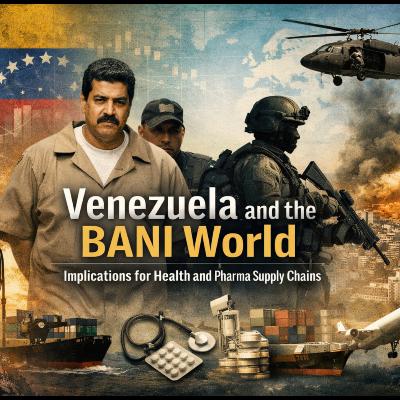
In this episode, I unpack the recent U.S. military operation that led to Nicolás Maduro’s capture and ongoing narco-terrorism proceedings in New York, and look at what this actually means for health and pharma supply chains in and around Venezuela.Rather than debating the politics, I focus on access to medicines, sanctions and logistics friction, and two working scenarios: a managed transition with selective relief versus a prolonged standoff where Venezuela remains a high-friction, low-priority market. I also explore how spillover effects, migration, shifting demand, and NGO procurement, could impact neighboring health systems.Finally, I translate this into practical actions for pharma and med-tech leaders: mapping exposure, separating humanitarian and commercial channels, tightening sanctions and compliance processes, building regional flexibility, and watching operational indicators instead of just political headlines, all framed through a BANI lens.
This short holiday episode is a quick thank-you from me to you before I step away for a year-end break. I share a few reflections on this past year in pharma supply chains and what’s coming next for the podcast, then hit pause until the new year.Wishing you a Merry Christmas, and a healthy start into the new year. See you soon in the next season of Supply Chain 360.
In this episode of Supply Chain 360, we complete the arc from scenarios to signals to action. After building an early-warning radar for your pharma supply chain, the next question is: what happens when a signal actually flashes red?We explore how to turn early warnings into fast, coordinated responses using lean, scenario-specific SOPs – response playbooks. Instead of long policy documents, these mini-SOPs define, on a single page:which triggers matter,what options you have,who owns each action, andwho is empowered to decide, and how quickly.We walk through concrete examples for suppliers and cold-chain lanes, show how to rehearse these playbooks in short cross-functional simulations, and discuss why clear decision rights often matter more than perfect data.Finally, we touch on how AI can support this: automatically pulling together relevant data when a trigger is hit and suggesting potential actions based on your existing playbooks—while humans stay firmly in charge.The goal: move your organization from “we saw it, but didn’t act” to a state where signals reliably drive smart, timely decisions.
In this episode of Supply Chain 360, we move one step further along the BANI journey: from imagining possible futures to actually seeing them coming.Building on the previous episode on scenario planning, we explore how pharma organizations can turn scenarios into a practical early-warning system – a simple risk radar that helps you act before disruption fully hits.We look at how to define meaningful signals for your key scenarios: creeping lead times, recurring minor quality issues, lane performance degrading, temperature excursions, regulatory noise, or carrier behavior that hints at capacity stress. Then we translate those into clear triggers and options that can plug straight into S&OP / IBP and regular risk reviews.On top of that, we discuss how AI – including more agentic AI – can support this radar by continuously scanning internal data and external news, highlighting weak signals, and even suggesting potential actions based on your playbooks, while keeping humans firmly in the loop.The goal is not a perfect cockpit, but a habit: regularly asking “What would we see first?” so your supply chain stops being surprised and starts anticipating.Listen in to learn how to turn scenarios into signals.
In this episode of Supply Chain 360, we move from forecasting to future-proofing. Instead of asking “What’s the plan?”, we ask a more powerful question: “What if?”We explore how simple, practical scenario planning can help pharma supply chains prepare for the unexpected. From export restrictions and supplier failures to regulatory changes or a sudden surge in demand when a new use for a drug is approved earlier than planned.You’ll hear how to:Work with one time horizon and just a few focused scenariosIdentify where service, inventory, or capacity would break firstDefine “no-regret moves” that help in almost any futureBuild options and triggers so you’re ready to act when signals appearRun short, cross-functional scenario sessions that plug into S&OP/IBPThe goal isn’t to predict the future perfectly, but to be less surprised by it. Scenario planning becomes your flight simulator for disruption, and a key capability in a BANI world.Tune in to learn how to move your organization from gut feeling to structured readiness.
In this final episode of the BANI mini-series on Supply Chain 360, we shift the focus from systems to the people who run them: leaders.We revisit what it means to operate in a world that is brittle, anxious, nonlinear, and incomprehensible, and explore why supply chains only become truly viable when leadership mindsets evolve. This episode looks at how the best leaders move from control to composure, from rigid plans to adaptive thinking, and from managing risk to learning from it.We discuss the leadership behaviors that enable Complexity, Orchestration, Risk, and Enablement to work in practice: creating psychological safety, making decisions with incomplete information, building cultures of curiosity instead of fear, and treating disruption as a constant condition rather than an exception.The core message: supply chains don’t just evolve because technology improves. They evolve because leaders do.Tune in for a reflective, practical close to the series, and a roadmap for leading in the BANI decade.
In this episode of Supply Chain 360, part of the BANI mini-series, we explore a major shift that isn’t a sudden shock or black-swan event, but a white swan: a visible, predictable transformation that’s already reshaping Europe’s industrial landscape.Recent data shows that around 70% of energy-intensive companies are moving investments out of Germany, driven by rising energy costs, CO₂ pricing, political uncertainty, and slowing demand. This includes global players like ArcelorMittal, redirecting low-carbon steel projects to France, and German-based Schott AG, increasingly shifting its specialty glass and packaging investments abroad under a “local-for-local” strategy.But what does this mean for pharma supply chains?A lot. When upstream industries relocate, the downstream effects ripple through sourcing, intermediates, packaging availability, regulatory logistics routes, and cold-chain design. These aren’t hypothetical risks, they’re emerging realities that viable supply chains must anticipate and proactively design around.This episode breaks down why Europe’s industrial migration is a white swan in plain sight and how pharma leaders can use this predictable change as a strategic signal rather than a surprise.
In this episode of Supply Chain 360, part of the ongoing BANI mini-series, we explore the fourth and final CORE pillar: Enablement - the force that turns strategy into motion.In a world that’s brittle, anxious, nonlinear, and incomprehensible, enablement is what transforms information into action. It’s not just about tools or training, it’s about trust, confidence, and culture. When people are empowered with data they can use, systems they can trust, and the freedom to act within clear boundaries, agility becomes real.We look at how pharma supply chains can close the gap between knowing and doing, giving planners, operators, and decision-makers the ability to respond to change faster than disruption unfolds.Because true adaptability doesn’t come from control; it comes from confidence. And when your people are trusted and your systems are designed for speed, your supply chain doesn’t just survive change, it thrives because of it.
In this episode of Supply Chain 360, part of our BANI mini-series, we unpack the third CORE pillar: Risk. In a world that’s brittle, anxious, nonlinear, and incomprehensible, traditional “risk management” as a checklist or insurance policy isn’t enough. Today’s disruptions, cyber events, trade shifts, API shortages, extreme weather, don’t arrive one at a time; they overlap, cascade, and amplify.We reframe risk as intelligence: something to sense early, understand quickly, and act on decisively. You’ll hear how pharma leaders can build real-time visibility across suppliers and lanes, turn incidents into learning loops, and foster risk literacy, thinking in scenarios, asking “what if?” before they have to, and sharing signals across finance, ops, quality, and logistics.Key takeaways: treat risk as shared intelligence (not a silo), design for adaptability rather than perfect prediction, and use every disruption to strengthen your system. Because the goal isn’t a supply chain that never breaks, it’s a supply chain that learns every time it does.Listen to discover why the future favors organizations that convert uncertainty into advantage.
In this episode of Supply Chain 360, part of the ongoing BANI mini-series, we explore the second CORE pillar: Orchestration — the art of turning complexity into coordination.Pharma supply chains are filled with hundreds of moving parts — suppliers, regulators, logistics partners, and manufacturers — all operating on their own timelines. True orchestration is about creating alignment along the entire value chain, bringing people, processes, and systems into rhythm even when the world feels out of tune.We’ll discuss why visibility is the “baton” for modern leaders, how collaboration beats control, and why culture matters just as much as technology. You’ll learn practical ways to foster shared data, faster decisions, and stronger cross-functional trust, the foundations of agility in a BANI world.Because in today’s supply chains, control doesn’t scale. But coordination does.
In this episode of Supply Chain 360, part of the ongoing BANI mini-series, we dive into the first CORE pillar: Complexity. Pharma supply chains aren’t simple, linear systems, they’re intricate networks of suppliers, regulators, manufacturers, and logistics partners, all bound together by interdependence and risk. The more we’ve optimized for efficiency, the more brittle those networks have become.This episode explores how leaders can move from fighting complexity to understanding and orchestrating it. We discuss visibility, systems thinking, and the power of mapping interdependencies to anticipate disruption instead of reacting to it.Because in a BANI world - brittle, anxious, nonlinear, and incomprehensible - simplicity isn’t realistic. But clarity is. Tune in to learn how to see complexity not as chaos, but as context, and how that perspective turns uncertainty into an advantage.
In this episode of Supply Chain 360, we continue our BANI mini-series — exploring how to lead and build in a world that’s brittle, anxious, nonlinear, and incomprehensible.For years, resilience was the ultimate goal in supply-chain management. But in today’s constant state of disruption, bouncing back isn’t enough. It’s time to move toward viability — the ability to adapt, evolve, and stay relevant no matter what happens next.We unpack what “viability” really means for pharma supply chains, why traditional recovery models are falling short, and how the next decade belongs to companies that design for continuous adaptation.You’ll hear practical insights on how to rethink supply-chain design through the CORE lens — Complexity, Orchestration, Risk, and Enablement — and learn why the future won’t reward the most resilient networks, but the most viable ones.
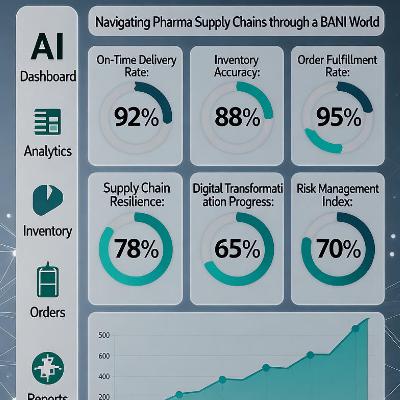
This kickoff to my BANI mini‑series unpacks how brittle, anxious, non‑linear and incomprehensible dynamics are reshaping pharma supply chains. We discuss real‑world brittleness: a 7.4‑magnitude earthquake in Japan that halted chip production and ground Detroit’s auto assembly, and a software update that locked up millions of computers and grounded. We examine how U.S. tariffs on Chinese imports have pushed logistics costs up 10–15 % for 60 % of companies and how Houthi attacks have closed the Red Sea shipping route, forcing vessels to detour around the Cape of Good Hope, adding up to 12 days and roughly US $1 million per voyage. We also highlight China’s dominance in pharma ingredients, producing more than 80 % of API, and why geopolitical instability tops risk forecasts for 2026.
In this episode, I reflect on the growing trend of AI being used to cut jobs, often without a clear plan for reskilling or redeployment. Triggered by a recent New York Times article mentioning layoffs at companies like Microsoft and Recruit Holdings, I question whether we’re losing the human in the process. AI isn’t the problem. It’s how we choose to implement it that matters. Here is the link to my whitepaper on this topic: The Social Impact of AI: Rethinking Corporate Responsibility in the Age of Intelligent Transformation | LinkedIn
Welcome to this special episode of my podcast, where I explore the critical aspects of Talent Management—not just as a process of developing leaders but as a balanced framework that equally emphasizes followership development. Using insights from various scholarly and professional sources, I aim to reshape how organizations think about managing their most vital asset: People.
Today's episode focuses on the role of AI in Pharmaceutical Manufacturing, specifically how it is powering personalized medicine. We will explore AI's impact today and what the future looks like by 2030, with technologies like digital twins driving efficiency and precision in drug development.
In this episode we will dive into how identified challenges in supply chain management become opportunities - or maybe not?Curious? Tune in and find out.

Comments

Download from Google Play

Download from App Store
 United States