DiscoverThe Saga of Human Civilization
The Saga of Human Civilization
Claim Ownership

The Saga of Human Civilization

Author: Maitt Saiwyer

Subscribed: 1Played: 7
Share

Description

"The Saga of Human Civilization" is the definitive, -episode journey through the entire arc of human history, from the emergence of consciousness to the challenges of the digital age. This series rejects simple narratives of kings and dates, instead exploring the deep forces—biological, cultural, and economic—that built the modern world.


Each week, we will investigate a critical turning point in the human story, drawing on seminal works of history, philosophy, and science. We begin with the Cognitive Revolution, examining how shared fictions like language and myth enabled Homo sapiens to conquer the globe, only to find themselves trapped by the Agrarian Revolution and the subsequent rise of inequality. We then delve into the rise and collision of the classical and medieval world powers, from Plato’s ideal state and the Mandate of Heaven in China to the cultural zenith of the Islamic Golden Age.


We examine the great globalizers—the Crusaders, the Mongols, and the explorers of —and track the monumental intellectual shifts of the Enlightenment: the rise of capitalism under Adam Smith, the call for revolution by Rousseau and Marx, and the challenge to creationism posed by Darwin. Finally, we confront the great conflicts and crises of the 20th century, analyzing the rise and fall of totalitarianism, the psychological toll of empire (Fanon), and the modern fight for human autonomy in the Age of Surveillance Capitalism.


This is the story of how we learned to cooperate, how we fought, how we innovated, and where we go next. It is the full, complex, and unblinking saga of us.
21 Episodes
Reverse
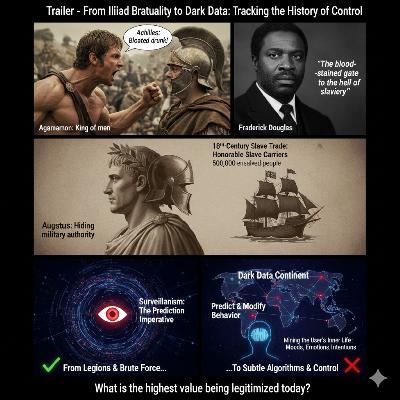
This episode embarks on a historical deep dive to connect ancient power dynamics with modern technological control. The journey begins with extreme power and conflict, from the visceral brutality of the Iliad, where Achilles called Agamemnon a "bloated drunk", to the horror of slavery, described by Frederick Douglass as the "blood-stained gate to the hell of slavery". The focus then shifts to how ruling powers persist, whether through Augustus's mastery of hiding military authority behind familiar republican titles, or through the historical ignorance of early American scholars who portrayed Native societies as static and "changeless". The theme of power is then traced into economic exploitation, as exemplified by the 18th-century slave trade, where British traders acted as "honorable slave carriers" for half a million enslaved people. This history of control through physical force and political maneuvering has now pivoted to control through data extraction, known as surveillance capitalism. The core driver of this modern system is the prediction imperative—the economic need to constantly gather data not just to see what users do, but to predict and subtly modify their future behavior for profit. This search for control has expanded into what is chillingly termed the "dark data continent". This goes beyond mere clicks and likes to mining the user's inner life—their moods, emotions, and intentions. The overall progression shows that the methods of control have changed dramatically, from legions and brute force to economic exploitation and, now, subtle algorithms. The constant in this long history is the persistent struggle between power and vulnerability, leaving a final question: what is the highest value being legitimized today by this massive collection and mining of our inner lives?
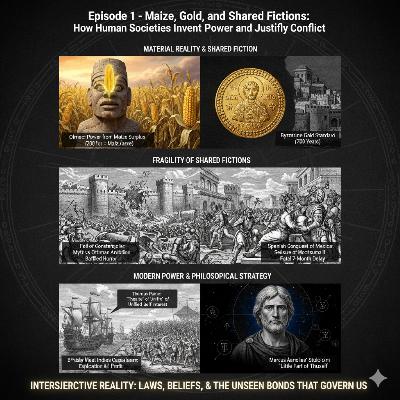
This episode embarks on a comparative journey across history to explore how human societies structure power and cooperate based on "shared fictions"—ideas, laws, and beliefs that exist in our intersubjective reality. The material basis for these shared beliefs is critical; the power of the Olmec civilization, for instance, was rooted in the cultivation of maize (corn), which reliably produced a surplus above 200 pounds per acre. This guaranteed abundance provided the bedrock for a shared political and spiritual belief system, where the ruler was explicitly linked to the maize ear, the source of life. This concept is paralleled in the power of the Byzantine Empire, which lasted over 700 years due to the incredible durability and predictable value of its gold standard—a coin (the nomisma) of precise purity. The coin itself carried a political message, depicting the emperor being crowned by Christ, explicitly showing that the emperor's right to rule was based on divine mandate. The fragility of these power structures is exposed when external forces challenge the shared fictions; the fall of Constantinople was a clash between the myth of an impregnable Christian Empire and the pragmatic, relentless ambition of the Ottomans. Similarly, the Spanish conquest of the Mexica succeeded not through superior force but by challenging the shared fiction of the sacred power of the ruler, Moctezuma II, whose seizure caused "baffled horror" and a fatal seven-month delay in counter-attack. The analysis also covers the economic engine of slavery, with the British West Indies sugar economy serving as an early form of industrial capitalism requiring massive upfront capital investment, making exploitation a necessary structural component. The long history of power then connects to modern times through thinkers like Thomas Paine, who saw that the external conflict of warring kings was often a mere "theatre" masking the unified self-interest of a powerful elite. Finally, the philosophical strategy for enduring this chaos is found in Marcus Aurelius's Stoicism, which advises one to retreat to the "little part of thyself," focusing only on one's own virtuous actions, regardless of the unjust and unpredictable external world.
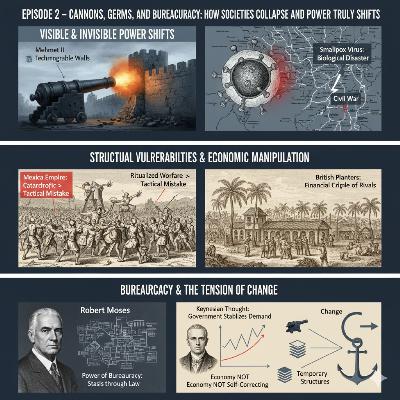
This episode delves into historical crises to synthesize the factors that fundamentally shift power and cause societies to collapse. The visible shift is seen in the Ottoman transformation under Mehmet II, who centralized power, moved toward a rigid, ceremonial monarchy, and used technological supremacy—such as the massive siege cannons that fired relentlessly day and night—to shatter the myth of Constantinople's impregnable walls. In contrast, the collapse of the Inca Empire was driven by an invisible biological disaster; the smallpox virus, introduced unintentionally, became a devastating biological weapon that spread quickly along the highly efficient Inca road network, killing the Sapa Inca and triggering a civil war. The vulnerability of complex systems is often structural, as demonstrated by the Mexica Empire's adherence to its own sacred rules, which prevented them from annihilating Cortés's forces after the Noche Triste. Their ritualized warfare, which prioritized capturing high-status warriors over total annihilation, proved a catastrophic tactical mistake against the rule-breaking pragmatism of the Spanish. The theme shifts to the subtle, slow, and cynical manipulation of economic systems, such as how the British sugar planters eventually supported the abolition of the slave trade—not for moral reasons, but to financially cripple their rising competitors in the French and Spanish colonies. The analysis concludes with the power of bureaucracy, highlighted by the Robert Moses model of power, which perfected stasis through legal systems that made him virtually unaccountable. Similarly, Keynesian economic thought countered the flawed idea that the economy was self-correcting, arguing that external government management was necessary to stabilize demand and prevent self-defeating deflationary spirals. This dynamic between innovation and stability is evident throughout history, from the Ottoman's cannons to the economic reforms proposed by Keynes and the political choices of ancient societies that actively debated and chose different, temporary social structures. Ultimately, the core tension is between the inherent human desire to maintain stability and the constant, often non-linear, pressure for change.
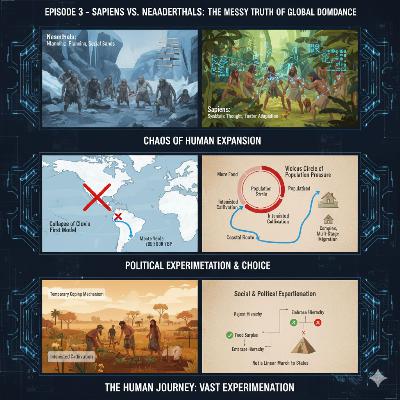
This episode examines the factors that led to the global dominance of Homo sapiens, contrasting our species' success with the fate of our closest relatives, the Neanderthals. The key difference was not necessarily a massive superiority in tools, but a theorized greater cognitive plasticity—a superior capacity for symbolic thought and faster social adaptation that enabled cooperation on a much larger scale. The complexity of the human story is immediately apparent in the study of the peopling of the Americas; the old Clovis First model collapsed with evidence from sites like Monte Verde in Chile, which were definitively dated to have been occupied before the supposed opening of the ice-free corridor. The current thinking suggests that the migration was not a single, orderly march, but a complex, multi-stage process that likely began with a coastal route, bypassing the massive ice sheets entirely. Furthermore, genetic markers, particularly Mitochondrial DNA (mtDNA), and the distinct Paleoamerican morphology of the oldest American skeletons, support the idea that there were multiple, separate waves of arrivals. After settlement, a key driver for change was population pressure; as resources became strained, early communities adopted intensified plant cultivation as a coping mechanism. This coping mechanism created a vicious circle where more food allowed for larger populations, which then demanded even more intensified cultivation, forcing societies into agriculture and permanent settlement. This led to a counter-narrative to traditional historical assumptions: early human societies were surprisingly politically flexible, often retaining the ability to consciously choose or reject hierarchy for centuries after agriculture emerged. Evidence of this can be seen in seasonal shifts in governance and the political sophistication of groups that could deliberately structure their societies. Ultimately, the human story is not one of linear progress, but a history defined by social and political experimentation.
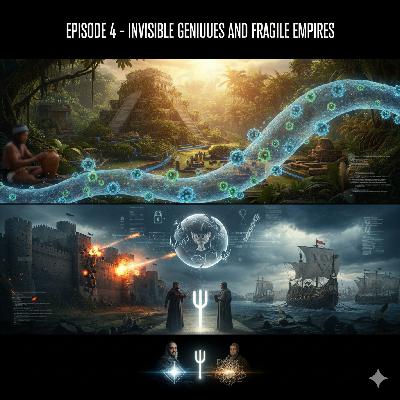
This episode begins by challenging the "empty continent" myth, highlighting new archaeological evidence that the Americas were highly complex, densely populated, and technologically sophisticated long before 1492. Specifically, the Amazon basin around 1000 AD contained huge settlements, like the Marajo chiefdom, which had populations of over 100,000. These complex societies were sustained by advanced, long-term agroforestry techniques and the creation of fertile Terra Preta soil, a model of sustainable tropical living that was largely lost after the massive demographic collapse. Further proof of early independent genius is seen at Norte Chico in Peru, which features monumental public architecture built at the same time as Sumer, and the finding of the oldest known pottery in the Americas at Painted Rock Cave in the Amazon, dating back 6,000 BC. The theme of complexity and fragility continues into the age of empires, using the Siege of Constantinople in 1453 as a case study in the psychological and logistical pressures that can make power instantly fragile. The survival of empires often hinged on unexpected geopolitical events, such as the rise of the Byzantine successor states after the Fourth Crusade, where the Crusaders' distraction by the Bulgarian Czar allowed the Empire of Nicaea to solidify power. The political fragility of the Roman Republic is also examined through the civil wars, contrasting Sextus Pompeius’s peripheral power based on personal loyalties with Octavian’s more durable central power, built on controlling institutions and appealing to the aristocracy's traditional ambitions. The episode asserts that the most devastating force for collapse in the Americas was the arrival of Eurasian pathogens, which acted as a "biological sledgehammer" that decimated populations often before European colonizers physically arrived. Existing cultural practices, such as gathering around the sick person's bedside, tragically became vectors for the rapid transmission of diseases like smallpox. In the flux of history, humans constantly sought anchors, from physical objects like the re-written Reliquary of Pepin to abstract belief systems. The episode concludes by contrasting Descartes' quest for singular metaphysical certainty with Confucius's acceptance of complexity and difference in human relationships, and questioning whether, in the modern world of total digital and environmental enclosure, we have lost the physical option our ancestors had to simply "step outside the system" to escape state control.
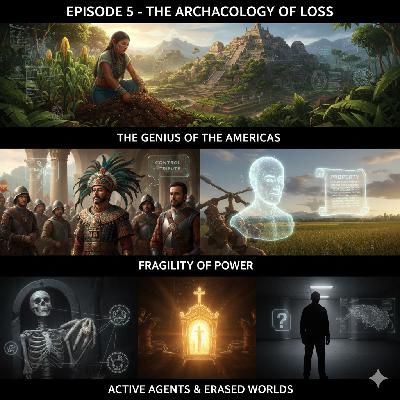
This episode begins by exploring the "archaeology of loss," challenging the long-held Western notion that the pre-Columbian Americas were an "empty wilderness" and highlighting how recent evidence proves they were densely populated and technologically advanced. Archaeological research now suggests the Amazon basin was potentially more crowded in 1000 AD than today, with population centers like Maraho and Tapajos supporting potentially hundreds of thousands of people. These complex societies were sustained by advanced agroforestry techniques that involved actively cultivating the forest and the creation of Terra Preta (Amazonian Dark Earth), an anthropogenically made fertile soil that completely defies the old argument that the soil was too poor for civilization. A prime example of indigenous genius is the "creation" rather than "domestication" of maize from the tough, inedible grass Teosinte, a feat of long-term selective breeding that produced a food source essential to global agriculture. The discussion shifts to the fragility of power, contrasting the immense material wealth and artistry of the Aztec Empire, which was praised by Hernán Cortés, with its surprising political vulnerability. The Spanish seizure of Emperor Montezuma and the subsequent collapse was exacerbated by the Aztec philosophy of warfare, which prioritized control and tribute over the total annihilation of the enemy. This allowed Cortés and his men to survive a devastating defeat and eventually win, a situation where a philosophical difference in the objective of war had direct strategic consequences. The continued relevance of political philosophy is explored by noting Machiavelli's counsel to avoid generating hatred by respecting subjects' property, which he considered more vital than avoiding the killing of opponents, and Rousseau's unique argument that monarchy might work best in fertile lands to consume surplus wealth and prevent destabilizing private accumulation. The episode delves into material culture, emphasizing that modern archaeology views objects not just as passive evidence, but as active agents in historical processes, carrying identity, memory, and political power. This is illustrated by the personal significance of engraved rings found in ancient Greek graves and how, in early Christianity, sacred objects were seen as vessels that actively contained or channeled holy power. The entire vast, complex pre-Columbian world was erased so completely that even the descendants of the conquered barely knew its true scale, leading to the final thought: that the speed and totality of this loss should make us question what subtle genius in our own world today we might be similarly failing to recognize, value, or actively erasing.
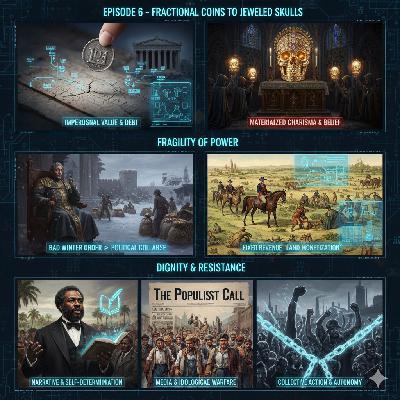
This episode explores the complex, often fragile mechanics of power, control, and resistance across various historical epochs, emphasizing that societal structures are constantly shaped by contingency and material tools. The analysis begins by noting how the introduction of small, fractional coinage in ancient Greece was a revolutionary act that broke the social contract of neighborly reciprocity, substituting personal debt and obligation with detached, verifiable, materialized value. This material reality of coinage, distinct from subjective social standing, became a foundation for impartial, impersonal economic control. In contrast, medieval spiritual authority was built on the materialized charisma of objects like the jeweled skull of Saint Foy, which required constant human effort and financial investment to sustain belief and economic power. The fragility of centralized power is highlighted by the Byzantine Empire, where the long reign of Emperor Theodosius II was sustained by costly cash payments to foreign threats, and his successor's downfall was triggered by a disastrous operational decision—a bad winter order—that spiraled into a military revolt and violent political discontinuity. Similarly, colonial empires prioritized bureaucratic convenience over sustainability, with the British Permanent Settlement in India fixing revenue demands purely to ensure predictable state income, which ultimately created a wealthy, often parasitic landlord class by monetizing the scarcity of land and population growth. The violence used to establish and maintain power is a recurring theme, from the ritualistic brutality inflicted upon enslaved people in America to the calculated suppression of the Jacquerie peasant revolt in 14th-century France. The perpetual human struggle for dignity and self-determination manifests in various forms of resistance, such as Frederick Douglass's early life, where finding a narrative that validated his lived reality became a powerful, life-altering act. Later examples include the American Populist Movement of the 1890s, which aimed for a complete ideological overhaul by creating its own media to challenge the dominant financial elite. The struggle for worker dignity in the industrial age also led to massive collective actions like the 1934 West Coast Longshoremen's Strike and the Textile Workers' Strike, forcing employers and the state to recognize labor's collective power. Ultimately, the analysis suggests that history is defined by this constant tension between the forces attempting to impose control from the top and the persistent, powerful impulse for autonomy and self-determination from below.
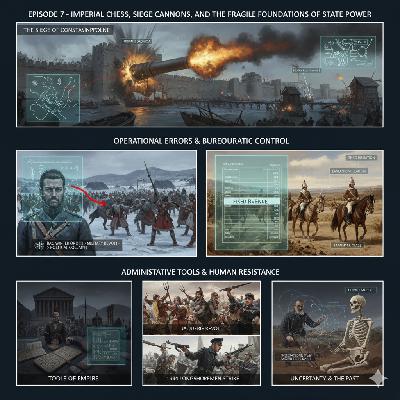
This episode undertakes a vast historical analysis, examining the forces that build, sustain, and ultimately fracture state power, drawing examples from ancient history to the early modern period. The analysis begins with the Fall of Constantinople in 1453, which was the culmination of a sophisticated geopolitical chess game where the Ottomans first shifted their capital to Adrianople to isolate the Byzantine capital before moving in with colossal, custom-made siege cannons. The final attack included theatrically clever moves, such as building a floating bridge across the Golden Horn and pressing the attack with the strategic use of siege towers, forcing the desperate defenders to innovate with fiery counterattacks. The eventual collapse was defined not by a slow erosion, but by a sudden, unexpected breach in the walls, leading to immediate confusion and chaos. The theme of fragile centralized power is further explored through the history of the Byzantine Empire, where a major military revolt in 602 AD was triggered by a disastrous operational decision to order troops to winter in hostile territory. The rebellion quickly gained support from powerful urban and aristocratic factions in the capital, demonstrating how an operational error can swiftly metastasize into a full-blown political crisis. Moving from grand imperial collapse to the foundations of control, the episode analyzes colonial administration, specifically the British Permanent Settlement in India. This 1793 policy was a political act of radical bureaucratic simplification, fixing the land revenue demand in perpetuity and creating a class of entrenched land collectors who quickly became entrenched landlords, prioritizing reliable revenue for the British state over agricultural sustainability or fairness. Beyond the politics of collapse and control, the episode highlights the necessity of reliable administrative tools for maintaining state order, referencing the crucial early bookkeeping devices in Mesopotamia and the sophisticated, direct tax assessment system used by Tipu Sultan in India. The discussion also touches on the pervasive human struggle against systemic oppression, using the Jacquerie revolt in 14th-century France and the violent military suppression of labor strikes in 20th-century America as stark examples of the state's readiness to use force to maintain economic order. Finally, the limitations of historical knowledge are acknowledged, pointing out how seemingly objective evidence, such as radiocarbon dating and archaeological artifacts, must be handled with extreme care, as even natural forces like burrowing badgers or early curatorial practices can complicate the true historical picture.
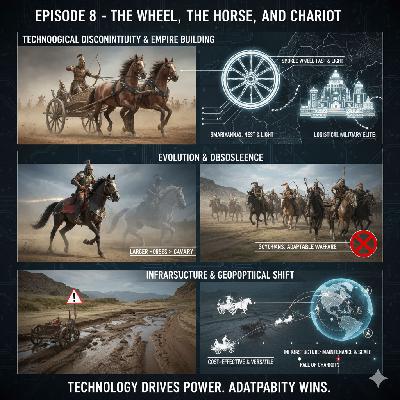
This episode traces how advancements in mobility technology—the wheel, the chariot, and the horse—were pivotal forces that both built and broke early civilizations, demonstrating the power of technological discontinuity. The invention of the spoked wheel was a game-changer, making chariots light, fast, and agile, transforming them from mere ceremonial transports into devastating military platforms. The emergence of the light, horse-drawn chariot gave rise to a new, powerful military elite, known as the in the Near East, whose supremacy was tied directly to the expense and complexity of this new weapon system. The societal impact of this technology was profound, driving the need for specialized artisans and new forms of political and military organization to sustain the chariot's use. The rise of the war chariot illustrates a classic pattern of technological lock-in, where its initial military dominance led to a rigid, hierarchical structure among the elite. However, the very technology that brought the chariot's dominance—the domestication and breeding of the horse—eventually led to its obsolescence. As horses were selectively bred to be larger and stronger, they became capable of carrying a rider in armor, leading to the gradual replacement of the chariot by the more versatile and cost-effective cavalry. The Scythians and other nomadic groups were among the first to master this new, more flexible form of warfare, demonstrating the power of adapting a technology to fundamentally shift military and political power. This historical pattern reveals that the success of a technology isn't just about its initial superiority, but its adaptability and cost-efficiency against newer, rival innovations. The early adoption of the wheel also highlights a fundamental and enduring challenge: how to effectively manage and maintain the infrastructure—the roads—necessary for a technology to function at scale. This deep dive ultimately shows that mobility technologies are never neutral; they are catalysts for geopolitical change, constantly creating and collapsing systems of power.
This episode covers the profound, often unexpected ways early human actions from 20,000 to 5000 BC reshaped the planet, demonstrating that humanity has been an ecological force for far longer than typically assumed. The expansion of human populations coincided with massive waves of megafauna extinction, which was not a natural event but was closely correlated with human arrival on various continents, suggesting an active role in driving these animals to extinction. The ecological consequences of these extinctions were far-reaching, fundamentally changing global plant life and ecosystems by removing large herbivores that had previously managed the landscape. Early humans also actively engineered their environment through practices like fire-stick farming, which used controlled burns to clear underbrush, promote specific plants, and improve hunting grounds, creating the first anthropogenic landscapes. The rise of agriculture following the Ice Age was another monumental reshaping event, marking a dramatic shift from foraging to settled life and a dependence on a few staple crops like wheat, rice, and maize. This agricultural transition was not a sudden invention but a long process of selective breeding and co-evolution, where both humans and the cultivated plants adapted to new, mutually dependent lifestyles. The new agrarian lifestyle, with its dense, often unsanitary settlements, created conditions for pathogen evolution, leading to what is called the "plague bottleneck". This bottleneck describes a period when large, settled populations were repeatedly decimated by new infectious diseases that jumped from domesticated animals to humans. The necessity of managing the complexities of settled, agricultural life drove the invention of bureaucratic tools and early state structures to organize labor, distribute resources, and manage conflict. The emergence of early social stratification and the need to control the agricultural surplus led directly to the first major societal divisions, which became the foundation of early statecraft. Therefore, this deep history illustrates a continuous theme: that human activity is the primary force behind significant ecological and demographic discontinuities throughout history, long before the Industrial Revolution.
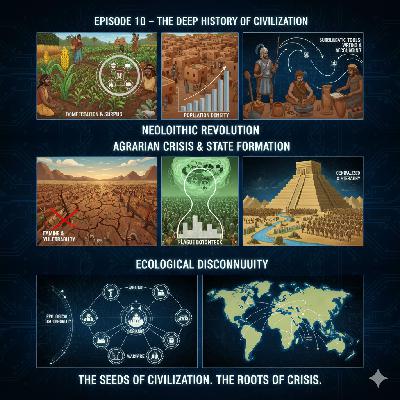
This episode delves into the Neolithic Revolution, marking a fundamental shift in human history from mobile hunter-gatherer societies to settled agricultural life. The core of this revolution was the domestication of plants and animals, which provided a reliable, managed food supply, leading to an unprecedented increase in population density. This agricultural surplus allowed a portion of the population to specialize in tasks other than food production, becoming artisans, priests, and soldiers. The necessity of managing this surplus and organizing the dense, settled populations drove the invention of bureaucratic tools, such as accounting systems and early forms of writing, which were vital for the collection and redistribution of resources. The shift to agrarian life, however, came with severe trade-offs, as the dense populations relying on a few staple crops made early societies vulnerable to famine if the annual harvest failed. Furthermore, the close cohabitation of humans and domesticated animals created an ideal environment for pathogen evolution, leading to waves of new infectious diseases that repeatedly swept through and decimated early agrarian populations—a phenomenon known as the plague bottleneck. The need to organize large-scale irrigation and defense for these dense settlements was a primary driver for the emergence of centralized states and hierarchical social structures. These early states were built to extract and control the agricultural surplus necessary to support their specialized elites. Ultimately, the Neolithic Revolution was an ecological discontinuity—a massive, rapid reshaping of the planet by human activity. This fundamental transition, which started with selective breeding and settled life, set the stage for all subsequent civilization, inventing the necessary tools of the state, including writing, law, and organized warfare, all while simultaneously creating new forms of vulnerability and crisis.
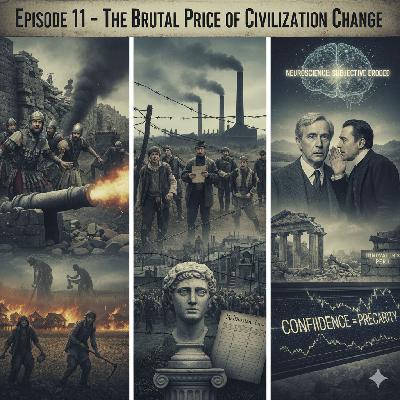
The discussion explores the theme of the brutal cost of civilizational change by analyzing seemingly disparate historical and intellectual shifts. The conversation starts on the battlefield, examining the Siege of Constantinople in 1452 as an example of technological innovation—like the primitive mortar—forcing military and psychological change, leading to the collapse of an old order through fear and sheer brutal human effort. This idea of violence and cost is then traced to medieval Europe, where private wars deliberately destroyed peasant agricultural resources, maiming people and leaving a visible, lasting legacy of suffering for generations as a core strategy for economic warfare. The theme then shifts to massive economic and social transformations. The rise of agriculture is presented as a "paradox of drudgery", where hunter-gatherers were likely forced into back-breaking farming, leading to a poorer diet and life, by external pressures like climate change and hostile neighbors. Centuries later, new economic ideas imposed similar hardship, such as the British imposition of individual land ownership on communal Indian systems and the Enclosure Movement in England, which destroyed the support systems of the rural poor, making them completely reliant on money wages and market insecurity. This hardship was often justified by classical rationalism and theories like Malthusianism, which asserted that poverty and suffering for the masses were inevitable and necessary "natural laws". The episode concludes by examining the psychological and philosophical costs of change. In contrast to Malthus's grim certainty, Marxism is presented as an opposing theory where change is driven by class struggle, with the proletariat as the only truly revolutionary class. The discussion then pivots to the uncertainty of the inner world, contrasting Keynes's focus on confidence and the precarity of long-term investment with Machiavelli's warning about the peril of being an innovator due to fierce opposition and "lukewarm defenders". Finally, modern neuroscience is discussed as posing an unsettling cost by potentially dissolving the importance of subjective experience, thus eroding the very basis of our modern ethical and moral systems.
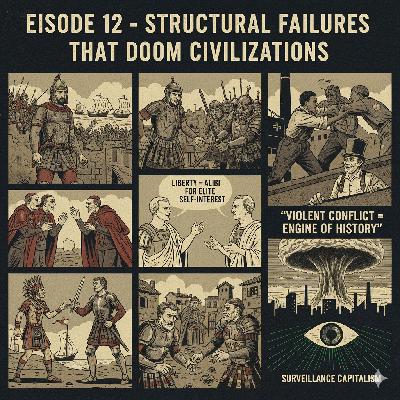
This episode explores the structural fragility of civilizations, arguing that long-term internal decay and division often set the stage for external collapse. The fall of Constantinople serves as a prime example, where a politically and religiously fractured Byzantine state, paralyzed by internal debates over union with Rome, was easily overcome by the agile Ottoman Empire. Adding to this paralysis was the self-interest of supposed Christian allies, like Genoa and Venice, who prioritized old financial debts and economic rivalries over the city's survival. The conquest of the Aztec Empire further illustrates this, showing how a highly sophisticated, ritualized civilization—with immense historical depth—was undone by its own cultural rigidity when faced with the Spanish, an enemy operating outside their established rules of sacred warfare. Internal decay also contributed to the collapse of the Byzantine Empire over centuries, primarily through the destruction of the loyal, land-holding thematic armies and a disastrous reliance on costly, disloyal foreign mercenaries. Similarly, the decay of the Roman Republic stemmed from deep political tensions, as the self-serving rhetoric of the senatorial elite alienated the pragmatic common populace, who saw "liberty" as an alibi for elite self-interest. These internal weaknesses led to a political fragility that was not only exploited by military forces but also by institutionalized banditry, where mercenary companies professionalized extortion rackets and were often paid off by local rulers, further exposing the state's failure to provide security. Jumping forward, this pattern of internal division was weaponized in the US industrial sphere, where employers actively used newly imported ethnic labor groups to fuel internal conflict, breaking worker solidarity to maintain power. The most devastating forms of self-perpetuating destruction were seen in the 20th-century ideological struggles, which rejected the optimism of the Enlightenment and adopted a distorted Darwinian view that violent conflict was the necessary, inevitable engine of history. Today, the question remains whether modern societies are equipped to recognize new forms of structural fragility, especially if current threats, like surveillance capitalism, are cloaked in the familiar language of technology and progress.
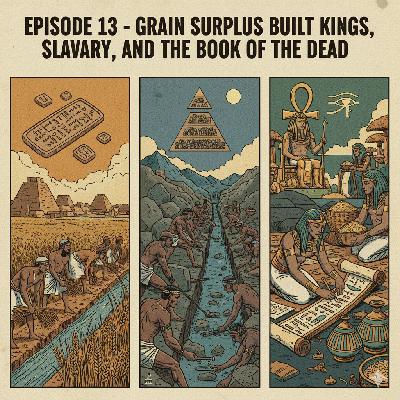
The discussion explores the dark paradox of early civilizations, arguing that the foundations of complex society in Mesopotamia and Egypt rested on the Neolithic Package—a combination of specific grains, legumes, and livestock that allowed for sustainable surplus. This grain surplus, which could be stored, created the fundamental dividing line between small villages and large, specialized societies, as it allowed up to 20% of the population to be freed from food production to become specialists like scribes and priests. However, the rise of this surplus, while enabling great achievement, immediately created new, brutal conditions, including entrenched social hierarchy, widespread slavery, organized warfare, and an increased vulnerability to mass famine from relying on single crops. The average early farmer saw a drop in health and height, making the agricultural shift a huge win for the species' numbers but a bad deal for the individual. The state's need to manage and defend this valuable, stored surplus created the first hierarchies, with early administration starting small, perhaps managed by temple communities using accounting tools like clay tokens. The true cost of this shift was revealed in the need to manage labor risk: the immense, hazardous work needed to build monuments and maintain the agricultural base (like dredging canals and quarrying stone) was often assigned to a separate, disposable proletariat of slaves. This calculated strategy of outsourcing the drudgery to captives or foreigners helped insulate the core population of free subjects, preventing the political unrest that would follow from forcing free citizens into such lethal conditions. In Egypt, the grain surplus wasn't just funding labor, but an elaborate spiritual bureaucracy of priests and artisans who supported the divine authority of the Pharaoh. This entire complex religious system, including the extensive preparations and the Book of the Dead, was explicitly tied to ensuring the cosmic and agricultural stability of the state. Ultimately, the trajectory of these first civilizations was defined by the transition from local management to centralized state power through the ability to control essential resources—food, water, and the necessary labor—with political stability resting on this foundation.
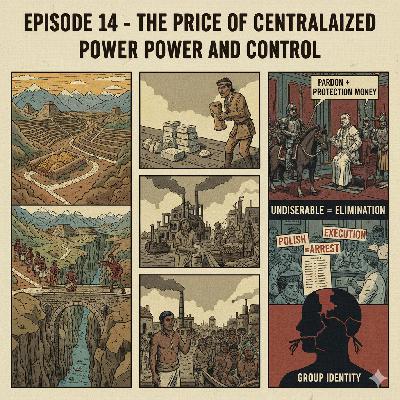
This episode examines the mechanics of centralized state control and the price paid for building vast human systems, starting with the Inca Empire, a state that achieved incredible stability and scale without money or markets. The Inca achieved this by dictatorially centralizing an existing communal labor tradition, called mita, turning it into mandatory state conscription for infrastructure projects, the military, and other state needs. The logistical success was immense, demonstrated by Spanish reports of vast, overflowing state warehouses—a visible guarantee of abundance and a symbol of prestige that proved the state could guarantee provision and eliminate hunger. However, this system's reliance on centralized control of labor and resources, rather than market efficiency, presents a fundamental challenge to modern economic assumptions about stability and success. The theme of central control is then traced to global trade and military logistics, where strategic commodities like salt and sugar became crucial state assets. The Spanish Crown's attempt to centralize profit by taxing Yucatan salt, for example, failed disastrously, making the salt too expensive to compete and creating logistical inefficiencies that defied logic. Conversely, the strategic importance of salt was recognized by Union military planners during the US Civil War, who specifically targeted Confederate saltworks to cripple the Southern war effort. In the 18th century, the immense wealth generated by sugar refineries in places like Bristol was entirely dependent on the brutal, centrally organized Atlantic slave trade, illustrating how a single commodity could fuel vast wealth and entrenched exploitation. Finally, the discussion turns to the human cost when the state's power is absolute, from mercenary captains like Arnaut de Cervole holding the Pope hostage for a full pardon and protection money, to the horrific efficiency of 20th-century totalitarian regimes. Under the Soviet Union's Great Terror, bureaucratic quotas and simple ideological labels like "Polish" or "kulak" were used as deadly short-cuts for statistically motivated mass arrests and executions. Similarly, in Nazi Germany, the system was geared toward the systematic elimination of categories of "undesirable" people, with even doctors complicit in using crude biological criteria to identify victims for murder. The philosophical underpinning for such actions often came from a counter-Enlightenment thought that rejected universal human nature in favor of unique group identity, justifying exclusion and providing the intellectual soil for totalitarian control.
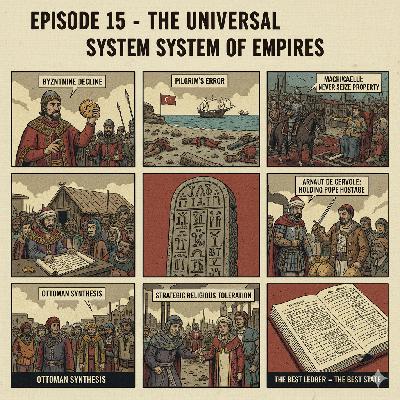
This episode explores the concept of a universal administrative blueprint by comparing successes and spectacular failures across diverse historical settings to understand what makes a state function. The Byzantine Empire provides a case study in systemic administrative failure, with the long decline following the Battle of Manzikert in 1071 accelerated by internal bureaucratic rot. For instance, Emperor Constantine X Doukas prioritized short-term fiscal convenience by debasement of the coinage and neglecting the military, sacrificing long-term security for immediate political ease. This culminated in the "suicidal decision" of 1284 to abolish the imperial navy, driving highly skilled sailors to defect to the rising Ottomans and actively strengthening a major rival. In stark contrast, the rising Ottoman Empire demonstrated administrative excellence through organizational synthesis, adapting and integrating existing Byzantine tax and administrative structures rather than dismantling them, which gave them immediate functional control over new territories. Their strategy also included a form of strategic religious toleration (though conditional), which bought internal peace and stability by not delving into the theological differences that had fueled conflicts among fellow Christians in the declining Byzantine Empire. On the other hand, the early English pilgrims provide a case study in logistical self-sabotage, as their venture capitalist backing and desire for quick profit led to disastrous planning, including arriving in winter without adequate food or shelter, causing the deaths of half the settlers in the first winter. Across all these examples, the durability of any state, regardless of its ideology, ultimately boils down to a fundamental administrative toolkit. This toolkit includes the ability to create durable records—often in stone (lithic time)—to establish uncontestable claims of ownership and law across generations. It also involves maintaining authority, which Machiavelli argued rests on a practical administrative rule: a ruler must never seize the property of his subjects, as the hatred and permanent resentment resulting from the loss of patrimony is the greatest threat to a state's stability. Ultimately, the quality of a state, whether imperial or revolutionary, seems to depend on the quality of its administrative ledger, demonstrating that the most successful state is fundamentally the one that keeps the best and most accurate books.
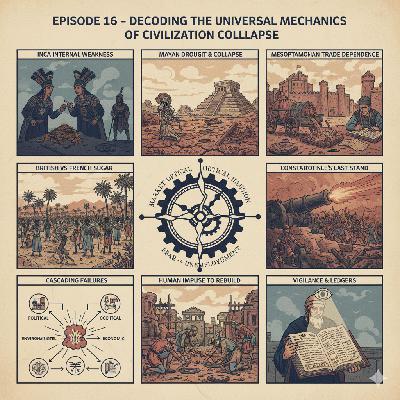
This episode explores the universal language of systemic failure, aiming to identify recurring vulnerabilities that lead to the collapse of complex civilizations. One major theme is internal weakness, where systems become brittle, as seen in the Inca Empire, where the political structure was driven by the rivalries of dead emperors' estates (panacas), leading to "remorse political intrigue" and contributing to the civil war the Spanish exploited. This internal fragility is worsened by demographic and environmental shocks, such as the Mayan collapse, which was likely not solely due to overpopulation, but also to prolonged, severe drought hitting a population already pushing the ecosystem's limits. Similarly, early settled communities in the Near East were vulnerable, with many abandoned sites suggesting that complex investment in agriculture was not permanent and failed due to a pile-up of climate change, disease, and exhausted soil. Another source of fragility is the risk of economic interdependence, where the breakdown of external connections causes internal collapse. For instance, ancient Mesopotamian societies were highly reliant on long-distance trade for critical resources like metal ores and timber, but their administrative focus was still primarily on internal goods, leaving them vulnerable to external trade route disruptions. This fragility is further demonstrated by the 18th-century rivalry between British and French sugar islands, where the higher efficiency of French production caused economic devastation in British colonies like Jamaica, showing how market competition can import failure and destroy economic viability. Modern economic theory, particularly the work of Polanyi and Keynes, also highlights hidden fragility, noting that the market's assumed self-regulating connection between savings and investment is an "optical illusion" that can break down due to psychological factors like fear, leading to high unemployment despite high savings. Finally, the ultimate driver of collapse is often the external shock that hits an already weakened system, such as the Siege of Constantinople in 1453. The Ottoman military, under Mehmed II, mounted an overwhelming, highly organized logistical and technological effort, while the Byzantine defense was already severely weakened by centuries of decline and reliance on mercenary forces. The historical record shows that these factors often combine in a multi-causal "perfect storm," where political, environmental, and economic vulnerabilities cascade. Ultimately, the internal human impulse is to rebuild complexity after collapse, as briefly seen in Mistra after Constantinople's fall, but the lesson remains that constant vigilance against the combined threats of internal rot and external stress is essential for stability.
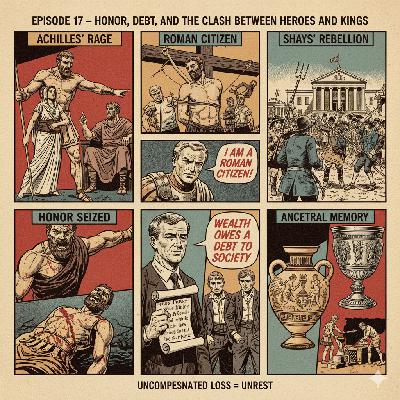
This episode traces the profound, enduring tension between individual honor and state authority by starting with the ancient Greek epic, the Iliad. The entire conflict is fueled by Achilles' rage (menis), triggered when King Agamemnon publicly insults him by seizing his prize (timē), which was the tangible proof of his battlefield value and contribution. This clash—where the individual hero's merit is invalidated by an overreaching authority—is a core theme that escalates into the brutal tragedy of Patroclus' death and Achilles' vengeful, destructive return to the war. The same dynamic is seen later in history: a perfect parallel occurs at the Siege of Constantinople, where the Ottomans' brutal execution of Italian prisoners incited the Greek defenders to a violent, collective act of retaliation, escalating the war. This focus on individual value and rights remains a flashpoint when abused by power, as shown in Roman history where the rights of a Roman citizen were stripped by a corrupt official. Despite pleading, "I am a Roman citizen," Publius Gavius was tortured and crucified, proving that legal protection was powerless against the will of a local tyrant. In the late 18th century, philosopher Thomas Paine applied a similar logic to the economy, arguing that personal property is not solely the result of individual effort, but is enabled by society. Paine concluded that the wealthy, whose accumulation is often built on paying too little for labor, owe a debt back to the collective that made their success possible. This tension between the wealthy and those who labor often boils over into conflict, as seen in Shays' Rebellion, where heavily indebted farmers felt cheated by the wealthy elite and resorted to force to right the perceived economic injustice. The ideas of heroism and merit are continually reshaped and remembered, as seen in ancient Greek art which linked the achievements of contemporary Athenian elites to the mythic, divine craftsmanship that forged Achilles' armor, and in objects like Vespasian's silver cup, which served as a vessel for ancestral memory and personal identity. This shows that the core of human conflict—from the Bronze Age to the modern era—is often the same: a deep-seated feeling of uncompensated loss or fundamental injustice.
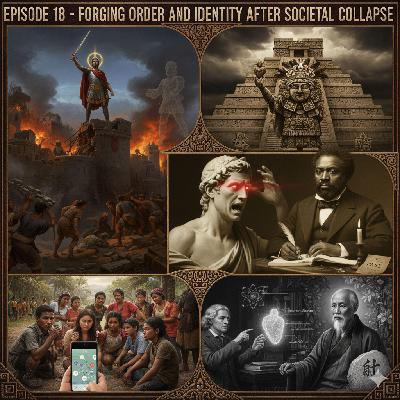
This episode explores the human need for social and political order and how societies and individuals re-establish identity after collapse. The dramatic fall of Constantinople in 1453 is presented as a symbolic end, where Emperor Constantine's refusal to flee—a choice of legend over strategic utility—forged a potent narrative of sovereignty. His final stand, alongside the "incessant nocturnal labor" of every citizen to reinforce the walls, shows that survival required both heroic rhetoric and grinding, collective effort. The Ottoman successor state immediately asserted its new legitimacy through aggressive centralization, ritual, and a symbolic claim as the "Sultan of Rome," quickly adopting the trappings of the very empire they destroyed to legitimize rule over a vast, multi-ethnic population. The episode contrasts this state-driven order with the individual and internal struggles for identity. The Aztec empire maintained political and cosmic order through ritualized, spectacular violence and human sacrifice, where access to the most potent religious acts was restricted to the nobility. Conversely, the Greek heroic path, epitomized by Achilles' rage, focused on the individual reclaiming lost honor through deeply personal, passionate violence. In a society structured by oppression, like slavery, figures like Frederick Douglass achieved self-sovereignty not through external help or a grand ritual, but through absolute self-reliance, with his quest for identity beginning with literacy and the dangerous path of writing his own "pass" to freedom. Philosophically, Descartes anchored both political stability and individual identity in the immortal, unique human soul, distinct from "brutes" and "complex machines," arguing this certainty was crucial to underpinning morality and social order. Later, Confucian thought offered an alternative, valuing self-policing and moral fidelity—the internal "sense of shame" (chi)—over external force. Finally, the episode examines modern attempts to restore order in chaotic places like Papua New Guinea, where communities have used strategic "civilizing offensives" involving community action and the clever use of cellphones for conflict resolution, underscoring that peace is often a manufactured invention.
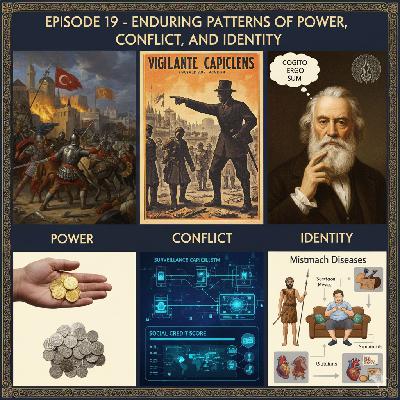
This episode explores the enduring patterns of power, conflict, and identity across history, moving from ancient empires to the modern digital age. The fall of Constantinople in 1453 is presented as a moment that, despite the complex reality of mixed nationalities defending the city, was deliberately framed by both sides as a religious clash—a simplistic narrative that cemented lasting interfaith attitudes. The centuries leading up to this point reveal a similar pattern, as the early rise of Islam under the Prophet Muhammad created a powerful, unifying, and disciplined force that expanded rapidly into the fractured Byzantine territories using brilliantly adaptive desert tactics. The lesson is that in times of conflict, messy realities are often simplified into stark, monolithic struggles to forge clear, us-versus-them identities. The discussion shifts to how power and control manifest through economic and information systems. The historical transition from the elite-focused gold coinage of the post-Roman era to the common silver penny of the Carolingian period reflects the rise of a broader, more decentralized economy requiring a more accessible medium of exchange. In the modern era, the state's drive for control has become increasingly technological, moving from old suppression tactics like government-sanctioned vigilante groups and media propaganda during World War I to the sophisticated control systems of surveillance capitalism. This new economic logic turns human behavior into a "free raw material" used to create prediction products, a process rapidly expanding through the Internet of Things and exemplified by China's social credit system. Finally, the episode touches on the foundations of knowledge and health, contrasting the search for certainty and the nature of life. René Descartes sought absolute certainty for individual identity through pure reason ("I think, therefore I am"), viewing physical sensation as often "confused" or "misleading". Charles Darwin provided a different foundation, explaining life through natural variation and selection, a framework which, when applied to modern health, helps define mismatch diseases. These are chronic, non-infectious conditions caused by the disparity between our Stone Age biology and the modern industrial environment, a problem that understanding our evolutionary heritage can help us resolve.
loading
Comments 
loading