


 Claim Ownership
The UX Sidekick Podcast
Subscribed: 8Played: 5
Subscribe

© Adonay Lizardo
Description
Design, technology & pragmatic spirituality, with a human (and sarcastic) touch.
uxsidekick.substack.com
uxsidekick.substack.com
3 Episodes
Reverse
Last week, I was mentoring a Senior UX/UI Designer on their job hunting. Their craft was dope. But there was no actual proof of their impact. “We don’t track metrics at my company 🥺”That is always the excuse.Junior designers don’t know how to do it. Seems like Senior Designers either. So let’s be honest… You’re telling me you have NO IDEA if your design worked?🚫 You shipped it and... then what? Just pray for the best?🚫 Your PM said “looks good” and that’s your entire success story?🚫 Looks nice, so it must be working, right? Move on to the next ticket.I know this is not only your fault. This meme is so painfully real:Business wants results. It also wants to do more of what has worked in the past. But it doesn’t want to be disrupted — it wants to disrupt. It wants to reduce Time To Market and minimize expenses; increase revenue and existing business, and find new markets. This requires fast delivery and good execution.And that’s what we are often supposed to be — good “executors”. Or to put it differently, “pixel pushers”.But I’m here to help you be more than that.So let’s cut to the chase. The difference between being hired and being rejected?I’ve hired over 100 people in my career.And helped many others to land a new job.I promise you It’s not about having a fancy B2B and B2C projects.Or worked with big companies like Apple, Stripe, or Airbnb.It’s about having your eyes open and caring about your impact. No metrics? Find signals:✅ Support tickets about that feature? Check if they dropped.✅ Customer complaints? Notice if they stopped.✅ Task completion? Time it yourself.✅ Team feedback? Document what changed.✅ User emails? Screenshot the shift from angry to happy.THAT’S your impact.And it’s way simpler to document and follow up than you may think. Don’t overcomplicate things.Impact isn’t in the tool or process; it’s in the change you create. Metrics aren’t about perfection; they’re about proof. Even small signals, documented clearly, separate the pros from the amateurs every time.Here’s what separates the pros from the amateurs:❌ Amateur: “We don’t measure success”💚 Pro: “Support tickets dropped 70% after my redesign”❌ Amateur: “Just launched, no data yet”💚 Pro: “Week 1: Zero bug reports. Previous version had 47.”❌ Amateur: “I delivered what PM asked for”💚 Pro: “I pushed back on the initial request. Saved 3 weeks of dev time.”Stop waiting for perfect analytics.Other people don’t care about impact. You should.Start noticing what actually changed.Because here’s the thing:If you don’t know what improved, how can you possibly know you’re any good?As designers, we rarely have a set of established Design KPIs that we report to senior management. We don’t have a clear definition of design success. And we rarely measure the impact of our work once it’s launched. So it’s not surprising that most parts of the business barely know what we actually do all day long.Your process? Nobody cares that much. It will be different for each company.Your Figma skills? Expected. What got better? EVERYONE cares.Impact is one of the signals that you care how your design drives business. So not knowing it just shows you don’t care about the product in the way employers look forMy last hire?Beat top product designers with “proper metrics.”How?They proved impact using messages from stakeholders and users.That's simple.Quick, dirty, and damn impactful.Go fix your portfolio.Show me what changed.Get hired.P.S. Next time someone tells you metrics don’t matter, ask them how they know they’re not wasting everyone’s time. Watch them scramble.Remember the perfect formula:Design + Proof = Career Growth This is a public episode. If you would like to discuss this with other subscribers or get access to bonus episodes, visit uxsidekick.substack.com
A UX designer once shared their perspective with me during a portfolio review: “My bootcamp emphasized how crucial displaying the process is.” This highlights an issue and opens the door to a discussion on how it can be rectified:🚨 The Issue:* Placing excessive focus on the process can result in a case study that mirrors countless others, potentially leading to hiring manager fatigue. Think about sifting through approximately 200 case studies, all following the same format, covering identical process steps. It becomes monotonous, and engagement drops.* While it’s beneficial to highlight elements like research, discovery, and user testing, the essential focus should be on how these efforts influenced the outcome and your subsequent learnings, not as a catalog of accomplishments.* At times, the process component is filled with unused resources, such as personas, which can be indicative of process theatre – a definite warning sign. It’s usually best to exclude these elements.🎉 The Solution:* Highlight the effects of your design work from the outset. Use before-and-after screenshots, changes in user behavior, and enhanced business metrics to attract the hiring manager’s attention.* Make your case study stand out by emphasizing unique content, including collaboration partners, learnings, and the mistakes you made.* Condense your research learnings and their impact on your designs. Rather than making the hiring manager wade through materials like personas, journey maps, and interview results, offer a summary of the insights gained and how they were applied. While it’s acceptable to include the entire process, ensure the key takeaways are readily accessible without unnecessary scrolling.Here is a structure that you may wanna try. 👩💼 Risk Management in Hiring:Hiring managers, while reviewing hundreds of portfolios, typically conduct a risk evaluation, striving to identify low-risk candidates and avoid high-risk ones. A candidate who convincingly demonstrates their ability to influence user behavior through design, thereby creating business value, is considered a low-risk—endeavor to weave this narrative.💥 In Conclusion:* Prioritize showing impact over process.* Emphasize what sets you and your project apart.* Demonstrate how your design work influenced user behavior and advanced business objectives through storytelling. This is a public episode. If you would like to discuss this with other subscribers or get access to bonus episodes, visit uxsidekick.substack.com
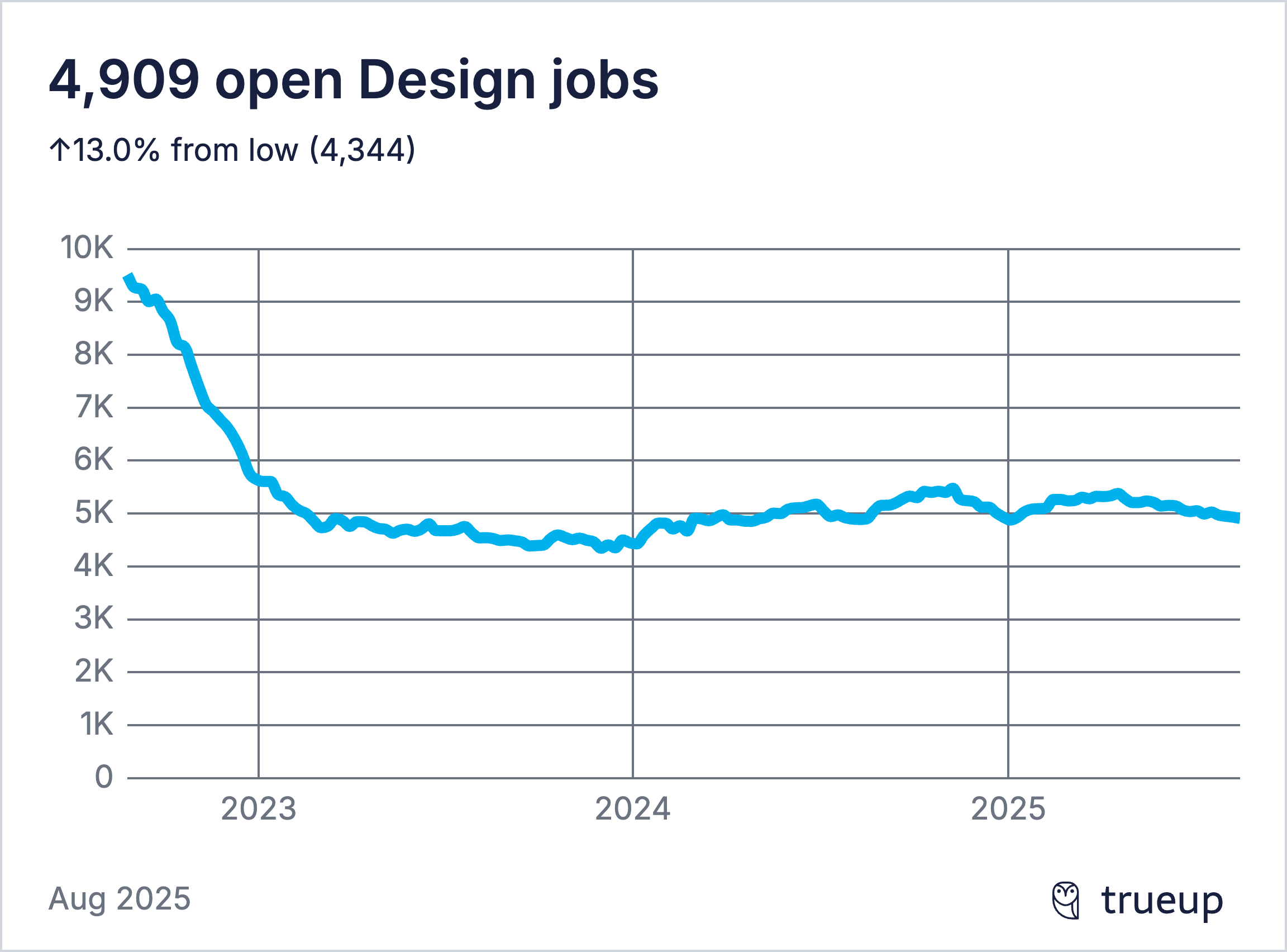
Hi, my beloved pixel-pushers,I’ve been mentoring Designers for many years. Job Hunting is one of the most frustrating experiences for most of those who approach me for help. If you’re job searching right now but not getting much traction and getting increasingly frustrated, here is a quick rundown of what you should do. I’m gonna make some jokes (so please bear with me). I’m gonna also give you some real data (I know you don’t need any more BS advice). We’ve all lived through the roller-coaster: the 2021 hiring frenzy, the 2023 ‘Great Re-think,’ and the subsequent anxiety. The reality of 2025? It’s far more nuanced. The data tells a story of stabilization, maturity, and a clear path forward for those ready to navigate the new landscape.As designers, our job is to look past the hype cycles. Here is your smart, fun, and data-driven snapshot of the design market in August 2025.1. The 5K Mark is the New NormalFirst, the good news. Open design roles are officially trending up, climbing 13% from the recent low to 4,909 active openings. We’ve stabilized, holding steady around the 5K mark after the 2023 hiring bottomed out.A key takeaway for all designers: The recent ascent of AI has not led to a decline in hiring demand. Despite the breathless narratives, your unique ability to define, empathize, and structure complex user needs is still irreplaceable. (Guess an LLM can’t tell a product manager they need more white space… yet).The market demands specialization: UX Design is the clear job-volume king, dominating the list with 3,621 roles.2. The Remote Reality Has SettledRemember the dream of a fully remote life? It’s time to set your expectations. Remote work has established a “new floor.”The Remote Index sits at 21.3% of all job postings, down from a high of nearly 30% at the end of 2022. The fully-remote job is now a scarcer commodity, especially in hardware and deeply collaborative product areas. You might be swapping your sweatpants for business casual again, but look on the bright side—at least you’ll remember where you put your work keys.3. Follow the Stability, Find the JobsWhere should you focus your job hunt?* Public Tech Dominates: Forget the glamour of the early-stage startup for a moment. Public tech companies are driving the bulk of the hiring, listing 2,314 roles—that’s nearly double the combined roles at Early-stage startups (378) and Unicorns (1,110). If you want volume and stability, you know where to look.* Location Still Matters: The Bay Area remains the global design capital, claiming 18.4% of all open roles. However, the general trend is hybrid positions around most big cities. 4. Advice for the Rising Star (And the Veteran)Finally, fantastic news for our mentees: Junior and Entry & mid-level hiring is finally recovering, accounting for 40.7% of all roles. The investment in our future designers is back!But if you’re a seasoned pro, the market is screaming for you: Senior roles still command the largest share at 42.6%. Your experience, leadership, and resilience over the last few years are now highly valued commodities.The Bottom Line:2025 is not the boom of 2021, nor the pain of 2023. It’s a return to smarter, more stable hiring. The opportunities are opening up, but they demand clarity.My SuggestionManage your emotional state to skew from neutral to positive. When bad things happen, realize you were meant to learn a valuable lesson. Find it.Stay focused. Resist and persist. Resist easy distractions. Persist when times are tough.Lastly, be willing to do the hard work that others aren’t.By shying away from challenging tasks, you are essentially shaping the person you aspire to become and the path your future will take.Change your mindset, and I can promise you this: Your future will be brighter. Now, what’s the hard thing to do?* Stop chasing the 100% remote unicorn job. * Focus your search on stable Public Tech companies* Highlight your ability to ship and lead, and know that your expertise in core UX Design is the most valued skill on the market today.The future of design is bright, grounded, and ready to get back to building great things. Now, let’s get to work.In case you need any support, polishing your hiring strategy, reach me out. I could be your Sidekick.Since 2015, I have helped more than 3,000 designers from the United States, Latin America, and Europe to advance their careers through education, support, and mentoring alongside companies such as DesignLab, CareerFoundry, and Crehana.Many of them are now working at top-tier companies and enjoying financial freedom. Others have started their own projects as freelancers or founders.Maybe you could be the next one to write something incredible. This is a public episode. If you would like to discuss this with other subscribers or get access to bonus episodes, visit uxsidekick.substack.com
Comments

Download from Google Play

Download from App Store
 United States