


 Claim Ownership
Very True by Verissimo
Subscribed: 0Played: 0
Subscribe

© 2026 Alex
Description
Brought to you by Verissimo Ventures, The Very True Podcast features candid startup insights and conversations with early-stage founders, operators, and investors shaping the future of tech. From behind-the-scenes startup stories to hard-earned lessons on fundraising, scaling, and staying resilient, each episode offers a window into what it really takes to build something bold.
44 Episodes
Reverse
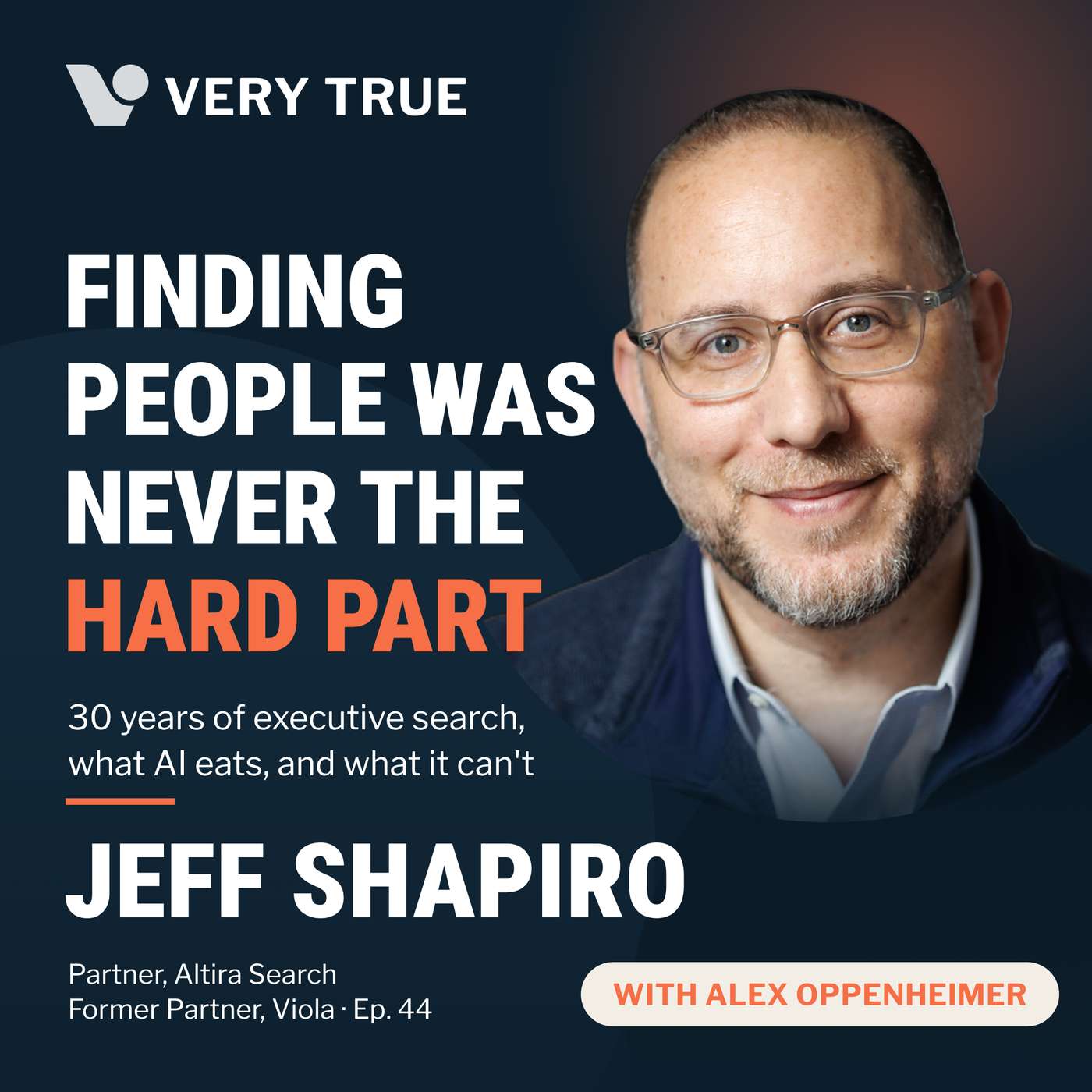
In this episode of Very True, Alex sits down with Jeff Shapiro, a thirty-year executive recruiter now at Altira Search, former Partner at Viola Group, and one of Alex's closest friends in Israel. Jeff came up through Egon Zehnder, Korn Ferry and Christian & Timbers, built Everest Search Partners in Israel over eleven years, sold it to Kingsley Gate in 2019, then spent three years on the other side of the table running human capital at Viola. They start with what an executive recruiter actually does and which parts of it AI has already eaten. Jeff's answer: finding people was never the secret. Getting them over the line is. From there: why the interview starts with the client, not the candidate. Why the CRO you're asking for might really be a VP of Sales. How Zuckerberg ended the era of adult supervision. Why culture is the only moat you control. Leaders versus managers, and why your best seller should not run sales. What three years inside a VC taught Jeff about founders, and the advice he gives them now: just decide. They close with a rapid-fire round: is the resume dead, when to hire your first VP of Sales, which function to go fractional on first, and whether founders should run their own searches.Episode Highlights[04:05] What AI can and can't do to executive search: the research and the lists were always automatable. "There's no secret to finding people. The secret is in influence, in getting them over the line."[07:04] The interview starts with the client, not the candidate. Why a company posting "we're looking for a CRO" on LinkedIn is betting that great executives are browsing job boards.[11:54] Zuckerberg ended the era of adult supervision. Investors now give founders as much rope as they can, maybe to a fault, and Israeli visionaries with "supernatural powers" on product wait too long to surround themselves with company builders.[13:43] "Founder is now a step on the career ladder." Alex on the golden age of liquidity, triple-triple-double-double-double, and why late-stage money at founding stage kills companies that should be surviving to iterate.[21:44] Culture is the whole value of the business. Tech moats are surmountable. What's left is speed, access to customers, and whether people will go above and beyond. Then the Vinod Khosla chief of staff post, and why "the 9-to-5 being enough went away with the gold standard."[27:32] The first search Jeff ever ran: a CEO for Vinod Khosla at Kleiner Perkins, a sat phone from India, and the email from Eric Schmidt saying thanks but it's not for me, six months before he joined Google.[32:26] Leaders vs. managers. Your best seller, a high percentage of the time, is not the best person to run the sales team. Leadership is an actual skill, and clients still ask for last year's quota numbers.[42:33] Three years inside Viola: the 2021 war for talent, the mandate to build an edge, how 2022, 2023 and October 7th changed the priorities, and the advice Jeff gives every founder now: just decide.[52:13] Rapid fire: never ask yes-or-no questions in an interview, two years is the new minimum tenure, hire your first VP of Sales at $7 to $10 million, go fractional on marketing first, and exhaust your network before you call a search firm.Links & ResourcesAltira Search: https://www.altirasearch.com/ Jeff Shapiro on LinkedIn: https://www.linkedin.com/in/jeshapiro/ Verissimo Ventures: https://verissimo.vc/ Alex Oppenheimer on LinkedIn: https://www.linkedin.com/in/alex-oppenheimer/ Alex's Substack (leaders vs. managers): https://alexoppenheimer.substack.com/Mentioned in this episode: Very True Ep. 35, Everyone's Wrong About AI Moats, with Michael Stoppelman: https://share.transistor.fm/s/203f5be6 Very True Ep. 38, Why the Multi-Sport Kid Wins, with Nick Greenfield: https://share.transistor.fm/s/4e6b9e99About Very TrueHosted by Alex Oppenheimer, Very True by Verissimo Ventures explores the honest, unvarnished stories of founders and the real problems they are solving. We look past the hype to find the truth in technology and entrepreneurship.
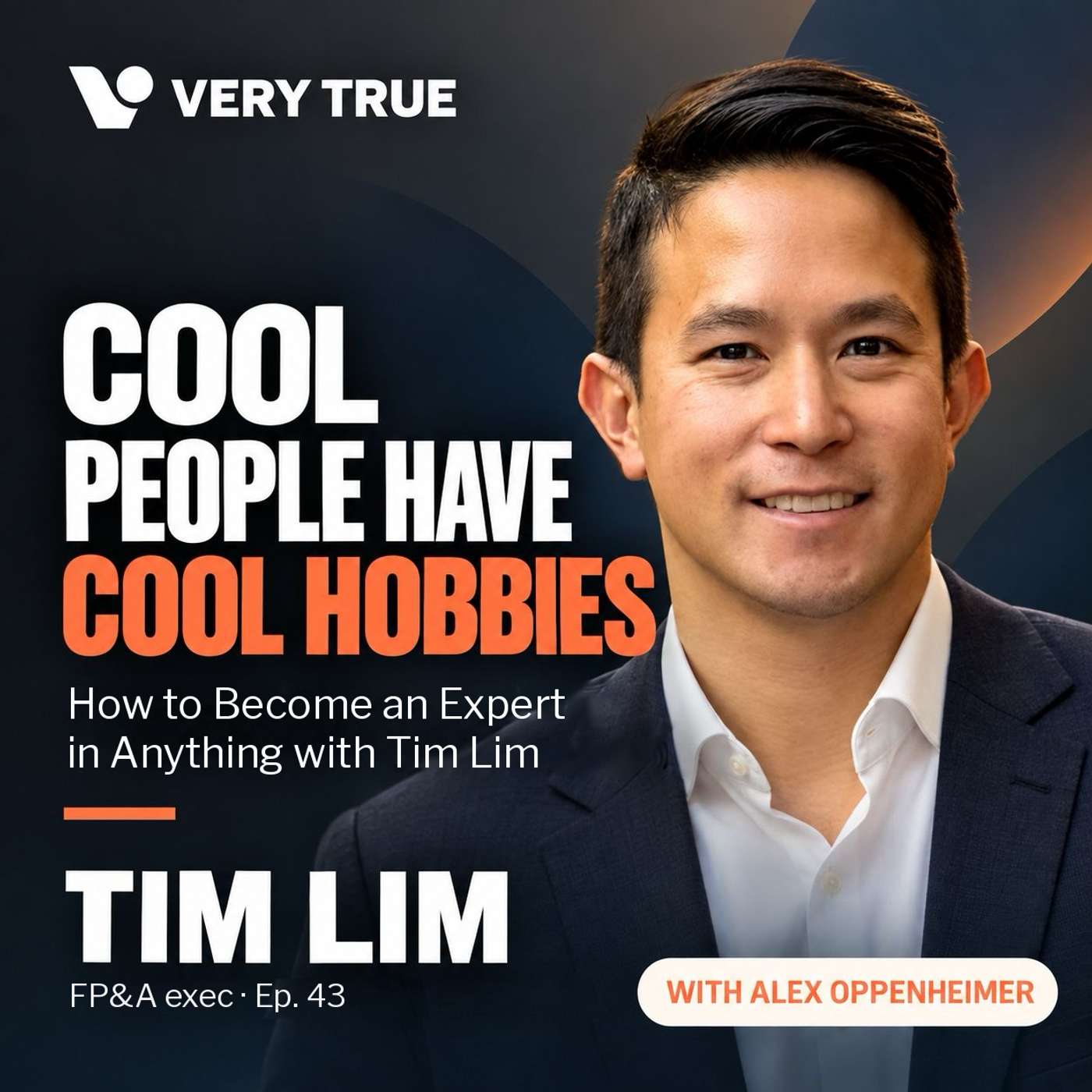
In this episode of Very True, Alex sits down with his college friend Tim Lim, FP&A exec, whiskey connoisseur and Executive Director at Edgewood Companies, for a conversation that has nothing to do with FP&A. Tim and Alex both built careers in finance, and both go unreasonably deep on the things they do outside of work: bourbon, watches, wine, bikes, snowboards. This one is about what happens when you take that seriously.They start with a question Alex gets asked constantly: what should I do with my career now that the well-trodden paths are gone and every college senior wants to be an influencer? Then they use whiskey as the worked example for how anyone becomes an expert in anything. Figure out what "good" means. Figure out what you actually like. Cut the world down to a slice you can learn. Find the people who are already ten years ahead of you. Along the way: the pitfalls (buying at the top of a hype cycle, not slicing thin enough, chasing rarity instead of taste), why a $500 microbrand watch is consumption but a steel Rolex is an asset, how the bourbon crash made the hobby fun again, and the John Mayer test for what a real maven looks like. They close on the harder question: should you turn your passion into your job, or does that ruin it? Tim, who moved into food and beverage for exactly this reason, has a more honest answer than most.Episode Highlights[06:22] Hope for America, via bourbon: Alex on why whiskey Facebook groups, with members from Kentucky to Hawaii, are the least polarized places on the internet.[14:20] What "good" actually means: Tim on the bar for straight bourbon, the cult bottles, and the 1980s Wild Turkey Japanese export that retailed for $50 and now trades near $2,000.[21:58] Cut the world: why the fastest way to build taste is to narrow the field. Weeded vs. high rye, two years of only Cabernet, and using AI to map the dimensions of a new hobby before you spend a dollar.[27:24] The pitfalls: not slicing thin enough, entering a hobby at the top of its market, and why the middle of the whiskey market fell out, not just the bottom.[44:32] Knowledge over stuff: Tim's rule for restraint. Learn on the way up, buy the one thing at the pinnacle of what you value, and let the secondary market tell you what's real.[1:02:32] Hobby or job? Whether turning a passion into a business ruins it, why Tim moved into food and beverage, and the safer path of working at a company built around the thing you love.Full Chapter List[00:53] Welcome: career advice when the well-trodden paths are gone[05:06] Tim's intro: engineering, FP&A at Netflix and Twitter, and the hobbies that stuck[06:22] Bourbon Facebook groups and hope for America[07:47] It runs in the family: growing up with collector parents[11:28] Two different questions: what is good, and what do I like?[12:30] Reddit reviews, Hard Water, and the friends who became a pandemic pod[14:20] What "good" means in bourbon: the $50 Wild Turkey that now sells for $2,000[18:27] Where a beginner should start: low proof, primary notes, learn from people[21:58] Cut the world: weeded vs. high rye, two years of only Cabernet, three kinds of bikes[27:24] Alex's mistakes: not slicing thin enough, and entering a hobby at the top[31:45] Why the whiskey crash made the hobby better[33:41] Buy low, sell high: the John Mayer Daytona test[35:17] Should your hobby become your job? Plus safe bets vs. weird bets in watches[42:13] Disposable income vs. assets: the $500 microbrand and the retail Rolex[44:32] Knowledge acquisition over physical acquisition[46:32] Limited releases, bots, and the six-month rule[51:30] "Cool people have cool hobbies": the Dumoreau story[54:07] Intentionality: the makers worth obsessing over[57:36] Being the wine guy, and buying watches for other people's weddings[1:02:32] Should you turn your passion into a business?[1:06:43] The safer bet: work somewhere built around the thing you loveLinks & ResourcesEdgewood Companies: https://edgewoodcompanies.com/Verissimo Ventures: https://verissimo.vc/Tim Lim on LinkedIn: https://www.linkedin.com/in/timlims/Alex Oppenheimer on LinkedIn: https://www.linkedin.com/in/alex-oppenheimer/About Very TrueHosted by Alex Oppenheimer, Very True by Verissimo Ventures explores the honest, unvarnished stories of founders and the real problems they are solving. We look past the hype to find the truth in technology and entrepreneurship.
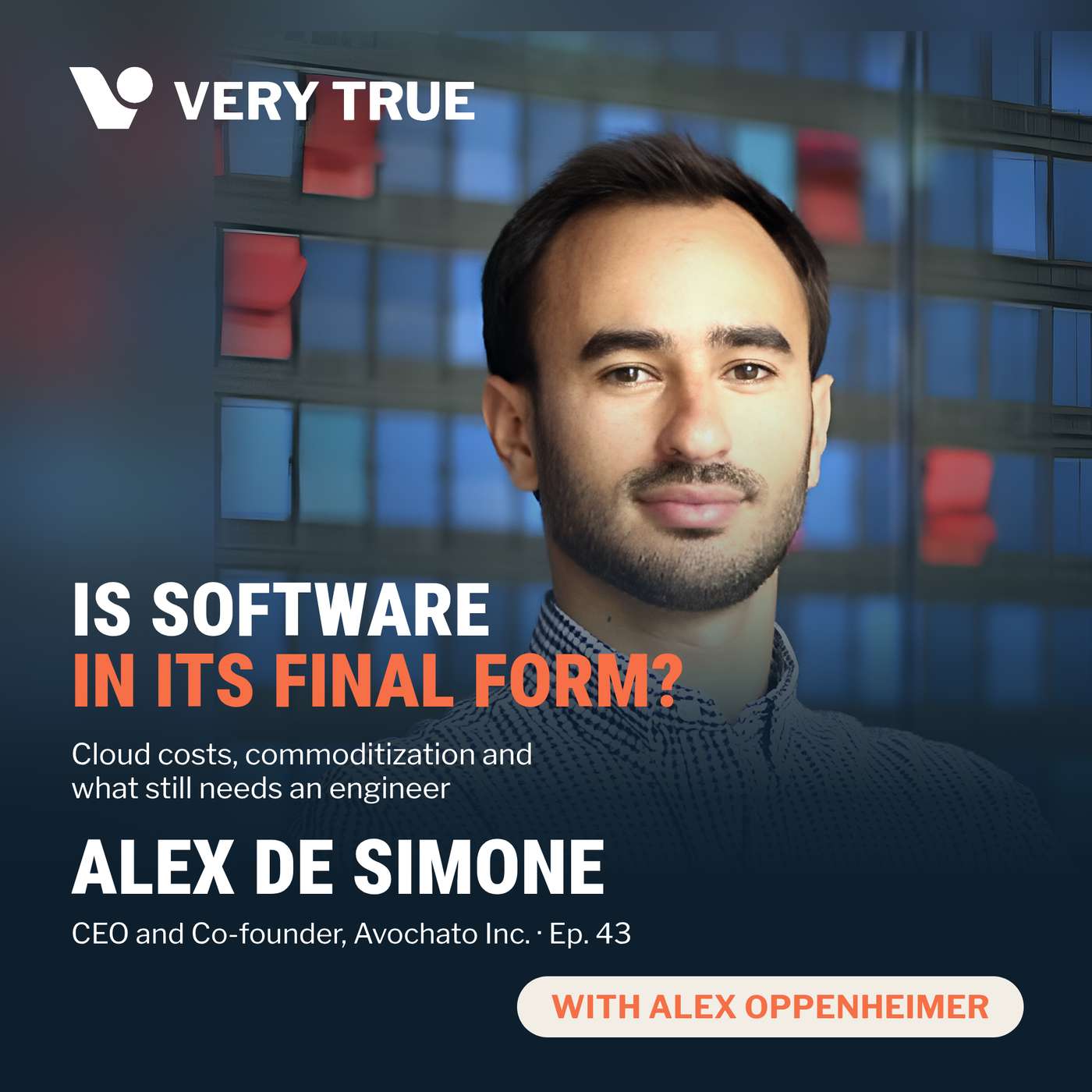
Alex sits down with Alex De Simone, a friend since their Stanford days and a fellow mechanical engineer, for a conversation that starts with a VCR turned into a Hot Wheels garage and ends with a server rack in Santa Clara. Alex De Simone is the CEO and co-founder of Avochato, a business messaging platform coming up on ten years, and Alex is an investor. They walk through the company's origin as "Caller Zen," born from waiting on hold with Comcast in a business school dorm, and how texting became the channel that gets people to actually respond.The core of the episode is Avochato's decision to pull its OpenSearch workload off AWS and onto its own hardware after the cloud bill tripled as a share of costs. A team of two toured data centers, spec'd a 42U rack with help from AI, and ended up with half the bill, far more compute headroom, and sub 80 millisecond latency. From there the two Alexes go wide: whether software is approaching its final form, why the things that get abstracted away are exactly where the security vulnerabilities live, why learning to code never mattered as much as learning to think like an engineer, and what they'd tell a 25 year old asking for a guaranteed career path. Expect E30 manuals, Rolexes, resto mods, and Tiger Woods versus Roger Federer along the way. Guest: Alex De Simone, CEO and Co-founder of Avochato.Episode HighlightsFrom CallerZen to Avochato: The original idea was simple: when someone doesn't pick up, send a text. The first customer was a pet gift box company sending delivery updates in 2015, back when most notifications were email if anything.The Yelp Cloud Line: Alex recalls how mutual friend Mike Stoppelman kept Yelp right at the edge of where it made sense to be fully cloud, and how that line kept moving as the years went on.Software's Final Form: Alex's thesis that a lot of technology's goal is to disappear into ubiquity, like the plastic cup, the modem-router combo, or spices that were once the most valuable commodity on earth.Why the Abstracted Layer Bites Back: Every major security vulnerability lives deep in something someone stopped thinking about. The E30 manual teaches you to fix the whole car; the 2025 manual says don't drink the oil.Leaving AWS for a Rack in Santa Clara: When OpenSearch jumped from 20% to 60% of the cloud bill, Avochato went back to first principles. The result: half the cost, eight to sixteen times the compute potential, and full visibility into their own logs. Alex De Simone's analogy is buying a nice car and renting the valet garage instead of leasing.Learning to Code Never Mattered: Alex argues that what accrued real value was learning to think like an engineer, and that coder, computer scientist, software engineer, and architect are four different jobs that got lumped together.The DIY Spectrum: Alex De Simone on why it's fine to pick where you want to play, whether that's patching bike tubes, doing your own brake pads, or assembling a watch movement from a kit, and why the only wrong answer is ignoring a lesson from history because it left your field of vision.Advice for the Mid-20s: No more guaranteed paths. Optimize for what you're passionate about, what you're good at, and what the world needs, and if you can't get an internship, go solve someone's problem and get paid for it.Full Chapter List(00:53) Introduction: Stanford, San Francisco, and a shared network(01:38) Alex De Simone's origins: taking apart the VCR, mechanical engineering, and fluid mechanics(03:01) Why solved problems get taken for granted: banking coverage of semis vs. internet companies(05:00) The birth of Caller Zen and waiting on hold with Comcast(08:59) First customer Pet Box, Twilio, and Uber's build vs. buy(10:31) Same problem, new challenges: where AI bots fall short(12:37) Mike Stoppelman, Yelp, and the ever-moving cloud line(14:15) Is software approaching its final form? Plastic cups and Wi-Fi routers(17:45) The 1987 E30 manual vs. "do not drink the oil"(19:15) Why security vulnerabilities live in the abstracted layers(20:46) Cloud bill as a percentage of revenue, and the OpenSearch problem(24:30) DHH, the pink chained elephant, and touring data centers(26:45) The rack at Equinix: half the bill, sub 80ms latency, and the valet garage analogy(29:33) Patching bike tubes, teenagers who don't want to drive, and the car ownership spectrum(31:20) Software as a layer of the economy, and why it only matters when it hits the physical world(34:00) Learning to code never mattered; thinking like an engineer did(37:22) Obsolete vs. commoditized: fax machines, Micron, and Ambarella(40:00) Nick Greenfield's rule: go in naive if you want to build something big(42:23) Software's final form, explained: Riverside, spices, and Deel(45:42) Robotics and bridging the software-hardware gap(46:51) 2006 BMW 7 Series vs. 2026 Corolla, and the resto mod world(49:17) Handmade vs. machine-made: the Rolex tangent(50:19) The DIY spectrum: E30 brake pads and DIY Watch Club(52:56) You don't know what you'll learn: banking, Jane Austen, and being forced out of your comfort zone(57:14) Don't just AI your way to code: read it, review it, be around people who speak it(1:00:36) Range, rich kids in pro sports, and NBA injury theories(1:04:42) Advice for the mid-20s: no guaranteed paths, lean into who you are(1:07:54) Pleasure vs. enjoyment, and turning an internship into a founder's eyeLinks & ResourcesAvochato: https://www.avochato.com/Alex De Simone on LinkedIn: https://www.linkedin.com/in/ajdesimone/Verissimo Ventures: https://verissimo.vc/Alex Oppenheimer on LinkedIn: https://www.linkedin.com/in/alexoppenheimer/Range by David EpsteinSlow Productivity by Cal NewportAbout Very TrueHosted by Alex Oppenheimer, Very True by Verissimo Ventures explores the honest, unvarnished stories of founders and the real problems they are solving. We look past the hype to find the truth in technology and entrepreneurship.
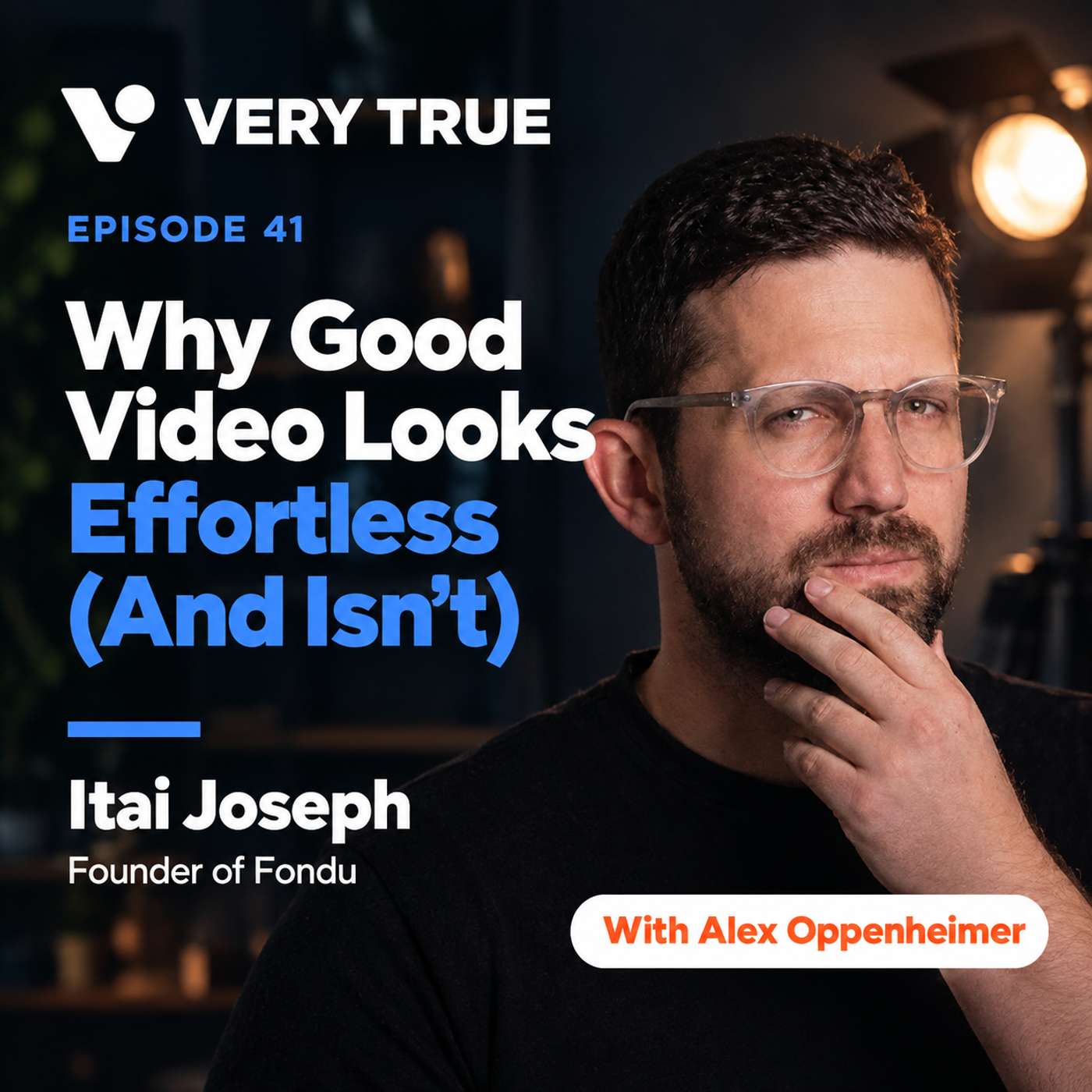
In this conversation, Alex reconnects with his friend Itai Joseph, filmmaker and founder of Fondu, to explore what actually goes into making video content that feels effortless, and what it takes to build a creative business without a boss. Itai shares his journey from making home movies as a kid in Zanesville, Ohio, through film school at Northwestern, to building Fondu, a remote-first creative video agency, out of the shift to digital storytelling during the pandemic.Alex and Itai dive deep into the full anatomy of video production, from concept and audience to the shoot and the edit, and how generative AI is starting to remove the "no do-overs" constraint that's always made video riskier than other forms of content. They also get into the mechanics of running your own business: what to delegate, what to keep for yourself, and how to stay connected to the work that actually energizes you instead of just the work that keeps the business running.Episode HighlightsEffortless Is the Hardest Thing to Make: Itai and Alex compare good video production to watching Roger Federer play tennis, the more natural it looks, the more work went into it.No More Reshoots: Itai walks through how AI is changing iteration in video, letting his team regenerate a style frame instead of re-shooting an entire scene.Naive vs. Expert: Alex and Itai debate whether building a big business requires knowing nothing about your market, while building a small, sustainable one requires knowing it intimately.Delegate the Craft, Keep the Vision: Itai explains why he's pulled back from hands-on production to focus on strategy, AI transformation, and business development, and how founders scale by defining their role from the inside out.Front-Load Your Relationships: Alex and Itai agree that the relationships built earliest in a career compound the most, and are often what create opportunities decades later.Full Chapter List(01:59) Welcome and Introduction(02:41) Itai's Origins: Zanesville, Ohio to Northwestern Film School(05:21) How Fondu Was Born During the Pandemic(09:19) Building a Remote, Distributed Creative Team(13:16) The Full Production Process: Concept to Final Cut(20:27) How AI Is Changing Iteration in Video Production(22:47) Naive vs. Expert: Building a Big Business vs. a Small One(24:16) How to Start Creating Content on a Shoestring Budget(37:22) Running a Business With No Boss(43:11) Venture's Slow Payoff vs. Chasing Fast Outcomes(45:31) Career Advice, Prioritization, and Front-Loading Relationships(49:15) What Fondu Does and How to Work With ThemLinks & ResourcesFondu: https://fondu.co/Verissimo Ventures: https://verissimo.vc/Alex Oppenheimer on LinkedIn: https://www.linkedin.com/in/alex-oppenheimer/Itai Joseph on Linkedin: https://www.linkedin.com/in/itaijoseph/About Very True: Hosted by Alex Oppenheimer, Very True by Verissimo Ventures explores the honest, unvarnished stories of founders and the real problems they are solving. We look past the hype to find the truth in technology and entrepreneurship.
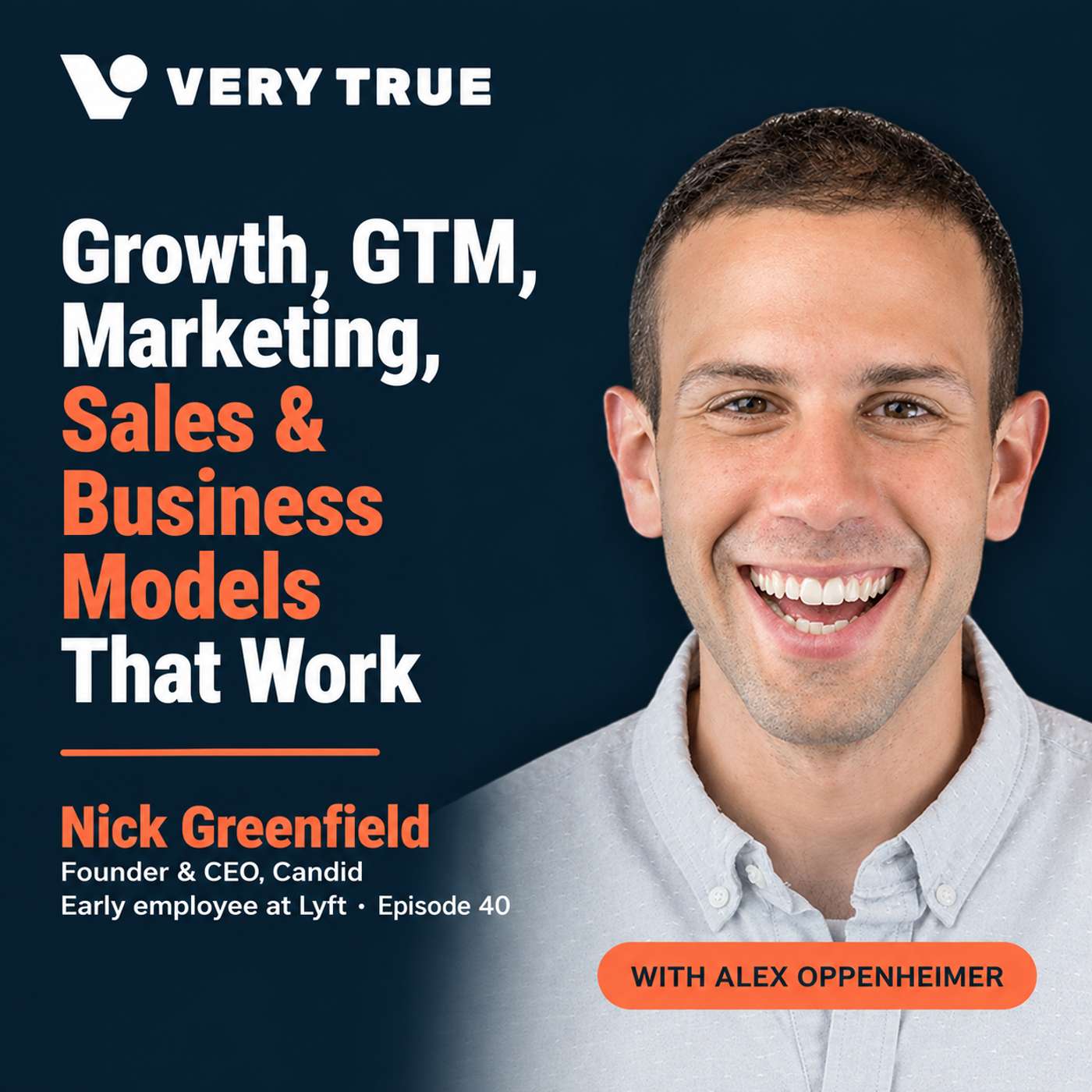
Alex and Nick Greenfield close out their three-part conversation with the episode that's most useful to anyone running or funding a company. Nick walks through the years after Lyft: a stint at on-demand laundry startup Washio, living in the Snapchat house in LA, moving to New York to join Paribus (later sold to Capital One, and whose founders went on to start Ramp), and then co-founding Candid in 2017 as a direct-to-consumer clear aligner company. Candid went from zero to a $100 million run rate in four years with 700 employees and 40 retail locations, and it was still a flawed business. Nick explains exactly why.The heart of the episode is the math. Nick and Alex break down why direct-to-consumer arbitrage collapses as you scale, why the nth customer costs so much more than the twenty-first, and how Candid's pivot to selling through dentists turned a negative $300 per customer into a positive $700 with a 4 to 6x LTV to CAC ratio. Along the way they cover the history of performance marketing, Craigslist as the arbitrage that built Lyft, Uber, and Airbnb, why direct mail is the one channel where the arb never closes, and what "growth" and "GTM" actually mean now. Nick ends with the three business models he most admires, Toast, Shopify, and Ramp, and Alex owns up to passing on the Ramp seed round.Guest: Nick Greenfield, Founder and CEO of Candid. Part three of three.Episode HighlightsFrom Washio to Paribus to Candid: Nick's path through an LA laundry startup, a New York price-tracking company acquired by Capital One, and the founding of Candid, which claims the title of Ramp's first customer.Naivete Is Mission Critical: Nick's rule that if you want to build a small company you need to know the segment, but if you want to build a big one it's better to know nothing, because knowing the limitations keeps you from finding the massive market.Why Candid's DTC Model Was Flawed: Zero to $100 million in four years, and two problems that growth couldn't cure: a one-time purchase with no recurring component, and a medical procedure that needs in-person care.Recurring vs. Reoccurring: Alex's distinction between contractual and habitual repeat revenue, why companies delude themselves on LTV, and why Casper's one-transaction model was at least honest.The CAC Curve and the Nth Customer: Alex draws the curve, Nick does the math. When your Google click goes from $3.21 to $6.42 and seven competitors show up, the incremental profit flows straight to Google, Meta, and Amazon.Growth Is Arbitrage: Nick on the Udemy whiteboard session that taught him the model, $10 customer acquisition on Facebook in 2011, Craigslist as the arb behind Lyft and Airbnb, and why AEO and LLM optimization are today's version of the same trade.Direct Mail Never Dies: The one channel where the price is set by the post office rather than an auction, and why Capital One has spent billions on it.What GTM People Actually Do Now: Nick's honest split: the AEs are still selling human to human, and the growth and marketing people are mostly banging their heads against AI tools, with a handful finding 100x breakthroughs.Candid Today, With the Math: DTC was $2,000 revenue, $800 COGS, $1,500 CAC, negative $300 per customer. B2B is $1,500 to the dentist who charges the patient $5,000, $700 margin per case, CAC falling every year, and a 50x runway before hitting the top of the US market.Consumer Surplus: Toast, Shopify, Ramp: Why the best business models are the ones where you only win when your customer wins, why a $25 Shopify store is unbeatable, and why Ramp beat Brex on product and go-to-market despite being second.Alex Missed the Ramp Seed: "The dumber it sounds and the more impressive the founder is, that's the most interesting stuff." The lesson Alex still carries as an investor.Full Chapter List(00:00) Washio, the Snapchat house, and moving to New York for TAM reasons(01:05) Paribus, Capital One, and being Ramp's first customer(01:45) The origin of Candid: local, regulated, consumer, complex(02:41) Naivete as a founder's advantage(03:28) Zero to $100M in four years, and the two flaws in the DTC model(05:58) Recurring vs. reoccurring revenue, and the Casper Series A(07:25) Why the nth customer breaks the model(07:53) Alex's CAC curve and the sellable addressable market(08:52) Doing the math: Google clicks, seven competitors, and profits accruing to the platforms(11:47) Growth hides all, then cures all: the accumulation function(12:16) The Lyft marketing budget on Nick's personal credit card(12:19) How performance marketing enabled the consumer startup wave(14:24) The Udemy whiteboard, $10 Facebook customers, and the birth of "growth"(16:08) Growth is arbitrage: Craigslist, AEO, and being only as good as your next trade(18:00) Direct mail, the one arbitrage that never closes(18:49) What do GTM people actually do all day?(20:39) Candid today: the fastest growing clear aligner company for general dentists(22:06) B2B2C: why the end-customer CAC drops to near zero(22:39) The full unit economics, DTC vs. dentist channel(24:18) 4 to 6x LTV to CAC, and 50x room to grow in the US(26:31) The trust leverage of a patient's existing dentist(27:11) Consumer surplus: Toast, Shopify, and Ramp(28:13) Alex on passing on the Ramp seed(31:59) Why Ramp beat Brex: better product, better GTM, lower cost of capital(34:08) Shopify at $25 a month, and Alex's "Design the Wave" pricing piece(34:58) Wrap upLinks & ResourcesCandid: https://www.candidpro.com/Nick Greenfield on LinkedIn: https://www.linkedin.com/in/nick-greenfield-10189923/Alex's Substack piece on pricing models, "Design the Wave, Don't Just Ride It": https://alexoppenheimer.substack.com/Verissimo Ventures: https://verissimo.vc/Alex Oppenheimer on LinkedIn: https://www.linkedin.com/in/alex-oppenheimer/Earlier in the series: Part one is on the early part of a career and the case for range. Part two is the Lyft story, told from the inside.About Very TrueHosted by Alex Oppenheimer, Very True by Verissimo Ventures explores the honest, unvarnished stories of founders and the real problems they are solving. We look past the hype to find the truth in technology and entrepreneurship.

Comments

Download from Google Play

Download from App Store
 United States