


 Claim Ownership
GovCon Intelligence
Subscribed: 0Played: 0
Subscribe

© Sam Le Law PLLC
Description
Small-business government contracting updates and analysis from legal, regulatory, and data perspectives. I spent 20 years writing contract regulations for the government. Now I help small business owners understand the fine print.
www.govconintelligence.com
www.govconintelligence.com
18 Episodes
Reverse
On a GovCon Intelligence live stream, I covered the current state of the 8(a) Business Development Program and the latest suspension numbers, significant OHA and Federal Court decisions, and SBA administrative changes. I also addressed the impact of the Washington District Office’s move to Herndon and previewed the OIG’s 2026 audit priorities.00:00:00 Introduction & 8(a) Suspensions Update00:03:57 SBA Terminations and the Data Call00:05:46 Office of Hearings and Appeals (OHA) Update00:08:46 Understanding Economic Disadvantage: The ACC International Case00:13:30 SBIR Phase III Bridge Contracts and the ThreatTec Case00:16:34 Mentor-Protégé Past Performance and the iAdeptive Technologies Case00:19:25 Corporate Transactions and SDVOSB Status: The Crosstown Courier Service Case00:22:45 SBA Office Relocation00:23:32 Impact of the SBA Washington District Office Relocation00:26:02 Challenges in 8(a) Program Servicing and Application Approvals00:27:10 The Mid-America Milling Decision and DBE Program Presumptions00:31:13 New Legal Challenges to Private Sector Diversity Programs00:32:12 Updates on the Ultima Services Case and SBA Regulations00:33:22 Status of SBIR/STTR Program Reauthorization00:34:27 The SBA OIG 2026 Oversight Plan: Audit Priorities00:36:43 SBA COVID Relief Loans and EIDL Collections00:38:06 Upcoming SBA Regulatory Reforms: Fraud, Waste, and Abuse00:40:23 Summary and ClosingLinksSBA’s 8(a) suspensions (Jan 22 - Mar 26, 2026)Recent OHA decisionsMatter of ACC International Inc (OHA)ThreatTec v. United States (Ct. of Fed. Cl.)Stephen Bacon on the GAO’s decision in iAdeptive (LinkedIn)iAdeptive Technologies (GAO)VSBC Protest of Crosstown Courier Services (OHA)News release: SBA Relocates Washington Metro Area District Office to Herndon, VirginiaMid-America Milling Co. LLC v. US DOT (E.D. Ky.)News release: American Alliance for Equal Rights Files Federal Lawsuit Challenging Race-Based Minority Supplier Certification ProgramUltima Services Docket (courtlistener)S. 3971, SBIR ReauthorizationSBA OIG Audit Division 2026 Oversight PlanSBA OIG Evaluation of SBA’s All Small Mentor-Protege ProgramNew York Times: The Small Business Administration lent $378 billion to keep businesses afloat. Getting paid back is proving difficult.Pending EO 12866 Regulatory Review on Fraud, Waste, and Abuse ReformsEO 12866 Meeting on Fraud, Waste, and Abuse ReformsWith 20 years of Federal legal experience, Sam Le counsels small businesses through government contracting matters, including bid protests, contract compliance, small business certifications, and procurement disputes. Sam obtained his law degree from the University of Virginia and formerly served as SBA’s director of procurement policy. His website is www.samlelaw.com.This video is for informational purposes only and does not constitute legal advice. This is a public episode. If you would like to discuss this with other subscribers or get access to bonus episodes, visit www.govconintelligence.com

Today on GovCon Intelligence, I’m joined by Jayna Rust, a partner at Thompson Coburn and an adjunct professor at The George Washington University Law School. We break down the long-term impact of the 2023 Supreme Court affirmative action ruling on government contracting, including a look at whether there is a flood of DEI-driven discrimination claims. Because she also works on wills and trusts, we rounded out the conversation by covering what GovCon owners need to think about when preparing their estate plans.LinksJayna Rust bio at Thompson CoburnStudents for Fair Admissions decisionUltima Services v. USDAThe Democratic Brand Is Toxic in Too Many States by Matthew Yglesias (The New York Times)Should Moving to the Middle Win Candidates Votes? It Depends Where Voters Are by David Broockman and Joshua KallaVSBC Appeal of American Defense Builders Trust, SBA No. VSBC-395-A (2024)VSBC Appeal of Vialytix, LLC, SBA No. VSBC-462-A (2026)An auto-generated summary follows. In the coming days, this will be replaced at www.govconintelligence.com with a full transcript.On GovCon Intelligence, host Sam interviews Jayna Rust, a Thompson Coburn partner and GW Law adjunct, about how the Supreme Court’s 2023 Students for Fair Admissions decision has reverberated through government contracting, grants, and employment practices. Rust describes tracking the case because earlier affirmative-action precedents drew heavily on government contracting law, and she notes how the Ultima Services decision quickly applied the ruling to SBA’s 8(a) program by rejecting a race-based presumption.She says contractors and grant recipients began reassessing preferential programs for litigation risk, and that a later executive order revoking Executive Order 11246 accelerated reviews and scrutiny, including reported agency questions and Justice Department investigations. The conversation turns to rapid, broad reviews of small-business set-asides, the future of 8(a), the need for clearer public messaging, and how SBA trust-ownership rules complicate veteran-owned certifications. Rust also contrasts claims work with bid protests as more fact-intensive and document-driven.00:00 Welcome and Guest Intro00:29 Supreme Court Case Recap04:02 Early Ripple Effects05:59 Anti DEI Enforcement07:58 Grants and Contracts Impact10:45 8(a) Program Fallout13:10 Set Asides Under Fire14:24 Future of 8(a)15:32 Messaging and Public Support17:31 White Men Presumption Question19:07 College Admissions Outcomes21:26 Switch to Estate Planning24:13 Contractor Succession Pitfalls26:03 Trust Ownership Rules27:51 Teaching Claims at GW30:28 How to Connect and Wrap UpWith 20 years of Federal legal experience, Sam Le counsels small businesses through government contracting matters, including bid protests, contract compliance, small business certifications, and procurement disputes. Sam obtained his law degree from the University of Virginia and formerly served as SBA’s director of procurement policy. His website is www.samlelaw.com.This video is for informational purposes only and does not constitute legal advice. This is a public episode. If you would like to discuss this with other subscribers or get access to bonus episodes, visit www.govconintelligence.com

Damien Specht, a partner at the Morrison Foerster law firm, joined me yesterday on GovCon Intelligence, just a few days after the Senate passed a bill to reauthorize the SBIR program. We got into the details of the reauthorization bill. Then we talked about his specialty—mergers and acquisitions of government contractors. After working on hundreds of M&A deals, Damien shared his tips for companies in dealing with the recent small-business M&A cliff, plus what small businesses need to take care of before selling.And, with SBA’s most recent announcement on an additional 620 proposed terminations, we discussed the 8(a) audits. How do SBA’s actions affect firms on OASIS+ and the GSA Schedule?An auto-generated summary follows. A full transcript is posted at https://www.govconintelligence.com/p/...Sam Le interviews Damien Specht, a Morrison & Foerster partner, about Senate-passed SBIR reauthorization after the program’s first lapse, including debates over capping repeat Phase I/II winners, adding larger awards, and emphasizing commercialization while keeping SBIR focused on early-stage R&D. Damien discusses how small business legislation moves slowly on Capitol Hill compared with regulatory change, and how private equity, minority investment, and strategic M&A shape the govcon market.He analyzes SBA’s January 16 recertification “cliff,” uncertainties for IDIQ reserves, GSA Schedule and novation, and suggests mentor-protégé JVs and minority investments as post-cliff strategies. The conversation also covers SBA’s 8(a) suspension waves and limitation-on-subcontracting enforcement, alleging AI-driven screening with errors and due-process concerns, conflicts between SBA rules and the FAR overhaul, and common diligence pitfalls like affiliation, delayed SAM updates, ownership structure noncompliance, and JV mistakes.00:00 Show Welcome00:41 SBIR Reauthorization Update01:51 Caps Awards Commercialization04:06 Program Purpose And Outreach06:18 Hill Experience And Partisanship09:23 Investment And Affiliation Rules11:42 Recertification Cliff Explained19:32 Market Outlook And Deal Types21:51 Post Cliff Strategies24:28 Minority Investment Rule Changes25:09 Venture Capital Affiliation Trap27:10 8a Suspensions and AI Audits31:14 Subcontracting Limits Enforcement32:56 FAR Overhaul vs SBA Rules35:51 Building People GAO Case38:27 Wish List for New SBA Rules39:32 HUBZone 35 Percent Challenge41:06 M&A Valuation Near Size Limit43:11 Due Diligence Compliance Pitfalls46:40 Joint Venture Rules and Wrap Up This is a public episode. If you would like to discuss this with other subscribers or get access to bonus episodes, visit www.govconintelligence.com

Jessica Tillipman is the dean of GW Law’s procurement law program and the leading expert on the use of AI in government contracting. I caught up with her about the Supreme Court’s tariffs decision, the potential for AI-enabled corruption, and the future of lawyering. Along the way, we discussed SBA’s recent wave of suspensions and proposed terminations of 8(a) firms.An auto-generated summary of the conversation follows.In this episode of GovCon Intelligence, Jessica Tillipman, the associate dean for government procurement law studies at the George Washington University Law School, discusses how rapid federal adoption of artificial intelligence is reshaping oversight, competition and integrity in government contracting. The conversation opens with breaking news about a Supreme Court decision striking down tariffs as a tax and turns to Tillipman’s forthcoming article, Buying Blind: Corruption Risk and the Erosion of Oversight in Federal AI Procurement, which argues that “risky buying equals risky deployment” when agencies pursue A.I. without sufficient training, infrastructure and governance. Sam links those concerns to the Small Business Administration’s February 11 wave of more than 150—closer to 230—letters suspending or proposing termination of 8(a) companies, describing basic errors and legal deficiencies that suggest automated screening without adequate human verification or due process.Tillipman explains her “wedding cake” model of the A.I. tech stack—chips, data and cloud infrastructure at the base; foundation models as the “brain”; applications near the top; and human oversight above it, with security and governance layered throughout.She warns that market concentration and preferred partnerships can deepen lock-in and complicate accountability. She also outlines how the stack can create organizational conflicts of interest, from biasing ground rules and unequal access to information to risks that arise during customization and fine-tuning, and she raises concerns about “algorithmic collusion” and the use of telemetry and logging data. Drawing on South Africa’s “state capture” scandal, she describes how procurement can be exploited to capture institutions and argues that A.I., operating quietly inside data-rich agencies, could magnify those dangers.The episode distinguishes between “corruption risks,” including A.I.-generated fraud, prompt injection and proposal gamification, and “integrity risks,” such as bias, drift, hallucinations, opacity and automation bias. Tillipman urges agencies to treat A.I. as an aid rather than a substitute, emphasizing human-in-the-loop oversight, traceability to solicitation requirements and proposal text, and the need to protect due process for those flagged by fraud tools. She critiques the current federal posture as governance in retreat—citing a speed-first approach, promotional OneGov pricing that can fuel behavioral dependency, and the disruption of a FAR overhaul alongside buyouts and retirements.The discussion also addresses a ProPublica report on the Department of Transportation’s effort to draft regulations rapidly with Gemini and rumors of Pentagon pressure on Anthropic tied to contractual clauses allowing any lawful use of A.I. systems. Tillipman says these developments underscore that A.I. governance is not neutral and that the government still wields leverage, including through supply-chain risk designations. Turning to the classroom, she describes growing anxiety among students about the job market and worries that heavy reliance on A.I. is eroding foundational legal skills, prompting a shift toward more in-person, closed-book assessment and instruction aimed at A.I. literacy. Tillipman predicts that industry may use governance as a competitive differentiator, but she expects a scandal-driven swing back toward reform. She directs listeners to jessicatillipman.com and LinkedIn.00:00 Meet Dean Jessica Tillipman (GW Law) 00:31 Small Business Affiliation Rules: The Paper That Shaped SBA Policy02:23 Supreme Court Tariffs Ruling—What It Means for Business & GovCon05:20 The paper, ‘Buying Blind,’ and AI Corruption Risk in Federal Procurement06:16 SBA’s 8(a) Suspension Letters. Did AI Fraud Detection Get It Wrong?08:48 ‘Risky Buying = Risky Deployment’: Human-in-the-Loop & Due Process Safeguards11:36 The ‘Wedding Cake’ AI Tech Stack Explained16:03 Conflicts of Interest in the AI Stack: Algorithmic Collusion, OCIs & Telemetry21:40 South Africa’s ‘State Capture’ Scandal25:47 Promo Pricing, OneGov Deals & Behavioral Dependency30:23 Corruption Risk vs. Integrity Risk32:31 AI Fraud & Voice Consent: The Next Wave of Scams32:47 System Corruption in Procurement, Prompt Injection & Proposal Gaming34:01 Hallucinations, Protests, and FAR Part 15: Why Humans Must Stay in the Loop37:08 Using AI the Right Way in Evaluations40:10 AI ‘Slop’ and Losing Your Voice41:44 Speed vs Guardrails in the FAR Overhaul Era45:35 Should AI Write Regulations? The DOT ‘20-Minute Draft Rule’ Debate48:34 Prompts for Brutal, Bias-Checking Feedback50:58 Pentagon vs Anthropic54:48 Preparing the Next Generation for the Job Market59:52 10-Year Outlook: Compliance as Advantage, the Next Scandal, and Finding the Middle Ground01:02:54 Wrap-Up: Governance & AI Literacy as Differentiators + Where to Find Jessica Tillipman About the GuestJessica Tillipman is the Associate Dean for Government Procurement Law Studies and Government Contracts Advisory Council Distinguished Professorial Lecturer in Government Contracts Law, Practice & Policy at the George Washington University Law School. She is a leading authority on public procurement, corruption, and the governance of AI in the public sector, with a particular focus on integrity, compliance, and emerging technology risks in government contracting.With 20 years of Federal legal experience, Sam Le counsels small businesses through government contracting matters, including bid protests, contract compliance, small business certifications, and procurement disputes. Sam obtained his law degree from the University of Virginia and formerly served as SBA’s director of procurement policy. His website is www.samlelaw.com.This video is for informational purposes only and does not constitute legal advice. This is a public episode. If you would like to discuss this with other subscribers or get access to bonus episodes, visit www.govconintelligence.com
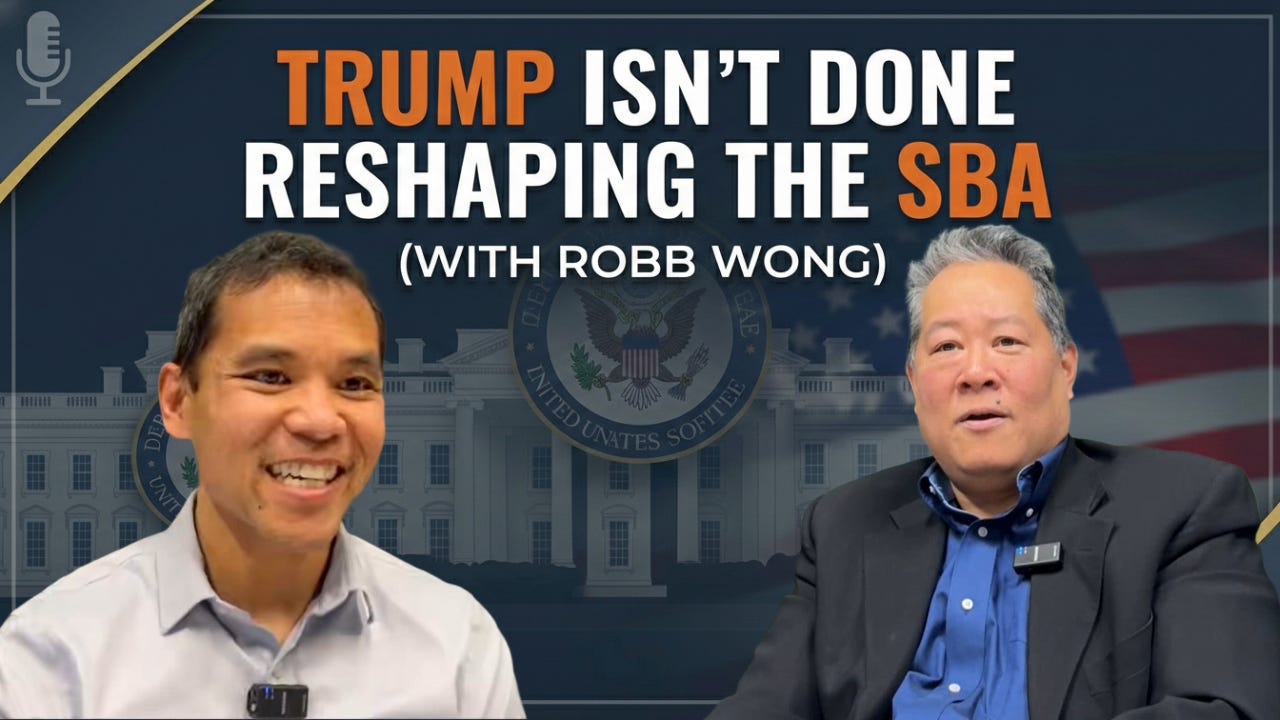
Robb Wong was the government’s top small-business advocate in the first Trump Administration, working closely with former SBA Administrator Linda McMahon. He joins Sam on GovCon Intelligence to discuss the Trump Administration’s posture toward small-businesss contractors, the 8(a) data call, and his outlook for 2026.An auto-generated summary of the conversation follows.Guest Background * Robb Wong served as the government’s leading advocate for small business contractors in the Trump administration from 2017 to 2020 under SBA Administrator Linda McMahon. He currently runs FedSolve, a platform supporting high-performing small businesses in IT, professional services, and construction.* SBA Achievements: During his tenure, federal small business utilization goals were exceeded for four consecutive years, and the market grew to over $240 billion.* Key Policy Wins: Robb formalized the Women-Owned Small Business (WOSB) certification program, initiated the transfer of the VA’s Service-Disabled Veteran-Owned Small Business (SDVOSB) program to the SBA, and shaped the current SBA Mentor-Protégé program.The “Trump 2.0” Administration and SBA Policy* Administrative Approach: Robb observes that the current administration is operating differently than the first but hopes they remain faithful to the same goals. His philosophy during Trump 1.0 was to strictly follow the law.* Department of Government Efficiency (DOGE) Cuts: Robb generally supports the concept of smaller government and procurement reform but criticizes the “ham-handed” execution of recent cuts.* Staff Reductions: The SBA’s Office of Government Contracting and Business Development (GCBD) staff was reduced from approximately 80 employees to 40, according to Robb.* Impact: Robb notes that losing key personnel hurts the agency’s ability to process actions and support the warfighter.The Hegseth Memo and DEI Scrutiny* The Memo: Sam discusses a memo from Secretary of War Pete Hegseth directing a review of all small business set-asides over $20 million for cost efficiency, questioning the DEI focus.* Robb’s Reaction: Robb suggests Hegseth’s memo parrots language from a recent SBA press release. While the industry fears the 8(a) program will be eliminated, Robb argues the program is grounded in the Small Business Act and 13 CFR regulations.* Removing DEI: Robb agrees with the administration’s move to remove DEI as a criteria for 8(a), emphasizing that admission should not be based on race alone.Status of the 8(a) Program: Freezes and Audits* Approval Freeze: Sam notes that there have been zero 8(a) approvals since August 15, 2025. This is due to a change in processing and a slowdown rather than an outright termination of the program.* The Data Call: The SBA has shifted resources from processing applications to conducting audits and data calls.* Survival Rates: Robb helped firms successfully navigate the data call by ensuring their submissions were complete and on time, warning that incomplete submissions would result in removal.Future Scrutiny (Economic & Social Disadvantage):* Economic Disadvantage: Robb predicts the next wave of audits will focus on economic disadvantage thresholds. He advises firms to verify their numbers and prepare explanations.* Social Disadvantage: The administration may scrutinize narratives. The “two incidents” rule is weak, Robb says, compared to the requirement of “chronic and longstanding” disadvantage.* White Male Eligibility: Robb clarifies that white males have historically been able to enter the 8(a) program through a social disadvantage narrative. That makes new guidance on “illegal DEI” redundant to existing regulations.Market Environment and Predictions for 2026* CIO-SP4 Cancellation: Robb predicts what will come out of the cancellation of the CIO-SP4 contract vehicle.* Mentor-Protégé & Joint Ventures: Robb continues to advocate for the Mentor-Protégé program. He advises firms to form joint ventures to combine capabilities (”Mighty Mouse and Superman”) and pursue small-business contracts.Advice for Small Businesses* Change the Pitch: Robb emphasizes that companies must stop leading with their certifications (e.g., “I’m 8(a)”). Instead, they must lead with quality, problem-solving, and past performance.* Do the Homework: Businesses must conduct deep market research, understanding agency missions and specific program problems using public information.* Business Development: Companies must actively engage contracting officers by proving they can solve specific problems, rather than relying solely on status.About the GuestRobb Wong is the founder and principal of FedSolve, an advisory service for high-performing small businesses. He served as the White House-appointed SBA Associate Administrator for Government Contracting and Business Development from 2017 to 2020. With 20 years of Federal legal experience, Sam Le counsels small businesses through government contracting matters, including bid protests, contract compliance, small business certifications, and procurement disputes. Sam obtained his law degree from the University of Virginia and formerly served as SBA’s director of procurement policy. His website is www.samlelaw.com.This video is for informational purposes only and does not constitute legal advice. This is a public episode. If you would like to discuss this with other subscribers or get access to bonus episodes, visit www.govconintelligence.com

Links mentioned:Dave Zvenyach: “The 8(a) Dustup”SBA: “SBA Issues Clarifying Guidance That Race-Based Discrimination is Not Tolerated in the 8(a) Program”SBA 8(a) Program MandateSBA Small Business SearchCity Journal: “They Systematically Discriminate Against One Group: White Men.”Below is an auto-generated summary of a live video.This episode discusses recent developments and heightened scrutiny surrounding the Small Business Administration's (SBA) 8(a) program. Sam touches upon the announcement by Secretary of War Pete Hegseth regarding a review of sole source contracts, leading to an intense week of actions by SBA. Key points include the recent data call for 4,300 8(a) firms requiring submission of 39 documents, SBA's suspension of over 1,000 firms for lack of response, and new guidance which states that race-based discrimination is not tolerated. Sam also goes over the removal of the guide for demonstrating social disadvantage, implications for new applicants, and a controversial article claiming no 8(a) contracts were awarded to white men between 2020-2023.Sam discusses the suspension of firms, the efficiency of sole-source contracts, the program's historical context, and upcoming reviews that could impact the program. Audience questions address the suspension appeal process and broader application of sole source authority.Topics Introduction to Recent Developments in the 8(a) Program SBA's Data Call and Immediate Consequences New Mandates and Social Disadvantage CriteriaRace-Neutral Administration and Social Disadvantage Narratives Reverse Discrimination and White Men in the 8(a) Program Suspensions and Their Impact on the 8(a) Program Q&A and Final Thoughts This is a public episode. If you would like to discuss this with other subscribers or get access to bonus episodes, visit www.govconintelligence.com

On this episode of the GovCon Intelligence podcast, Sam and Christine Williams cover the current state of the SBA 8(a) program, focusing on recent administrative challenges, fraud allegations, and the specific role of Alaska Native Corporations (ANCs).The SBA 8(a) Data Call and Data Security. The discussion begins with Christine describing the recent SBA 8(a) data call as “awful” due to a portal that was unequipped for large contracts, resulting in slow performance and timeouts. She expresses distress over an SBA proclamation that the submitted data was not proprietary, raising concerns about the protection of sensitive information and social security numbers. Sam notes the possibility of the SBA using third-party vendors like Palantir for forensic analysis, which raises further questions about data security for 8(a) participants.Debunking Fraud and Misconceptions. The speakers address recent reports of fraud within the program, with Sam clarifying that actual fraud figures are significantly lower—estimated between $22,000 and $13 million—than the “click bait” figures of $550 million often cited. They emphasize that the 8(a) program is not a “giveaway” but is highly competitive, with some estimates suggesting four out of five firms never receive a contract award. To counter negative narratives, they highlight 8afacts.org, a resource that tracks the program’s significant economic and job impact across various congressional districts.The Role of Alaska Native Corporations (ANCs). Christine explains the historical context of ANC participation in the 8(a) program, noting it was established through the Alaska Native Claims Settlement Act (ANCSA) as a negotiated exchange for land and pipeline rights. She highlights that the U.S. Supreme Court has affirmed the status of ANCs as tribal organizations entitled to self-determination. The speakers also discuss Alaska’s strategic military importance, noting that the state receives over $10 billion in defense money.Demographic Shifts and Political Scrutiny. The conversation shifts to the 2023 change in SBA rules that removed racial presumptions for social disadvantage. This change has led to a 50% increase in participation by white male-owned firms and a high level of participation among service-disabled veterans. Despite these shifts toward objective standards, the program faces new scrutiny from the Department of War. Sam and Christine discuss a video by Secretary Pete Hegseth that targets sole-source contracts exceeding $20 million, a threshold that primarily affects ANCs and tribes. Christine warns that this targeted scrutiny could create a “chilling effect” for contracting officers, even though 8(a) sole-source awards provide unmatched procurement speed.Proposed Reforms and Conclusion. In closing, the participants suggest several reforms to improve the program’s transparency and palatability:* Implementing electronic reporting systems for subcontracting compliance.* Developing a “TSA pre-check” style pre-vetting process for qualified firms.* Formalizing social disadvantage through objective standards like poverty levels in specific zip codes or veteran status.* Encouraging small businesses to adopt corporate compliance programs based on Department of Justice guidelines: https://www.justice.gov/criminal/criminal-fraud/page/file/937501/dl?inline=The episode concludes with an emphasis on the lethality and efficiency that 8(a) firms bring to the government and a recommendation for listeners to use 8afacts.org as a resource for verified data.About the GuestChristine Williams is a principal at Outlook Law in Anchorage, Alaska. She was named one of America’s Top 50 Lawyers for her work on government contracts in Alaska. She is a fellow of the American Bar Foundation and a former adjunct law professor at Seattle University School of Law’s Alaska Campus.Relevant Links* Outlook Law: outlooklaw.com* 8a Facts: 8Afacts.org* An Open Letter to Sec. Hegseth (Holly MathNerd)* DOJ Evaluation of Corporate Compliance Programs: https://www.justice.gov/criminal/criminal-fraud/page/file/937501/dl?inline=With 20 years of Federal legal experience, Sam Le counsels small businesses through government contracting matters, including bid protests, contract compliance, small business certifications, and procurement disputes. Sam obtained his law degree from the University of Virginia and formerly served as SBA’s director of procurement policy. His website is www.samlelaw.com.This video is for informational purposes only and does not constitute legal advice. This is a public episode. If you would like to discuss this with other subscribers or get access to bonus episodes, visit www.govconintelligence.com

Matt Schoonover and I got together this afternoon to discuss what SBA told the Office of Management and Budget about the 8(a) data call. Below is an auto-generated summary of our conversation. You can find the topic of our conversation, SBA’s submission to OMB, on reginfo.gov.In this episode of GovCon Intelligence, Sam sits down with Matt Schoonover, a leading attorney in government contracting, to unpack the SBA 8(a) data call.The conversation focuses on the data call issued by the SBA in December, which requires 4,500 firms in the 8(a) program to submit extensive operational and financial records by January 19th—a federal holiday. Bypassing standard public notice procedures under the Paperwork Reduction Act, the agency cited urgent concerns over “waste, fraud, and abuse” and the potential for evidence destruction as justification for the emergency measure.Together, Sam and Matt analyze the regulatory filings that reveal the SBA’s rationale, the estimated $32 million compliance cost to small businesses, and a surprising statement regarding the confidentiality of the data collected.TopicsEmergency Authorization: The SBA used emergency clearance procedures to fast-track the data collection, bypassing the standard notice-and-comment period. The agency argued that a public process could allow bad actors to “alter, destroy, or otherwise conceal” evidence.The Cost of Compliance: The SBA estimates the total burden on the 4,500 respondents will be approximately $32 million—roughly $7,000 per participant. However, the hosts note that for less sophisticated firms or those with complex contracts, the actual costs could be significantly higher.“No Assurance of Confidentiality”: Perhaps the most concerning discovery in the SBA’s supporting documents is a statement explicitly declaring, “There is no assurance of confidentiality.” This raises questions for contractors asked to hand over sensitive “secret sauce” data, including complete accounting ledgers, employee lists, and vendor details.Fraud Narrative: The data call appears rooted in the SBA’s belief that the 8(a) program is riddled with waste, fraud, and abuse. Matt argues this premise undermines a program that has successfully fostered economic development for decades.Social disadvantage focus?: Sam and Matt discussed SBA’s investigation into program compliance, focusing on potential issues with social disadvantage narratives and truthful representation in admissions. They speculated that SBA may be reviewing data to verify the accuracy of companies’ social disadvantage claims. Sam suggested that a permanent government-wide solution could involve implementing a system for companies to report their compliance with subcontracting limitations, as required by statute.Format changes: Sam and Matt discussed changes between SBA’s initial data call draft and the final version, focusing on format requirements and data collection methods. They noted that SBA switched from requesting Excel files to CSV files, which Matt suggested could be intended to be more inclusive of non-Microsoft users or to facilitate easier analysis.About the GuestMatt Schoonover is the lead partner at Schoonover & Moriarty, a Kansas-based law firm specializing in federal government contracting for small businesses. He serves as a co-chair on the American Bar Association’s Small Business Committee.Relevant Links* Schoonover & Moriarty: schoonoverlawfirm.comWith 20 years of Federal legal experience, Sam Le counsels small businesses through government contracting matters, including bid protests, contract compliance, small business certifications, and procurement disputes. Sam obtained his law degree from the University of Virginia and formerly served as SBA’s director of procurement policy. His website is www.samlelaw.com.This video is for informational purposes only and does not constitute legal advice. This is a public episode. If you would like to discuss this with other subscribers or get access to bonus episodes, visit www.govconintelligence.com
For a full summary, go to http://www.govconintelligence.com.TopicsThe 8(a) Fraud Debate and Senate HearingsNuances of Limitations on Subcontracting (LOS)SBA Audit Updates and FAQs SBA Atlassian website.The FAR OverhaulQ&A SessionQ: Can you “stack” the 40% rule for JVs on top of LOS?Q: Is the ultimate intent to do away with set-aside programs?Q: Is there rampant fraud in the 8(a) program?Q: How do you challenge a Social Disadvantage narrative?Q: Will the audit uncover LOS violations?Caselaw updateGAO: Certificates of Competency (COC) and Binary ChoicesC-SlopeCOFC: The “Once 8(a), Always 8(a)” Rule and CoordinationCourt of Federal ClaimsSBA OHA: Ownership Changes and “Gaps” in EligibilitySBA Office of Hearings and AppealsCriminal Case: 8(a) Fraud and the “Unconstitutionality” DefenseMiddle District of PennsylvaniaGAO: SBIR Phase III Sole Source AuthorityBode Technology.GAO: 8(a) Eligibility and GSA MAS PoolsThe Building People With 20 years of Federal legal experience, Sam Le counsels small businesses through government contracting matters, including bid protests, contract compliance, small business certifications, and procurement disputes. Sam obtained his law degree from the University of Virginia and formerly served as SBA’s director of procurement policy. His website is www.samlelaw.com.This video is for informational purposes only and does not constitute legal advice. This is a public episode. If you would like to discuss this with other subscribers or get access to bonus episodes, visit www.govconintelligence.com

Full transcript available at http://www.govconintelligence.com.Here are five areas that I think SBA is going to look into when it receives documentation from the 8(a) audit.Audit Focus AreasThe five areas are:* Limitations on Subcontracting* Compliance with the Mentor-Protégé Program* Excessive Withdrawals* Benefits Reporting for entity-owned firms* Indications of Bribery or KickbacksWith 20 years of Federal legal experience, Sam Le counsels small businesses through government contracting matters, including bid protests, contract compliance, small business certifications, and procurement disputes. Sam obtained his law degree from the University of Virginia and formerly served as SBA’s director of procurement policy. His website is www.samlelaw.com.This podcast is for informational purposes only and does not constitute legal advice. This is a public episode. If you would like to discuss this with other subscribers or get access to bonus episodes, visit www.govconintelligence.com

For a full transcript with links, go to http://govconintelligence.comWelcome to a live GovCon Intelligence video. We’re going to be going over a filing at the Supreme Court about the 8(a) program, as well as a filing in state or district court in Louisiana about the 8(a) program’s race-based presumption. There’s also been a bill introduced in the Senate about suspending 8(a) sole source awards. During the SBA audit, Secretary Hegseth of the Department of War gave a speech about acquisition transformation, and GAO has reopened. So there have been a couple of cases about small businesses at the VA and involving NAICS codes coming out of the GAO. Also, go over a few questions that we’ve received through the app and by email through the GovCon Intelligence Newsletter.As a reminder, you can always comment on this post or send me an email, or fill out the contact me form to send questions for the next edition of our Q&A.TopicsA Supreme Court petition on the 8(a) programSenate bill to suspend 8(a) sole-source awardsAcquisition Transformation at DoWGAO rules on small business: NAICS and LOSFidelity Contract Flooring: missing NAICS in SAMAAA General Contractors: VA Limit on SubcontractingQ&A about SDBs, eSRS, and TreasuryMore SDB dollars mean more veteran-owned contractseSRS transition to SAM.govTreasury audits “preference-based contracting”------------------With 20 years of Federal legal experience, Sam Le counsels small businesses through government contracting matters, including bid protests, contract compliance, small business certifications, and procurement disputes. His website is www.samlelaw.com.This video is for informational purposes only and does not constitute legal advice. This is a public episode. If you would like to discuss this with other subscribers or get access to bonus episodes, visit www.govconintelligence.com
Please go to govconintelligence.com for a full transcript of this episode.Welcome back to another Q&A edition of GovCon Intelligence. Today, I want to discuss several important documents that came out over the past few weeks for small business contractors, specifically the FAR Companion Guide and the Department of Transportation’s frequently asked questions on the Disadvantaged Business Enterprise (DBE) program.Topics:FAR Companion Guide Version 2.0The FAR Companion Guide came out last week in version 2.0, and we now see the companion guide for Part 19. However, the most interesting part I discovered was actually outside of Part 19, in Part 8, which covers the required use section of the FAR. The companion guide is organized with the same numbering structure as the FAR uses.- Required use- Category management buying guide- The Rule of Two and Small Business Set-Asides- Subcontracting GoalsDOT’s FAQs on the DBE ProgramThe Department of Transportation has published official FAQs for the Disadvantaged Business Enterprise (DBE) program. This FAQ follows the interim final rule that DOT published in the Federal Register on October 3rd, which changed the DBE program so that DBEs now have to submit disadvantaged narratives in order to get into the program or to continue their DBE status. The FAQ answers many questions that people had about the interim final rule.- Withholding payments and terminating contractsCase update: MLB TransportationLink: MLB Transportation v. United States.Contracting Q&A- Multiple Certifications in Set-Asides- FAR Part 19 Companion Guide and OSDBU- Impact of Rule of Two Changes on Small Business ContractorsPlease keep your questions coming at GovConIntelligence.com. With 20 years of Federal legal experience, Sam Le counsels small businesses through government contracting matters, including bid protests, contract compliance, small business certifications, and procurement disputes. His website is www.samlelaw.com.This article is for informational purposes only and does not constitute legal advice. This is a public episode. If you would like to discuss this with other subscribers or get access to bonus episodes, visit www.govconintelligence.com

This is a free newsletter. If you’d like to support my work, please consider donating to the Capital Area Food Bank, which is helping furloughed federal workers across D.C., Maryland, and Virginia. Donate at samlelaw.com/give.I’m back with another Q&A for GovCon Intelligence this time. We’re going to talk more about the FAR Overhaul and look closely at Part 19 to see what’s changed.I’m going to debunk some myths that I’ve heard about the FAR Overhaul. There’s a lot of misinformation out there, fake news, and I’m going to try to get to the heart of what’s really happening with the FAR Overhaul.Thanks for reading GovCon Intelligence! Subscribe for free to receive new posts and support my work.But first, I want to let everybody know that we’re starting a giving campaign at GovCon Intelligence. I’m going to run the Marine Corps Marathon on Sunday. It’s the 50th running of the Marine Corps Marathon, and I’m going to do it in support of the Capital Area Food Bank. There are really long lines at the Food Bank as federal workers lose their paychecks for last week and as the shutdown goes on.So we’re starting a campaign. You can go to samlelaw.com/give. Please donate in support of the Capital Area Food Bank. One possible donation is 26.2. That’s the number of miles that I’m hoping to run on Sunday for the 50th running of the Marine Corps Marathon.So wish me luck there.Okay, we’ll get into the questions. Thanks to everybody who’s been reading me and sending questions by replying to the emails or comments, or by finding me on LinkedIn. I’ll continue these Q&A sessions and go through all your questions.Subcontract plan administration appears in Part 42The first question I got was about a statement I made in the last Q&A. It said that the FAR eliminated a section on administrative contracting officers, 19.706. And I said maybe it would have come back in Part 42, but administrative contracting officers didn’t come back in Part 42.Well, what I said was incomplete. Somebody pointed out to me that there may not be the term “administrative contracting officers” in Part 42, but there is something called the administrative contracting or contracting administrative office. And it’s in Part 42.302, the CAO, Contract Administration Office. And it covers some of the subcontracting responsibilities that were in 19.706 about the administrative contracting officers. Specifically, it’s a very long section, by the way. Specifically, parts 52, 53, 54, and 55 of that CAO, Contract Administration Office, section 42.302.All four of those sections deal with subcontracting. They include reviewing and evaluating and approving subcontracting plans; obtaining contractors’ approved subcontracting for its commercial products; if there’s not an approved plan, assisting the contracting officer in evaluating proposed subcontracting plans; and, importantly to this point, by periodic surveillance, ensuring that the contractors’ compliance with small, disadvantaged, women-owned, veteran-owned, etc., subcontracting plans maintain documentation of the contractor’s performance and compliance with these plans requirements and provide advice and assistance to the firms involved.So that’s a lot of the material that was in the former 19.706 that was eliminated in the FAR Overhaul. It was already there in this 42.302. I think the FAR misled a bit in saying that they eliminated 706 because it was not necessary to sound procurement. Really, it’s duplicative. I think they should have said it was duplicative. 19.706 just went over some of the material that was in 42.302, just in different words, saying administrative contracting officer instead of contracting administration office. But it really covers the same ground.So I think in the end, not much has changed. You still have many, if not all, of the responsibilities that were in 19.706. Now it’s just in 42.302. It was already there, but it remains in 42.302. And it’s just in a different title. It’s in the CAO instead of the ACO.So my apologies if I was confused on that point. The word search does not work in all instances when you’re switching terms like that.Sole-source contracts to entity-owned firmsSomeone sent in a question about what the FAR Overhaul means for entity-owned firms. That’s ANCs, the Alaska Native Corporation, Indian tribes, and NHOs, which are Native Hawaiian Organizations. And the question is about the removal of a provision in the 8(a) part of the FAR that said that agencies could award sole-source contracts to 8(a) participants owned by Alaska Native firms and Indian tribes above the competitive threshold.That was in 19.805-1(b)(2) and that’s been removed. So the question is, if the FAR has removed that authority, does that mean that the agency can’t—they no longer are able to use 8(a) sole-source awards above the competitive threshold to those entity-owned firms?Just one note. I said Alaska Native and Indian tribes,. That’s because Native Hawaiian Organizations have that authority, but it’s through a separate provision in the DFARs, which is the DOD-specific area of the FAR. That authority still exists. I’ll start with that. The authority to award sole-source 8(a) contracts to entity-owned firms above the competitive threshold still exists. It’s in statute. It’s in public law through various NDAAs over the years. I’ll link to that in the show notes. [Link: The Legal basis for Native 8(a) participation]It is not as clear in the FAR Overhaul now, though, because the FAR does not specifically state the authority for Indian tribes and Alaska Native firms and Native Hawaiian Organizations. Instead, it refers by reference to another FAR provision that does say it.I’ll go to the text here and give you an idea of what I’m talking about. By the way, I made a note at the last time that they messed up the numbering. It was really easy to figure out which of the FAR sections was 8(a), because it’s just 19.8. You just remember the number 8, and you get to it. They did try to keep that to some extent here because they put the 8(a) program under 19.208. They changed the numbering, but still kept the number 8 in the title, which I like because then it makes things easier to find.It says now that, under competitive 8(a) contracting. So this is 19.208-2(a)(1). It says SBA may not accept for negotiation a sole-source 8(a) contract that exceeds $30 million unless the requesting agency has completed a justification in accordance with the requirements of 6.104.That $30 million threshold is the $30 million threshold for entity-owned firms for civilian agencies. That $30 million threshold is still in the FAR. It still exists there in Part 6. The FAR is just referring to it by reference rather than putting the whole authority in 19.8.And furthermore, the 19.208—it is going to be a while before I remember all the numbering here. It also says that—competitive threshold, let me see it here. There’s a mention of Alaska Native Indian Tribe and Native Hawaiian organizations in 19.208-2. Let me just find the threshold here. So, I think this might be a be about service-disabled vet.The other section is 19.108-7. So, you still get the 8 in there. And it says, where an acquisition exceeds the competitive threshold, the SBA may accept the requirement for a sole source 8(a) award, only after the contracting officer has complied with the requirements for other than full and open competition andin accordance with 6.103.So there again, it’s referring back to another section. It’s referring to 6.103. Part 6 is the part of the FAR that deals with competition. And if you go to 6.103, so it’s basically saying, oh, you can’t do a sole source below the competitive threshold, which is now $5.5 million. Unless there’s something in 6.103.If you go to 6.103, that section speaks to statutory exceptions to competition. And one of those statutory exceptions to competition is the ability to issue a sole-source contract to an Alaska Native firm, Indian Tribe, and then if you’re within DOD, a Native Hawaiian organization.It’s 6.103-5(e), which refers to sole source 8(a) contracts and above 30 million, they require justification and approval. That’s 100 million within DOD. But below that, any agency can use a sole source contract to an Alaska Native, Indian Tribe, or Native Hawaiian firm.And that’s clear from the public law. I’ll put the citations to the public law in the show notes so that you can refer to them.* Public Law 100-656, sect. 602* Public Law 109-148, sect. 8020There’s a really roundabout way of telling agencies that they can award sole-source contracts to Alaska Native owned 8(a) participants and Indian Tribe 8(a) participants.You’ve got to go to -108, -208; maybe you have to know the Public Law. That’s really the outcome of the FAR Overhaul. In trying to streamline things and use fewer words, so you don’t state that, it sometimes puts the readers on a wild-goose chase to try to find the different sections that, once you piece it together, end up in the same place. You could just said that, but now you’ve got to switch between different sections of the FAR to get there.Changes to the Rule of Two for R&DThe next question asks, what is the status of the language from the former rule of two?So this was 19.502-2 that said the following. It said, “total small business status should not be made unless a reasonable expectation exists. Although past acquisition history and market research of an item or similar items are always important, these are not the only factors to be considered in determining whether a reasonable expectation exists. In making research and development small business set-asides, there must also be a reasonable expectation of obtaining from small businesses the best scientific and technological sources consistent with the demands of the proposed acquisition for the best mix of cost performances and schedules.”This language, particularly the language about research and development, discouraged agencies from using small b

One of the questions I’ve received is: What is the role of OSDBU under the FAR Overhaul, and how will the companion guide affect the roles of the OSDBU?It seems as if the roles of the OSDBU were minimized. I think that’s absolutely right. The roles of the OSDBU have been minimized in the FAR Overhaul, but I’m not sure it’s going to matter.What the FAR Overhaul did is take all the content of the responsibilities of the OSDBU and, in the FAR Overhaul, delete them. Potentially they will come back in the FAR companion guide. All those responsibilities of the OSDBU are statutory—they’re in Part 15(k) of the Small Business Act. About 21 responsibilities altogether. They include supervision, appointing small business technical advisors, things like helping with the SBIR program, and helping small business subcontractors get paid. So there are very important responsibilities for the OSDBU. Small businesses rely on the OSDBU to perform these responsibilities.Thanks for reading GovCon Intelligence! Subscribe for free to receive new posts and support my work.Those responsibilities are not going away. They’re still in the Small Business Act. They’re still in Section 15(k). They’re not in the FAR Overhaul, but the FAR Overhaul can’t override a statute. So 15(k) is still in effect.The FAR Overhaul effort was to try to minimize the number of words in the FAR and really keep it to things that were relevant to contracting officers. And it’s not really necessary that contracting officers know what the responsibilities of OSDBU are. I think that was the logic behind deleting that material from the FAR Overhaul.So I don’t think the OSDBU responsibilities are affected by the changes in the FAR Overhaul. What is important, however, is that there are new efforts to try to reduce the staff at OSDBU offices.We saw this in April at HHS. The HHS OSDBU office went from a full office to just one director. And then reportedly, the Air Force is also going through the same process and may be reduced to one director. We’ll know when we get back from the shutdown as to whether that actually happened with the Air Force, but that was reported in September as potentially occurring in the Air Force come October 1st.So I think that’s a big loss for small businesses. The OSDBU and small business specialists are the front door to agencies for small businesses, and they also play a very important advocacy role. So if you’re reducing the OSDBU, there are fewer people around to help small businesses figure out the complexities of government contracting.Even though the FAR Overhaul effort was supposed to minimize the complexity and make it more simple, in some areas it’s actually gotten more complicated. It’s not obvious to someone from outside government contracting what a contract vehicle is, or what an IDIQ is, and how to go from an IDIQ to a BPA to an order. All that stuff is supported and encouraged in the FAR Overhaul. And if you’re new to government contracting and you haven’t figured that stuff out yet, you need somebody to hold your hand through it. And that’s what small business specialists, that’s what OSDBU and offices of small business programs would do.So if we reduce those offices and take responsibilities away from those offices, that’s a big blow to small businesses that are starting to get into contracting and trying to figure it out.FAR 19.706 and Administrative Contracting OfficersThe next question is: Do you think FAR 19.706 will show up in FAR 42? If not, no one will care about subcontracting.FAR 19.706 is the section about administrative contracting officers. Those are officials that help contracting officers review compliance with subcontracting plans. And the FAR Overhaul deleted all of FAR 19.706. Maybe it’ll come back in the companion guide. It’s not in there, it’s also not in FAR Part 42.The notation said that this is not statutory and it’s not essential for sound procurement. They could come back. I think administrative contracting officers primarily are within Department of Defense. DoD has not deviated to the FAR Overhaul yet, so they haven’t gotten rid of 19.706. And there’s still an opportunity for DoD to keep that role of administrative contracting officers around, either in the DFARS or through guidance, or just call them something else.If it’s the case that they are important to the system and they’re required to have humans pay attention to subcontracting plans, I think the Department of Defense will find somebody—it may be something other than an administrative contracting officer—to play that role.FAR Overhaul StatusThere’s a question about whether the FAR Overhaul is a proposed rule or final. Actually, it’s neither. It’s actually before the proposed rule. The FAR Overhaul is what they call a model deviation. So it’s text that agencies could take on through a deviation process. That’s why some agencies have—the Department of Defense has not actually deviated—but a lot of agencies have deviated so that they’re following the FAR Overhaul now.The proposed rule comes next. The FAR has set a November 3rd deadline for members of the public and companies to provide informal comments on the FAR Overhaul. It’ll probably take a while to go through that. So toward the end of November or December, you’ll probably see a proposed rule issued by the FAR Council, maybe the entire FAR, all 53 parts of it. And then that will open up a period of public comment through Regulations.gov—the more formal public comment. And then after reviewing those comments, the FAR will move to final.It’s very important for small businesses especially to comment. The FAR takes those comments very seriously. I mean, you’ve already seen with the change in FAR Part 8, the FAR is really listening to public sentiment. They made a change in FAR Part 8 based on what businesses said in either the informal comment or just online generally—the change from the “best in class” mandate to something called “required use,” which is much more favorable to small businesses.So if you’re a small business and you have a view on something the FAR has done, maybe on the Rule of Two, then it’s important that you do comment both in the informal process that ends November 3rd and then in the more formal Regulations.gov process that will be upcoming.Women-Owned Small Business CertificationThere’s a question about women-owned small business certification. It says the WOSB contracting program limits eligibility to certain NAICS codes, but for some contracting purposes, it seems burdensome to require WOSBs to certify since there’s no preference programs for WOSBs at that level.So this question is referring to the FAR Overhaul’s new requirement that women-owned small businesses certify for the purposes of being counted towards subcontracting plans.I’m a bit confused about why this happened. In the past when SBA has done this, when they’ve required firms to be certified for subcontracting, SBA has given those firms a full year grace period to do that. That’s what SBA did with service-disabled veteran-owned firms. And now the FAR in the Overhaul is requiring both women-owned small businesses and service-disabled veteran-owned small businesses to become certified. But there’s no grace period, there’s no notice. Just whenever that FAR Overhaul takes effect, those firms are going to have to be certified to count towards subcontracting plans.And this question is making the point that in the prime contracting program, women-owned small businesses only participate in specific NAICS codes. There’s about 70% of the NAICS codes on the NAICS code list where the program’s active. But that means about 30% of the NAICS codes do not have any preference for women-owned small businesses. There’s no set-asides within that other 30%.So if you’re a women-owned small business that’s in that other 30% of NAICS codes, there’s no reason for you to get certified right now, because there’s no preference for you. Now with the subcontracting, it’s not based on NAICS codes. So all women-owned small business subcontractors that want to count towards subcontracting plans are going to have to be certified regardless of NAICS codes.There are probably thousands, maybe even tens of thousands, of women-owned small business subcontractors that are out there that have not gotten certified, because it costs time and maybe you have to hire somebody to help you through the certification. And they have not had a reason to do that. Now they have a reason to do that, so you will expect a big rush of certification applications at SBA.I’m not sure that they’re ready for that. I doubt that the FAR Overhaul checked with SBA about their capacity to handle these certification applications, because it doesn’t seem like something that the FAR wanted to give companies notice about. In other settings, there’s a small business compliance guide that an agency will publish to let companies know what their responsibilities are, but the FAR did not do that in this case.Understanding FAR 2.0 ChangesAnother person asked, similar to the women-owned small business question: Is there a section of the FAR 2.0 where we can read what’s changed within that section?Not really for small businesses. It is for contracting officers. They can read the practitioner album, but that’s really directed at 1102 contracting officers and what changes they need to make. But for businesses, there isn’t that small business compliance guide that I mentioned where you can go and see, “Oh, my new responsibilities are this.”The FAR is required by law to do that, but they’re not required to do that until the end of the process, which in this case is the final rule that’ll probably be either December 2025 or somewhere in the beginning of 2026. And then they’ll put out the compliance guide, and then they’ll tell you, “Here’s what you need to do.”But if you want to know now, there’s not a great place to go. You can read my newsletter, GovConIntelligence.com, follow some of

This is a public episode. If you would like to discuss this with other subscribers or get access to bonus episodes, visit www.govconintelligence.com

My presentation to the 25th Annual HUBZone conference on the FAR Overhaul and HUBZone data. All credit to Christine Williams for the presentation title!The slides are available for download here:Thanks for reading GovCon Intelligence! Subscribe for free to receive new posts and support my work.Sam Le is a Virginia- and D.C.-licensed attorney. His website is samlelaw.com. This is a public episode. If you would like to discuss this with other subscribers or get access to bonus episodes, visit www.govconintelligence.com

This is a public episode. If you would like to discuss this with other subscribers or get access to bonus episodes, visit www.govconintelligence.com

Thank you to everyone who tuned into my first live video on GovCon Intelligence! This one summarizes my article The latest SBA Scorecard comes from a world that no longer exists. I’ll plan to do these occasionally to introduce new articles and to give my thoughts on breaking news in GovCon. This is a public episode. If you would like to discuss this with other subscribers or get access to bonus episodes, visit www.govconintelligence.com
Comments


Download from Google Play

Download from App Store
 United States