


 Claim Ownership
Cultural Commentary Project
Subscribed: 0Played: 0
Subscribe

© Copyright 2025 All rights reserved.
Description
Read. Create. Comment.
The CULTURAL COMMENTARY PROJECT taps into a powerful, often underused tool: the public comment system. Every time laws are proposed, public comments are required to be considered—this is your chance to make your voice count. Whether it’s about local transit or national policy, your thoughts matter. By submitting your art as a comment, we can influence change and bring a fresh perspective to the table.
Artists have a unique way of seeing and interpreting the world, often uncovering ideas that policy experts may overlook. Now is your time to share those insights through art, words, sounds, and images—whatever form your creativity takes.
3 Episodes
Reverse
Details about the proposed rule
Comment by February 3, 2026, here.
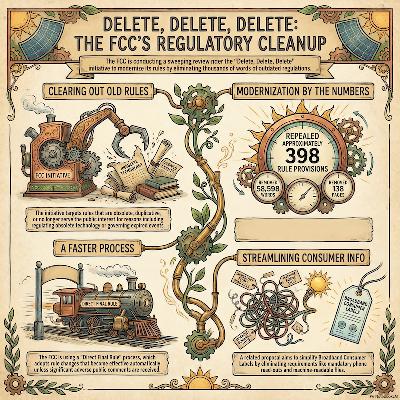
The Federal Communications Commission initiated a sweeping deregulatory campaign titled "In Re: Delete, Delete, Delete" in March 2025 to align with a broader executive mandate for government efficiency. This initiative, specifically tracked under GN Docket No. 25-133, utilizes a "direct final rule" process to expedite the removal of hundreds of regulations deemed facially obsolete, redundant, or burdensome. The Commission evaluates these rules based on a seven-factor framework, considering cost-benefit ratios, technological advancements like the shift from telegraphs and phone booths, and legal changes following the Loper Bright decision. Multiple waves of deletions have already targeted sectors including wireless, wireline, broadcast, and public safety, removing tens of thousands of words from the Code of Federal Regulations. While the FCC allows a short window for public comment, rules are automatically repealed unless significant adverse comments are received. Ultimately, this effort aims to modernize the regulatory framework and spur economic innovation by clearing out decades of administrative accumulation.
----
The Cultural Commentary Project
Read. Create. Comment.
The Cultural Commentary Project taps into a powerful, often underused tool: the public comment system. Every time laws are proposed, public comments are required to be considered—this is your chance to make your voice count. Whether it’s about local transit or national policy, your thoughts matter. By submitting your art as a comment, you can help drive change and bring a fresh perspective to the table.Artists have a unique way of seeing and interpreting the world, often uncovering ideas that policy experts may overlook. Now is your time to share those insights through art, words, sounds, and images—whatever form your creativity takes. Read more about this project on the WEAD Artist Magazine.
See full legislation and comment options here .
AB 412, the A.I. Copyright Transparency Act, creates a framework requiring Generative AI (GenAI) developers to disclose whether registered copyrighted materials were used to train their models. Developers must document covered materials and establish a mechanism for rights owners to submit requests, often including a content "fingerprint," to identify use. They must respond within 30 days. Failure to comply allows rights owners to seek civil relief, including statutory damages of $1,000 per violation (per day). Supporters emphasize this is vital for creator rights and enforcement, while opponents argue the bill creates an "impossible standard" leading to excessive litigation and market consolidation among large tech firms.
Read. Create. Comment.
The CULTURAL COMMENTARY PROJECT taps into a powerful, often underused tool: the public comment system. Every time laws are proposed, public comments are required to be considered—this is your chance to make your voice count. Whether it’s about local transit or national policy, your thoughts matter. By submitting your art as a comment, we can influence change and bring a fresh perspective to the table.

EPA is proposing to amend the Greenhouse Gas Reporting Program to remove program obligations for most source categories, including the distribution segment of the petroleum and natural gas systems source category, and suspend program obligations for the remaining subpart W segments until the reporting year 2034.
Comments are open on this proposed rule until November 3, 2025.
Comments

Download from Google Play

Download from App Store
 United States