


 Claim Ownership
Conversing with Mark Labberton
Subscribed: 171Played: 5,287
Subscribe

Description
Conversing with Mark Labberton invites listeners into transformative encounters with leaders and creators shaping our world at the intersection of Christian faith, culture, and public life.
241 Episodes
Reverse
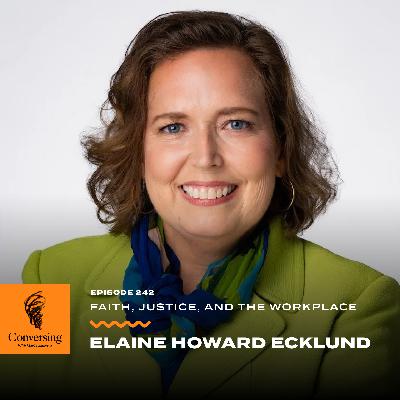
How should Christian faith shape work in an era of pluralism, fear, and systemic inequality? Sociologist Elaine Howard Ecklund (Rice University) is presenting new insights for faith at work through data, theology, and lived experience. "People love to talk about individual ethics … but what was really hard for them to think about was, what would it mean to make our workplace better as a whole?" In this episode, Ecklund joins Mark Labberton to reflect on moving from individual morality toward systemic responsibility, dignity, and other-centred Christian witness at work. Together they discuss faith and work, the gender and race gaps created by systemic injustice, fear and power, religious diversity, rest and human limits, gender and racial marginalization, and the cost of a credible Christian witness. Episode Highlights "People love to talk about individual ethics." "What would it mean to make our workplace better as a whole?" "People are much more apt to take us seriously if we first take them seriously." "Suppression of faith in particular is not the answer." "God is God and I am not." About Elaine Howard Ecklund Elaine Howard Ecklund is professor of sociology at Rice University and director of the Boniuk Institute for the Study and Advancement of Religious Tolerance. She is a leading sociologist of religion, science, and work whose research examines how faith operates in professional and institutional life. Ecklund has led large-scale empirical studies on religion in workplaces and scientific communities, supported by the National Science Foundation, Templeton Foundation, and Lilly Endowment. She is the author or co-author of several influential books, including Working for Better, Why Science and Faith Need Each Other, and Science vs. Religion. Her work informs academic, ecclesial, and public conversations about pluralism, justice, and moral formation in modern society. Learn more and follow at https://www.elaineecklund.com and https://twitter.com/elaineecklund Helpful Links And Resources Working for Better (IVP): https://www.ivpress.com/working-for-better Why Science and Faith Need Each Other (IVP): https://www.ivpress.com/why-science-and-faith-need-each-other Elaine Howard Ecklund website: https://www.elaineecklund.com Rice University Boniuk Institute: https://boniuk.rice.edu Conversing with Mark Labberton: https://comment.org/conversing Show Notes Sociological study of religion, work, and group behavior Christian faith taken seriously at personal and academic levels Ecklund's former research focus on science as a workplace environment Expanding faith-at-work research beyond scientific communities Compartmentalized Christian faith and the fear of offending colleagues Friendship and collaboration emerging from leadership retreats Large-scale data-driven study on religion in changing workplaces Religious pluralism at work and changing workplace demographics Writing for Christian audiences shaped by empirical research From individual ethics toward systemic responsibility at work "People love to talk about individual ethics." Systemic injustice blind spots Moral shorthand focused on time sheets and office supplies Organizational leadership and culture change Difficulty imagining organizational or structural workplace change Fear of retaliation when confronting unjust systems Responsibility for workplace realities Power underestimated by those holding leadership positions Costly examples of speaking up against workplace injustice Christian fear of marginalization in pluralistic environments Suppression of religious expression as common workplace response Suppression versus accommodation: "Suppression of faith in particular is not the answer." Religious diversity as unavoidable reality of modern work Other-centered faith rooted in dignity of every person Imago Dei shaping engagement across religious difference "People are much more apt to take us seriously if we first take them seriously." Racialized religious minorities: the double marginalization of racial minorities of faith Gender inequity and underexamined workplace power dynamics Faith-based employee groups Fear masquerading as anger in cultural and religious conflict Workplaces as rare spaces for meaningful civic encounter Justice beyond activism Rest as theological foundation for justice and leadership Limits, Sabbath, and resisting productivity as ultimate value "God is God and I am not." Human limits in leadership Production Credits Conversing is produced and distributed in partnership with Comment magazine and Fuller Seminary. #FaithAndWork #ElaineHowardEcklund #ChristianEthics #WorkplaceJustice #ReligiousPluralism #RestAndFaith
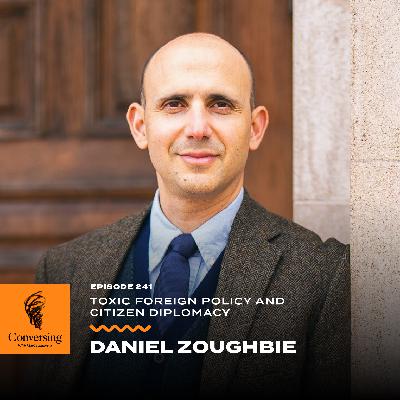
As global powers double down on militarism and defense, Daniel Zoughbie argues that the most transformative force in the Middle East has always come from citizen diplomacy. A complex-systems scientist and diplomatic historian, Zoughbie joins Mark Labberton to explore how twelve US presidents have "kicked the hornet's nest" of the modern Middle East. Drawing on his work in global health and his new book Kicking the Hornet's Nest: U.S. Foreign Policy in the Middle East from Truman to Trump, Zoughbie contrasts the view from refugee camps and micro-clinic networks with the view from the Oval Office, arguing that American security rests on a three-legged stool of defence, diplomacy, and development. He explains why Gerald Ford stands out as the lone president who truly leveraged diplomacy, how the Marshall Plan model of enlightened self-interest can guide policy now, and why nationalism, not mere economics, lies at the heart of Gaza's future. Throughout, he presses listeners toward "citizen diplomacy" that resists pride, militarism, and fatalism. Episode Highlights "We've constantly ignored diplomacy." " You don't have to be enemies with people to get them to do what is in their own self-interest." "You can build skyscrapers in Gaza. You can build the Four Seasons in Gaza and it's not going to work. You're just going to have another war until you address that core issue of nationalism." "These three D's, defense, diplomacy, development, are the three-legged stool of American security and we know how important diplomacy and development are." "From Truman to Trump, only one president, and that is Gerald Ford, surprisingly the only unelected president, gets this right." "Pride—national pride, the pride of any one individual—is toxic. It's toxic to the individual. It's toxic to the nation. It's toxic to the world." "Foreign policymaking is not just something for secretaries of state and those in power. All of us in a democracy have a role to play." Helpful Links and Resources Kicking the Hornet's Nest: U.S. Foreign Policy in the Middle East from Truman to Trump https://www.simonandschuster.com/books/Kicking-the-Hornets-Nest/Daniel-E-Zoughbie/9781668085226 American University of Beirut (founded as Syrian Protestant College), a key example of long-term educational diplomacy https://www.aub.edu.lb Al-Ahli Arab (Gaza Baptist) Hospital in Gaza City https://en.wikipedia.org/wiki/Al-Ahli_Arab_Hospital Max Weber, "Politics as a Vocation" https://dn790009.ca.archive.org/0/items/weber_max_1864_1920_politics_as_a_vocation/weber_max_1864_1920_politics_as_a_vocation.pdf Quaker Friends School, Ramallah: https://www.rfs.edu.ps/en Amman Baptist School: https://baptist.edu.jo/ American Colony Hotel in Jerusalem founding in the Husseini Estate by the author of "It is Well" https://www.loc.gov/exhibits/americancolony/amcolony-family.html and https://en.wikipedia.org/wiki/American_Colony_Hotel Foreman Christian College, Pakistan (Presbyterian) https://en.wikipedia.org/wiki/Forman_Christian_College American University of Cairo (Presbyterian) https://en.wikipedia.org/wiki/American_University_in_Cairo About Daniel Zoughbie Daniel E. Zoughbie is a complex-systems scientist, historian, and expert on presidential decision-making. He is associate project scientist at UC Berkeley's Institute of International Studies, a faculty affiliate of the UCSF/UCB Center for Global Health Delivery, Diplomacy, and Economics, and principal investigator of the Middle East and North Africa Diplomacy, Development, and Defense Initiative. He is the author of Kicking the Hornet's Nest: U.S. Foreign Policy in the Middle East from Truman to Trump and of Indecision Points: George W. Bush and the Israeli-Palestinian Conflict. His award-winning research has appeared in journals such as PLOS Medicine, Mayo Clinic Proceedings, and Social Science and Medicine. A Phi Beta Kappa graduate of UC Berkeley, he studied at Oxford on a Marshall Scholarship and completed his doctorate there as a Weidenfeld Scholar. Show Notes Middle East Background and Micro-clinic Origins Daniel Zoughbie recalls visiting the Middle East as a child—"frankly horrified" by what he saw UC Berkeley protests over the Iraq War and post-9/11 US policy in the region Metabolic disease and type 2 diabetes as an overlooked "greatest killer in the region." Neighbours in the West Bank sharing food, medicine, and blood-pressure cuffs—leads to the "micro-clinic" concept Good health behaviours, like bad ones and even violence, can be contagious through social networks Social Networks, Anthropology, and Security Social anthropology, political science, and international relations Medical problems as simultaneously biological and sociological problems Understanding Middle East security demands attention to decisions "at the very bottom" as well as "the view from above" October 7 and 9/11 illustrate how small groups of people can "change the world with their decisions." Complex Systems and Foreign Policy Complexity is always increasing, and diplomacy and development exist to slow it down. Definition of "complex system": as one where many inputs produce outcomes that cannot be reduced to single causes. "We almost have a new law here, which is that complexity is always increasing in the universe. And the role of diplomacy and development, as I see it in international relations, is to slow things down. It's to stop complexity from advancing so that people have time to cool their tempers and to solve major security crises." Type 2 diabetes as a model for thinking about how city planning, economics, relationships, and habits interact He applies that lens to international relations: nations, leaders, institutions, and history form a "cascade of complexity." From Refugee Camps to Presidential Palaces George Shultz and Tony Blair: decision-makers as "real human beings," not abstractions Theological and ideological forces—such as certain apocalyptic readings of Scripture—that shape US foreign policy Gnosticism and eschatology within American right-wing Christianity Painstaking global health work on the ground and sweeping decisions made in Washington, Brussels, or New York Twelve Presidents and One Exception Kicking the Hornet's Nest: analysis of twelve presidents from Truman to Trump through the lens of Middle East decision-making Core claim: Only Gerald Ford truly rebalanced the three D's of defence, diplomacy, and development. US policy in the Levant: heavy reliance on militarism, coups, and covert actions while underinvesting in diplomacy and development Claim: "Far better alternatives were on the table" for every administration, yet consistently passed over. Gerald Ford, Kissinger, and the Path to Peace Daniel contends that the 1967 and 1973 wars were both preventable and nearly became global nuclear catastrophes. Ford inherits the presidency amid Watergate and national division, but keeps Henry Kissinger at State. Ford presses Israel and Egypt toward serious negotiations, empowering Kissinger's shuttle diplomacy and personal ties. A sharply worded letter threatening to "reconsider" the US-Israel relationship Ford's diplomacy and the development of Camp David and the enduring Egypt-Israel peace based on "land for peace." Pride, Personality, and Presidential Failure Did Ford's temperament keep him from making himself the center of the story? In contrast, many presidents and other leaders write themselves "thickly" into the narrative of the conflict. Pride—personal and national—as a toxic force that repeatedly undermines US policy The Iraq War and democracy-promotion agenda and the self-defeating nature of moralistic, militarized crusades Marshall Plan and Enlightened Self-Interest George Marshall and harsh punishment after World War I helped produce Nazi Germany The Marshall Plan models an "enlightened way of viewing the American self-interest": rebuilding Europe and Japan to secure U.S. security. He contrasts that with the neglect of the Levant, where aid and institution-building never matched military activism. Marshall's genius lies in locating the intersection between others' deepest needs and American capabilities. Militarism, Iran, and Nuclear Risk Recent US-Israel-Iran confrontation as an "extremely dangerous moment"—with 60 percent enriched uranium unaccounted for JCPOA as an imperfect but effective diplomatic achievement, but dismantled in favor of militarism Claim: Bombing Iran scattered nuclear material and increased complexity rather than reducing the threat. He warns that one nuclear device could be delivered by low-tech means—a boat or helicopter—endangering civilians and US forces in the Gulf. The only realistic path forward: renewed multilateral diplomacy between US, Israel, Iran, Russia, China, Pakistan, India, and regional actors Ethical Realism and Max Weber "Ethical realism"—Max Weber's distinction between the ethic of the gospel and the ethic of responsibility Statespeople bear responsibility for using force, yet the greatest can still say "here I stand and I can do no other." Claim: True leadership seeks a higher ethic where national interest aligns with genuine concern for others. Gaza, Nationalism, and Two States Welcoming the end of active war between Israel and Hamas and critiquing reconstruction plans that ignore politics Conflict is fundamentally nationalist: a struggle for self-determination by both Jewish and Palestinian peoples Claim: Economic development without a credible political horizon will not prevent "another October 7th and another terrible war." In his view, only partition of mandatory Palestine into two states can meet legitimate self-determination claims. For example, "You can build skyscrapers in Gaza… and it's not going to work" without addressing nationalism. Citizen Diplomacy and a Better Way Foreign policy is not only the work of secretaries of state; democratic citizens have responsibilities. American University of Beirut and the Gaza Baptist Hos
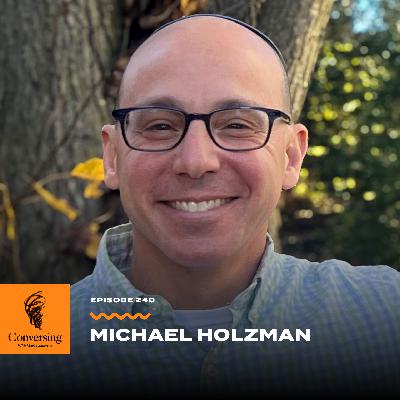
Rabbi Michael G. Holzman joins Mark Labberton to explore the formation of his Jewish faith, the pastoral realities of congregational life, and the multi-faith initiative he helped launch for the nation's 250th anniversary, Faith 250. He reflects on his early experiences of wonder in the natural world, the mentors who opened Torah to him, and the intellectual humility that shapes Jewish approaches to truth. Their conversation moves through the unexpected depth of congregational ministry, the spiritual and emotional weight of the pandemic, the complexities of speaking about God in contemporary Jewish life, and the role of cross-faith friendships. The episode concludes with Rabbi Holzman's reflections on how the suffering in Israel and Palestine reverberates among Jews and Muslims in America. Episode Highlights "I think we are desperately in need of ways to get Americans to agree that they're in the same community… simply by naming the Declaration of Independence as a piece of shared American scripture… we are inviting people and really challenging ourselves to think about the words in those documents seriously, and prayerfully." "My formation as a child was relatively non-theological… my mother just would sit there and say, 'Do you feel that wind?' And for me, knowing that it was in a national park mattered… being in such a grand and awesome space, under the enormity of the heavens." "The pursuit of truth with epistemic humility really became the cornerstone…if Moses wasn't allowed to see God's face, I'm never gonna see God's face—and yet we are all still pursuing what the meaning of this incredible text is." "I was a little bit unprepared… until you experience it as a pastor, you don't really understand the power of those things. That rootedness in this particular congregation gave me a sense of existential meaning that I didn't anticipate." "The thing that got me through that darkness was Saturday morning Torah study… just being there with the text and with these faces and these people… that to me was my path through the darkness." "When people are sitting over the text, the most palpable experience of God is this moment of understanding another human being… it's so vulnerable and it's so fleeting and it's so beautiful." "There is an experience happening on the ground of absolute suffering and horror on both sides… and there's a parallel experience happening for Jews and Muslims in America. It's powerful, spiritually powerful, emotionally powerful, and to people's core." Helpful Links and Resources Faith 250 https://www.faith250.org/ "The New Colossus" by Emma Lazarus https://www.poetryfoundation.org/poems/46550/the-new-colossus "What to the Slave Is the Fourth of July?" by Frederick Douglass https://teachingamericanhistory.org/document/what-to-the-slave-is-the-fourth-of-july/ "America the Beautiful" by Katherine Lee Bates https://www.gilderlehrman.org/history-resources/spotlight-primary-source/america-beautiful-1893 I and Thou, Martin Buber https://press.princeton.edu/books/paperback/9780684717258/i-and-thou About Rabbi Michael G. Holzman Rabbi Michael G. Holzman is the Senior Rabbi of Northern Virginia Hebrew Congregation (NVHC), where he has served since 2010. His work focuses on spiritual formation, civic engagement, multi-faith partnership, and the cultivation of communities grounded in dignity, learning, and ethical responsibility. He founded the Rebuilding Democracy Project, which developed into Faith 250, a national multi-faith initiative preparing communities for the 250th anniversary of the United States through shared reflection on foundational American texts. He teaches and writes on Jewish ethics, civic life, and spiritual resilience. Show Notes Faith 250 American Scripture Faith 250 as a response to political despair and a way for clergy to exercise agency Four core American texts explored as shared scripture across faiths Intent to counter politicization of the 250th anniversary through spiritual depth Multi-faith relationships grounding the initiative in shared civic and moral concern Emphasis on clergy as conveners of spiritually safe, local containers for reading The Declaration, New Colossus, Frederick Douglass, and America the Beautiful as "scriptural" portals to civic meaning "American scripture" as a means of naming shared identity and shared community Jewish Formation and Torah Childhood shaped by nature, wonder, and ethical awareness rather than synagogue life Early encounters with the Everglades as formative experiences of spirit and awe Discovery of Torah study as a young adult across Orthodox, Conservative, and Reform settings Epistemic humility as a defining mark of Jewish study practice Pursuit of truth understood through the "through a glass darkly" frame of Moses Torah received "through the hand of Moses" as mediating truth and mystery Chevruta (paired study) as the engine of discovery, disagreement, and meaning Pastoral Life and Congregational Meaning Surprised by the depth of pastoral work: weddings, funerals, life-cycle passages Intimacy of congregational leadership as a source of meaning rather than tedium Congregational relationships forming an existential and vocational anchor The role of community support during family medical crises How decades-long pastoral presence shapes shared covenantal life Teaching 12- and 13-year-olds to encounter the text as spiritual practice The power of intergenerational relationships in spiritual resilience Pandemic and Spiritual Survival Early months of 2020 as a time of fear, isolation, and emotional strain Counseling families whose loved ones were dying without visitors Previous experience with depression creating early warning signals Telehealth therapy as a critical intervention Saturday morning Torah study on Zoom becoming the path through darkness Growth of the study community throughout the pandemic Predictable humor and shared reading as markers of communal stability Textuality, God-Language, and Jewish Hesitations Jewish discomfort speaking explicitly about God for theological and cultural reasons Layers of humility, anti-mysticism, differentiation from Christianity, and historical experience Sacredness and mystery of the scroll growing in the digital age Physicality of the Torah scroll attracting deeper attention and reverence Hebrew as a source of multivalent meaning, sonic power, and spiritual resonance Reading together as the most common encounter with God: understanding another's soul Pastoral awareness of individuals' life stories shaping group study dynamics Cross-Faith Devotion and Shared Honor Friendships with Muslim, Christian, and Hasidic leaders deepening spiritual insight Devotion in others sparking awe rather than defensiveness Disagreement becoming a site of connection rather than separation Devotion in other traditions prompting self-reflection on one's own commitments Stories of praying with and learning from ultra-Orthodox leaders Shared pursuit of truth across tradition lines as a form of civic and spiritual honor American religious diversity offering unprecedented exposure to sincere piety Israel, Gaza, and American Jewish Experience Suffering, fear, and horror experienced by Israelis and Palestinians Parallel emotional and spiritual pressures faced by Jews and Muslims in America Concern about political manipulation of community trauma Generational trauma and its transmission, including Holocaust-era family stories Emotional resonance of global conflict in local congregational life Distinction and connection between geopolitical realities and American spiritual experience Call to honor emotional realities across neighborhoods and communities Production Credits Conversing is produced and distributed in partnership with Comment Magazine and Fuller Seminary.
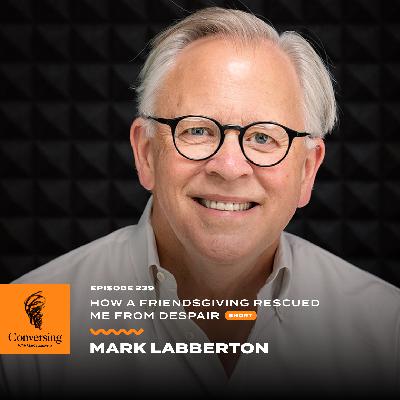
In this Thanksgiving reflection, Mark Labberton opens up about a period of darkness and despair, when as a younger man he considered ending his life. But when he was invited to share Thanksgiving dinner with a local couple, his eyes were opened to concrete acts of hope, friendship, and joy—all embodied in the simple feast of a community "Friendsgiving" potluck. Every year since, Mark calls these friends on Thanksgiving Day, in gratitude for and celebration of the hospitality, generosity, beauty, friendship, and hope he encountered that day. Here Mark reflects on the emotional and psychological difficulties he was going through, the meaning and beauty of friendship, how every dish of a Thanksgiving dinner is an act of hope and community, and how hospitality and generosity can uplift every member of a community. If you or anyone you know is struggling with depression or considering suicide, there is help available now. Simply call or text 988 to speak with someone right away, share what you're going through, and get the support you need. About Mark Labberton Mark Labberton is the Clifford L. Penner Presidential Chair Emeritus and Professor Emeritus of Preaching at Fuller Seminary. He served as Fuller's fifth president from 2013 to 2022. He's the host of Conversing. Show Notes A story about Thanksgiving Day many years ago, during Mark Labberton's master of divinity degree at Fuller Seminary "… not just overwhelmed, but really undone" " … the possibility of ending my life …" Every Thanksgiving dish as an act of hope and community Beauty of friendship A magnificent extravaganza Sharing not just food but hope "Things had radically changed. And that in fact they had, they had not only changed my mindset, but they had saved my life." "For me, Thanksgiving Day holds this deep and pensive awareness that Thanksgiving doesn't always come easy, that often it's a difficult act, that it involves things that are sometimes impossible for certain people to carry. And at the same time, it's possible for other people to carry them in our place, which is what these friends did for me that day." If you're feeling despair, seek professional help. Call or text 988 for an immediate response with a counsellor. Seek community. "Whether you're in darkness or in light, whether your heart feels full of gratitude or whether it may not, I just hope that you'll be aware that God is with you, that you are not alone, that there are people that want to support you and help you, and that there are people that know you who would welcome you into a circle of celebration and gratitude today." Production Credits Conversing is produced and distributed in partnership with Comment magazine and Fuller Seminary.
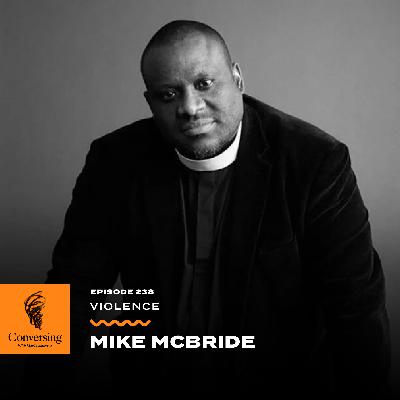
To exist as a black male in America is to be perceived as a threat, where criminality is attributed by default and violence is justified from racial bias. And as a young man, Pastor Mike McBride learned through personal experience that following Jesus does not protect you from the violence of the state. How could it, when Jesus himself was crucified by religious- and state-sponsored violence? In this episode, Pastor Mike (The Way Christian Center, Berkeley, CA) joins Mark Labberton to discuss the confluence of Black Pentecostal holiness, police brutality, gun violence prevention, Christian nationalism, political polarization, racial justice, and the urgent spiritual crisis facing the American church. From his childhood in the San Francisco neighborhood of Bayview–Hunter's Point, to the trauma of a police assault in 1999, to national leadership in Ferguson, to confronting the rise of authoritarian Christianity, Pastor Mike traces the formation of his vocation and the cost of staying faithful to Jesus in a nation shaped by anti-blackness and state-sponsored violence. His story of survival, theological awakening, moral urgency, and hopeful action is rooted in the gospel's call to respond with peaceful action against the violence of the world. Episode Highlights "What is it about this gospel that their family members, their parents trust you with the salvation of their souls, but not the safety of their bodies." "It forced me to really have a strong come to Jesus meeting about how am I being prepared to do what I was already feeling a lifeline calling of ministry while I was starting the work of justice as a first victim and crime survivor." "It is some kind of delusion for us to follow Jesus who got crucified and killed by the state and then be surprised when we get crucified by the state." "I think there was just this sensibility that was a part of our upbringing that this is what it means to be black in America." "People are being discipled into racism. People are being discipled into anti-blackness." "I hope that feeding the hungry clothing the naked healing the sick is not something that in 2025 Christians identify as some leftist socialist liberal Christianity or we've lost it." Helpful Links and Resources Live Free USA https://www.livefreeusa.org Roots, Alex Haley https://www.amazon.com/Roots-American-Family-Alex-Haley/dp/030682485X Boston TenPoint Coalition / Eugene Rivers https://btpc.org/ Oscar Grant Case (NPR Overview) https://www.npr.org/2010/07/09/128401136/transit-officers-verdict-sparks-violent-protests About Michael McBride Pastor Michael McBride (often known as "Pastor Mike") is the National Director of Live Free USA, a nationwide movement of faith leaders and congregations dedicated to ending gun violence, mass incarceration, and the criminalization of Black and Brown communities. A respected activist, pastor, and organizer, he has been a prominent voice in national efforts to address police violence, promote community-based safety strategies, and mobilize churches for racial justice. Pastor Mike is also the founding pastor of The Way Christian Center in Berkeley, California. His leadership, advocacy, and public witness have been featured across major media outlets, integrating faith, justice, and community transformation. Show Notes Holiness, formation, and black pentecostal roots Growing up as the second oldest of six in Hunters Point with deep Southern family roots "We grew up just very much enmeshed in a black church, holiness culture." Strict holiness prohibitions: no movies, no drinking, no secular music, no dancing. Holiness as both constraint and survival strategy during the crack era The world of Southern Baptist school culture colliding with black identity Racial Identity, Civil Rights Memory, and Family Formation Annual watching of Eyes on the Prize as civic and spiritual ritual. Leaving school to attend MLK Day celebrations: "I dare you to say something about it." Roots, Alex Haley, and early consciousness of black struggle and survival State violence, trauma, and theological turning point March 1999 police assault: physical and sexual violence during a "weapons search." "You can be following Jesus faithfully and still be subjected to violence at the hands of the state." The dissonance of worshiping a crucified Messiah while denying contemporary crucifixions Youth in his ministry revealing they didn't tell him because "we didn't think the church would do anything." Call to ministry, theological awakening, and training Exposure to church history, patristics, Thomas Merton, and MLK Jr. Grant Wacker inviting him to Duke; scholarship leading to seminary training Influence of black theologians and faculty shaping his justice imagination Meeting Eugene Rivers and the birth of a vocation in violence reduction and organizing Ferguson, activism, and the crisis of Christian witness Returning from Cape Town when Mike Brown was killed; sudden call to St. Louis Tear gas, militarized police, and "the ugly underside of the American law enforcement apparatus." "Our marriages didn't survive that era." Ferguson as exposure of the divide within the American church: respectability politics, sexuality panic, racial division "People are being discipled into racism … into militarism … into economic exploitation." Political polarization and Christian Nationalism 2016–present: Trumpism as a carrier of a broader reactionary Christian political project. Concern for Christian authoritarianism masquerading as religious fidelity. "You should definitely live out your convictions… but that don't mean you should kill everybody else on your hill." Deep grief over the church's inability to discern the danger George Floyd, red lines, and the urgency of now Summer 2020 as national smelling salt: "the banality and the violence of this state." The ceiling on empathy in American evangelicalism Targeted universalism and the need for differentiated strategies for shared goals Wealth inequality, homelessness, hunger, and the moral failure of Christianized politics "I hope that feeding the hungry clothing the naked healing the sick is not something… Christians identify as leftist." Participatory democracy as spiritual stewardship The Trinity as a model of unity-with-difference Holiness as public witness: protecting bodies and souls A charge to oppose Christian nationalism and join justice-infused faithfulness Production Credits Conversing is produced and distributed in partnership with Comment Magazine and Fuller Seminary.
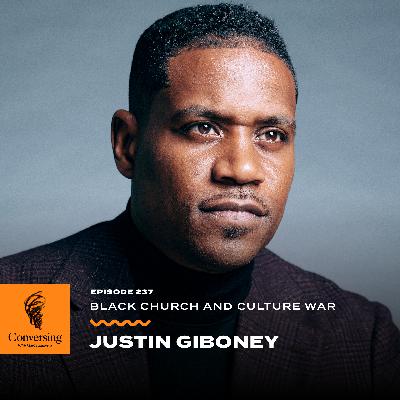
How would the black church's public witness guide Christians through today's polarization, culture-war dynamics, and ideological captivity? Drawing from Don't Let Nobody Turn You Around, Justin Giboney joins Mark Labberton to reflect on Christian credibility (and lack thereof), the black church's public witness, and the deep forces shaping American polarization. Reflecting on the legacy of the twentieth-century civil rights generation, Giboney describes how the black church's fusion of orthodoxy and social action offers a model for healing division, resisting ideological captivity, and embodying what he calls "moral imagination." Citing the formative influences of his grandmother Willie Faye, the example of Mahalia Jackson, and the ongoing challenge of navigating truth, justice, family, unity, and political engagement in a fractured moment, Giboney explores discipleship in an ideological age, the cost of a credible public witness, and the hope of a church capable of transcending partisan allegiance to seek the good of neighbor and the glory of God. Episode Highlights "One thing that I saw in the civil rights generation is they were able to have a bigger perspective, even in songs like 'Keep Your Eyes on the Prize.'" "Love is self-sacrifice. It's being willing to at my own expense in some instances give up what I have to others." "This was a deliberate decision that they made to say, we're not gonna choose one of these two sides that these groups are creating for us." "Within the public square, credibility is currency." "I want all Christians to take that as their own and build on that." Helpful Links and Resources Don't Let Nobody Turn You Around by Justin Giboney https://www.ivpress.com/don-t-let-nobody-turn-you-around The AND Campaign https://andcampaign.org/ Mahalia Jackson biography (PBS) https://www.pbs.org/wnet/americanmasters/mahalia-jackson-about-the-singer/602/ Reading While Black by Esau McCaulley https://ivpress.com/reading-while-black About Justin Giboney Justin Giboney is an attorney and political strategist in Atlanta, Georgia. He is also the co-founder and president of the AND Campaign, a Christian civic organization focused on asserting the compassion and conviction of the gospel in the public square. He has served as an attorney, political organizer, and civic leader, and he regularly speaks and writes on the intersection of Christianity and politics. Show Notes Justin Giboney describes being an attorney, political strategist, and ordained minister, and cofounder of the AND Campaign He explains the AND Campaign's mission to raise civic literacy among Christians and resist purely partisan frameworks in favor of a biblical one "Social justice and moral order, love and truth, compassion and conviction" as a united Christian vision rather than opposing camps Lit City literacy initiative in Atlanta bringing churches across racial and partisan divides together for shared mission Ten-week programs for Christians preparing to run for office or engage politics constructively Naming and confronting polarization as a dialectical division that splits what should be held together Intro and summary to Giboney's book, Don't Let Nobody Turn You Around, framed as applying civil rights wisdom to the current culture-war moment Giboney's grandmother Willie Faye and Mahalia Jackson as representative figures of the civil rights generation's theological and moral framework Moral imagination defined as the capacity to see what ought to be, not merely what is: "the ability to see what will be based on God's promises" Songs like "Keep Your Eyes on the Prize" as examples of moral imagination sustaining courage and humility The necessity of Scripture's authority and why the black church's orthodoxy and orthopraxy shape public witness Giboney's critique of individualism and his insistence that love is fundamentally "self-sacrifice" rather than self-expression Historical correction: The black church neither mirrors conservative ideology nor progressive ideology; it deliberately resisted both. "If we go to the right, we lose our bodies… if we go to the left, we could lose our soul." The strategic theological posture of black church leaders Christian credible witness requires coherence, humility, and honesty—rather than partisan performance Credibility in public "is currency," requiring self-examination, confession, and honesty about ideological idols Civil Rights Movement disciplines: self-purification, preparation through prayer and fellowship, resisting bitterness before engaging action Parenting, resilience, and teaching his sons not to give disproportionate emotional energy to racist comments, while still confronting wrongdoing The role of community formation, honor, and integrated humanity within black church worship life Hopes for the church: rejecting secular assumptions about who can reconcile, cultivating humility across divisions AND Campaign's twenty-year vision: Christians uniting across party lines around shared commitments like racial justice, family, sanctity of life, and poverty Final exhortation: The black church's public witness is a gift and challenge to the entire American church, not just one community. Production Credits Conversing is produced and distributed in partnership with Comment magazine and Fuller Seminary.
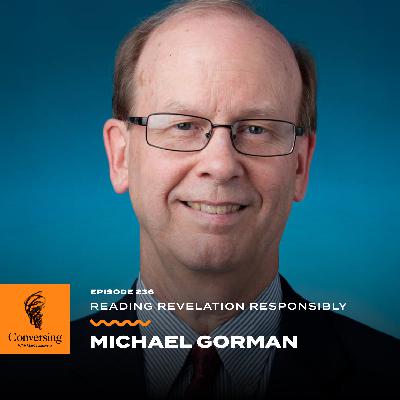
What is the book of Revelation really about? For ages, it has been the source of sensationalism, idolatry, confusion, and end-times predictions. But at its root, it is about the power and worship of the Lamb who was slain. Biblical scholar Michael J. Gorman joins Mark Labberton to explore how Christians can read the book of Revelation with wisdom, faith, and hope rather than fear or sensationalism. Drawing from his book Reading Revelation Responsibly: Uncivil Worship and Witness—Following the Lamb into the New Creation, Gorman offers a reorientation to Revelation's central vision: worshipping the Lamb, resisting idolatrous power, and embodying faithful discipleship in the world. Together they discuss Revelation's misuses in popular culture, its critique of empire and nationalism, and its invitation to follow the crucified and risen Christ into the new creation. Episode Highlights "The book of Revelation is about lamb power—not hyper-religious or political power. It's about absorbing rather than inflicting evil." "This book is for those who are confused by, afraid of, and or preoccupied with the book of Revelation." "We shouldn't look for predictions but for parallels and analogies." "Worship, discipleship, and new creation—that's where Revelation hangs its hat." "At its root, Christian nationalism is a form of idolatry." "The only way to come out of Babylon is to go back into Babylon with new values and new practices." Helpful Links and Resources Reading Revelation Responsibly – https://www.amazon.com/Reading-Revelation-Responsibly-Following-Creation/dp/1606085603/ Reverse Thunder by Eugene Peterson – https://www.amazon.com/Reversed-Thunder-Revelation-Praying-Imagination/dp/0060665033 St. Mary's Seminary & University, Baltimore – https://www.stmarys.edu About Michael J. Gorman Michael J. Gorman is the Raymond E. Brown Professor of Biblical Studies and Theology at St. Mary's Seminary & University in Baltimore, Maryland. A leading New Testament scholar, he is the author of numerous books on Pauline theology and Revelation, including Reading Revelation Responsibly, Cruciformity, and Participating in Christ. Gorman's teaching and writing emphasize Scripture as a call to cruciform discipleship, faithful worship, and the hope of new creation. Show Notes Introducing Reading Revelation Responsibly "This book is for those who are confused by, afraid of, and or preoccupied with the Book of Revelation." "Apocalypse" means revelation, not destruction. Emerging from twenty-five years of study and teaching, aimed at rescuing Revelation from misinterpretation or neglect Growing up amid 1970s end-times obsession—Hal Lindsey's The Late Great Planet Earth and fearful youth-group predictions of the world's end Fear of the book of Revelation until he studied it with Bruce Metzger at Princeton Seminary Why he wrote the book: for people who have been scared or confused by Revelation's misuse Interpretation and misreading the book of Revelation Early questions: Does Revelation predict particular events or people? No predictions, but symbolic speaking into every age "Our task is not to find predictions but to discern parallels and analogies." Warning against mapping Revelation onto modern crises or personalities "When those predictions fail, the book gets sidelined or scoffed at." Keep one foot in the first-century context and one in the present Worship and discipleship The heart of Revelation is worship. "This is a book about worship—and about the object of our worship." Explaining the subtitle: Uncivil Worship and Witness—Following the Lamb into the New Creation "Uncivil worship" contrasts with "civil religion"—worship that refuses to idolize political power Influence from Eugene Peterson's Reverse Thunder and his own teaching at St. Mary's, where Peterson once taught Revelation Worship leads to discipleship: "Those who follow the Lamb wherever he goes." True discipleship mirrors the Lamb's humility and non-violence. The lamb and the meaning of power Interpreting Revelation's vision of the slain and standing Lamb as the key to understanding divine power "The crucified Messiah is the risen Lord—but he remains the crucified one." The Lamb appears twenty-eight times, a symbol of universality and completeness. "Revelation is about lamb power—absorbing rather than inflicting evil." Discipleship is cruciform: following the Lamb's way of self-giving love. The unholy trinity and the danger of idolatry Chapters 12–13 depict the dragon and two beasts—the "unholy trinity" of satanic, imperial, and religious power. "Power gone amok": political, military, and spiritual domination that mimic divinity How true worship resists empire and exposes idolatry Warning against reading these beasts as predictions of the UN or the pope; rather, they reveal recurring alliances of religion and politics "At its root, Christian nationalism is idolatry." When political identity eclipses discipleship, "political power always wins, and faith loses." Faith, politics, and worship today Christian nationalism as a modern form of "civil religion," conflating patriotism with divine will "It's only Christian in name—it lacks Christian substance." Idolatry is not limited to one side: "It permeates the left, the right, and probably the centre." Labberton agrees: false worship is endemic wherever self-interest and fear shape our loves. Both stress that Revelation calls the church to worship the Lamb, not the state. "Revelation critiques all human systems of false worship." Revelation's goal: Not destruction, but new creation "Destruction is penultimate—cleansing the way for renewal." Believers already live as citizens of that new creation. "The only way to come out of Babylon is to go back into Babylon with new values and new practices." Communal, not merely individual, discipleship: "Revelation is written to churches, not just believers." Reinterpreting Revelation 3:20: Jesus knocking isn't an altar call to unbelievers but Christ seeking re-entry into his own church. "Jesus always wants to come back in." Living revelation today Spirituality of hope, not fear or withdrawal "Reading Revelation responsibly means engaging the world through worship and witness." How true worship is dangerous because it transforms our allegiance. "Following the Lamb into the new creation is the church's act of resistance." Conclusion: "Worthy is the Lamb." Production Credits Conversing is produced and distributed in partnership with Comment magazine and Fuller Seminary.
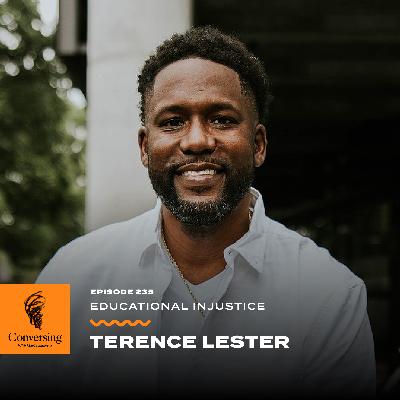
Adverse childhood experiences are notoriously hard to overcome, and they can affect a person well into adulthood. But the grace of close, stable, nurturing relationships can offer hope. Terence Lester—author of From Dropout to Doctorate and founder of Love Beyond Walls—joins Mark Labberton for a conversation about resilience, faith, and the redemptive power of seeing and being seen. Lester recounts his life's journey from poverty, homelessness, and gang membership in southwest Atlanta to earning his PhD in public policy and social change. Together, they explore the impact of childhood trauma on personal development; education as a form of love, justice, and community service; and the healing potential of local community and proximity. Lester's story is a testament to divine grace, human courage, and the transformative impact of compassionate words and faithful presence. Episode Highlights "The higher your ACE score, the more your body has to overcome… Every 'yes' cultivates a stronger relationship with pain. Your counterparts with lower scores may never develop those same muscles of resilience." "Education is a tool that increases your capacity to serve others." "People don't become what you want them to become—they become what you encourage them to become." "I am a product of people who invested in me and of the things I've had to resist." "You can't love your neighbour if you're not concerned about the neighbourhood that produces your neighbour." "Each sentence spoken can become a seed of hope—or a curse that crushes it." Helpful Links and Resources Terence Lester's website – https://terencelester.com/ From Dropout to Doctorate – https://www.ivpress.com/from-dropout-to-doctorate I See You: How Love Opens Our Eyes to Invisible People – https://www.ivpress.com/i-see-you Love Beyond Walls (Terence Lester's non-profit) – https://www.lovebeyondwalls.org ACEs Study (Adverse Childhood Experiences) – https://www.cdc.gov/violenceprevention/aces/index.html The Color of Compromise by Jamar Tisby – https://jemartisby.com/the-color-of-compromise/ About Terence Lester Terence Lester is a speaker, activist, author, and founder of Love Beyond Walls, a non-profit organization dedicated to raising awareness about poverty and homelessness while mobilizing communities to serve those in need. A graduate of Union Institute & University with a PhD in public policy and social change, he is the author of I See You: How Love Opens Our Eyes to Invisible People, When We Stand: The Power of Seeking Justice Together, **and All God's Children: How Confronting Buried History Can Build Racial Solidarity. His latest book is From Dropout to Doctorate: Breaking the Chains of Educational Injustice. Through storytelling, advocacy, and faith-rooted organizing, Lester seeks to dismantle systemic barriers and call communities toward justice, empathy, and proximity. Show Notes Education and social change Terence Lester describes sitting beside his father's hospital bed reflecting on vulnerability, legacy, and resilience. His father's words—"I'm proud of you"—affirmed the journey from poverty to doctorate. Growing up amid trauma, gangs, and homelessness in southwest Atlanta. The generational impact of systemic injustice and public policy shaping social outcomes Education as a tool for empowerment and community transformation, not self-advancement "Education is a tool that increases your capacity to serve others." How the post–Civil Rights era shaped identity and pride in blackness while still marked by inequality Frames poverty itself as a form of trauma, calling for empathy and systemic response Trauma, resilience, and the ACEs framework Adverse Childhood Experiences (ACEs) test as a tool for understanding trauma Lester shares his 10/10 ACE score—complete exposure to childhood trauma "Every 'yes' cultivates a stronger relationship with pain… You must climb out of a pit to reach emotionally stable ground." How adversity produced resilience, not fragility Connecting personal trauma to compassion in ministry among the unhoused How proximity to suffering forms the capacity for empathy and love Faith, identity, and calling Connecting resilience and faith: "I believe my being was intricately woven together by God." Psalm 139 and seeing himself as "fearfully and wonderfully made" Jesus's life as a model of proximity and compassionate visibility—"Jesus saw." The church as a community of affirmation and blessing How words spoken over others—curses or encouragement—shape identity "People don't become what you want them to become—they become what you encourage them to become." Community, visibility, and flourishing "You can't love your neighbor if you're not concerned about the neighborhood that produces your neighbor." Warns of a "compassion deficit" and urges the rebuilding of community communication Seeds and environments: people cannot flourish where conditions are hostile The need for better care for impoverished environments that stunt potential Community as the soil of hope—"People find hope and possibility in community." Lester's mother's resilience and faith—earning her own doctorate while raising two children "I am a product of her never giving up." The generational power of education and faith as liberation Hope, words, and the power of blessing Transformative and timely sentences: encouraging words of seeds or yeast—small yet life-altering How to speak life, not curses, over others "Each sentence spoken can become a seed of hope—or a curse that crushes it." Mentorship, community affirmation, and divine proximity as instruments of healing Interrogating falsehoods: "God is not the source of cursing." A call to faith-rooted compassion, proximity, and collective responsibility. Production Credits Conversing is produced and distributed in partnership with Comment magazine and Fuller Seminary.
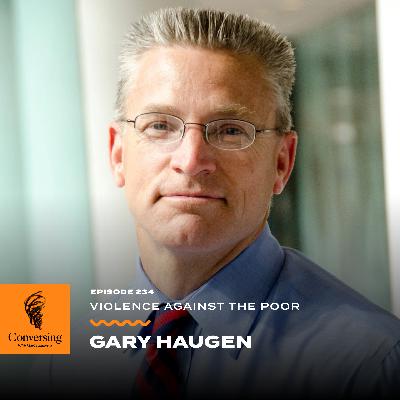
How can we address the problem of violence against the poor? International Justice Mission exists to answer this question by protecting and rescuing victims, bringing criminals to justice, restoring survivors to safety and strength, and helping local law enforcement build a safe future that lasts. In this episode, International Justice Mission's founder and CEO, Gary Haugen, joins Mark Labberton to reflect on almost three decades of IJM's fight against violence and slavery worldwide—and the spiritual formation that sustains it. Haugen shares the origins of IJM in response to systemic violence against the poor, the evolution from individual rescues to transforming justice systems, and the remarkable rise of survivor leaders transforming their own nations. Together they reflect on courage, joy, and faith amid immense risk—bearing witness to God's power to bring justice and healing through ordinary people. Episode Highlights "Protecting the poor from violence is God's weight, but it's our work, and we're gonna seek to do it Jesus's way." "In this era, I just think what the world is aching to see is the followers of Jesus who have a incandescent freedom from fear and a life-giving joy." "Most of this violence will go away if government does just even a decent job of enforcing the law." "Our first commitment is to help each other become more like Jesus—and from that strength, to do justice." "The greatest miracle of IJM is not only the results—it's the freedom from fear and the joy with which they've done it." "God saw them in their darkness, and they now testify to the goodness of an almighty God who loved them." Helpful Links and Resources International Justice Mission – https://www.ijm.org Gary Haugen, The Locust Effect: Why the End of Poverty Requires the End of Violence – https://www.amazon.com/Locust-Effect-Poverty-Requires-Violence/dp/0199937877 Gary Haugen, Just Courage: God's Great Expedition for the Restless Christian – https://www.amazon.com/Just-Courage-Expedition-Restless-Christian-ebook/dp/B001PSEQR4 Riverside Church Sermon by Martin Luther King Jr., "Beyond Vietnam" — https://kinginstitute.stanford.edu/encyclopedia/beyond-vietnam William Lloyd Garrison biography – https://www.britannica.com/biography/William-Lloyd-Garrison Rwanda Genocide Investigation (UN Historical Overview) – https://www.un.org/en/preventgenocide/rwanda About Gary Haugen Gary Haugen is the founder and CEO of International Justice Mission (IJM), the world's largest international anti-slavery organization. Before founding IJM in 1997, he served as the director of the United Nations' investigation into the Rwandan genocide and previously worked at the US Department of Justice, focusing on police misconduct. A graduate of Harvard University and the University of Chicago Law School, Haugen has dedicated his life to ending violence against the poor and mobilizing the global church for justice. Show Notes The founding of IJM in 1997 as a Christian response to violence against the poor Gary Haugen's formative experience directing the UN's genocide investigation in Rwanda Realization that hunger and disease were being addressed—but violence was not Early cases in the Philippines, South Asia, and Peru exposing police-run brothels and child slavery IJM 1.0: rescuing individuals from slavery and abuse, case by case IJM 2.0: strengthening local justice systems to prevent violence before it happens Martin Luther King Jr.'s "Jericho Road" as a model for systemic transformation Formation of small multidisciplinary teams—lawyers, investigators, social workers IJM's evolution from rescue operations to building sustainable justice infrastructure Twenty-year celebration: Liberate conference and the global IJM staff retreat IJM's culture of spiritual formation: daily solitude, prayer, and community rhythms A Christian order of justice rooted in prayer, silence, and shared joy Spiritual formation as the foundation for sustainable justice work Experiments in Cambodia, the Philippines, and South Asia reducing violence by up to 85 percent Replication of IJM's model across 46 regions to protect 500 million vulnerable people Goal by 2030: one million freed from slavery, 300 million living under protection Empowering survivor leaders: from victims to advocates and elected officials Stories of transformation like Pama in South Asia leading the Release Bonded Laborers Association The Kenyan case of Willie Kimani—murdered IJM lawyer whose legacy reformed police accountability IJM's resilience: pursuing justice for six years until conviction of perpetrators Theological grounding: justice as God's work, pursued in Jesus's way Haugen on resilience: "It's a marathon, not a sprint" Joy and freedom from fear as hallmarks of IJM's culture How IJM balances global crisis fatigue with focused mission clarity Future challenges: technology-driven oppression—live-stream child abuse and forced scamming Global body of Christ as the essential network for courage and joy Sustainability and local leadership as the future of global justice movements Spiritual communities as the seedbed for future justice leaders Production Credits Conversing is produced and distributed in partnership with Comment magazine and Fuller Seminary.
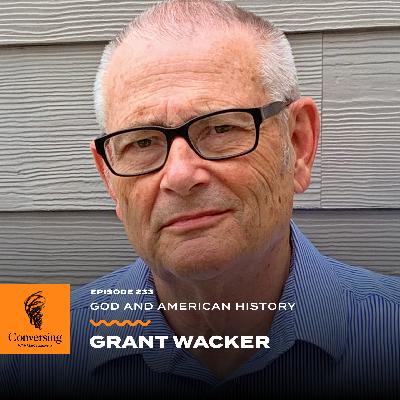
What is the theological meaning of American history? In this episode, American church historian Grant Wacker joins Mark Labberton to explore the theological dimensions of American history, the legacy of Billy Graham, and the evolving face of evangelicalism. Wacker reflects on his Pentecostal upbringing, his formation as a historian, and his conviction that faith and scholarship must speak honestly to one another. Together they trace how religion has both shaped and distorted American life—from the enduring wound of slavery to the reformist spirit woven through its history. Wacker, now in his eighties, offers his perspective on evangelicalism's past, present, and global future. Episode Highlights "Religion has always been at the forefront of rationalizing and making enslavement seem perfectly normal—perfectly natural. It's just the order of things." "Many of the very finest religious historians are not believers—and they do superb work in understanding where religion lies." "I don't think there is Christian nationalism out there. What there is is that there is nationalism that draws on Christian categories to legitimate itself." "I don't think what we're looking at is a religious movement. We're looking at a political movement that uses religious categories." "We should write about others the way we wish they would write about us." "You Americans are always asking the Holy Spirit to bring revival. What you ought to be doing is asking the Holy Spirit to open your eyes to the revival that is already flourishing." Helpful Links and Resources America's Pastor: Billy Graham and the Shaping of a Nation by Grant Wacker — https://www.amazon.com/Americas-Pastor-Graham-Shaping-Nation/dp/0674052188 Heaven Below: Early Pentecostals and American Culture by Grant Wacker — https://www.amazon.com/Heaven-Below-Pentecostals-American-Culture/dp/0674011287 One Soul at a Time: The Story of Billy Graham by Grant Wacker — https://www.amazon.com/One-Soul-Time-Religious-Biography/dp/0802885500/ Mark Noll's The Civil War as a Theological Crisis — https://www.amazon.com/Theological-Crisis-Steven-Janice-Lectures/dp/1469621819 Religion in American Life: A Short History — ****https://www.amazon.com/Religion-American-Life-Short-History/dp/0199832692/ About Grant Wacker Grant Wacker is the Gilbert T. Rowe Distinguished Professor Emeritus of Christian History at Duke Divinity School. A leading scholar of American religious history, he is the author of numerous books including Heaven Below: Early Pentecostals and American Culture and America's Pastor: Billy Graham and the Shaping of a Nation. His research has helped shape modern understanding of American evangelicalism, Pentecostalism, and the intersection of faith and culture. Show Notes Wacker's path to the study of history through mentorship at Harvard Divinity School and a fascination with theology's relationship to historical reality He distinguishes between observing "religion operating in history" and perceiving "the divine hand," emphasizing the tension between secular and theological approaches to the past. Four major contexts that define the American story: geography, capitalism, immigration, and race Eleven domains where the power of religion—and possibly divine influence—can be seen, from colonization and enslavement to revivalism and reform. "We are a people of plenty—prosperous partly because of the accident of geography." Reformed and Wesleyan theology as twin engines shaping the nation's moral and social imagination. Humility as "at the heart of Reformed theology: we don't run our lives; something else is running the show." Wesleyan theology, by contrast, stresses human enablement and responsibility: "If we are able to do it, we are responsible for doing it." Catholic contributions to the American story, especially the richness of liturgy and the continuity of two thousand years of history Reflections on racial sin as a "permanent wound," calling religion both complicit in and necessary for confronting slavery's legacy Mark Noll's The Civil War as a Theological Crisis, highlighting how both sides invoked Scripture without self-awareness or self-critique "Religion has always been implicated in making enslavement seem natural—as natural as breathing." Describes evangelicalism's deep roots in pietism and revivalism, its mainstream dominance by the late nineteenth century, and its later fragmentation. "Evangelicalism became the main line—it was the standard way Protestantism operated." Outlines the modern trifurcation: fundamentalists, liberals, and a centrist evangelical river that remains influential. "Christian nationalism" is largely a political, not religious, phenomenon: nationalism using Christian categories to legitimize itself. "Religion is rarely an independent variable in determining how people vote." Richard Bushman (paraphrase): Have we written about [the subjects of academic history] as fairly and honestly as we can, or have we distorted their story in order to make ourselves look good? A call for fairness in historical judgment: "Write about them the way you wish they would write about you." Prediction: Evangelicalism's future lies "south of the equator"—in Africa, Asia, and Latin America. Quotes a Jesuit: "Americans keep asking for revival; they should ask to see the revival that's already happening." On Christian nationalism: "The question is not whether religion and politics collude—they always have—but whether we can be self-conscious and humble about it." Identifies power, prosperity, and digital speed as the toxic combination shaping contemporary polarization. "Speed is a narcotic for humans—we want to be connected now." Reflects on Billy Graham's unifying role and his progressive evolution on race and nuclear disarmament: "He became increasingly moderate, increasingly inclusive." Notes Graham's three conversions—to Christ, to racial justice, and to peace. "The United States and the Soviet Union are like two little boys in a bathtub filled with gasoline, playing with matches." On teaching and legacy: "My students are earnest—they want to do well for the world they live in." "Whatever good has come—it's a gift, not earned." Humility, humor, and grace as rare marks of faith and scholarship integrated Production Credits Conversing is produced and distributed in partnership with Comment magazine and Fuller Seminary.
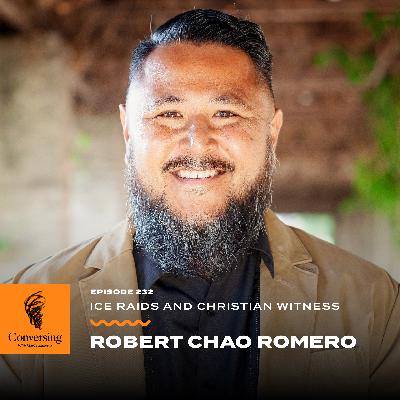
"Migration is grace," says UCLA professor Robert Chao Romero, author of Brown Church: Five Centuries of Latina/o Social Justice, Theology, and Identity. In this episode, he joins Mark Labberton to discuss the immigration crisis through stories from Southern California, theology of migration, and the challenge of Christian nationalism for the American response to the immigration crisis we face. Romero narrates heartbreaking accounts of ICE raids, racial profiling, and dehumanization, while also offering hope rooted in scripture and the early church. He points out the "Xenodochias" of the ancient and medieval church that cared for migrants. And he shows how biblical narratives—from Abraham to Jesus—reveal God's mercy in migration. Romero calls Christians to see the image of God in migrants, resist the "Latino threat narrative," and reclaim the church's historic role in welcoming the stranger. Episode Highlights "Migration is grace. … You wouldn't have a Bible without migration." "Jesus lived and died as an outsider in solidarity with all outsiders, and he rose to new life among outsiders." "The gospel is an outward pushing invitation… it is the pushing out actually into the far and remote places of suffering in need." "This level of targeting of the Latino community has not happened since 1954 and Operation Wetback." "We think that crossing the US border is like crossing the Jordan into the promised land, and we're baptized into the Yankee Doodle song." Helpful Links and Resources Brown Church by Robert Chao Romero UCLA César E. Chávez Department of Chicana/o and Central American Studies Fuller Seminary's Centro Latino CLUE: Clergy and Laity United for Economic Justice World Relief About Robert Chao Romero Robert Chao Romero is an associate professor in the UCLA César E. Chávez Department of Chicana/o and Central American Studies and in the Asian American Studies Department. With a background in law and history, his research and teaching explore the intersections of race, immigration, faith, and justice. He is the author of Brown Church: Five Centuries of Latina/o Social Justice, Theology, and Identity (IVP Academic), which chronicles the long history of Latino Christian social justice movements. Romero is also an ordained pastor, active in local church ministry and theological reflection on immigration, Christian nationalism, and the global church. Show Notes Immigration Crisis and ICE Raids Student testimonies of fear and trauma at UCLA during immigration crackdowns Stories of ICE targeting bus stops, car washes, and Home Depots in Southern California Latino citizens, veterans, and even high school students detained despite legal status A man fleeing ICE was killed in traffic, sparking vigils and protests Historical Parallels and Christian Nationalism Comparison to Operation Wetback of 1954, when over one million were deported Escalating racial profiling, reinforced by Supreme Court decisions "Latino Threat Narrative" portrays Latinos as criminals and unwilling to assimilate Christian nationalism merges citizenship and faith, echoing "manifest destiny" Theology of Migration and Outsiders Migration as grace: God intervenes with compassion in nearly every biblical migration story "We live alongside the world. We don't belong to the world." " Jesus lived and died as an outsider in solidarity with all outsiders, and he rose to new life among outsiders." (Jorge Lara-Braud) Jesus as an asylum seeker in Egypt; Ruth and Joseph as biblical migrants Early church created "xenodochias"—ancient and medieval social service centers for immigrants and the poor Outsider theology: Christians as strangers and aliens, called to care for outsiders "Jesus lived and died as an outsider in solidarity with all outsiders." Policy Challenges and Misconceptions Millions of mixed-status households trapped by the "10-year bar" in immigration law Asylum seekers legally present cases at the border under U.S. law Refugees undergo extensive vetting, often over decades Common myths about immigrants as "illegal" are contradicted by law and history Faith, Empathy, and the Church Empathy as central to Christian response, counter to narratives of fear and scarcity Latino pastors passing on both the gospel and nationalism from missionary influence The church historically provided refugee care before the UN Refugee Agency existed Worship with immigrant congregations as a source of hope and resilience Orthodox theology: worship joins heaven and earth, every tribe and nation before the Lamb Production Credits Conversing is produced and distributed in partnership with Comment Magazine and Fuller Seminary.
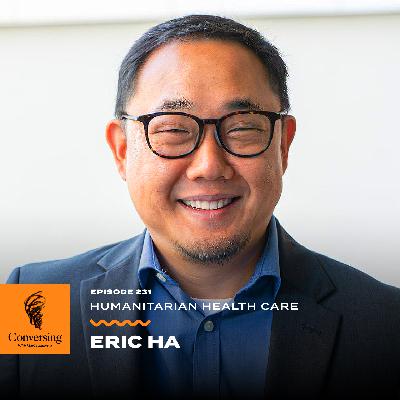
Millions of people today face dire medical and mental health challenges. What role should the church play in foreign humanitarian aid to address starvation and deadly illness? In this episode, Eric Ha, CEO of Medical Teams International, joins Mark Labberton for a sobering, hopeful conversation on global humanitarian crises and the role of the church in responding to both the physical and spiritual needs of those who are suffering. Drawing from his years at International Justice Mission and now at Medical Teams International, Ha shares vivid accounts from refugee camps in East Africa and migrant communities in Colombia. He reflects on the collapse of US foreign aid, the limits of humanitarian response, and the urgent need for churches to reclaim their historic role in caring for the vulnerable. Ha wrestles candidly with the calling of Christian communities to embody God's expansive love even amid staggering need. Episode Highlights "These humans that bear the image of the divine and the eternal, and the holy and the sacred." "Last year, Medical Teams staff helped deliver fifty thousand babies—that's a delivery every ten minutes, somewhere around the world in these extraordinarily harsh settings." "Finding the thread and kernel of hope is actually a lot more challenging." "For thousands of years prior to the UN, the infrastructure and ecosystem for the care of refugees was the church. It was God's people." "The gospel is an outward pushing invitation.… It is the pushing out actually into the far and remote places of suffering in need, and to see the presence of God." Helpful Links and Resources Medical Teams International International Justice Mission UNHCR: The UN Refugee Agency PEPFAR—The US President's Emergency Plan for AIDS Relief Clinton Global Initiative About Eric Ha Eric Ha is the chief executive officer of Medical Teams International, a Christian humanitarian relief organization providing life-saving medical care for people in crisis worldwide. Before joining Medical Teams, he served more than a decade in senior leadership roles at International Justice Mission, advancing global efforts to combat human trafficking and slavery. A lawyer by training, Ha brings a deep commitment to justice, compassion, and the mobilization of the church in service of the vulnerable. Show Notes Global Humanitarian Crises and Refugee Care Eric Ha shares his journey from law and IJM to leading Medical Teams International Medical Teams founded in response to Cambodia's killing fields, continuing nearly 50 years of healthcare missions Primary healthcare for refugees: maternal care, vaccinations, mosquito nets, antimalarials, antidiarrheals, and mental health Serving 9 million people in East Africa, including Uganda, Ethiopia, Tanzania, and Sudan Refugee camps lack electricity, clean water, and adequate shelter—average displacement nearly 20 years Medical Teams delivers maternal care that dramatically reduces mortality, helping deliver 50,000 babies last year Healthcare and Human Dignity The crisis is not statistics—it's humans bearing God's image, glimpses of laughter, joy, and resilience Colombia: working with Venezuelan migrants amid drastic cuts in U.S. aid (down to 10% of prior levels) Withdrawal of foreign aid leaves communities devastated and forces NGOs to scale back Transition from justice work at IJM to medical humanitarian work brings both immediacy of impact and insufficiency of resources Hope and Despair in Humanitarian Work Theories of change at IJM allowed for hope in systemic reform; displacement crises feel harder to solve Challenge of holding onto hope in the face of preventable death and suffering Churches historically provided refugee care before the UN; today, withdrawal of aid exposes the need for church re-engagement Need to reimagine church-government partnerships in humanitarian response Empathy, Collaboration, and Mental Health Empathy as essential orientation in humanitarian work, easily lost without intentionality Competitiveness and survivalism among NGOs risks eclipsing empathy Mental health needs are massive: trauma among children in refugee camps threatens future stability Clinton Global Initiative highlights Medical Teams' commitment to expand mental health care for children in Sudan Training local health workers and communities to recognize trauma and create safe spaces for children Invitation to the Church and Listeners The gospel calls us outward, not inward—expanding our experience of God's vastness through engagement with suffering Churches must discern how to integrate humanitarian concerns without distraction, embracing their historic role in refugee care Prayer requests: for hope, for patience to wait on the Lord, and for wisdom in making hard decisions "We are invited into a different orientation—the empathy piece is so critical because it is the thing that allows us to engage." Production Credits Conversing is produced and distributed in partnership with Comment magazine and Fuller Seminary.
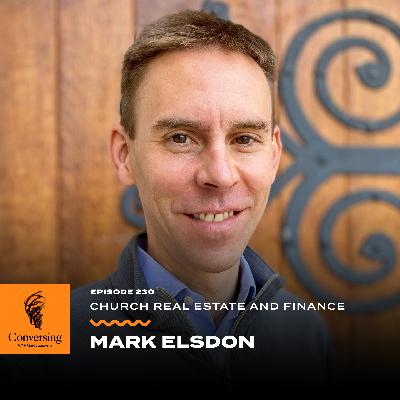
The church is so much more than a building—but when it comes to managing the physical property of church real estate, we often overlook the great good that can emerge from the land and structures. In this episode, social entrepreneur, strategic executive, and author Mark Elsdon joins Mark Labberton on Conversing to explore how churches and faith communities can reimagine their assets—land, buildings, and money—as instruments for mission, community transformation, and spiritual flourishing. From his decades of work at Pres House in Madison, Wisconsin, to his role as consultant, author, and co-leader of RootedGood, Elsdon shares stories of innovation, courage, and the hard but hopeful work of repurposing property and resources for God's mission in the world. Episode Highlights "It isn't about property, nor is it about money. It's about people's lives and it's about God's work in people's lives." "We often have the faith of our forebears in the church. But the question is, do we have the courage of them?" "I don't think God's going away. I don't think God's declining. But the way people are engaging their faith is really changed and is changing." "Sometimes I talk about this as like the Blockbuster Video moment… People still want experiences of the divine. They just don't want to access it primarily on a Sunday morning." "Constraints can produce creativity and, in the life of faith, can also produce a willingness to trust." Helpful Links and Resources Mark Elsdon's Website *We Aren't Broke: Uncovering Hidden Resources for Mission and Ministry,* by Mark Elsdon *Gone for Good? Negotiating the Coming Wave of Church Property Transition,* by Mark Elsdon RootedGood - resources for congregations, judicatories, and other church leaders related to social enterprise and church property Good Futures Accelerator course How-To Guides Threshold Sacred Development - A mission-aligned property development company focused on supporting churches doing community-oriented development About Mark Elsdon Mark Elsdon lives and works at the intersection of money and meaning as an entrepreneur, non-profit executive, author, and speaker. He is the author of We Aren't Broke: Uncovering Hidden Resources for Mission and Ministry (2021) and editor of Gone for Good? Negotiating the Coming Wave of Church Property Transition (2024). In addition to his role as a director with RootedGood, Mark is also executive director at Pres House, where he led the transformation of a dormant non-profit into a growing, vibrant, multi-million-dollar organization. Mark has a BA in psychology from the University of California–Berkeley, a master of divinity from Princeton Theological Seminary, and an MBA from the University of Wisconsin School of Business. He is an ordained minister in the Presbyterian Church, USA, and lives in Madison, Wisconsin. Mark is an avid cyclist and considers it a good year when he rides more miles on his bike than he drives in his car. Show Notes Mark Elsdon reflects on thirty years of ministry, beginning with campus work at the University of Wisconsin–Madison. Launch of a $17 million student housing project that became a transformative ministry for thousands of students. Elsdon's discovery: "It isn't about property, nor is it about money. It's about people's lives and it's about God's work in people's lives." Creation of a sober housing program at Pres House that has saved the state of Wisconsin more than a million dollars in addiction-related costs. Innovative blend of mission, ministry, and real estate development to foster student flourishing. The unique impact of housing students in recovery alongside the wider student population. Elsdon's MBA studies at UW–Madison and his calling at the intersection of money and mission. The "Blockbuster Video moment" for American Christianity: people still seek meaning, community, and transcendence, but not in traditional formats. Challenges churches face with aging buildings, declining attendance, and financial strain. How repurposing property reveals new opportunities for mission and ministry. RootedGood's "Good Futures" Accelerator course: helping churches rethink land, buildings, and resources for social enterprise and revenue generation. Example of two congregations in Madison merging to create an environmentally sustainable multifamily housing project and community center. Redefining church property as community space: "flipping the script" so the building belongs to the neighborhood, with the church as anchor tenant. Courage, risk-taking, and letting go of past models are essential for churches to reimagine their future. The critical role of pastoral and lay leadership in sparking change and vision. Storytelling as central to church renewal: "We often have the faith of our forebears in the church. But the question is, do we have the courage of them?" Learning from the pandemic: every church has the capacity for innovation and adaptation. Honouring grief and loss while embracing resurrection hope in church property transitions. Example from San Antonio: members resisted redevelopment until their need for funerals in the sanctuary was acknowledged—turning "either/or" into "both/and." Affordable housing crisis intersects directly with church land opportunities. Turner Center study: California churches and colleges hold land equal to five Oaklands suitable for affordable housing development. Elsdon warns against cookie-cutter "models" and emphasizes local context, story, and creativity. Forecast: up to 100,000 church properties in the US may be sold or repurposed in the next decade. Elsdon's hope: more repurposing than selling, with land and buildings becoming assets for life-giving mission. The value of constraints: "Constraints can produce creativity and, in the life of faith, can also produce a willingness to trust." Production Credits Conversing is produced and distributed in partnership with Comment magazine and Fuller Seminary.
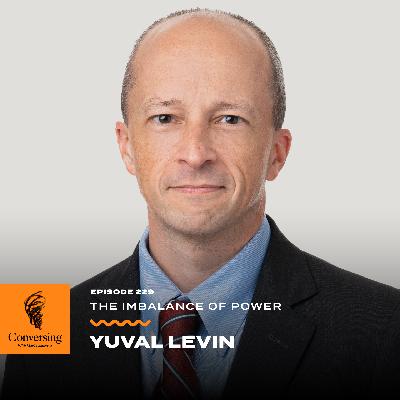
Unity is acting together even when we don't think alike. And one of the primary aims of the American Constitution is to support a democracy of those unified in diversity. Yuval Levin joins Mark Labberton to explore the precarious state of American constitutional life and the imbalance of power between the branches of the U.S. government. Drawing from his book America's Covenant, Levin argues that the Founders designed the Constitution above all to preserve unity in a divided society. Yet today, he warns, the imbalance of power—particularly the weakness of Congress and the rise of presidential authority—threatens democratic legitimacy. In this conversation, Levin reflects on originalism, the courts, Donald Trump's expanding influence, and the dangers of both passivity and autocracy. With clarity and urgency, he calls for renewed civic engagement and for Congress to reclaim its central role. Episode Highlights "Unity doesn't mean thinking alike. Unity means acting together. And the question for a modern political society is how do we act together when we don't think alike?" "The biggest problem we have is that Congress is under-active, radically under-active and has turned itself into a spectator." "The president is in charge of the executive branch, but the executive branch is not in charge of the American government." "I am very concerned about this kind of Caesar-ism. I think it is very dangerous." "What we're seeing is constitutional creep, where the president is pushing and nobody's pushing back, and only Congress can do it." "I worry a lot about Donald Trump. But the reason I worry is because Congress isn't doing its job." "The politics of an autocratic state is a politics of spectators, and we just cannot become spectators." "All of us will find ourselves in the minority sooner or later." Helpful Links and Resources America's Covenant: The Constitution and the Path to National Unity, by Yuval Levin American Enterprise Institute (Find Yuval Levin's current research and publications) *New York Times Opinion* – Yuval Levin's columns at the New York Times About Yuval Levin Yuval Levin is director of Social, Cultural, and Constitutional Studies at the American Enterprise Institute (AEI), where he also holds the Beth and Ravenel Curry Chair in Public Policy. He is the founder and editor of National Affairs, senior editor of The New Atlantis, a contributing editor at National Review, and a contributing opinion writer at The New York Times. He is the author of several books on political theory and public policy, most recently American Covenant: How the Constitution Unified Our Nation—and Could Again (Basic Books, 2024), which examines the U.S. Constitution through the lens of national unity in a divided society. Show Notes Constitutional unity and division Yuval Levin summarizes America's Covenant as a reintroduction to the Constitution framed around the challenge of unity in diversity. "Unity doesn't mean thinking alike. Unity means acting together." The Constitution prioritizes bargaining, negotiation, and legitimacy over efficiency. Congress was designed as the "first branch" of government to embody pluralism and force compromise. The decline of Congress and rise of the presidency Levin argues Congress is radically under-active, ceding ground to presidents and courts. "The biggest problem we have is that Congress is under-active, radically under-active and has turned itself into a spectator." Excessive focus on the presidency erodes democratic legitimacy. Current frustrations stem from misunderstanding the system's design: it resists narrow majorities and forces broad coalitions. Courts, originalism, and the unitary executive Levin affirms he is an originalist: "a philosophy of judicial interpretation … a mode of self-restraint for judges." Supreme Court decisions in recent years repeatedly signal: "Congress, do your job." He outlines the unitary executive theory: the president controls the executive branch, but not the government as a whole. "The president is in charge of the executive branch, but the executive branch is not in charge of the American government." Trump's expanding power Levin warns of the growing push to centralize authority in the presidency. "I am very concerned about this kind of Caesar-ism. I think it is very dangerous." Trump's second term differs because restraints have vanished; his circle now encourages unrestrained executive action. Disruption of long-held norms has weakened trust in American institutions globally and domestically. Constitutional crisis vs. constitutional creep Levin distinguishes between "creep," "conflict," and "crisis." He argues the U.S. is experiencing constitutional creep: unchecked executive power without Congress pushing back. True crisis would involve direct defiance of the courts—something still possible but not yet realized. The role of citizens and civic responsibility Levin stresses the danger of passivity: "The politics of an autocratic state is a politics of spectators, and we just cannot become spectators." Citizens should keep writing to Congress, vote with clear expectations, and engage in local governance. State legislatures, though less visible, often function better than Congress today. Clear thinking itself, Levin suggests, is a moral act for a healthy republic. Production Credits Conversing is produced and distributed in partnership with Comment Magazine and Fuller Seminary.
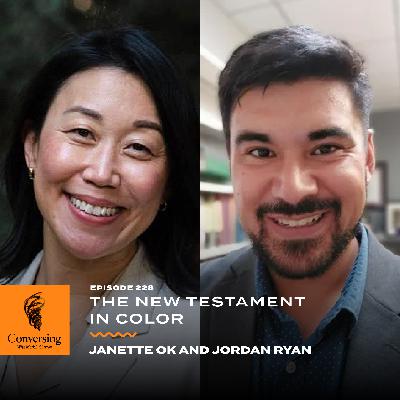
There's no such thing as a neutral reading of the Bible. Every reading is inflected by first-person experience, cultural context, history, and more. In this episode, biblical scholars Janette Ok and Jordan J. Ryan join Mark Labberton to reflect on The New Testament in Color, a groundbreaking new biblical commentary that brings together diverse voices across racial, cultural, and social locations. They share how their own ethnic and cultural backgrounds as Asian American and Filipino Canadian readers shaped their understanding of Scripture, the importance of social location, using the creeds as guardrails for hermeneutics, and how contextual interpretation deepens biblical authority rather than diminishing it. Episode Highlights "There is no such thing as a neutral reading of the Bible." —Mark Labberton "It really dawned on me the importance of being aware of who I am, my family background, my history in the United States, all these things." —Janette Ok "Filipinos I think are always sort of on the margins… trying to understand how Asian we really are or aren't." —Jordan J. Ryan "Objectivity is nothing more than the fruit of authentic subjectivity." —Jordan J. Ryan quoting Bernard Lonergan "Colorblindness is actually something that's not true… particularity is fundamental to the gospel." —Janette Ok "It was one of the most freeing experiences that I've had because it finally gave me permission to do the thing that I'd always wanted to do." —Jordan J. Ryan Helpful Links and Resources The New Testament in Color: A Multiethnic Commentary on the New Testament (IVP Academic) About Janette Ok Janette Ok is associate professor of New Testament at Fuller Theological Seminary. A leading scholar in Asian American biblical interpretation, she is a co-editor of The New Testament in Color and author of Constructing Ethnic Identity in 1 Peter. About Jordan Ryan Jordan Ryan is associate professor of New Testament at Wheaton College and Graduate School, and author of The Role of the Synagogue in the Aims of Jesus and From the Passion to the Church of the Holy Sepulchre. His research explores Acts, archaeology, and Filipino American biblical interpretation. Show Notes The New Testament in color and contextual biblical Interpretation "There is no such thing as a neutral reading of the Bible." Janette's growing up in a Korean immigrant church in Detroit, carrying "the weight of assimilation." Asian American literature, especially Bone by Fae Myenne Ng Opening our eyes to the power of articulating immigrant experience Jordan Ryan's mixed-race Canadian upbringing—Filipino mother, white father—and early encounters with Scripture through unhoused communities. "Filipinos are always sort of on the margins of Asian America." —Jordan Ryan Contextual reading of the bible All readings are contextual, contrasting liberation theology, unhoused readers, and Western academic traditions Challenges and dangers of contextualization "The first danger is to think that we can remove ourselves from the work of textual interpretation." Social location is not an external lens but intrinsic to the gospel. "Objectivity is nothing more than the fruit of authentic subjectivity." Archaeology that informs contextual questions "Colorblind" readings ignore particularity and miss the incarnational nature of Scripture. Biblical authority and the living word Biblical authority as central: "It's why I teach at Wheaton College and not somewhere else." "When we say the Bible is the living Word of God… it means it has to speak to us today." Preachers already contextualize every Sunday; The New Testament in Color makes this explicit and communal New Testament in Color was initiated by Esau McCaulley in 2018 Preceded by works like True to Our Native Land and Women's Bible Commentary Distinctive by gathering scholars from African American, Latino, Asian American, Native American, and European American backgrounds in one volume Goal: Embody diversity without sacrificing particularity or biblical trust. Commentary on Acts, including Filipino American theology and diaspora identity "It was one of the most freeing experiences that I've had." He traced themes of foreignness, colonialism, and God's care for the imprisoned in Acts 1 Peter and Asian American biblical interpretation, wrestling with exile, belonging, and "perpetual foreigner" stereotypes Home as central theological concern—"not everyone feels at home in the same way." —Janette Ok Editing, diversity, and reader reception Balancing freedom with theological boundaries rooted in the creeds Diversity created unevenness, but also richness and authenticity. "The fingerprints that make it so living." —Janette Ok Professors report the book resonates with students of color whose lived experiences often feel absent in traditional scholarship "Sometimes people don't know where to begin… I encourage my students to always consult scholars who read and look differently from themselves." Production Credits Conversing is produced and distributed in partnership with Comment magazine and Fuller Seminary.
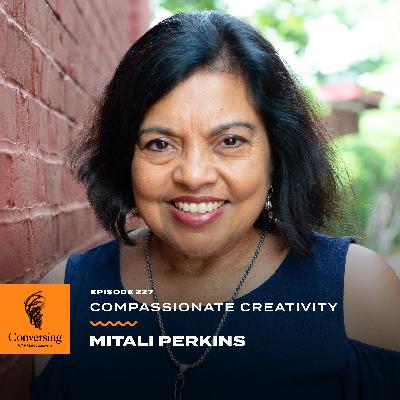
Creativity doesn't come easy. It is often an act of resistance against chaos and other de-personalizing forces. In this episode, author Mitali Perkins joins Mark Labberton to discuss her latest book Just Making: A Guide for Compassionate Creatives. Known for her acclaimed novels for young readers—including You Bring the Distant Near and Rickshaw Girl—Perkins reflects on the creative life as both a gift and a struggle, marked by tenderness and tenacity. With candour about rejection, moments of mortification, and the relentless call to keep making, Perkins offers encouragement for artists who want their work to be both beautiful and just. Episode Highlights "I was very, very close myself to giving up on the creative life." "Any time we're bringing order from chaos, there's going to be pushback—and it's diabolical pushback." "Stories widened my heart, they widened my mind, they gave me a sense of calling that I was not just here for myself." "We can't put on our faith like lace and bows; it has to be in the bones of the story." "When I feel that embarrassment, that mortification, if I can just stay and do something physical to honour my work, goodness comes pouring back." "To not write it, after hearing your passion to combat this foe of our age, would be exactly what the diabolical enemy wants us to do." Helpful Links and Resources Just Making: A Guide for Compassionate Creatives by Mitali Perkins *You Bring the Distant Near* by Mitali Perkins (National Book Award finalist) Rickshaw Girl (adapted into a film) *Steeped in Stories: Timeless Children's Novels to Refresh Our Tired Souls* by Mitali Perkins The Dangerous Act of Worship by Mark Labberton Kiva Microloans About Mitali Perkins Mitali Perkins writes novels for young readers that cross borders and break down walls. Her books include You Bring the Distant Near, a National Book Award nominee; Rickshaw Girl, now a feature film; and Tiger Boy, winner of the South Asia Book Award. Born in Kolkata, India, Perkins immigrated to the United States as a child and has published with major houses including Penguin Random House, Charlesbridge, Candlewick, and Little, Brown. Her newest book for adults, Just Making: A Guide for Compassionate Creatives, encourages artists to persist with both tenderness and tenacity. She speaks widely at schools, libraries, and conferences. More at mitaliperkins.com. Show Notes Perkins describes the heart of Just Making as born from nearly giving up on the creative life during the pandemic. Creativity, tenderness, and tenacity "I was very, very close myself to giving up on the creative life." Just Making: a survival guide for writers and artists facing rejection, discouragement, and the sense that their work doesn't matter The struggles of the creative life Perkins speaks candidly about rejection, failed manuscripts, and the long twelve-year gap between her first and second published books. "You end up looking at the exterior packaging—my career looks amazing on social media—but inside it's pride, vainglory, rejections, bad reviews." Practices such as finding "third spaces" and championing one's own work sustain her through rejection. Childhood, immigration, and storytelling Born in Kolkata, India, Perkins immigrated to New York at age seven. She calls herself a "feral reader," devouring fourteen hundred novels in four years as a child "Stories widened my heart, they widened my mind, they gave me a sense of calling that I was not just here for myself." Obstacles and motivation during her upbringing as the daughter of refugees Encountering faith through story Growing up in a Hindu home and finding coming to Christ in college Through reading the Gospels and C.S. Lewis, she encountered Jesus as "the true story behind all the stories." Conversion and baptism while a student at Stanford Writing, justice, and flourishing "We can't put on our faith like lace and bows; it has to be in the bones of the story." Fiction that tackles themes of poverty, gender, courage, and flourishing Justice is defined not only as righting wrongs but fostering shalom—wholeness and human flourishing. Publishing industry and perseverance Perkins recounts the twelve-year struggle to publish her second book, revising manuscripts dozens of times. "It was twelve years between my first book and my second book." Tenacity grounded in prayer and a sense of God's invitation: "I've got the heavy yoke; will you walk with me?" Moments of humiliation Perkins shares a public humiliation at a book signing where no one lined up for her book. Choosing not to leave, she pulled out her manuscript and began editing "When I feel that embarrassment, that mortification, if I can just stay and do something physical to honor my work, goodness comes pouring back." How Rickshaw Girl was published and adapted into a film Coaching for creatives Perkins counsels Mark Labberton on his unfinished book about fear "To not write it, after hearing your passion to combat this foe of our age, would be exactly what the diabolical enemy wants us to do." How to embrace imperfection and see writing as part of a larger communal conversation Community and the impact of children's literature Direct engagement with children in classrooms and libraries How young readers form friendships with her characters and are inspired toward justice How books like Rickshaw Girl and her forthcoming The Golden Necklace connect global justice issues with young readers' imaginations Production Credits Conversing is produced and distributed in partnership with Comment magazine and Fuller Seminary.
What are the implications of Jesus's radical ethics of love and shalom? How far are Christ followers meant to go with the compassion and witness of the gospel? Philosopher Tom Crisp (Biola University) reflects on how a powerful religious experience transformed his academic career and personal faith. Once focused on metaphysics and abstract philosophy, Crisp was confronted in 2009 by the radical compassion of Jesus in the Gospels. That moment led him toward the Catholic Worker movement, the teachings of Dorothy Day, and ultimately, deep involvement in labour and immigrant justice through Clergy and Laity United for Economic Justice (CLUE). He describes participating in civil disobedience, forming solidarity with marginalized communities, and serving as a nonviolent presence in immigration courts where migrants face arrest and deportation. Through these stories, Crisp testifies to the cost and invitation of discipleship: following Jesus into the margins with courage, humility, and love. Episode Highlights "What struck me was Jesus's deep compassion, mercy, fiery concern for people in the margins. And it came to me as deeply convicting." "I immersed myself in the writings of Dorothy Day… she's had an enormous influence on how I've come to think about what it would look like to be a Jesus follower in our context." "I was having this very powerful sense of God's presence, feeling broken by it, feeling like I'd hit a turning point in my life." "If Jesus really is the Jesus of the margins that I'm seeing in the Gospels, then I need to figure out how to get to the margins." "This isn't a matter of guilt, it's invitation… we're always being invited further in." "When you're with someone who's been separated from their children, when you're with someone who's shaking with fear… it's just a completely different thing." "So a horrific violation of human rights is happening around us in our immigration courts, and it's happening here in Orange County." "We are trying to be a presence of love for everybody there." Helpful Links and Resources Clergy and Laity United for Economic Justice (CLUE) Shalom Ethics: Loving Your Neighbor as Yourself, by Thomas M. Crisp The Irresistible Revolution: Living as an Ordinary Radical, by Shane Claiborne About Tom Crisp Tom Crisp is professor of philosophy at Biola University, specializing in ethics and justice. After completing his PhD at Notre Dame, Crisp shifted his academic work toward Christian ethics following a transformative religious experience in 2009. He is a community member of the Orange County Catholic Worker and active in Clergy and Laity United for Economic Justice (CLUE), advocating for immigrant and labour rights through nonviolent action and accompaniment. Show Notes Religious Experience and Transformation Tom Crisp recounts his 2009 religious awakening while reading the Gospels. "Fire—my soul is blowing apart, I need to quit my job." Realization of Jesus's "deep compassion, mercy, fiery concern for people in the margins." Movement from abstract philosophy to Neighbour Love Command. Catholic Worker movement and Dorothy Day Influence of Shane Claiborne's The Irresistible Revolution and new monastic movement. Encounter with Dorothy Day's writings as a model of radical discipleship. Involvement with the Orange County Catholic Worker community. Attraction to Catholicism Inspired by Notre Dame liturgy and Benedictine practices. Influenced by saints like St. Francis, Maximilian Kolbe, Oscar Romero. "As I spend time in Catholic spaces, I feel the presence of this cloud of witnesses." CLUE and Nonviolent Action History of CLUE: founded by Rev. James Lawson, trained in Gandhian nonviolence, connected to Martin Luther King Jr. Focus on labour justice and immigrant rights. Training in nonviolent presence, civil disobedience, and accompaniment. Example: shutting down LAX in a five-hundred-person protest for hotel workers. Court Observation and Migrant Accompaniment CLUE partnership with Orange County Rapid Response Network. ICE arrests of migrants who believed they had lawful parole status. "A horrific violation of human rights is happening around us in our immigration courts." Strategy of nonviolent presence to "dramatize bureaucratic and physical violence." Clergy presence offers spiritual authority and comfort. Judges and ICE agents sometimes allow moments of prayer or comfort before deportation. "We want to accompany migrants into this dark, dark space and be there as a source of comfort to them." Formation and Solidarity "When you're with someone who's been separated from their children, when you're with someone who is shaking with fear … it's just a completely different thing." Experience of humility, solidarity, and courage among migrants and workers. Philosophy, theology, and action integrated in discipleship. Production Credits Conversing is produced and distributed in partnership with Comment magazine and Fuller Seminary.
"Habit eats willpower for breakfast." As the apostle Paul says in Romans 7, we do the evil we don't want to do, and we don't do the good we want to do. Pastor and author John Ortberg joins Mark Labberton on Conversing to discuss his latest book Steps: A Guide to Transforming Your Life When Willpower Isn't Enough. Drawing on decades of pastoral ministry, the wisdom of the Twelve Steps, and the profound influence of Dallas Willard, Ortberg explores the limits of willpower, the gift of desperation, and the hope of genuine transformation. With humour, honesty, and depth, he reflects on why human will is insufficient, why churches struggle to embody desperation, and how communities of honesty and grace can become places of real healing. Episode Highlights "Habit eats willpower for breakfast." "The first step is a deeply despairing step. I can't, and it feels like hell and death—and that opens people up to God." "If you have a wimpy step one, you will have wimpy steps two through twelve." "Desperation really is a gift." "Failure and pain so often become helps in our meeting God." Helpful Links and Resources Find more from John Ortberg at becomenew.com John Ortberg, Steps: A Guide to Transforming Your Life When Willpower Isn't Enough Dallas Willard, Renovation of the Heart Kent Dunnington, Addiction and Virtue: Beyond the Models of Disease and Choice Stephen R. Haynes, Why Can't Church Be More Like an AA Meeting? About John Ortberg John Ortberg is a pastor, speaker, and bestselling author dedicated to spiritual formation and transformation. He served as senior pastor at Menlo Church from 2003 to 2020, and has written numerous books, including The Life You've Always Wanted and Faith & Doubt. He studied at Wheaton College and Fuller Theological Seminary and has been a trustee at Fuller. His most recent book, Steps: A Guide to Transforming Your Life When Willpower Isn't Enough, reframes the Twelve Steps as a wisdom tradition for all seeking deeper life with God. Show Notes The Nature of Willpower and Habit John Ortberg reflects on Dallas Willard's framework for understanding persons. "Habit eats willpower for breakfast." The human will is essential, but terrifically weak when confronting sin, ego, or deep habits. The Gift of Desperation and the Twelve Steps First step: "We admitted we were powerless." "The first step is a deeply despairing step. I can't, and it feels like hell and death—and that opens people up to God." Desperation becomes a gateway to spiritual power. "If you have a wimpy step one, you will have wimpy steps two through twelve." Comparing church and AA Ortberg: "Desperation really is a gift." The church often resists being a community of desperation. Honesty is not the same as desperation; both are needed for transformation. Why AA's structure works: fellowship plus program. "Failure and pain so often become helps in our meeting God." Storytelling and Transformation Testimonies and stories at the center of AA's power. Why narrative makes meaning for human life. "Story is the essential unit of meaning for personhood." Spiritual Practices and Confession Step 5: "Confess to God, ourselves, and one other person the exact nature of our wrongs." John recalls confessing to a close friend: "John, I love you more right now than I've ever loved you before." The liberating power of being fully known and loved. Addiction, Sin, and Disease The debate: is addiction a disease, a habitus, or sin? Disease language reduces shame but risks erasing agency. The overlap of sin, brokenness, and habit. The challenge of shame, judgment, and superiority in church contexts. Fellowship and Program "If you have program but not fellowship, you're dead. If you have fellowship but not program, there is no hope." AA as a model for church life: communal honesty plus concrete practices. The gospel calls for grace-filled action, not passivity. Production Credits Conversing is produced and distributed in partnership with Comment magazine and Fuller Seminary.
Who are the black evangelicals? How has contemporary evangelicalism reckoned with racial justice? Theologian Vincent Bacote joins Mark Labberton to discuss Black + Evangelical, a new documentary exploring the in-between experience of black Christians in white evangelical spaces. Bacote—professor of theology at Wheaton College and director of the Center for Applied Christian Ethics—shares his personal faith journey, early formation in the Navigators, growing racial consciousness, and decades-long engagement with questions of race, theology, and evangelical identity. Together, they work through the tensions, challenges, and possibilities for a more truthful and hopeful evangelical witness. Episode Highlights "The goal of the documentary is not to be a kind of hit piece about the evangelical movement. It's to tell the story of the church." "To be for Black people is not to be against somebody else." – Tom Skinner "I couldn't understand why the Bible people weren't leading the way on questions of race." "Participation in evangelical spaces can't mean leaving part of yourself outside." "Realism allows you to have honesty, but also remember the good news is the greatest news of all." "God wants all of us—our whole selves—not a muted version." Helpful Links and Resources Black + Evangelical Documentary (Christianity Today) Black + Evangelical Documentary Trailer The Political Disciple: A Theology of Public Life by Vincent Bacote Reckoning with Race and Performing the Good News by Vincent Bacote Breaking Down Walls by Raleigh Washington & Glen Kehrein Tom Skinner's Urbana 1970 Address (Full Audio) *The Color of Compromise* by Jemar Tisby About Vincent Bacote Vincent Bacote is professor of theology at Wheaton College and director of the Center for Applied Christian Ethics. He is the author of several books, including The Political Disciple: A Theology of Public Life and Reckoning with Race and Performing the Good News: In Search of a Better Evangelical Theology. His research and teaching address public theology, ethics, and the intersection of race and evangelical identity. Bacote is a widely cited commentator and a frequent voice in conversations about Christian faithfulness in public life. Show Notes Mark Labberton welcomes Vincent Bacote, professor of theology at Wheaton College and director of the Center for Applied Christian Ethics. Introduction to the Black + Evangelical documentary, a project Bacote helped conceive and produce. Bacote's upbringing at Shiloh Baptist Church of Glenarden, Maryland—unknowingly part of the Progressive National Baptist Convention. Conversion experience around age ten, preceded by years of genuine faith. College years at the Citadel; involvement in the Navigators campus ministry. Influence of a summer training program in Memphis focused on African American ministry. Early exposure to evangelical culture through radio preachers like Chuck Swindoll, Charles Stanley, John MacArthur, and James Dobson. Initial tensions over the lack of evangelical engagement on issues of race. Graduate studies at Trinity Evangelical Divinity School with the initial goal of becoming a pastor. Encounter with Raleigh Washington and Glen Kehrein's Breaking Down Walls, grounding racial reconciliation in Ephesians 2. Observations of the scarcity of black theologians in evangelical seminaries. 1993 Geneva College conference on black evangelicals—learning from leaders like Bill Pannell, Tom Skinner, Tony Evans, Carl Ellis, and Eugene Rivers. Writing an editorial titled "Black and Evangelical: An Uneasy Tension?" for the student paper at Trinity. Realization that evangelicalism is both a biblical and socio-cultural movement with contextual blind spots. Arrival at Wheaton College in 2000 with a focus on public theology and ethics beyond race alone. Genesis of the Black + Evangelical project at a 2008 Fuller Seminary gathering with Ron Potter. Partnership with Christianity Today and filmmaker Dan Long to shape the documentary. Filming over forty hours of interviews with twenty-four participants, distilled into a ninety-four-minute film. Mark Labberton highlights Tom Skinner's impact and his "Blackface" critique of white evangelicalism. Bacote reflects on his "racially optimistic" early years and growing awareness of systemic realities. Analysis of the Promise Keepers movement and the need for sustained relational work beyond large gatherings. Challenges in building genuine multiethnic churches versus surface-level diversity. The documentary's aim: to tell the church's story, honour lived experiences, and inspire commitment to mission. Bacote's "four stages" for minorities in evangelical institutions: delight, dissonance, distress, and decision. Emphasis on "sober hope"—honesty about pain while holding onto the good news. The gospel's call to bring one's full self into the life of the church. Closing encouragement to watch and share Black + Evangelical as a story worth hearing for the whole church. Production Credits Conversing is produced and distributed in partnership with Comment magazine and Fuller Seminary.
Conservationist and environmental advocate Ben Lowe discusses our ecological crisis, the role of Christian faith and spirituality, and how churches can respond with hope, action, and theological depth. He joins Mark Labberton for a grounded conversation on the intersection of faith, climate change, and the church's role in ecological justice. As executive director of A Rocha USA, Lowe brings over two decades of experience in environmental biology, ethics, and faith-based conservation to explore how Christians can engage meaningfully with environmental crises. They move from scientific clarity about climate urgency to the theological blind spots that have hindered the Christian response. Together, they explore how churches across the US and beyond are reclaiming creation care—not as a political issue, but as a form of discipleship and worship. With stories ranging from urban stream cleanups to coral reef restoration, Lowe emphasizes small, local, relational efforts that respond to God's ongoing work in the world. At the heart of the conversation lies a call to moral will, theological clarity, and faithfulness in the face of ecological grief. Episode Highlights "The world is good—but it's groaning." "Small does not mean insignificant. … We have the solutions. The problem is not our technical ability—it's our moral and political will." Learn More about A Rocha Visit arocha.us for more information. About Ben Lowe Ben Lowe is executive director of A Rocha USA, a Christian conservation organization engaged in ecological discipleship, community-based restoration, and climate advocacy across the US and globally. He holds a PhD in interdisciplinary ecology from the University of Florida and a BS in environmental biology from Wheaton College (IL). Ben has spent over two decades working at the intersection of faith, science, and environmental justice, and is passionate about equipping churches to participate in God's restoration of creation. Since his first encounter with A Rocha as a Wheaton student in 2003, Ben has served on A Rocha staff teams and boards, nationally and internationally, most recently as deputy executive director of A Rocha International. Ben's training as a scientist and a minister inform his leadership and development of A Rocha USA's national strategy and team. Originally from Singapore, Ben was the founding national organizer of Young Evangelicals for Climate Action and has served on the boards of A Rocha USA, A Rocha International, the Au Sable Institute, and Christians for Social Action. He is the author of multiple books, and his work has been featured in media outlets including Audubon Magazine, Christianity Today, and the New York Times. He has a bachelor of science in environmental biology from Wheaton and a PhD from the University of Florida focussed on the human, religious, and ethical dimensions of environmental change and conservation. Ben is based in the warm and watery state of Florida, where he can often be found kayaking on the Indian River Lagoon. Show Notes Earth Day began in 1970, a pivotal moment for environmental awareness—"That means that I was a junior in high school when the world embraced this name as a way of trying to bring attention to the whole world about environmental issues." Mark Labberton opens with concern for "the political moment that we're in … in the United States and in other places around the world." Ben Lowe introduces the biblical framing: "This world is good, but it's also groaning." Why Climate Action Still Matters "We don't know where we would be, were it not for Earth Day fifty years ago." "The question is not whether we know what to do, but whether we're doing the right thing and we're doing enough of it." "It's never too late to take action and to get engaged." Scientific Consensus and Urgency "The science has gotten a lot more sophisticated and a lot clearer." "We're not talking about hypothetical issues anymore. We're talking about issues that many, if not all of us, are tangibly experiencing now." "Things are moving faster, further, and at a greater scale and magnitude than we were hoping to be experiencing right now." Oceans, Heat, and the Limits of Natural Buffers "The oceans are a huge gift to human society, and they have been buffering and absorbing a lot of the heat and the carbon that we've been emitting." "The oceans are not limitless. … We are seeing signs that the oceans are warming more than they can sustain." "Every year now we have these hurricanes that are huge in terms of their scale and the amount of water that they can suck up from these overheated oceans." Practical Impact of Climate Change "My homeowner's insurance rates more than doubled in the last few years." "We're just getting all these signs coming from all of our systems that are warning us that we are on a completely unsustainable path." "The silver lining to us being the driver of so many of these problems is that we can also choose to be part of the solution." Role of the Church in Ecological Transformation "The church can really shine a light of hope, of love of the good news that God promises for this world in the midst of all that." "Small does not mean insignificant." "We have the solutions we need. … The problem is not our technical ability, it's our moral and political will that has been lacking." Global Clean Energy Transition "We are in a great transition, but that transition is happening and it's sort of unstoppable." "The question is how quickly will it happen and will we be able to move it forward quickly enough?" "Christians have a particular contribution. … We can bring the moral will to help shape the decisions." A Rocha's Global and Local Work "A Rocha is a network of Christian conservation organizations in about twenty-five countries around the world." In Florida, "we're helping to work with local partners, universities, high schools, churches, to conserve the lagoon." "In Austin, Texas … we have a lot of Spanish-language programming … to help connect recent immigrants with the communities that they're living in." Partnering with Churches for Creation Care "The cutting edge of what we're moving into now though is our work with churches." "Research … is showing that there is a shift happening with more and more Christians in churches becoming aware of the problems in God's world." "Now we have more and more people coming to us, so much that we're growing, but we're not growing fast enough and we have to turn some people away." Localized Action and Practical Partnerships "We launched a cohort of Vineyard USA churches … to support Vineyard congregations that want to get more involved." "We walk them through a process of discerning … the ways that God might be inviting them to participate in what God's already doing." "We're working with a church on Oahu in Hawaii that bought a defunct golf course … we're working together to help restore the native habitat." Creation Care as Worship and Witness "We see this as being in God's hands … and us as playing a faithful role in responding to what God is doing." "What would a follower of Jesus do in this situation?" "Everything that we do to care for creation … the offering itself is one that we direct to God as the creator." Theological Reformation, Not Innovation "It's not theological change so much as it's theological reformation. This is orthodoxy." "We don't see this work as of our own initiative. What we see ourselves doing is responding to what God is already doing." End Times Theology and Ecological Responsibility "We don't treat anything else in life that way. We don't treat our bodies that way. We don't treat our children that way." "It has been biblically orthodox from the very beginning to care for God's world." "It's not because we're Christian, it's because we've not been Christian enough." Political Identity vs. Christian Witness "We see these issues first and foremost through our political lenses instead of through our theological biblical Christian lenses." "These issues transcend any particular political ideology or party." "They're moral issues, they're faith issues, they're spiritual issues, and for us, they're an integral matter of our Christian discipleship and witness." How A Rocha Helps Churches Avoid Partisan Pitfalls "We try to say, all right, what does God call us to do as people, as his image bearers in the world today?" "Let's do a stream cleanup together." "You kind of learn as you go … and before you know it, you look back and you realize, oh gosh, how far I have come." Discipleship and Environmental Stewardship "The longer I'm in this work, the more I'm learning how to care for creation and help others do the same." "The closer I grow to Christ too, and the more I find myself being conformed into what the Bible calls us to be." "It's not always an easy journey, but it's a really good and life-giving and sanctifying journey." Mark's Personal Reflection: Replanting His Garden "It has utterly changed the way that I now look out the kitchen window." "Just that small change has given me a better sense of life, a better sense of creation … a better sense of the importance of having a world that you can meditate on." Ben Lowe's Formative Experiences in Singapore and the Black Hills "We'd sort through the catch with them and they'd give us the things that they couldn't sell." "Being able to step out into a national forest and breathe the air … reminds me that … there is still so much good in this world worth protecting." Production Credits Conversing is produced and distributed in partnership with Comment magazine and Fuller Seminary.

Comments

Download from Google Play

Download from App Store
 United States