


 Claim Ownership
Revolution 250 Podcast
Subscribed: 58Played: 2,056
Subscribe

© 2026 Revolution 250 Podcast
Description
Revolution 250 is a consortium of organizations in New England planning commemorations of the American Revolution's 250th anniversary. https://revolution250.org/Through this podcast you will meet many of the people involved in these commemorations, and learn about the people who brought about the Revolution--which began here. To support Revolution 250, visit https://www.masshist.org/rev250Theme Music: "Road to Boston" fifes: Doug Quigley, Peter Emerick; Drums: Dave Emerick
289 Episodes
Reverse
Join Bradley Jay, Bob Allison & Jonathan Lane as they discuss the events surrounding the Boston Massacre Trials, Pope's Day, and Crime & Punishment in 1770 Boston. Tell us what you think! Send us a text message!
In this episode of the Revolution 250 Podcast, host Robert J. Allison welcomes Richard Howell of the Nathanael Greene Homestead for a conversation about the life and legacy of one of the most remarkable commanders of the American Revolution, Nathanael Greene. Born into a Rhode Island Quaker family and raised as an ironmaster, Greene’s path to military leadership was anything but ordinary. Yet he would rise to become one of George Washington’s most trusted generals, playing a decisive role in ...
Why did an antislavery movement emerge at the time of the American Revolution, both in the American colonies and in Britain? Christopher Brown asks this question and many more in Moral Capital: Foundations of British Abolitionism. The American Revolution on both sides of the Atlantic brought together strands of thought and feeling which had been latent, as men and women grappled with questions of power and justice. Abolition was one way for Britons to restore their moral cap...
In this episode of the Revolution 250 Podcast, host Robert Allison welcomes historian and author Ryan Cole for a sweeping conversation about memory, gratitude, and the young republic’s most celebrated guest. Cole, author of Light Horse Harry Lee and his new work The Adieu explores the extraordinary 1824–1825 return tour of Gilbert du Motier, marquis de Lafayette. Nearly fifty years after the shots at Lexington and Concord, Lafayette’s journey across all twenty-four states became a rolling nat...
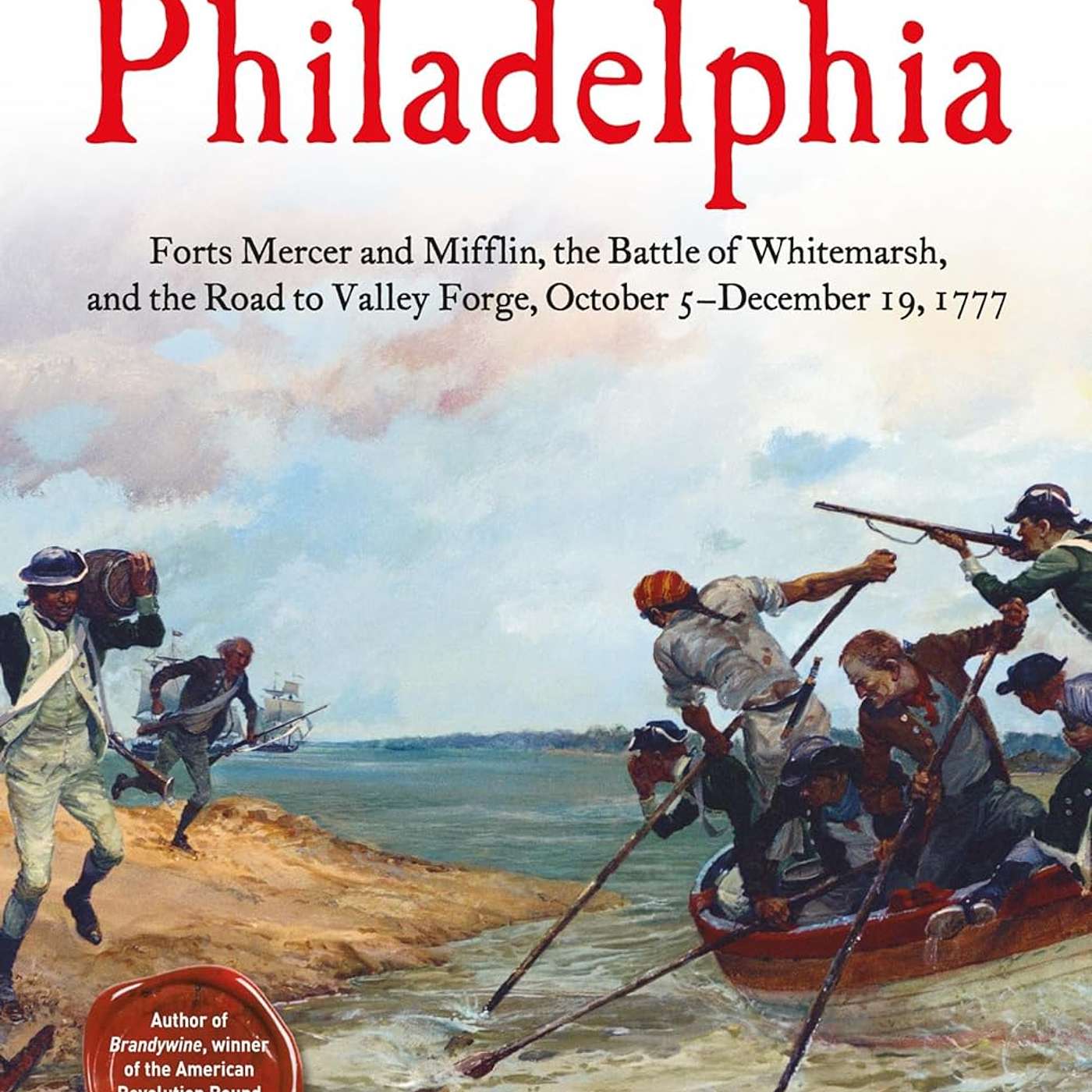
. Why did Philadelphia matter so deeply to both the British and the Continental Army? How did strategy, logistics, and personalities shape the campaign that culminated in Brandywine, Germantown, and the winter at Valley Forge? And what did the occupation of the revolutionary capital mean for civilians caught between armies? Michael C. Harris tells this story in his new book, Fighting for Philadelphia: Forts Mercer and Mifflin, the Battle of Whitemarsh, and the Road to Valley ...
Who was Thomas Jefferson? Do we really need another book about him? Andrew Burstein has written other books on Jefferson, and his new book, Being Thomas Jefferson: An Intimate Portrait answers both questions with depth and grace. Jefferson was an extraordinarily interesting person, and Burstein navigates his ambition, friendships, rivalries, political controversies, and intellectual inquiries. Biography, Burstein shows, is not just storytelling but interpreta...
On today’s episode of the Revolution 250 Podcast, host Professor Robert Allison charts a course across storm-tossed legal waters with historian Suzanne Amy Foxley, author of The American Experience of British Prize Law, 1776–1804. From the decks of daring privateers to the hushed chambers of admiralty courts, Foxley reveals how the American Revolution was fought not only with muskets and cannon, but with writs, warrants, and meticulously argued cases. Together, they explore how captured ships...
Lights, camera, Revolution! In this episode of the Revolution 250 Podcast, host Professor Bob Allison sits down with acclaimed filmmaker Kirk Ellis to explore the alchemy that turns ink on a page into images that linger in the national memory. Ellis, the creative force behind the celebrated screen portrayals of Benjamin Franklin (2024) and John Adams (2008), pulls back the curtain on shaping complex founders into compelling, human characters. From distilling intricate historical texts into sh...
Manufacturing Independence: Forging a Nation in the Crucible of War What did it really take to turn rebellion into a revolution—and ideals into a functioning nation? In this episode of the Revolution 250 Podcast, host Professor Robert Allison welcomes Professor Robert Smith of the Valley Forge Military College, author of Manufacturing Independence: Industrial Innovation in the American Revolution, for a sweeping conversation about the workshops, foundries, supply lines, and human ingenu...
In this episode of the Revolution 250 Podcast, host Robert Allison of Suffolk University speaks with Independent Historian Bob Hyldburg, who is leading the effort to erect a public statue honoring Sarah Bradlee Fulton in Medford. Sarah Bradlee Fulton emerges as a figure woven through some of the most dramatic moments of the Revolution in Massachusetts. She took part in the Boston Tea Party, helping disguise and equip the participants who struck a symbolic blow against imperial authority. In t...
Few figures of the American Revolution wielded words as powerfully as Thomas Paine. In this episode of the Revolution 250 Podcast, host Professor Robert Allison is joined by historian and journalist Jack Kelly, author of Tom Paine’s War, for a wide-ranging conversation about Paine’s outsized influence on the Revolutionary cause. Kelly explores how Paine’s pamphlet Common Sense transformed colonial resistance into a popular movement for independence, reaching audiences far beyond elite politic...
Pulitzer Prize–winning historian Joseph J. Ellis joins host Professor Robert Allison to talk about his new book, The Great Contradiction: The Tragic side of the American Founding. Drawing on decades of scholarship, Ellis reflects on the ideas, personalities, and hard choices that shaped independence and the early republic. Together, Allison and Ellis explore what made the Revolution truly revolutionary, how figures like Washington, Jefferson, Adams, and Madison, whose stories Ellis has ...
In this episode of the Revolution 250 Podcast, host Professor Robert Allison is joined by Reese Holmes, National President of the Children of the American Revolution, for a lively conversation about one of the nation’s oldest and most forward-looking patriotic youth organizations. Together, they explore the origins of the Children of the American Revolution, founded in 1895 by Concord author Harriet Lothrop to foster knowledge of America’s founding ideals among young people, and the organizat...
In this episode, our host Professor Robert Allison welcomes historian and educator Sean Heuvel, Director of Graduate and Professional Enrollment at Christopher Newport University, for a spirited exploration of the newly edited Revolutionary War Memoirs of General William Heath. Together they stroll through Heath’s vivid accounts of the Siege of Boston, the New York campaign, the intrigues of command, and the quiet burdens shouldered by a Massachusetts gentleman-general whose pen was often as ...
Join host Professor Robert Allison for a dynamic conversation with historian Ronald Angelo Johnson, author of Entangled Alliances: Racialized Freedom and Atlantic Diplomacy During the American Revolution. Together they explore how the American Revolution unfolded within a vibrant and contested Atlantic world shaped by Black leadership, Caribbean revolutions, and international diplomacy. Johnson, who holds the the Ralph and Bessie Mae Lynn Chair of History at Baylor University, hig...
Host Professor Robert Allison welcomes historian Paul D. Lockhart to discuss Lockhart’s acclaimed book The Drillmaster of Valley Forge: The Baron de Steuben and the Making of the American Army. Together they explore the remarkable life and career of Baron de Steuben, the Prussian-born officer whose training, discipline, and organizational genius helped transform Washington’s ragged Continental Army into a professional fighting force. Lockhart places Steuben in a broader European military and ...
In this episode of the Revolution 250 Podcast, host Professor Robert Allison welcomes historian Dr. Cynthia Hatch for a timely and eye-opening conversation about her forthcoming book, Enablers of Rebellion: The Colonial Court and the Road to the American Revolution, to be published by Savas Beatie in the spring of 2026. Hatch reveals a dimension of the Revolution that is often overlooked: the pivotal role of colonial courts, local magistrates, sheriffs, and justices of the peace in the decade...
This week t Professor Robert Allison welcomes Dr. Matthew Keagle, Curator at Fort Ticonderoga, for a vivid exploration of one of the most audacious logistical feats of the American Revolution: Henry Knox’s Noble Train of Artillery. Together they trace Knox’s remarkable mid-winter journey of 1775–1776—300 miles across frozen rivers and lakes, treacherous terrain, and sometimes snow-choked roads—to deliver more than 60 tons of captured British artillery to General George Washington. He al...
In The American Revolution and the Fate of the World, historian Richard Bell explores how the struggle for American independence reverberated far beyond the thirteen colonies—reshaping politics, empires, and ideas of liberty around the globe. Bell reveals how revolutionaries from Boston to Bengal, Paris to Port-au-Prince, drew inspiration and warning from the events of 1776. The American Revolution became a test case for freedom in an age of empire. Looking at the stories of individuals caugh...
Host Professor Robert Allison welcomes Dr. Kathryn P. Viens, public historian and scholar, to explore how local histories have shaped Americans’ understanding of patriotism and the Revolution from the nineteenth century to today. Drawing from her essay “Mobs or the Martial Ideal? The Mutable Definition of Patriotism in Local Historical Narratives,” published in the online journal Remembering the American Revolution at 250, Viens discusses how community-based histories—often written by ninetee...

Comments

Download from Google Play

Download from App Store
 United States