


 Claim Ownership
Talk Like An Egyptian
Subscribed: 29Played: 602
Subscribe

© 2025
Description
A podcast about Ancient Egypt with Dr Chris Naunton and Iszi Lawrence
19 Episodes
Reverse

Its the end of series questions episode! Go to our patreon to find out when we will be back! https://www.patreon.com/TalkLikeAnEgyptian you can watch this episode on Youtube here: https://youtu.be/4ehgopP_v2A Egyptologist Chris Naunton and author Iszi Lawrence discusses Chris's recent trip to Egypt, his preference for communicating about Egyptology over excavation, and the diverse roles within the field. They also explains the symbolism of Osiris' green skin and recommend resources for learning about ancient Egypt, including books, lectures, and hieroglyph guides. Thank you to Ben, gandolph9994, Yulia, Anna, Rosie, Emma, Hal, Ömer and Joanne. Do consider supporting the show for a load of bonus content and to keep the podcast advert free for everyone. https://www.patreon.com/TalkLikeAnEgyptian LIFE! PROSPERITY! HEALTH!
Economic strife, migrating peoples, and potential climate issues led to the decline of the Egyptian Empire. The Valley of the Kings was abandoned, and the mummies of kings from the 17th to 20th dynasties were reburied in a secret cache to protect them from tomb robbers. This cache, discovered in the 19th century, contained the mummies of numerous kings, including those from the 18th, 19th, and 20th dynasties. The discovery of the royal tomb in the Valley of the Kings in 1881 revealed a complex story of mummy reburial and robbery. The mummies, stripped of their finery, were rewrapped and placed in new coffins, with the process spanning decades and involving multiple locations. The dockets found on the mummies provide valuable information about their identities and the reburial process. Please support the podcast: https://www.patreon.com/TalkLikeAnEgyptian Watch this episode on youtube: https://youtu.be/nxvShg1Wkas
Support the podcast and get extra content: https://www.patreon.com/TalkLikeAnEgyptian Ramesses II is not known as 'the great' for no reason: his life and reign were exceptionally long, he had an enormous number of wives and children, he built on a grand scale up and down the country and beyond his borders. And he was renowned as a great warrior - all great pharaohs were, to some extent, but at Qadesh we are led to believe that Ramesses was personally responsible for quite some heroics against his enemy, the Hittites. The Egyptians' battle against them at Qadesh is one of the best attested in ancient history and is depicted in the great detail on the walls of several of Ramesses' great temples. The peace treaty that eventually ended hostilities is documented in both Egyptian and Hittite sources. This is the story of one of the great battles, between two of the great powers of the ancient world.

You can watch a video of this podcast here: https://youtu.be/Xz_x-QEli0Y Support the podcast and listen to bonus episodes: www.talklikeanegyptian.com/ Hatshepsut features in The Cursed Tomb, Iszi's historical fiction novel for 9+ https://amzn.eu/d/1g3QNOX In the 1820s scholars began to notice something strange in the inscriptions of the great temple of Deir el-Bahri - some of the royal names and titles appeared to be grammatically feminine. Eventually, it became clear that there had been a pharaoh, previously unknown, who was female. Her name was Hatshepsut. She was the mother-in-law of Thutmose III who came to the throne as a very young boy, and was later renowned as one of the great warriors of the 18th Dynasty. Hatshepsut had initially ruled the country on her son-in-law's behalf as a regent but then she took the throne herself. For a long time this was seen as a dastardly power grab, but we now think Hatshepsut may have had no choice but to step up and become pharaoh as the country needed someone to play that role and she was best placed. In any case, not only has she become an icon of early female power, her reign was undoubtedly one of great achievements, in building, in particular her mortuary temple which is one of the greatest achievements of ancient Egyptian architecture, and in creating the myth of the divine birth of the pharaoh, which would endure for centuries.
You can watch this episode on youtube: https://youtu.be/a58Yopf6yfE To support the show/get bonus content: patreon.com/cw/TalkLikeAnEgyptian/home In this episode of Talk Like an Egyptian, Iszi Lawrence and Egyptologist Dr Chris Naunton explore the life and legacy of Nefertiti, one of the most recognisable yet enigmatic figures of ancient Egypt. Beginning with her first appearances alongside Akhenaten, they examine why Nefertiti is shown so prominently in temple reliefs and ritual scenes, sometimes undertaking roles normally reserved for the pharaoh himself. The discussion considers what this exceptional visibility might indicate about her political and religious status, as well as the enduring mysteries surrounding her family background and origins. The episode also investigates the discovery of the famous painted bust of Nefertiti in 1912 and the controversy over how it came to be displayed in Berlin. Chris outlines the archaeological context of the find, the highly questionable circumstances of its removal from Egypt, and the ongoing debate over its rightful home. The conversation concludes by addressing the possibility that Nefertiti ruled as pharaoh in her own right after Akhenaten's death, under the name Neferneferuaten, a theory that, while contested, would place her among the most powerful rulers of ancient Egypt.
If there's on period of Egyptian history that Egyptophiles want to hear about it's the short period (less than 20 years) of pharaoh Akhenaten's reign. Very early on the king who had been crowned as Amenhotep ('the god Amun is satisfied') IV set about changing things. The worship of the traditional gods bar was forbidden leaving just one – a manifestation of the sun-god called the Aten. He built new temples dedicated to the Aten according to an entirely new design and decorated in a new style. He changed the way that the human form was depicted in art, and he himself took on an exaggerated, almost grotesque appearance prompting scholars to speculate that he may have suffered from a terrible illness (we don't think that anymore). After a few years he announced that he would be changing his name from Amenhotep to Akhenaten meaning 'effective for the Aten' an entirely new capital city in the middle of nowhere. It would be called Akhetaten – the 'horizon of the Aten' – and archaeology has revealed that he really did build an entire city in the desert in a matter of a few years and that it was occupied by perhaps as many as 50,000 people. To watch a video version of this podcast go to https://youtu.be/J08DfGv87SY To support the podcast and get extra content go to www.patreon.com/talklikeanegyptian
WARNING: we do talk about creation myths and mention onanism. It isn't explicit, but then again, it isn't an episode for children or suitable for the classroom. This episode explores ancient Egyptian religion, focussing on the creation myth, the significance of the Nile River, and the influence of gods and goddesses. We highlight the fluidity of Egyptian religion, with regional variations and the merging of gods, and the importance of animals in religious and cultural practises. Watch this episode on youtube: https://youtu.be/DhiRB7Sgizc Do please support the show and get access to bonus episodes: www.patreon.com/TalkLikeAnEgyptian
It occurs to us that in order to prep for some of the deep-dives we have coming up, a quick run down of the major aspect of Egyptology might be helpful. And in act Chris has found it quite the challenge to think about what Egyptology is. And here is his attempt to explain what he does… Where was Egypt (silly questions perhaps) but were its boundaries exactly where they are today (nope)? When was it? When did Egypt of the pharaohs begin and end? What language did the Egyptians speak and what scripts (plural) did they use to write things down? If you want links to bonus material and support the podcast please go to www.patreon.com/talklikeanegyptian You can watch this episode on youtube here: https://youtu.be/CPNTRQSvjlI Links to The Cursed Tomb by Iszi Lawrence: https://amzn.eu/d/6goeSPz Links to Chris's books: https://chrisnaunton.com/writing/
This is a mildly edited recording of the livestream we broadcast on youtube on 11.11.25. Thank you for all those who made it. You can watch the broadcast from our patreon page where you can also download loads of extra content. Please go to https://www.patreon.com/TalkLikeAnEgyptian If you are looking for iszi's books find them here (or on your favourite shop) https://www.bloomsbury.com/uk/author/iszi-lawrence/ Find Chris's books here: https://chrisnaunton.com/writing/ Massive thanks for listening - remember to join our patreon so you don't miss out on any future live streams, Life! Prosperity! Health!
Big thank you to Bill, Temika, Tini, Amy and Danny. All your support means the world to us! We hope to be back for another series as soon as possible, please subscribe and follow us on Patreon to make sure you do not miss an announcement. https://www.patreon.com/TalkLikeAnEgyptian Meanwhile do please check out our books. For those interested in Medieval England, Iszi has a new novel, The Domesday Cows coming out in January. https://www.bloomsbury.com/uk/domesday-cows-9781801996068/ Life! Prosperity! Health! Chris & Iszi x
Tutankhamun is now very famous of course but ironically he was relatively insignificant right? We know that Tutankhamun was the 'boy king' and ruled as a child and so didn't - couldn't have - done much… In this episode we challenge this view, and show that in fact Tutankhamun ruled at the most interesting of times and may have been responsible for restoring the traditional religion after the brief period of heresy under Akhenaten. Links: Extra content: https://www.patreon.com/talklikeanegyptian Reeves, Akhenaten: Egypt's false prophet Dodson, Amarna Sunrise (for the early part of Akhenaten's reign and the period immediately before it) and Amarna Sunset (for the later part f the reign and Akhenaten's successors including Tutankhamun. For a fictional adventure into the Valley of Kings: The Cursed Tomb: https://www.bloomsbury.com/uk/cursed-tomb-9781801996020/
The greatest archaeological discovery of all time. Even now, it's difficult to comprehend the full extent of what Howard Carter found in Valley of Kings tomb no. 62: the intact tomb of a pharaoh who turned out to have been a little boy when he came to throne, and possibly still in his teens when he died, containing more than 5,000 objects, almost all of them made of the finest materials and exquisitely fashioned. It was watershed moment for Egyptology, and it's almost inconceivable that anything more sensational will ever be found in future. Links: Extra content: https://www.patreon.com/talklikeanegyptian The last word on the subject, is Reeves, The Complete Tutankhamun, a revised edition of which was produced in time for the centenary of the discovery in 2022. For an even more lavishly illustrated volume on the objects alone see Hawass, Tutankhamun: The Treasures of the Tomb The most thorough account of the life of the discoverer, Howard Carter, and the story of the discovery itself, is James, Howard Carter: The Path to Tutankhamun For a fictional adventure into the Valley of Kings: The Cursed Tomb: https://www.bloomsbury.com/uk/cursed-tomb-9781801996020/
Why are we so obsessed with Ancient Egypt? All children study it, museum galleries displaying Egyptian objects are always full, documentaries always do really well, and we've had a couple of waves of Egyptomania – in the 1800s and following the discovery of the tomb of Tutankhamun. We talked a lot in this episode about the historical background to the development of Egyptology, in particular colonialism and the rivalry between Britain and France. Also about how the aesthetic of Egyptian art and architecture is very distinctive and striking and so many other aspects of Egyptian culture are so intriguing including: mummies and mummification, animal-headed gods, the lure of the desert, and the idea that treasure is buried and awaiting discovery - 'revealing' things that are 'hidden'… Links: Extra content: https://www.patreon.com/talklikeanegyptian Thompson, Wonderful Things: A History of Egyptology (three vols.) And for a more concise, illustrated account we couldn't not mention – sorry! – Chris' book, Egyptologists' Notebooks. On 'Egyptomania', see Brier, Egyptomania: Our Three Thousand Year Obsession with the Land of the Pharaohs Chris's book for kids that gets mentioned this episode King Tutankhamun Tells All! https://chrisnaunton.com/king-tutankhamun-tells-all/ Iszi's book for kids which didn't get mentioned this episode The Cursed Tomb: https://www.bloomsbury.com/uk/cursed-tomb-9781801996020/
The pyramids, particularly those at Giza, are pretty famous right? In this episode we ask: What were they? Where were they? When were they? Were the all the same? (No). How did they differ, how did they develop? What was inside? Are you sure they're tombs? Not power stations or spacecraft? When weren't they? Why did the Egyptians stop building them? What's the significance of the shape? They had them in Mexico and elsewhere. They must have been connected right, come on… Links: Extra content: https://www.patreon.com/talklikeanegyptian The best concise overview of every aspect of the pyramids – in Egypt and Sudan, their design, meaning etc is Lehner, The Complete Pyramids. The author has spent an entire career working at Giza and he, along with the world's other leading expert on the site, has now published the last word on the pyramids there, also the sphinx and thousands of other monuments at the site: Lehner and Hawass, Giza and the Pyramids. This is a bog book and it's not cheap but it is indispensable for research on the site. It's not the only reason why Chris became an Egyptologist but as a young Dr Who nut he liked nothing more than watching old serials on VHS, and The Pyramids of Mars from 1975 might just have helped nudge him in the right direction: https://www.bbc.co.uk/iplayer/episode/p00vf241/doctor-who-19631996-season-13-pyramids-of-mars-part-1 Iszi's book (she's so needy) The Cursed Tomb where you go into The Pyramid of Unas: https://www.bloomsbury.com/uk/cursed-tomb-9781801996020/
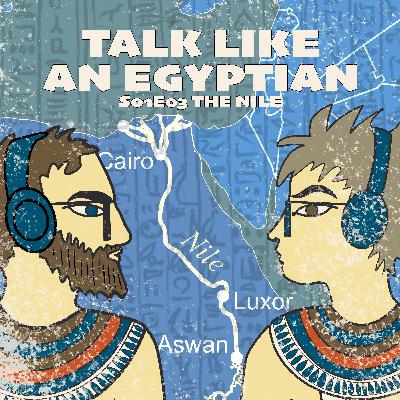
The Nile In this episode we're trying to explain how fundamentally important the river Nile was to the presence of human beings in what we now call Egypt, and how this allowed civilisation to flourish there at such an early moment in human history, and to endure for such a long time. We talked about people settling along the banks of the Nile where the water and silts allowed plants and animals to thrive, how irrigation and agriculture allowed for these natural resources to be harnessed, and how this in turn freed people from spending all their time trying to find food to survive to do other things. We also talked about how the Nile was so important that the Egyptians imagined it being embodied by a god, Hapy, and how important the emergence of the land from the flood waters, and life springing forth from it, was to the Egyptians' myths about the creation of the world. Also, in more practical terms, how they were dependent on the annul flood ('inundation;'), on it not being too high or too low, and they built basins, channels and dams to manage the water, and grain silos to guard against the food running out of the flood wasn't right for a good harvest. The Nile was also the Egyptians primary means of transport and communication and this explains why boats are central to many Egyptian myths including how you get to the afterlife – by boat of course. Links: Extra content: https://www.patreon.com/talklikeanegyptian For the geology and geography of Egypt and the Egyptians' response to the river environment – the annual flood, irrigation channels, dams etc – try Reader, A Gift of Geology: Ancient Egyptian Landscapes and Monuments For the idea that before the creation of the world there was nothing but watery chaos, and that from this an island emerged on which life would grow, see the creation myths as covered in: Wilkinson, The Complete Gods and Goddesses of Ancient Egypt Shaw, The Egyptian Myths: A Guide to the Ancient Gods and Legends Iszi's book (she's so needy) The Cursed Tomb where ythe hero gets dropped into the nile: https://www.bloomsbury.com/uk/cursed-tomb-9781801996020/
The ancient Egyptians' beliefs in the afterlife were many and varying, weren't the same for pharaohs and commoners, and changed over time but in this episode we did our best to cover the main bases including: the journey made the sun / the king through the netherworld (the 'amduat'), the main groups of texts including the Pyramid Texts, Coffin Texts and 'Book of the Dead', the decoration of tombs, coffins, papyri and other funerary equipment including shabti figurines. Links: An excellent overview of Egyptian funerary practices beliefs in the afterlife is Taylor, Death and The Afterlife in Ancient Egypt. This includes discussions of all the major groups of texts but should any of you wish to look into those in more detail you might enjoy: The Pyramid Texts online: https://pyramidtextsonline.com Faulkner, The Ancient Egyptian Book of the Dead (mentioned in the notes for the previous episode). Hornung, The Ancient Egyptian Books of the Afterlife (includes discussions of the Amduat and related texts/ideas) On Egyptian tombs you might like Dodson and Ikram, The Tomb in Ancient Egypt Or, ahem, Chris's own book: Naunton, Searching for the Lost Tombs of Egypt. Oh, and I supposed, if you are after historical fiction for 9-12 year olds that touches on real ancient egyptian belief in the after life and heart scarabs you'll want iszi's book: Iszi Lawrence, The Cursed Tomb Do support us and grab some bonus content: www.talklikeanegyptian.com
So, it's easy – if you an Egyptology pedant – to pick holes The Mummy, which the two of us have done several times at the British Museum. But actually, being more generous about it, a lot of what's in the film is clearly inspired by good evidence and in this episode we tried to cover what seemed to us to be the most important themes: including the way ancient Egypt appears – architecture, landscape, people, costumes, names – characters and places – the idea of the 'Medjay', the practice of mummification and whether anyone was ever mummified alive as in the movie (nope), and the way more modern Egypt and Egyptologists are portrayed (Egyptian Museum good, Bembridge Scholars… What?? No, what are they talking about?!) Links: To watch the movie online: https://www.justwatch.com/uk/movie/the-mummy For the original (1932) movie featuring Boris Karloff in the lead role which provides some of the inspiration including the names Imhotep and Anck-su-namun: https://www.justwatch.com/uk/movie/the-mummy-1932 Some excellent books on some of the themes we covered include: Gods and goddesses: Wilkinson, The Complete Gods and Goddesses of Ancient Egypt Mummification: Dodson and Ikram, The Mummy in Ancient Egypt The Book of the Dead (the real one that isn't really a 'book'): Faulkner, The Ancient Egyptian Book of the Dead The novel Chris mentioned about a society of Egyptologists which is actually a cover for men to get away from their wives and have affairs etc is Kingsley Amis and Robert Conquest, The Egyptologists. Oh and iszi's book incase she feels left out: https://www.bloomsbury.com/uk/cursed-tomb-9781801996020/ www.talklikeanegyptian.com
LAUNCHING SEPT 2025! Talk Like An Egyptian with Dr Chris Naunton and Iszi Lawrence. To support the podcast join us on Patreon.com/talklikeanegyptian and unlock bonus content. Get in touch talklikeanegyptianpod@gmail.com or use #TLAE. We need your questions for the end of the series so please don't hold back. Remember to leave us five stars (of Nut) and share this episode with your friends. Find out more at www.talklikeanegyptian.com. Life Prosperity Health!
LAUNCHING SEPT 2025! Talk Like An Egyptian with Dr Chris Naunton and Iszi Lawrence. To support the podcast join us on Patreon.com/talklikeanegyptian and unlock bonus content. Get in touch talklikeanegyptianpod@gmail.com or use #TLAE. We need your questions for the end of the series so please don't hold back. Remember to leave us five stars (of Nut) and share this episode with your friends. Find out more at www.talklikeanegyptian.com. Life Prosperity Health!
Comments

Download from Google Play

Download from App Store
 United States