


 Claim Ownership
Climate Economics with Arvid Viaene
Subscribed: 5Played: 57
Subscribe

© 2026 Climate Economics with Arvid Viaene
Description
A research-focused podcast on the economics of climate change and air pollution. Episodes are released every two weeks on Tuesday at 6 am CET. Episodes will be either expert interviews or solo explorations of key issues. Hosted by Dr. Arvid Viaene, a climate economist with a PhD from the University of Chicago. He has done research on the impacts of climate change on agriculture and mortality. His research on climate-related mortality has been published in The Quarterly Journal of Economics, and he has advised the European Commission on the impacts of climate policy on firm competitiveness.
22 Episodes
Reverse

In Part 2 of my conversation with Richard Tol, we move from model structure to policy use. We discuss the social cost of carbon, how the Obama-era EPA worked with FUND, DICE, and PAGE, and why Tol thinks the process of understanding a model matters as much as running it. We also talk about why integrated assessment models are often misunderstood, why debates around damage functions get so heated, and what this reveals about the boundary between economics and politics. The second half of the e...

In this episode, I speak with Richard Tol about the origins of the FUND integrated assessment model and why its structure matters for climate economics. We start with the basic question: what is an integrated assessment model actually for? From there, Richard explains how FUND was built in the early 1990s, why it took a different path from models like DICE and PAGE, and why sector-by-sector damages, public goods, demography, and adaptation all matter if you want to say something useful about ...

Voluntary carbon offsets are often discussed on the supply side—quality, additionality, adverse selection. In this episode, we go to the demand side: what do people actually pay for carbon mitigation when it shows up as a real choice at checkout? My guest is Matthias Rodemeier (Assistant Professor of Finance, Bocconi University), co-author of the paper “Willingness to Pay for Carbon Mitigation: Field Evidence from the Market for Carbon Offsets.” Using a large-scale field experiment with...

CBAM is simple conceptually, but very hard to put into practice. Turning CBAM into a working system requires something the EU doesn’t naturally have for global supply chains: credible, product-level emissions data, verified across jurisdictions. In Episode #19, I’m joined by Pauline Miquel, a policy expert who has been tracking CBAM’s fast-moving details and its implications for importers. We discuss: What CBAM covers first (cement, steel, aluminium, hydrogen, electricity, fertilizers—and eve...

Climate policy faces a built-in incentive problem: countries bear the costs of domestic regulation, while the benefits of lower CO₂ are shared globally. One proposed solution is a Carbon Border Adjustment Mechanism (CBAM) — charging imports a carbon cost comparable to domestic producers (with credits for carbon prices already paid abroad). In this episode, I’m joined by Kimberly Clausing to discuss her paper on the global effects of CBAM, with a focus on steel and aluminium — two sect...

International carbon credits are back in the policy conversation—especially after the EU’s new 2040 proposal reopened the question of whether (and how) Paris Agreement Article 6 credits might play a role. But “offsets” are a loaded term for a reason: past systems created large volumes of credits, and a recurring critique is that too many didn’t represent real, additional emissions cuts. So what is Article 6, what’s genuinely different under Paris, and what still isn’t settled? In Episode #17,...

If you think carbon taxes and cap-and-trade are basically the same thing, this episode might change your mind. For Episode 16, I’m joined by Jeroen van den Bergh (ICREA Research Professor at ICTA-UAB Barcelona) to unpack why carbon markets (ETS / cap-and-trade) may outperform carbon taxes, especially once you take bounded rationality seriously. We discuss: Why the EU ETS scales across borders more easily than taxesHow cap-and-trade can be politically more resilient (and sometimes “hidden”)Why...

With the end of the year approaching, it is time to take stock and reflect on the past 14 episodes. I present lessons and takeaways from each and discuss some upcoming episodes. For questions, comments or suggestions, you can contact me at arvid.viaene.ce@gmail.com

We talk a lot about the “right” climate policies—carbon pricing, clean investment, regulation. But there’s a step before all of that: politics. Who wins elections. What voters actually do—not just what they say in surveys. And how politicians reposition when the climate gets hotter and the economy starts to transition. Today’s episode asks three concrete questions: When a place experiences unusually extreme heat, does it measurably shift votes?Do local green and brown jobs shape climate...

In this episode, Berkeley professor Reed Walker discusses his American Economic Review paper with Joe Shapiro on the costs and benefits of U.S. air-pollution regulation—using Clean Air Act offset markets to infer marginal abatement costs—and why the results suggest regulation is often too lenient on the margin. We also touch on his Journal of Political Economy paper on the long-run consequences of cleaner air for children’s adult earnings. For questions, comments or suggestions, you can...

Is U.S. air pollution policy still too lenient – even after decades of regulation? In this episode, I’m joined by Dr. Joseph Shapiro (UC Berkeley, NBER, Energy Institute at Haas) to discuss his recent research using 40 pollution offset markets under the U.S. Clean Air Act. By looking at how much firms actually pay for emission reductions, Joe and his co-authors back out marginal abatement cost curves and compare them to the health and welfare benefits of cleaner air. We talk about: How pollut...
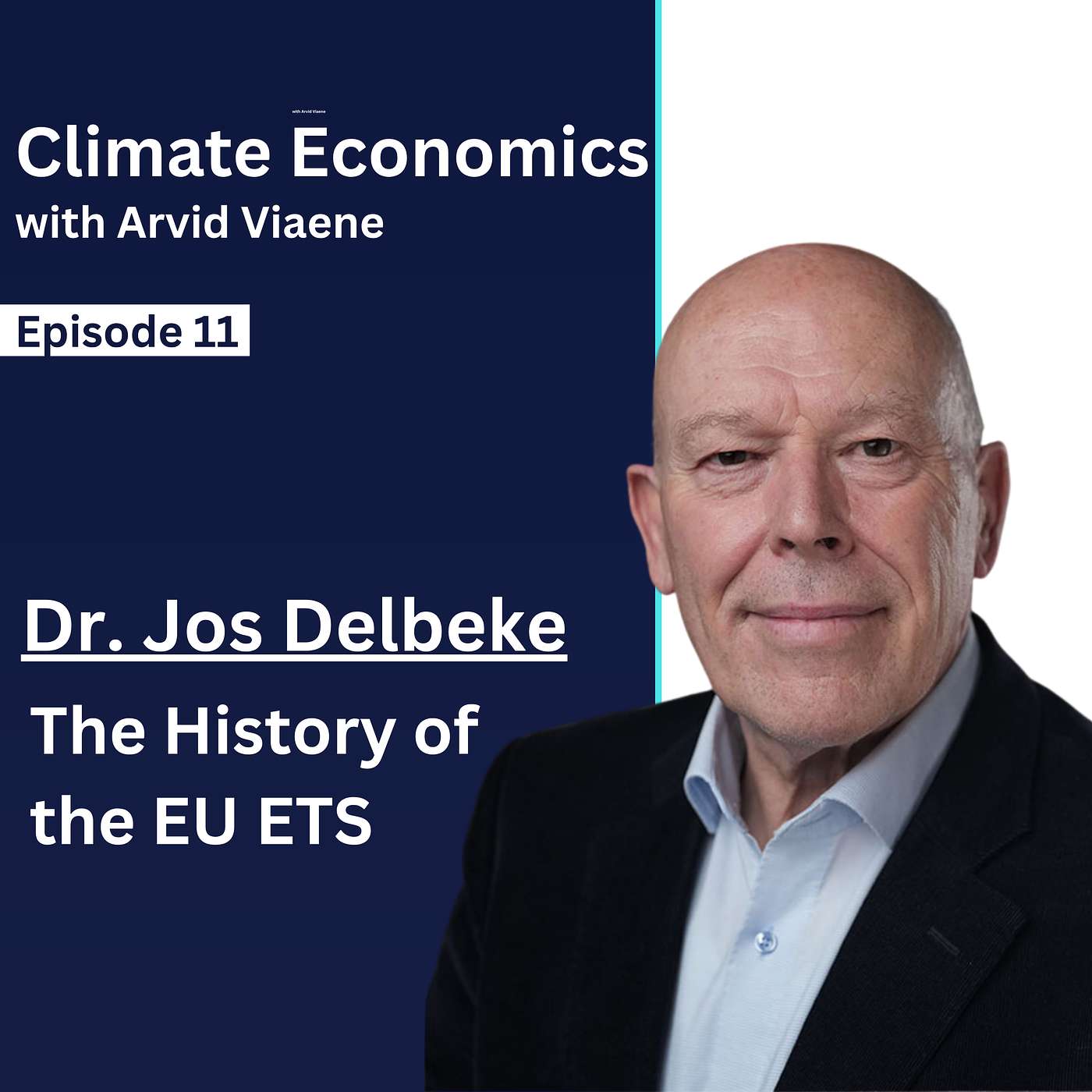
On paper, climate policy sounds simple: you put a price on carbon. Either you tax it, or you cap it and let firms trade. In practice, doing that for one of the world’s biggest economies — as the first mover — is anything but simple. This episode looks at 20 years of the EU Emissions Trading System (EU ETS): how it started, the challenges, the lessons, and where it’s going next. The ETS is the world’s first major carbon market, and it has helped drive CO₂ emissions in covered sectors down by m...
Air pollution isn’t just a climate co-benefit—it’s the number one threat to human health. In this best-of compilation, we revisit three standout conversations to trace the arc from global impacts to two of the world’s most important case studies: China and India. Both tackled air pollution, but one In this episode: The global picture (Dr. Christa Hasenkopf, EPIC – UChicago): Why fine particulate matter (PM2.5) quietly shaves ~2 years off global life expectancy—and how microscopic partic...
Marion Kruger, co-founder of Remove, explains how carbon removal technologies are essential for achieving net zero targets by compensating for emissions that are impossible or extremely expensive to eliminate. Carbon removal is what puts the "net" in net zero, and by 2050, we'll need to remove 5-10 gigatons of CO2 annually—creating an industry comparable in size to today's oil and gas sector. • Three main types of carbon removal technologies: nature-based, hybrid, and engineered solutions • ...
Did the 2018 US–China trade war make China’s air dirtier and increase its CO2 emissions? This question is not easy ex-ante. On the one hand you have a decrease in production which decreases emissions and pollution. On the other hand, there is more pressure on politicians to relax environmental standards. Notice any similarities with recent events? In my latest episode, I therefore sit down with Prof. Lorenzo Trimarchi to unpack these forces in his new JDE paper, “The Unintended Co...

Find the clean transcripts on my Substack: https://substack.com/@climateeconomicswitharvid Could market forces be the key to solving one of the world's most pressing public health crises? The evidence from India's groundbreaking air pollution markets suggests a resounding yes. Air pollution in India has reached catastrophic levels. With 74 of the world's 100 most polluted cities located there, the average Indian loses 3.5 years of life expectancy to dirty air. In Delhi, that number climbs to...
Pricing carbon is the backbone of climate cost-benefit analysis in the U.S. If the price is high, stronger environmental rules pay for themselves; if it’s low, they don’t. In this episode, I trace how the social cost of carbon entered federal policy and why the number has shifted between administrations. What we cover From Reagan-era cost-benefit rules to a 2007 court case that rejected “carbon = $0”The Obama team’s Interagency Working Group and a unified SCC built from leading IAMsTrump’s sh...
A plain-English tour of how economists put a price on climate harm—the Social Cost of Carbon—and a quick way to estimate damages with just a few numbers. We start from 2023 anchors (≈4.7 tCO₂ per person; ≈38 GtCO₂ worldwide), explain SCC and how U.S. administrations have used very different values, and compare with recent EU carbon-permit prices. Using a €100/ton example, we translate emissions into ~€500 per person per year and ~3.8% of global GDP, then show how the result scales...
Carbon credit offsets sound great in theory. But how well do they actually work in practice? In this new episode of my podcast, I talk with Dr. Benedict Probst about one of the largest reviews ever done on the effectiveness of carbon credit offsets, which covers over 1 billion credits across dozens of studies. We discuss what his research says, why less than 16% of credits were found to be effective, and what this means for future climate policy, especially as the EU considers offsets in its ...
Air pollution is responsible for shortening global life expectancy by more than two years—making it the world’s leading threat to human health, ahead of HIV/AIDS, malaria, and even smoking. Yet it receives only a fraction of the funding and policy attention. In this episode, Dr. Christa Hasenkopf breaks down why air pollution is such a silent but devastating force—especially in the Global South—and what can be done to fight it. From real-time data sharing in Mongolia to clean air markets in I...

Comments

Download from Google Play

Download from App Store
 United States