


 Claim Ownership
Tales From Aztlantis
Subscribed: 107Played: 3,203
Subscribe

© 2026 Chimalli Institute of Mesoamerican Arts
Description
We explore Chicano, Mexicano, and Mesoamerican history, archaeology, and culture, and combat the spread of disinformation about these very topics. Your hosts Kurly Tlapoyawa and Ruben Arellano Tlakatekatl invite you to join them on a fascinating journey through Mesoamerica's past, present, and future!
166 Episodes
Reverse

Today, we’re peeling back the layers of a name we use every single day, often without a second thought: America. But we aren’t just looking at a map; we’re looking at a philosophical crisis. It’s a crisis that really came to a head in 1958. That was the year Edmundo O’Gorman—one of Mexico’s most brilliant modern historians—published a book that sent shockwaves through the academic world. listener comments? Feedback? Shoot us a text! Your Hosts: Kurly Tlapoyawa is an archaeologist, ethnohi...
Well, dear listeners, it’s that time of year again: when the mainstream media and their corporate overlords conspire to wage war on the winter holiday meant to celebrate the birth of our savior and erase our annual traditions. We are referring of course, to the birth of Witzilopochtli as our sun reborn, and the associated feast of Panketzaliztli. But fear not, dear listeners, because here in Aztlantis we proudly say “Merry Panketzaliztli” and honor Witzilopochtli as the true reason for the se...

The culture that thrived at Teotihuacan in the Classic period has a unique place in Mesoamerican history. Today, it is held as an emblem of the Mexican national past and is one of the most visited archaeological sites in the Americas. Nevertheless, curious visitors are told that the ethnic and linguistic affiliation of the Teotihuacanos remains unknown. Whereas the decipherment of other Mesoamerican writing systems has provided a wealth of information about dynasties and historical events, sc...

With the passing of the Spring Equinox, we once again bring another year to a close. “In Xiwitl itlamiliz” The year has ended. This means it is once again time for the annual online arguments over whose calendar system follows the correct correlation. We here at the Tales from Aztlantis world headquarters thought it would be helpful to lay out four things you should remember about the ancestral Mexika calendar that might help you discern which calendars are based on solid evidence, and which ...

It was March 1968, and East Los Angeles was ready to explode. The city didn’t know it yet—hell, the country didn’t know it—but a brown revolution was about to burst forth out of its high schools. Over the course of a single week, up to 22,000 Chicano students—most of them teenagers, some still clutching textbooks and brown paper lunch bags—stood up, turned their backs on the chalkboards, and walked out. Their message was clear: they were tired of being treated as second-class citizens in the ...

The Assassination of Kwawtemok! On February 28, of the year 1525, Kwawtemok – the last sovereign tlatoani (ruler or speaker) of the Mexikah nation and the Anawak Confederacy, was assassinated by Hernán Cortés. But who was Kwawtemok, and why is he an important figure in the collective memory of Mexicans? listener comments? Feedback? Shoot us a text! Support the show Your Hosts: Kurly Tlapoyawa is an archaeologist, ethnohistorian, and filmmaker. His research covers Mesoamerica, t...

We are joined By Dr. Magnus Pharao Hansen to discuss his new book "Nahuatl Nations: Language Revitalization and Semiotic Sovereignty in Indigenous Mexico." Nahuatl Nations is a linguistic ethnography that explores the political relations between those Indigenous communities of Mexico that speak the Nahuatl language and the Mexican Nation that claims it as an important national symbol. Author Magnus Pharao Hansen studies how this relation has been shaped by history and how it plays out today ...
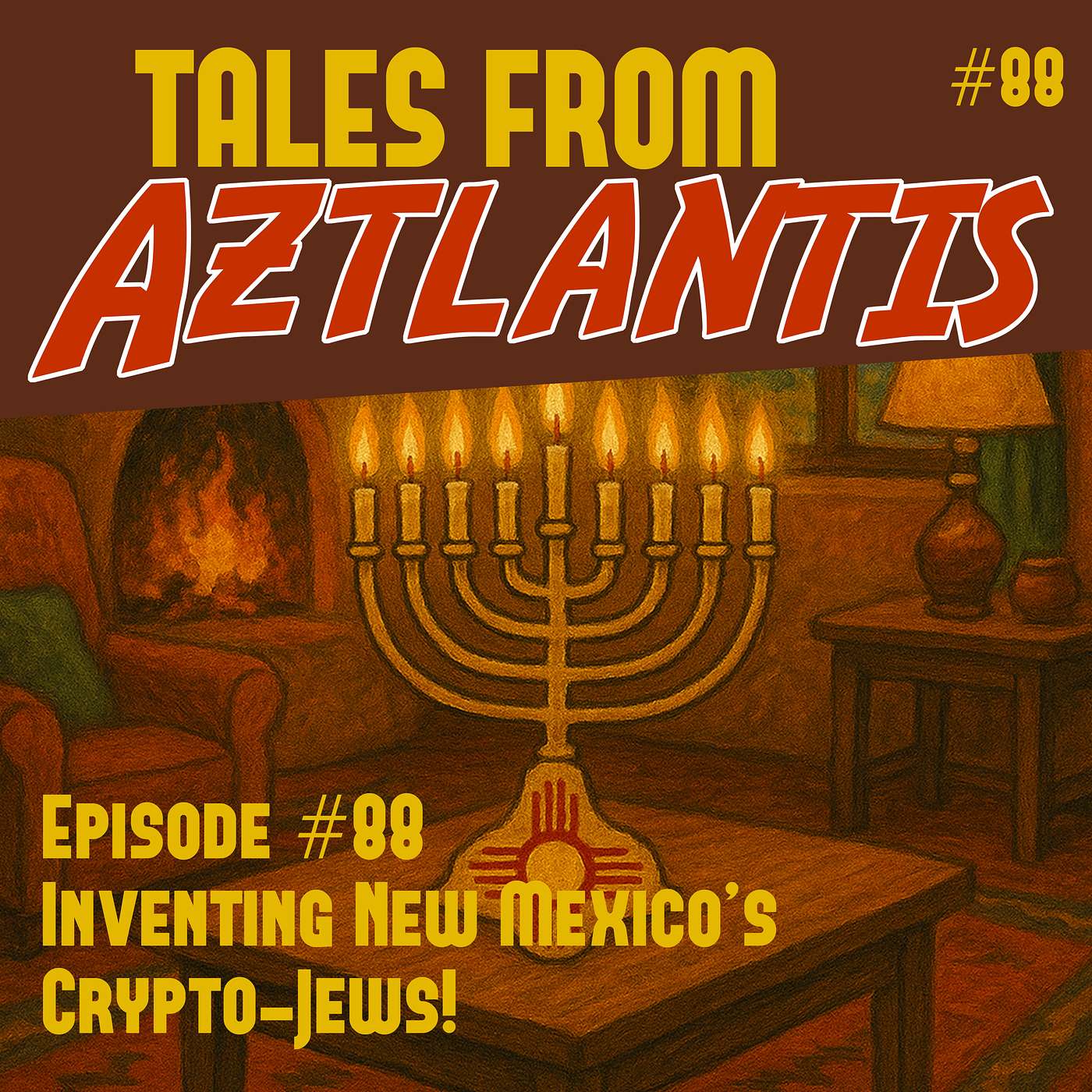
In the blistering heat of New Mexico’s sun-baked earth, under the protective gaze of Okuu Pin–the Turtle Mountain that majestically stands guard over Albuquerque–a strange and persistent legend has taken hold. It’s a story of hidden Jews, of ancient rites disguised as Catholic rituals, and of shadowy ancestors who supposedly hid their true faith during the Inquisition. This is the tale of New Mexico’s crypto-Jews—a myth so tangled in folklore, mistaken identities, and selective memory that it...

Day of the Dead is Subversive Spirituality! Long before the arrival of Europeans, some of the Indigenous Mesoamerican traditions of honoring the dead were celebrated with two specific feasts: Mikailwitl (feast of the dead), and Wey Mikailwitl (great feast of the dead). These feasts were celebrated in early August through mid-September. In fact, we are currently in the “month” of Mikailwitl right now, as it began on August 8th or the day Chikome Kozkakwawtli in the ancestral Mexika calendar....

It was October 9th, and the orange-tinted manchild sat hunched in the Oval Office, surrounded by his usual circus of bootlickers, propagandists, and professional ass-kissers. Cameras clicked, flags flapped, and the stench of urine, Axe body spray, and fascism filled the room. With a greasy Sharpie and a look of divine idiocy, he scrawled his signature across a proclamation declaring that every second Monday in October would henceforth be Columbus Day—no Indigenous Peoples’ Day, no nuance, no ...

During a 1990 visit to Mexico, Pope John Paul II confirmed the long-standing liturgical cult in honor of Juan Diego, officially beatifying him. This act set in motion the process of canonizing Juan Diego as the first saint Indigenous to the Americas. The Juan Diego Faithful were, of course, elated at the prospect. They only had to deal with one tiny problem: Juan Diego never existed. In this episode we delve into the myth of Juan Diego, and examine efforts made by the church to prove that thi...

On November 26, 1988, a person by the name of Ramón Tirado delivered the “Consigna del sexto sol: Segunda consigna de Anáhuac” –or the “Mandate of the Sixth Sun: Second Mandate of Anahuac”– at the Convención de Anáhuac – or the “Anahuac Convention” – which was held in Mexico City. In this Episode, we take a look at the speech, discuss it's message, and explore it's contemporary significance. Enjoy! listener comments? Feedback? Shoot us a text! Support the show Your Hosts: Kurly Tlapoyawa is ...
The Myth of New Mexican Spanish This week we are joined by the official New Mexico State historian Rob Martinez! Rob joins us as we dissect the many myths surrounding the way Spanish is spoken in New Mexico. In this episode, we ask the question: is New Mexican Spanish actually an archaic and “pure” form of ancient Spanish? Spoiler alert: Hell no, it isn’t!! Our guest: State Historian Rob Martinez is a native New Mexican born and raised in Albuquerque. A graduate of the University of New ...

Proponents of the nepohualtzintzin hail it as a marvel of ancient Mesoamerica. Elevated as a symbol of mathematical sophistication, the device has captured the imagination of scholars and enthusiasts since the 1970s. However, a close examination of the available evidence raises questions about the nature and origin of the nepohualtzintzin. In this episode we dive into the bizarre history of the alleged "Aztec computer." listener comments? Feedback? Shoot us a text! Support the show Yo...

What happens when you invite Kurly Tlapoyawa to give the keynote address at a Latinx conference? Let's find out! listener comments? Feedback? Shoot us a text! Your Hosts: Kurly Tlapoyawa is an archaeologist, ethnohistorian, and filmmaker. His research covers Mesoamerica, the American Southwest, and the historical connections between the two regions. He is the author of numerous books and has presented lectures at the University of New Mexico, Harvard University, Yale University, San Diego S...

Today marks the 55th anniversary of the Chicano Moratorium March, a movement of Chicano anti-war activists that built a broad-based coalition of Mexican-American groups to organize opposition to the Vietnam War. Led by activists from local colleges and members of the Brown Berets, a group with roots in the high school student movement that staged walkouts in 1968, the coalition peaked with an August 29, 1970 march in East Los Angeles that drew 30,000 demonstrators. The march was described by ...

In this special extended throwback episode, we are joined by Chicano author Scott Russell Duncan to talk about his new book "Old California Strikes Back" and the state of Chicano publishing! "Old California Strikes Back is a modern Ramona Diary, the record tourists kept of the sites of Old California and the book Ramona and Hollywood movies that renamed and transformed them. A mix of fantasy and memoir, the author SRD's tour turns surreal as he enters the myths of the Californios with the tal...

Is wokeness destroying the discipline of archaeology? Is chattel slavery a bad thing? And just how much does "Big Archaeology" pay, anyway? We break it all down as we are joined by Dr. Ken Feder to discuss his new book "Native America: The Story of the First Peoples." listener comments? Feedback? Shoot us a text! Your Hosts: Kurly Tlapoyawa is an archaeologist, ethnohistorian, and filmmaker. His research covers Mesoamerica, the American Southwest, and the historical connections be...

Danzantes, Mexicanistas, and other cultural practitioners often display a banner that they claim is the "original" and "true" banner of the Mexika people. Often referred to as the Panketzalli, Bandera de Cuitlahuac, or the Bandera de Victoria, this symbol can be found emblazoned on t-shirts, flags, dance regalia, murals and tattoos. But where does this image actually come from? And who created it? listener comments? Feedback? Shoot us a text! Support the show Your Hosts: Kurly Tlapoyawa is a...

Today, we’re tackling a really fascinating and, frankly, provocative topic. We’re going to be talking about an article by Stephen Pearson titled “Indigenizing Settlers: The White Appalachian Self and the Colonialism Model of Appalachian Exploitation.” And it's a deep dive into how a specific group of people—White Appalachians—have, in some ways, come to see themselves as an Indigenous population. listener comments? Feedback? Shoot us a text! Your Hosts: Kurly Tlapoyawa is an archaeo...


Download from Google Play

Download from App Store
 United States
I think continuing to use “Latino” contributes to erasure and self hate. Because it means white and euro centered. As scholars we need to shift that and stop using those terms just because it’s acceptable in the dominant paradigm. Couldn’t help but cringe every time it was used in this podcast. Can we use detribalized brown people or survivors of Spanish colonialism? Or something else but who colonized us? We don’t call black peoples Englic because of who colonized them. We need to start using terms on our own terms and not perpetuate “Latino”. I know im preaching to the choir haha. But as a mental health wellness worker as well, I know lexicon matters in regards to our sense of self.
My partner shared this podcast with me. Great work, bringing up important dialogues and breaking apart very popular misconceptions. Truth hurts sometimes, but it's good!
Pokju (thank you) so much for this important information. I try explaining and explaining about Latin/Hispanic/Latinx etc but to def ears. So listening to this was very refreshing and validating.