


 Claim Ownership
Govcon Giants
Subscribed: 90Played: 4,503
Subscribe

Description
Hosted by government contracting expert, 8(a) business mentor, and founder of the Govcon Giants platform, Eric Coffie. With over 250K+ podcast listens, a thriving YouTube channel of 49K+ subscribers, and a LinkedIn community of 19k+ followers, Eric has built one of the most trusted voices in federal contracting. Govcon Giants isn't just another podcast—it ranks on the U.S. procurement leaderboard and is recognized as the #5 overall creator worldwide in procurement, cementing Eric's role as a true authority in this space.
On this podcast, you'll discover how to win more contracts, scale your small business into a sustainable government contracting powerhouse, and learn the insider strategies that have helped countless entrepreneurs break into the $700B+ federal marketplace. Through real conversations with industry leaders, agency insiders, and successful business owners, Eric brings you the playbook for success—covering everything from 8(a) certification and set-asides to subcontracting, teaming, and beyond.
Whether you're just starting out or looking to scale, Govcon Giants is your roadmap to navigating one of the most profitable yet misunderstood markets in the world—government contracting.
On this podcast, you'll discover how to win more contracts, scale your small business into a sustainable government contracting powerhouse, and learn the insider strategies that have helped countless entrepreneurs break into the $700B+ federal marketplace. Through real conversations with industry leaders, agency insiders, and successful business owners, Eric brings you the playbook for success—covering everything from 8(a) certification and set-asides to subcontracting, teaming, and beyond.
Whether you're just starting out or looking to scale, Govcon Giants is your roadmap to navigating one of the most profitable yet misunderstood markets in the world—government contracting.
667 Episodes
Reverse

Most contractors lose opportunities not because they're unqualified—but because they don't understand how buyers actually want to purchase. In this episode of the Federal Help Center Podcast, Ryan Atencio breaks down how Unison Marketplace works, why agencies love it, and how simplified acquisitions under $350,000 create some of the fastest paths to revenue in government contracting. You'll learn how shaping requirements with custom kits and part numbers keeps you in control, why crossing the $350K threshold can instantly complicate a deal, and how consistent follow-ups with contracting officers and program managers put you top of mind when real requirements appear. This episode is a masterclass in positioning, timing, and selling the way the government prefers to buy. Key Takeaways How Unison Marketplace enables fast, simplified purchases under $350K Why custom kits and part numbers help you shape and protect opportunities How staying visible with government buyers leads to inbound quote requests If you want to learn more about the community and to join the webinars go to: https://federalhelpcenter.com/ Website: https://govcongiants.org/ Connect with Encore Funding: http://govcongiants.org/funding

Most contractors chase solicitations without understanding how federal agencies actually buy. In this episode of the Federal Help Center Podcast, Ryan Atencio break down micro-purchase thresholds, government card swipes, and why agencies will always choose the fastest, least complicated buying path whenever they can. You'll learn how the $15,000 micro-purchase limit for supplies really works, why quotes magically come in just under the threshold, and how understanding micro-purchases and the simplified acquisition threshold ($350K) helps you position earlier, think like the customer, and stop missing easy GovCon wins hiding in plain sight. Key Takeaways How micro-purchase thresholds allow agencies to buy without contracts Why card swipes dominate federal buying behavior under $15,000 How understanding acquisition thresholds gives you a strategic advantage If you want to learn more about the community and to join the webinars go to: https://federalhelpcenter.com/ Website: https://govcongiants.org/ Connect with Encore Funding: http://govcongiants.org/funding

In this episode of the Federal Help Center Podcast, Colin Nchako delivers a hard truth most small business owners don't want to hear: adding skills you don't plan to master is one of the fastest ways to stall your growth in government contracting. Colin explains why skills must connect, not just exist—and how mismatched offerings confuse buyers, weaken proposals, and slow your path to larger contracts. Using real examples from his own journey, Colin breaks down how marketing and training naturally work together, how to evaluate whether a skill truly belongs in your business, and why chasing every opportunity is a losing strategy. He also shares how he monitors state and local portals daily, strategically targets contracts that ladder up to federal work, and reverse-engineers opportunities to build past performance that actually matters. Key Takeaways Don't add skills unless you plan to master and monetize them Skills should connect logically (not just sound impressive on paper) Use state and local contracts as stepping stones to federal awards If you want to learn more about the community and to join the webinars go to: https://federalhelpcenter.com/ Website: https://govcongiants.org/ Connect with Encore Funding: http://govcongiants.org/funding

In this episode of the Federal Help Center Podcast, Colin Nchako challenges small business owners to stop hiding their skills and start monetizing them—now. From programming language courses and AI content to trade training and workforce development, Colin explains why the fastest path to new contracts isn't always chasing something new, but packaging what you already know in a way the government and private sector will pay for. If you've been waiting for the "perfect" contract, this episode shows why that mindset is costing you money. Colin breaks down how he turned professional training into a repeatable revenue stream—starting with a small, one-day engagement and leveraging it into bigger opportunities. He walks through how skills like IT, graphic design, carpentry, leadership, and workforce training can be positioned for state procurement, Job Corps, workforce development programs, and recurring training needs. The takeaway is simple: training is renewable, scalable, and one of the most overlooked ways to grow your portfolio without abandoning your core business. Key Takeaways You don't need new skills—you need to package and position the ones you already have Training and workforce development contracts are renewable and scalable Small wins (even one-day trainings) can be leveraged into larger, higher-paying opportunities If you want to learn more about the community and to join the webinars go to: https://federalhelpcenter.com/ Website: https://govcongiants.org/ Connect with Encore Funding: http://govcongiants.org/funding


In this episode of the Federal Help Center Podcast, Colin Nchako breaks down one of the most common mistakes small businesses make in government contracting: confusing talent with expertise. Colin shares how he recently restructured his own capability statement, shortened his positioning language, and redefined his business around what the government actually buys — not what sounds impressive. The key lesson? You can add new skills to your business, but if you don't intentionally build and position expertise around them, the government won't see the value. Colin also pulls back the curtain on why training, SOP development, and knowledge-based services are some of the most overlooked — and most profitable — opportunities in GovCon. From in-person training to e-learning and standard operating procedures, he explains how leveraging existing skills, packaging them correctly, and building credibility over time can unlock faster wins and larger contract vehicles like OASIS. This episode is a wake-up call for contractors sitting on valuable skills they haven't fully monetized yet. Key Takeaways Talent isn't enough — expertise is built, positioned, and proven over time Training, SOPs, and knowledge services are high-margin, high-demand opportunities Clear positioning in your capability statement directly impacts contract size and access to major vehicles If you want to learn more about the community and to join the webinars go to: https://federalhelpcenter.com/ Website: https://govcongiants.org/ Connect with Encore Funding: http://govcongiants.org/funding
Most small businesses are doing government contracting completely wrong—and it's costing them months of time, thousands of dollars, and contracts they should already have. In this live recap, Eric breaks down the 5 moves that separate winners from everyone else in 2026—without the "spray and pray" approach, without waiting on RFPs, and without wasting your life refreshing SAM.gov. This episode is a condensed bootcamp breakdown of what Eric taught during an 8-hour training—compressed into a fast, actionable playbook. You'll learn how to target the right agencies, uncover real agency pain points, use AI prompts to gain an edge, find low-competition opportunities using the Hit List Method, and tap into the expiring contracts "honeypot" so you can get positioned early—either as a prime, a sub, or part of the winning team before the recompete drops. Key Takeaways: Target, don't chase. Pick 3 agencies and focus—spraying opportunities is why most contractors lose. Solve problems, not sell services. Agencies award contracts to businesses that speak to their pain points, not their features. Expiring contracts = hidden gold. Recompetes let you get in early—before the real competition shows up. If you want to learn more about the community and to join the webinars go to: https://federalhelpcenter.com/ Website: https://govcongiants.org/ Connect with Encore Funding: http://govcongiants.org/funding

Most people think they're "new to government contracting." They're not. They're new to how the government does business—and that's a massive difference. In this episode, Colin Nchako breaks down how to help someone who wants to pivot (like a general contractor moving into the product game) without wasting months guessing what the Army buys. The play is simple: stop speaking in vague terms like "Army supplies" and start doing real research using USAspending and FPDS, then match yourself to the right NAICS code so you can target opportunities with precision. Colin also explains the bigger lesson behind pivoting: you don't need to reinvent yourself—you need to identify a skill you can deliver, build credibility around it, and then use that credibility to win again. He shares examples from his own business where he added a capability (like training or SOP writing), landed awards, and used those wins to expand into more contracts. The goal isn't to learn everything at once—it's to marry the skills you already have to a new client (the government) and move with confidence. If you want to learn more about the community and to join the webinars go to: https://federalhelpcenter.com/ Website: https://govcongiants.org/ Connect with Encore Funding: http://govcongiants.org/funding

In this episode of the Federal Help Center Podcast, Ryan Atencio breaks down a critical truth most contractors overlook: the incumbent wasn't always experienced either. Before winning their first contract, many companies had no federal past performance—they simply put their name in the hat and refused to disqualify themselves early. Ryan walks through how to research recompetes properly by digging into parent awards, task orders, and spending patterns to uncover the real contract value—often far larger than what appears at first glance. Ryan also explains why federal contracting success requires focus, systems, and dedicated effort. Most businesses fail because they try to "dabble" in government work while prioritizing private-sector revenue. Ryan emphasizes that winning in the Department of Defense space demands someone whose only job is federal capture, shaping opportunities, and responding strategically. The companies that win don't self-reject—they submit, learn, and let the government decide. Key Takeaways: The best contractors win because they don't deselect themselves before submitting Parent awards and spending data reveal the true value behind "small" task orders Federal contracting requires dedicated systems—successful firms don't just dabble If you want to learn more about the community and to join the webinars go to: https://federalhelpcenter.com/ Website: https://govcongiants.org/ Connect with Encore Funding: http://govcongiants.org/funding
In this episode of the Federal Help Center Podcast, Ryan Atencio breaks down one of the most important moves in federal contracting: identifying the incumbent and controlling the recompete strategy before the bid even drops. By uncovering that the current contract holder (T3I) is now considered a large business, Ryan explains how small businesses can leverage sources sought responses to push an opportunity back into a service-disabled veteran-owned small business set-aside, forcing the incumbent to compete through a joint venture instead of dominating solo. The episode goes even deeper into contract intelligence, showing how to analyze a $13.8M ceiling contract and realistically project it into a $16M+ recompete due to inflation. Eric demonstrates how tools like USA Spending and AI can help contractors reverse engineer pricing, estimate hourly fully burdened rates ($115–$135/hr), and strategically undercut profit margins to "snipe" the contract away. This is a masterclass in modern capture, pricing strategy, and small business positioning in high-stakes Special Operations contracting. Key Takeaways: Recompetes are won early by identifying the incumbent and shaping the set-aside strategy through sources sought A $13.8M contract today can quickly become a $16M+ opportunity when inflation and option years are factored in AI + USA Spending data allows contractors to reverse engineer pricing and compete smarter, not cheaper If you want to learn more about the community and to join the webinars go to: https://federalhelpcenter.com/ Website: https://govcongiants.org/ Connect with Encore Funding: http://govcongiants.org/funding

In this episode of the Federal Help Center Podcast, Ryan Atencio shares his experience as someone who has worked both sides of the table — first as a government customer developing performance work statements, cost estimates, and source selections for tens of millions of dollars in contracts, and later as a contractor selling directly to Special Operations units after leaving the military in 2021. He shares how capturing end-user requirements and building custom "kits" can create a powerful edge that competitors can't easily match. The conversation then goes behind the curtain into the world of Special Operations professional service contracts, including highly specialized SERE (Survive, Evade, Resist, Escape) training support. You will get a rare look at how opportunities are found live on SAM.gov, shaped through source sought responses, and "shredded" quickly using AI tools like Gemini to extract the who/what/why before competition even wakes up. This is a masterclass in modern capture strategy for serious federal contractors. Key Takeaways: Winning starts before the RFP — source sought responses help shape the requirement early Contractors who understand the "customer side" gain a major advantage in DoD procurement AI shredding tools can accelerate bid/no-bid decisions and opportunity analysis in minutes If you want to learn more about the community and to join the webinars go to: https://federalhelpcenter.com/ Website: https://govcongiants.org/ Connect with Encore Funding: http://govcongiants.org/funding
Are you spending time chasing agencies that don't have money—or don't have a reason to buy from you? In this episode, Eric Coffie breaks down how federal spending actually works (appropriations + continuing resolutions) and why understanding where funding is flowing matters more than ever for small businesses. He explains the reality behind "fast" solicitations (2–3 week turnarounds), how Q1 spending pressure creates urgency, and why positioning before opportunities drop is the real advantage. Eric then walks through 8 agency pain points that create immediate opportunity—especially for businesses that can speak directly to mission needs instead of using generic "we do IT / we do construction" language. You'll hear how to use the NDAA and agency research to craft agency-specific capability statements, where to look beyond SAM.gov (IDIQs/task orders), and a practical 4-week action plan to build your target list, align your offerings to real problems, and start getting responses from the right buyers. Key Takeaways: No funding = no new contracts. Track appropriations/CR realities so you know where to focus your limited time and budget. Agencies are struggling to find qualified small businesses and match capabilities to needs—this is your opening to stand out fast. The 8 biggest Agency pain points right now If you want to learn more about the community and to join the webinars go to: https://federalhelpcenter.com/ Website: https://govcongiants.org/ Connect with Encore Funding: http://govcongiants.org/funding

In this episode, Zach Golden breaks down what OpnGovIQ really is — and why contractors who don't understand the difference between basic AI tools and a full federal CRM pipeline are already falling behind. Zach explains how OpnGovIQ's built-in agents can handle everything from capability statements to proposal timelines, FAR-based compliance questions, and even SAM.gov guidance, making it an all-in-one advantage for federal contractors moving fast. The conversation then shifts into one of the hottest opportunities in GovCon right now: AI companies entering the federal space. Zach shares why AI demand is exploding, why agencies "perk up" instantly when governance and security layers are mentioned, and why the real key is differentiation and building complementary teams — not chasing every lead at once. The contractors who position correctly now will dominate later. Key Takeaways: OpnGovIQ combines AI proposal agents + a full CRM pipeline for end-to-end federal capture AI GovCon isn't "too saturated" — the demand is so high agencies can't ignore it The winners will be firms with clear differentiators + complementary AI partnerships If you want to learn more about the community and to join the webinars go to: https://federalhelpcenter.com/ Website: https://govcongiants.org/ Connect with Encore Funding: http://govcongiants.org/funding
In this episode, Zach Golden walks through one of the most critical skills in federal contracting: making fast, confident bid/no-bid decisions before you waste weeks chasing the wrong opportunity. Using OpnGovIQ, Zach shows how contractors can decode an RFP in under five minutes, identify hidden requirements, and immediately spot what could prevent them from winning — especially in complex VA janitorial and medical-adjacent contracts. Zach also explains how this rapid breakdown process scales across industries, allowing contractors to review 6+ projects in a single session, plan months ahead during capture, and highlight red flags early (like hospital experience, medical waste handling, or compliance gaps). The goal is simple: move faster than competitors, avoid disqualification, and build a repeatable proposal engine that wins. Key Takeaways: OpnGovIQ helps contractors break down RFPs in 3–5 minutes for faster bid/no-bid decisions The biggest proposal killers are usually disqualifiers like missing hospital experience or compliance gaps Reviewing multiple opportunities weekly builds a pipeline — winning starts before the RFP drops If you want to learn more about the community and to join the webinars go to: https://federalhelpcenter.com/ Website: https://govcongiants.org/ Connect with Encore Funding: http://govcongiants.org/funding

In this episode of the Federal Help Center Podcast, Zach Golden walks through how contractors can use OpnGovIQ to break down an RFP quickly and avoid falling behind as opportunities begin dropping faster and deadlines shrink. He explains how uploading key documents like the PWS and price schedule can instantly generate a compliance matrix, helping businesses identify exactly what the government is asking for before wasting weeks on the wrong bid. Zach also highlights the importance of spotting early "beige flags," like difficult overnight staffing shifts or specialized medical cleaning requirements inside VA hospital environments. Instead of bidding blindly, this approach allows contractors to make smarter bid/no-bid decisions, understand evaluation factors beyond lowest price, and prepare stronger proposals with confidence and speed. Key Takeaways OpnGovIQ helps contractors evaluate RFP requirements fast by building a submission matrix from uploaded documents. Deadlines are shortening and opportunities are accelerating, so speed in bid/no-bid decisions is now a competitive advantage. Specialized requirements (medical spaces, surgical suites, shift coverage) must be flagged early before committing to a proposal. If you want to learn more about the community and to join the webinars go to: https://federalhelpcenter.com/ Website: https://govcongiants.org/ Connect with Encore Funding: http://govcongiants.org/funding
In this episode of the Federal Help Center Podcast, Zach Golden sets the tone for entrepreneurs who refuse to navigate federal contracting alone—then the session shifts into a practical, real-time working breakdown of an actual VA Janitorial Services RFP. The focus is speed and decision-making: how to do a quick bid/no-bid review now, because once contract volume ramps up in April–June, you'll need a repeatable process to keep up with SAM.gov opportunities and everything else on your plate. Zach walks through how he evaluates solicitations fast—using a rapid skim, pulling all attachments, and using an AI-assisted proposal workflow (via OpenGovIQ Proposal Manager) to organize requirements and accelerate analysis. Zach stresses the real value is knowing what to do with the material, not just downloading it. Key Takeaways Speed wins: A fast, repeatable bid/no-bid method is essential before SAM.gov volume spikes later in the year. Real RFP example: A VA Janitorial Services opportunity in Salt Lake City, SDVOSB set-aside, due Feb 13, with a base year + option years structure. AI workflow: Zach demonstrates a simple approach—download all attachments → run analysis in a proposal-focused AI tool—so you can move from "overwhelmed" to "organized" quickly. If you want to learn more about the community and to join the webinars go to: https://federalhelpcenter.com/ Website: https://govcongiants.org/ Connect with Encore Funding: http://govcongiants.org/funding
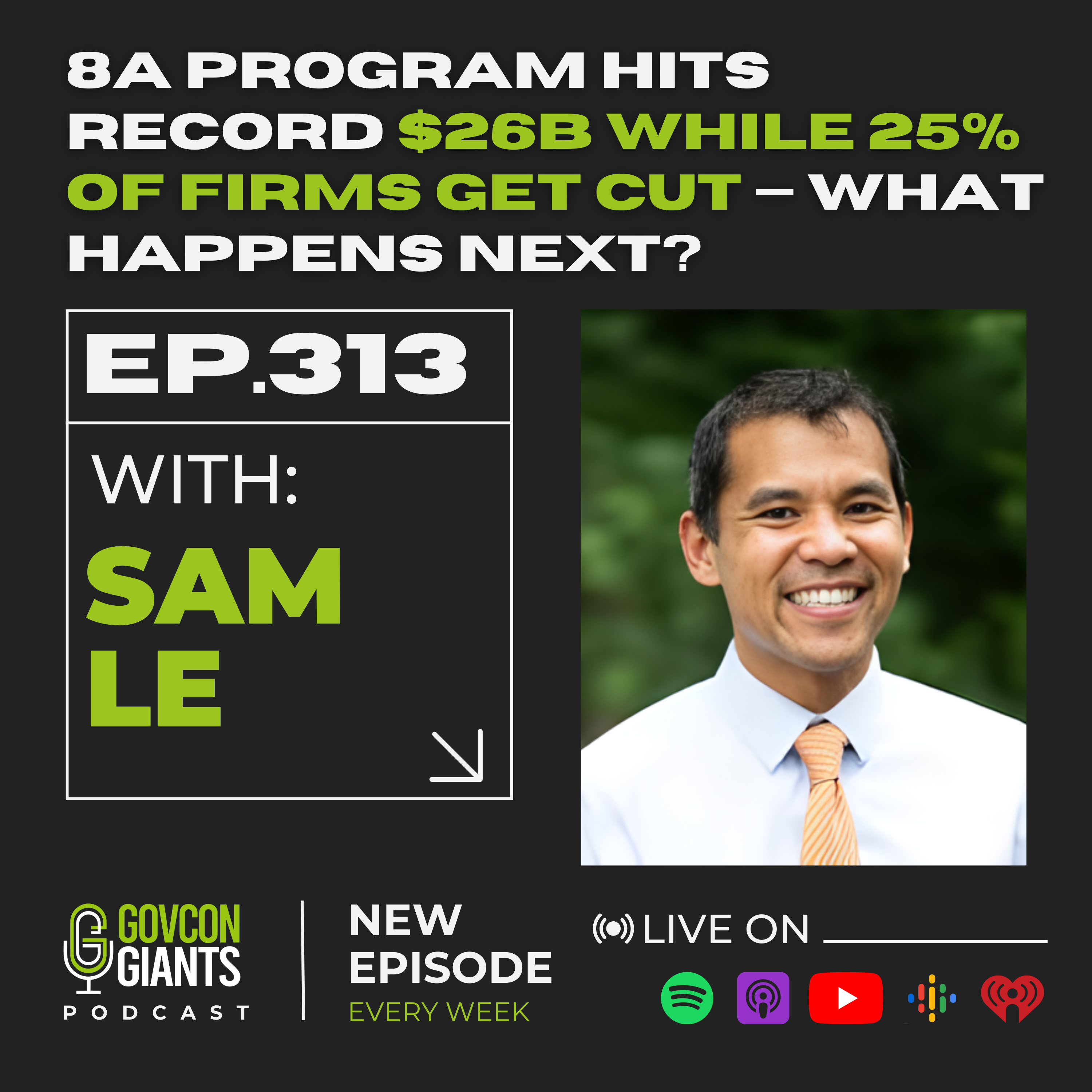
In this episode of the Govcon Giants Podcast, Eric Coffie sits down with Sam Le, founder of GovCon Intelligence and former SBA procurement policy leader with 17 years in federal contracting. Together, they break down the latest turbulence surrounding the 8A Program — including SBA's massive data call, the suspension of 1,100 firms, and heightened scrutiny on sole source awards above $20M. But despite the headlines, Sam explains why this may actually be the strongest moment in 8A history: the program reached a record $26B in awards in 2025, competition is shrinking, and small businesses that stay compliant can emerge with more opportunity than ever. The conversation also challenges misconceptions around "DEI labeling," highlights the true purpose of sole source contracting, and calls for SBA to expand visibility into industries like advanced manufacturing beyond the usual IT and construction pipeline. Key Takeaways: 8A is at an all-time high ($26B in 2025) even as 1,100 firms were suspended, reducing competition for active participants. Sole source contracts make up only 2–3% of federal spending, while 96% of sole source awards go to non-8A giants like Boeing and Lockheed. The biggest advantage right now belongs to firms that stay compliant, resilient, and relationship-driven before opportunities hit the bid platforms. If you want to learn more about the community and to join the webinars go to: https://federalhelpcenter.com/ Website: https://govcongiants.org/ Connect with Encore Funding: http://govcongiants.org/funding Learn more about Sam Le: https://www.govconintelligence.com/ Website: https://www.samlelaw.com/ Linkedin: https://www.linkedin.com/in/samlelaw/ Sam's Podcast: https://www.govconintelligence.com/podcast

In this episode of the Federal Help Center Podcast, Randie Ward reminds contractors that getting found isn't just about proposals — it's about proximity to the right people. Randie highlights how conferences, industry days, and LinkedIn connections help small businesses stay visible long before opportunities drop. She also shares an important invitation: learning directly from seasoned experts who have already built, scaled, and exited successful federal businesses. Randie previews upcoming Pro Member sessions featuring specialists with 32+ years of federal contracting experience, including former SDVOSB owners turned coaches and community leaders helping small businesses grow strategically. From vision and perseverance to building support networks (including a new women's group), this episode reinforces one truth: no contractor wins alone — the right room can change everything. Key Takeaways: Visibility comes from relationships, events, and staying engaged — not just bidding Learning from veterans with decades of experience can shortcut years of mistakes Community support is a growth multiplier in federal contracting If you want to learn more about the community and to join the webinars go to: https://federalhelpcenter.com/ Website: https://govcongiants.org/ Connect with Encore Funding: http://govcongiants.org/funding Join 2026 Surge Bootcamp Starting January 31: https://govcongiants.org/surge
In this episode of the Federal Help Center Podcast, Eric Coffey explains why winning contracts isn't about showing up when the bid is posted — it's about being discovered before the solicitation ever hits the street. Eric shares how relationship-building helped his team win a $2 million university Job Order Contract (JOC) by staying close to the project manager, showing up at events, and learning exactly what needed to be in the proposal long before submission day. Eric also breaks down the unfair advantage of engaging early: contracting personnel can talk to you freely before the RFQ drops — but once it's released, communication stops. From maintaining long-term relationships with FAA decision-makers to leveraging forecasts and pre-solicitations, Eric reinforces the core lesson: complex contracts aren't won last-minute. They're won through upfront strategy, visibility, and consistent conversations. Key Takeaways: Contractors who build relationships early get found before bids go public Pre-solicitations and forecasting are where the real advantage begins Long-term agency connections (like FAA) can open doors for years to come If you want to learn more about the community and to join the webinars go to: https://federalhelpcenter.com/ Website: https://govcongiants.org/ Connect with Encore Funding: http://govcongiants.org/funding Join 2026 Surge Bootcamp Starting January 31: https://govcongiants.org/surge

In this episode of the Federal Help Center Podcast, Randie Ward shares a powerful real-world breakdown of how relationship-building and strategic teaming led to a major $5 million contract win. Instead of chasing bids last-minute, Randie explains how early conversations with the right program managers revealed what the customer actually wanted: a capable small business prime supported by the right partners—not a massive prime contractor takeover. Randie walks through how the winning team came together by aligning a strong construction prime, a reputable design partner, and a prepared small business lead. When the RFQ finally dropped, they were already ahead—ready with resumes, key personnel, and a complete package. After being shortlisted, Randie coached the team through a high-stakes Phase Two interview with scripts, rehearsals, and precision timing… and they ultimately won. Key Takeaways: Relationships uncover what customers want before the RFQ ever hits Winning teams are built early through smart partnering (prime + design + support) Phase Two interviews are where preparation separates finalists from winners If you want to learn more about the community and to join the webinars go to: https://federalhelpcenter.com/ Website: https://govcongiants.org/ Connect with Encore Funding: http://govcongiants.org/funding Join 2026 Surge Bootcamp Starting January 31: https://govcongiants.org/surge

Comments

Download from Google Play

Download from App Store
 United States