


 Claim Ownership
What Do You Mean By That?
Subscribed: 158Played: 6,765
Subscribe

Description
Join multi-ethnic co-hosts Sara + Misasha - two wickedly smart, heart-led, long-distance best friends - as they help folks talk smarter and think deeper about the world around us. Whether it's about science, history, current events, social justice, or more, their community consists of people who want to be better humans, to benefit all of us.
We won't let the fire hose of information overwhelm us. Whether you're a seasoned expert or new to the work, you'll find yourself listening, learning, and feeling inspired to do something new after each episode.
If you can never get enough knowledge but also don't want to feel overwhelmed… Congratulations, you've found your people. Follow to join a community of curious folks who constantly wonder: what do you mean by that?
We won't let the fire hose of information overwhelm us. Whether you're a seasoned expert or new to the work, you'll find yourself listening, learning, and feeling inspired to do something new after each episode.
If you can never get enough knowledge but also don't want to feel overwhelmed… Congratulations, you've found your people. Follow to join a community of curious folks who constantly wonder: what do you mean by that?
292 Episodes
Reverse
Here we are, February, which is also Black History Month (and for the record: Black history is American history. We'll say this all day, every day, until everyone gets on this train.). It's not lost on us that this is the shortest month of the year. It's also not lost on us that, currently, our administration is actively erasing or whitewashing our nation's history in real time, including this month itself, and we are being gaslit in the process. So, this Black History Month, we encourage everyone out there to take a moment to learn our real history, expand the narrative of Black excellence in our country, and actively question the racist tropes and more subtle - yet still overt and noticeable - rewriting of history that is taking place. Many things can be true at once, including fear and the need to not stay silent. Listen in to hear more about what we think about that and simple ways to get these conversations started. What to listen for: The blatantly racist actions our current administration is taking How the administration is pushing for the whitewashing of history – for example, by requiring the murderer of Medgar Evers, a civil rights legend who was gunned down on his own driveway, to no longer be called racist. Though murderer Beckwith was "a member of the racist and segregationist White Citizens' Council" and Ku Klux Klan. What can we each do this Black History Month to hold the line? Focus on your community, sharing Black excellence, expanding your book club discussions, and asking your local schools what they're doing to teach Black history (which is American history, all year long).
*** We recorded this episode before ICE murdered Alex Pretti, a 37 year old ICU nurse who was attempting to help a woman up who had been pushed to the ground by ICE agents in Minneapolis on the morning of January 24, 2026. Despite the administration's attempt to cover up and justify this murder by claiming that Pretti was holding a gun (he wasn't, it was a phone), the facts are clear: ICE is murdering American citizens. And then, they are lying about it. This is not the America we want for ourselves or for our children. We stand with Minnesota, Maine, and everywhere else that is fighting back. Part of our fight is this episode, and the resources we share in it. Please share widely. We are strongest when we stand together. NO ICE. We leave you with the words of Alex Pretti's parents, who, in the face of the callous killing of their son, left us with who he truly is, in their statement that they released on January 24: "We are heartbroken but also very angry. Alex was a kindhearted soul who cared deeply for his family and friends and also the American veterans whom he cared for as an ICU nurse at the Minneapolis VA hospital. Alex wanted to make a difference in this world. Unfortunately, he will not be with us to see his impact. I do not throw around the 'hero' term lightly. However, his last thought and act was to protect a woman. The sickening lies told about our son by the administration are reprehensible and disgusting. Alex is clearly not holding a gun when attacked by Trump's murdering and cowardly ICE thugs. He had his phone in his right hand and his empty left hand is raised above his head while trying to protect the woman ICE just pushed down, all while being pepper sprayed. Please get the truth out about our son. He was a good man." Horns honking, people chanting ICE OUT as they crowd busy intersections. Horns honking, ICE agents smashing car windows, and grabbing people from their cars. Which scenario sounds like the America you know? Which one, more importantly, sounds like the America you want to be fighting for? Regardless of what you answered, this episode is a must-listen. We unpack the history of ICE (it's not a long one, despite what might be suggested by our current administration), why ICE acting as the secret police for the administration is not only incredibly illegal today but also reminds us of another secret police which rhymes with Schmestapo, and what we can all DO about ICE in our communities, especially when it seems like we have no agency. What to listen for: ICE's history in America is fairly new – it was formed after the attacks on 9/11/2001. The purpose and guideposts around ICE have shifted with administrations. Most recently? This federalized force of vigilantes, loosely recruited with even looser standards, has been weaponized and deputized to create mass terror, egged on by a fascist leader with an outsized ego and zero morality. The historic precedent: Brownshirts → SA. Like the Proud Boys but 1930s style, and this is where we're at now. But Himmler wanted educated men to be this force, which developed into the SS. Let's not find out what happens in America if and when we get to the SS stage. What can you do? We have tons of ideas for using your body, wallet, writing/petitioning power, and joy. Listen in for our suggestions. Easy links to click to take action: Tell Congress to listen to "wine moms" and stop ICE Tell Congress to stop funding ICE & CBP and demand accountability Urge senators to pass the DREAM Act Use 5calls to make your voice as a US constituent heard Names of companies supporting ICE, courtesy of The Nation, that you can boycott Resources: KNOW YOUR RIGHTS if ICE shows up (we've printed this out to make sure our teens see it too) What to know if you're thinking about planning an event Example of how it can be done: A local Colorado grassroots organization
If you're a repeat listener to the podcast over the last almost SEVEN years, you know that sometimes, we've done seasonal arcs in which we focus on a topic or theme for the season. (And if you've just found us - hello!) This year, we're doing something different: a year-long focus on action, which is the third pillar of our listen, learn, and act framework. It moves us from "what can I do?" to "here's how I show up." We'll take the things that you've been curious about (but didn't want to ask about, maybe), break down the history behind them, and walk you through why these things matter. And then we'll throw in tips on how, now that you know about them, you can make small changes in your own lives to make a huge impact in your communities and in the fight for all of us. We're in it to win it this year. Hope you'll come along for the journey. Welcome to 2026, and a whole new year of What Do You Mean By That? - the podcast about asking better questions, having deeper conversations, and taking action that helps all of us. Make sure you're signed up for our newsletter to catch all the details in between. What to listen for: What does a name actually carry beyond just identification? The cocktail party effect of perking our brains up, increasing engagement, attention, and memory. Plus, the big answer: belonging. Even to a whole country. Why does mispronouncing or misspelling someone's name — even unintentionally — have an impact? Just ask Miasma… I mean Misasha. AKA "Sasha" in coffee shops. Why do people so often hesitate to ask for help with names? Perfectionism, fear of awkwardness (but isn't it also awkward to get it wrong?!), and the effort it takes to actually listen to and learn someone's name. What happens when people feel pressured to shorten, change, or "Americanize" their names? Sure, study after study proves we are biased against certain names. But is that enough reason to ask folks to erase their heritage, their parent's pride, their sense of identity - so you can call them "Alice"? Getting names right is a simple but powerful practice of belonging. Make the effort. For more like this, listen to our conversation with Mita Mallick (another "get my name right" advocate) on colorism. And this conversation with Naomi Raquel Enright on specific phrasing around identity (i.e., presumed to be White, instead of White-presenting or passing for White) Finally, to read more, check out our book Dear White Women: Let's Get (Un)comfortable Talking About Racism.
We've had rough years before—but 2025? This one hit different. If you've been listening to us for the last six years, you know we're no strangers to hard conversations. DEI. Wellbeing. Systems that don't work the way they should. And this year pushed all of that—from the global to the deeply personal. So what did we learn when everything felt heavier than usual? Let's talk about the biggest lessons this year forced us to learn - what we're leaving behind in 2025, and what we are carrying forward, with purpose, into 2026. What to listen for: Mindsets that we're embracing: There are two things you can control, attitude and effort. Thank you, kids' basketball camp, for teaching us this one. It feels a lot more peaceful to identify and wear one identity at a time, and not feel guilty that you're not being anybody else in that moment. Even if you've got a trillion things on the go, if you need to be mom right now, be a rockstar mom; if you need to get a workout, be an amateur athlete. Some strong truthbombs amidst laughter, including this: Nobody cares. You're giving other people's opinions far more power than they actually have. Everybody's going through something. Tough doesn't look the same; have empathy. What we're bringing into 2026: Relationships and empathy.
In today's episode, we sit down with feminist author and activist Soraya Chemaly for a conversation that feels both urgent and deeply grounding. Soraya's new book, All We Want Is Everything, traces how male supremacy shows up everywhere—our politics, our homes, our faith spaces, our workplaces, and especially in the lives of our children. Together, we talk about the rising backlash against women and queer people, the ways boys are being pulled into misogynistic online spaces, and why so many young men are drifting toward anti-democratic movements without even realizing they're being manipulated. Soraya offers a powerful reframe for what we're seeing culturally, along with real, everyday actions that families can take to disrupt old gender scripts—on sports fields, around dinner tables, and in the tiny moments we rarely name but constantly repeat. This conversation is challenging, hopeful, beautifully honest, and filled with the clarity that can actually shift how we move through the world. Let's dive in. What to listen for: What inspired Soraya to write this book, now, beyond the backlash from the presidential elections. The one cultural shift she'd want to see in the next decade: Young men understanding that the anti feminism they are largely accepting and in many cases promulgating is a manipulation. "If boys could understand that they, too, are part of progressive movements in a way that allows them to accept women as equals, and that means also equal competitors, for example, in school, then that's what I would want to see. " Specific actions that hold the line for feminists and womanists, and the roles we have to play What practices we all use to sustain ourselves in challenging times About our guest: Soraya Chemaly is an award-winning author and activist. As a cultural critic, she writes and speaks frequently about gender norms, social justice, free speech, sexualized violence, politics, and technology. The former Executive Director of The Representation Project and Director and co-founder of the Women's Media Center Speech Project, she has long been committed to expanding women's civic and political participation. Soraya's most recently released book, All We Want is Everything: How We Dismantle Male Supremacy, has been called "a potent rallying cry for a beleaguered feminist movement." In it, she challenges dearly held beliefs about gender and equality today, drawing clear lines between the dynamics of intimate inequality and global anti-feminist, anti-democratic backlash and machofascism. Her first book, Rage Becomes Her: The Power of Women's Anger, was recognized as a Best Book of 2018 by the Washington Post, Fast Company, Psychology Today, and NPR, and has been translated into multiple languages. She is a contributor to several anthologies, most recently Free Speech in the Digital Age and Believe Me: How Trusting Women Can Change The World. Soraya is also a co-producer of a WMC #NameItChangeIt PSA highlighting the effects of online harassment on women in politics in America. Her work is widely featured in the media, documentaries, books, and academic research. As an activist, Ms. Chemaly also spearheaded several successful global campaigns challenging corporations to address online hate and harassment, restrictive content moderation and censorship, and institutional biases that undermine equity and negatively affect free speech. Before 2010, Ms. Chemaly spent more than fifteen years as an executive and consultant in the media and data technology industries.
In an age where AI can fake a video, social platforms reward outrage, and even the word 'misinformation' means different things to different people, one question rises above the noise: how do we know what to trust? Today, we're joined by Vanessa Otero, the lawyer-turned-media-analyst behind Ad Fontes Media and its well-known Media Bias Chart, to explore exactly that. Vanessa takes us inside the mechanics of bias, the structures driving extreme content, and the habits that actually make us smarter news consumers. This episode is your practical guide to staying informed without getting manipulated. What to listen for: What the Ad Fontes media bias chart looks like, and how to use it: their mission is to rate all the news to positively transform society. Knowing that there's a high correlation between high bias and low reliability Advice for media consumers who are trying to recognize bias without all the tools – including considering disbelieving everything until you can verify it through multiple sources New ways to discuss the media landscape. Example: Instead of saying "fake news" or "misinformation," which are politically charged and open to interpretation, consider using more accurate language like "misleading information" or "inaccurate information." About our guest: Vanessa Otero is the Founder and CEO of Ad Fontes Media, the company that rates news for bias and reliability. Ms. Otero founded Ad Fontes in 2018 with a mission to rate all the news to positively transform society. She created the original Media Bias Chart in 2016, which was the seed idea for creating the company. She is passionate about bringing people together and overcoming the challenges of political polarization in our present environment. Prior to starting Ad Fontes, she practiced as a patent attorney specializing in software. Vanessa holds a B.A. in English from UCLA and a J.D. from the University of Denver.
Are you a little worried about holiday conversations with your relatives and family members in this increasingly polarized political climate? You're not alone. Welcome to something new – a live discussion with our guest, Dr. Bill Doherty, co-founder of Braver Angels and a deeply experienced relationship therapist, coaching one of us (Sara) through how to have difficult conversations, not in theory, but with an actual extended family member who has differing political viewpoints from me. Nowadays, politics is personal. So, as much as it's tempting to bury our heads in the sand, these conversations are skills of democratic living - we can't abandon them at a family level and expect our political leaders to do it for us. You won't want to miss the discomfort, the realizations, the tips and perspectives that can help us ALL have better, more meaningful connections and conversations with the people we love in our lives – even and especially if we don't always agree with them. What to listen for: What are the two types of conversation levels, and what you should do when one or both are challenged by something like a provocative question Why it's important to have difficult conversations like these 1-1, versus in a group How we approach these conversations with a "grownup" mindset, despite what we're seeing these days on a more global scale About our guest: Bill Doherty is a Professor Emeritus in the Department of Family Social Science at the University of Minnesota. As a therapist, he focuses on couples on the brink of divorce and on political stress in relationships. He has authored 14 books for professionals and the public. Following the 2016 U.S. Presidential election, he co-founded Braver Angels, a citizen initiative bringing conservatives and liberals together to counteract political polarization and restore the fraying social fabric in American society. Bill is the chief designer of the Braver Angels workshops and has conducted workshops all over the country, including for state legislatures and Members of Congress. Braver Angels now has volunteers working in all 50 states. Among his awards is the Lifetime Achievement Award from the American Family Therapy Academy. Related episodes: How to have uncomfortable conversations, our primer for holiday seasons How to have compassionate dialogue, with Dr Nancy Dome
When we have repeat guests back on the pod, it's because we love them, their work, and the message that they're not only sending out into the world but embodying themselves. And we think all of this can be said a million times over for today's guest and her brand new book (out today!). As we think about this conversation, which we can't wait for you to listen to, there were those mic drop moments, but there were also those contemplative moments where we were not only deep in conversation, but we really felt the power of this notion of uncompeting. We can't wait for you to feel this too, as you listen to our conversation with Ruchika Malholtra about her new book Uncompete and why we should all be redefining success together. What to listen for: What led Ruchika to coin this new term – uncompete – and what it really means, including various nuances that are important to understand Which parts of uncompeting were the hardest for each of us to integrate – liberating our bodies, redefining success, accepting joy, among them The power of community and radical generosity, as we shift our understanding of power from "power over" to emphasize "power to" What's been bringing each of us joy lately! About our guest: Ruchika T. Malhotra is the founder of Candour, a global inclusion strategy firm that has worked with some of the world's biggest organizations, and author of Uncompete: Rejecting Competition to Unlock Success. A former business journalist, she is now a regular contributor to Harvard Business Review. Her writing has appeared in The New York Times, Forbes, Bloomberg, The Seattle Times, and more. She has held adjunct faculty positions in communications at the University of Washington and Seattle University and is the author of Inclusion on Purpose: An Intersectional Approach to Creating a Culture of Belonging at Work, MIT Press's top-selling book of 2022. Ruchika was born in Singapore and has lived in six cities across four countries. She is the Thinkers50 Radar class of 2019; Shortlisted for the 2023 Thinkers50 Talent Award; and co-wrote one of HBR.org's top 100 most-read articles in history: Stop Telling Women They Have Imposter Syndrome. Ruchika invests in and advises various ventures as a Venture Capital limited partner and angel investor. Related episodes: Inclusion on Purpose, with Ruchika on Dear White Women: https://www.whatdoyoumeanbythat.com/dwwepisodes/159-inclusion-on-purpose-with-ruchika-tulshyan-mwdah On being kinder, not nicer, with Dr. Kelli Harding: https://www.whatdoyoumeanbythat.com/episodes/03-how-to-be-kinder-not-nicer-with-dr-kelli-harding
Welcome to our first Debrief episode, where we reflect and digest what our brilliant guests shared in a prior conversation. We were blown away by the sheer brilliance and clarity in our last episode with former litigator and political commentator Elie Mystal, author of Bad Laws and Allow Me to Retort. We've read and recommend both books, and especially want Bad Laws to get in the hands of our Democratic lawmakers for whenever (fingers crossed) they get back in power. But say you don't have time or desire to go back and listen to a full hour of incredible insights. We pulled out some of the key quotes that hit us hard, and we're gonna get into our thoughts on them. What to listen for? The behind-the-scenes on why and how we ended up talking with a phenomenal legal mind, thanks to books, college reunions, and a bold podcast title What we think about the idea that we need to still teach our kids, outside of what they learn at school That we all deeply believe that what you're doing right now is what you would have been doing during any major crisis in history – the Holocaust, the Underground Railroad. So what are you doing?
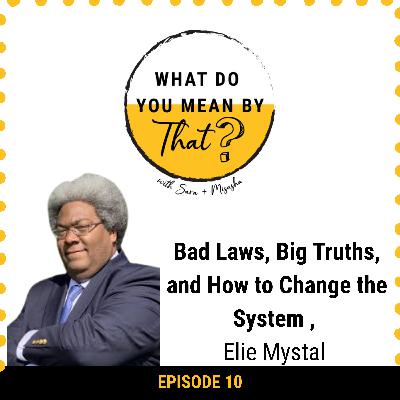
This episode is a must-listen for anyone who's ever felt like legal talk is impossible to understand (👋 Sara included!). We're joined by Elie Mystal, brilliant legal mind, powerful truth-teller, and New York Times bestselling author of Allow Me to Retort: A Black Guy's Guide to the Constitution, to break down the complex world of American law and what Democrats are doing all wrong (and can do better) in a way that's sharp, accessible, and even funny. 💥 He's back with a bold new book: Bad Law: Ten Popular Laws That Are Ruining America. If you're fired up about the state of our country, about policy that is working frighteningly as intended, or simply want to understand how certain laws are quietly shaping (and harming) everyday life, this conversation is for you. What to listen for: The least-legal legal chat we've ever had, including loads of straight-talking humor that makes the truth go down a little easier – on how SCOTUS operates and how we can change it, on the laws we might easily repeal to make tremendous change in our country, and more Why we might be seeing more whitewashing of history, and the truth that we are back to us all needing to educate our own children on this country's true history. That what we are (or aren't) doing now is exactly what we would have been doing during any great catastrophe in history Practical ideas for how YOU can help dismantle harmful laws and make a difference in our country's trajectory. This episode is perfect for fans of legal analysis without the jargon, book lovers, including our former Dear White Women book club, and anyone looking to better understand (and change) our current system. 🎧 Press play, and get ready to rethink what you thought you knew about the law. About our guest: Elie Mystal is the Justice Correspondent for The Nation, where he writes about politics and social and racial justice. Elie's first book, Allow Me To Retort – A Black Guy's Guide to the Constitution, was on the NYT's bestsellers list in April 2022. His second book, Bad Law: Ten Popular Laws That Are Ruining America, was released in March 2025. Mystal was the executive editor of Above the Law, a website with approximately 2 million unique visitors that focuses on law, courts, and justice. He's known for writing about the law and politics, breaking down Supreme Court decisions, and up-to-the-minute coverage of Supreme Court confirmation battles. Off the page, Mystal is a legal contributor to the More Perfect podcast, a Radiolab spinoff, on WNYC. He's appeared regularly on MSNBC since 2018, appearing on All In With Chris Hayes, The Beat With Ari Melber, A.M. Joy with Joy Reid, and Up with David Gura. On the Radio, Mystal has been a frequent guest on the Brian Lehrer Show, the Dean Obedallah Show, and Signal Boost with Zerlina Maxwell. He's also appeared on The Mike Huckabee Show, the Megyn Kelly Show, Red Eye with Greg Gutfeld, and done various appearances on CNBC and Fox Business about legal industry news. Mystal received his undergraduate degree in Government from Harvard University, his J.D. from Harvard Law School, and worked as an associate at Debevoise and Plimpton from 2003-2005.

Whether you've ever been a boss or have ever had a boss, you know how much those singular individuals can shape the workplace. According to studies, a good manager can increase employee engagement by as much as 70%. And, according to a survey by the American Psychological Association, a whopping 75% of employees report their boss as the worst and most stressful part of their jobs. So, how do we know if we're being a good boss or a bad boss? Do we just know, or should we be looking out for specific things? Enter the incredible stories that focus on what good leaders can learn from bad bosses, featuring the author of the brand-new book, The Devil Emails at Midnight, Mita Mallick. What to listen for: The importance of time in creating a healthier workplace culture Accountability - and how to hold others accountable, as well as check in with yourself What boss archetypes Mita has found most personally challenging The keys to being a good boss About our guest Mita Mallick is a Wall Street Journal and USA Today best-selling author. She's on a mission to fix what's broken in our workplaces. She's a corporate change-maker with a track record of transforming businesses and has had an extensive career as a marketing and human resources executive. Mallick has brought her talent and expertise to companies like Unilever, Pfizer, AVON, Johnson & Johnson, Carta, and more. She's a highly sought-after speaker and business coach to start-up founders, executives, and CEOs of public companies. Her highly anticipated second book, "The Devil Emails at Midnight: What Good Leaders Can Learn from Bad Bosses," comes out September 30, 2025. For more about the book or to purchase The Devil Emails at Midnight: What Good Leaders Can Learn From Bad Bosses, click here: https://www.amazon.com/dp/1394316488
We had a very insightful superfan make a brilliant suggestion that we're acting on, starting with this episode. David Gaines, author of Radical Business, CEO of La Terza Coffee, and kind human being, sent in a message cheering us on for the podcast rebrand, and then pushed us to do just a bit more. Specifically, he said, "The guests you have on clearly have their brilliance to add to the world, but for me personally, the main reason I listen to your work is that I find a lot of brilliance in your perspectives as you process in real time what your guests are saying." Considering that while we are deeply curious human beings who are pretty darn good at interviewing people, we are ALSO speakers who very much have our own brilliant perspectives - his words, not ours - too. So, David, thank you. We're going to weave in more episodes with our thoughts, reflections, and actions based on what we learn from our guests going forward! In addition, this fall, we're working on something new for our newsletter subscribers, so make sure you're subscribed to be the first to hear about it! And if you're more of an audiophile, based on the fact that you're listening to this podcast, take a moment to check the link below to leave an audio recording of your feedback on how we can make this podcast the best it can be for YOU! What to listen for: Insight into how we came up with this idea for our 2025 summer series, and how we source our guests. Our favorite takeaways from each one of our summer episodes, including practical tips, general themes, and questions that we're still mulling over. How you can make the podcast better - we're looking for your input! CLICK HERE to record yourself giving us feedback on how to make this podcast and newsletter better for you!!!!! https://platform.amoofy.com/record/podcast-feedback/start
In our last episode of our series on how to be a better human, we're talking about rest. Specifically, what do we mean by rest, and why is it so important? How do we grapple with its significance in our individual and collective lives, and for real, how do we DO LESS? This conversation has become increasingly frequent in our lives, and we wanted to share our thoughts with you. If this resonates, please share with your friends, and tell us how you incorporate rest, in whatever form, into your lives as well. What to listen for: How we reframe the idea of rest - from something used as a break from your life to something that is part of your life Ways that we incorporate rest in our everyday lives, for real, with the caveat to make sure we're not judging others for their ability/inability to rest the way we think is best Having no guilt about resting, by drawing on the concepts of Rest as Resistance - pulling ourselves out of the system of exploitative capitalism as per Tricia Hersey's book by the same name Resources we mention in this episode: The Reclaimed (Whitney Alese) post with ideas of things to do that matter: https://www.instagram.com/p/DI_kN69Nb-0/?img_index=1&igsh=aDB2Z2pocXgwNDFr The book Rest is Resistance (Tricia Hersey): https://bookshop.org/p/books/rest-is-resistance-a-manifesto-tricia-hersey/18255493?ean=9780316365215&next=t The Dear White Women episode featuring Kibi Anderson: https://www.whatdoyoumeanbythat.com/dwwepisodes/248-for-all-womxn-the-rested-rebel-with-kibi-anderson-hyagx A neurologist website about the foods to avoid to quell migraines: https://www.gottaheadache.com/
Maybe these are some questions you've asked yourself, as we've moved from the election of 2024 to the present: Where the heck are the Democrats? What's happening with the dysfunctional American two-party political system, and if we don't support what the Trump administration is doing to our people and our rule of law, how do we find any hope we might have left for regaining control of our Democracy? What do we even mean when we say Democrat these days? We've asked ourselves the same questions and have come up empty. As a result, we decided to ask these very same questions of a Democratic insider, as this week we discuss how to be a better Democrat. What to listen for: What better strategies look like for Democratic strategies going forward, including increasing youth leadership, and getting into your communities to learn what people really care about How do we hold Democratic leaders accountable? Finding commonality across the aisle Holding Republican leaders accountable for preserving our democracy as well About our guest: Megan Imperial is a seasoned political strategist with over eight years of experience in policy development, legislative strategy, and organizational leadership. She has worked across public, private, and nonprofit sectors, specializing in racial equity, budget analysis, and workforce development. Megan's background includes advising government agencies on equity initiatives and managing high-impact campaigns, including her recent work as Campaign Manager for Jesse Arreguín for State Senate and Victor Flores for BART. At the state level, Megan has held leadership roles within the California Young Democrats, including VP of Finance and Chair of the Womxn's Caucus. She serves as a sitting member of the California Democratic Party Women's Caucus. Locally, she is the Immediate Past President of the East Bay Young Democrats.
It's not controversial to say that we are living in times of deep division, where there are so many forces keeping us apart, politics being a big part of that. But did you know that there's a link between how satisfied you think you are with your life, how much you trust others, and how you vote? It's a mind-blowing, less-discussed topic, despite being a chapter in the latest World Happiness Report. Importantly, to make a difference, we wonder this - how do we actually build trust with people who hold different viewpoints, especially if our first impulse is to block them, disregard their comments, or ignore them entirely? We're so glad today to have one of the co-authors of the World Happiness Report here to talk with us about how we can use our understanding of wellbeing and trust to build stronger communities, reconnect with each other, and also bridge the politics of division. What to listen for: What the World Happiness Report is Despite our focus on class struggle or traditional ideologies as the explanation for why people vote a certain way, it's actually more about life satisfaction and trust. The wallet study The truth - that unhappy people are attracted by the extremes of the political spectrum. Low-trust people are found more often on the far right, whereas high-trust people are more inclined to vote for the far left. How we can rebuild trust in community, one meal at a time About our guest: Jan-Emmanuel De Neve is Professor of Economics and Behavioural Science at the University of Oxford, where he also directs the Wellbeing Research Centre. He is best known for his research on the economics of wellbeing which has led to new insights into the relationship between happiness and income, productivity, firm performance, and economic growth. His pioneering research is published in the leading academic journals across multiple disciplines, including Science, Nature, The Review of Economics and Statistics, Psychological Science,world we Management Science, Journal of Political Economy, and the British Medical Journal. His research was recognized among "The Management Ideas That Mattered Most" by Harvard Business Review and he currently guides the world's largest study on workplace wellbeing in partnership with Indeed. De Neve co-authored the main textbook on wellbeing science with Richard Layard, is an editor of the World Happiness Report, and co-founder of the World Wellbeing Movement. Additionally, he serves as a member of the UN Expert Group on Wellbeing Measurement. De Neve frequently consults for governments and major corporations, and his insights on wellbeing and policy are sought by leading global media. Two of his books include Wellbeing: Science and Policy, and Why Workplace Wellbeing Matters.
Depending on who you are and where you get your news from, you may be seeing a completely separate version of the news from your neighbor down the street, your aunt in another state, or your coworker who only gets his news from a specific social media platform. Maybe everyone around you gets the same news you do. But you also know that there is a very different version of reality out there, that many people are deeply believing in. So, how do we figure out what's true and what's convenient? How do we talk to each other if we don't have the same baseline of understanding about, perhaps, anything? We'd argue that this is where critical thinking skills come in. But what do you mean by critical thinking skills? We're glad you asked. This episode is for anyone who wants to think deeper about what we mean when we say critical thinking skills and how we can use them to bridge the divides in our communities, our country, and maybe even in our own households. What to listen for: What are critical thinking skills, and why are they so important? How do we avoid the common mistake of confusing critical thinking for believing in counter-narratives, especially when we are living in an era of disinformation or misinformation, where even the truth is hard to find? The main parts of critical thinking - and how we can each practice these skills About our guest: Colin Seale was born and raised in Brooklyn, NY, where struggles in his upbringing gave birth to his passion for educational equity. Tracked early into gifted and talented programs, Colin was afforded opportunities his neighborhood peers were not. Using lessons from his experience as a math teacher, later as an attorney, and now as a keynote speaker, contributor to Forbes, The 74, Edutopia and Education Post and author of Thinking Like a Lawyer: A Framework for Teaching Critical Thinking to All Students (Prufrock Press, 2020) and Tangible Equity: A Guide for Leveraging Student Identity, Culture, and Power to Unlock Excellence In and Beyond the Classroom (Routledge, May 2022), Colin founded thinkLaw (www.thinklaw.us), a multi-award-winning organization to help educators leverage inquiry-based instructional strategies to close the critical thinking gap and ensure they teach and reach all students, regardless of race, zip code or what side of the poverty line they are born into. When he's not serving as the world's most fervent critical thinking advocate or tweeting from @ColinESeale, Colin proudly serves as the world's greatest entertainer to his two young children.

This is Sara, and I remember the time 20 years ago when I got schooled by a psychoanalyst. It must have been the fall, because I was supremely agitated that I was having to write, design, and send holiday cards out to a huge list of people all by myself, without the help of my fiancé. If you know me, you know that cards were a staple of my winter growing up, with cards from my parents' friends stapled onto long felt ribbons hanging down each doorway, surrounding us with love and smiling faces for weeks on end. The therapist asked if I could just not do them, if it was annoying me so much, and my instant fury was revealed: Are you kidding? I have to send these cards out, it's the nice thing to do!! Cut to the point, and it's this - nice according to who? Nice for whom? Certainly not nice for me if I were going to be resentful and pissy about it. I came to terms with the fact that I actually just really enjoyed writing and sending cards out to people who warmed my heart that year, and that my partner wasn't a nice person for not agreeing to send these cards out with me. But it leads us to ask this. What do we mean by niceness - and what, more importantly, is its not-as-related-as-it-seems and so much more important character trait of kindness? How can understanding this difference and leaning into kindness help us be better people? What to listen for: How a medically trained doctor got into a "touchy-feely" thing like kindness The shockingly tremendous impact that kindness has on our individual health and our societal wellbeing What's the difference between niceness vs kindness? Ways to begin practicing more kindness About our guest: Kelli Harding, MD, MPH, is dedicated to creating a kinder and healthier world for all. An expert in mental health, medicine, and public health, she teaches at Columbia University's Vagelos College of Physicians and Surgeons (VP&S) in New York City and is a diplomate of the American Board of Psychiatry and Neurology, also boarded in the sub-specialty of consultation-liaison psychiatry or psychosomatic (mind-body) medicine. Known for making complex scientific research understandable to general audiences, she's the author of the critically acclaimed book The Rabbit Effect: Live Longer, Happier, and Healthier with the Groundbreaking Science of Kindness. Dr. Harding has appeared on Today, Good Morning America, BBC, The New York Times, The Washington Post, Prevention, LA Times, Oprah Magazine, Parents, Medscape, Sesame Street Workshop, and The World Economic Forum. Additionally, she has spoken at global events at the United Nations and World Happiness Summits and served on the Boards of Organizations such as the Association of American Medical Colleges (AAMC) and social media platform Nextdoor. Dr. Harding lives in New York City with her husband and three sons—an eleventh-grader, a ninth-grader, and a sixth-grader, and beloved rescue pup, Athena. Her next book, Different, co-authored with Sara Blanchard, will be out in Fall 2026. Website kellihardingmd.com LinkedIn Kelli Harding MD MPH Instagram @kellihardingmd
One of the ways that we believe we can be better humans is to actually listen to each other - not just nod along when we watch people's mouths move, or wait impatiently for someone to finish their thought before we can jump in and say what we've been dying to say - but actually listen to what they're saying, take a moment to reflect on that, and respond. Perhaps you ask a clarifying question, perhaps you share a reflection, perhaps you simply agree and ask for more details. Regardless of your response, if you're really listening, people will know and will see you in a better light as a result. If you're curious about how to be a better listener, we offer two experts on the topic who help us understand: What do you mean by radical listening? What to listen for: Why listening better makes you a better human Six skills important to growing your ability to listen better The role culture can play in listening and communication What environment is most conducive to listening, and what YOU can do to be a better listener About the guests: Dr. Robert Biswas-Diener is a researcher, author, and consultant with 75 peer-reviewed academic articles with over 27,000 citations. His previous books include The Upside of Your Dark Side (New York Times Bestseller, 2014), and the 2008 PROSE Award winner, Happiness. He has presented keynotes to Lululemon, Deloitte, Humana, AARP, The World Bank, and others. In 2024, Thinkers50 named Robert one of the "50 Most Influential Executive Coaches in the World". He lives in Portland, Oregon, enjoying drawing and rock climbing. Prof. Christian van Nieuwerburgh (PhD) is an academic, consultant, and executive coach. He is Professor of Coaching and Positive Psychology at the Centre for Positive Health Sciences at RCSI University of Medicine and Health Sciences (Ireland) and Consulting Professor for Growth Coaching International, a provider of coach training and consultancy for the education sector. In recognition of his contributions to the fields of positive psychology and coaching, he is Principal Fellow of the Centre for Wellbeing Science at the Melbourne Graduate School of Education of the University of Melbourne (Australia) and Honorary CollectivEd Fellow of the Carnegie School of Education at Leeds Beckett University (UK). Christian is a certified executive coach and is well published in the academic literature on the topics of coaching and positive psychology. He has authored, co-authored, and edited numerous books in the field of coaching, most notably An Introduction to Coaching Skills: A Practical Guide (2014, 2016, 2020). His latest books are Your Essential Guide to Effective Reflective Practice (2025, with David Love) and Radical Listening: The Art of True Connection (2025, with Robert Biswas- Diener). Follow Christian on Instagram (@coachonamotorcycle), on his YouTube channel (@coachonamotorcycle), and on his website (coachonamotorcycle.com).
We have a big announcement! We have rebranded and are now known as the podcast, What Do You Mean By That? If you've listened to our former show, Dear White Women, you know that What do you mean by that? has been one of our favorite questions to use to interrupt people in a healthy way, spur on conversation, and cue ourselves to listen. Our purpose has always been to help our society realize that it's all of us or none of us. That a world that is good for those who are most systematically oppressed is a world that's good for all of us. After 272 episodes, we've come to understand just how intertwined the systems are that hold us together and keep us apart. This is a show dedicated to helping folks talk smarter and think deeper about the world around us - even when information is flying at us at warp speed. We will not let the fire hose overwhelm us. Whether it's about science, history, current events, social justice, or more, our community consists of people who want to be better humans, and we want to explore all the conversations in a succinct way so we can cut to the chase and help us all be better, together, for all of us. We can't wait to keep asking, along with you: What do you mean by that? What to listen for: What this new show - What Do You Mean By That? - stands for and is about Why we rebranded, including the history of our former podcast Dear White Women The commitment we have to getting in front of people to emphasize our message that it's all of us, or none of us - and we want all of us to feel like we belong and can thrive.
Raise your hand if you've been to therapy before. My first time, if I'm remembering correctly, is a few months after my Dad died when I was in my mid-twenties, and my college roommate set me up with her aunt, who was a renowned psychoanalyst. She also happened to be Asian. Now that it's been decades and I've had so many more experiences with so many more therapists, all of whom have been white, I realize how rare and fortunate it was for me to have had that experience of a therapist who culturally understood me, which then played a formative role in my own understanding of my relationship with myself, my parents, self care and success and my place in the world. If you've never had the experience of having therapists who are the same race as you, you might really get this visceral sense of relief that we are talking about. This unspoken understanding that can-not always, but often, exist in those spaces of similarity. I think it's played a huge part in the relationship we have had, as multi-ethnic daughters of one Japanese immigrant parent and one white American parent each - there were just some things we didn't have to explain to each other. Which is why when we learned about a whole mental health support system - one we've come to learn doesn't have to just include therapists, but a whole system of community support - that is centered on Asian Americans, we wanted to seize the opportunity to talk about culturally responsive care, about what it means to work on ourselves to be better people, and more. What to listen for: What it means to be a better person Therapy 101 - what challenges people go to therapy for, what types of therapists are out there What culturally responsive care means, and how this applies to the Asian American community How we can support our own mental health, and that of others About our guests: Soo Jin Lee, a licensed therapist, executive director of Yellow Chair Collective, and co-founder of Entwine Community, has made a profound impact in mental health advocacy, shaped by her own experiences as an Asian immigrant. Her work focuses on culturally responsive mental health care, addressing the unique challenges faced by immigrant and Asian American communities. She co-authored the influential book Where I Belong: Healing Trauma and Embracing Asian American Identity, which explores identity and healing through a culturally informed lens. Recognized by NPR, PBS, CBS, and CUNY, Soo Jin is dedicated to fostering community support and advancing culturally sensitive mental health services. Linda Yoon is the founder of Yellow Chair Collective and co-founder of Entwine Community, organizations dedicated to addressing mental health education and service gaps in services for BIPOC communities, with a special focus on Asian Americans. She is recognized as a co-author of the book "Where I Belong: Healing Trauma and Embracing Asian American Identity," which delves deeply into themes of Asian American identity and resilience, alongside the racial, cultural, and intergenerational dynamics present within Asian American communities. Linda's work has been recognized and featured in media outlets including NPR, PBS, CBS, LA Times, and Buzzfeed. With a heartfelt commitment to well-being and community empowerment, Linda drives changes through mental health programs and advocacy initiatives. Brief synopsis of the book: Soo Jin Lee and Linda Yoon have personally observed the frequent neglect of mental health issues in their own immigrant families and within Asian and Asian American communities. Their book "Where I Belong" illuminates how trauma perpetuates through generations and impacts relationships, emphasizing the Asian American experience for better understanding and healing of racial and intergenerational trauma. "Where I Belong" offers crucial therapeutic techniques, reflective questions, journaling prompts, and grounding exercises, empowering readers to recognize their intergenerational strengths and resilience and to fully embrace their identity and cultural heritage. About Yellow Chair Collective: Yellow Chair Collective is a psychotherapist group with a special focus on Asian and Asian American identity based in California, Oregon, Washington, and New York. Asian Americans and the multicultural population struggle with unique pain points. Much of what Asian American and multicultural therapy identifies as intergenerational trauma or racial discrimination has been neglected and dismissed throughout American history. As a Collective, we are dedicated to bridging cultural identity as a huge part of everyone's mental struggles. The Yellow Chair Collective


Download from Google Play

Download from App Store
 United States
my new favorite podcast!! sharing w/all the women in my life!