


 Claim Ownership
We Are Not Saved
Subscribed: 54Played: 7,425
Subscribe

© 2016 Ross W. Richey
Description
We Are Not Saved discusses religion (from a Christian/LDS perspective), politics, the end of the world, science fiction, artificial intelligence, and above all the limits of technology and progress.
490 Episodes
Reverse
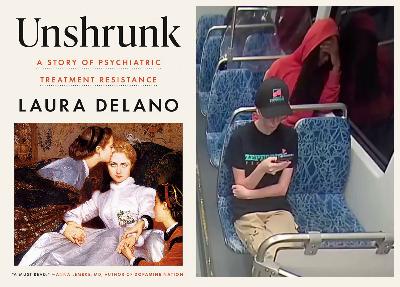
Delano is very much an example of something being wrong with psychiatry, the question is how emblematic is her experience? Unshrunk: A Story of Psychiatric Treatment Resistance By: Laura Delano Published: 2025 352 Pages Briefly, what is this book about? An autobiographical tale of Delano's experience with the mental health industry starting at the age of thirteen. Among other things, it covers her bipolar diagnosis, eating disorders, cutting, and one, nearly successful, suicide attempt. On the treatment side of the ledger she took at least a dozen drugs, engaged in constant therapy, and was committed to psychiatric hospitals and treatment programs on several occasions. In the end she decided that most of her problems stemmed from the substances she was taking, both those that are recognized as harmful, like cocaine and alcohol, and those that were supposed to help her. A major theme of the book is that the horrible withdrawal symptoms that accompany most psychiatric drugs go a long way towards creating the impression that "the drugs are helping". Woven through all of this, Delano provides significant research illustrating the bad incentives, and shoddy testing engaged in by the pharmaceutical industry, along with critiques of the DSM, the paradigm of mental illness as a chemical imbalance, and reliance on drugs as a first line of treatment. What authorial biases should I be aware of? Delano includes some extensive research. This is not merely an n=1 anecdote, there are clearly a significant number of people who are taking too many psychiatric drugs, and don't have the skills to taper off those drugs. Also Delano is explicitly not "antimedication" or "antipsychiatry". Nevertheless, it is clear that she is not a neutral observer, that she is profoundly distrustful of the pharmaceutical industry, and that she came by this distrust honestly, even if it doesn't necessarily apply to everyone. It should also be mentioned that money was never a problem for Delano, which probably meant both that she received too much care, but also that she had a large support network available during every phase of her journey. Who should read this book? The debate over how to care for the mentally ill is both fascinating and fraught. It sits at a convoluted nexus that includes healthcare availability, cost, worries over youth, violence, homelessness, anti- and pro- drug narratives, and a weird tangle of culture war issues. Navigating this mess is going to take as much information as we can get and this is a great book describing one of the many angles available for approaching it. As a more specific matter I would recommend it to psychologists and psychiatrists as something of a counter-narrative/steelman for those who are wary of medications and interventions. Finally, for those seeking to taper or get off of medication, this book is essential reading, and the idea of hyperbolic tapering may be the single most important bit of knowledge it contains. If you want a taste of things, I read this as part of the Blocked and Reported book club, and they had an interview with Delano which was quite good. Specific thoughts: Mental health treatment is crazy complicated
The Obstacle Is the Way Expanded 10th Anniversary Edition: The Timeless Art of Turning Trials into Triumph by: Ryan Holiday The Enchiridion & Discourses by: Epictetus The Lives of the Caesars by: Suetonius
![Grand Strategy In Life [Essay] (w: review of 33 Strategies of War)](https://s3.castbox.fm/3e/e0/e6/f4ecad030220783a02c2a2cf42a8808893_scaled_v1_400.jpg "Grand Strategy In Life [Essay] (w: review of 33 Strategies of War)")
There's a concept within statecraft known as grand strategy. The "grand" strategy means paying attention to every avenue of conflict, not just the military sphere, but also the diplomatic, the logistical, and the domestic, and everywhere else advantage might be gained or lost. It encompasses soft power, irregular actions, public opinion, etc. But at the same time, it also encompasses prioritization and focus, because, while it's important to consider every avenue, resources are always limited and need to be spent wisely. A great example of grand strategy done right is the US in WWII. We supported the Soviets, we developed nukes, we invaded Europe, we came together as a nation, and most of all, we buried the Axis with our industrial capacity. For an example of grand strategy done poorly consider Vietnam. Our battlefield tactics were great. But at the strategic level we comprehensively failed in almost every domain. There was vast domestic opposition, political goals were unclear, we failed to contain the conflict geographically, and never really understood the resolve of the Vietnamese people. You might think that the point of grand strategy, if well executed, would be winning. I disagree, I think the point of grand strategy is not losing. (There's probably an essay to be written about how this applies to Iran, but I think we have enough hot takes on that subject at the moment.) Grand strategy asks you to pay attention to all potential avenues by which disaster may arrive. Disaster in Vietnam did not arrive through the front door, it came from many unexpected directions, but an unexpected disaster is still a disaster, and generally worse than disasters which have been foreseen. As one considers the various aspects of grand strategy, what would it mean to have a personal grand strategy? And how would that be different from just living a "good life"? As a bridge between these two ideas, consider the life of Napoleon. Something Robert Greene does at great length in his book: The 33 Strategies of War By: Robert Greene Published: 2006 496 Pages
![Meta-Competition and the Downfall of Civilization [Essay]](https://s3.castbox.fm/44/34/b9/4a64f92015a07bffa26c0e63f785ebb674_scaled_v1_400.jpg "Meta-Competition and the Downfall of Civilization [Essay]")
Or how America went from the platonic ideal of goal-scoring to the messy theatricality of flopping. And whether we can stop it before someone get's stoned in the forum.

Eugenics and Other Evils By: G. K. Chesterton Published: 1922 188 Pages Briefly, what is this book about? Once this book entered the public domain, someone (most likely Inkling Books) added a subtitle to their edition: "An Argument Against the Scientifically Organized State". This is a pretty good description of the book's thrust, though the book's major focus is still definitely eugenics. When the book was written eugenics was a powerful political force, supported by numerous well known individuals. Buck v. Bell, the famous case which approved involuntary sterilization, didn't arrive until 1927. This is where we get the infamous line from Oliver Wendell Holmes Jr. writing for the majority, "Three generations of imbeciles are enough." Though it was only when researching this piece that I discovered that the ruling explicitly invoked the precedent already set around compulsory vaccination. The full context is: We have seen more than once that the public welfare may call upon the best citizens for their lives. It would be strange if it could not call upon those who already sap the strength of the State for these lesser sacrifices, often not felt to be such by those concerned, in order to prevent our being swamped with incompetence. It is better for all the world if, instead of waiting to execute degenerate offspring for crime or to let them starve for their imbecility, society can prevent those who are manifestly unfit from continuing their kind. The principle that sustains compulsory vaccination is broad enough to cover cutting the Fallopian tubes. Jacobson v. Massachusetts, 197 U. S. 11. Three generations of imbeciles are enough. What authorial biases should I be aware of? You're probably already aware of Chesterton's biases, though in addition to being very Catholic, and very traditional, he was also a big supporter of the "little guy". This comes out a lot in this book since eugenics seems primarily aimed at the "unwashed masses", not the inbred nobility. Who should read this book? I have previously mentioned that I am gradually working through an ebook I picked up many years ago collecting Chesterton's best-known works. This happened to be next on the list. I wouldn't recommend it as the first Chesterton you read, or even the fifth, but it gives a great insight into a particular time and place, and puts you in the middle of an argument we consider long settled but which was raging at the time. What does the book have to say about the future? I think there's a lot that could be taken from this book and applied to the current debate over MAID (medical aid in dying). It will be interesting to see if that practice ends up following a similar arc. Specific thoughts: Chesterton's surprisingly prescient archetypes
1- Operation Overflight By: Francis Gary Powers and Curt Gentry Published: 1970 384 Pages Briefly, what is this book about? An autobiographical account of Powers' experiences before, during, after and around his U-2 spy plane being shot down over the Soviet Union, including his 21 months of imprisonment in a Soviet prison and his long campaign to rehabilitate his reputation upon his return to the US. 2- Flybot By: Dennis E. Taylor Published: 2025 430 Pages Briefly, what is this book about? Another Taylor book where a few scrappy nerds get thrust into the middle of world altering events. In this case it's the emergence of an ASI (artificial superintelligence). 3- Gun Runner By: Larry Correia and John D. Brown Published: 2025 430 Pages Briefly, what is this book about? Set in a science fiction future, this is a classic tale of scoundrels with a heart of gold, who may seem like bad guys but once you peel away their gruff exterior. Though actually the story is somewhat reversed. You see the heart of gold right from the beginning, but because they are still scoundrels, some of the scoundrelly things they do end up being bad, and they have to undo the damage they've caused. The story mostly revolves around Jackson Rook, a mech pilot whose piloting implants were once subverted forcing him to cause tremendous harm. This has left him haunted and in search of redemption.

Come for the unreplicatable science, stay for the promise of a planetary heart beating out peace for a thousand years. The HeartMath Solution: The Institute of HeartMath's Revolutionary Program for Engaging the Power of the Heart's Intelligence By: Doc Childre, Howard Martin, and Donna Beech Published: 1999 304 Pages (But somehow this translates to only 2 hours 45 minutes on audio…) Briefly, what is this book about? The idea that the heart contains a separate brain, and true emotional health comes from aligning the heart's brain and its "intelligence", with the actual brain. Basically it's mindfulness, meditation, and cognitive behavioral therapy (CBT) wrapped in pseudoscience. What authorial biases should I be aware of? These guys are definitely trying to sell you on the HeartMath program. Also many of the studies they cite were conducted by their institute. Who should read this book? No one, unless perhaps for its (completely unintentional) value as a work of humor. Specific thoughts: You had me at "quantum nutrients"
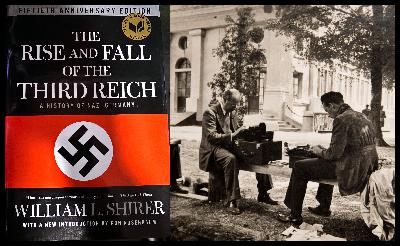
A book full of potential comparisons to our own day for the motivated, and strangely removed from our own day if you're really going to be honest about it. The Rise and Fall of the Third Reich: A History of Nazi Germany By: William L. Shirer Published: 1960 1250 Pages Briefly, what is this book about? A comprehensive history of Nazi Germany, from Hitler's birth to the Nuremberg trials. Written by someone who was there for a great deal of the most important period. What authorial biases should I be aware of? Shirer is a journalist, not a historian, but he did have access to the German state and party archives, plus some diaries, etc. that were captured at the end of the war. Plus he witnessed the rise of Hitler in the 30's. I love passages like this: No wonder that Hitler was in a confident mood when the Nazi Party Congress assembled in Nuremberg on September 4 [1934]. I watched him on the morning of the next day stride like a conquering emperor down the center aisle of the great flag-bedecked Luitpold Hall while the band blared forth "The Badenweiler March" and thirty thousand hands were raised in the Nazi salute. Who should read this book? It's clear that this isn't the most accurate book about this subject. Scholarship is always advancing and this was written more than 60 years ago. But it may be the most readable book on the subject. It flows very well. 1250 pages fly by. (Or rather the minutes fly by, I listened to it, but with a physical copy for reference and anchoring.) If you're at all interested in this period I think you'll really enjoy this book. What does the book have to say about the future? I think a lot of people are trying to draw comparisons between the rise of Hitler and the Trump phenomenon. Other people see echoes of fascism in the ubiquity of woke-ism. I don't think history is going to repeat. And I'm not even sure it's going to rhyme this time around. People are still too aware of the dangers of populist demagoguery for someone to come to power in the same way Hitler did. Which is not to say there's nothing to be gleaned from this book, but I suspect that by the time things start lining up, in some bizarre fashion, it will be too late. Specific thoughts: Pivot points
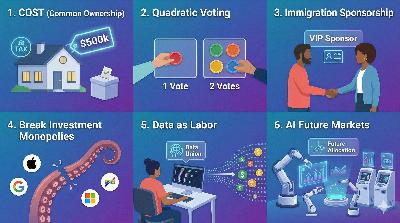
Policy proposals from the White Queen. (It's a Lewis Carroll reference. No, I'm not talking about the Mad Hatter or the Red Queen. It's from "Through the Looking Glass".) Radical Markets: Uprooting Capitalism and Democracy for a Just Society By: Eric A. Posner and Eric Glen Weyl Published: 2019 384 Pages Briefly, what is this book about? A series of radical proposals for restructuring property, voting, immigration, investing, and employment. All of the proposals seek to solve the problem of "monopolized or missing markets" in ways that seem pretty strange. One has to wonder if there's a good reason those markets didn't exist in the first place. What authorial biases should I be aware of? Posner has his finger in all sorts of things, and has defended everything from post-9/11 government surveillance to increasing foreign aid. I guess the throughline is a belief in technocratic solutions? Weyl is an economist working for Microsoft who helped popularize the idea of quadratic voting, and had a political awakening while reading Ayn Rand. This feels more like his book than Posner's but perhaps I'm imagining that. Who should read this book? I read this as part of an ACX/SSC book club. Most of the people didn't like it. They felt that it was too radical. (Though you can't say we weren't warned, it's right there in the title.) But if you want to see what mechanisms Georgist economists come up with when they're completely unrestrained, this might be the book for you. What does the book have to say about the future? Hayek is famous for noting that the big advantage of markets is that they are giant distributed systems for discovering prices and allocating resources effectively. They're obviously not perfect, and socialists have long dreamt of having a centrally planned economy that would be fairer and work better. Posner and Weyl imagine a future where computing power and machine learning could take over some of the work currently being done by markets, and thereby improve the outcomes. Specific thoughts: "Six impossible things before breakfast"
![Gemini Goes Insane — How Should I Update? [Essay]](https://s3.castbox.fm/87/55/92/ba8d574f6e4a266f7aa8410188caebfced_scaled_v1_400.jpg "Gemini Goes Insane — How Should I Update? [Essay]")
One part documentation of a strange AI hallucination. One part panic about whether I'll be put out of business by AI.
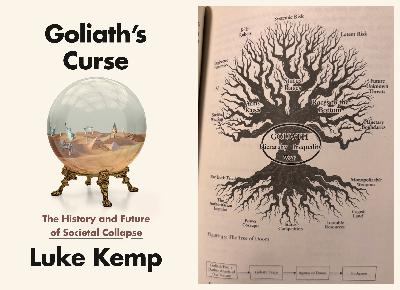
Using the Stone of Democracy to Slay the Goliath of Inequality Goliath's Curse: The History and Future of Societal Collapse By: Luke Kemp Published: 2025 592 Pages Briefly, what is this book about? By most accounts, civilization, which is to say the large Hobbesian state, is a good thing. Kemp doesn't necessarily agree. In his account, states are lumbering, tyrannical, extractive Goliaths, cursed to grow bigger, more oppressive and more brittle until they are eventually brought down by a "stone" that hits in just the right place. Civilization forms out of dominance hierarchies, and these hierarchies generally only move in one direction, towards greater inequality, greater extraction, and more self-interested decisions. This leads to ever increasing fragility and eventual collapse. Collapse might actually be a better place for the masses of people, though it's often quite bloody to get there. Though if that's how it played out in the past, Kemp doesn't think it will necessarily play out that way going forward. If (when?) civilization collapses this time, it will be far more apocalyptic. What authorial biases should I be aware of? Kemp is associated with the Centre for the Study of Existential Risk at Cambridge. I was recommended this book by the sagacious Florian U. Jehn of the excellent Existential Crunch blog. Jehn knows his stuff which gives me the confidence to safely locate Kemp as an important scholar in the genre of collapse research, with an interesting, albeit populist/anti-elite take on the subject. Who should read this book? Kemp draws heavily on the ideas of James C. Scott (Seeing Like a State and Against the Grain) and writes in opposition to the ideas of Steven Pinker (in particular The Better Angels of Our Nature). If you find yourself similarly situated, you'll enjoy this book. It's also a great book for anyone who can't get enough discussion of existential risk. And really given the stakes we should be considering as many viewpoints as possible. What does the book have to say about the future? As you might imagine, Kemp's vision of the future is pretty bleak. He is not a techno-optimist, rather he sees in technology the emergence of a new Goliath, a new arena of dominance and extraction. He has a certain amount of hope, but it all revolves around using democracy to disrupt the ratcheting up of inequality and elite power, which seems like a tall order. Specific thoughts: Past, present, and future collapse

I was promised useful stories to assist me in a quest for justified belief. Instead I got a lesson in the limits of expertise. Unfortunately it was the author's expertise that was limited. Knowing Our Limits By: Nathan Ballantyne Published: 2019 344 Pages Briefly, what is this book about? Regulative epistemology as opposed to descriptive epistemology. Put more simply, this is about how to find truth, as opposed to how to define truth. Though because the author recommends having very high standards, you may come away from the book thinking that there is no truth. That is not Ballantyne's intent, but most of his guidance revolves around less confidence rather than more confidence. There is some good stuff about tolerance, and the utility of doubt. And while I take issue with some of what he says on the subject of expertise, he covers the subject exhaustively and thought-provokingly. What authorial biases should I be aware of? Ballantyne isn't just interested in epistemology. He doesn't dabble in it. He is epistemology, or rather an epistemologist. Accordingly, even though it's apparent that he's trying really, really hard to not make the book overly academic, it's still pretty academic. For example: If an undefeated defeater for believing p were included in the evidence I don't have, then I (probably) would have heard of it by now. But I have not heard of it and the "silence" gives me reason to think that the unpossessed defeater is probably defeated. He's a big fan of the word defeater, and various constructions involving the word. In the course of a few pages he uses the term "defeater-defeater" seventeen times. Who should read this book? Epistemological collapse is the major crisis of our time, so on some level it's probably useful to read everything you can get your hands on. (Which was my big reason for reading it.) But, as much as I crap on Yudkowsky's Rationality: From AI to Zombies I'd probably read his chapters on Bayes' Theorem before reading this. I heard about the book on Jesse Singal's substack. He was much more bullish on it. So you might read that if you're interested or on the fence. Specific thoughts: Lots of epistemic tools, Ballantyne really only covers one

The Westmark Trilogy by: Lloyd Alexander RoadKill by: Dennis E. Taylor Slicing Pie Handbook: Perfectly Fair Equity Splits for Bootstrapped Startups by: Mike Moyer Fables for Young Wolves by: Thomas O. Bethlehem

Would you like some genetics in your politics? The Origin of Politics: How Evolution and Ideology Shape the Fate of Nations – Social Disintegration, Birth Rates, and the Path to Extinction By: Nicholas Wade Published: 2025 256 Pages Briefly, what is this book about? Wade offers up an evolutionary psychology account of how to make politics actually function; how, when you try to disconnect politics and the exercise of power from core human nature, as shaped by evolution, things go off the rails. What authorial biases should I be aware of? Nicholas Wade worked as a science writer for the NYT for 30 years. For the bulk of those years he was the science and health editor. He left the paper in 2012 and in 2014 he published A Troublesome Inheritance: Genes, Race and Human History. The book argued that human evolution is ongoing and that it has been "recent, copious, and regional". The regional part got him "cancelled" or at least it attracted a lot of negative attention, since it implied that differing national outcomes might be partly genetic in nature rather than wholly the result of chance, culture, or colonization. Who should read this book? If you're looking for a strong pushback against blank-slateism along with a defense of the traditional nation-state (and of tradition in general). Or if you're looking for another reason to worry about decreasing fertility. What does the book have to say about the future? The aforementioned fertility decline looms large in his warnings about the future, but as I mentioned he also warns about any policy that tries to exercise power in ignorance of evolutionary drives. One of the major drives is tribalism and immigration directly conflicts with that instinct. All of this points to the potential for a demographically declining society with lots of disorder. Specific thoughts: Children are the ultimate civilizational scorecard
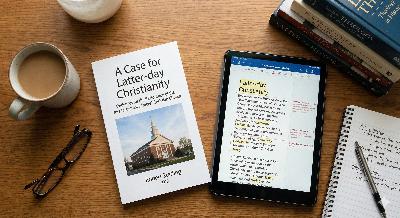
I feel like I should make some clever connection between this book and the discussion which raged about the Shroud of Turin, but nothing occurs to me. A Case for Latter-day Christianity: Evidences for the Restoration of the New Testament's "Mere" Christian Church By: Robert Starling Published: 2019 360 Pages Briefly, what is this book about? A broad, and intensive defense of the theology of The Church of Jesus Christ of Latter-day Saints (LDS). With a special focus on tying that theology to the theology of the early Christian Church. As such it spends a lot of time examining differences between LDS theology and other Christian denominations (things like the Trinity, Grace, The Book of Mormon, etc.) and how those differences look in relation to actual scripture. What authorial biases should I be aware of? Starling has obviously been compiling stuff and working the "Mormons are Christians" beat for a long time. Which is to say he definitely has a dog in the fight. This gives the work a somewhat tendentious tinge. What about my biases? I met Starling at a conference and he asked me to read his book. Outside of that meeting and a follow-up email he sent me there hasn't been any further interaction. So I wouldn't say we were close. I am however pretty close to the topic of "Latter-day Christianity", so that's a pretty big bias. Who should read this book? Anyone who wants to see the comprehensive case for The Church of Jesus Christ of Latter-day Saints being the same Church Jesus Christ established in the 1st Century. Specific thoughts: Who is this book for?

In which I mostly talk about the Shroud of Turin. Murray only spends seven pages on the it, so my review is not comprehensive. Actually, never mind. That's what the top sections are for. Taking Religion Seriously By: Charles Murray Published: 2025 152 Pages Briefly, what is this book about? Murray's journey from agnosticism to belief, a journey that is largely intellectual rather than spiritual. Because it was largely intellectual, it's also more explicable. This allows Murray to write a different sort of conversion story, one that's more amenable to being mapped out as a straightforward guide with sources and citations. What authorial biases should I be aware of? Murray has been a libertarian thinker for decades, though he's probably best known for The Bell Curve which he co-authored. So Murray is approaching things from a conservative/libertarian milieu. That said, it's a very balanced book. When he provides his sources for a particular idea he also includes sources that are critical of that idea. Who should read this book? I've read a lot of books that fall in this general area. Too many to list (consider The New Testament in Its World, Modern Physics and Ancient Faith and Believe just in the last six months) I would read Murray before reading any of them. It's clear, comprehensive, short, and meaty. Even if you're a raging atheist I would read this book because it's the quickest way to understand your opponents' best arguments. Specific thoughts: The surprising strength of the Shroud of Turin
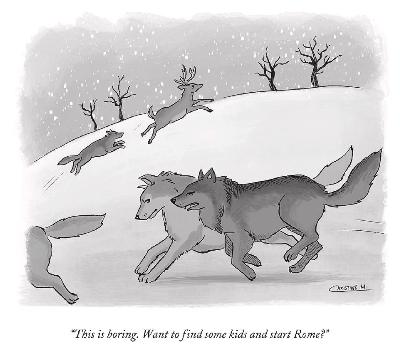
Back when Rome was just one Italian settlement out of many, but a settlement with a dream! Children of Mars: The Origins of Rome's Empire By: Jeremy Armstrong Published: 2025 288 Pages Briefly, what is this book about? The deep history of Rome. What we actually know about its legendary founding, its early rise to prominence, and the shape of its military. Additionally, the development of Roman identity and how that identity interacted with the other elements. What's the author's angle? This belongs to that genre of book which takes recent scholarship and archaeological evidence and uses it to puncture the previous, more simplistic historical view. Who should read this book? Military history buffs, or anyone who's interested in Rome, particularly the period from roughly 8th–3rd centuries BC. Specific thoughts: How video games get Rome wrong

We have a lot of nice things. We're really good at making nice things. We should preserve these nice things. But also nothing lasts forever? The Origins of Efficiency By: Brian Potter Published: 2025 384 Pages Briefly, what is this book about? The clever and incremental ways we've vastly increased humanity's ability to make stuff. We're constantly finding ways to build stuff cheaper, faster, and with fewer resources. What's the author's angle? Potter is probably best known for his Substack Construction Physics, which covers infrastructure, manufacturing, and building stuff in general. He also works at the Institute for Progress. Put those two together and you've got someone who's a big fan of material progress, or what is sometimes referred to as a techno-optimist. Who should read this book? If you want some amazing stories of how processes have improved, and a stirring defense of the modern world and all its wonders this is a great book. If you're looking for higher level reflection on what it all means, particularly any sort of caution around progress and efficiency, then this is not the book for you. Potter is definitely an "onward and upward!" kind of guy. He does note that efficiency can't be applied everywhere, and that it's often constrained by other goals, like safety, but he still treats it as being inherently good. What does the book have to say about the future? The book does point out that efficiency has become a "sociotechnical" issue. Particularly in the West, we often make choices to constrain efficiency as part of some broader societal goal. Potter doesn't talk very much about China, but one could imagine that their drive for efficiency is not constrained in the same way and, going forward, this could give them the edge in our ongoing competition. Specific thoughts: Fantastic, awesome, hopeful, and scary
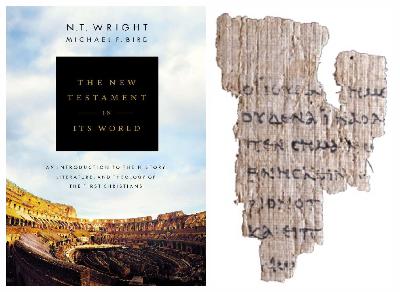
Everything you wanted to know about 1st Century Palestine, but were afraid to ask… The New Testament in Its World: An Introduction to the History, Literature, and Theology of the First Christians By: N. T. Wright and Michael F. Bird Published: 2019 992 Pages Briefly, what is this book about? An deep dive on the New Testament covering (as the subtitle suggests) the history: Second Temple Judaism against a Greco-Roman background; the literature: the New Testament's genesis, structure, authors and audience; and theology: the religious claims of the book, the doctrine, miracles, and contentions. What's the author's angle? Despite me saying that this is a deep dive, it is also something of a sampler for Wright's other, even more expansive books. Also it's important to note that Wright is very much a believing Christian and while the book is exceptionally scholarly, it's also backgrounded by the idea that Jesus Christ is the Messiah who died for the sins of the world and was gloriously resurrected. Who should read this book? This is a long book, and I ended up deciding to read it, rather than listen to it. As such, it honestly took me several months to get through, so you should certainly take that into account. This should not be construed as saying the book is difficult. It's very accessible, and reads easily. I will say that I learned a lot, but I'm not sure that will be true for everyone. Members of The Church of Jesus Christ of Latter-day Saints (LDS) don't generally focus on straight down the line Bible scholarship. To the extent that we do deep scholarship in this area it's in search of parallels between early Christianity and LDS Christianity. (For example in 1 Corinthians 15:29 when Paul mentions baptisms for the dead. Something no major denomination does, other than us.) This is all to say that I think LDS individuals might find this book particularly enjoyable, as being somewhat outside of our normal wheelhouse. Specific thoughts: It's both shocking how much New Testament we have and how little we have of everything else

Superbloom: How Technologies of Connection Tear Us Apart By: Nicholas Carr Published: 2025 272 Pages Briefly, what is this book about? On its surface, this is a fairly typical anti-social media book, though Carr does have some interesting things to say about weaknesses inherent to the medium: content collapse, algorithmic engineering, and hostility generation. All things I'll get to in a bit. What's the author's angle? Carr comes from the Marshall McLuhan and Neil Postman school of media criticism. Media have inherent properties that lead to different sorts of communication, and different strengths and weaknesses. Carr, like many, thinks that social media has some particularly salient weaknesses. Who should read this book? When considering whether to read a non-fiction book, one has to consider where it fits with one's various interests. If you're really interested in the negative effects of social media, then I would definitely read this book. If it's one of many interests, but not in your top 5-10, then you can probably skip it. What does the book have to say about the future?

Comments

Download from Google Play

Download from App Store
 United States