


 Claim Ownership
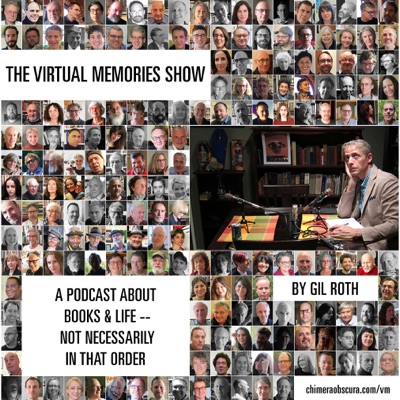
The Virtual Memories Show
Subscribed: 110Played: 3,730
Subscribe

© 2011-2023 Gil Roth
Description
A weekly conversation about books and life, not necessarily in that order.
768 Episodes
Reverse

With their new book MY BELOVED OTHER: A Memoir of Love, Race, and Optimism in a Time of Denial (23rd St. Books), cartoonist Nick Abadzis and psychotherapist Angela Watson use the story of their biracial marriage to explore racism in the UK and US, and what it means to be seen as Other. We talk about how the book went through 10+ years of drafts before Nick asked Angela to collaborate with him, what they learned about each other over the course of making the book, the casual but deep racism in the UK and the challenge of incorporating the Golliwog character in the book, and how Nick's creative process changed when he integrated Angela's voice. We get into their fathers' immigrant experiences (one banished from Alexandria and the other part of the Windrush Generation), how their first date was almost derailed by a riot against Salman Rushdie, in 1989, Nick's caution in telling their story and Angela's push to go further, how their daughter felt after reading the book, and what it's like to be a biracial (Brit) couple in London vs. NYC. We also discuss Nick's history in comics and his career as a corporate graphic recorder, Angela's experience in psychotherapy and what it's taught her about building narratives, what it was like to live in the US in the Obama years and then the next administration, whether they plan to collaborate again, and more. Follow Nick on Instagram and Bluesky, follow Angela on Instagram, and follow My Beloved Other on Instagram • More info at our site • Support The Virtual Memories Show via Stripe, Patreon, or Paypal, and subscribe to our e-newsletter

Biblical scholar David M. Carr rejoins the show for a conversation about his fantastic new book, UNMAKING EDEN: Genesis and the Domestication of the World (Cambridge University Press). We talk about how his close reading of the first 11 chapters of Genesis opened up a new understanding of how human beings related to non-human beings (animals, that is), the concept of onto-stories and how those chapters set up a world of subjugation and othering, how Tiger King inspired him to write this book, and how God's first idea of the world fell out of harmony and led God into becoming a genocidal maniac (my words, not David's). We get into how we need to find a new story to change our domestication-programming so we can see what it means to live in relation to others and not just see everyone/everything in terms of utility, how integrating indigenous, non-western traditions can help with that process (without just being a la carte cultural appropriation), how AI may accelerate our self-domestication, and how embracing a sabbath might be the first step in fixing our world. We also discuss David's jazz-funk organ habit, his other project on scroll technology, his Quaker-Buddhist outlook and how he continues to pursue traditions that range farther from the Bible, what it means for something to be freely given, and more. Follow David's podcast, The Bible And The Living World, and listen to our 2016 conversation • More info at our site • Support The Virtual Memories Show via Stripe, Patreon, or Paypal, and subscribe to our e-newsletter

With PEPPER (Toon Books), Karl Stevens brings us the latest adventures of existentialist housecat, Penny, and her eponymous sister. We talk about the fun of making a sequel to 2021's PENNY, the challenge of getting all the cats' markings right, how he found the right balance in the voices & outlooks of his main cat-characters, how giving Pepper mystical powers allowed him to get away from drawing his apartment over and over, and how cat comics PULL. We get into his realist drawing style and the underexamined potential of realistic art in comics, his upcoming gallery show of oil paintings, how he might fuse his interest in comics and oils by exploring narrative genre paintings, his collaborations with other writers (and the cartoonists he'd love to write for), and how listening to music on vinyl gives him an excuse to get up from the drawing table and stretch every 20 minutes. We also discuss Something Fell, the page-by-page podcast he co-hosts about Dave Sim's Cerebus comics to try to appreciate Sim's art and storytelling modes, his recent focus on Pre-Raphaelite painters, his progress with finishing the last book of Knausgaard's My Struggle, his thoughts on making one more big autobio book, life after having to say goodbye to Penny and whether he's drawn her since, and a lot more. Follow Karl on Instagram and check out his Linktree • More info at our site • Support The Virtual Memories Show via Stripe, Patreon, or Paypal, and subscribe to our e-newsletter

She's been on the show to talk about her essays, novel, and memoir, and now Wallis Wilde-Menozzi gets to talk about translation! With Emerging from the Winter Sea: Selected Poetry and Prose (FSG Poetry), Wallis has translated a career-spanning collection by Antonella Anedda. We talk about her love of Anedda's writing and how it led to their friendship, how Italian poetry addresses past poetry and changes in language, how the island of Sardinia stands in for the "I" in Anedda's poems, and how Anedda chooses the world over herself (a la Kafka) and how her writing changes over the course of decades. We get into how Wallis tends to lose herself in the voice of the people she translates (which is why she's resisted requests to be a writer's official translator), the masked, genderless figure of the Componidori and how it corresponds to Anedda's art-identity, how Anedda shows us reconciling ourselves to suffering and cruelty by associating it with someone else, and how Italian poetry's ambiguity contrasts with American poetry's "just the facts, ma'am" vibe. We also discuss These Times and how Wallis' activism in the '60s contrasts with today's clicktivism, the new memoir she's working on, how personal change can be like the discovery of dark matter, and more. • Listen to our 2013, 2017, and 2022 conversations • More info at our site • Support The Virtual Memories Show via Stripe, Patreon, or Paypal, and subscribe to our e-newsletter

With DIANA (Abrams ComicArts), Nate Powell has completed his "accidental triptych" of Ozark horror & the punk scene. During SPX weekend, he returned to the show to talk about the creative leap he took with this book, the ways that DIANA fulfills but doesn't complete the stories of COME AGAIN and FALL THROUGH, why this book is set during the transitional period of the early '90s, and the challenge of writing characters in their early 20s while he's approaching his 50s (and what it meant for Frank Miller to write about 50-something Bruce Wayne when he was in his 20s). We get into his re-imagining of the punk music/art scene in Arkansas, the ways horror-genre gave him a framework on which to build story, his use of duotone and spot colors to get a midcentury color palette for the book, how he's making his art messier as an unconscious reaction to generative AI, and his lead character's self-identity and the importance of being your own canon. We also discuss how Bob Ross got him started on art, and what he got from rewatching Bob's show during lockdown, the joy of his annual pilgrimage to Small Press Expo and embrace of the comics community, his formative experiences at School of Visual Arts, the total lack of crossover between the readers of his John Lewis biography and his personal work, the right age to expose kids to the golden age of the X-Men, and more. Follow Nate on Instagram and Bluesky • More info at our site • Support The Virtual Memories Show via Stripe, Patreon, or Paypal, and subscribe to our e-newsletter

Comments

Download from Google Play

Download from App Store
 United States