


 Claim Ownership
Thematic Edge Podcast
Subscribed: 5Played: 50
Subscribe

© Thematic Markets, Ltd
Description
Marvin Barth of discusses the thematic investing and the Themes driving markets with Mark Farrington of the Global Watchtower, with and without guests as the occasion demands.
thematicmarkets.substack.com
thematicmarkets.substack.com
11 Episodes
Reverse
How could the Iran conflict reshape global markets, China risk premiums and emerging market capital flows? Marvin Barth and Erik @YWR discuss geopolitics, uncertainty and the investment implications of a changing global order.In this episode, they explore whether a US-aligned Middle East could reduce geopolitical risk, why emerging markets may benefit from shifting capital flows, and whether China’s equity story changes if Taiwan risk declines. The conversation also examines Europe’s strategic positioning, the future of the dollar, and the broader macro consequences of global power realignment.Key themes• Iran conflict and market uncertainty• China risk premium and valuation debate• Complexity cascades and tail risks• Emerging markets and global capital flows• Europe’s strategic, technological and debt challenges• Dollar strength, stablecoins and global liquidityTimestamps00:00 Intro and why AI was postponed02:30 Iran conflict and market uncertainty03:00 Bullish macro view and the “new empire” thesis04:35 China markets and Taiwan risk premium07:45 Complexity cascades and tail risk10:50 Volatility, options and market pricing12:40 Is containing China bullish for China?18:30 The Godfather analogy for US strategy25:20 China’s economic model versus market pricing28:30 Emerging markets bull case explained32:00 US versus China, global alignment choices37:20 EM flows, currencies and investor FOMO39:00 The end of the old world order40:30 Europe’s strategic mistakes43:30 AI regulation and Europe’s competitiveness47:50 “Europe as the new EM” debate49:30 Debt, growth and macro positioning51:00 Dollar outlook and stablecoins54:00 Europe risks from dollarisation55:25 Final thoughts and next episode teaser This is a public episode. If you'd like to discuss this with other subscribers or get access to bonus episodes, visit thematicmarkets.substack.com/subscribe
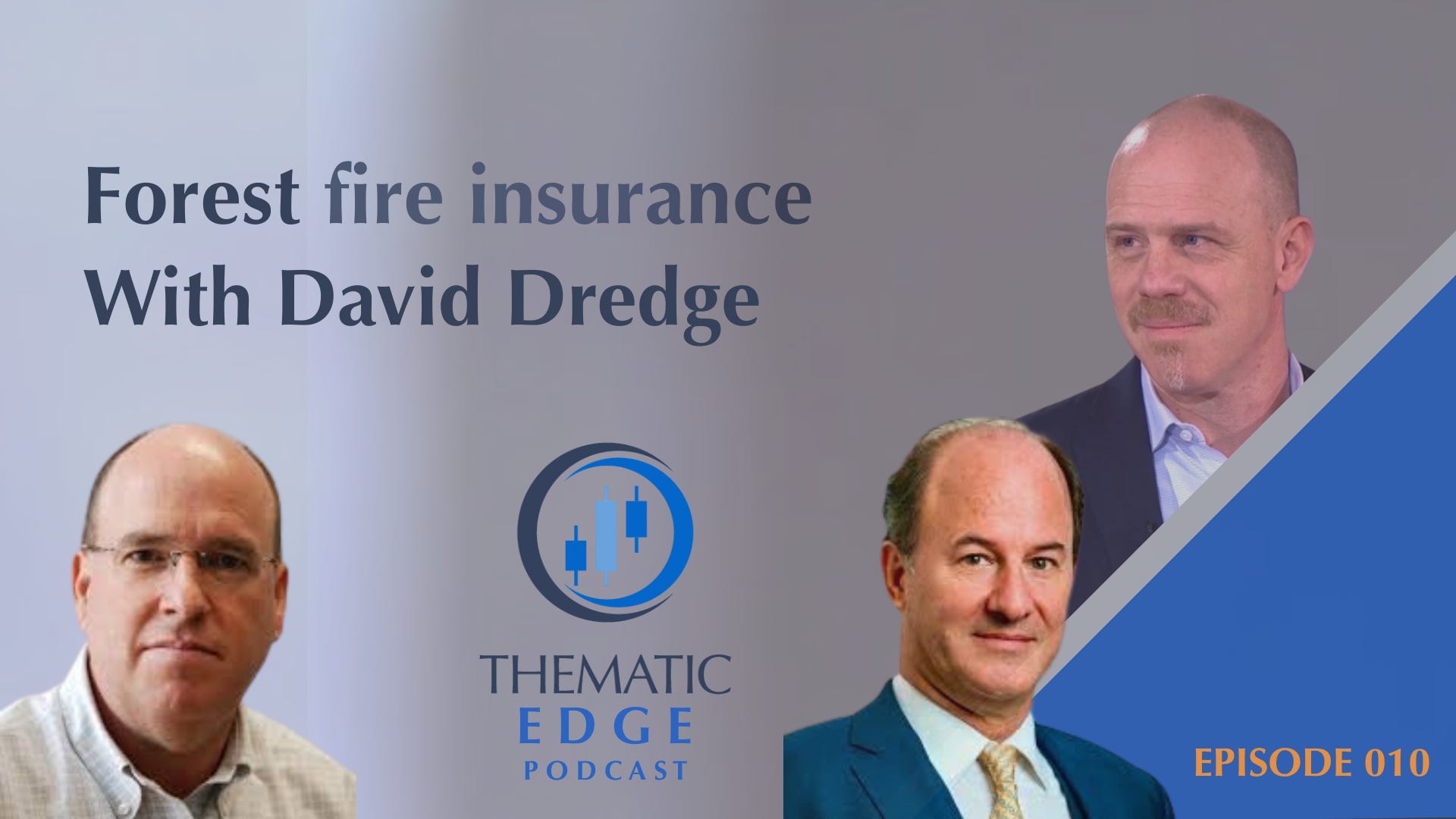
Forest Fire Insurance explores how risk truly builds in financial systems and why volatility is not the enemy it is often portrayed to be.Marvin Barth and Mark Farrington are joined by David Dredge, CIO of Convex Strategies, to unpack the idea of self organised criticality in markets using the forest fire analogy. The discussion ranges from leverage, correlation and contagion to the failures of Sharpe ratio thinking and the dangers of suppressing volatility.The conversation moves through convexity, tail risk, demographic decline, central bank policy and the growing fragility of the global financial system. Dredge explains why insurance is cheapest when it feels least necessary and why the real risk lies in accumulated undergrowth rather than the spark that eventually ignites it.This episode is a deep dive into how systemic risk forms, how it is mispriced and why prudent investors should think less about forecasting outcomes and more about preparing for nonlinear shocks.Timestamps00:00 Introduction to Thematic Edge and today’s guest01:00 David Dredge, Convex Strategies and tail risk investing03:20 Forecasting versus risk management05:30 The forest fire analogy and self organised criticality07:00 What is Sharpe World and why it fails09:30 Rational Accounting Man versus prudent risk management12:00 Incentives, leverage and systemic fragility14:45 Good volatility versus bad volatility16:00 Convexity, skew and why upside volatility matters18:50 Why investors are not taking enough risk21:30 Forest management, undergrowth and controlled burns24:30 Geopolitical and financial systems colliding27:40 Volatility pricing and the cost of insurance29:30 Japan, debt dynamics and demographic decline33:30 Population ageing as a structural risk driver37:30 Global competition for capital and bond market stress40:00 Arsonists, campers and fire marshals in the global system43:00 Markets driving economies, not the reverse45:00 Bond market stress and policy intervention47:00 Kevin Warsh, central banks and balance sheet risk49:30 Basel III, regulation and unintended leverage52:00 Why systemic risk keeps being misdiagnosed This is a public episode. If you'd like to discuss this with other subscribers or get access to bonus episodes, visit thematicmarkets.substack.com/subscribe
Unfortunately, the audio for this episode was terrible, so in addition to the time-stamped table of contents, a full, edited transcript is included below.In this episode, Marvin Barth and Mark Farrington reflect on a sequence of events that together signal a decisive shift in US strategy, from Venezuela to Greenland, and from emerging markets to monetary policy.They examine how recent US actions have reasserted strategic deterrence, clarified a new Western Hemisphere doctrine, and forced allies and adversaries alike to confront an uncomfortable reality. Whether welcomed or resented, American power still sets the terms.The discussion moves from geopolitics to markets, exploring what these shifts mean for asset allocation, the dollar, and global capital flows. Drawing on historical parallels with the 1990s, they unpack the case for a year of two halves, a steepening yield curve, bank outperformance, and a rotation away from debasement trades.They also assess the implications of a more orthodox Federal Reserve, balance sheet contraction, and deregulation, questioning widely held assumptions about gold, bonds, and portfolio construction.This is a wide ranging conversation about power, deterrence, and markets in transition, cutting through noise to focus on structure, incentives, and consequences.Table of contents00:00 Why this year feels different02:00 Venezuela and the return of US deterrence06:00 Allies have fewer choices than they think08:00 Nigeria and the logic of alignment10:00 Capital leaving China, where it goes next11:30 Greenland, power, and nuclear deterrence15:00 NATO tension is not new19:00 Why Europe wants out of US assets21:00 The 1990s playbook markets forgot24:00 Dollar fear versus earnings reality27:00 What a harder Fed really means30:00 Yield curve, banks, and rotation36:00 Gold is a risk asset, not a hedge40:00 Why the 60–20–20 portfolio failed43:00 Bonds may matter again46:00 Hawk or organiser, redefining the Fed48:00 Power, markets, and the next phaseFull, edited transcriptMARVIN BARTHI’m Marvin Barth, and I’m here with my good friend and colleague, Mark Farrington, The Global Watchtower. We’re back to talk about some of the issues that we discussed in our last few episodes, where we got to interview some very interesting guests. We also changed our environment and are actually together at the Cross Keys Pub in Chelsea. Something I think we should do more often, do this in person.MARK FARRINGTONAbsolutely.MARVIN BARTHWhat I wanted to start with is looking back at the Venezuela event and the David Kilcullen interview. Because that interview was unbelievable. Though it went way over time we could have talked to Dave for, I think, another hour or two if we had had the time. But for me, Venezuela set the tone for the year in the sense that last year, there was a lot of shock and awe from the Trump Administration, but there was never any clear definition. And I think other than tariffs, people didn’t get the sense of a real change in US strategy and position in the world. And then as we got towards the end of the year, we had the National Security Strategy, which we discussed back in December as widely misinterpreted. But it was abstract. Venezuela made the NSS tangible. First, it brought home very clearly the Trump corollary to the Monroe Doctrine, or the “Donroe Doctrine,” as people have been calling it.Second, it demonstrated an exceptionally important point Dave made about need for the US to reassert strategic deterrence. After the Afghanistan fiasco after the disaster of Ukraine US strategic deterrence was basically nil and while I’m not saying it’s back and I don’t think Dave was either, I do think it makes it very clear that any adversary around the world has to think twice before they try to counter the US or at least how they go about countering the US.I also think, and we’ll get into this more later, it also sends a very strong message to allies as well. Especially so given the contrast with how European allies handled the whole Greenland situation, Venezuela, as Dave said, wasn’t a flawless operation, but it was a very impressive show of capabilities, especially relative to the European show of sending a few soldiers to Greenland to, literally lay a towel on the ice. It clearly established to every ally that they cannot do this without the US. So, I think that’s going to be very important given how adversarial Trump administration has been in its rhetoric and actions with allies.Do you read that differently? Or what are your key reflections from the Kilcullen interview?MARK FARRINGTONI definitely agree with all those points, and I think that point that Dave made about re-establishing US deterrence was a very important insight. I didn’t immediately put that together, but, you know, he did, and that was helpful. And I also think, explains a lot of behavior of the Trump Administration around Greenland. There’s also an element of reinforcing nuclear deterrence too. The slight difference I might have to how you described it is that I broke the National Security Strategy into three compartments. I was interested in what it implied for the new corollary, the Western Hemisphere corollary, but also what it means for projection of power in the Pacific, the first island chain strategy, and also what it means for Europe and NATO and the Middle East, etc.So Venezuela definitely defined the Western Hemisphere doctrine clearly. And I think everyone got the message. It’s received the usual criticism you would expect anytime you use force. But otherwise, I feel like it has been surprisingly well accepted by the world and South America. I think it’s helped to tip elections in Latin America, as we’ve seen Costa Rica, for example, to the right as well. And I think it will be a successful strategy. Also, I would say Rubio deserves a lot of credit for that as well, not just Trump in this case.And that Latin America views it as a Trump / Rubio strategy, which is helpful. So yeah, I would concur on all the points.MARVIN BARTHSo, I don’t disagree with any of that. When I say that it was a defining event, I agree that it was a demonstration only in the Western Hemisphere and only of one slice of the broader National Security Strategy, i.e. the Western Hemisphere Trump corollary. But it had a broader implication as the first clear manifestation of the NSS and the complete shift we’re seeing in the US relationship with the rest of the world. That’s what it brought home to me, because one of the problems with the Trump administration is they say so many different things and he’s so good at misdirecting that you often are left questioning what is real. This made the strategy real.MARK FARRINGTONIt definitely means it’s real for everyone in the Caribbean. Exactly. Cuba is immediately standing to attention.MARVIN BARTHBut it wasn’t just there. And by the way, you remember Dave said, watch Cuba next.Another really interesting point from the interview with Senator Dafinone of Nigeria, that you couldn’t join, that we should definitely delve into more here, is this tension between people being shocked and offended by how the Trump Administration treats them but realizing they have no choice because you’re either out in the wild by yourself or you have the protection of the United States. Senator Dafinone put that in very clear terms: the US Christmas Day bombings in Nigeria were not an imposition on Nigeria, we were equal participants; we wanted this. Yes, President Trump may be selling it at home in his own way that he needs to do for his politics. But for we Nigerians, this was about an ongoing counter-terrorism operation, and we were really happy to have a big, powerful friend come join us.At the same time, however, he did express very clearly they were very concerned about the Venezuela operation. So it wasn’t just in Latin America, it was around the world. People said, whoa!MARK FARRINGTONNo, it was a strong statement, and it has various implications. And I think that one of the implications can be, that you’re concerned, you’re either aligned with the US or you’re not aligned. But one of the other implications can be that if we have an overlap in our goals, it can be the most useful partnership that you can have. In this case, Nigeria definitely wanted and collaborated with that operation. It supported the government’s goals as well. So, I think the US will be used like that. Not as a policeman, but as the deliverer of the painful, punitive message. And perhaps that’s what the Trump posture will be like. Not a normal policeman, but standing ready to act, to create decisive change in the use of military force.MARVIN BARTHBy the way, the Dafinone interview brought home another topic we’ve discussed that we need to devote a whole podcast to, which is emerging markets where we both have strong backgrounds. I was fascinated by the opportunity that Senator Dafinone described in Nigeria under the reforms that President Tinubu is undertaking, and in the broader context of these geostrategic realignments, in the competition for these regions’ resources, populations and hearts and minds. That latter point was well illustrated in the news after our interview was that President Tinubu went to visit Turkey and establish relationships with the Turks and increasing trade ties there. Separately, China and Nigeria reaffirmed their strategic partnership. All these pieces are in the mix, and that competition is potentially a huge opportunity in emerging markets.MARK FARRINGTONTotally agree. And if you look at the equity flows that we’ve seen so far in the emerging markets, there’s clearly a big outflow from China and then redeployment in emerging markets ex-China. So, for all of the West, which have some restrictions now on being fully invested or invested at all, in China, they’ve made that strategic allocation and so they’re on the search for new stories, stories which maybe are less impacted by geopolitics and where the country or
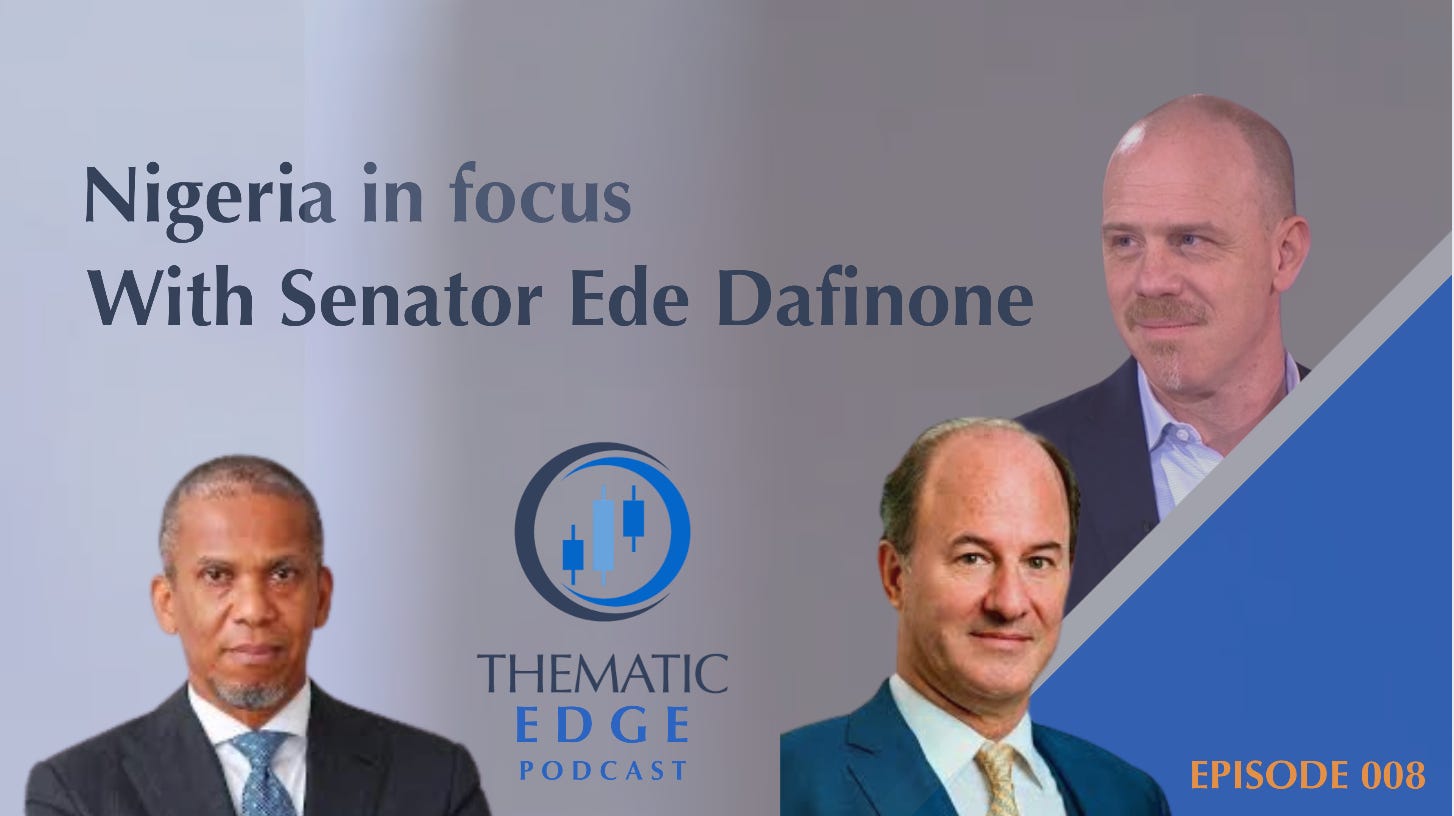
Nigeria is the largest economy and population in Africa, is abundant in natural resources, is an emergent cultural and technology center, and increasingly a regional manufacturing hub. Senator Ede Dafinone of Delta Central State (the main oil-producing region) explains the reforms of President Tinubu, the vast potential opportunities they may release, and how this lynchpin of Africa can navigate strategic competition between the US and China.0:33 Why Nigeria merits your attention.2:40 Who is Senator Ede Dafinone of Delta Central State?6:19 The basis of Nigeria’s cooperation with US attacks on ISIS.9:33 Nigerian perspectives on the shift to a new world order.14:35 Nigerian views on President Trump.17:14 President Tinubu’s willingness to challenge the system and reform.21:00 What will define success and prospects for long-run success.23:30 Senator Dafinone’s priorities for Delta State and Nigeria.25:36 Opportunities in Nigeria created by reform.31:52 Nigeria’s secret weapon: its educated diaspora.33:52 Fine arts and fashion in Nigeria. This is a public episode. If you'd like to discuss this with other subscribers or get access to bonus episodes, visit thematicmarkets.substack.com/subscribe
The Thematic Edge opens 2026 with its first guest, David Kilcullen, retired Australian Army colonel, intellectual architect of both the “Surge” in Iraq and Afghanistan, and the world’s foremost authority on counterinsurgency. Colonel Kilcullen helps us make sense of what happened in Venezuela on 5 January and what to expect going forward.The discussion is structured around three questions that matter for markets. * First, what actually happened operationally, and what it reveals about escalation control, deterrence, and the limits of legacy air defence systems. * Second, what the episode signals about US grand strategy, the “Trump corollary of the Monroe Doctrine, the return of gunboat diplomacy, and the use of suzerainty style constraints to shape trade, currency choice, and commercial alignment. * Third, what long-term “success” means and what must be achieved to meet it, including political stabilisation of Venezuela, establishment of payments systems, control over resources, and how quickly the US needs to move before the window closes.Along the way, we challenge the prevailing narratives including claims of pre-negotiation with or foreknowledge of China and Russia, implications for the emergent global order, Taiwan, Ukraine, Europe, other regions’ security, who might be “next,” the scramble for resource control, what to watch for, and Venezuela’s potential as a test case for dollarization via stablecoins. With so much to talk about and such an insightful guest, this episode is longer than usual, but it will be required listening/viewing for anyone interested in assessing risks and making informed decisions in today’s rapidly shifting global order.Full transcript 100:00:06.560 --> 00:00:09.120Marvin Barth: Good evening, and welcome to…200:00:09.150 --> 00:00:25.030Marvin Barth: the Thematic Edge. We are very excited, to start 2026 with our very first guest on the Thematic Edge. So, this time I’m not only joined by my longtime friend and colleague, Mark Farrington.300:00:25.030 --> 00:00:29.289Marvin Barth: Who’s going to join me in asking some of the questions of our guests.400:00:29.290 --> 00:00:39.329Marvin Barth: But I’m also joined by another very old friend of mine, David Kilcolon, and we are very fortunate to have him.500:00:39.620 --> 00:00:54.339Marvin Barth: for reasons we can discuss another time. My nickname for him is the International Man of Mystery, and most of that has to do with the fact that I can never get ahold of him, and he seems to be in some crazy place without cell phone connections.600:00:54.700 --> 00:01:02.499Marvin Barth: So we’re very lucky to have him, because he is exactly the right person to talk to700:01:02.750 --> 00:01:13.620Marvin Barth: about the events in Venezuela that occurred over the weekend. David is a retired colonel from the Australian800:01:13.620 --> 00:01:24.070Marvin Barth: Army. He, was a key advisor in both the Bush and Obama administrations. He has a consulting business, Cordillera Applications Group.900:01:24.070 --> 00:01:29.290Marvin Barth: That consults to many of the leading militaries, military alliances.1000:01:29.290 --> 00:01:40.729Marvin Barth: and companies, around the world on security issues. He is universally acknowledged as the world’s foremost authority on counterinsurgencies.1100:01:41.280 --> 00:01:57.119Marvin Barth: And he also happens to be a tremendously good, grants strategist, as illustrated by his last book, The Dragons and the Snakes. All his books are fantastic. I highly encourage you to go out and1200:01:57.420 --> 00:01:58.490Marvin Barth: read them.1300:01:58.660 --> 00:02:02.519Marvin Barth: David, welcome, and thank you for joining us.1400:02:02.990 --> 00:02:09.389David Kilcullen: Thanks, Marvin. It’s an honor to be here, and my publisher thanks you for that very blatant plug of my books.1500:02:10.300 --> 00:02:21.289Marvin Barth: well-deserved. I mean, if you want to understand any of the military or geostrategic developments of the last 20 years.1600:02:21.290 --> 00:02:34.590Marvin Barth: you have to read David Gilkullen’s books. You know, Counterinsurgency is literally the field manual for counterinsurgency, not only for the U.S. military, but for most militaries around the world at this point.1700:02:34.600 --> 00:02:48.110Marvin Barth: Out of the Mountains really described many of the things that we are now seeing take place, whether it was in Gaza or Ukraine. All of those things were basically forecast by David over a decade ago in that book.1800:02:48.110 --> 00:02:58.420Marvin Barth: And in terms of the best possible framework for thinking about the geostrategic environment and the challenges that Western democracies face.1900:02:58.420 --> 00:03:09.939Marvin Barth: Both militarily, economically, and strategically. You know, The Dragons and the Snake was second to no book out there, so, you know…2000:03:10.470 --> 00:03:16.739Marvin Barth: I’ll give you another plug there. Now, before we… Before we go on,2100:03:16.740 --> 00:03:38.359Marvin Barth: The, I do want, to remind everyone that nothing on this podcast should be considered, financial advice. You need to do your own research. We are providing information here, and especially on this topic, where we are literally in the fog of war, even though it’s an undeclared war.2200:03:38.840 --> 00:03:49.660Marvin Barth: You should not rely on any of this information as being factual, because everything is up in the air right now, and we are doing our best to make sense of the information that is available.2300:03:49.930 --> 00:03:57.890Marvin Barth: So with that, let’s start with, I actually wanted to structure this in sort of 3 segments that I think2400:03:58.120 --> 00:04:16.149Marvin Barth: best fit your expertise, Dave. The first is just, like, diagnostic. What actually happened? You know, if you were a theater commander or something, and you were getting in this, this information, or you were,2500:04:16.149 --> 00:04:21.899Marvin Barth: the head of the PLA trying to figure out what the heck the Americans just did.2600:04:21.959 --> 00:04:25.400Marvin Barth: How would we assess what actually happened?2700:04:25.400 --> 00:04:35.189Marvin Barth: Based on the information we have, today, the 5th of January. The second is really getting to that geostrategic point.2800:04:35.190 --> 00:05:00.130Marvin Barth: you know, what are the grand strategy implications of this, not just for the U.S. and for the region, but globally, and then finally get back to where you are the, you know, clear, acknowledged expert, on counterinsurgency, which is really, and you’ve emphasized this over and over, really about creating a stable society, which is what it’s going to take to make this operation ultimately successful. So we want to get that.2900:05:00.320 --> 00:05:12.070Marvin Barth: And in the end, I think we’ll get to, if we have some time, some, markets issues, which, feel free to, ask Mark and I questions around that.3000:05:12.580 --> 00:05:13.440David Kilcullen: Absolutely.3100:05:13.900 --> 00:05:16.430Marvin Barth: So let’s start with… I mean…3200:05:17.510 --> 00:05:28.149Marvin Barth: One of the things that has been floated around a lot, is that this was somehow, pre-arranged, right? That this was a negotiated.3300:05:28.180 --> 00:05:41.639Marvin Barth: settlement. And, you know, there are several signs, at least to my untrained eye, that suggest that. One, the strikes that were… that took place were actually quite limited, it seems.3400:05:42.190 --> 00:06:00.480Marvin Barth: And there are a lot of, anti-aircraft weapons in, Venezuela. Their army may not be fabulously trained, but they’ve got lots of, equipment from, all their, foreign friends. And yet you were able to have a helicopter-led,3500:06:00.690 --> 00:06:18.329Marvin Barth: exfil within a couple of hours without losing anybody. And then there’s also the sort of confidence that President Trump displayed in his press conference, suggesting that, you know, they’re basically going to run things under the new regime.3600:06:18.570 --> 00:06:28.579Marvin Barth: Do you see this as a prearranged, or a negotiated settlement, or… and how did that work, or do you have other theories about what was going on?3700:06:29.220 --> 00:06:29.900David Kilcullen: So…3800:06:35.220 --> 00:06:40.040David Kilcullen: So I’ll put that caveat out there to start with. But I think it’s pretty clear…3900:06:40.040 --> 00:06:44.080Marvin Barth: Dave, you froze for a second, so if you wouldn’t mind, what was that caveat again?4000:06:44.560 --> 00:06:57.519David Kilcullen: Sorry, I was just saying that, the short answer to many of these questions is we don’t know, right? Or we don’t know yet. So, we should just bear that in mind as we’re… as we’re talking about it.4100:06:57.710 --> 00:07:00.220David Kilcullen: The… I think the…4200:07:00.460 --> 00:07:18.170David Kilcullen: it’s not a secret that there’s been ongoing negotiation between the US government and the Venezuelan government over almost a year now about a set of issues, but the one that’s become the sticking point was the stepping down4300:07:18.270 --> 00:07:23.879David Kilcullen: of Maduro. As far as we know, about a week ago.4400:07:24.010 --> 00:07:30.470David Kilcullen: that set of negotiations reached an impasse, where Maduro was essentially offered4500:07:30.660 --> 00:07:43.920David Kilcullen: safe passage to exile, perhaps to the Middle East, or to Russia, where Bashar al-Assad is right now, of course. And this has seemed to have been a…4600:07:43.980 --> 00:07:56.840David Kilcullen: preferred playbook from the Trump administration to offer a way out and a graceful exit with as much cash as you can carry, you know, to a comfortable retirement somewhere else.4700:07:56.840 --> 00:08:09.899David Kilcullen: by the way, watch that space for Zelensky’s future, too, depending on how things go in Ukraine. But, I think the, the ultimate breach came about a week ago, when Madur
After a brief hiatus, the Thematic Edge is back! In the first half of this week’s episode, Mark queries me on Fed reform, a consistent theme of senior Trump officials that hasn’t received sufficient attention given its immense implications: what do they want to do and what can they do without Congress. In the second half we switch roles as I pull from Mark the real international relations implications of the abrupt turn in the latest US National Security Strategy paper.0:00 Intro2:23 Who will be the next Fed chairman?3:23 Fed reform and financial deregulation is more important than low interest rates8:16 Trump as Mafia don and not as an insult11:38 Why Warsh stands out: early proponent of Fed reform16:10 Why we need to do a podcast on the Global Financial Crisis response sometime...17:04 Why regulatory reform is critical to slimming down the Fed’s balance sheet20:32 Fed reform is a consistent Administration priority22:16 The role of regulation in extending banks’ and central banks’ asset duration24:51 How bank regulation can be unwound by the Fed27:19 First-order effects of bank deregulation: US banks versus foreign; small versus large banks29:13 The role of the Reserve Banks in implementation of deregulation31:12 Implications for bank stock prices33:20 Yield curves and broader stock prices35:22 The US National Security Strategy36:42 Clear continuity of NSS with think-tank analyses showing the need for the US to pull back from imperial overstretch to a more defensive position38:29 A live war in Europe forces a change in framework: the US no longer can be as transparent as in a period of peace39:44 Look to Asia for a live example of how this new framework will work41:18 China’s blockade contingency forced Japan’s hand42:14 US not withdrawing, but shifting its focus to be a strategic reserve force44:48 NSS in a nutshell “Quality adjustment, not quantity adjustment”49:16 Definitive message to China: we don’t want war...but are preparing if you do52:40 What investment themes arise from the NSS54:50 Stepped-up euro and European asset risks57:50 Increasing US pressure on Northeast Asian currencies59:04 Investment themes for 2026 This is a public episode. If you'd like to discuss this with other subscribers or get access to bonus episodes, visit thematicmarkets.substack.com/subscribe
A very lively discussion this week that goes on a bit longer than usual as Mark & I get into a disagreement over the implications of Chinese gold-backed stablecoins. But before the fireworks, Mark & I review what President Trump achieved at ASEAN and APEC, how his earlier successes set him up for it, and what it means for Global bifurcation; then we fire both barrels at the failure that has been central bank forward guidance and our prediction (hope?) that this travesty is about to meet it well deserved, but likely messy, end as fundamentals expose the fundamental errors in central banks’ forecasts and policies.00:00 President Trump takes La Cosa Nostra Americana to ASEAN and APEC.02:45 Trump-Xi meeting seen in context of broader strategy and earlier building blocks.03:28 Cementing ASEAN as part of US sphere was critical final plank ahead of APEC.07:29 Who backed down & who won what from the Trump-Xi meeting?09:04 Fentanyl concessions as a win against “hybrid warfare.”11:13 China’s “own goal” with critical minerals response to narrow US NVIDIA export controls.14:38 Was the real loser revealed to be Europe and its much deeper weaknesses?15:59 The depth of China’s fundamental supply-chain leverage and the years it will take to overcome.16:42 Did Xi and Trump come to a durable understanding?18:35 Validation of Trumpian “tariff wall” approach over targeted industrial policy.20:16 Realignment of Western alliances from “US dependencies” to regional alliances with US cooperation.22:05 Success of La Cosa Nostra American and national interests over foreign policy as a popularity contest.23:26 Market narratives’ basis in informational asymmetries regarding China and the US.26:32 Devaluation’s role in adjustment for inflexible state-run economies like China.27:57 Difference between modern Chinese overinvestment and Japan’s in the 1980s.30:24 Information asymmetries in central banking and the flaws of forward guidance.33:24 What did we learn from last week’s Fed, BoJ and ECB meetings last week?38:17 Forward guidance’s undermining of central banks’ credibility.43:02 Abusing a new tool.45:13 When will there be a market reckoning of central banks’ credibility failures?48:34 Markets aren’t the omniscient fortune tellers they (and central banks) believe.51:02 TIPS breakevens are not inflation expectations; bond traders don’t set prices they (badly) forecast them.52:06 The 1970s analogue: myths and facts.53:45 The “dual mandate” is robbing Peter to pay Paul; you’re going to lose those jobs eventually if you ignore inflation.54:55 The “debasement trade” amid overvalued, risky gold prices.56:44 The “stopped watches” of the debasement trade and US decline.57:34 The role of zero rates in fueling commodity speculation.58:26 Conflating narratives: asset seizure fears are not the same as fiat debasement.61:57 China’s embrace of a gold-based system.63:23 Will China replace its CNH strategy with gold-backed stablecoins to counter the US GENIUS act?64:06 But why would anyone want a Chinese-law issued gold stablecoin?64:48 Most bullish signal ever for equities/gold ratio?66:53 What’s the best inflation hedge?67:19 Confusion over payments system versus money.68:31 No, I’m going to disagree with you, Mark! This is a public episode. If you'd like to discuss this with other subscribers or get access to bonus episodes, visit thematicmarkets.substack.com/subscribe
This week, Mark Farrington and I discuss what I learned from the semiannual World Bank-IMF meetings last week in Washington. Where do both policymakers’ and markets’ center of gravity lie?0:00 Introduction: Impressions of World Bank-IMF meetings2:25 IMF’s forecasts and embedded biases4:08 Market participants’ views6:13 Benchmarked managers more consensus than absolute-return managers9:14 Strongest pushback on my views? Geopolitics and the dollar12:00 Consensus take on Chinese rare earth controls is wrong17:40 Why does the consensus accept that Trump’s economic policies may be working but not his foreign policies?21:42 IMF forecasts out of date already24:10 IMF ties themselves in pretzels to justify their forecasts27:48 US labor supply growth slowing? Or demand?31:38 2026 surprise will be labor supply constraints’ effects on inflation33:54 Fed missing labor supply’s role; making a policy error cutting; markets’ price to aggressively37:07 Strongest alignment of those agreeing with my views is to pay 1y1y interest rates39:33 Markets failing to price inflation risks42:07 How will the Fed handle a CPI upside surprise this week?44:25 Where are the bond vigilantes?45:07 Are there any “hard money” central banks?47:53 IMF forecast risk cases: A hammer looking for a nail?50:52 Is the AI boom Dot.com 2.0?58:38 Nonbank financial institution risks This is a public episode. If you'd like to discuss this with other subscribers or get access to bonus episodes, visit thematicmarkets.substack.com/subscribe
This week Mark and I discuss how “we’re all state capitalists now” but that both new Japanese Prime Minister Takaichi and US President Trump make an error when they try to include central banks in that effort. We discuss what markets are missing — inflation — and how that’s likely to be a key risk theme for 2026, and we touch upon whether the current equity boom is Dot.com 2.0, or something different.0:07 The message of new Japanese Prime Minister Takaichi and what it means for Japan and the yen.6:23 We’re all state capitalists now, but where do governments need to draw the line.12:43 Can we run economies hotter? And what did we learn from Stephen Miran?15:57 Does President Trump want a housing refi cycle or does he just have a time-inconsistency problem?23:18 Will we see a pivot from President Trump early next year? What form will it take?27:33 President Trump is delivering the relative price changes his voters want.33:31 Current central banking philosophy may be a bigger problem than fiscal authorities’ interference.36:07 Why are central banks getting the labor market so wrong?49:08 How much of a constraint is slowing labor supply growth on the economy?52:09 Why aren’t markets more worried about central banks’ continuing mismanagement and pricing more inflation? Is inflation the risk theme for 2026?59:53 Are markets’ fears about equity valuations valid? Are the comparisons to the Dot.com bubble valid? This is a public episode. If you'd like to discuss this with other subscribers or get access to bonus episodes, visit thematicmarkets.substack.com/subscribe
Mark and I covered a lot in this episode. We start with a quick recap of the Bank of Japan meeting Friday and the Federal Reserve meeting two days earlier. But we spend most of our time discussing a new piece by Mark, Dollar upside gamma: Systemic pressures, that mostly aligns with my long-standing views but raises both some critical differences and questions about the future.0:00 Intro1:18 The Bank of Japan pauses but October is live for another rate hike.4:53 Mark calls 25 and done for the Fed; Marvin thinks it was a Train wreck, a clear policy error that raises the risks that they will further compound it with more cuts before being forced to reverse. Both of us agree the Fed doesn’t understand what “risk management” means and is no longer really an inflation-targeting central bank.17:03 Mark defines and explains his “dollar gamma” thesis: the end of “monetary extremism,” rising geopolitical risks, and a “tech super cycle” are combining to create fundamental divergence between the US and others that contradicts the narrative of the “end of US exceptionalism” and sets the stage for a snapback on a significant risk event.22:06 Where our views align on his thesis: a dollar reversal is coming based on fundamentals that counter the dominant market narrative and the trigger may be something innocuous..33:10 But there are also areas where we differ: equities as an inflation hedge, the risks from a large balance sheet, the efficacy of Quantitative Easing and potential for adverse effects from Quantitative Tightening.49:10 When Western central banks veered into “monetary extremism” and the lagged effects on yield curve shape that are now manifesting.53:55 What will be the effects of the “Great reckoning” beyond the dollar and term premia?58:40 Energy’s role in the realignment and sorting winners from losers.61:17 “Western-centric” circles of Global bifurcation and value in asset prices and FX. This is a public episode. If you'd like to discuss this with other subscribers or get access to bonus episodes, visit thematicmarkets.substack.com/subscribe
Mark Farrington of the Global Watchtower and I have kicked off our own podcast on the Themes driving markets. Mark was practicing thematic investing as a portfolio manager long before it became a “thing” and a thematic approach to analysis of the global political economy has been my modus operandi for a quarter century. Mark and I have been debating markets for over twenty years and thought we’d bring that debate into the public.In this, our first episode we talk about the shifting sands of geopolitics in the wake of China’s Shanghai Cooperation Organization meetings, what it means for the global economy, for emerging markets, and for digital assets. We discuss the surprising and amazing insights into President Trump’s policies from the Bank of Japan, President Trump’s assault on the Federal Reserve and its meaning for markets, and put the recent yield curve steepening in context.Here are some of the topics and questions we cover:0:00 Introductions: who we are and why you should listen to the Thematic Edge Podcast.3:30 Did Donald Trump really drive India into the arms of China and Russia?14:59 Message and effects of China’s 80th Anniversary military parade.17:29 Accepting a Russia-India relationship to help separate the former from China.21:31 What does the Great Game of geopolitics mean for emerging markets?23:19 Japan as the first “emerging market” and the myth of higher EM returns in a world without globalization.26:24 2008 to 2012 as the high watermark for emerging market investing.30:15 Emerging markets in the new world order: FDI, not portfolio, flow driven and the importance of navigating the Chinese versus American spheres amid Global bifurcation.32:08 The opportunities that crypto and digital assets open for emerging markets, especially Africa.36:03 Bank of Japan Deputy Governor Himino provides best description of the Trump policy agenda, its motives and its aims.43:24 When breaking convention becomes necessary in national and international policy.46:04 Trump’s attack on the Federal Reserve and the need for reform.51:21 Fed independence versus legitimate democratic oversight.54:03 The propriety and effects of pursuing criminal and ethical investigations of central bankers.55:16 Is Jerome Powell the worst Fed Chair in history?57:04 The effects on the yield curve and swap spreads. This is a public episode. If you'd like to discuss this with other subscribers or get access to bonus episodes, visit thematicmarkets.substack.com/subscribe
Comments


Download from Google Play

Download from App Store
 United States