DiscoverRendered by Robots | AI & the Future of Design Education
Rendered by Robots | AI & the Future of Design Education
Claim Ownership

Rendered by Robots | AI & the Future of Design Education

Author: Spencer Striker, PhD

Subscribed: 0Played: 1
Share

Description

What happens when robots do the reading—and the designing?


Rendered by Robots explores how artificial intelligence is transforming creative education. Hosted by Dr. Spencer Striker and Alessandra El Chanti of Northwestern University | Qatar, the series brings together leading voices from design, media, and technology to discuss how AI is reshaping what it means to teach, learn, and create.


Each episode features educators, technologists, artists, and researchers confronting the most pressing questions of the AI era:


  • What does originality mean when machines can mimic mastery?


  • How do we assess creativity in AI-assisted classrooms?


  • Which human skills—curiosity, empathy, critical thinking—become more vital as automation advances?


Season 1 features:


  • Clay Shirky (NYU) on how AI reshapes collaboration and learning.


  • James Walsh (New York Magazine) on authorship and creative economies.


  • John Gibbs (“Dr. Know-It-All Knows,” YouTube / UGA) on teaching creativity with AI.


  • Marc Watkins (University of Mississippi) on generative-AI writing pedagogy.


  • Olivio Sarikas (Digital Artist) on co-creation between humans and machines.


  • Nataliya Kosmyna (MIT Media Lab) on brain–computer interfaces and embodied AI.


  • Renée Hobbs (University of Rhode Island) on media literacy and AI ethics.


  • Jeremy Gilbert (Northwestern Medill) on AI-driven storytelling and design thinking.


  • Lila Shroff (The Atlantic) on authorship, ethics, and creative confidence.


  • Rebecca Winthrop (Brookings Institution) on AI and global learning equity.


Supported by the Artificial Intelligence & Media Lab (AIM-LAB) and Northwestern University’s Alumnae Award for Curriculum Innovation, the podcast invites educators, students, and creators to think critically about the next chapter of creative practice in the age of intelligent machines.


Learn more at spencerstriker.com


Keywords: AI Education, Design Education, Generative AI, Media Innovation, Creative Pedagogy, AI Literacy, EdTech, Future of Learning, Creative AI, Media Futures, AI Ethics

8 Episodes
Reverse
It would have been a little strange in 2007 if we handed everybody an iPhone and said, okay, you really have to learn this technology. But we also can't pretend students aren't using these tools because everybody sort of is. Lila Shroff, writer and assistant editor at The Atlantic and recent Stanford graduate, joins Spencer Striker and Alessandra El Chanti to discuss the blurry line between legitimate AI scaffolding and cheating, the dark patterns creeping into chatbots, and what it was like to be a college sophomore when ChatGPT took over. In this conversation, Lila walks us through her experience at Stanford, where she studied human centered AI and watched the technology explode in real time with tech company headquarters right down the street. She describes how in the early days there was anxiety and trepidation about whether using these tools was appropriate, and how over time it became so normalized that 85 to 90 percent of students are now using them in some form. We explore the steroid era analogy: students who want to do it the old fashioned way feel pressure because everyone around them is using AI to get ahead. Lila makes a sharp observation that whether something counts as cheating is almost a semantic issue now, which depends entirely on context. We dig into her brilliant Atlantic article on chatbait, her term for the way chatbots append follow up questions at the end of every response. She describes how this creates an infinite conversation dynamic reminiscent of the infinite scroll on TikTok. The core question she raises is when you're talking to Claude or ChatGPT or Gemini, who has the agency, who is in charge of the conversation. Lila explains the memory versus privacy trade off: on one hand, AI tools are not that useful if they don't remember who you are, it's the 51 First Dates problem of having to reintroduce yourself in every new thread. On the other hand, the idea that your medical records, email exchanges, and conversations with friends are all aggregated in one place raises serious questions. We discuss the death of the ten blue links and what a natural language browser means for how we navigate the web. Lila shares her perspective as a Gen Z journalist at the beginning of her career: the core of journalism is reporting, talking to people, knocking on doors, uncovering new information, and that's something AI is not well positioned to do. She believes the best writing will be connected to the real world, filtered through the specific lens and experience of a human voice. We touch on Tillie Norwood, the AI generated actress with Hollywood agents, and whether people would watch a movie starring AI actors. Lila says if she's on Netflix and sees an AI movie next to a human one, she's clicking the human one. But she also notes that if you can't tell the difference, the preference starts to vanish. Looking ahead, how we figure out the friction between reality and the deepfake world will be an important question. Referenced: "Chat Bait Is Taking Over the Internet" by Lila Shroff, The Atlantic. Clay Shirky on education as changes to long term memory. Stanford's Human Centered AI program. OpenAI's browser and Sora 2. Tillie Norwood, the AI generated actress. Links: Lila Shroff's article: theatlantic.com/technology/archive/2025/09/chatbait-ai-chatgpt-engagement/684300/ Host: spencerstriker.com About the Series Rendered by Robots: AI & the Future of Design Edu explores how AI is transforming the way we teach, create, and imagine media production education. It’s a podcast for educators, creators, and students navigating the AI revolution with clear eyes and curious minds. CREDITS: Creator & Host — Spencer Striker, PhD | Co-Host & Director — Alessandra El Chanti, MFA | Featured Guest — Clay Shirky, Vice Provost for AI and Technology in Education at NYU | Editor, Sound Design & Motion Graphics — Kyle Trueblood | Producer — Adam Sullivan | Camera & Sound — Yunting "Unity" Zhan, Qinbei "Bissy" Li | Project Manager — Aimelyn Geronimo | Special Thanks — Miriam Sherin (Associate Provost for Undergraduate Education); Alumnae Award for Curriculum Innovation (Northwestern University Office of the Provost); Marwan M. Kraidy, PhD (NU-Q Office of the Dean); S. Venus Jin, PhD (Artificial Intelligence and Media Lab | AIM-LAB); Nisar Keshvani (NU-Q Communications and Public Affairs); Rami Al-Badry, Floyd Yarmuth, Ihsan Yahya (NU-Q Production & Digital Media Services)
ChatGPT has unraveled the entire academic project. The question is no longer how do we regulate this. The question is why are we teaching what we're teaching if a robot can do it easily. James Walsh, journalist at New York Magazine and author of the viral article "Everyone Is Cheating Their Way Through College," joins Spencer Striker and Alessandra El Chanti to discuss what his deep dive investigation revealed about the state of higher education in the age of generative AI. In this conversation, James walks us through how he broke this story. His editor asked a simple question: how are kids cheating these days? A week into reporting, he went back and said the thing is, everybody is cheating. We explore what the term "academic project" really means and why it's being called into question at every level, from cutting edge research to business school to poetry class. James describes the despair he encountered among K-12 teachers and college professors, some looking forward to retirement, others scrambling for AI-proof assessments like oral exams and blue books. We discuss the Wendy problem, named for a student who walked him through step by step how she constructs papers with AI. Wendy likes writing. She speaks nostalgically about high school before AI when she had to formulate her own ideas. But if all her classmates are using AI to get ahead, she feels she has no choice. We get into the arms race between faculty and students, from Turnitin detectors to students laundering AI text to sound more human, to professors trying Trojan horse prompts that trick AI into revealing itself. James argues none of it is sustainable. We talk about Roy Lee, the Columbia undergrad who raised five million dollars for an AI company while still in school, and what his mindset reveals about a generation being told that humans are the liability. James draws parallels to the Industrial Revolution and Bryan Merchant's book Blood in the Machine, noting that the attitudes of today's tech entrepreneurs toward labor are shockingly resonant with factory owners of the past. The conversation closes with James reflecting on what's changed since his article came out: professors inspired to switch things up, conversations finally happening, but also AI advancing so fast that these questions are more urgent than ever. Referenced: "Everyone Is Cheating Their Way Through College" by James Walsh, New York Magazine. Clay Shirky on identity formation. Nataliya Kosmyna's MIT study "Your Brain on ChatGPT." Bryan Merchant's Blood in the Machine. The Paper Chase (1973). Links: James Walsh's article: nymag.com/intelligencer/article/openai-chatgpt-ai-cheating-education-college-students-school.html Host: spencerstriker.com About the Series Rendered by Robots: AI & the Future of Design Edu explores how AI is transforming the way we teach, create, and imagine media production education. It’s a podcast for educators, creators, and students navigating the AI revolution with clear eyes and curious minds. CREDITS: Creator & Host — Spencer Striker, PhD | Co-Host & Director — Alessandra El Chanti, MFA | Featured Guest — Clay Shirky, Vice Provost for AI and Technology in Education at NYU | Editor, Sound Design & Motion Graphics — Kyle Trueblood | Producer — Adam Sullivan | Camera & Sound — Yunting "Unity" Zhan, Qinbei "Bissy" Li | Project Manager — Aimelyn Geronimo | Special Thanks — Miriam Sherin (Associate Provost for Undergraduate Education); Alumnae Award for Curriculum Innovation (Northwestern University Office of the Provost); Marwan M. Kraidy, PhD (NU-Q Office of the Dean); S. Venus Jin, PhD (Artificial Intelligence and Media Lab | AIM-LAB); Nisar Keshvani (NU-Q Communications and Public Affairs); Rami Al-Badry, Floyd Yarmuth, Ihsan Yahya (NU-Q Production & Digital Media Services)
The 'Tarantino Moment': Why AI Is the New 90s Indie Cinema | Olivio Sarikas on Rendered by Robots Art is only lazy if the artist is lazy. The medium itself has nothing to do with it. Olivio Sarikas, conceptual artist and one of the premier YouTube educators on AI tools for design, joins Spencer Striker and Alessandra El Chanti to discuss what it really means to create in an age when any style is possible and skill limits have dissolved. In this conversation, we explore how AI represents a new kind of creative liberation. Olivio walks us through the history of how technology has always transformed art, from industrial paint tubes freeing artists from their ateliers to photography killing realistic representation and forcing painters to look inward. But AI does something no previous technology could: it sets you free from style itself. We discuss what it's like to paint on a canvas that's always moving, where the hallucinations and errors become sources of inspiration rather than obstacles. Olivio addresses the anti-AI backlash head on, acknowledging the legitimate anger of artists whose work trained these models while also pointing out that complaints about "lazy art" have followed every artistic movement in history. We get into the strange reality that this is a top-down revolution funded by billionaires rather than emerging from the edges of culture like punk or impressionism. He introduces the cookbook metaphor: having the ingredients doesn't mean it tastes good, you still need to try it a hundred times before you become a good cook. We discuss content inflation and why social media skills are now non-negotiable for artists who want to be seen. Olivio makes a compelling case that jobs won't disappear because complexity always increases with new technology, and humans remain cheaper and more versatile than machines for most tasks. He closes with a fascinating observation about the AI bubble: the real lifestyle of a new technology begins only after the hype collapses and people have to figure out what it can actually do. Nobody predicted that the big use of the internet would be posting cat photos. Nobody knows what AI will actually become. Referenced: The history of Impressionism and how industrial paint tubes changed art. Andy Warhol and the industrialization of reproduction. Maurizio Cattelan's banana artwork. The dot-com bubble as precedent for AI hype cycles. Links: Olivio Sarikas: youtube.com/@OlivioSarikas Host: spencerstriker.com
What is it we really want to do, not how do we adapt to the technologies we use? Jeremy Gilbert, Knight Professor of Digital Media Strategy at Northwestern and Director of the Knight Lab, joins Spencer Striker and Alessandra El Chanti to discuss why we need to stop automating yesterday's tasks and start designing for what people actually need. In this conversation, we explore human-centered design and the discipline of cutting past the habitual to get to the desirable. Jeremy walks us through what he calls the Kodak trap, showing how Google, Xerox, and news organizations all made the same mistake of confusing the product with what people actually want. People don't want search engines, they want answers. People don't want news apps, they want to understand the world. From there, we get into the two ends of what news consumers are really after: hyper-personalization on one side and parasocial connection on the other. This leads to a frank discussion about filter bubbles and AI media literacy, where the facts across sources are often similar but the framing can be radically different. We touch on the dead internet theory and the strange loop of AI creating content for AI to read. Jeremy makes a sharp distinction around intellectual ownership, arguing that if you're not constantly evaluating AI outputs, it's not your work. We talk about why journalists now need to think entrepreneurially and build personal brands, and then pivot to education, where Jeremy describes the one-room schoolhouse as an ideal we can finally pursue at scale using AI. He introduces the zone of proximal development, the sweet spot where learning is hard enough to stretch you but not so hard you give up. He shares his approach to the iterative assignment, where students don't turn in the final AI output but document each step of the process. And he closes with a five-year prediction: chatbots are a demo, not a destination, and soon nobody will want to go to one. Referenced: The Knight Lab at Northwestern University. Particle News. Nataliya Kosmyna's MIT study "Your Brain on ChatGPT." Khan Academy. Hard Fork podcast. The Innovator's Dilemma. Links: Knight Lab: knightlab.northwestern.edu Host: spencerstriker.com About the Series Rendered by Robots: AI & the Future of Design Edu explores how AI is transforming the way we teach, create, and imagine media production education. It’s a podcast for educators, creators, and students navigating the AI revolution with clear eyes and curious minds. CREDITS: Creator & Host — Spencer Striker, PhD | Co-Host & Director — Alessandra El Chanti, MFA | Featured Guest — Clay Shirky, Vice Provost for AI and Technology in Education at NYU | Editor, Sound Design & Motion Graphics — Kyle Trueblood | Producer — Adam Sullivan | Camera & Sound — Yunting "Unity" Zhan, Qinbei "Bissy" Li | Project Manager — Aimelyn Geronimo | Special Thanks — Miriam Sherin (Associate Provost for Undergraduate Education); Alumnae Award for Curriculum Innovation (Northwestern University Office of the Provost); Marwan M. Kraidy, PhD (NU-Q Office of the Dean); S. Venus Jin, PhD (Artificial Intelligence and Media Lab | AIM-LAB); Nisar Keshvani (NU-Q Communications and Public Affairs); Rami Al-Badry, Floyd Yarmuth, Ihsan Yahya (NU-Q Production & Digital Media Services) 🔖 #ClayShirky #AIEducation #HigherEd #FutureOfLearning #IdentityFormation #EdTech #GenerativeAI #NYU
The true purpose of education is changes to long-term memory and identity formation. AI short-circuits that. Clay Shirky, Vice Provost for AI & Tech in Edu at NYU, and one of the sharpest voices on tech and society, joins Spencer Striker, Professor of Digital Media Design at NU-Q, and co-host, Alessandra El Chanti, to discuss what AI actually breaks in higher education. In this conversation: - Why education is in the business of identity formation, not credential production - The product of higher education is changes in long-term memory (there's no shortcut) - For 500 years, universities didn't assess through writing; what can we learn from the lost art of rhetoric? - How LLMs short-circuit curiosity (when used lazily) - The homework apocalypse: how ChatGPT is OP against traditional assessment - What should a college grad be able to do: specialization is for insects 📚 Referenced in this episode: - Clay Shirky's NYT piece, Students Hate Them. Universities Need Them. The Only Real Solution to the A.I. Cheating Crisis: https://www.nytimes.com/2025/08/26/opinion/culture/ai-chatgpt-college-cheating-medieval.html 🔗 LINKS Clay Shirky: @cshirky Host: spencerstriker.com 🔖 #ClayShirky #AIEducation #HigherEd #FutureOfLearning #IdentityFormation #EdTech #GenerativeAI #NYU About the Series Rendered by Robots: AI & the Future of Design Edu explores how AI is transforming the way we teach, create, and imagine media production education. It’s a podcast for educators, creators, and students navigating the AI revolution with clear eyes and curious minds. CREDITS: Creator & Host — Spencer Striker, PhD | Co-Host & Director — Alessandra El Chanti, MFA | Featured Guest — Clay Shirky, Vice Provost for AI and Technology in Education at NYU | Editor, Sound Design & Motion Graphics — Kyle Trueblood | Producer — Adam Sullivan | Camera & Sound — Yunting "Unity" Zhan, Qinbei "Bissy" Li | Project Manager — Aimelyn Geronimo | Special Thanks — Miriam Sherin (Associate Provost for Undergraduate Education); Alumnae Award for Curriculum Innovation (Northwestern University Office of the Provost); Marwan M. Kraidy, PhD (NU-Q Office of the Dean); S. Venus Jin, PhD (Artificial Intelligence and Media Lab | AIM-LAB); Nisar Keshvani (NU-Q Communications and Public Affairs); Rami Al-Badry, Floyd Yarmuth, Ihsan Yahya (NU-Q Production & Digital Media Services)
Cognitive debt accumulates. Unlike a credit card, you can't pay it back. Nataliya Kosmyna, Research Scientist at MIT Media Lab and author of the viral "Your Brain on ChatGPT" study, joins Spencer Striker, Professor of Digital Media Design at Northwestern University | Qatar, and co-host, Alessandra El Chanti, to discuss what happens to your brain when you outsource your thinking to AI. In this conversation: - The study: 54 students, 3 groups, and the Session 4 "swap" that revealed everything - Why 15% of AI users felt zero ownership over their own essays - Cognitive debt: the short-term ease that costs you long-term development (and you can't pay it back) - Loss of ownership leads to loss of caring; dangerous for students, pilots, doctors, everyone - Why "Study Mode" is idealistic but likely to fail (your brain is wired to seek shortcuts) - The hopeful finding: AI works best AFTER you've done the hard thinking yourself - Zone of proximal development: what game-based learning teaches us about productive struggle - The solution: process first, AI second; AI as just-in-time, infinitely patient, hyper-personalized expert tutor in your pocket 📚 Referenced in this episode: - "Your Brain on ChatGPT" MIT Media Lab study: https://www.media.mit.edu/projects/your-brain-on-chatgpt/overview/ 🔗 LINKS Nataliya Kosmyna: MIT Media Lab media.mit.edu/people/nkosmyna Host: spencerstriker.com 🔖 #MITMediaLab #CognitiveDebt #YourBrainOnChatGPT #AIEducation #HigherEd #EdTech #GenerativeAI #BrainScience About the Series Rendered by Robots: AI & the Future of Design Edu explores how AI is transforming the way we teach, create, and imagine media production education. It's a podcast for educators, creators, and students navigating the AI revolution with clear eyes and curious minds. CREDITS: Creator & Host — Spencer Striker, PhD | Co-Host & Director — Alessandra El Chanti, MFA | Featured Guest — Nataliya Kosmyna, Research Scientist, MIT Media Lab | Editor, Sound Design & Motion Graphics — Kyle Trueblood | Producer — Adam Sullivan | Camera & Sound — Yunting "Unity" Zhan, Qinbei "Bissy" Li | Project Manager — Aimelyn Geronimo | Special Thanks — Miriam Sherin (Associate Provost for Undergraduate Education); Alumnae Award for Curriculum Innovation (Northwestern University Office of the Provost); Marwan M. Kraidy, PhD (NU-Q Office of the Dean); S. Venus Jin, PhD (Artificial Intelligence and Media Lab | AIM-LAB); Nisar Keshvani (NU-Q Communications and Public Affairs); Rami Al-Badry, Floyd Yarmuth, Ihsan Yahya (NU-Q Production & Digital Media Services)
A "quiet disaster" is unfolding in higher education as AI tools outpace our ability to adapt. While some envision a future of hyper-efficient, AI-run schools, Marc Watkins argues this misses the point of education entirely. From $40,000-a-year "teacherless" academies to the backlash against AI grading, the tension is no longer just about cheating; it is about the value of human connection in the learning process. Marc Watkins, Assistant Director of Academic Innovation at the University of Mississippi and Director of the AI Institute for Teachers, joins Spencer Striker, Professor of Digital Media Design at Northwestern University | Qatar, and co-host, Alessandra El Chanti, to discuss why we must move from policing students to building standards. In this conversation: - The "Quiet Disaster": how students are navigating the AI chaos without guidance - The AI Grading Backlash: Why students feel shortchanged when professors offload grading to AI. - Automation vs. Augmentation: The danger of "uploading the PDF" vs. using AI to challenge your rough draft. - Why bans fail and detection software is a dead end (the "arms race" helps no one) - The death of deep reading? NotebookLM and the problem of "sufficiency" skimming - Normalizing disclosure: Moving from "Did you cheat?" to "How did you use this?" Focus on AI Literacy and Transparency. 📚 Referenced in this episode: "Make AI Part of the Assignment" (The Chronicle of Higher Education): https://www.chronicle.com/article/make-ai-part-of-the-assignment 🔗 LINKS Marc Watkins, AI Pedagogy Project: aipedagogy.org/authors/marc-watkins Host: spencerstriker.com About the Series Rendered by Robots: AI & the Future of Design Edu explores how AI is transforming the way we teach, create, and imagine media production education. It's a podcast for educators, creators, and students navigating the AI revolution with clear eyes and curious minds. CREDITS: Creator & Host — Spencer Striker, PhD | Co-Host & Director — Alessandra El Chanti, MFA | Featured Guest — Marc Watkins, Assistant Director of Academic Innovation, University of Mississippi | Editor, Sound Design & Motion Graphics — Kyle Trueblood | Producer — Adam Sullivan | Camera & Sound — Yunting "Unity" Zhan, Qinbei "Bissy" Li | Project Manager — Aimelyn Geronimo | Special Thanks — Miriam Sherin (Associate Provost for Undergraduate Education); Alumnae Award for Curriculum Innovation (Northwestern University Office of the Provost); Marwan M. Kraidy, PhD (NU-Q Office of the Dean); S. Venus Jin, PhD (Artificial Intelligence and Media Lab | AIM-LAB); Nisar Keshvani (NU-Q Communications and Public Affairs); Rami Al-Badry, Floyd Yarmuth, Ihsan Yahya (NU-Q Production & Digital Media Services) 🔖 #AILiteracy #HigherEd #ChatGPT #AcademicInnovation #MarcWatkins #ChronicleHigherEd #FutureOfEducation #EdTech
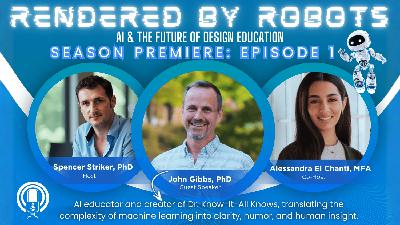
What happens when robots do the reading, and the designing? In Episode 1 of Rendered by Robots, host Dr. Spencer Striker and co-host Alessandra El Chanti (of Northwestern University | Qatar) talk with Dr. John Gibbs, Prof at UGA, CEO of Artimatic Inc, and influential YouTube futurist “Dr. Know-It-All”, about the future of teaching creativity in the age of AI. We explore: The assessment crisis in AI-assisted classrooms The “creative paradox” when machines mimic mastery What skills still matter for the next generation of designers 🌐 Learn more at spencerstriker.com 📺 Guest: YouTube @DrKnowitallKnows About the Series Rendered by Robots: AI & the Future of Design Edu explores how AI is transforming the way we teach, create, and imagine media production education. It’s a podcast for educators, creators, and students navigating the AI revolution with clear eyes and curious minds. 🔖 #AIEducation #DesignEducation #AIinMedia #CreativeAI #SpencerStriker #RenderedByRobots #JohnGibbs #DrKnowItAll #aicreativity #EdTech #GenerativeAI #mediaeducation Official Credits: Creator & Host — Spencer Striker, PhD | Co-Host — Alessandra El Chanti, MFA | Featured Guest — John Gibbs, PhD | Editor, Sound Design & Motion Graphics — Kyle Trueblood | Producer — Adam Sullivan | Camera & Sound — Yunting “Unity” Zhan, Qinbei “Bissy” Li | Project Manager — Dan Paloma | Special Thanks — Miriam Sherin (Associate Provost for Undergraduate Education); Alumnae Award for Curriculum Innovation (Northwestern Provost Office); Marwan M. Kraidy, PhD (NU-Q, Office of the Dean); S. Venus Jin, PhD (Artificial Intelligence and Media Lab | AIM-LAB); and Nisar Keshvani (NU-Q Communications and Public Affairs).
Comments