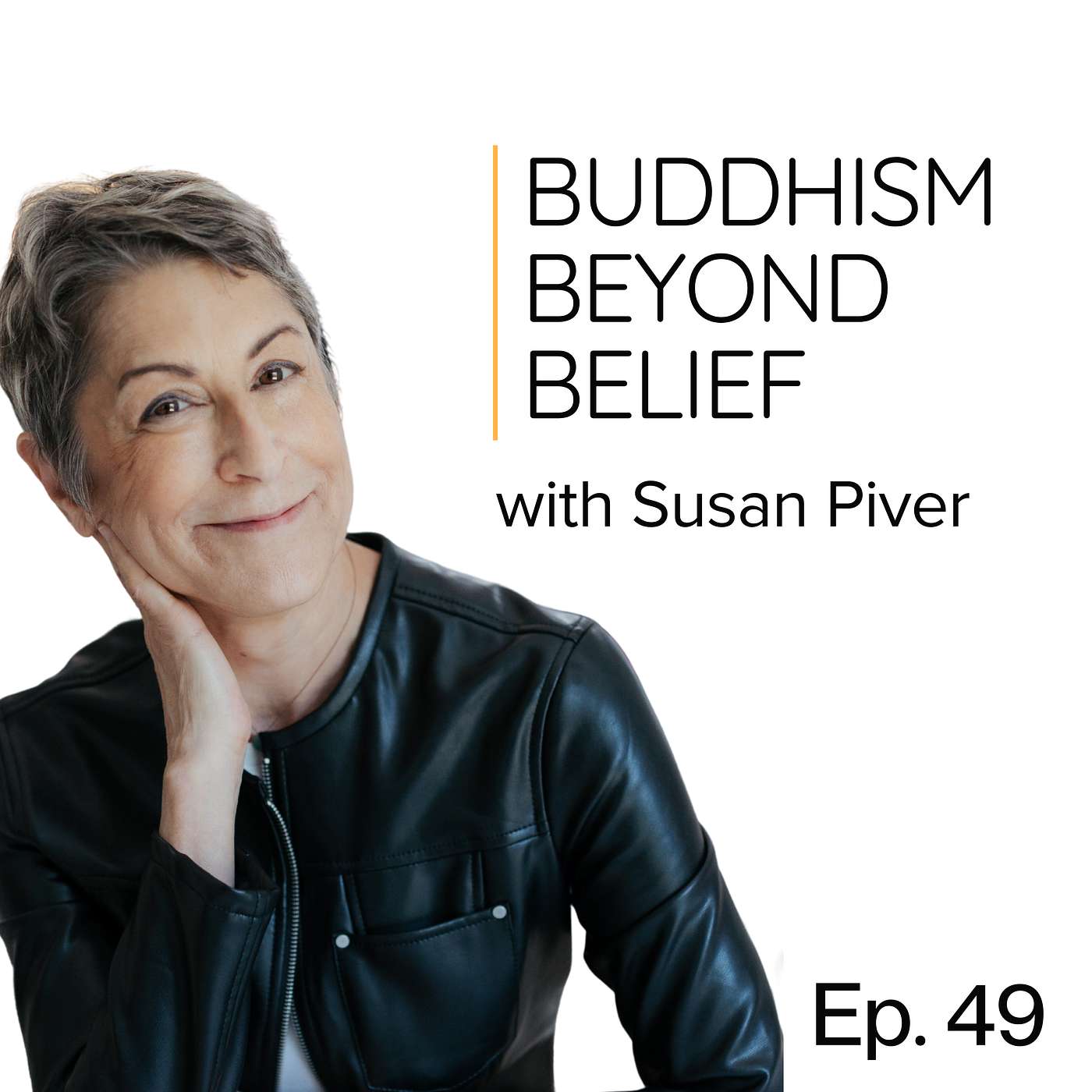
DiscoverBuddhism Beyond Belief with Susan Piver
Buddhism Beyond Belief with Susan Piver
Claim Ownership

Buddhism Beyond Belief with Susan Piver

Author: Susan Piver

Subscribed: 23Played: 438
Share

Description

Buddhism Beyond Belief is a podcast from Susan Piver, a 30 year student of Tibetan Buddhism and founder of the Open Heart Project, an online meditation community with close to 20000 members.

With Susan as a friend and guide, we will look at traditional teachings like the four noble truths and the six paramitas–but not from an academic standpoint. Rather, we will talk about how to make it all personal and relevant in everyday life. 

This podcast is not about Buddhist doctrine. It’s about how anyone can bring the profound wisdom of the dharma into their real life: at home, at work, and in love. The foundation for it all is meditation as a spiritual practice, not the latest life hack. Let’s go beyond the science and celebrity testimonials to discover the true power of meditation which is not based in self-improvement but in self-discovery. 

42 Episodes
Reverse
In this episode, I introduce the Four Karmas—pacifying, enriching, magnetizing, and destroying—as practical actions for meeting chaos, conflict, and confusion without losing clarity or heart. In this Buddhist framework, karma means action, not fate. These are not strategies for getting your way, but ways to protect the mind, deepen compassion, and interrupt ignorance in real time. I also explore the “ Māras ,” the obstacles that can distort each karma, and why wisdom sometimes needs to be gen...
As we move into a new year, how do we deepen our understanding: of ourselves, our relationships, and our spiritual practice? In this episode, we explore the three essential steps of learning in the Buddhist tradition: hearing, contemplating, and meditating. Highlights: Why the first step, hearing, is more than listening: it’s opening to what’s being offered without judgment or projection.How contemplating allows teachings to be tested, weighed, and integrated through experience rather than ac...
For the final episode of the year, I am sharing a short excerpt from a book I am writing called Inexplicable Magic: Meditation for Mystics. This work grows directly out of the heart of this podcast and its focus on how we actually live–not as monastic meditators, but as householders. In this excerpt, I reflect on the Buddha’s awakening and on meditation as it was originally understood, not as self-improvement or stress reduction, but as a path of waking up from delusion and helping others do ...
As we close out a year many of us are ready to leave behind, this episode reflects on what we might want to carry forward—and what we can gently let go of. I explore the Buddhist teaching of the brahmavihāras, or Four Immeasurables, as a way of giving our hearts a place to live that is honest, resilient, and humane. The Four Immeasurables—loving-kindness, compassion, sympathetic joy, and equanimity—are called “immeasurable” because they are not limited resources. They don’t require perfection...
In today’s episode, I’m doing something a little different. Lately I’ve been ending each show with what I called the Podcast After-Party—I share a song I love, along with a few words about why it matters to me. I never meant it to be anything formal. It was simply a delight, a way of sharing the music that has struck some essential chord in my life (no pun intended). I’m not a scholar of music, nor a musician, nor anything close. But I’ve been lucky. My early years in Austin, I worked at a li...
In this episode, I speak directly to a question I’m often asked: what can we do when anxiety or panic takes over? While many people associate Buddhism with calming the mind, the path is far more layered than stress reduction. Sometimes the most skillful response is not meditation but something far more ordinary and tender. I share my own experience with severe panic attacks—episodes triggered whenever I felt trapped, especially on airplanes. These attacks arrived suddenly and with enormous fo...
In this episode, I explore what I believe to be one of the most urgent Buddhist teachings for our current moment: Right Speech. Many people associate Buddhism with stress reduction or calming the mind, and while those benefits are real, the path is far more robust. It offers a way to wake up, to see clearly, and to live everyday life with more meaning, compassion, and courage. I also share a story that unfolded early this morning at Austin’s Barton Springs pool—an unexpected confrontation bet...
In this episode of Buddhism Beyond Belief, I explore how we can keep our meditation practice genuinely spiritual without making it complicated, performative, or “weird.” After more than thirty years of practice, I’ve learned that depth comes from sincerity, not technique. The simplest form of meditation—just sitting—can open profound dimensions of patience, clarity, confusion, authenticity, and genuine confidence. I share a story from a long retreat in the Colorado Rockies, where I unexpected...
In this episode of Buddhism Beyond Belief, I explore how we truly enter the path—not through esoteric or “advanced” practices, but by grounding ourselves in simple awareness and presence. After more than thirty years of practice and teaching, I’ve come to see that depth in meditation isn’t about complexity. It’s about sincerity—how fully we can find our breath, sit with our mind, and meet life as it is. I share what the Tibetan Buddhist tradition calls the seven characteristics of a Dharmic p...
In this episode, I offer a guided meditation and explore what it really means to not be trying—not striving to get somewhere, even in practice. Rather than exerting effort or resisting, meditation invites us to let go again and again and rest in a state of receptivity. We look at how love, insight, and creativity are not things we can get, but things we receive, and how meditation teaches us to rest in that open space. I also clarify common misconceptions about meditation—especially the idea ...
In this episode, I explore the sixth and final pāramitā—prajna, or wisdom—the one beyond words and concepts. True wisdom isn’t about knowledge but about recognizing the interdependence of all things and walking the Middle Way between eternalism (“something lasts forever”) and nihilism (“nothing matters”). We revisit the first five pāramitās—generosity, discipline, patience, exertion, and meditative absorption—and see how they lead us to the spacious awareness that meditation reveals. Mindfuln...
In this episode, I talk about something that’s been making me a little grumpy: how meditation is often reduced to stress relief. While that’s a real benefit, it misses the deeper purpose — waking up to reality itself in order to be of benefit to others. Meditation isn’t a self-improvement plan. It’s a path of presence — one that begins with self-awareness but is meant to open outward, toward others and the world. When practice stops at “me,” it can harden into self-absorption. When we remembe...
In this episode, I share why I wrote The Buddhist Enneagram and how two life-changing systems—the Buddha Dharma and the Enneagram—can support your journey toward wisdom, compassion, and self-understanding. Contrary to common views of Buddhism as merely stress relief, I explore its deeper invitation: to live more fully, to wake up, and to meet life with an open heart. The Enneagram, in turn, becomes a powerful upaya—a skillful means—for making compassion real. In this episode, I talk about: Wh...
In this episode, I share something very personal and deeply resonant for the times we’re living in: how we vacillate between hope and fear, and how the Buddhist path invites us to wake up beyond either one. Also, drugs. Just gotta say that right up front. We often think of mindfulness or meditation practice as a way to feel better, to reduce stress or calm down—and while those benefits are real and important, this path is so much more. It’s about learning how to live fully awake, moment...
Thinking about working with a meditation teacher? It’s a powerful step—but how do you choose the right one? In this episode, I offer a framework based on the three Yanas (vehicles) of Buddhist practice. Each path reflects a different view of meditation—and can help you clarify the kind of guidance you need. Three Yanas, Three Teaching Styles 1. Hinayana – The Foundational Path Best if you're starting out and need structure. Look for a teacher who emphasizes: Simplicity and disciplineEthica...
In this episode, I explore the fifth of the six paramitas, or transcendent actions of the bodhisattva path: Meditative Absorption—sometimes just called meditation. But this isn’t your typical “sit on the cushion and follow your breath” kind of conversation. We go deeper into what it means to live meditation—to carry the practice off the cushion and into our everyday experience. Highlights from this episode: Why the Buddhist path is so much more than stress relief Meditation isn’t just a...
I'm away this week, so we're revisiting the very first episode of the podcast. Originally titled “On Meditation: An Uncommon View,” it now becomes episode 25. Meditation is often framed as a self-help tool—to reduce stress, manage pain, improve sleep, or boost performance. And yes, science supports all of that. But the original intention, as taught by the Buddha, was something much deeper: a path to wake up from suffering, discover wisdom, cultivate compassion, and live with courage. This epi...
In this episode, I dive into the fourth of the six paramitas, or transcendent actions, from the classical Buddhist teachings: exertion. If you’ve been following along with our exploration of the first three—generosity, discipline, and patience—you’ll know these aren’t lofty ideals but practical ways to bring dharma off the cushion and into real life. Here, we go deep into what exertion really means. Spoiler: it’s not about trying harder. I talk about what makes exertion so powerful, what gets...
In this episode, I move on in our exploration of the Six Paramitas (“transcendent actions”) to the third paramita: patience. There is a common misconception that patience means tolerating bad behavior or remaining silent in the face of harm. Instead, patience is a profound and active spiritual practice that can help us transcend aggression and stay present with reality as it unfolds. Drawing on classical Buddhist teachings and a personal story about losing my temper in traffic, I talk a...
This week we continue our exploration of the Six Paramitas (or Transcendent Actions)—the Buddhist teachings on how to go beyond suffering and confusion into wakefulness, compassion, and liberation. I talked about the first paramita, Generosity, in a previous episode. Now we look at the second: Discipline. This isn’t the harsh, rigid discipline of making yourself do things you don’t want to do. Here, discipline is a joyful, courageous return to presence—a practice of continuously coming back t...
loading
Comments