


 Claim Ownership
Workhorse - RAAF C-130s
Subscribed: 7Played: 116
Subscribe

© 2026 Workhorse - RAAF C-130s
Description
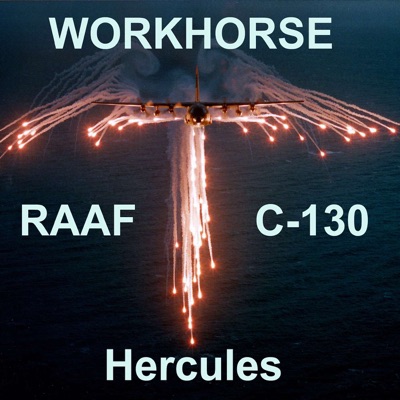
"Workhorse" is a podcast about Royal Australian Air Force C-130 Hercules aircraft from their earliest history through to modern times. The series is based on the soon to be released book “Air Mobility Workhorse”, which will be available from Big Sky Publishing.
Topics include:
- Operations from around the globe, including all four corners of the planet, from 1959 to now
- Aircraft technical discussions
- Training
- Roles (Search and Rescue, Air Logistics, Airborne Operations, Special Operations, Humanitarian Assistance/Disaster Relief, Surveillance, Non-combatant Evacuation, Aeromedical Evacuation and Firefighting)
- Maintenance and modifications
- Logistics
- And, of course, the people that made it all possible.
62 Episodes
Reverse
Exercise Cope Thunder was run in the Philippines, providing combat air mobility training for anyone lucky enough to participate. Greg Scholes was a pilot with 36 Squadron and relates his experience on Cope Thunder, as well as details about his career on C-130Hs, VIP operations, and his RAAF career.
Detachment 'S' was a loosely formed task force that conducted air transport operations in Vietnam during, circa April 1975. It was primarily a humanitarian assistance mission, providing food to refugees on the island of Phu Quoc, but it also conducted evacuations from Phan Rang, Operation Babylift, and evacuated embassy officials from Saigon. Ian 'Scooter' Scott was involved in some of these missions, including an Operation Babylift sortie. In this episode Scooter details his exploits as part...
Air Force safety systems evolved through the 1990s-present day. This journey included major shifts in policy that led the Royal Australian Air Force (RAAF) to the current airworthiness system that oversights C-130 operations. Dave 'DT' Turner was a C-130H navigator and held many safety roles during his long career in the Royal Australian Navy and RAAF. In this episode, DT recounts the pros and cons of the various safety policies, along with touching on operations he flew during his career.
Shark 02 crashed on the island of Nias in 2005, resulting in 9 fatalities. Scott Olsen was a C-130H and J loadmaster, and in this episode, he recounts the repatriation mission that ensued, along with a rundown of his career.
Nicknames are rife in Australian culture; particularly in the Royal Australian Air Force. This episode of Workhorse dives into nicknames used by the RAAF C-130 community (aircrew, maintenance and support staff). Tony Hall (Hally, or 'Tony Hall from Australia') and Graham Johnson (Johno 1, or Kramer) join me (K9) in presenting the top 100 nicknames and spinning tales about the nicknames and how people got them. WARNING: Many nicknames came from an era when political correctness was not a...
Royal Australian Air Force C-130s participated in courses run by the US Advanced Airlift Tactical Training Center (AATTC) to hone their skills in combat environments. The course developed skills in airdrop, low-level flying, and threat avoidance. Michael 'Gus' Garside captained a 36SQN C-130H crew on this course in June 1998, and his crew experienced a double-engine failure during one of the sorties at AATTC. In this episode of Workhorse, Gus recounts the flight, along with highlights from hi...
Ash Pendergast had a long association with the Royal Australian Air Force's 36 Squadron where he was a Qualified Flying Instructor (QFI); took part in original NVG trials; and was a Flight Commander. Ash recalls these roles and his RAAF career in this episode.
In mid-March 1997, the yacht Queen Charlotte was being skippered from New Zealand to Japan by Australian Bob Cornell, with four passengers. On 19 March, the yacht was located approximately 600 nm east of Cairns when it ran into Cyclone Justin and its emergency position-indicating radio beacon (EPIRB) was activated. In response, Ben Charters and his crew from 37 Squadron flew A97-181 on a search-and-rescue mission. This episode details that mission and the consequent engine fire that caused th...
This episode features a wide-ranging discussion of the flight engineer category and its place on the C-130 Hercules. Tony Hall also covers his operational C-130 experience, along with his transition onto Caribous and then as a Loadmaster on C-130Js. The discussion ranges into: RAAF B-707 operations based in Kyrgyzstan (where Tony was an Operations Officer)Impact of the Safety system on Flight Engineer authorisationsThe latter years of C-130H operations in the RAAFRAAF consideration of having ...
Gav Nicholson recounts his involvement with systems integration on RAAF C-130Hs during the late 1990s to the late 2000s, including electronic warfare self-protection, the FMS-800 flight management system, and other modifications of that era. Also discussed are PNG operations, Operations Falconer (Iraq 2003), Shaddock (PNG), Catalyst (Iraq, as C-130J Detachment Commander) and a mission on Spitfire (East Timor) during which his crew flew an evacuation with 180 people onboard a C-130H.
Royal Australian Air Force C-130s airdrop parachutists and equipment to force project Australian military capabilities. C-130s flew in formation as a tactic to concentrate Army parachutists on a target area as quickly as possible (thereby minimising the risk to the paratroopers and aircraft). In this episode of 'Workhorse', Andrew "Stretch" Elliott discusses the many factors that formation lead pilots considered when leading C-130s to a formation airdrop. He also covers his experiences...
Graham 'Johno' 'Johno1' 'Kramer' Johnson flew C-130Hs on a variety of operations from 1989 to 1999, including Operations Solace (Somalia 1993), Immune (Pilot Strike 1989) and Ples Drei (PNG famine 1998), all of which he discusses in this episode. Johno also discusses the differences between pushing crew training to the boundaries of aircraft limits and when that transitions into unauthorised flying.
The Royal Australian Air Force's C-130J fleet was acquired in 1999, but it was not fitted with electronic warfare self-protection systems. When C-130Hs deployed to the Middle East in early 2003, 37 Squadron had only just begun training its C-130J crews in tactical procedures. Thus when Middle East operations were extended into 2004, 36 Squadron's C-130Hs remained in the Middle East on an extended deployment because there wasn't a replacement force. This placed great pressure on 36 Squadron's ...
Reports arising in 1996 from Australian-flagged fishing vessels indicated the presence of dozens of Illegal, Unreported and Unregulated fishing vessels in the Heard Island and McDonald Islands Exclusive Economic Zone. In response, the Australian Fisheries Management Authority (AFMA) sought an enforcement action and requested Defence assistance with search, reconnaissance and apprehension. The first of these ADF missions took place under the name Operation Dirk, and it was enabled by th...
The FMS-800 flight management system was installed on RAAF C-130Hs in 1999 under Project AIR 5195. The FMS-800 delivered a range of enhanced capabilities for C-130Hs making them even more ideally suited for the Airborne Operations and Special Operations support roles. These capabilities included GPS precision navigation, airdrop navigation, receiver autonomous-integrity monitoring (RAIM), jamming protection, and it was integrated with the Litton 92 inertial navigation system, APN-241 radar an...
On 26 December 2004, an earthquake measuring 9.2 on the Richter scale struck north of Simeulue Island in the Indian Ocean. The earthquake lifted an estimated 30 cubic kilometres of water which radiated from the epicentre devasting coastal communities around the Indian Ocean. Banda Aceh was hardest hit, and the RAAF responded immediately. This episode features 36 Squadron pilot Charlie Siedentopf who flew one of the first two RAAF C-130s into Banda Aceh. He recounts the devastation, suffering...
WARNING: This episode discusses a graphic account of the 2002 Bali bombing and related PTSD issues. On 12 Oct 2002 two bombs exploded in the Kuta district, Bali, Indonesia, destroying two popular night clubs – Paddy’s Irish Bar and the nearby Sari Club – showering the patrons with shrapnel and causing fierce fires at both sites. More than 500 people were either killed or injured in the blasts; 202 died from their injuries (88 were Australian). RAAF C-130s were central to Australia's response...
Royal Australian Air Force C-130s arrived in Doha 11 February 2003 to support Australian, US and Coalition efforts as part of the US-led invasion of Iraq. In this episode of 'Workhorse', Anthony 'Locky' Lock describes his role as a Liaison Officer supporting Australian Special Forces air mobility requirements during the early stages of Operation Falconer and his deployment on Operation Catalyst (mid-2004). In particular, he details his experience as the C-130H aircraft captain dur...
In early January 2002, Rob 'Soky' Sokel captained the first RAAF C-130 mission to Afghanistan - under Operation Catalyst. In this episode you can hear Soky describing this epic mission with all its challenges: Scrounging for equipmentBeing hit by lightningUnable to pay contracted support agencies (loading and fuel)Making a wrong turn and being confronted by armed guardsRunning late for their slot time into the area of operationsA leaking fuel tankA bombed out runwayFailing communications equi...
On 2 July 1997 civil war erupted in Cambodia. Nations rushed to evacuate non-combatants. This episode details the Australian evacuation which was conducted by 36 Squadron, under the name Operation Vista. This marked the first use of C-130H electronic warfare equipment on an operation. The discussion with Dave Steel and Jon Kain focuses on the last flight of the operation which they flew in a thunderstorm using night vision goggles.

Comments

Download from Google Play

Download from App Store
 United States