


 Claim Ownership
The Informed Investor
Subscribed: 4Played: 41
Subscribe

© 2025
Description
Dimensional thought leaders break down the financial headlines to help you separate the news from the noise. Dimensional is an asset management firm with deep connections to leading academics and Nobel laureates in economics that has been applying financial science to real-world investing since 1981.
-
None of the content on this site is directed at any particular jurisdiction or investor located outside of the United States. All videos and other content on the site are protected by US and worldwide copyright and trademark laws and treaty provisions. © 2025 Dimensional Fund Advisors LP
-
None of the content on this site is directed at any particular jurisdiction or investor located outside of the United States. All videos and other content on the site are protected by US and worldwide copyright and trademark laws and treaty provisions. © 2025 Dimensional Fund Advisors LP
40 Episodes
Reverse

Episode 40: Does everyone need a financial advisor? Not necessarily. But for many investors, having a coach makes sense. Think about your financial needs beyond your investment portfolio. Are you in good shape when it comes to insurance, taxes, saving for college, retirement, and estate planning? How would you know? The uncomfortable truth is that there's a lot more to your financial life than the ups and downs of the stock market. That's where an unbiased investment professional, sitting on your side of the table, can help. An advisor can assess every aspect of your finances and create a holistic wealth management plan that can change as life happens, in the short and long run. Yes, the advisor will charge for these services, so investors would pay more under this scenario than if they were to go it alone. But if an advisor can help you capture more of the gains available in the capital markets while tailoring your portfolio to your needs and goals and helping you develop a comprehensive financial plan, odds are you may come out ahead. Not every investment professional who offers financial advice will suit you. It's important to find one who can speak with you in depth about your hopes, dreams, and concerns—and be accessible when you need to talk. In Episode 40 of The Informed Investor, Dimensional Head of Client Communications Jake DeKinder talks with Rob Morrison, Chief Experience Officer at Savant Wealth Management, about the evolution of financial advice and the key role coaching can play in your investment journey. LINKS FROM TODAY'S EPISODE: Subscribe to the Stay Calm Investing Newsletter https://www.staycalminvesting.com/newsletter The Informed Investor: Feedback Survey https://www.dimensional.com/us-en/informed-investor-survey "The Informed Investor" on YouTube The Informed Investor - YouTube Dimensional Fund Advisors Shorts on YouTube https://www.youtube.com/@dimensionalfundadvisors/shorts Jake DeKinder on LinkedIn https://www.linkedin.com/in/jake-d-4105b98/ Rob Morrison on LinkedIn https://www.linkedin.com/in/robert-morrison-73766211/ Learn more at https://www.dimensional.com/

Episode 39: What's it like to spend 35 years at the center of Wall Street—and never want to leave? In this compelling conversation, longtime CNBC markets correspondent Bob Pisani reflects on a career that began almost by accident and evolved into a front-row seat to some of the most transformative moments in financial history. From his early days as a real estate reporter, shaped by teaching at Wharton and co-authoring a foundational industry book, to becoming a trusted voice on the floor of the New York Stock Exchange, Bob shares how a mix of timing, curiosity, and communication skills shaped his journey. He recounts CNBC's unlikely rise in the 1990s, fueled by the explosion of the internet, the debut of online trading, and the network's unique position as the "stock market channel" during the dot-com boom. Bob reflects on what it felt like to go from having virtually no audience to being part of one of the hottest platforms in television—and why those years were the most exciting of his life. Beyond the stories, Bob dives into the principles that guided his reporting and investing philosophy. He explains the importance of understanding your audience and simplifying complex financial concepts. And he shares lessons from influential figures like Jack Bogle and insights from behavioral economics that reshaped how he thinks about markets and investing. Bob also discusses his deep experience covering ETFs, including why they resonate with investors and his concerns about their growing complexity. In Episode 39 of The Informed Investor with Dimensional's Mark Gochnour, Head of Global Client Services, Bob Pisani shares unforgettable stories from the floor of the NYSE, lessons from decades of market coverage, and the mindset that helped him thrive in one of the most demanding environments in media—offering valuable insights for investors, communicators, and anyone curious about what really drives success on Wall Street. LINKS FROM TODAY'S EPISODE: The Informed Investor: Feedback Survey https://www.dimensional.com/us-en/informed-investor-survey "The Informed Investor" on YouTube https://www.youtube.com/playlist?list=PLCyJr6FFig-h1mA7rVP7Mbk0irFw2wA90 Dimensional Fund Advisors Shorts on YouTube https://www.youtube.com/@dimensionalfundadvisors/shorts Mark Gochnour on LinkedIn https://www.linkedin.com/in/mark-gochnour-9a23598a Bob Pisani on LinkedIn https://www.linkedin.com/in/bobpisani Learn more at https://www.dimensional.com/
Episode 38: What if there are already too many exchange-traded funds—and that's actually a good thing? Dive into the ever-evolving world of ETFs with industry expert Todd Rosenbluth to unpack the explosive growth, innovation, and complexity shaping today's ETF landscape. Todd offers a front-row perspective on how the industry has evolved from simple index-tracking funds to a universe of over 5,000 products—and counting. With decades of experience and deep roots in ETF research and education, Todd shares his perspective on where the ETF industry stands today—and where it's headed next. He explores key trends, including the impact of the ETF Rule of 2019, which opened the door for a wave of actively managed ETFs. Todd explains why this surge in new products isn't necessarily a bad thing—but it does put more responsibility on investors and advisors to truly understand what they're buying. From thematic strategies to leveraged and options-based ETFs, this conversation explores the growing complexity within the market. Todd emphasizes that while low cost, tax efficiency, and liquidity remain core advantages, they shouldn't be the only factors guiding investment decisions. "Cheaper" doesn't always mean "better," and knowing the use case behind each ETF is critical. In Episode 38 of The Informed Investor, Dimensional's Mark Gochnour, Head of Global Client Services, speaks to Todd about all things ETF, including the future of ETF share classes, the ongoing shift from mutual funds to ETFs, and whether retirement accounts like 401(k)s will eventually embrace ETFs more fully. Plus, Todd shares why he believes the ETF industry's strong reputation remains intact—even as more sophisticated (and sometimes riskier) products enter the market. LINKS FROM TODAY'S EPISODE: VettaFi: https://www.vettafi.com ETF Trends: https://www.etftrends.com ETF Database: https://etfdb.com The Informed Investor: Feedback Survey https://www.dimensional.com/us-en/informed-investor-survey "The Informed Investor" on YouTube: https://www.youtube.com/playlist?list=PLCyJr6FFig-h1mA7rVP7Mbk0irFw2wA90 Dimensional Fund Advisors Shorts on YouTube https://www.youtube.com/@dimensionalfundadvisors/shorts Mark Gochnour on LinkedIn https://www.linkedin.com/in/mark-gochnour-9a23598a/ Todd Rosenbluth on LinkedIn https://www.linkedin.com/in/todd-rosenbluth-89120a/ Learn more at https://www.dimensional.com/
Episode 37: What's the biggest risk in investing? Longtime financial advisor Cameron Passmore says it's not AI or geopolitical turmoil, and it's not oil prices or inflation. It's you! Passmore, one of the original hosts of the popular Rational Reminder podcast, believes bad behavior by investors causes big trouble. Especially when stress rises due to turmoil in the market or around the globe. Passmore is the CEO of an investment advisory firm based in Canada. On the podcast, he has interviewed Nobel laureates, explored complex investment strategies, analyzed stock market history, and pondered simple but profound questions like, do you need a financial advisor? If you're itching to sell as soon as the stock market takes a tumble, he thinks your behavior is a potential problem. If you're eager to pick the next big winner, ditto. Compare those strategies to the simple concept of "buy, hold, and rebalance." Sounds boring. But if you can't stick to that approach, Passmore says, you may have difficulty reaching your goals. In Episode 37 of The Informed Investor podcast, Dimensional's Mark Gochnour, Head of Global Client Services, speaks with Passmore about his biggest takeaways from the Rational Reminder podcast and the homespun advice that every investor needs to hear. LINKS FROM TODAY'S EPISODE: The Informed Investor: Feedback Survey https://www.dimensional.com/us-en/informed-investor-survey "The Informed Investor" on YouTube https://www.youtube.com/playlist?list=PLCyJr6FFig-h1mA7rVP7Mbk0irFw2wA90 Dimensional Fund Advisors Shorts on YouTube https://www.youtube.com/@dimensionalfundadvisors/shorts Mark Gochnour on LinkedIn https://www.linkedin.com/in/mark-gochnour-9a23598a/ Cameron Passmore on LinkedIn https://www.linkedin.com/in/cameronpassmore/?originalSubdomain=ca Ben Felix on LinkedIn https://www.linkedin.com/in/benjaminwfelix/?originalSubdomain=ca Learn more at https://www.dimensional.com/

Episode 36: Why all the hubbub about private credit? This unusual investment vehicle, which accounts for about 2% of the global fixed income market, seems to be all over the financial headlines. Some reports say investors are cashing out in droves. Others claim lending to troubled software firms catalyzed a meltdown that's chilling the entire private credit market. Then there are the optimists who argue all the turmoil will lead to enticing opportunities. Investors might have heard that private credit offers untapped potential for higher returns, so the latest developments may be perplexing. In simple terms, private credit consists of loans by nonbank lenders to small and midsize firms that may have trouble obtaining traditional bank loans. The money for the loans comes from investors who are typically seeking yields higher than what's available in the traditional fixed income market. Everyday investors can access this private market through publicly traded business development companies (BDCs), which make these loans and are then required to distribute at least 90% of their taxable income to shareholders. While outsize returns on offer by BDCs make them attractive, the risks are significant and shouldn't be overlooked. BDCs outperformed the conventional bond market in the past five and 10 years. Yet in the past 12 months through February, BDCs tumbled nearly 20% even while the bond market posted positive returns. (S&P data © 2026 S&P Dow Jones Indices LLC, a division of S&P Global. All rights reserved; Bloomberg data from Bloomberg.) Costs are another concern. The combined management and incentive fees for public BDCs may exceed 5% annually. (Incentive fees are performance-based charges payable if managers exceed a specific return target.) Compare those fees to the average 0.54% net expense ratio for the US Intermediate Core Bond Fund category, based on Morningstar data. In Episode 36 of The Informed Investor, Dimensional's Mark Gochnour, Head of Global Client Services, Kevin Green, PhD, Head of Investment Solutions Analytics, and Jake DeKinder, Head of Client Communications, assess the numerous tradeoffs facing investors in private credit and highlight those that should garner the most attention. LINKS FROM TODAY'S EPISODE: The Informed Investor: Feedback Survey https://www.dimensional.com/us-en/informed-investor-survey Dimensional Perspectives: "Hiding in Plain Sight: Private Asset Exposure Through Public Equities" https://www.dimensional.com/us-en/insights/hiding-in-plain-sight-private-asset-exposure-through-public-equities Dimensional Perspectives: "A Deep Dive into Private Fund Performance" https://www.dimensional.com/us-en/insights/a-deep-dive-into-private-fund-performance The Informed Investor, Episode 11: "Do Private Markets Deliver an Edge?" https://www.youtube.com/watch?v=TUGb1LLeB1A&list=PLCyJr6FFig-h1mA7rVP7Mbk0irFw2wA90&index=26&pp=iAQB "The Informed Investor" on YouTube https://www.youtube.com/playlist?list=PLCyJr6FFig-h1mA7rVP7Mbk0irFw2wA90 Mark Gochnour on LinkedIn https://www.linkedin.com/in/mark-gochnour-9a23598a/ Kevin Green on LinkedIn https://www.linkedin.com/in/kevin-green-505b15355/ Jake DeKinder on LinkedIn https://www.linkedin.com/in/jake-d-4105b98/ Learn more at https://www.dimensional.com/

Episode 35: What are the best reasons to invest in bonds? Maybe you're looking to dampen the volatility of your portfolio or address future spending needs in a concrete way. Maybe you want to reduce the impact of inflation or taxes. Bonds, also known as fixed income, can be used to meet a variety of needs. But different bond categories may be better or worse for accomplishing your goals. A crucial point that some investors might not understand: Putting bonds to work in your portfolio can get complex in part because not all of them behave the same way. If you have short-term spending needs, extremely short-term bonds like Treasury bills may be helpful. (Cash is obviously an alternative.) But longer-term bonds may be more useful as you plan for longer-term saving and spending needs. The credit quality of bonds makes a difference, too. Those issued by the US government and successful businesses are generally considered safer, and typically have lower interest rates. The opposite is true for bonds with lower credit quality. Your goals may steer you one way or the other. Some types of bonds, known as Treasury Inflation-Protected Securities (TIPS), can help manage the risks of inflation. That's important because an average annual inflation rate of just 2.5% over 30 years reduces your purchasing power by half. Yet TIPS aren't risk-free, another characteristic that may confuse some investors. In Episode 35 of The Informed Investor, Dimensional's Mark Gochnour, Head of Global Client Services, Wes Crill, PhD, Senior Client Solutions Director, and Jake DeKinder, Head of Client Communications, identify five reasons to consider investing in bonds and analyze what types of fixed income should (and shouldn't) be used to meet your goals. LINKS FROM TODAY'S EPISODE: The Informed Investor: Feedback Survey https://www.dimensional.com/us-en/informed-investor-survey Dimensional Perspectives: "Chutes and Bond Ladders" https://www.dimensional.com/us-en/insights/chutes-and-bond-ladders Dimensional Perspectives: "Sizing Up the Bond Market" https://www.dimensional.com/us-en/insights/sizing-up-the-bond-market "The Informed Investor" on YouTube www.youtube.com/playlist?list=PLCyJr6FFig-h1mA7rVP7Mbk0irFw2wA90 Dimensional Fund Advisors Shorts on YouTube https://www.youtube.com/@dimensionalfundadvisors/shorts Mark Gochnour on LinkedIn https://www.linkedin.com/in/mark-gochnour-9a23598a/ Wes Crill on LinkedIn https://www.linkedin.com/in/wes-crill-77a49417/ Jake DeKinder on LinkedIn https://www.linkedin.com/in/jake-d-4105b98/ Learn more at https://www.dimensional.com/
Episode 34: If you believe your portfolio is too concentrated in big-name companies, why not buy the same amount of every stock in a broad-market index? That's the basic philosophy behind equal-weighted strategies. Instead of letting market capitalization determine weights in your portfolio, just keep the proportions of your holdings the same by buying and selling as often as needed. This approach means you'll prevent a handful of large cap companies from dominating your portfolio. But here's the thing. The name—equal-weighted—belies what's under the hood. Consider the constituents of the S&P 500, a widely followed index of large cap and mid cap companies across the growth/value spectrum. Since the index is weighted by market cap, stocks with large market caps impact performance much more than mid caps. In this structure, the Magnificent 7 (Alphabet, Amazon, Apple, Meta, Microsoft, NVIDIA, and Tesla) regularly move the needle on in the index's return, but mid caps don't because of their much smaller market cap. Recent data show that the top 10 stocks in the S&P 500 account for roughly 38% of its market cap, while the remaining 490 stocks account for 62%. Now imagine that every company regardless of its past performance or expected return accounts for just 2% of the index's market cap. This means a massive overweight for mid caps compared to their typical weights. Is that your goal? After underperforming the S&P 500 in recent years, the so-called S&P 500 Equal Weight Index more than doubled the return of its counterpart in January 2026. (S&P data © 2026 S&P Dow Jones Indices LLC, a division of S&P Global. All rights reserved.) Now, some investors are no doubt wondering whether this turn of events will continue—and whether they should adjust accordingly. In Episode 34 of The Informed Investor, Dimensional's Mark Gochnour, Head of Global Client Services, Wes Crill, PhD, Senior Client Solutions Director, and Jake DeKinder, Head of Client Communications, interrogate the trendy rationales behind equal-weighted strategies and discuss alternative ways to tilt portfolios to target higher returns. LINKS FROM TODAY'S EPISODE: The Informed Investor: Feedback Survey https://www.dimensional.com/us-en/informed-investor-survey Above the Fray, Dimensional's Weekly Newsletter Subscribe: https://www.dimensional.com/us-en/subscribe-atf "The Informed Investor" on YouTube www.youtube.com/playlist?list=PLCyJr6FFig-h1mA7rVP7Mbk0irFw2wA90 Dimensional Fund Advisors Shorts on YouTube https://www.youtube.com/@dimensionalfundadvisors/shorts Mark Gochnour on LinkedIn https://www.linkedin.com/in/mark-gochnour-9a23598a/ Wes Crill on LinkedIn https://www.linkedin.com/in/wes-crill-77a49417/ Jake DeKinder on LinkedIn https://www.linkedin.com/in/jake-d-4105b98/ Learn more at https://www.dimensional.com/

Episode 33: What if the biggest threat to your investment returns isn't picking the wrong stocks—but how you trade them? Many investors are drawn in by "free trading" and low expense ratios. But while your ETF or stock might be cheap—your trade might not be. Every time you go to market, you face explicit costs (like commissions and exchange fees) and implicit costs (like bid-ask spreads, market impact, and timing risk). Those costs don't disappear—they come directly out of the return you take home. A major theme is clarity around your top priorities: Price, Quantity, and Time (PQT). In trading, you can prioritize two—but rarely all three. If you demand immediate execution and a specific security, you'll likely sacrifice price. If you want the best price, you may need flexibility on timing or position size. Understanding what matters most in each trade—and in your overall strategy—can dramatically improve outcomes. Then there is the relationship between turnover and performance. Data consistently shows that higher portfolio turnover often leads to lower outperformance. More buying and selling means more friction. Even index funds can't avoid turnover entirely, but minimizing unnecessary trading reduces the hurdle your returns must overcome. In Episode 33 of The Informed Investor, Dimensional's Mark Gochnour, Head of Global Client Services, Jake DeKinder, Head of Client Communications, and Rob Harvey, Co-Head of Product Specialists, go beyond the mantra of "buy low, sell high" to show how trading costs can shape your long-term returns. They address common concerns about high-frequency trading, flash crashes, and market volatility. While markets have evolved to be more liquid and efficient—they note the importance of flexibility and discipline. Sometimes the best trade is the one you don't make. LINKS FROM TODAY'S EPISODE: The Informed Investor: Feedback Survey https://www.dimensional.com/us-en/informed-investor-survey "The Informed Investor" on YouTube [update with live link] Dimensional Fund Advisors Shorts on YouTube https://www.youtube.com/@dimensionalfundadvisors/shorts Mark Gochnour on LinkedIn https://www.linkedin.com/in/mark-gochnour-9a23598a/ Jake DeKinder on LinkedIn https://www.linkedin.com/in/jake-d-4105b98/ Rob Harvey on LinkedIn https://www.linkedin.com/in/robkharvey/ Learn more at https://www.dimensional.com/

Episode 32: Can you define BRICS or BATMMAAN? If not, maybe you've got FOMO? OK, we're talking investing acronyms. For the record: BRICS is a term coined in 2001 to represent investment opportunities in Brazil, Russia, India, and China. (South Africa was added in 2011.) BATMMAAN stands for the following tech companies: Broadcom, Apple, Tesla, Meta, Microsoft, Amazon, Alphabet, and NVIDIA. FOMO (fear of missing out) is what you get when you're worried (unnecessarily?) that other people know, have, or do something you don't. In the investment world, people throw around acronyms regularly. From ETFs (exchange-traded funds) and NFTs (non-fungible tokens) to ESG (environmental, social, governance) and SPACs (special purpose acquisition companies), there seems to be a trendy acronym for everything. You might feel smart if you know the lingo or feel the opposite if you don't. Either way, what really matters if whether acronyms can help you invest, and on that score, the evidence isn't all that convincing. Looking at the BRICS from 2001 to 2025, only India outperformed a broad emerging markets index, and Russia literally became uninvestable. (MSCI data © MSCI 2026, all rights reserved.) Tech stock jargon—think FAANG and BATMMAAN—has proven more rewarding due to the tendency for strong market performance to be concentrated in a subset of companies. But that's also a cautionary tale. Big firms with winning stocks don't necessarily keep winning. https://www.dimensional.com/us-en/insights/large-and-in-charge-why-to-think-twice-before-chasing-only-big-stocks. Investors with concentrated portfolios may actually miss out on the very stocks that deliver the best of what the market has to offer. FWIW, YOLO (you only live once) is a fun acronym used as a justification for doing something less than cautious (because of expense, danger, risk of seeming foolish, etc.), but it's not a sound investment philosophy. In Episode 32 of "The Informed Investor," Dimensional's Mark Gochnour, Head of Global Client Services, Wes Crill, PhD, Senior Client Solutions Director, and Jake DeKinder, Head of Client Communications, explain investing acronyms that investors may want to know—and several they might consider ignoring. LINKS FROM TODAY'S EPISODE: The Informed Investor: Feedback Survey https://www.dimensional.com/us-en/informed-investor-survey The Informed Investor on YouTube https://www.youtube.com/playlist?list=PLCyJr6FFig-h1mA7rVP7Mbk0irFw2wA90 Dimensional Fund Advisors Shorts on YouTube https://www.youtube.com/@dimensionalfundadvisors/shorts Mark Gochnour on LinkedIn https://www.linkedin.com/in/mark-gochnour-9a23598a/ Wes Crill on LinkedIn https://www.linkedin.com/in/wes-crill-77a49417/ Jake DeKinder on LinkedIn https://www.linkedin.com/in/jake-d-4105b98/ Learn more at https://www.dimensional.com/
Episode 31: You need to invest in emerging markets if you want a globally diversified portfolio, right? That may seem like an obvious choice considering emerging markets account for roughly 12% of the world's equity market capitalization. But it's easy to understand why many investors might say no to emerging markets. Uneven returns tell the story. From 2015 through 2024, the broad US stock market gained an annualized +12.6% while international developed markets added +7.7%. Emerging markets? A measly +3.6%. Then came 2025. As concerns mounted about the seemingly high relative prices of US stocks and the decline of the US dollar against other currencies, emerging markets returned +31.4%, almost doubling the return of the US market. Any investor who had shunned emerging markets probably regretted their lack of wanderlust. This evidence suggests that a longer-term lens is critical when evaluating opportunities in emerging markets. A broad view is helpful, too. Emerging markets comprise more than 20 countries, including large economies like Brazil, China, and South Korea as well as tiny ones like Colombia and Indonesia. But predicting which ones will deliver outsize (or undersize) returns is impossible. In 2025, Colombia was the top gainer at +112% while Indonesia, at –2.8%, brought up the rear. In 2024, it was Taiwan (+34.4%) and Egypt (–31.2%). And the leaders and laggards were also different in 2023, 2022, and 2021. Based on the difference between the highest and lowest average returns in emerging markets from 2005 through 2025, it's fair to say they are more volatile than developed markets. Which may scare some investors. But ignoring emerging markets means avoiding opportunities to offset weak performance in one market with stronger returns elsewhere. In Episode 31 of The Informed Investor, Dimensional's Mark Gochnour, Head of Global Client Services, Rob Harvey, Co-Head of Product Specialists, and Jake DeKinder, Head of Client Communications, survey the emerging markets landscape and lay out what investors should look for through their viewfinders. Past performance is not a guarantee of future results. Indices are not available for direct investment; therefore, their performance does not reflect the expenses associated with the management of an actual portfolio. Risks include loss of principal and fluctuating value. Diversification does not eliminate the risk of market loss. Sources: Frank Russell Company is the source and owner of the trademarks, service marks, and copyrights related to the Russell Indexes; MSCI data © MSCI 2025, all rights reserved. LINKS FROM TODAY'S EPISODE: The Informed Investor: Feedback Survey https://www.dimensional.com/us-en/informed-investor-survey The Informed Investor on YouTube https://youtube.com/playlist?list=PLCyJr6FFig-h1mA7rVP7Mbk0irFw2wA90&si=0mJiRGEkZqYosieU The Informed Investor, Episode 2, "Should You Invest Outside the US" https://www.youtube.com/watch?v=gmiL0GM01bg&list=PLCyJr6FFig-h1mA7rVP7Mbk0irFw2wA90&index=30&pp=iAQB Dimensional Fund Advisors Shorts on YouTube https://www.youtube.com/@dimensionalfundadvisors/shorts Mark Gochnour on LinkedIn https://www.linkedin.com/in/mark-gochnour-9a23598a/ Rob Harvey on LinkedIn https://www.linkedin.com/in/robkharvey/ Jake DeKinder on LinkedIn https://www.linkedin.com/in/jake-d-4105b98/ Learn more at https://www.dimensional.com/
Episode 30: If a traditional investment portfolio with 60% stocks and 40% bonds has a down year, should you abandon this approach? Plenty of investors were probably asking that question in 2022, when the Russell 3000 Index plunged 19.2% and the Bloomberg US Aggregate Bond Index tumbled 13.0%. (Frank Russell Company is the source and owner of the trademarks, service marks, and copyrights related to the Russell Indexes; Bloomberg data from Bloomberg.) Relying on a balanced portfolio for reasonable returns and reduced risk didn't work. But 2022 was the quintessential outlier—a data point that lies outside the mainstream in a particular dataset. History shows that 2022 was the only year from 1979 through 2025 that both US stocks and US bonds posted negative returns. All told, US bonds suffered five down years and US stocks eight in that 47-year period. The rest of the time they delivered gains. The blend of stocks and bonds that's right for you—60/40, 80/20, 30/70, etc.—will depend on your goals and your time horizon, and it might change over time. However, we believe critics of the traditional 60/40 mix are arguably misguided if they think it's no longer relevant, particularly as a tool for mitigating risk. To wit: From 1986 through 2025, the amount of volatility reduction investors gained from adding 40% bonds to their portfolio was stable through time even though the correlation between stocks and bonds varied widely. In Episode 30 of The Informed Investor, Dimensional's Mark Gochnour, Head of Global Client Services, Wes Crill, PhD, Senior Client Solutions Director, and Jake DeKinder, Head of Client Communications, consider the arguments for and against the 60/40 portfolio and explain why popular alternatives may not get investors where they want to go. Past performance is not a guarantee of future results. Indices are not available for direct investment; therefore, their performance does not reflect the expenses associated with the management of an actual portfolio. Risks include loss of principal and fluctuating value. Diversification does not eliminate the risk of market loss. LINKS FROM TODAY'S EPISODE: The Informed Investor Feedback Survey https://www.dimensional.com/us-en/informed-investor-survey The Informed Investor, Episode 26, "Will You Be OK If Stocks Stumble?" https://www.youtube.com/watch?v=5E6POt0MQgM&list=PLCyJr6FFig-h1mA7rVP7Mbk0irFw2wA90&index=4&pp=iAQB The Informed Investor, Episode 9, "How Do You Protect Against Market Drops?" https://www.youtube.com/watch?v=7A3f2LE1DQg&list=PLCyJr6FFig-h1mA7rVP7Mbk0irFw2wA90&index=22&pp=iAQB The Informed Investor on YouTube https://www.youtube.com/playlist?list=PLCyJr6FFig-h1mA7rVP7Mbk0irFw2wA90 Dimensional Fund Advisors Shorts on YouTube https://www.youtube.com/@dimensionalfundadvisors/shorts Mark Gochnour on LinkedIn https://www.linkedin.com/in/mark-gochnour-9a23598a/ Wes Crill on LinkedIn https://www.linkedin.com/in/wes-crill-77a49417/ Jake DeKinder on LinkedIn https://www.linkedin.com/in/jake-d-4105b98/ Learn more at https://www.dimensional.com/
Episode 29: What really drives the outcome of your investment portfolio—market performance or your own behavior? Investors often view returns as a purely quantitative result of markets, risk, timing, or expertise. Yet psychology tells a different story. Emotions and behavioral biases quietly shape decisions, frequently pushing investors away from their long-term goals. Any number of common biases can show up again and again in real life. For example, hindsight bias makes unpredictable events feel obvious after the fact, while the illusion of control leads investors to overestimate their ability to influence outcomes. Pattern-seeking behavior can cause people to see meaning in random data, and beliefs about reversion to the mean may encourage premature or poorly timed decisions. Others include confirmation bias and attribution bias (crediting skill for success but blaming markets for failure). The discussion goes further, examining deeper categories of bias. Encapsulated biases are emotionally driven and resistant to logic, while attentional biases cause investors to overlook critical information. Then there is the GI Joe fallacy—the false belief that simply knowing about biases is enough to overcome them. In Episode 29 of The Informed Investor, Dimensional's Mark Gochnour, Head of Global Client Services, Scott Bosworth, Head of the Speakers Bureau, and Jake DeKinder, Head of Client Communications, dive into behavioral finance—the study of how psychology impacts investor behavior—to explore how our emotions influence portfolio outcomes. Through academic research and real-world examples, they compare the narratives of disciplined investors and short-term speculators, offering a framework for bridging human behavior with market efficiency. LINKS FROM TODAY'S EPISODE: The Informed Investor: Feedback Survey https://www.dimensional.com/us-en/informed-investor-survey "The Informed Investor" on YouTube [update with live link] Dimensional Fund Advisors Shorts on YouTube https://www.youtube.com/@dimensionalfundadvisors/shorts Mark Gochnour on LinkedIn https://www.linkedin.com/in/mark-gochnour-9a23598a/ Jake DeKinder on LinkedIn https://www.linkedin.com/in/jake-d-4105b98/ Scott Bosworth on LinkedIn https://www.linkedin.com/in/sbosworth/ Learn more at https://www.dimensional.com/
Episode 28: Many stock market pundits are forecasting rewarding returns in 2026. Should you act on their predictions? On the other hand, should you get out of the market based on doom-and-gloom warnings about the US economy? It's tempting to think someone out there has a crystal ball. But it may be more worthwhile to consider the point of predictions. Forecasts for the stock market and the economy get people talking. Headline writers in the media are looking to stir up interest. They often exaggerate the apparent likelihood of a greed- or fear-inducing outcome. Accordingly, you can find a prediction for almost any outcome, good or bad. Some headlines claim the US stock market will keep rallying after three straight years of double-digit gains. Others argue a bear market is just around the corner. Bitcoin will hit $250,000 this year, screams a recent headline. But then there's one insisting the most popular cryptocurrency will collapse to $10,000. Still another headline claims the job market will suffer from "uncomfortably slow growth" in the first half before rebounding later in the year. Talk about hedging bets. The point is that predictions for 2026 (and every year) are all over the map. That doesn't mean they'll be wrong, but there simply is no way to know which ones will be right. In Episode 28 of The Informed Investor, Dimensional's Mark Gochnour, Head of Global Client Services, Wes Crill, PhD, Senior Client Solutions Director, and Jake DeKinder, Head of Client Communications, dig into the headlines predicting how the market and economy will perform this year and try to suss out what, if anything, investors can learn from the prognosticators. LINKS FROM TODAY'S EPISODE: The Informed Investor Feedback Survey https://www.dimensional.com/us-en/informed-investor-survey The Informed Investor, Episode 11, "Do Private Markets Deliver an Edge?" https://www.youtube.com/watch?v=TUGb1LLeB1A&list=PLCyJr6FFig-h1mA7rVP7Mbk0irFw2wA90&index=18&pp=iAQB The Informed Investor on YouTube https://www.youtube.com/playlist?list=PLCyJr6FFig-h1mA7rVP7Mbk0irFw2wA90 Dimensional Fund Advisors Shorts on YouTube https://www.youtube.com/@dimensionalfundadvisors/shorts Mark Gochnour on LinkedIn https://www.linkedin.com/in/mark-gochnour-9a23598a/ Wes Crill on LinkedIn https://www.linkedin.com/in/wes-crill-77a49417/ Jake DeKinder on LinkedIn https://www.linkedin.com/in/jake-dekinder-cfa-4105b98/ Learn more at https://www.dimensional.com/
Episode 27: Do small capitalization stocks typically outperform in January? If so, can investors capitalize on that pattern? This trend is known as the January Effect. It's a popular idea because historical data show a sizable small cap premium versus large caps in January. Still, that's not a reason to avoid small cap stocks in other months, assuming you want to own them. Why not? Two reasons: (1) Nobody really knows why this "January Effect" exists—or whether it will continue, and (2) small caps, in general, have higher expected returns. Welcome to the wild world of odd stock market indicators, few of which seem to offer sensible investing signals. Another popular one is the Super Bowl Indicator: The winner of the Super Bowl supposedly determines how the stock market will perform that year. Silly idea, obviously, because this widely followed signal suggests that the market will deliver a positive return only in years when the NFC champion wins. There isn't any academic or logical explanation for this indicator. But since the correlation between the Super Bowl winner/loser and market returns appeared to be perfectly accurate when the indicator was first identified in the late 1970s, people started believing it. They probably should stop believing. In the 21st century, the indicator's success rate is 38%. Technical analysts also look for signals in data like moving averages, often referencing something called a "Golden Cross" or a "Death Cross" in a stock index. The former is when the 50-day moving average crosses above the 200-day moving average; the latter is the opposite. (A moving average is a constantly updated average price or level.) The S&P 500 experienced both a golden cross and a death cross in 2025. Which signal, if any, was right? The same question applies to all of these strange indicators … and others like men's underwear purchases, hemline lengths, and even sunspots. In Episode 27 of The Informed Investor, Dimensional's Mark Gochnour, Head of Global Client Services, Wes Crill, PhD, Senior Client Solutions Director, and Jake DeKinder, Head of Client Communications, scrutinize the data and try to determine whether investors can benefit from any of these so-called signals. LINKS FROM TODAY'S EPISODE: The Informed Investor: Feedback Survey https://www.dimensional.com/us-en/informed-investor-survey The Informed Investor, Episode 3 "Debts, Deficits, and Investing" https://youtu.be/AK66PrRFBTU?si=W5gJ-thCErETX7kV The Informed Investor on YouTube https://www.youtube.com/playlist?list=PLCyJr6FFig-h1mA7rVP7Mbk0irFw2wA90 Dimensional Fund Advisors Shorts on YouTube https://www.youtube.com/@dimensionalfundadvisors/shorts Mark Gochnour on LinkedIn https://www.linkedin.com/in/mark-gochnour-9a23598a/ Wes Crill on LinkedIn https://www.linkedin.com/in/wes-crill-77a49417/ Jake DeKinder on LinkedIn https://www.linkedin.com/in/jake-dekinder-cfa-4105b98/ Learn more at https://www.dimensional.com/
Episode 26: Can anyone accurately predict when the stock market will hit a rough patch? Not likely. Although the market's long-term annualized return sits just above 10% and good years are more common than bad years, unexpected outcomes are not unusual. Which means holding a portfolio suitable for all market environments probably makes sense for most investors—as does conducting an investing "fire drill" to determine whether your portfolio is prepared for the unexpected. The 2000–2009 period, often termed the "lost decade," offers a helpful reminder. The annualized return for the S&P 500 was –0.9%. But in 2000 did anyone expect they would lose money over the next 10 years, especially after the index gained an annualized +18.2% in the previous 10 years? Again, not likely. Non-US stocks see similarly unexpected outcomes. During that lost decade in the US, the MSCI All-Country World ex USA index, a widely followed international stock index, gained an annualized +2.7%. Then there's Japan, where the stock market peaked in 1989 and proceeded to go nowhere for the next 28+ years. More recent evidence confirms that investors should expect the unexpected. In 2021, 2023, and 2024, the S&P 500 Index gained more than +25% each year. Through late December of 2025, its year-to-date return was north of +18%. But in 2022 the index lost –18.1%. Note that none of those returns is close to the long-term average. The fact is that stocks often deliver surprising results. Bonds do too. Another example: From 2000 to 2020, the annualized return for the S&P 500 was +6.6%, far below its long-term average. Meanwhile, the Bloomberg U.S. Government Bond Index Long gained +7.8%, higher than its long-term average. In Episode 26 of The Informed Investor, Dimensional's Mark Gochnour, Head of Global Client Services, Wes Crill, PhD, Senior Client Solutions Director, and Jake DeKinder, Head of Client Communications, examine the high volume of surprises that come with investing and explain why investors should set their expectations accordingly. LINKS FROM TODAY'S EPISODE: The Informed Investor: Feedback Survey https://www.dimensional.com/us-en/informed-investor-survey "The Informed Investor" on YouTube https://www.youtube.com/playlist?list=PLCyJr6FFig-h1mA7rVP7Mbk0irFw2wA90 Dimensional Fund Advisors Shorts on YouTube https://www.youtube.com/@dimensionalfundadvisors/shorts Mark Gochnour on LinkedIn https://www.linkedin.com/in/mark-gochnour-9a23598a/ Wes Crill on LinkedIn https://www.linkedin.com/in/wes-crill-77a49417/ Jake DeKinder on LinkedIn https://www.linkedin.com/in/jake-dekinder-cfa-4105b98/ Learn more at https://www.dimensional.com/ Sources: S&P data © 2025 S&P Dow Jones Indices LLC, a division of S&P Global. All rights reserved; MSCI data © MSCI 2025, all rights reserved; Bloomberg data from Bloomberg. Past performance is not a guarantee of future results. Indices are not available for direct investment; therefore, their performance does not reflect the expenses associated with the management of an actual portfolio.
Episode 25: At the end of every calendar year, stock market pundits publish predictions for the coming 12 months. Should you pay attention to these forecasts? A look back at predictions for 2025 may help you decide. Some market pros argued that international stocks would struggle due to tensions around global trade and tariff policies. But that's not what happened. From January through the end of November, non-US stocks were performing far better than US stocks based on index returns. Similarly, many countries pegged as potential victims in a trade war—like Canada and Mexico—were outgaining the US market through the end of November. What about specific predictions for the US market—did they prove prescient in 2025? Not exactly. Ditto for the four years leading up to 2025. Many predictions weren't close, as realized gains mostly ran far ahead of the forecasts. At least one category did see accurate predictions: gold. Soothsayers in late 2024 went all in on a gold rally—and the coveted metal soared past $4,000 through November after starting the year just above $2,600. But similar predictions for a bitcoin boom didn't work out; the widely followed cryptocurrency was hit with big losses late in the year. In Episode 25 of the "The Informed Investor" podcast, Dimensional's Mark Gochnour, Head of Global Client Services, Wes Crill, PhD, Senior Client Solutions Director, and Jake DeKinder, Head of Client Communications, conduct an investment autopsy on 2025 predictions and offer some insights on why accurate forecasts were hard to come by. LINKS FROM TODAY'S EPISODE: "The Informed Investor" on YouTube https://www.youtube.com/playlist?list=PLCyJr6FFig-h1mA7rVP7Mbk0irFw2wA90 Dimensional Fund Advisors Shorts on YouTube https://www.youtube.com/@dimensionalfundadvisors/shorts Mark Gochnour on LinkedIn https://www.linkedin.com/in/mark-gochnour-9a23598a/ Wes Crill on LinkedIn https://www.linkedin.com/in/wes-crill-77a49417/ Jake DeKinder on LinkedIn https://www.linkedin.com/in/jake-dekinder-cfa-4105b98/ Learn more at https://www.dimensional.com/

Episode 24: Why do the majority of ETF and mutual fund managers fail to outperform their benchmarks? The reasons are numerous but not always clear. As a result, many investors might believe they own winning funds that will continue to beat their benchmarks or the market at large. But they might be wrong, on both counts. Other investors might be painfully aware that their funds are underperforming but unsure what to do about it. Every year Dimensional analyzes returns (https://www.dimensional.com/us-en/insights/the-fund-landscape) from a large sample of US-domiciled exchange-traded funds and mutual funds. Our objective is to assess the performance of fund managers relative to benchmarks. Based on data through 2024, the evidence shows that a majority of fund managers in the sample failed to deliver benchmark-beating returns after costs. Published costs include fund expense ratios, and the data show that funds with lower expense ratios tend to perform better than those with higher expense ratios. The same is true for funds with lower vs. higher turnover, a measure of how often holdings are bought and sold. But this data doesn't mean investors should just own the funds with the lowest expense ratios and lowest turnover. This approach might steer you toward index funds, which attempt to track the performance of their underlying indices in a rigid way. But one consequence is that such funds aren't necessarily focused on stocks with higher expected returns. On the other end of the spectrum, some investors might think that paying up for a supersmart fund manager will ensure outsize returns. But the data don't support that approach either; fund managers who outperform over periods of five years tend to underperform in the next five years. In Episode 24 of the "The Informed Investor" podcast, Dimensional's Mark Gochnour, Head of Global Client Services, Wes Crill, PhD, Senior Client Solutions Director, and Jake DeKinder, Head of Client Communications, analyze the complexities of the fund landscape to help investors assess their fund managers and determine whether their funds are getting the job done right. LINKS FROM TODAY'S EPISODE: The Fund Landscape https://www.dimensional.com/us-en/insights/the-fund-landscape "The Informed Investor" on YouTube https://www.youtube.com/playlist?list=PLCyJr6FFig-h1mA7rVP7Mbk0irFw2wA90 Dimensional Fund Advisors Shorts on YouTube https://www.youtube.com/@dimensionalfundadvisors/shorts Mark Gochnour on LinkedIn https://www.linkedin.com/in/mark-gochnour-9a23598a/ Wes Crill on LinkedIn https://www.linkedin.com/in/wes-crill-77a49417/ Jake DeKinder on LinkedIn https://www.linkedin.com/in/jake-dekinder-cfa-4105b98/ Learn more at https://www.dimensional.com/
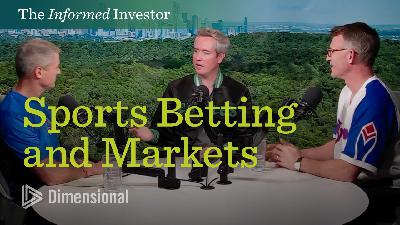
Episode 23: Are there any connections between betting on sports and investing in stocks? Obviously, investing is not the same as placing a bet on your favorite team. For most people, after all, investing is usually a long-term endeavor. But you might be surprised to learn how the betting lines that drive wagering in sports are not unlike prices set by buyers and sellers in securities markets. Point spreads set by sportsbooks are largely based on all available information about the teams competing in upcoming games and the athletes who are expected to play. Similarly, research shows that stock prices in public markets are largely based on all available information about publicly traded companies as well as economic metrics and geopolitical trends. The outcome of any upcoming game is always in doubt because the game hasn't been played. Likewise, the future price of a stock is never known in advance. However, betting lines and market prices typically offer reasonable estimates of fair value. What does that mean, exactly? It means lines and prices are set at levels that will attract bettors and investors, respectively, regardless of their beliefs about the future. Then, when new information becomes available, those lines and prices frequently change so that bettors and investors will keep coming back. In this sense, markets are always working, whether it's a betting market or a securities market. In Episode 23 of the "The Informed Investor" podcast, Dimensional's Mark Gochnour, Head of Global Client Services, Wes Crill, PhD, Senior Client Solutions Director, and Jake DeKinder, Head of Client Communications, suit up and "show out" for a revealing discussion on sports betting and markets. LINKS FROM TODAY'S EPISODE: The "Grumpy Economist" on Growth, Tariffs, and the Fed WITH JOHN COCHRANE https://www.youtube.com/watch?v=KrOnqG0t-z4 "The Informed Investor" on YouTube https://www.youtube.com/playlist?list=PLCyJr6FFig-h1mA7rVP7Mbk0irFw2wA90 Dimensional Fund Advisors Shorts on YouTube https://www.youtube.com/@dimensionalfundadvisors/shorts Mark Gochnour on LinkedIn https://www.linkedin.com/in/mark-gochnour-9a23598a/ Wes Crill on LinkedIn https://www.linkedin.com/in/wes-crill-77a49417/ Jake DeKinder on LinkedIn https://www.linkedin.com/in/jake-dekinder-cfa-4105b98/ Learn more at https://www.dimensional.com/
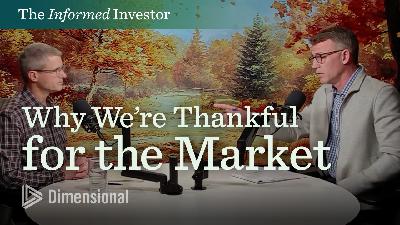
Episode 22: Regardless of which way the market is moving, do you feel thankful as an investor? That's easy when the market is rising, but it may be challenging if stock prices are falling. Worrying about your portfolio can be unnerving. At Dimensional, we hope everyone can have a rewarding investment experience. But our view is that great returns aren't the only thing worth celebrating. We're thankful for the power of markets, for example. In 2025, most investors can easily build a globally diversified, low-cost, transparent portfolio and then potentially benefit from what the capital markets deliver. They can also obtain reliable, fairly priced financial advice from investment professionals all around the country. And they can count on numerous investor protections built into the system at all levels. In Episode 22 of the "The Informed Investor" podcast, Dimensional's Mark Gochnour, Head of Global Client Services, and Jake DeKinder, Head of Client Communications, offer nine reasons why all investors can be thankful during the holiday season. LINKS FROM TODAY'S EPISODE: "The Informed Investor" on YouTube https://www.youtube.com/playlist?list=PLCyJr6FFig-h1mA7rVP7Mbk0irFw2wA90 Dimensional Fund Advisors Shorts on YouTube https://www.youtube.com/@dimensionalfundadvisors/shorts Mark Gochnour on LinkedIn https://www.linkedin.com/in/mark-gochnour-9a23598a/ Jake DeKinder on LinkedIn https://www.linkedin.com/in/jake-dekinder-cfa-4105b98/ Learn more at https://www.dimensional.com/
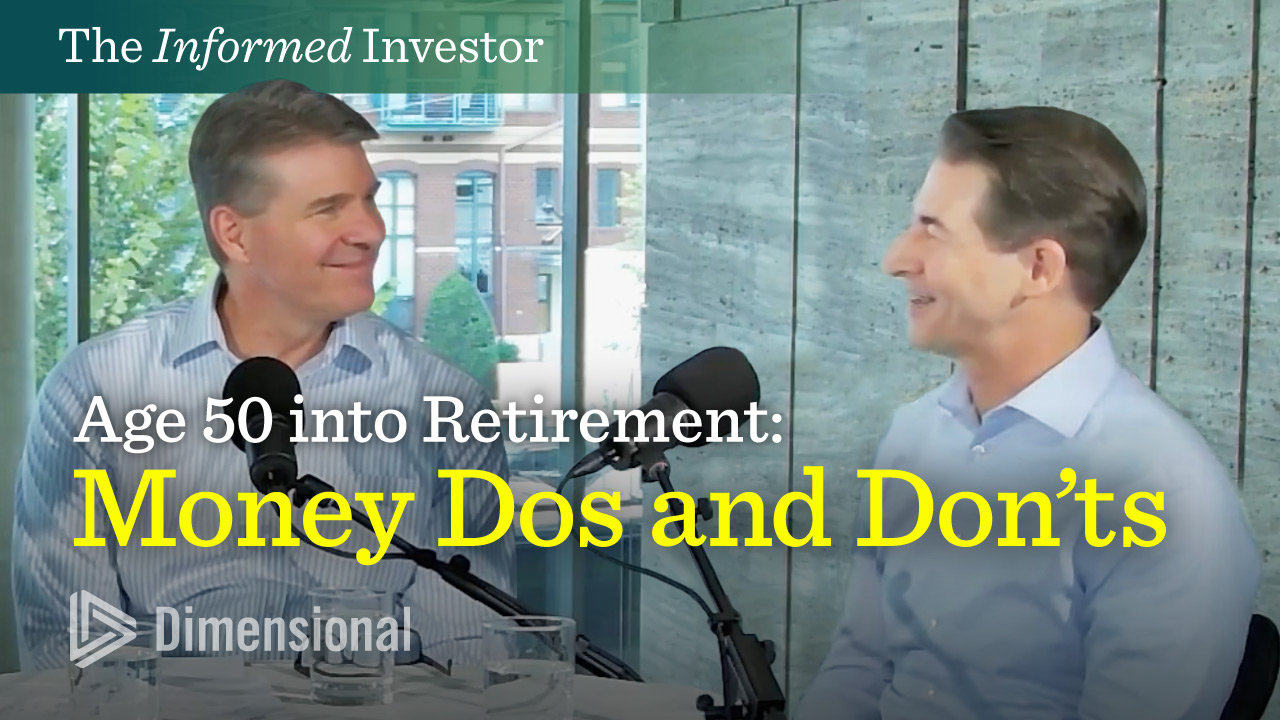
Episode 21: What are the essential money moves for people over 50? By this point, many are beginning to prepare for retirement. Some may have built up significant wealth and gotten used to spending it after hitting their peak earning years. Others may be focused on preserving their wealth but feel unsure about whether they'll have enough for the decades ahead. "Lifestyle creep"—getting accustomed to spending on second homes, boats, vacations, entertainment, and more—may be a source of concern as you get closer to retirement. Planning for the future also means thinking about an estate plan, wills, trusts, and health care. Estimating how much money you'll spend in retirement, after you stop working and earning a paycheck, is an important task. If you've purchased a second home, maintenance costs can be significant. If aging parents are in the picture, now may be the time to address their financial circumstances and health-care needs. Once people hit retirement, how they spend their time becomes a puzzling question for many. Continuing to work but at a slower pace may be an option that ensures a comfortable transition. Carefully preparing for this stage of your career can be beneficial. Tax planning also rises in importance as you go from the accumulation to the decumulation phase with your savings. Thinking about your legacy—gifting to children or focusing on philanthropy—is another topic to consider carefully. In Episode 21 of the "The Informed Investor" podcast, Dimensional's Mark Gochnour, Head of Global Client Services, welcomes Tim Slattery, PhD, Chief Investment Officer of Heritage Investment Group, and Mike Mers, Founder of Aspen Capital Management, to talk wealth, health, and financial planning for people 50 and up. Next week, tune in for a special episode of "The Informed Investor" podcast as Dimensional's Mark Gochnour and Jake DeKinder, Head of Client Communications, discuss the many reasons why investors can be thankful during the holiday season. LINKS FROM TODAY'S EPISODE: "The Informed Investor" on YouTube https://www.youtube.com/playlist?list=PLCyJr6FFig-h1mA7rVP7Mbk0irFw2wA90 Dimensional Fund Advisors Shorts on YouTube https://www.youtube.com/@dimensionalfundadvisors/shorts Tim Slattery https://heritageinvestment.com/our-professionals/timothy-g-slattery/ Mike Mers https://www.aspencapitalmgmt.com/mike-mers Mark Gochnour on LinkedIn https://www.linkedin.com/in/mark-gochnour-9a23598a/ Jake DeKinder on LinkedIn https://www.linkedin.com/in/jake-dekinder-cfa-4105b98/ UPCOMING WEBCAST Fast Takes on a Fast Market: Your 2025 Market Q&A The 2025 market has been anything but quiet. From shifting rate expectations and tariff talk to the latest moves in gold and digital assets, investors have had plenty to process and even more to ask about. Join Dimensional's Courtney Scott, Jake DeKinder, and Apollo Lupescu for a fast-paced webcast that cuts through the noise and examines what's currently driving investor questions and market sentiment. Tuesday, December 9, 2025, at 1 pm CT REGISTER NOW: https://event.webcasts.com/starthere.jsp?ei=1742855&tp_key=0ddcbb9c03&sti=apple Learn more at https://www.dimensional.com/

Comments

Download from Google Play

Download from App Store
 United States