


 Claim Ownership
Real Cases: A Legal Podcast
Subscribed: 5Played: 93
Subscribe

© 2022
Description
Follow real law students as they journey to become practitioners. Learn from real faculty as they examine the ins and outs of the field's most provocative cases. Catch up and stay tuned into Stetson Law's podcast – your trusty legal resource for great debate and greater ideas.
39 Episodes
Reverse
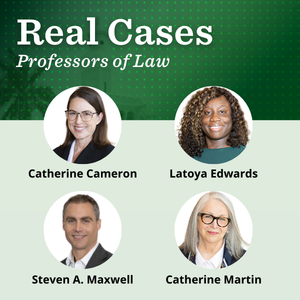
Behind every confident lawyer is someone who helped them find their footing. In the latest episode of Real Cases, we explore the mentorships—with deans, with professors, and with working attorneys—that help Stetson students navigate law school and launch meaningful careers. Professors Catherine Cameron and Assistant Deans Catherine B. Martin, Latoya Edwards, and Steve A. Maxwell join us to discuss what mentoring looks like at every stage of law school, from your transition into 1L year through bar prep and career planning. The conversation highlights Stetson's unique Inns program, our support for first-generation and non-traditional students, and how early guidance helps students gain real-world perspective before entering the profession.
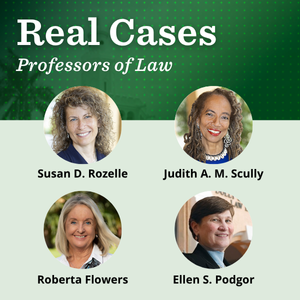
Criminal law sits at the crossroads of fairness, accountability, and reform. From questions of who gets prosecuted to how victims are heard, Stetson Law pushes students to see beyond the verdict and into the systems that shape it. In this episode of Real Cases, we sit down with Professors of Law Susan D. Rozelle, Roberta Flowers, and Judith A. M. Scully, along with the Gary R. Trombley Family White-Collar Crime Research Professor of Law Ellen S. Podgor, to discuss the new Criminal Law Concentration at Stetson. We explore what draws students to prosecutorial work versus defense work, the moral and procedural complexities of plea bargaining, and the role of criminal lawyers in addressing corruption, white-collar crime, and social justice reform.
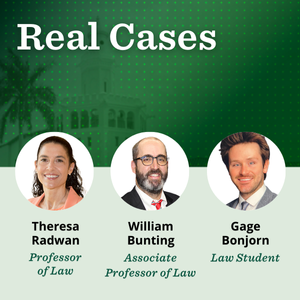
On this episode of Real Cases, we discuss the business law concentration and Stetson's three-year dual JD/MBA degree with Professor of Law Theresa Radwan, Associate Professor of Law William Bunting, and Gage Bonjorn, a third-year law student. Along the way we find out how bankruptcy law can merge the roles of a transactional lawyer and a litigator, why it's helpful when lawyers and business executives speak the same language, and why a surprising number of law school grads have a side hustle managing investment properties.
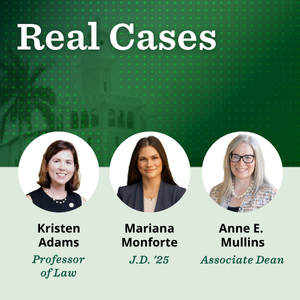
In the second episode of this two-parter, we sit down with Dean Anne Mullins; inaugural faculty bencher, Professor Kristen Adams; and one of the Inns program's first student readers, Mariana Monforte, a 3L who graduated from Stetson Law this spring. We discuss how law students go from private citizens to public advocates, the importance of developing a cross-generational professional network, and why Dean Mullins calls the Inns program "Hogwarts for law students'!
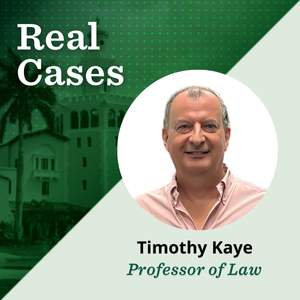
Your first few weeks of law school can feel like moving to another country where everyone speaks a slightly different language—and you need to be fluent by midterms. Perhaps that's why Stetson looked to a venerable institution from the UK's legal system to help 1Ls connect with each other, their professors, and the profession: English Inns of Court. In this first episode of a two-parter, we sit down with Stetson Law Professor Timothy Kaye, one of the program's inaugural "benchers"—i.e. faculty mentors—to discuss how Stetson's Inns program got its start, the system's British origins, and how the program cultivates a more thoughtful and immersive approach to the study and practice of law.

Athletes and celebrities may be the ones in the spotlight, but behind every sponsorship deal, headline-making trade, or backstage battle over royalties, there's a lawyer making it all happen. On this episode of Real Cases, we sit down with three Stetson Law alums: music industry attorney and Founding Partner of Keller, Turner, Andrews, & Ghanem, Jason L. Turner; Senior Director and Associate Council for the Charlotte Hornets, Cymoril White; and Vice President of Basketball Strategy for the Utah Jazz, Steven Schwartz. We discuss the ins and outs of copyright termination, new legal questions around data gathering through wearable technology, and the multitude of unusual avenues through which people enter the profession.
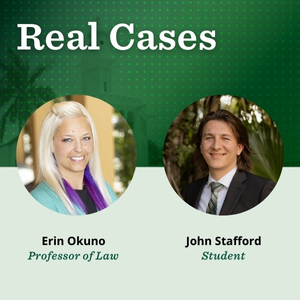
They say you should treat law school like a full-time job. But what does that really mean in practice, and how do you get the most out of your first year? In this episode, we sit down with Assistant Professor Erin Okuno, who both teaches at Stetson Law and graduated from the school in 2013, and John Stafford, who's now a second-year student at Stetson. We discuss the most common challenges students face in their first year at law school, ways the environment for new grads has changed in the last decade, and how Stetson's uniquely collaborative environment sets students up for success.
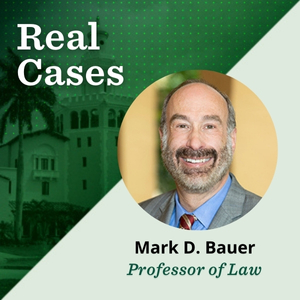
What's the difference between "waiving" and "modifying," and how does that affect whether the President of the United States can forgive student loan debt? In this episode, we sit down with Stetson Law Professor Mark Bauer to discuss Biden v. Nebraska, the Supreme Court case that struck down the Biden administration's partial student loan forgiveness efforts. On the way we consider the major questions doctrine, the vagaries of standing, and how sometimes―just sometimes―your work in antitrust law gets made into a Hollywood movie.
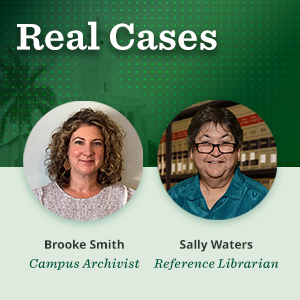
What do Babe Ruth, Ruth Bader Ginsberg, and a cat named Porkchop all have in common? They've all been distinguished guests on Stetson Law's storied hundred-year-old campus. In this episode we sit down with Brooke M. Smith, a Circulation Librarian and Archivist, and Reference Librarian Sally Ginsberg Waters to discuss the history of that campus, dating back to its original construction as the Hotel Rolyat, an attraction for celebrities during the Roaring Twenties.
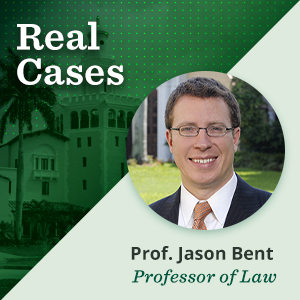
More and more job applications are processed by machine learning before a real person ever reads them. But can these algorithms exhibit prejudice? And, if so, what would it mean to adopt algorithmic affirmative action? In this episode, we sit down with Stetson Professor Jason Bent to discuss the changing landscape of employment and employment discrimination law in the twenty-first century. We discuss the impact of AI, growing concerns about data privacy in employment contexts, and the role new Supreme Court decisions have played in the interpretation of Title VII.
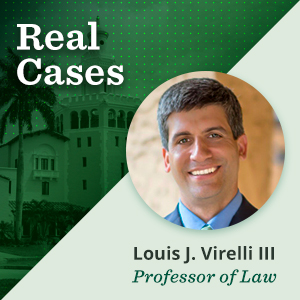
Are presidents immune from criminal prosecution for actions they take in office? That was just one question – and perhaps not even the most wide-ranging one – under consideration in the decisions released at the end of the Supreme Court's latest term this summer. In this new episode, we sit down with Stetson Law Professor Louis Virelli to discuss how the court's recent slate of decisions is reshaping the balance of powers. From gun rights to presidential immunity to fundamental workings of administrative law, the cases from this latest term are rewriting the textbooks.
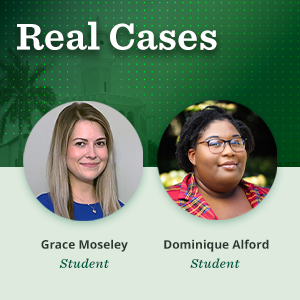
How do part-time law students juggle a family, a job, and law school all at once? In this episode, we sit down with two strong advocates for Stetson Law's part-time program, Dominique Alford-Raymond and Grace Moseley. Together we discuss the diversity, the resilience, and the uniquely strong community among members of Stetson's part-time program.
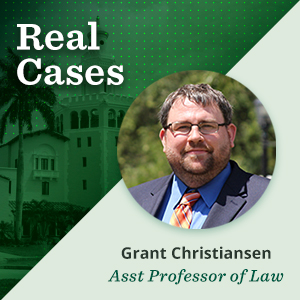
In an era of sharp and often predictably partisan disagreements within the Supreme Court, it might surprise some that Neil Gorsuch, one of the court's 6 conservative justices, has emerged as one of the fiercest proponents of tribal sovereignty to ever serve on the bench. That fact doesn't surprise Stetson Law Professor Grant Christensen, however. Christensen is a specialist in Federal Indian Law, the unique mixture of federal regulations and tribal sovereignty that governs the lands set aside for Native American communities within the states. In this episode, we discuss the unexpected Supreme Court majorities that can emerge in Indian Law cases that test questions about federalism, recent decisions about the Indian Child Welfare Act and tribal lands in Oklahoma, and how indigenous legal traditions can propose models for reforming corporate governance.
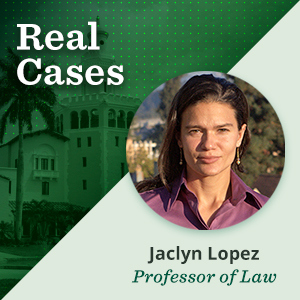
Florida isn't just on the front line for climate change in America – it's also a testing ground for new legal questions about how to deal with its consequences. In the latest episode of Real Cases, we speak with Assistant Professor Jaclyn Lopez, Director of the Jacobs Public Interest Law Clinic for Democracy and the Environment. We discuss public access to environmental justice, new legal problems raised by increased flooding, and the role the Jacobs Law Clinic is playing in fighting to extend federal Endangered Species Act protection to the ghost orchid, a rare and famous flower unique to the region.
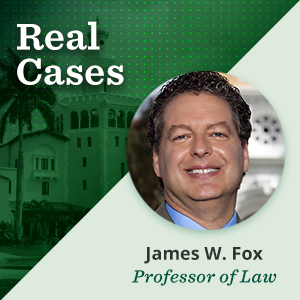
How did free African Americans before the Civil War regard the Constitution, freedom, and citizenship in a republic that excluded them from political participation? In the latest episode of Real Cases, we sit down with Stetson Professor James Fox to discuss the fuzzy boundaries between history and legal scholarship, different varieties of originalism on today's Supreme Court, and how greater racial diversity in the academy advances new ways of understanding the past.
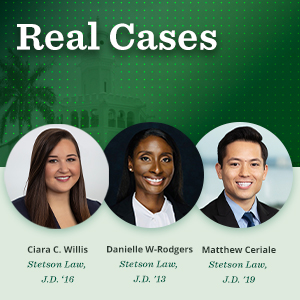
What's life like for young legal professionals in Tampa Bay? On this month's episode of Real Cases, we talk to three Stetson Law alums with prominent positions at law firms in the greater Tampa Bay community: Ciara Willis J.D. 16, a Partner at Bush Ross, P.A. who practices community association law, Matthew Ceriale J.D. '19, an Associate Attorney at Shumaker, Loop & Kendrick, L.L.P. who practices civil litigation, and Danielle Weaver-Rogers J.D. '13, Senior Corporate Counsel for Labor and Employment at Qualfon Data Service Group, L.L.C., who works in employment law. They talk about life in Tampa Bay, how they got into their current line of work, and how their experiences at Stetson led to the jobs they have today.
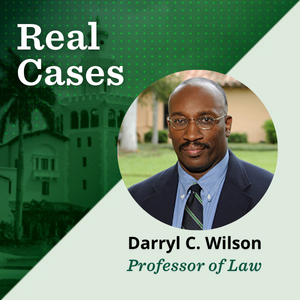
By scrubbing the internet for information that it recombines into new texts and images, generative AI has launched a host of new questions about intellectual property law and liability. For instance, who's responsible if an AI infringes upon your intellectual property? The company that made it? The company that used it? The AI itself? We discuss these questions and more in the latest episode of Real Cases with Professor Darryl C. Wilson, Stetson Law's Associate Dean for Strategy & Operations.
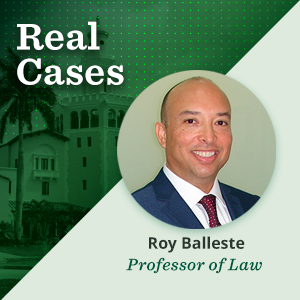
What nation has jurisdiction if an astronaut commits a crime in space? Who owns the right to mine asteroids? How do countries co-manage the physical infrastructure of the internet – on earth and in orbit? On this month's episode of Real Cases, Stetson Law Professor Roy Balleste discusses the complex web of maritime precedents and international agreements that govern space exploration. He explains why the final frontier holds a host of new ethical, technological, and legal questions that law scholars have only just begun to contemplate.

Are AI tools like ChatGPT reshaping the landscape of law and legal education? Or are they just another form of information technology that lawyers and students can harness with a properly critical approach? In this episode, Stetson professors Catherine Cameron and Kelly Feeley discuss the limits of AI tools and online databases, the persistent importance of legal interpretation and analysis, and the unexpected ways new technologies can replicate structural biases.
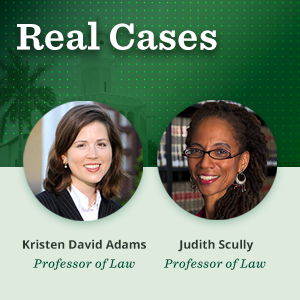
In this episode, Professors Judith Scully and Kristen Adams join us to discuss Stetson Law's Social Justice Advocacy concentration. They discuss how law students can build their portfolios, how students can learn to advocate for themselves, and how lawyers around the country work for what they believe in without sacrificing their own well-being.


Download from Google Play

Download from App Store
 United States
I am a Public Safety Officer with Stetson College of Law and I have just found this Podcast. It is my goal now to make sure "EVERY" student I speak with knows about this Podcast and especially this episode. It gave great insight for preparing to attend thier first year. GREAT JOB!