


 Claim Ownership
Contact Center Show
Subscribed: 9Played: 29
Subscribe
© All rights reserved 2022
Description
This is the public square for all things contact center. This is where the world's best Call & Contact center professionals come to get better at delivering a great experience for customers.
Your contact center mentors - Amas Tenumah & Bob Furniss
Your contact center mentors - Amas Tenumah & Bob Furniss
88 Episodes
Reverse
Summary In this conversation, Amas Tenumah and Bob Furniss discuss the implications of AI in quality assurance within contact centers. They explore the benefits of AI, such as increased coverage and trend spotting, while also addressing concerns about accuracy and the potential for AI to replace human interaction. The discussion emphasizes the importance of using AI to enhance human capabilities rather than eliminate them, and the need for effective coaching and data utilization to improve agent performance. Main Content: Understanding AI in Quality Assurance The podcast opens with a light-hearted discussion about the weather, but it quickly shifts focus to a pressing topic: the use of AI in quality assurance. Amas and Bob agree that deploying AI in this area can be beneficial, especially regarding monitoring agent performance. One of the primary advantages they mention is the ability to achieve 100% call coverage. Traditionally, QA teams may only review a small percentage of calls, leading to inaccurate assessments of agent performance. With AI, contact centers can analyze every call, providing a more accurate picture of quality and performance. Spotting Trends and Gaining Insights Another significant benefit of AI mentioned in the podcast is its capability to spot trends in customer interactions. Bob highlights the importance of understanding call spikes, such as the recent increase in calls related to a coupon offer. AI can analyze large data sets quickly, allowing managers to respond to customer needs more effectively. This capability not only improves the customer experience but also empowers managers to make informed decisions based on real-time data. The Risks of Relying Solely on AI While Amas and Bob are enthusiastic about the potential of AI, they also express concern over its limitations. One critical issue is the accuracy of AI assessments. Amas warns that AI systems are often trained on human data, which can lead to discrepancies in scoring calls. He emphasizes the need for a human touch in QA processes, suggesting that AI should assist rather than replace human judgment. Without human oversight, there's a risk that AI can misinterpret nuances in customer-agent interactions, leading to misguided conclusions. The Importance of Human Interaction The conversation takes a deeper turn as they discuss the nature of customer service as a human interaction. Bob argues that technology should enhance the capabilities of QA teams, not eliminate them. He points out that while AI can streamline processes, it cannot replicate the empathy and understanding that a human agent brings to a conversation. The hosts advocate for a balanced approach where AI tools are used to support agents rather than replace them, ensuring that customer experiences remain positive and personalized. Conclusion: In conclusion, while AI presents exciting opportunities for enhancing quality assurance in contact centers, it is essential to approach its implementation with caution. Amas and Bob remind us that technology should complement human skills and insights rather than undermine them. By finding the right balance, organizations can leverage AI to improve performance while maintaining the human touch that is vital in customer service. Key Takeaways: 1. AI can enhance quality assurance by providing 100% call coverage and spotting trends in customer interactions. 2. The accuracy of AI assessments can be problematic; human oversight is crucial in the QA process. 3. Customer service is fundamentally a human interaction, and technology should support, not replace, human agents. Tags: AI, Quality Assurance, Contact Centers, Customer Service, Technology, Human Interaction, Trends in Customer Experience, Agent Performance, Podcast Insights
Summary In this episode, Amas Tenumah and Bob Furniss delve into the current state of Software as a Service (SaaS) and its intersection with artificial intelligence (AI), particularly in the context of contact centers. They discuss the recent downturn in stock prices for major SaaS companies like Salesforce and ServiceNow, attributing this to Wall Street's skepticism about the actual impact of AI on these platforms. Amas expresses concern that the hype surrounding AI is outpacing the reality of its implementation, suggesting that many companies are not yet ready to fully embrace AI-driven solutions. Bob echoes this sentiment, emphasizing the importance of expertise and experience in successfully implementing these technologies. AI hype is ahead of customer readiness. Wall Street is skeptical about SaaS companies' future. Vibe coding may not replace the need for expertise. Experience in implementation outweighs potential of new tech. Both extremes of AI adoption are currently inaccurate. Sound bites "Service now stock hasn't been this cheap in like four years." "There's two different stories going on here." "Both extremes are wrong today." Chapters 00:00 Introduction and Current Market Overview 00:53 The Impact of AI on SaaS Companies 03:42 Building vs. Buying: The New Paradigm 07:18 Navigating Contract Renewals and New Technologies 10:49 The Future of AI in the Contact Center Industry 13:38 Conclusion and Key Takeaways
Most customer experience goals are meaningless. In this episode, Bob Furniss and Amas Tenumah dismantle the way contact centers set annual CX metrics and explain why leaders keep optimizing numbers that customers neither notice nor value. Using insights from a John Goodman article on CX goal-setting, the conversation exposes the disconnect between executives, customers, and frontline teams—and why automation, deflection, and "respectable" percentage improvements often make service worse, not better. This episode is about shifting from internally convenient metrics to customer-impactful outcomes. What You'll Hear Why CX goals are often chosen because they sound reasonable, not because they solve customer problems How executives chase a single "magic number" instead of understanding service complexity The fundamental incentive gap between customers and senior leadership Why customers and frontline agents are aligned—but executives aren't How automation and bots optimize company metrics while frustrating customers Where AI actually helps: analyzing volume, root causes, and systemic friction Why average metrics (ASA, AHT) distort reality and reward the wrong behavior How poor goal-setting punishes leaders who successfully automate the "easy" work The risk of letting someone else define your goals if you don't take control A real-world example of automation done right—and how bad metrics mislabel it as failure Key Takeaways Vanity metrics don't fix customer experience Deflection and containment may look good internally while actively harming trust CX leaders must own the narrative or be trapped chasing numbers they don't believe in AI should surface customer pain, not just reduce contact volume Goals should reflect customer outcomes, not executive convenience Resources Mentioned John Goodman's article on CX goal-setting (referenced in discussion) HOLD: The Suffering Economy of Customer Service by Amas Tenumah Available on Amazon Signed copies at waitingforservice.com Who This Episode Is For Contact center and CX leaders setting 2026 goals Executives relying on NPS, ASA, AHT, or deflection as proxies for success Practitioners tired of fixing the wrong problems Anyone responsible for explaining service performance to leadership
2025 predictions — graded AI-powered knowledge Bob's 2025 prediction: AI would dramatically improve knowledge in contact centers. Result: Early but mostly wrong. The technology moved, but the data did not. Knowledge bases were too fragmented, too dirty, and too poorly governed for AI to meaningfully improve frontline work. The industry instead spent another year chasing bots, automation, and surface-level "AI assistants." Grade: C+ The failure was not AI. It was the state of enterprise knowledge. Remote work reversal Bob's 2025 prediction: Work-from-home would shrink and revert toward pre-COVID norms. Result: Correct. Remote and hybrid work has fallen to within five percentage points of pre-COVID levels. Companies quietly reversed course not because it helped customers or employees, but because leadership never learned how to manage distributed teams. Hybrid was the worst of both worlds: frontline leaders juggling physical rooms, video calls, and dashboards without the training or structure to do any of it well. Grade: A Why remote work collapsed The reversal was not ideological. It was operational. Executives defaulted back to what felt controllable: physical presence. Organizations refused to do the hard work of re-engineering leadership, coaching, quality management, and accountability for a distributed workforce. They solved a people problem with proximity. Amas' prediction for 2026 Voice comes back. Digital channels absorbed most of the AI hype: chat, bots, messaging, and self-service. But customers never stopped calling. Voice is where frustration spikes, where trust is tested, and where automation breaks down. Amas' call: 2026 will be the year voice reasserts itself as the center of the customer relationship — and the CCaaS market will look radically different by 2027 because of it. Bob's prediction for 2026 Data becomes the bottleneck. AI will only become useful where it has access to clean, structured, reliable data. The industry rushed into AI before fixing the foundations: knowledge, case data, call logs, customer history, and operational context. 2026 will be the year contact centers slow down, audit their data, and rebuild the plumbing that AI actually runs on. No data. No intelligence. What the industry is claiming Analysts and vendors are promising three things for 2026: • Predictive and proactive service • Agent empowerment through AI • Fewer humans in contact centers Bob and Amas reject the third and remain skeptical of the first two without structural change. The hype assumes AI will replace labor. Reality says AI will expose how broken the systems around labor really are. Amas' 2026 wish Stop calling software "agents." For twenty years, "agent" meant a human being doing emotional, cognitive, and relational labor. Rebranding bots as agents erases the workforce and confuses accountability. Language shapes power. That battle matters. Bob's 2026 wish Focus on the employee. AI should not be used to replace people. It should be used to remove friction from their work: searching, documenting, switching systems, hunting for answers. Knowledge was always the real use case. The industry just skipped the hard part. Core takeaway 2025 proved that AI without data, governance, and human-centered design does not transform anything. It only adds noise. 2026 will reward the companies that stop chasing demos and start rebuilding the foundations: voice, knowledge, data, and frontline enablement. That is where the real disruption will come from.
Amas Tenumah explains why customer service is not "broken" but intentionally designed to fail. Drawing on decades inside contact centers, historical research, and real corporate incentives, he argues that long waits, deflection, and automation-first strategies are features—not bugs. The conversation dismantles common CX myths, challenges executive complacency, and frames consumer behavior as the only force capable of triggering real change. Core Themes The Suffering Economy of Customer Service: When service is universally bad across industries, it's systemic. Incentives—not incompetence—drive outcomes. Why This Is a "How Dare You" Book: The indictment is aimed squarely at executives who treat service as a cost center while overfunding marketing narratives. Marketing Replaced Service as Trust Mechanism: Historically, service was marketing. Industrialized marketing severed that link, allowing companies to tolerate bad service and buy growth instead. Metrics That Poison Service: Deflection, containment, and avoidance KPIs reward companies for not talking to customers—while punishing leaders who try to deliver what customers actually want. Wait Times Are Engineered: Hold times are budgeted, modeled, and accepted. They are designed friction, not operational accidents. AI as Distance, Not Salvation: AI is currently deployed to protect companies from customers, not customers from friction. It scales avoidance unless incentives change. Executives Don't Experience Their Own Service: Many leaders despise customer service—just not their own. Forcing executives to call their own 1-800 numbers is revelatory and uncomfortable. The Revolt Is Consumer-Led: Change will not come from CX professionals alone. It comes when consumers punish bad service with their wallets and reward companies that respect their time. Notable Moments The opening story of the 1750 BC clay tablet complaint—the first recorded customer service grievance—reads like a modern Amazon review. The Chipotle refund anecdote exposes time theft: hours of customer labor to recover trivial amounts of money. The contrast between automation done for customers versus automation used to avoid them. Practical Takeaways For Consumers: Vote with your wallet. Pay slightly more. Wait one more day. Call customer service before you buy big-ticket items. For Service Leaders: If your CEO doesn't believe in service as value creation, your job is to change their mind—or change jobs. Data plus customer stories are the leverage. For Executives: Service is deferred revenue protection. Treating it purely as cost is strategic malpractice. Resources Mentioned Book: HOLD: The Suffering Economy of Customer Service — And the Revolt That's Long Overdue Signed Copies & Tools: waitingforservice.com Consumer scripts Cancellation guides Practitioner playbooks No email required
Summary The conversation explores the integration of AI in sales, focusing on how it enhances customer engagement and improves sales efficiency. Bob Furniss discusses the importance of using data to empower salespeople rather than reducing their numbers, emphasizing a customer-centric approach to AI in sales. Takeaways AI can enhance customer engagement in sales. The focus should be on empowering salespeople with data. AI is not just about reducing costs but improving efficiency. Sales strategies should prioritize customer needs. Data-driven insights can lead to better sales outcomes. AI can make sales calls faster and smarter. The role of AI is to support, not replace, sales personnel. Understanding customer needs is crucial in sales. AI tools should be designed to assist sales processes. The future of sales lies in the integration of technology and human touch.
Summary In this conversation, Amas Tenumah, Bob Furniss and Brad Cleveland discusses the three levels of value that contact centers create: efficiency, customer satisfaction and loyalty, and strategic insights provided by AI. He emphasizes the importance of these levels in improving products, services, and processes. Takeaways there's three levels of value that contact centers create Level one is efficiency customer satisfaction, loyalty, if we do a good job it's the strategic insight that AI can provide it can still tell us, hey, here's a trend I'm seeing Here's an opportunity to improve products and services AI doesn't have to be perfect to provide value Strategic insights can drive business improvements Understanding trends is crucial for growth Contact centers play a vital role in customer experience Titles Unlocking Value in Contact Centers The Role of AI in Customer Service Sound bites "Level one is efficiency" "customer satisfaction, loyalty, if we do a good job" "it's the strategic insight that AI can provide" Chapters 00:00 Introduction to the Contact Center Show 00:27 AI and Its Impact on Customer Interactions 00:31 Future Jobs in the Contact Center Industry
Low-Cost, High-Impact CX Improvements The Power of Language: Transform "I can't" into "How can we" Shift from "I have to" to "We get to" Being "impeccable with your word" (inspired by The Four Agreements) Words trigger emotional responses that shape customer perception Getting CX Buy-In Across Organizations The Alignment Problem: CX initiatives fail when metrics aren't shared across departments Success came when executives adopted the same CX metrics as the CX team Without shared goals, customer insights get shelved with "we'll get to it later" The Pilot Program Strategy: Start small before asking for big budgets Show proof of concept with intentional, measurable pilots Use success to rally and align different areas of the company Real Example - CX Day Success: Introduced first-ever CX Day celebration at 145-year-old engineering company Started small despite skepticism Now an annual tradition that continues after her departure Rethinking CX Metrics Beyond Traditional Measurements: NPS and effort scores are starting points, not endpoints "Satisfaction" is no longer good enough (it's the equivalent of "fine") New focus: Emotional altitude across every touchpoint The Emotional Impact: Brains constantly cycle between thinking and feeling Emotions create lasting imprints that shape brand perception Research shows: 12 positive experiences needed to overcome 1 negative Measure emotional highs to identify gaps and successes The Four Rs of CX Impact: Revenue Retention Reputation Referrals The Future of Contact Centers Human + AI Integration: Smart companies intentionally map where humans add value vs. where AI should handle interactions The answer is "both/and" not "either/or" Critical: Validate designs with real customers, not just internal teams The Contact Center Superpower: Contact center teams speak to more customers in a week than other departments do in a year This proximity to customers gives agents unique power to be organizational change agents Voice of customer insights should inform product development, marketing messaging, and more Words Matter in the AI Era: Example: Website offering "24/7 support, our guides are happy to help you" "Guides" for both humans and AI feels impersonal Naming and framing still matters The Power of Customer Voice The 10-Minute Video Story: A contact center leader captured customer feedback about a failed new product. At an executive meeting, he played a 10-minute compilation of customer complaints. The CEO's initial advisor said it was a career-ending mistake The CEO walked out during the video Result: CEO returned and said it was "the best 10 minutes anybody's ever played" and named him employee #1 Customer voice changed the company's trajectory The Validation Imperative: Internal perspective isn't enough Customer validation must be iterative, not one-time Can't use internal team as proxy for outside voice Both internal knowledge AND customer validation matter The Fundamental C-Suite Challenge When C-suite leaders aren't aligned in their meetings, misalignment trickles down through the entire organization. This is the root problem preventing effective CX implementation. Notable Stories The Morgan & Morgan Tattoo Story: Leadership promised to get company logo tattoos if the team hit an unprecedented conversion rate goal. When they achieved it, 40 leaders got matching tattoos - four tattoo artists came in for the day. The question became: "Is your brand tattoo-worthy?" Stacey's Podcast Origin: Bought her first microphone for under $50, then waited six months before taking it out of the box due to fear. That mic ignited her journey to intentionally sharing her voice through podcasting. Living Podcasting: At the conference, Stacey pulled out her mic to record a 10-minute session where Amas (who has Parkinson's) gave direct advice to her relative with a similar condition - creating immediate, personal value rather than secondhand communication. Takeaways for Contact Center Leaders Language shapes reality - Small word changes create emotional shifts in customer experience Demand metric alignment - CX can't succeed unless executives share the same measurements Start with pilots - Prove value small-scale before requesting major investment Leverage your proximity to customers - Use it to become the organizational glue and change agent Validate everything with real customers - Internal assumptions aren't enough Map the human-AI journey intentionally - Design where each adds value, then test with customers Bring customer voice to leadership - Sometimes the most powerful thing is making them listen directly Average isn't acceptable - Move beyond satisfaction to creating emotional highs
Episode Summary Broadcasting live from the ICMI conference in Orlando, Amas and Bob discuss the evolving role of AI in contact centers, the ongoing struggle for strategic recognition, and welcome special guest Bianca, who shares her unique perspective on running HR as a contact center at Michigan State University.
Host: Bob Furniss (without co-host Amos) Guest: Daniel Thomas, Informa Location: ICMI Conference Expo Floor Guest Background Daniel Thomas approaches contact center industry from a research background Surveys audiences and writes research reports Has "front row seat" to industry transformation Conducts the annual State of the Contact Center survey About the State of the Contact Center Report Comprehensive benchmark study surveying contact center professionals Covers multiple verticals including: Training and skills Compensation and salary Technology use Leadership perceptions Strategy Tracks year-over-year progress Recent additions include AI and workforce training questions Key Surprising Findings 1. Contact Centers as Strategic Intelligence Hubs Major shift: Contact centers increasingly viewed as "strategic customer intelligence hubs" rather than cost centers Described as "customer intelligence and nervous system" No other department has closer customer proximity or more customer data C-suite now acknowledges value with direct data funnels informing executive decisions 2. AI Perceptions and Impact 72% believe AI will transform roles, not replace them Only ~25% think AI will lead to workforce reductions AI expected to handle "level one, rote, monotonous, repetitive work" Agents will focus on: Complex needs and edge cases Soft skills: empathy, communication, problem solving, critical thinking 90% of surveyed leaders believe humans necessary as AI overseers Gartner prediction: 40% of agentic AI projects will fail by 2027 (often due to neglecting human oversight) Agent Evolution Agents increasingly viewed as: Consultants Solutions architects Higher-tier problem solvers "White glove service" providers Rising expectations due to AI support Agents becoming intelligence providers to C-suite More analytical roles: identifying trends, patterns, creating intelligent summaries Top AI Implementation Concerns Customer resistance (top concern) Data accuracy Data privacy and security Lack of proper AI governance Workforce and Quality Management Insights Workforce Models (Nearly Equal Three-Way Split) In-office full time Hybrid Fully remote Models remain transitional and subject to change Increased scheduling flexibility critical for retention Quality Focus Shift Traditional metrics: CSAT, utilization, average handle time New priority: Agent experience rising in importance Recognition that internal customer experience drives external customer experience Customer Satisfaction Challenges Current CSAT surveys often lack nuance Can't distinguish between: Poor agent performance vs. poor company policy Single bad experience vs. overall satisfaction Need for more qualitative feedback mechanisms "Watermelon effect": High metrics but poor actual experience Channel Evolution Significant jump from multi-channel to omni-channel implementation Growth in non-traditional channels: Social media SMS/text Video Technology enabling unified customer history across channels Key Takeaways Successful organizations treat contact centers as "valuable strategic sources of intelligence" Organizations not recognizing this value are "dropping the ball" and will "see the consequences" Contact centers serve as the "hub" and "nervous system" reaching everywhere in the organization When no one knows the answer, they turn to the contact center Notable Quotes "If your agents aren't excited about AI, then you actually haven't communicated to them how enriching and transforming it could be" "Agents are increasingly going to play a role where they are the eyes and the ears... providing the intelligence back to the C-suite" Contact centers as "the strongest data... the hub... the nervous system that reaches in everywhere else"
Summary In this conversation, Amas, Luke and Bob explore the evolving complexity of contact centers, challenging the notion that they are becoming simpler. They emphasizes that while the intention may be to simplify processes, the reality is that sophistication often leads to increased complexity. They also highlights the reliance on outdated metrics, such as those managed in Excel, which can contribute to agent burnout and friction with customers. They advocate for a shift towards more effective lead metrics to enhance the overall efficiency and satisfaction in contact centers. Takeaways Contact centers are perceived as becoming simpler, but they are actually becoming more complex. Sophistication in processes can lead to increased complexity. There is a challenge in addressing the complexity of contact centers. Many organizations are still reliant on outdated tools like Excel. Using lead metrics can help prevent agent burnout. Improving metrics can reduce friction with customers. The conversation highlights the need for modernization in contact center operations. Understanding complexity is crucial for effective management. Agent burnout is a significant issue in the industry. A shift in metrics is necessary for better outcomes. Sound Bites "Sophistication also brings complexity." "We are still for the most part stuck in Excel." "Lead metrics could stop agent burnout." Live from Orlando at ICMI Expo

Summary In this conversation, Amas Tenumah and Bob Furniss discuss the evolution of contact centers, the impact of CRM systems like Salesforce, and the role of AI in enhancing agent performance. They reflect on the historical context of CRM, the challenges faced by agents, and the future of customer service technology, particularly focusing on the Agent Force initiative. The discussion also touches on the sentiment within the Salesforce community and the potential for new competitors in the market. Takeaways Salesforce has become a dominant player in the CRM space. The evolution of contact centers has been significant over the years. AI can enhance agent performance rather than replace them. Understanding customer needs is crucial for effective service. The Agent Force initiative aims to improve agent capabilities. There is a negative sentiment towards Salesforce in the contact center community. The cost of building technology is decreasing, making competition more feasible. AI's role in customer service is still evolving and needs to focus on agents. Salesforce must communicate its value to agents to maintain loyalty. The future of customer service technology is uncertain but full of potential. Chapters 00:00 Introduction and Context Setting 01:29 The Evolution of CRM and Contact Centers 06:05 Current Trends in Salesforce and AI 11:13 Agent Force and the Future of Customer Service 15:54 Prognosis for Salesforce and the Industry
Summary In this conversation, Amas Tenumah and Bob Furniss discuss the intricate relationship between marketing and call center operations, particularly during high-demand periods like holidays. They share personal anecdotes about challenges faced in fulfilling customer orders due to marketing miscommunications and emphasize the importance of building strong relationships between marketing and contact center teams. The discussion highlights the need for effective communication, data sharing, and collaboration to enhance customer experience and operational efficiency. Takeaways The holiday season can create significant challenges in call center operations. Marketing decisions can directly impact call center workload and customer satisfaction. Building relationships with marketing teams is crucial for effective communication. Data sharing between marketing and contact centers can improve customer service. Understanding operational limitations is essential for marketing strategies. Regular meetings between marketing and contact center teams can foster collaboration. Customer feedback is valuable for shaping marketing strategies. Effective communication can prevent misunderstandings and operational chaos. A cooperative approach can lead to better resource allocation and planning. Engaging with customers directly can provide insights that benefit marketing efforts.
Summary: For decades, leaders have debated whether the contact center should be a cost center, a profit center, or something in between. In this episode, Amas and Bob cut through the noise and tackle the question head-on: Is the contact center truly a profit center—or are we just telling the story wrong? Amas argues that the CFO decides the labels, not us, and that contact centers suffer from being terrible storytellers compared to marketing. Bob reinforces that stories, not spreadsheets, are what move executives to invest in customer experience. Together, they break down how leaders can turn raw data into persuasive narratives that actually secure budget, influence the C-suite, and prove value. What You'll Learn in This Episode: Why the "profit center" debate hasn't gone away—and probably won't. The crucial difference between value creation and revenue generation. How marketing gets credit (and budget) despite spending every dollar they touch. Why endless Excel spreadsheets put executives to sleep—and what to do instead. The art of translating metrics into stories that CFOs and CEOs actually care about. Practical steps for contact center leaders to elevate their influence in the boardroom. Key Quotes: "The CFO decides what's a cost center and what's a revenue center. We are just bad at telling our story." – Amas "People don't remember your statistics. They remember your stories." – Bob "Marketing spends money all day, but they've convinced the world they're indispensable. We should learn from that." – Amas Episode Highlights: (01:00) Revisiting the old debate: profit center vs. cost center. (02:30) Why marketing gets treated differently—and why service leaders should care. (04:30) The deadly sin of sending executives binders of metrics. (06:00) How to tell stories executives will remember—and fund. (09:00) Using customer stories to anchor your data. (11:30) Why your relationship with marketing and the CFO matters most. (12:45) Teaser: Amas & Bob will be recording LIVE at the ICMI Contact Center Expo in Orlando, Oct 27–30. Resources & Links: Amas's blog post: "Contact Centers Are Not Revenue Centers" [link] Learn more about the ICMI Contact Center Expo
We're back from summer break (okay, maybe fall break too) and diving straight into the mess where AI, customers, and reality collide. In this episode, Amas and Bob unpack the hype vs. the truth about AI in contact centers: Is AI replacing humans—or just making customers angrier? Why human agents are still the heart of service, even as bots sound more "human." How contact center leaders feel stuck—between CEOs chanting "AI, AI, AI" and customers who just want their problems solved. What the data really says about automation, agent workloads, and customer expectations. Practical advice for leaders: use AI to reduce after-call work, not replace human connection. We also share personal summer highlights—Amas' trip to Italy with his son, Bob's perfect beach-and-donut days—and a fiery debate about tipping culture. Finally, big news: The Contact Center Show is hitting the road! Catch us live at the ICMI Contact Center Expo in Orlando (October 27–30). We'll have guests, fresh perspectives, and maybe even say the things your CEO wishes you wouldn't. Key Takeaways AI isn't the enemy. The problem is how it's rolled out—done to agents, not for them. Agents aren't disappearing. Industry headcount is actually growing, despite automation hype. Data is your weapon. Use it to show execs that customers can tell when a bot can handle it—and when they need a human. Customer trust is fragile. Overcomplicate service and they'll punish you with churn and complaints. Leadership focus must return to people. Coaching, development, and real support matter more than the next shiny tool. Episode Quotes "I don't hear the C-suite anymore talking about our people as the difference. It's just AI, AI, AI." – Amas "It's not about reducing talk time. It's about reducing the after-call work so agents can get back to serving." – Bob "Adoption is failing in many companies because reps just ignore the tools. You're doing it to them, not for them." – Amas Resources & Links Register for ICMI Contact Center Expo in Orlando → https://www.icmi.com/contact-center-expo-conference Follow Amas on LinkedIn: @amastenumah Next Steps Want us to bring The Contact Center Show to your company, campus, or event? Reach out—we'll say the things you can't without getting fired.
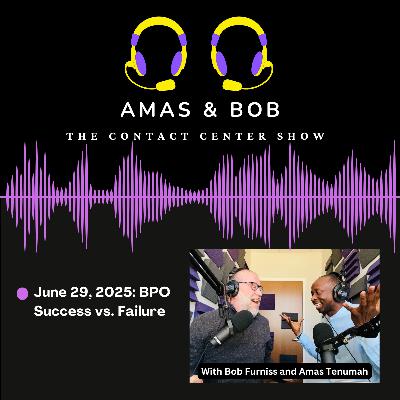
Summary In this conversation, Amas Tenumah and Bob Furniss discuss the intersection of sports fandom and the business of contact centers, particularly focusing on business process outsourcing (BPO). They explore the reasons companies choose to outsource their customer service operations, the challenges involved, and the evolving landscape of the BPO industry. The discussion emphasizes the importance of understanding core competencies, cost savings, and the need for competent consultants in the BPO space. Takeaways The NBA Finals can evoke strong emotions and rivalries. BPOs are third-party services handling customer interactions. Cost savings is the primary reason for outsourcing. Companies often outsource to focus on their core competencies. Successful outsourcing requires understanding what to delegate. BPOs can leverage scale and technology for efficiency. Choosing the right outsourcing partner is crucial. AI is changing the landscape of customer service. Consultants with deep contact center experience are valuable. The BPO industry is evolving to include more tech services. Chapters 00:00 NBA Finals and Personal Rivalries 01:15 Understanding BPOs and Contact Centers 02:26 The Decision to Outsource 03:35 Implementing Outsourcing Strategies 06:25 The BPO Industry's Shift to AI 08:07 Core Competencies in Outsourcing 10:52 Final Thoughts on BPO and Customer Care
Summary In this heartfelt conversation, Bob Furniss shares the story of his daughter Keisha, who bravely battled breast cancer and inspired many through her positivity and strength. Bob discusses the impact of her life, the challenges of writing a book about her journey, and the mission of the nonprofit established in her honor to raise awareness about breast health. The conversation emphasizes the importance of early detection and encourages listeners to take action in their own lives. Takeaways Keisha was a light in the world, known for her positivity. Bob wrote the book to honor Keisha's legacy and help others. The nonprofit aims to raise awareness about breast health. Early detection of breast cancer is crucial for survival. Keisha's story is a reminder to cherish loved ones. Bob encourages open conversations about health in families. The book captures the essence of Keisha's spirit. Bob's journey of writing was both challenging and healing. The nonprofit provides resources for young women regarding breast health. Keisha's impact continues through the stories shared by others. Chapters 00:00 Introduction and Weekend Highlights 02:54 The Story of Keisha: A Daughter's Legacy 05:58 Keisha's Impact and Personality 08:56 The Journey of Writing the Book 11:48 The Nonprofit Mission and Its Connection to Keisha 15:09 Encouraging Action: Breast Health Awareness 17:52 Reflections on Loss and Legacy 21:11 Final Thoughts and Call to Action 📚 Get the book: On to Blue (available on Amazon in all formats) 🌐 Support the cause: www.warriorprincess.org If you're a parent, friend, or leader—especially in a contact center full of women aged 25–45—listen to this conversation. Then talk to the women in your life. 👉 And ask her.
Summary In this conversation, Amas Tenumah and Bob Furniss discuss various aspects of customer service, focusing on trends, the importance of human interaction, and the role of AI. They reflect on personal experiences with customer service, emphasizing the need for effective communication and the challenges faced by contact centers. The discussion highlights customer preferences, skepticism towards AI, and the potential for technology to enhance human agents rather than replace them. Takeaways Customer service impacts loyalty, trust, and brand reputation. Ineffective customer service can quickly damage a brand's reputation. Customers still prefer human interaction, especially older demographics. AI is not yet fully capable of replacing human agents in customer service. Many customers are skeptical about the use of AI in service. The majority of customers still want to talk to a human. Self-service options can be frustrating for customers who prefer direct contact. AI can be used to support agents rather than replace them. Effective communication is crucial in addressing customer needs. Understanding customer preferences is key to improving service. Chapters 00:00 Weekend Reflections and Brisket Adventures 01:11 Customer Service Trends: Insights from the Article 03:49 The Importance of Human Interaction in Customer Service 07:37 AI in Customer Service: Current Limitations and Future Potential 10:59 Customer Preferences: The Skepticism Towards AI 11:52 Effective Use of AI: Enhancing Human Agents 14:12 Navigating the Future of Customer Service https://www.cmswire.com/contact-center/customer-service-trends-show-what-customers-really-want-its-not-just-ai/
This conversation delves into the critical role of frontline supervisors in contact centers, exploring the challenges they face, the future of their roles amidst technological advancements, and effective leadership strategies to support them. The discussion emphasizes the importance of human connection in leadership and the need for organizations to prioritize the well-being and development of their frontline supervisors. Takeaways The job of a frontline supervisor can be overwhelming. Many supervisors lack adequate training for their roles. Time management is crucial for supervisors to balance their responsibilities. Supervisors often spend less than 50% of their time with their teams. Technology is changing the landscape of contact centers, impacting supervisors' roles. AI and automation may not replace supervisors but change their responsibilities. Leadership should focus on personal growth and development. Praise and coaching should be balanced in management practices. Human customers will always need human supervisors. Organizations must check in on their frontline supervisors regularly.

Summary In this conversation, Amas Tenumah and Bob Furniss discuss the evolving landscape of contact centers, particularly focusing on Microsoft's recent rebranding efforts that redefine the term 'agent' to refer to bots rather than human representatives. They explore the implications of this shift, the role of technology in customer service, and the importance of maintaining a human connection in an increasingly automated environment. The discussion emphasizes the need for leaders in the industry to advocate for human agents while navigating the challenges posed by AI and digital transformation. Takeaways Microsoft's rebranding reflects a significant shift in the contact center industry. The term 'agent' is now being associated with bots rather than human representatives. Technology is becoming the focal point in contact centers, often at the expense of human agents. There is a need for industry professionals to push back against the over-reliance on technology. AI should be used to support human agents, not replace them. The future of customer service must include a balance between technology and human interaction. Leaders should advocate for the value of human agents in the face of automation. Customer loyalty is built on human connections, not technology. The conversation around AI in contact centers is evolving rapidly. It's essential to maintain clarity in terminology to avoid confusion between human and digital agents. Titles The Future of Contact Centers: Humans vs. Bots Navigating the AI Revolution in Customer Service Chapters 00:00 Introduction and Sports Banter 02:01 Microsoft's Rebranding and the Future of Contact Centers 06:05 The Role of Technology in Contact Centers 12:03 Navigating Change in Contact Center Operations 17:57 Conclusion and Call to Action 18:59 contact center show vertical outtro.mp4 Links:https://www.cxtoday.com/contact-center/microsoft-rebrands-its-contact-center-workspace-stops-using-the-term-agent-for-live-reps/ https://www.cxtoday.com/contact-center/microsoft-releases-three-ai-agents-for-a-more-autonomous-contact-center/

Comments

Download from Google Play

Download from App Store
 United States