


 Claim Ownership
Masters of Search
Subscribed: 3Played: 58
Subscribe

Description
NEW: Masters of Search Conference 2026 – Only 175 seats on 22.10.2026 in Berlin – Presented by Radyant, in partnership with Peec AI & OMR Reviews | The Masters of Search podcast (presented by Radyant) brings you the smartest people around the world in SEO & AI Search. Learn from their strategies, mental models and top pieces of actionable advice.
50 Episodes
Reverse

Artur Kosch, Co-CEO of KKP, on the agency operating system his team built on Claude Code: the morning briefing, which SEO tools they cancelled, what finance legal teams ask about AI, what they ripped out, and how juniors still become seniors.
🎟️ Masters of Search Conference 2027: 12 October 2027, Berlin. Malte is one of the first confirmed speakers. Tickets: https://www.masters-of-search.com/conference
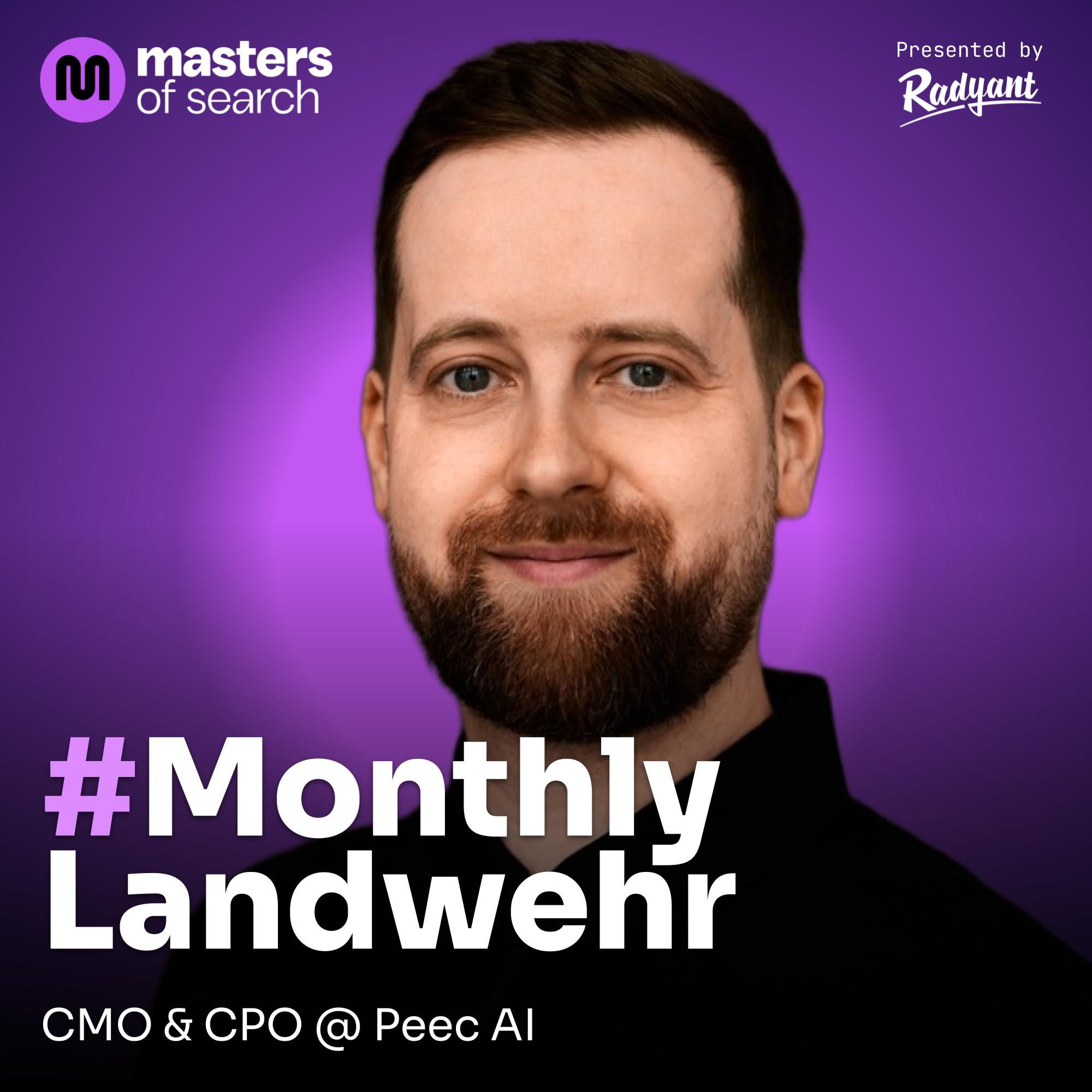
Every month I meet with Malte to take all the news, new research and interesting developments in SEO & AI Search to get his perspective on them. Malte Landwehr is CPO & CMO at Peec AI, one of the leading AI search analytics platforms.
This is the first episode after our summer break, recorded the day after the Masters of Search Conference 2026 in Berlin. We talk about Google poisoning the results it sends to scrapers, Graphite's research on parametric knowledge, ChatGPT's own search index Labrador, and why so many "LLM bot" visits in your log files are fake.
## My biggest takeaways from this episode:
1) Google now feeds some scrapers wrong results, so rank tracking is getting less reliable. Instead of blocking scrapers, Google sends some of them wrong results. This SERP poisoning is much harder to detect than a block. Expect less data, less accurate data and less up-to-date data from SEO tools. Malte does not expect this to get fixed. (Reference: https://www.masters-of-search.com/the-brief/google-is-poisoning-8-of-rank-tracker-serps-nozzle-finds)
2) What a model already knows about your brand decides which brands show up in its fan-out queries. Ask for white sneakers for the office, and the fan-out queries may already name Adidas and Nike. That makes it even harder for new brands to get in. Graphite calls optimizing for this Parametric Knowledge Optimization. (Reference: https://graphite.io/five-percent/research/parametric-knowledge-optimization)
3) For most companies, getting into training data takes the same work as getting into grounding. Publish a lot on your own site and earn positive mentions on reputable sites. Unless you sell data or are a publisher, you want LLMs to train on your content.
4) ChatGPT has its own search index, called Labrador. It is a family of indexes, with separate ones for PDFs, YouTube, news, shopping and more. Don't block OpenAI's crawlers, don't hide content behind JavaScript, and put your most important content right after your H1. (Reference: https://peec.ai/blog/chatgpt-built-its-own-search-index)
5) ChatGPT shopping works differently in the US than in Europe. In the US, product results mostly come from Labrador and merchant feeds. In Europe, ChatGPT still scrapes Google Shopping. (Reference: https://peec.ai/blog/chatgpt-shopping-optimization-in-2026-us-vs.-europe)
6) Many "LLM bot" visits in your log files are fake. First indications from Peec AI: about half of visits that claim to come from LLM bots do not, and on some sites it is 70 to 90 percent. Verify bots by IP and reverse DNS before you trust the data.
Our daily AI Search news, The Brief: https://www.masters-of-search.com/the-brief
## Let's connect!
Niklas on LinkedIn: https://www.linkedin.com/in/niklas-buschner/
Radyant on LinkedIn: https://www.linkedin.com/company/radyant/
Malte on LinkedIn: https://www.linkedin.com/in/landwehr/
Peec AI on LinkedIn: https://www.linkedin.com/company/peec-ai/

Apart from our monthly episodes with Malte Landwehr, David Konitzny is the first guest to come back to this podcast. In episode 2 he was still at the agency KKP, working on organic search. Since then he has joined Peec AI as a GEO researcher, which means he spends the whole day looking at how ChatGPT and the other AI search tools find and pick their sources. He shares most of it on LinkedIn the same day, because a finding can go stale within a week.
This time we went through his latest research. How ChatGPT reads a YouTube video, and why the answer is not what most people assume. What the drop of Reddit and YouTube in ChatGPT's retrieval means. Why so many of ChatGPT's searches started to target one specific domain. And how to tell which of the daily research posts should change your strategy, and which should not.

Marvin Müller joined OMR Reviews in 2021 as its first marketing hire, back when the platform held around 4,000 reviews. It has since passed 85,000, and the business is heading towards ten million euros in revenue. He came to it from Google in Dublin, where he spent his early career in search and performance marketing.
The interesting part is what happened in between. OMR Reviews grew on SEO — Marvin calls it the internal religion of the team — and then Google's AI Overviews rolled out in Germany. Impressions kept climbing to an all-time high. The clicks stopped arriving. Their first move was to block the LLM crawlers, and this episode is mostly the story of why they reversed that.
It worked. In the study OMR Reviews ran with Radyant — around 20,000 chats across five models and eight software categories, on German-language prompts — OMR Reviews came out as the single most-cited source of the roughly 8,000 domains analysed, ahead of YouTube and Reddit. After a hard 2024 the platform is now growing faster than ever and heading towards ten million in revenue.

Julian Redlich spent around six years at Booking.com, ending as Head of SEO, while the discipline there grew to roughly forty people across development, design, copy, analytics and SEO. He now sits on the other side of the table as an investor at Permira, looking at organic growth across a portfolio that includes mobile.de, Kleinanzeigen.de, Squarespace, Zendesk and Flixbus.
That combination is rare. Dozens of companies cross his desk every year, which means he sees patterns across business models most operators only ever see one of.
## My 8 biggest takeaways from our conversation:
1. The number one thing that worked at Booking.com was being able to change things on the website.
Not analysis. Most teams he sees spend the overwhelming majority of their time analysing, building internal decks and fighting internal battles, and only a few percent actually making a change. Adding content, creating pages, fixing the technical foundation: if those three are unblocked, you grow. Watching Search Console go up and reporting that it went up is not the work.
2. Three conditions decide whether SEO works at all: management support, peer trust, and access to the site.
If you lack top-management backing you spend your life re-proving the channel. If your development or data peers do not trust you, you stay in defensive mode. And if you cannot change the site, strategy is the only thing left to produce. When SEO stalls it is almost always one of these three, not a missing tactic.
3. Scaled landing pages only work when there is enrichment data behind them.
The Booking template was a database crossed with a pattern: hotels in {city} across roughly 230,000 cities, then the same again for around 600 regions. But a page for a village with no available hotels has no right to exist. That constraint is the whole difference between a large site and a thin one, and it is why "we need one perfect article" was never the strategy. A hundred thousand good pages bringing one click each beats one article.
4. Test on as much traffic as you can, not as little.
The instinct is to isolate an experiment in one small market so nothing breaks. Booking did the opposite: expose a big hypothesis to large traffic, get the signal back fast, keep it if it turns positive and kill it if it does not. A single blog article is usually not worth experimenting on at all. Experimentation earns its keep when the website is the product.
5. Failed experiments are the point, not an embarrassment.
Across roughly a thousand experiments plenty did not work, including a widely believed pagination theory the team tested at scale, which went nowhere because Google had quietly stopped using the signal at all. Every experiment that fails removes something from the list, so the list gets shorter and the remaining bets get better. Every experiment at Booking was peer reviewed, and product managers had to review other people's experiments as part of their own review cycle.
6. Delete the laundry list. Ship the one thing.
The complaint he hears at every company and every conference is that IT will not implement the backlog. His answer is blunt: delete the list, work out the single change most likely to move the site, and get that one shipped. Half the problem is self-inflicted. Stories are over- or under-documented, and SEOs routinely ask engineering for the wrong fix because they have already assumed the right one is impossible. Give the development team the full context of the real problem and they will usually solve it.
7. He hires on business acumen, communication and craft, and looks for people who build rather than opine.
Business acumen means understanding how the site makes money and how much your channel actually moves. Communication means being able to explain your three priorities to a C-level and to a junior. Craft is tested against the specific site type, because marketplace SEO and content-site SEO are different jobs. The disqualifier: arriving with a Lighthouse score to raise from 55 to 60. He wants to know whether you understand the demand in the market and can show relative share against competitors over time. He also still rates candidates with their own side project, because breaking your own site teaches you what does not move the needle.
8. The generative AI risk is ultimately a Google risk.
An opinion he formed back in 2022 and still holds. Google has the data, the decade of AI investment, and distribution across a stack of apps with billions of users: everything needed to do what ChatGPT, Claude and Perplexity are doing, better. On the super-app question his read is that customer behaviour changes slowly. The same fear was attached to Facebook becoming the place people shop and book, and to mobile-first destroying conversion rates. If it happens it happens gradually, with leading indicators in faster-moving markets, and that is when you react.
Also in this episode: how to size whether SEO deserves a place in your mix at all (if paid search works for you, organic probably matters too), and the keyword-universe method he uses to judge a market. Pull your competitors' keywords, pull their competitors' keywords, bucket the whole universe with an LLM, and compare share by commercial-intent bucket. Under a couple of hundred dollars in credits.
## Let's connect
Niklas on LinkedIn: https://www.linkedin.com/in/niklas-buschner/
Radyant on LinkedIn: https://www.linkedin.com/company/radyant/
Julian on LinkedIn: https://www.linkedin.com/in/julianredlich/
Check out Permira: https://www.permira.com/

Comments

Download from Google Play

Download from App Store
 United States