


 Claim Ownership
Cities@Tufts Lectures
Subscribed: 13Played: 99
Subscribe

Description
Tufts University and Shareable.net present Cities@Tufts, a free series exploring community innovations in urban planning. The live discussions are moderated by professor Julian Agyeman and the podcast is hosted by Shareable's Tom Llewellyn.
The sessions will focus on topics such as Environmental justice vs White Supremacy in the 21st century; Sacred Civics: What would it mean to build seven generation cities; Organizing for Food Sovereignty; From Spatializing Culture to Social Justice and Public Space; Exploring Invisible Women Syndrome; The Introduction of Street Trees in Boston and New York; Design principles for the urban commons; and The Past, Present, and Future State of Cities.
The sessions will focus on topics such as Environmental justice vs White Supremacy in the 21st century; Sacred Civics: What would it mean to build seven generation cities; Organizing for Food Sovereignty; From Spatializing Culture to Social Justice and Public Space; Exploring Invisible Women Syndrome; The Introduction of Street Trees in Boston and New York; Design principles for the urban commons; and The Past, Present, and Future State of Cities.
72 Episodes
Reverse
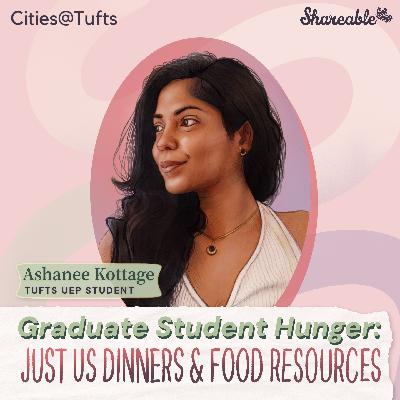
The Just Us Graduate Student Dinners emerged from a recognition of the quiet crisis of food insecurity and isolation that many graduate students—especially Global Majority, low-income, first-generation, and international students—experience. Academia often disembodies students, extracting them from their cultural food traditions and support networks while offering little institutional concern for whether they are nourished in mind and body. Just Us was conceived with a dual goal: to surface mutual aid networks that already exist among students while also advocating for institutional change to better support graduate student food security. Through shared meals and facilitated conversations, participants will unearth stories of food traditions, articulate their needs, and organize for concrete changes—whether through meal plans, stipends, or alternative food access programs. By partnering with campus affinity centers and guest facilitators who offer their own food stories as an invitation to dialogue, Just Us seeks to be more than just a meal—it is a movement toward re-rooting students in a sense of belonging, collective care, and food justice advocacy within the university. About the speaker Ashanee Kottage is a theater maker, poet, and scholar from Colombo, Sri Lanka, and the founder of Kavaya Press—an artist collective and sustainable publishing home for writers of the Global Majority responding to their environments. Her debut poetry collection Sand & Sweat traces a coming-of-age across continents, while her academic scholarship explores the journey of coming-of-place. With a degree from Georgetown's School of Foreign Service and a Master's in progress at Tufts in Sustainability, Ashanee approaches community gatherings and art making as both city-scale advocacy and national diplomacy. She is currently based between Boston and Colombo, working on her first film, Lunu Rekha, a meditation on tourism's impact on the south coast of Sri Lanka. Resources Cities@Tufts Lectures explores the impact of urban planning on our communities and the opportunities to design for greater equity and justice with professor Julian Agyeman. Cities@Tufts Lectures is produced by Tufts University and Shareable.net with support from Barr Foundation, Paige Kelly is our co-producer and audio editor. The original portrait of Ashanee Kottage was illustrated by Jess Milner. The series is co-produced and hosted by Tom Llewellyn. "Light Without Dark" by Cultivate Beats is our theme song.
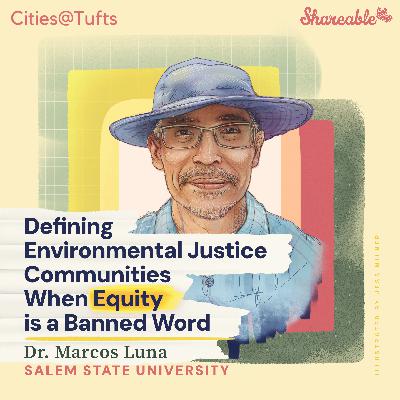
Since the emergence of the Environmental Justice movement, maps have been pivotal tools in revealing patterns of environmental and social inequality, in legitimizing what many communities already knew – that power and oppression shape the landscape of opportunity and risk. Mapping remains critical to Environmental Justice activism, research, and policy. Maps are often employed as tools of accountability, and as a result, mapping is both a technical and a political act, facing both technical and political challenges. Within the current political climate, these challenges have been magnified, but they are not new. They are familiar and pernicious obstacles to the larger movement for social justice. And they share a common root – a resistance to naming and confronting the role of racism and other forms of social and political marginalization that sustain the inequitable landscape of privilege and oppression. This is a discussion about how that resistance is manifested, how it challenges the task of mapping in environmental justice research and policy, and reflections on what it means to meaningfully engage with environmental justice mapping as a technical and political act. About the speaker Professor Marcos Luna joined the Geography and Sustainability Department at Salem State University in 2004. I received my Ph.D. in Urban Affairs and Public Policy with a concentration in Technology, Environment, and Society from the University of Delaware in 2007. I received my M.A. in Geography from California State University, Los Angeles, in 2000. Before coming to Salem State University, I worked as an Environmental Analyst for the Massachusetts Department of Environmental Protection, and before that, as a NASA-funded GIS consultant for Native American tribes in the Southwest and Northwest. I have participated in various health and environmental research and public service projects in Massachusetts, Delaware, and California, as well as at the national level. Resources Cities@Tufts Lectures explores the impact of urban planning on our communities and the opportunities to design for greater equity and justice with professor Julian Agyeman. Cities@Tufts Lectures is produced by Tufts University and Shareable.net with support from Barr Foundation, Paige Kelly is our co-producer and audio editor. The original portrait of Marcos Luna was illustrated by Jess Milner. The series is co-produced and hosted by Tom Llewellyn. "Light Without Dark" by Cultivate Beats is our theme song.
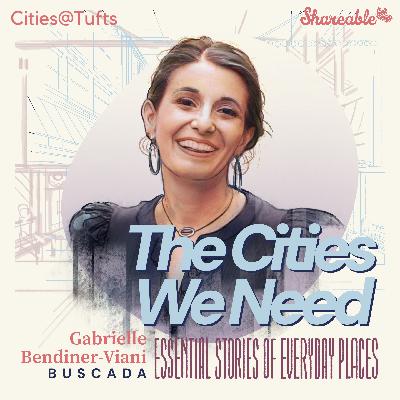
Where would you take someone on a guided tour of your neighborhood? In her recent book, The Cities We Need (MIT Press), photographer and urbanist Gabrielle Bendiner-Viani introduces us to the complex, political, and eminently personable stories of residents who answered this question in Brooklyn, New York, and Oakland, California. Their universal stories and Bendiner-Viani's evocative images illuminate what's at stake in our everyday places—from diners to churches to donut shops. In this culmination of two decades of research and art practice, Bendiner-Viani intertwines the personal, historical, and photographic to present us with placework, the way that unassuming places foster a sense of belonging and, in fact, do the essential work of helping us become communities. In this talk exploring her unique book, Bendiner-Viani makes visible how seemingly unimportant places can lay the foundation for a functional interconnected society, so necessary for both public health and social justice. The Cities We Need explores both what we gain in these spaces and how we risk losing both our senses of self and our democracy as they are threatened by gentrification, large-scale development, public health threats, and climate change. Ultimately, Bendiner-Viani shows us how to understand ourselves as part of a shared society, with a shared fate; she shows us that everyday places can be the spaces of liberation in which we can build the cities we need. More about The Cities We Need More about Gabrielle's work and her practice, Buscada About the speaker Dr. Gabrielle Bendiner-Viani is a writer, artist, and cofounder of the interdisciplinary studio on place and dialogue, Buscada. She is the author of The Cities We Need: Essential Stories of Everyday Places (MIT Press, 2024) and Contested City: Art and Public History as Mediation at New York's Seward Park Urban Renewal Area (University of Iowa Press, 2019), a finalist and honoree for the MAS Brendan Gill Award. A widely exhibited photographer, she was a professor of urban studies at the New School for a decade and has been a fellow at both the International Center of Photography in New York and the Centre for Urban Community Research at Goldsmiths, University of London. She holds a doctorate in environmental psychology from the Graduate Center, CUNY. Resources Cities@Tufts Lectures explores the impact of urban planning on our communities and the opportunities to design for greater equity and justice with professor Julian Agyeman. Cities@Tufts Lectures is produced by Tufts University and Shareable.net with support from Barr Foundation, Paige Kelly is our co-producer and audio editor. The original portrait of Dan O'Brien was illustrated by Jess Milner. The series is co-produced and hosted by Tom Llewellyn. "Light Without Dark" by Cultivate Beats is our theme song.
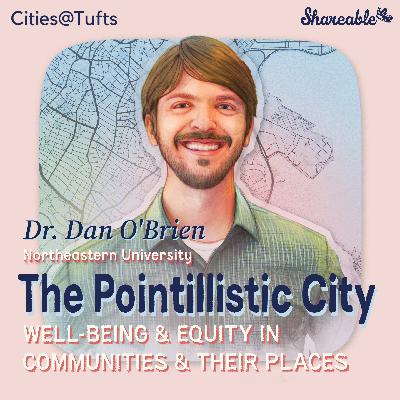
The Pointillistic City extends the classic observation that "neighborhoods matter" for health and well-being, arguing that we need to pay more attention to the other geographic scales that we live at—including streets within neighborhoods and even properties within streets—and how they each affect us. This is analogous to a pointillistic painting, which is similarly organized into dots within objects and objects within a full image. This "pointillistic perspective" surfaces microspatial inequities, or disparities between people living in the same neighborhood, as a pressing and overlooked concern for our science, policy, and practice. The book illustrates this perspective through two civic research projects: one on the impact of problem properties on public safety; and the other on the pertinence of "urban heat islets" and other hyperlocal hazards to environmental justice. It ends with guidance for designing policies and practices that address microspatial inequities, with an emphasis on putting cutting-edge data in the hands communities. About the speaker Dr. Dan O'Brien is Professor of Public Policy and Urban Affairs and Criminology and Criminal Justice at Northeastern University and Director of the Boston Area Research Initiative (BARI). His research focuses on equity in urban neighborhoods, including crime, environmental justice, and more. His three books, The Urban Commons (Harvard University Press; 2018), Urban Informatics (Chapman Hall / CRC Press; 2022), and The Pointillistic City (MIT Press; 2024), demonstrate the value of integrating data-driven science with community-oriented policy and practice. Resources Cities@Tufts Lectures explores the impact of urban planning on our communities and the opportunities to design for greater equity and justice with professor Julian Agyeman. Cities@Tufts Lectures is produced by Tufts University and Shareable.net with support from Barr Foundation, Paige Kelly is our co-producer and audio editor. The original portrait of Dan O'Brien was illustrated by Jess Milner. The series is co-produced and hosted by Tom Llewellyn. "Light Without Dark" by Cultivate Beats is our theme song.
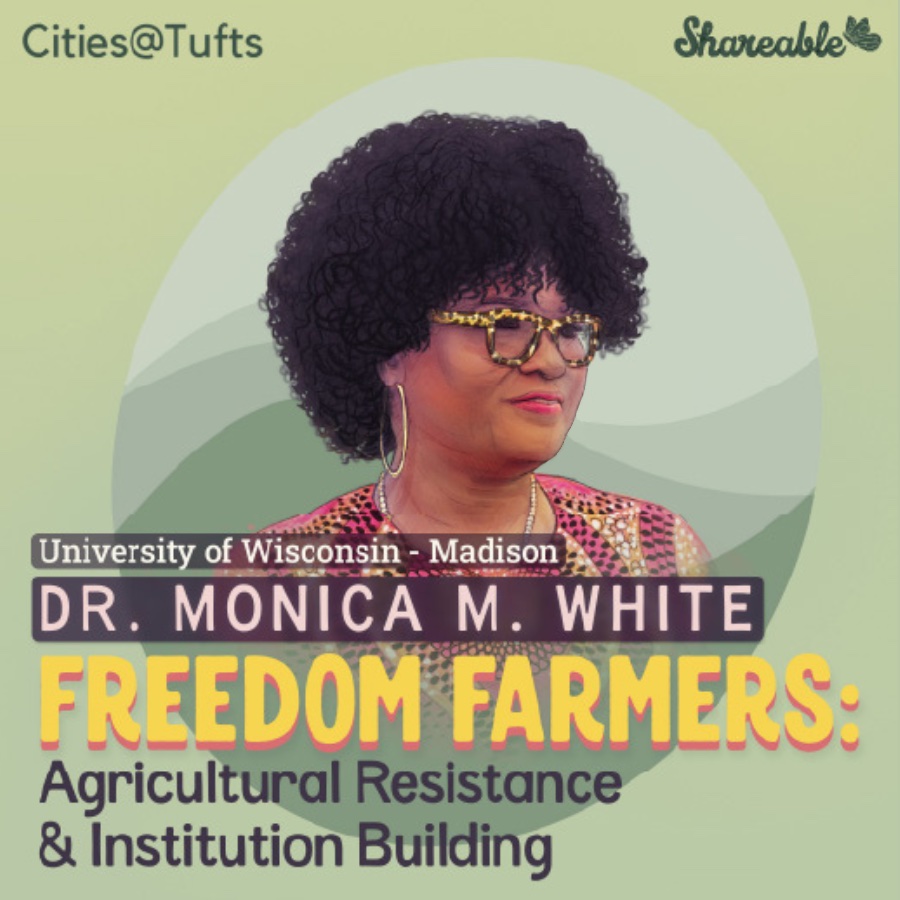
Dr. Monica M. White presented Freedom Farmers: Agricultural Resistance and Institution Building." The presentation provided context for understanding agriculture as a strategy of resilience and resistance for African Americans. It will offer a perspective of the labor and commitment to agriculture from those in southern Black rural communities to those building community-based food systems in urban spaces. About Monica White Dr. Monica M. White is the Distinguished Chair of Integrated Environmental Studies, associate professor of environmental justice at the University of Wisconsin-Madison, and past president of the board of directors for the Detroit Black Community Food Sovereignty Network. She is the first Black woman to earn tenure in both the College of Agricultural Life Sciences (established 1889) and the Nelson Institute of Environmental Studies (established 1970), to which she is jointly appointed. As the founding director of the Office of Environmental Justice and Engagement (OEJ) at UW-Madison, Dr. White works toward bridging the gap between the university and the broader community by connecting faculty and students to community-based organizations that are working in areas of environmental/food/land justice toward their mutual benefit. Her research investigates Black grassroots organizations that are engaged in the development of sustainable, community-based food systems as a strategy to respond to issues of hunger and food inaccessibility. In collaboration with the National Black Food and Justice Alliance, she serves as the Director of the HBCU project that seeks to develop agroecology centers at 1890-land grant institutions. She was an Andrew Carnegie Fellow for 2022-2024 and received the 2024 Distinguished Career for the Career Award in the Service of Sociology from the American Sociological Association. Dr. White's first book, Freedom Farmers: Agricultural Resistance and the Black Freedom Movement (University of North Carolina Press, 2019) received the First Book Award from the Association of Association for the Study of Food in Society, the Eduardo Bonilla-Silva Outstanding Book Award from the Division of Race and Ethnic Minorities Section of the Society for the Study of Social Problems, and an Honored Book Award from the Gendered Perspectives section of the Association of American Geographers. In addition to this audio, you can read the full transcript of the conversation and watch the lecture recording on Shareable.net—while you're there get caught up on past lectures. Cities@Tufts Lectures explores the impact of urban planning on our communities and the opportunities to design for greater equity and justice with professor Julian Agyeman. Cities@Tufts Lectures is produced by Tufts University and Shareable.net with support from Barr Foundation, Paige Kelly is our co-producer and audio editor. The original portrait of Monica White was illustrated by Jess Milner, and the series is co-produced and hosted by Tom Llewellyn. "Light Without Dark" by Cultivate Beats is our theme song.
Megan Saltzman presented her new book--Public Everyday Space: Cultural Politics in Neoliberal Barcelona--which explores how everyday practices in public space (sitting, playing, walking, etc.) challenge the increase of top-down control in the global city. Public Everyday Space focuses on post-Olympic Barcelona—a time of unprecedented levels of gentrification, branding, mass tourism, and immigration. Drawing from examples observed in public spaces (streets, plazas, sidewalks, and empty lots), as well as in cultural representation (film, photography, literature), this book exposes the quiet agency of those excluded from urban decision-making but who nonetheless find ways to carve out spatial autonomy for themselves. Absent from the map or postcard, the quicksilver spatial phenomena documented in this book can make us rethink our definitions of culture, politics, inclusion, legality, architecture, urban planning, and public space. About the speaker Megan Saltzman (PhD, University of Michigan) is a teaching professor at Mount Holyoke College in the department of Spanish, Latin American, and Latinx Studies, where she also contributes to the Five Colleges of Massachusetts Architectural Studies Program. Her research focuses on contemporary urban culture of Spanish cities with a transnational and ethnographic approach. Her 2024 book, Public Everyday Space: Cultural Politics in Neoliberal Barcelona combines literary and visual arts with fieldwork to expose how everyday practices in public space (sitting, playing, street selling) not only challenge the city's policed image but also serve to carve out autonomy from below. Megan has published on urban cultural themes in Spain related to gentrification, spatial in/exclusion, immigration, nostalgia, recycling, urban furniture design, grassroots cultural centers and "artivism." Most recently Megan has been teaching courses that revolve around three themes: (1) urban studies, (2) material and non-human culture, and (3) ethnically hybrid identities. Besides teaching at Mount Holyoke, Megan has enjoyed teaching at a variety of colleges, including the University of Otago (New Zealand), Grinnell College, the University of Michigan, Amherst College, West Chester University, and this coming fall at Sophia University in Tokyo. In addition to this audio, you can read the full transcript of the conversation and watch the lecture recording on Shareable.net – while you're there get caught up on past lectures. Cities@Tufts Lectures explores the impact of urban planning on our communities and the opportunities to design for greater equity and justice with professor Julian Agyeman. Cities@Tufts Lectures is produced by Tufts University and Shareable.net with support from Barr Foundation, Paige Kelly is our co-producer and audio editor. The original portrait of Hessann Farooqi was illustrated by Jess Milner, and the series is co-produced and hosted by Tom Llewellyn. "Light Without Dark" by Cultivate Beats is our theme song.

Canada was founded on enslavement and dispossession, most exemplified by its assimilationist ideologies and policies, the displacement, subjugation and oppression of Indigenous and Black peoples and cultures, and the expropriation of Indigenous lands. The colonial theft of land and the accumulation of capital have been foundational to Canada's wealth. In this presentation, Dr. Ingrid Waldron uses settler colonial theory to examine environmental racism in Canada to highlight the symbolic and material ways in which the geographies of Indigenous and Black peoples have been characterized by erasure, domination, dehumanization, destruction, dispossession, exploitation, and genocide. She offers a historical overview of cases of environmental racism in Canada and outlines how she has been addressing environmental racism over the last 10 years in partnership with Indigenous and Black communities, and their allies. About the speaker Dr. Ingrid Waldron is Professor and HOPE Chair in Peace and Health in the Global Peace and Social Justice Program in the Faculty of Humanities at McMaster University. Her research focuses on environmental and climate justice in Black, Indigenous, and other racialized communities, mental illness and dementia in Black communities, and COVID-19 in Black and South Asian communities. Ingrid is the author of the book There's Something in the Water: Environmental Racism in Indigenous and Black Communities, which was turned into a 2020 Netflix documentary of the same name and was co-produced by Waldron, actor Elliot Page, and Ian Daniel. She is the founder and Director of the Environmental Noxiousness, Racial Inequities and Community Health Project (The ENRICH Project) and helped develop the federal private members bill a National Strategy Respecting Environmental Racism and Environmental Justice (Bill C-226). Bill C-226 was approved at Senate on June 13, 2024, and given royal assent on June 20, 2024, becoming the first environmental justice law in Canada. Dr. Waldron's book entitled From the Enlightenment to Black Lives Matter: The Impact of Racial Trauma on Mental Health in Black Communities, was published on November 25, 2024. It traces experiences of racial trauma in Black communities in Canada, the US and the UK from the colonial era to the present. In addition to this audio, you can read the full transcript of the conversation and watch the lecture recording on Shareable.net – while you're there get caught up on past lectures. Cities@Tufts Lectures explores the impact of urban planning on our communities and the opportunities to design for greater equity and justice with professor Julian Agyeman. Cities@Tufts Lectures is produced by Tufts University and Shareable.net with support from Barr Foundation, Paige Kelly is our co-producer and audio editor. The original portrait of Hessann Farooqi was illustrated by Jess Milner, and the series is co-produced and hosted by Tom Llewellyn. "Light Without Dark" by Cultivate Beats is our theme song.
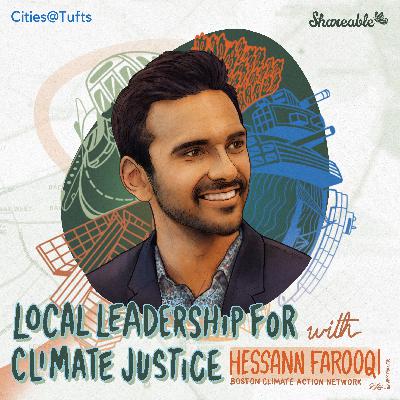
This talk explores how and why city governments can step up to lead on climate action and how resident organizing is critical in making this happen. This talk also explores how to build and sustain the political coalition to ensure climate justice policies can be passed and implemented. Hessann Farooqi is the Executive Director of the Boston Climate Action Network. He is the youngest person and the first person of color appointed to lead BCAN. Hessann studied economics at Boston University, worked in the United States Senate under Sen. Ed Markey, and served on various federal, state, and local political campaigns. Boston Mayor Michelle Wu also appointed him to oversee the implementation of Boston's key climate law on the Building Emissions Reduction and Disclosure Ordinance (BERDO) Review Board. Hessann is Co-Coordinator of the Boston Green New Deal Coalition and serves as an Environmental Justice Advisor to the Metropolitan Area Planning Council on developing their Greater Boston Climate Action Plan. Hessann previously served as an advisor to The White House and Department of Energy's Opportunity Project. In addition to this audio, you can read the full transcript of the conversation and watch the lecture recording on Shareable.net – while you're there get caught up on past lectures. Cities@Tufts Lectures explores the impact of urban planning on our communities and the opportunities to design for greater equity and justice with professor Julian Agyeman. Cities@Tufts Lectures is produced by Tufts University and Shareable.net with support from Barr Foundation, Paige Kelly is our co-producer and audio editor. The original portrait of Hessann Farooqi was illustrated by Jess Milner, and the series is co-produced and hosted by Tom Llewellyn. "Light Without Dark" by Cultivate Beats is our theme song.
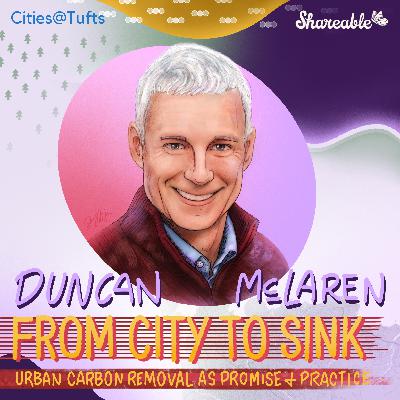
Climate policy increasingly relies on techniques to remove CO2 from the environment as a supplement to cutting emissions: counter-balancing residual emissions in 'net-zero' and reducing atmospheric concentrations of CO2 to safer levels. In this talk, Duncan will survey how cities are engaging with carbon removal – reviewing the realistic scope of possibilities such as carbon negative building materials, and carbon removal through urban waste management; and suggest ways in which urban carbon removal could be governed to contribute to goals of justice and sustainability. Duncan McLaren is currently a Research Fellow with the Institute for Responsible Carbon Removal at American University. His research examines the politics and implications for justice of novel technologies, particularly using public engagement methods. Prior to his PhD studies, completed in 2017, Duncan worked as an environmental researcher and campaigner, most recently as Chief Executive of Friends of the Earth Scotland from 2003 to 2011. He has advised and consulted for research and financial institutions, government departments, philanthropic donors and non-governmental bodies on energy, climate, urban and sustainable development issues. Duncan can be found on Bluesky @duncanmclaren.bsky.social, and at www.duncanmclaren.net. In addition to this audio, you can read the full transcript of the conversation and watch the lecture recording on Shareable.net – while you're there get caught up on past lectures. Cities@Tufts Lectures explores the impact of urban planning on our communities and the opportunities to design for greater equity and justice with professor Julian Agyeman. Cities@Tufts Lectures is produced by Tufts University and Shareable.net with support from Barr Foundation, Paige Kelly is our co-producer and audio editor. The original portrait of Duncan McLaren was illustrated by Jess Milner, and the series is co-produced and hosted by Tom Llewellyn. "Light Without Dark" by Cultivate Beats is our theme song.
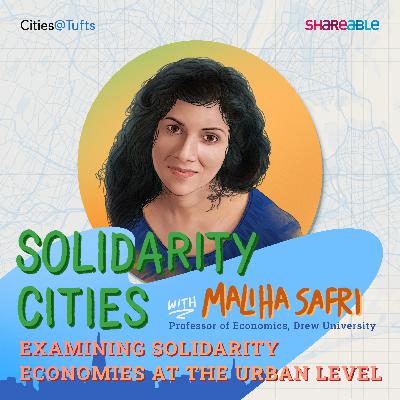
Contemporary urban discourse is caught in a binary between the Gentrified City, and the Disinvested City. Maliha Safri's new book presents an alternative urban imaginary: the Solidarity City. Her new co-authored book Solidarity Cities. Confronting Racial Capitalism, Mapping Transformation introduces an alternative spatial imaginary highlighting solidarity relations as definitional features of urban life. In contrast to profit-motive and competition, solidarity economies and the corresponding international movement have commitments to cooperation, democracy, and inclusion. The movement is exceptionally diverse, bringing together community gardens, worker cooperatives, credit unions, all kinds of consumer cooperatives, mutual aid societies, and other organizations. The book makes visible through mapping solidarity economies in three cities - New York City, Philadelphia, and Worcester, MA and analyzes its impact on urban space through spatial analysis, qualitative research, interviews, and economic impact modeling. About the speaker Maliha Safri is Professor of economics at Drew University. Her academic research has focused on collective economic practices (including worker, food, and housing cooperatives, amidst other organizations). By teaching popular education seminars and courses with activists since 2000, and specifically with migrant workers at a variety of worker centers in the process of forming collectives, her research was based in concrete issues faced by participants of what some movement activists call solidarity economies, which are economies prioritizing cooperation and inclusion. She has published articles in Signs, Antipode, Environmental Policy and Governance, the Economist's Voice, Organization, among other journals and edited book collections. She has a new co-authored book Solidarity Cities: Confronting Racial Capitalism and Mapping Transformation (January 2025, University of Minnesota Press). Resources Solidarity Cities Confronting Racial Capitalism, Mapping Transformation by Maliha Safri, Marianna Pavlovskaya, Stephen Healy and Craig Borowiak In addition to this audio, you can read the full transcript of the conversation and watch the lecture recording on Shareable.net – while you're there get caught up on past lectures. Cities@Tufts Lectures explores the impact of urban planning on our communities and the opportunities to design for greater equity and justice with professor Julian Agyeman. Cities@Tufts Lectures is produced by Tufts University and Shareable.net with support from Barr Foundation, Paige Kelly is our co-producer and audio editor. The original portrait of Maliha Safri was illustrated by Jess Milner, and the series is co-produced and hosted by Tom Llewellyn. "Light Without Dark" by Cultivate Beats is our theme song.
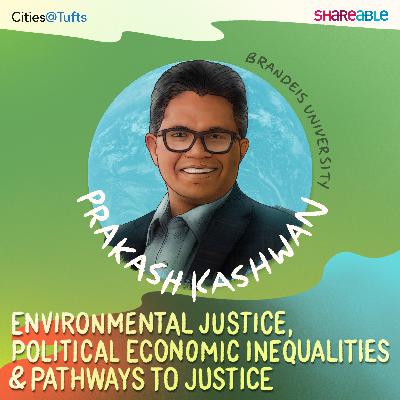
Most researchers of environmental and climate justice agree that political and economic inequalities hurt the environment, racial minorities, Indigenous Peoples, and other marginalized communities. Yet, these conclusions are based, almost exclusively, on analyses of the distribution of "environmental bads" (e.g., industrial pollution and toxic waste). Drawing on a longstanding and cumulative multi-methods research program focused on the distribution of "environmental goods" (biodiversity conservation), this lecture offers an alternative analysis of the relationship between environment and inequality with normative implications that are more complex than those implied in the environmental justice literature. Such ambiguous normative implications test the ability of societies to prioritize climate justice over climate action with dubious social impacts. In conclusion, we engage in collective reflections on the prospects of developing politically-resilient strategies for promoting environmental and climate justice. About the speaker Prakash Kashwan is an Associate Professor of Environmental Studies at Brandeis University. He is also the Chair of the Environmental Justice concentration in the Master of Public Policy (MPP) program at the Heller School of Social Policy and Management. His teaching, research, and scholarship focus on the intersections of environment, development, and socioeconomic and political dimensions of global environmental and climate change. Kashwan's academic engagements build on this interdisciplinary background, including a Bachelor of Science (B.Sc.), a Master's in Forestry Management), and a Ph. D. in Public Policy awarded under the tutelage of late Professor Elinor Ostrom, a political economist, who was the joint winner of the 2009 Nobel Prize for Economic Sciences. Equally important, Kashwan's research and writings are shaped profoundly by his over two decades-long engagements with global and international environmental governance, including a pre-academia career in international development (1999-2005). In addition to this audio, you can read the full transcript of the conversation and watch the lecture recording on Shareable.net – while you're there get caught up on past lectures. Cities@Tufts Lectures explores the impact of urban planning on our communities and the opportunities to design for greater equity and justice with professor Julian Agyeman. Cities@Tufts Lectures is produced by Tufts University and Shareable.net with support from Barr Foundation, Paige Kelly is our co-producer and audio editor, the original portrait of Prakash Kashwan was illustrated by Jess Milner, and the series is co-produced and hosted by Tom Llewellyn. "Light Without Dark" by Cultivate Beats is our theme song.
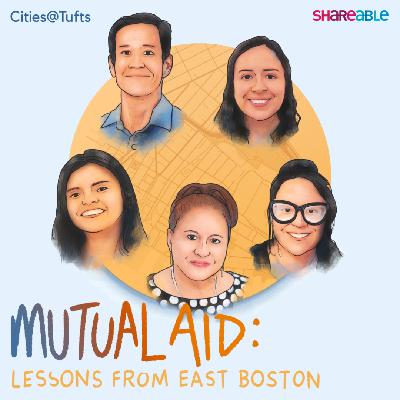
This is a special bonus episode of the Cities@Tufts podcast! Last fall, Tufts University Distinguished Senior Lecturer of Urban Environmental Policy and Planning, Penn Loh, hosted a discussion following the release of a new report, Mutual Aid Lessons from the COVID-19 Pandemic: Strengthening Civic Infrastructure in East Boston through Community Care. This episode is from that live event, hosted by Tufts UEP, on October 3, 2024 where panelists shared their mutual aid experiences, lessons learned, and other key findings from UEP-community report on how mutual aid can strengthen civic infrastructure, contribute to movements for social justice, and build communities of care. Resources: Report: Mutual Aid Lessons from the COVID-19 Pandemic: Strengthening Civic Infrastructure in East Boston through Community Care Shareable's Mutual Aid 101 Learning Series In addition to this audio, you can read the full transcript of the conversation on Shareable.net – while you're there get caught up on past lectures. Cities@Tufts Lectures explores the impact of urban planning on our communities and the opportunities to design for greater equity and justice with professor Julian Agyeman. Cities@Tufts Lectures is produced by Tufts University and Shareable.net with support from Barr Foundation, Paige Kelly is our co-producer and audio editor, the original portrait of the panelists was illustrated by Jess Milner, and the series is co-produced and hosted by Tom Llewellyn. "Light Without Dark" by Cultivate Beats is our theme song.
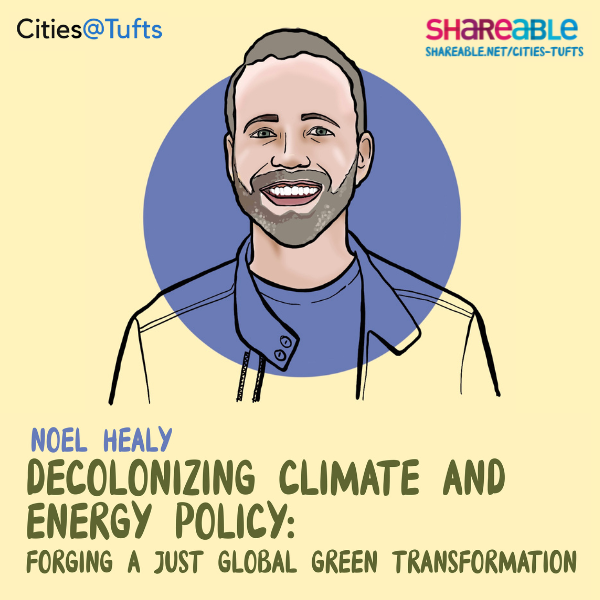
Addressing the climate crisis requires more than incremental reforms; it necessitates a transformative approach that dismantles deep-seated inequalities and confronts the historical injustices embedded in global structures. Achieving global climate justice hinges on decolonizing fossil fuel politics and dismantling obstructionist forces at both national and international levels. By drawing from and critiquing the Green New Deal movement, Professor Noel Healy explores what genuine economic and political transformation looks like in practice, emphasizing that these systemic changes are inseparable from the pursuit of global justice. Noel Healy is a Professor in the Geography and Sustainability Department at Salem State University (SSU) and the Director of the Climate Justice and Just Transitions Lab. His research explores the socio-political dimensions of rapid climate change mitigation, climate justice, fossil fuel politics, and climate obstructionism, with a focus on economic and racial justice in climate and energy policy. Dr. Healy was a contributing author on the UN's IPCC (AR6/WGIII) report, and he serves on the advisory board of Cell Reports Sustainability and the editorial board of Energy Research and Social Sciences. In addition to this audio, you can watch the video and read the full transcript of the conversation on Shareable.net – while you're there get caught up on past lectures. Cities@Tufts Lectures explores the impact of urban planning on our communities and the opportunities to design for greater equity and justice with professor Julian Agyeman. Cities@Tufts Lectures is produced by Tufts University and Shareable.net with support from Barr Foundation, Lectures are moderated by Professor Julian Agyeman and organized in partnership with research assistants Amelia Morton and Grant Perry. Paige Kelly is our co-producer and audio editor, the original portrait of Jose Richard Aviles was illustrated by Ronna Alexander, and the series is co-produced and hosted by Tom Llewellyn. "Light Without Dark" by Cultivate Beats is our theme song.
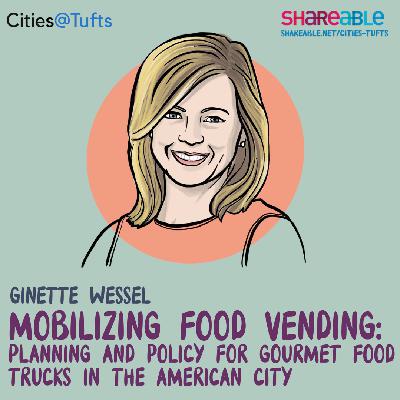
Throughout US history, street food vending has rarely been considered an improvement to modern society or its capitalist economy. However, beginning in 2008, a new generation of mobile vendors serving high-quality, inventive foods became popular among affluent populations. Ginette Wessel's new book, Mobilizing Food Vending: Gourmet Food Trucks in the American City (Routledge 2024), investigates the gourmet food truck movement in the US and provides a clearer understanding of the social and economic factors that shape vendor autonomy and industry growth. Using a human-centered approach, the book features case studies in a variety of American cities and uses top-down and bottom-up urban theory to frame a discussion of food trucks' rights, displacement, and resiliency. Wessel shows that food truck vendors are critical actors that support local economies and contribute to the public realm while shaping regulatory policy from the bottom up. This lecture appeals to urban scholars studying the contemporary neoliberal city, the public realm, and communication technology and mobility, as well as to urban planners seeking to understand how vendors shape city plans and policies. In addition to this audio, you can watch the video and read the full transcript of the conversation on Shareable.net – while you're there get caught up on past lectures. Cities@Tufts Lectures explores the impact of urban planning on our communities and the opportunities to design for greater equity and justice with professor Julian Agyeman. Cities@Tufts Lectures is produced by Tufts University and Shareable.net with support from Barr Foundation, Lectures are moderated by Professor Julian Agyeman and organized in partnership with research assistants Amelia Morton and Grant Perry. Paige Kelly is our co-producer and audio editor, the original portrait of Jose Richard Aviles was illustrated by Ronna Alexander, and the series is co-produced and hosted by Tom Llewellyn. "Light Without Dark" by Cultivate Beats is our theme song.

Reimagining Urban Planning is a talk based on the monthly webinar series of the same name hosted by the Othering and Belonging Institute at UC Berkeley. This talk openly critiques the ways in which Urban Planners have been trained and the impacts it has had in the ways Planners approach the Land, and the People that inhabit the land. This talk will share the key highlights from the series while also providing examples, shared by the speakers, that get us to an alternative approach to planning. The hope is that this talk will inspire planners to be more critical of how the field currently operates. Jose Richard Aviles is a Transportation Analyst for the Othering and Belonging Institute. As part of the Community Power and Policy Partnerships team, they support government agencies and partners with community organizations by providing trainings, technical assistance, and evaluation support centering lived experience, vision, and self-determination of the communities most impacted by transit inequities. Aviles draws inspiration from their involvement with the Bus Riders Union in Los Angeles and participation in other social justice movements like marriage equality. In addition to this audio, you can watch the video and read the full transcript of the conversation on Shareable.net – while you're there get caught up on past lectures. Cities@Tufts Lectures explores the impact of urban planning on our communities and the opportunities to design for greater equity and justice with professor Julian Agyeman. Cities@Tufts Lectures is produced by Tufts University and Shareable.net with support from Barr Foundation, Lectures are moderated by Professor Julian Agyeman and organized in partnership with research assistants Amelia Morton and Grant Perry. Paige Kelly is our co-producer and audio editor, the original portrait of Jose Richard Aviles was illustrated by Anke Dregnat, and the series is co-produced and hosted by Tom Llewellyn. "Light Without Dark" by Cultivate Beats is our theme song.
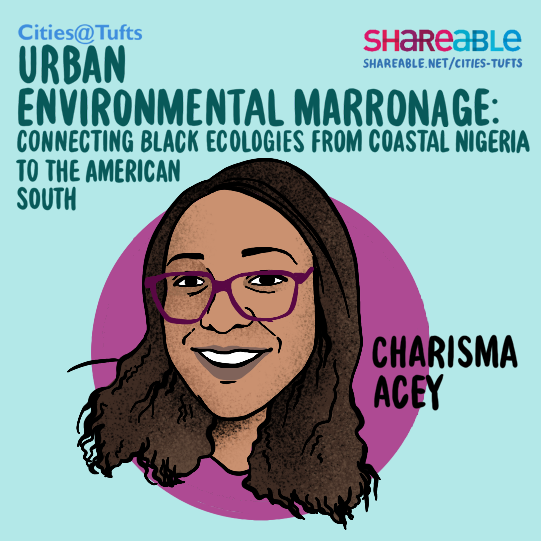
Urban Environmental Marronage: Connecting Black Ecologies from Coastal Nigeria to the American South explores how marginalized communities in coastal Nigeria and the American South draw upon historical practices of marronage to create autonomous spaces and combat environmental degradation within cities. Marronage refers to the practices of enslaved Africans who escaped to form free communities in inaccessible terrains. By connecting Black ecologies from Lagos and the Niger Delta to New Orleans and South Carolina, this presentation examines how communities adapt to environmental challenges, preserve cultural heritage, and develop alternative socio-ecological systems as forms of political and ecological empowerment. These contemporary case studies of resistance and resilience reflect the enduring legacies of maroon societies across the Black Atlantic, offering new insights into global struggles for human rights and environmental justice. Charisma Acey is Associate Professor and Arcus Chair in Social Justice and the Built Environment in the Department of City and Regional Planning at the University of California, Berkeley. Her research focuses on environmental justice, urban sustainability, and equitable access to basic services in cities. Dr. Acey's work spans the Americas and Africa, addressing issues such as climate vulnerability, access to clean water and safe sanitation, women's empowerment, and urban agroecology. She currently leads projects on air quality and food justice in California, employing participatory action research to identify inequitable policies impacting vulnerable communities. As Faculty Director of the Berkeley Food Institute and co-founder of the Dellums Clinic to Dismantle Structural Racism at the Institute for Urban and Regional Development, she champions interdisciplinary approaches to urban planning and environmental governance. Dr. Acey holds a Ph.D. in Urban Planning and a Master's in Public Policy from UCLA. She is a UW-Madison Health Equity Leadership Institute Scholar. Her work has been recognized with awards for excellence in community-based scholarship. Dr. Acey's publications appear in journals such as World Development, Landscape and Urban Planning, and The Lancet Global Health In addition to this audio, you can watch the video and read the full transcript of the conversation on Shareable.net – while you're there get caught up on past lectures. Cities@Tufts Lectures explores the impact of urban planning on our communities and the opportunities to design for greater equity and justice with professor Julian Agyeman. Cities@Tufts Lectures is produced by Tufts University and Shareable.net with support from Barr Foundation, Lectures are moderated by Professor Julian Agyeman and organized in partnership with research assistants Amelia Morton and Grant Perry. Paige Kelly is our co-producer and audio editor, the original portrait of Charisma Acey was illustrated by Anke Dregnat, and the series is co-produced and hosted by Tom Llewellyn. "Light Without Dark" by Cultivate Beats is our theme song.

Hacking the Archive: The Quest for More Just Urban Futures with Karilyn Crockett explores a Boston-based project that gamifies collective memory-driven social research and local knowledge sharing to anchor the intergenerational creation of future urban plans. Hacking the Archive (HTA) is a coalition of two dozen civic, faith-based and archival institutions advancing a novel data gathering and dissemination approach for populations underrepresented in the archive yet overrepresented in land-based battles for urban space. This talk focuses on HTA's current work to examine past and present grassroots strategies for tackling economic justice. Karilyn Crockett's research focuses on large-scale land use changes in twentieth century American cities and examines the social and geographic implications of structural poverty, racial formations and memory. Karilyn's book "People before Highways: Boston Activists, Urban Planners, and a New Movement for City Making" (UMASS Press 2018) investigates a 1960s era grassroots movement to halt urban extension of the U.S. interstate highway system and the geographic and political changes in Boston that resulted. In 2019 this book was named one of the "ten best books of the decade" by the Boston Public Library Association of Librarians. Karilyn holds a PhD from the American Studies program at Yale University, a Master of Science in Geography from the London School of Economics, and a Master of Arts and Religion from Yale Divinity School. She has previously served in Boston city government; first, as Director of Economic Policy & Research in the Mayor's Office of Economic Development and later as the City of Boston's first Chief of Equity, a Cabinet-level position. She is a professor of urban history, public policy and planning at MIT and currently leads the Greater Boston Chamber of Commerce in partnership with the Boston Federal Reserve Bank to assess the regional racial wealth gap. In addition to this audio, you can watch the video and read the full transcript of the conversation on Shareable.net – while you're there get caught up on past lectures. Cities@Tufts Lectures explores the impact of urban planning on our communities and the opportunities to design for greater equity and justice with professor Julian Agyeman. Cities@Tufts Lectures is produced by Tufts University and Shareable.net with support from Barr Foundation, Lectures are moderated by Professor Julian Agyeman and organized in partnership with research assistants Amelia Morton and Grant Perry. Paige Kelly is our co-producer and audio editor, the original portrait of Karilyn Crockett was illustrated by Anke Dregnat, and the series is co-produced and hosted by Tom Llewellyn. "Light Without Dark" by Cultivate Beats is our theme song.
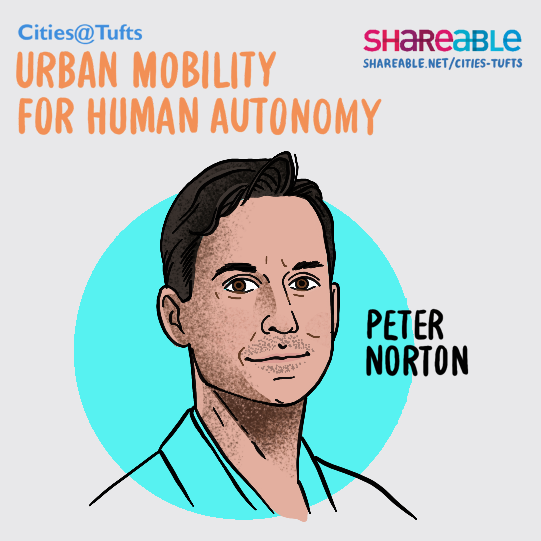
Measured by distance and speed, today North Americans move more than ever. Movement, however, is but a means to an end; more movement is not in itself beneficial. Movement is a cost of meeting daily needs, and provided these needs are met, less movement is generally advantageous. Nevertheless, since the 1930s traffic engineers have pursued movement maximization in North American cities as if movement is an end in itself, and even as if movement is in itself freedom. The human costs have included unbearable burdens measurable as financial, health, safety, equitability, livability and environmental costs. Together these burdens impair human autonomy; that is, by constraining people's choices about where and how to live, they diminish freedom. Automobility, promoted as a deliverer of freedom, has instead imposed car dependency, a kind of unfreedom. Paradoxically, many engineers now pursue so-called "autonomous" (robotic) driving, promising thereby to sustain unsustainable quantities of movement, when the sole worthy end of movement is not machine but human autonomy. To escape the traps that these errors set for us, we must trace them to their origins. Though engineering is defined as applied science, history reveals that the origins and persistence of prevailing traffic engineering principles lie not in scientific research but in power politics, and that such principles have more in common with religious dogmas than with natural laws. Far more practical possibilities await us when we escape the confines these dogmas impose on us and recognize movement as a secondary good that serves us only as it contributes to human autonomy. Peter Norton is an associate professor of history in the Department of Engineering and Society at the University of Virginia. He is a member of the University of Virginia's Center for Transportation Studies and has been a visiting faculty member at the Technical University of Eindhoven in the Netherlands. Norton is the author of Fighting Traffic: The Dawn of the Motor Age in the American City, and of Autonorama: The Illusory Promise of High-Tech Driving. He is a winner of the Usher Prize of the Society for the History of Technology, and a frequent speaker on the subject of sustainable and equitable urban mobility. In addition to this audio, you can watch the video and read the full transcript of the conversation on Shareable.net – while you're there get caught up on past lectures. Cities@Tufts Lectures explores the impact of urban planning on our communities and the opportunities to design for greater equity and justice with professor Julian Agyeman. Cities@Tufts Lectures is produced by Tufts University and Shareable.net with support from Barr Foundation, Lectures are moderated by Professor Julian Agyeman and organized in partnership with research assistants Amelia Morton and Grant Perry. Paige Kelly is our co-producer and audio editor, the original portrait of Peter Norton was illustrated by Anke Dregnet, and the series is co-produced and hosted by Tom Llewellyn. "Light Without Dark" by Cultivate Beats is our theme song.
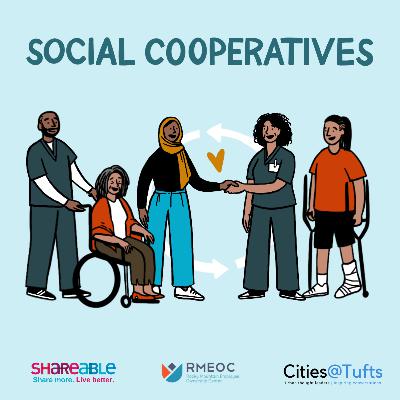
Cities@Tufts is still on our summer break, but we have a special offering for you this month. For the past eight weeks, Shareable has co-hosted the Social Cooperative Academy with the Rocky Mountain Employee Ownership Center and several other partners. Social cooperatives remain relatively obscure in the United States, despite thriving in various countries for over 30 years. Social coops blending the principles of cooperatives with a dedicated social purpose. Today, we're sharing a recording from the first session of the academy, "Why social coops offer potential transformation of care and more." This conversation features Doug O'Brien from the National Cooperative Business Association, John Restakis from Synergia Institute, Minsun Ji from RMEOC, and Matthew Epperson from Zolidar. In addition to this podcast, the video transcript and graphic recordings are available at Shareable.net. Cities@Tufts Lectures explores the impact of urban planning on our communities and the opportunities to design for greater equity and justice with professor Julian Agyeman. Cities@Tufts Lectures is produced by Tufts University and Shareable.net with support from Barr Foundation and SHIFT Foundation. Lectures are moderated by Professor Julian Agyeman and organized in partnership with research assistants Deandra Boyle and Grant Perry. Paige Kelly is our co-producer and audio editor, the original portrait of Karin Bradley was illustrated by Anke Dregnet, and the series is co-produced and hosted by Tom Llewellyn. "Light Without Dark" by Cultivate Beats is our theme song.
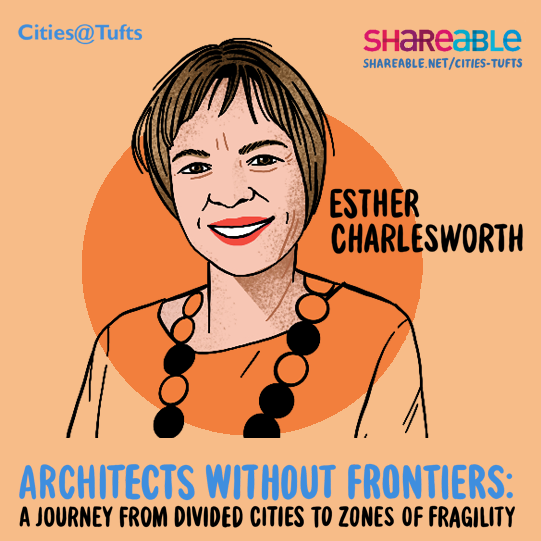
Professor Esther Charlesworth's talk for the Boston Salon on May 1, 2024 focused on her nomadic design journey across the last three decades. In trying to move from just theorizing about disaster architecture to designing and delivering projects for at-risk communities globally, Esther started both Architects Without Frontiers (Australia) and ASF (International); an umbrella coalition of 41 other architect groups across Europe, Asia and Africa. Architects Without Frontiers asks, how do we go from just pontificating about the multiple and intractable challenges of our fragile planet, to actually acting on them? Prof. Esther Charlesworth works in the School of Architecture and Design at RMIT University, where in 2016 she founded the Master of Disaster, Design, and Development degree [MoDDD] and the Humanitarian Architecture Research Bureau [HARB]. MoDDD is one of the few degrees globally, enabling mid-career designers to transition their careers into the international development, disaster and urban resilience sectors. In addition to this audio, you can watch the video and read the full transcript of their conversation on Shareable.net – while you're there get caught up on past lectures. Cities@Tufts Lectures explores the impact of urban planning on our communities and the opportunities to design for greater equity and justice with professor Julian Agyeman. Cities@Tufts Lectures is produced by Tufts University and Shareable.net with support from Barr Foundation and SHIFT Foundation. Lectures are moderated by Professor Julian Agyeman and organized in partnership with research assistants Deandra Boyle and Grant Perry. Paige Kelly is our co-producer and audio editor, the original portrait of Karin Bradley was illustrated by Anke Dregnet, and the series is co-produced and hosted by Tom Llewellyn. "Light Without Dark" by Cultivate Beats is our theme song.

Comments

Download from Google Play

Download from App Store
 United States