


 Claim Ownership
The Career Clinic Podcast
Subscribed: 6Played: 141
Subscribe

© Ronnie Dickerson Stewart 2026
Description
https://ohheycoachcareerclinic.libsyn.com
Whether you're in the "staying, growing or going" stage, on this podcast, no career topic is off the table.
Truth Moment: Everyone does not have equal access to executive coaching and career advancement resources. I believe everyone should be able to access tools to chart a successful career path that uniquely serves them. So YOU can think of me as a coach, consultant, or mentor who is one click and download away.
Welcome to The Career Clinic Podcast (powered by OhHeyCoach), I can't wait to see how we learn and grow together!
Whether you're in the "staying, growing or going" stage, on this podcast, no career topic is off the table.
Truth Moment: Everyone does not have equal access to executive coaching and career advancement resources. I believe everyone should be able to access tools to chart a successful career path that uniquely serves them. So YOU can think of me as a coach, consultant, or mentor who is one click and download away.
Welcome to The Career Clinic Podcast (powered by OhHeyCoach), I can't wait to see how we learn and grow together!
104 Episodes
Reverse

Episode 103: Stop: Before You Borrow Their Blueprint…First Ask "Why?" | The Career Clinic Podcast Host: Ronnie Dickerson Stewart Episode Overview In a world where we have front-row seats to everyone's success, it's never been easier to see what people are doing—and never harder to understand why. In this episode, Ronnie slows things down and invites you into a deeper level of discernment. Sparked by a powerful line from her recent newsletter, she breaks down a critical coaching principle: before you adopt someone else's strategy, path, or playbook…pause and ask better questions. Through personal stories, real-life examples, and a practical 5-question framework, this episode will help you move from imitation to intention—so you can build a life and career that actually fits you. What You'll Learn in This Episode: ✔️ Why copying what "works" for others can quietly lead you off track ✔️ The hidden gap between what people share and what actually drives their decisions ✔️ How Ronnie's own career pivot was shaped by context, not just courage ✔️ The difference between a possibility model and a blueprint (this will shift how you see everything) ✔️ A powerful 5-question framework to evaluate any move before you make it ✔️ How to filter inspiration without losing yourself in the process The 5 Questions to Ask Before You Borrow the Blueprint: • What problem were they actually trying to solve? • What did their life look like when they made that decision? • What values and priorities were driving that choice? • What did they try before this that you're not seeing? • What would your version of this actually look like? Links & Resources: 📖 Pre-Order Work Life Remix https://workliferemixbook.com/ 📩 Join the OhHeyMonday Newsletter: Get deeper insights and behind-the-scenes reflections → www.ohheyjoin.com 🤝 Let's Work Together! Explore coaching and leadership development → www.ohheycoach.com 📬 Want to Connect? Reach out at info@ohheycoach.com 🎧 Enjoying the Podcast? Leave a review—it helps more people find The Career Clinic and grow this community 💡 Final Thought: Before you move, before you adopt, before you execute—pause. Do you actually understand the why behind what you're seeing? That clarity might be the difference between building something that looks good… and building something that truly fits your life.
Episode 102. Let the Work Life Remix Era Begin | The Career Clinic Podcast Host: Ronnie Dickerson Stewart Episode Overview This episode is a little different—and a lot more personal. Ronnie takes you inside one of the most significant moments of her life and career: the private reveal and public pre-order launch of her debut book, Work Life Remix. Recorded in real time, just days after the launch, this episode brings you behind the scenes of the celebration, the emotion, and the deeper "why" behind the book. But more than that—it's an invitation. ✊🏾 An invitation to examine the changing reality of work, to question the default paths we've been handed, and to consider what it might look like to design something that actually fits your life. A grounded approach to reclaiming agency and building something that works for you. What You'll Learn in This Episode: ✔️ Why the traditional "work hard and you'll be okay" social contract is no longer holding up ✔️ The real tension high-achieving professionals are facing right now—and why it's not just you ✔️ Why the common options we're given around work often feel limiting ✔️ The philosophy behind Work Life Remix: keep what works, change what doesn't, design what fits ✔️ How to move out of the loop of fear, misalignment, and default decision-making ✔️ Why trusting your own judgment again is the ultimate goal ✊🏾 Links & Resources: 📖 Pre-Order Work Life Remix: Available wherever you buy books, including Bookshop.org, Amazon, Barnes & Noble, and more 🌐 Explore the Book Hub: https://workliferemixbook.com 📩 Join the OhHeyMonday Newsletter: Get insights, behind-the-scenes updates, and first access to everything Ronnie is building → www.ohheyjoin.com 🤝 Let's Work Together! Learn more about coaching and leadership development at www.ohheycoach.com 📬 Want to Connect? Reach out to the team at info@ohheycoach.com 🔥 If this episode resonated, share it with someone who's been asking bigger questions about their life and career—and tag Ronnie (@ohheycoach) so she can celebrate with you ✊🏾 💡 Final Thought: You can't rewind or redo what's come before, but you can remix it.
Episode 101: Naming & Navigating Your Season The Career Clinic Podcast Host: Ronnie Dickerson Stewart After the milestone of 100 episodes and the reveal of a new era, Ronnie brings the conversation back to something foundational: understanding the season you are in and learning how to move within it with clarity and honesty. In this episode, she sits with a simple but often overlooked idea—many of us are trying to move forward without first naming where we actually are. And when you don't name your season, you can end up: Expecting the wrong things from yourself Measuring progress incorrectly Feeling frustrated when things aren't moving the way you thought they would This conversation introduces Ronnie's Five Seasons framework—growing, sowing, glowing, woahing, and going—but more importantly, it's about helping you slow down long enough to tell the truth about your current season. Because when you can name it, you can work with it. And when you can work with it, you stop fighting it. What You'll Hear in This Episode ✔️ Why so many people feel stuck without realizing they've misidentified their season ✔️ A grounded walkthrough of the Five Seasons framework ✔️ How pressure and comparison distort how we see our current reality ✔️ Why each season requires a different pace, energy, and expectation ✔️ How to move forward with more clarity instead of forcing momentum The Invitation 🤎 Take a moment this week and ask yourself: What season am I actually in right now? Not the one that sounds impressive. Not the one you wish you were in. The one that is true. Then ask: What does this season require of me? You don't need to rush the answer. But you do need to be honest. RSVP for the Book Reveal & Pre-Order Party Tuesday, March 31 | 3:00–4:00 PM ET | Zoom https://us02web.zoom.us/meeting/register/gy7TLsAyRZSYFpp_2QbVHw I genuinely hope to see you there! The countdown is ON!
Episode 100: A New Era Unveiled The Career Clinic Podcast Host: Ronnie Dickerson Stewart 100 episodes. A journey that started in 2019 with a MacBook, Garage Band, and a closet full of pillows. Today, Ronnie sits in the milestone, gets honest about what it took to get here, and shares something she's been waiting to tell you. What You'll Hear in This Episode ✔️ The real journey to 100 episodes and why most podcasts never make it this far ✔️ The origin story: a journal entry, a camera, and a commitment to anti-gatekeeping ✔️ How the podcast is evolving beyond career strategy into work and life ✔️ A major announcement you don't want to miss Timestamps 00:00 — Sitting in the milestone 04:00 — The reality: 90% of podcasts don't make it past 10 episodes 08:00 — Regrounding: who I am and how we got here 10:00 — The origin story and the journal entry that started it all 15:00 — A new era: what's changing and where we're going 17:00 — The announcement 22:00 — What's next The Announcement 📖 Ronnie has written a book. And before the rest of the world finds out, she wants you in the room. On March 31st from 3:00 to 4:00 PM Eastern, she's hosting a private Book Reveal and Pre-Order Launch Party on Zoom. Cover reveal. Title reveal. Pre-orders open. Book tour cities announced. Behind-the-scenes details on what's coming between now and September 15th. Surprise and delight. And yes, it's a party. This is for the insiders. The community. The people who've been here. 👉🏾 Register here (free): https://us02web.zoom.us/meeting/register/gy7TLsAyRZSYFpp_2QbVHw What's Next 🤎 100 is not an endpoint. It's the foundation. New episodes drop every Wednesday. Follow or subscribe so you don't miss what's next. Stay Connected 🤎 📩 OhHeyMonday Newsletter: ohheyjoin.com 📖 Speaking, Facilitating & Leadership Development: ohheycoach.com 💼 LinkedIn: Ronnie Dickerson Stewart 📸 Instagram: @ohheycoach
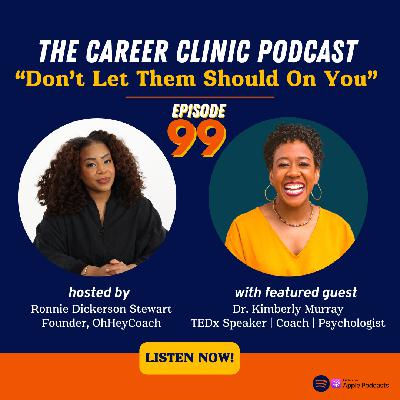
Episode 99: Don't Let Them Should on You (And Don't Should on Yourself Either) featuring Dr. Kimberly Murray The Career Clinic Podcast Host: Ronnie Dickerson Stewart Episode Overview In this episode of The Career Clinic Podcast, Ronnie Dickerson Stewart is joined by psychologist, leadership coach, and TEDx speaker Dr. Kimberly Murray for a thoughtful conversation about the quiet but powerful influence of "should." The expectations about what your career should look like. Who you should become. How long you should stay. What success should feel like. These expectations often come from workplaces, industries, family members, mentors, or even our own internalized beliefs about achievement. Over time, those voices can lead us to over-edit ourselves, silence our instincts, or follow paths that no longer fit the person we are becoming. Together, Ronnie and Dr. Murray unpack how the pressure of "should" shows up in leadership, identity, and career decisions. They explore how high-capacity professionals often learn to shrink, over-accommodate, or second-guess themselves in environments where their perspective is actually needed most. This conversation is honest, grounding, and practical. It's about recognizing when expectations are shaping your decisions and reclaiming the freedom to define your path in a way that actually aligns with your voice, values, and evolution. If you've ever felt pressure to follow a script that doesn't quite fit anymore, this episode will resonate deeply. What You'll Learn in This Episode ✊🏾 Why the word "should" can quietly shape career decisions in ways that disconnect us from our truth ✊🏾 How workplace culture, family expectations, and internal narratives influence how we edit ourselves professionally ✊🏾 Why high-achieving professionals often learn to over-accommodate or silence their instincts ✊🏾 The difference between thoughtful growth and living according to someone else's blueprint ✊🏾 How to begin reclaiming your voice and making career decisions that reflect who you are becoming About Dr. Kimberly Murray Dr. Kimberly Murray is a psychologist, leadership coach, and TEDx speaker who helps high-achieving professionals design lives and careers that reflect their full identities—not just their job titles. Her work centers on sustainable ambition, integrated leadership, and helping leaders navigate overlapping roles, creativity, purpose, and professional success without abandoning parts of themselves along the way. Through her coaching, speaking, and research-informed approach, Dr. Murray supports individuals in aligning their strengths, energy, and values so they can thrive both personally and professionally. Learn more about Dr. Murray and her work: 🌐 Website: https://drkimberlymurray.com/ 🎥 TEDx Talk: https://www.youtube.com/watch?v=ANQnt40GS3k 📩 Connect: hello@drkimberlymurray.com Links & Resources 📩 Join the OhHeyMonday Newsletter: Get my insights straight to your inbox every Monday! Sign up at www.ohheyjoin.com 🎧 Ask OhHeyCoach: Have a question you'd like answered on the podcast? Submit it here: https://form.typeform.com/to/ja89DHpT 🤝 Let's Work Together: If you're a leader or organization looking for executive coaching, leadership development, or career design strategies, we'd love to partner with you. Learn more at www.ohheycoach.com 📬 Want to Connect? Reach out to our team at info@ohheycoach.com 🔥 If you loved this episode, share it with a friend and tag me on LinkedIn or Instagram (@ohheycoach)! Let's keep this conversation going. 💡 Final Thought: Expectations will always exist, but they shouldn't run your life. Pay attention to the voices shaping your decisions and make sure the path you're walking actually belongs to you.
Episode 98: Don't Second-Guess the Shift… It Just Takes Time The Career Clinic Podcast with Ronnie Dickerson Stewart Building on last week's conversation about the changing social contract with work, this episode sits in the tension between knowing you need to build your own security and actually doing something about it. Ronnie gets real about the gap between awareness and action — and why that gap isn't a character flaw, it's the human experience of navigating change. In this episode, Ronnie explores: Why your job isn't the enemy — and why honoring your current provision matters The real tension: the thing that provides for you also takes up the time and energy you'd need to build something beyond it Why awareness and action aren't the same thing — and why we need to stop pretending they are The mindset shift isn't a one-time event; it's a messy, nonlinear, ongoing practice Giving yourself permission to wish the old blueprint still worked and build in the landscape that actually exists Small, doable starting points for building your own coverage — without blowing anything up Key Takeaways: The constraint is never desire — it's usually capacity, and lack of capacity is real. You can hold a wish for things to be different and still take care of yourself in the world as it is. Building your own security is not a weekend project. It's a long arc that starts with small, steady moves. The goal isn't to leap into a new mindset overnight — it's to close the gap a little bit at a time. Start Here — Small Moves Ronnie Suggests: Have a coffee conversation with someone you admire Update an asset that lets people see your work (like your LinkedIn profile) Engage on LinkedIn — comment, like, share — without the pressure to post Pay attention to what's portable: skills, relationships, and value that travel with you Name the thing out loud with someone you trust What's Next 🤎 We are approaching Episode 100 in March, and something special is coming 🤎. New episodes of The Career Clinic Podcast drop every Wednesday. Make sure you follow or subscribe so you don't miss what's next. If this episode resonated, share it with someone who may be waiting on themselves. Stay Connected 🤎 📩 Join the OhHeyMonday Newsletter Weekly reflections and grounded leadership tools 👉🏾 www.ohheyjoin.com 🤝 Work With Ronnie / OhHeyCoach Executive coaching and leadership development 👉🏾 www.ohheycoach.com Final Thought 🤎 Readiness often arrives after you begin, not before. If you've been waiting for a feeling to confirm what you already know, it may be time to trust your judgment and take the next step. See you next Wednesday.
Episode 97: This Is the Year That Will Completely Change Your Relationship With Work The Career Clinic Podcast Host: Ronnie Dickerson Stewart Episode Overview In Episode 97, Ronnie shifts the tone of the podcast to address something urgent and real: the reality that job security, as many of us once understood it, has fundamentally changed. This episode is less about tactics and more about a mindset shift. If you've felt like you're one restructure away from disruption, or you've watched talented people around you recalibrate unexpectedly, this conversation is for you. What You'll Hear in This Episode ✔️ Why job security has shifted — even at strong companies ✔️ Why this moment requires a new blueprint ✔️ How generational advice still makes sense — but needs updating ✔️ The danger of building provision in only one place ✔️ What it means to adopt a portfolio career mindset ✔️ Why this year may need to be the year you rethink your relationship with work The Mindset Shift: From Employee to "You Inc." Rather than offering a checklist of tips, Ronnie invites listeners into a deeper recalibration. What if you thought of yourself as "You Inc."? What if your primary employer was You Inc., and your job was simply one client of many possible revenue sources, identity anchors, or professional expressions? This is not just about side hustles. It's not a hustle culture pitch. It's about strategic optionality. It's about understanding that your time, skills, relationships, and brand have value beyond one organizational structure. A portfolio career mindset does not require you to quit your job. It requires you to think differently about permanence, agency, and alignment. Why This Year Matters 🤎 This episode is a call to stop pretending permanence still operates the way it once did. It is an invitation to rethink your relationship with work before something forces you to. We deserve better. And when we cannot immediately get better systems, we build better strategies for ourselves. Stay Connected 🤎 📩 Join the OhHeyMonday Newsletter Weekly reflections and leadership insight 👉🏾 www.ohheyjoin.com 🤝 Work With Ronnie / OhHeyCoach Executive coaching and leadership development 👉🏾 www.ohheycoach.com Final Thought 🤎 This may be the year that completely changes your relationship with work — not because something collapses, but because you finally choose to design it differently. See you next week!
Episode 96: Stop Waiting to Be Ready The Career Clinic Podcast Host: Ronnie Dickerson Stewart Episode Overview Welcome back to The Career Clinic Podcast 🤎. In Episode 96, Ronnie addresses something that quietly stalls more careers and ideas than lack of talent ever does: the habit of waiting to feel ready. This episode explores why readiness is often a moving target, how over-preparation can become avoidance, and why clarity rarely arrives before action. Whether you're considering a pivot, launching something new, raising your hand, or finally starting the thing you've been thinking about for years, this conversation is about moving forward without the illusion of perfect timing. What You'll Learn in This Episode ✔️ Why readiness is more of a decision than a feeling ✔️ The hidden cost of waiting too long ✔️ How over-preparation can delay execution ✔️ Why waiting for permission slows momentum ✔️ The myth of perfect timing ✔️ Three practical ways to move before you feel fully ready The Readiness Trap When people say, "I'm not ready," it's rarely about actual capability. More often, it's about exposure, uncertainty, or fear of being seen before everything feels polished. Ronnie reflects on launching this podcast without a 100-episode plan, stepping away from a C-suite role without a fully mapped five-year blueprint, and beginning the process of writing a book without knowing every detail of how it would unfold. In each case, clarity followed movement. It did not precede it. The idea that you will feel completely prepared before taking action is one of the most convincing myths in professional life. The Cost of Waiting 🤎 We often overestimate the risk of starting and underestimate the cost of delaying. Waiting can erode confidence. It can shrink momentum. It can quietly chip away at self-trust. The longer you sit with something you know you want to pursue, the louder doubt becomes and the smaller your original conviction feels. At some point, the cost of waiting outweighs the discomfort of beginning. Three Common Disguises of "I'm Not Ready" Over-preparation. Taking another course, reading another book, asking five more people for input. Preparation is wise. Endless preparation that never converts to execution is avoidance. Waiting for permission. There is rarely a formal invitation to step into your next chapter. No one is coming to certify you as ready. Authority is often assumed, not granted. Perfect timing. There will always be a reorg, a busy season, a market shift, or a personal responsibility that makes now feel inconvenient. Timing matters, but perfection is not a prerequisite for progress. How to Move Before You Feel Ready ✍🏾 First, shrink the ask. Instead of taking the full leap, take the next step. Send the email. Outline the idea. Have the conversation. Test the concept. Small action builds real clarity. Second, set a decision date. If something has been circulating in your mind for months, give yourself a deadline to decide your next move. Not the entire plan — just the next move. Third, borrow belief. If your fear is louder than your confidence, talk to someone who can hold perspective with you. A trusted friend, mentor, or coach can help steady the narrative long enough for you to move. Listener Invitation 🤎 If something has been tugging at you — an idea, a pivot, a conversation, an application — consider whether you're truly unprepared or simply uncomfortable. You may not feel ready. That doesn't mean you aren't capable. What's Next We are approaching Episode 100 in March, and something special is coming 🤎. New episodes of The Career Clinic Podcast drop every Wednesday. Make sure you follow or subscribe so you don't miss what's next. If this episode resonated, share it with someone who may be waiting on themselves. Stay Connected 🤎 📩 Join the OhHeyMonday Newsletter Weekly reflections and grounded leadership tools 👉🏾 www.ohheyjoin.com 🤝 Work With Ronnie / OhHeyCoach Executive coaching and leadership development 👉🏾 www.ohheycoach.com Final Thought 🤎 Readiness often arrives after you begin, not before. If you've been waiting for a feeling to confirm what you already know, it may be time to trust your judgment and take the next step. See you next Wednesday.
Episode 95: When You Can't Afford to Leave The Career Clinic Podcast Host: Ronnie Dickerson Stewart Episode Overview Welcome back to The Career Clinic Podcast 🤎. We're officially beyond the January Intensive and settling into our regular rhythm — with new episodes dropping every Wednesday. In Episode 95, Ronnie addresses a reality that doesn't get talked about enough: what to do when you know you need to leave a role, but you can't afford to leave yet. This episode is for seasoned professionals — people who've built full lives, reputations, and responsibilities over time. When leaving isn't just about finding another job, but about untangling financial, relational, and reputational realities, courage alone isn't enough. You need strategy. What You'll Learn in This Episode: ✔️ How to tell the difference between a hard moment and a completed season ✔️ Why "I need to leave" deserves validation — not dismissal ✔️ The difference between a Going Season and a Woahing Season ✔️ What it really means to "afford" an exit ✔️ How to plan an aligned departure without rushing or burning bridges ✔️ How to reclaim agency even when you can't move yet First: Validate the Feeling If you're feeling like something needs to change, that feeling matters. But before making definitive moves, Ronnie invites you to ask: Is this a persistent knowing or a reaction to a hard week? Is this about misalignment — or overwhelm? What would need to change for me to want to stay? Is that change actually possible here? Sometimes leaving isn't the answer — redesigning your experience is. Other times, the clarity has been there for months, and it's time to pay attention. Moment or Season? This episode revisits a core distinction from the January Intensive: Going Season A season where clarity is steady and confirmed. You've tried to make it work, and it no longer fits. Woahing Season A pause season. You may need rest, renegotiation, or boundaries — not an exit. Leaving during a Woahing Season often means carrying the same patterns into the next chapter. Why Leaving Isn't Simple at This Stage For many listeners, leaving isn't just about a paycheck. It's about: Mortgages, childcare, healthcare, and family obligations Benefits, PTO, and supplemental support Access, visibility, and professional identity Reputation built over years Acknowledging these realities isn't fear — it's wisdom. The Core Question: What Would It Take to Afford Leaving? 🤎 Ronnie reframes the problem with a powerful question: What would it take for me to afford leaving — financially, reputationally, and relationally? Financially Know your real number. Not just salary — but total provision. Benefits, insurance, time off, and margin all count. Reputationally What would it take to ensure your reputation travels with you? Writing, speaking, visibility, and leadership beyond one organization matter. Relationally If your network is tied entirely to your current role, it's fragile. Building relationships beyond your employer creates optionality. Designing the Exit (Even If It's Not Today) You can't sit in "I need to leave but I can't" forever. Ronnie outlines a practical approach: Choose a check-in date (3–6 months out) Assess progress toward affordability and readiness Identify barriers if progress isn't happening Choose an exit date — even if it's a year or more away Work backward to design the transition A date turns "someday" into a plan. Write the Resignation Letter Even if you don't send it yet. Writing it: Clarifies intention Creates emotional buoyancy Helps you move with integrity Signals commitment to yourself Leaving well is something you design, not something that just happens. You Need a Crew 🤎 This is not a solo process. You need: A small, trusted, confidential crew People who can hold your truth Accountability without pressure Support without panic Be strategic about who knows — not everyone needs this information. Listener Assignment 🤎 If this episode meets you where you are: Validate the feeling — moment or season? Get specific about what it would take to afford leaving Choose two dates: a check-in date and an exit date Put them on your calendar. What This Episode Reinforces You're not stuck — you're in a strategic season Agency returns with action Planning reduces resentment Optionality creates power Leaving well takes time, and that's okay What's Next 🎧 New episodes of The Career Clinic Podcast drop every Wednesday. If you haven't already, follow or subscribe so you don't miss what's coming next. Links & Resources 🤎 📩 Join the OhHeyMonday Newsletter Weekly reflections and leadership guidance 👉🏾 www.ohheyjoin.com 🤝 Work With Ronnie / OhHeyCoach Executive coaching, leadership development, and career design 👉🏾 www.ohheycoach.com 📬 Contact info@ohheycoach.com Final Thought 🤎 If you know you need to go but can't afford to leave yet, you're not failing. You're in a season that requires strategy, patience, and self-trust. And every aligned step you take brings you closer to the exit you deserve. See you next Wednesday.
Episode 94: Side-Hustling, New Roles & Staying Motivated | Ask OhHeyCoach The Career Clinic Podcast Host: Ronnie Dickerson Stewart Episode Overview Welcome to Episode 94 — and the final episode of The Career Clinic Podcast January Intensive Series 🤎. Over the last four weeks, we've spent intentional time together resetting, recalibrating, and strengthening how you approach work, leadership, provision, and agency as you move into the year ahead. This final Ask OhHeyCoach episode brings the series home with listener questions about: Knowing when to leave a role Positioning yourself for opportunities that don't yet exist Doing more with less without burning out Building additional income streams responsibly Staying hopeful and steady in a difficult market This episode isn't about quick fixes. It's about discernment, preparation, and sustainable forward movement. What You'll Learn in This Episode: ✔️ How to make decisions when no option feels perfect ✔️ How to create opportunities instead of waiting for job postings ✔️ How to navigate "more work, fewer resources" without resentment ✔️ How to explore side income without jeopardizing your current role ✔️ Why motivation isn't enough — and what actually carries you through ✔️ How systems, community, and clarity support long-term momentum Key Themes from This Episode Decision-Making Without Certainty You won't always get clarity first. Often, clarity follows action — especially when you're honest about what you're optimizing for and the real cost of staying where you are. Creating Opportunity Many of the best roles are built, not posted. Relationships, visibility, and specificity make it easier for others to support and advocate for you. Capacity & Boundaries Doing more with less requires data, communication, prioritization, and boundaries. Silence and overextension are not sustainable strategies. Side Hustles & Additional Provision Building another stream of provision requires awareness of contracts, conflicts of interest, discretion, and timing. Protection and patience matter. Staying Steady in a Tough Market Motivation fades. Systems, inputs, community, and rest are what sustain you — especially when results take time. A Note of Gratitude 🤎 If you listened to one episode or all of them — thank you. Thank you for: Showing up for yourself Sharing this series with others Submitting thoughtful, honest questions Being part of this community This January Intensive has been one of the most meaningful projects Ronnie has created, and your presence made it what it was. What's Next for The Career Clinic Podcast 🎧 New episodes will drop weekly on Wednesdays. There's also a possibility of adding a second weekly episode on Mondays — more to come on that. The January Intensive will live here permanently, so revisit it anytime — and feel free to recommend it to someone who could use it. Stay Connected 🤎 📩 Join the OhHeyMonday Newsletter Weekly reflections, tools, and leadership guidance delivered every Monday 👉🏾 www.ohheyjoin.com 🤝 Work With Ronnie / OhHeyCoach Executive coaching, leadership development, and career design 👉🏾 www.ohheycoach.com 📸 Follow on Instagram @ronniedickersonstewart @ohheycoach 💼 Connect on LinkedIn Ronnie Dickerson Stewart 👉🏾 https://www.linkedin.com/in/ronniedickersonstewart/ 📝 Ask OhHeyCoach Submit questions for future episodes 👉🏾 https://form.typeform.com/to/ja89DHpT Support the Podcast 🤎 If this series served you, please: Follow or subscribe to The Career Clinic Podcast Rate and review the show Share it with someone who could use it These actions help the podcast reach more people who need grounded, honest career conversations. Final Thought 🤎 You don't have to have everything figured out. You just have to stay connected — to yourself, to your people, and to what matters. Thank you for starting the year here. I'll see you next Wednesday.
Episode 93: How to Know When to Go The Career Clinic Podcast Host: Ronnie Dickerson Stewart Episode Overview Welcome to Week Four — the final week — of The Career Clinic Podcast January Intensive Series. In Episode 93, Ronnie tackles one of the most consequential career questions many people face: How do you know when it's time to go? Not quitting reactively. Not staying out of fear, loyalty, or inertia. Not confusing a hard season with a finished one. This episode offers a grounded, practical approach to discerning when a chapter is complete — and when what's actually required is a pause, reset, or renegotiation instead of an exit. What You'll Learn in This Episode: ✔️ Why "stay or go" is rarely a simple yes/no decision ✔️ How to distinguish misalignment from normal discomfort ✔️ A practical framework to assess your current season ✔️ The difference between a Going Season and a Woahing Season ✔️ Why staying too long can quietly erode health and momentum ✔️ How to prepare for transitions without panic or urgency ✔️ What aligned leaving actually looks like The Core Framework: Earning, Learning, Leveraging ✍🏾 Ronnie introduces a decision-making framework she uses frequently with coaching clients navigating inflection points. Ask yourself three questions: 1. Am I earning? Not just salary — but fair compensation, resources, respect, and support relative to the value you're creating. 2. Am I learning? Are you still growing, stretching, or building skills that matter for your future? 3. Am I leveraging? Is this role, leader, or organization creating momentum, credibility, or access for what's next? If the answer is no to two or more, it's time to pause and evaluate — not panic, but pay attention. When It May Be Time to Go If earning, learning, or leveraging cannot be improved — even after conversations, negotiation, or boundary-setting — that's often a signal the season may be ending. Going doesn't require immediate action. It requires clarity. Key questions include: What would need to change for this to work? Is that change realistically possible here? If not, what provision and timeline would I need to exit well? Leaving well is a process, not a reaction. An Important Signal: Languishing 🤎 Ronnie names a signal that deserves serious attention: languishing. This isn't a bad week or temporary fatigue. It's the slow loss of energy, clarity, and connection to yourself. Languishing often costs: Physical and mental health Personal relationships Confidence and self-trust Long-term career momentum No role is worth sustained erosion. Going Season vs. Woahing Season This episode adds nuance using Ronnie's Five Seasons Framework, with a clear distinction between Going Season and Woahing Season. Going Season A season of intentional preparation to leave — a role, organization, identity, or chapter that no longer fits. The clarity here is steady and persistent, not emotional or reactive. Woahing Season A pause season. Not leaving — but slowing down, repacing, restoring energy, resetting boundaries, or addressing overextension. Woahing is about saying "Hold on", not "I'm done." Leaving during a Woahing Season often means carrying the same patterns into the next chapter. When Going Isn't Your Choice Ronnie also addresses involuntary transitions — layoffs, restructures, and role eliminations. Key reminders: These are business decisions, not reflections of your worth You still get to shape your narrative Preparation protects you, even if nothing changes Preparation can include: Maintaining relationships inside and outside your organization Staying visible without becoming performative Creating financial runway when possible Paying attention without spiraling What Going Well Requires If you're clear that it's time to go, this episode emphasizes three essentials: Clarity Know what you're moving toward — even if it's rest, recovery, or space. Planning Timeline, provision, and next steps matter. Grace Leaving is emotionally complex, even when it's right. Aligned exits are thoughtful, not dramatic. Listener Reflection 🤎 This week, complete an Earning, Learning, Leveraging audit. Then ask: Am I in a Going Season or a Woahing Season? What one step would bring clarity right now? Discernment is part of leadership. There's no rush. Links & Resources 🤎 📩 Join the OhHeyMonday Newsletter Weekly reflections, tools, and leadership guidance 👉🏾 www.ohheyjoin.com 📝 Ask OhHeyCoach Submit a question for a future episode 👉🏾 https://form.typeform.com/to/ja89DHpT 🤝 Work With OhHeyCoach Executive coaching, leadership development, and career design 👉🏾 www.ohheycoach.com 📬 Contact info@ohheycoach.com
Episode 92: Managing Your Stakeholders (Without Losing Yourself) The Career Clinic Podcast Host: Ronnie Dickerson Stewart Episode Overview Welcome to Week Four — the final week — of The Career Clinic Podcast January Intensive Series. This week is focused on designing your career on purpose, with practical tactics you can apply immediately. In Episode 92, Ronnie tackles a topic that consistently trips up capable, thoughtful professionals: managing your stakeholders — without burning out, people-pleasing, or losing yourself in the process. This conversation reframes stakeholder management away from "corporate politics" and toward self-advocacy, stewardship, and clarity. The goal isn't to perform or overextend. It's to ensure the people who influence your progress and provision actually understand your value, priorities, and boundaries. What You'll Learn in This Episode: ✔️ What "stakeholders" really means — beyond your direct manager ✔️ Why stakeholder complexity increases as you become more senior ✔️ How mismanaged relationships lead to burnout, resentment, and missed opportunity ✔️ The shift from passive to participatory career management ✔️ A practical framework for managing stakeholder relationships intentionally ✔️ How to advocate for yourself without shrinking or over-explaining ✔️ When it's time to adjust — or exit — a stakeholder relationship Who Are Your Stakeholders, Really? In this episode, Ronnie defines stakeholders as anyone who influences your progress or your provision. That can include: Your manager and leadership team Skip-level leaders Clients and vendors Cross-functional partners Board members Collaborators on key initiatives As careers advance, stakeholder webs become more complex — not simpler. Managing up, down, and across requires intention, not assumption. The Core Shift: Passive → Participatory A common mistake many people make is waiting to be understood. They assume: Stakeholders know what they're working on Stakeholders understand what they need Past performance will speak for itself But assumption is not a strategy. Ronnie emphasizes that stakeholder management means actively participating in shaping how your work, value, and priorities are understood — rather than leaving it to chance. The Four Pillars of Stakeholder Management ✍🏾 Ronnie introduces a practical framework built on four elements: Anticipation Understanding what your stakeholders care about before they have to say it. Communication Sharing information in ways that are useful to them, not just you. Translation Framing your work in language that resonates with their priorities. Consistency Showing up in predictable, reliable ways over time. These four elements create clarity, trust, and momentum. Not All Stakeholders Care About the Same Things A key insight from the episode: stakeholders optimize for different outcomes. For example: A manager may care about execution and morale A skip-level leader may care about risk and alignment One client may prioritize speed, another results One partner may value collaboration, another optics Treating every stakeholder the same often creates friction. Managing relationships well requires understanding what each person is measured on and worried about. How to Understand What Your Stakeholders Care About Ronnie offers seven diagnostic questions to help you gain clarity: What pressure are they under? What are they being measured on? What keeps them up at night? What do they need to feel successful? What does success look like from their perspective? How does your work help solve their problem? How does your contribution make their job easier or their goals more achievable? When you can answer these, you can manage relationships strategically — not transactionally. Say vs. Show: Managing Perception Stakeholders don't experience your intentions — they experience patterns. This episode revisits the idea of closing the gap between: What you say you are What stakeholders actually experience from you Visibility here isn't about noise. It's about intentional surfacing of: Wins Progress Challenges Context that needs translation What gets shown consistently is what gets trusted. When Stakeholders Are Misaligned or Difficult Ronnie addresses a reality many listeners face: Conflicting priorities between stakeholders Unclear or inconsistent leadership Relationships that create ongoing friction The guidance: Name what's true without dramatizing it Focus on what you can influence (communication, framing, boundaries) Adjust strategy without abandoning yourself Recognize when a relationship may no longer be worth the energy it requires Not every stakeholder relationship is meant to be preserved at all costs. A Practical Stakeholder Audit 🤎 Ronnie closes the episode with a clear, actionable exercise: 1. Identify Your Stakeholders List anyone who influences your progress or provision. 2. Clarify What They Care About Note their priorities, pressures, and success metrics. 3. Identify Gaps Where are you unclear, inconsistent, or silent? 4. Choose One Small Shift One conversation, one update, one boundary — not an overhaul. Small adjustments compound. What This Episode Reinforces Stakeholder management is about protection, not performance Clarity reduces friction Advocacy builds provision Relationships compound over time You don't need to manage everyone — just the relationships that matter most What's Coming Next Tomorrow's episode tackles one of the hardest career decisions many people face: when to stay — and when to go. Links & Resources 🤎 📩 Join the OhHeyMonday Newsletter Weekly reflections, tools, and leadership guidance 👉🏾 www.ohheyjoin.com 📝 Ask OhHeyCoach Submit a question for a future episode 👉🏾 https://form.typeform.com/to/ja89DHpT 🤝 Work With OhHeyCoach Executive coaching, leadership development, and career design 👉🏾 www.ohheycoach.com 📬 Contact info@ohheycoach.com Final Thought 🤎 This is grown-folks career stewardship. I'll see you tomorrow.
Episode 91: Negotiation as Self-Advocacy The Career Clinic Podcast Host: Ronnie Dickerson Stewart Episode Overview Welcome to Week Four — the final week — of The Career Clinic Podcast January Intensive Series. This week centers on designing your career and life on purpose, and in Episode 91, Ronnie reframes negotiation as something far bigger than salary discussions or offer letters. This episode positions negotiation as self-advocacy — a posture and practice that helps create provision and margin across your work and life. Whether you're staying put, stepping up, or preparing for what's next, negotiation is about shaping the conditions that allow you to succeed and sustain yourself over time. Negotiation isn't about winning. It's about aligning the terms of engagement with the life you're trying to live. What You'll Learn in This Episode: ✔️ Why negotiation is about more than compensation ✔️ The difference between negotiating outcomes vs. negotiating conditions ✔️ How provision and margin protect against burnout and resentment ✔️ Common negotiation moments people miss entirely ✔️ Why half-negotiating often leads to overwhelm later ✔️ How to prepare for negotiation conversations with clarity and confidence ✔️ How to frame negotiations as alignment, not demands The Core Reframe: Negotiation Creates Provision and Margin Ronnie introduces two key concepts that ground this episode: Provision The resources, support, authority, and clarity you need to do your work well and live well — including team size, budget, tools, access, decision-making power, and fair compensation. Margin The breathing room that makes work sustainable — flexibility, boundaries, time, rest, and space to think strategically instead of constantly reacting. Negotiation is how you actively shape both. Where Most People Stop Too Soon This episode names a common pattern: people negotiate the number, but not the conditions. Examples include: Negotiating salary but not team size or resources Accepting a promotion without clarifying decision authority Getting a raise without discussing the path forward Absorbing additional scope without resetting expectations Working unsustainable hours without renegotiating boundaries The result is often short-term wins followed by long-term strain. Missed Negotiation Moments to Watch For ✍🏾 Ronnie walks through several moments that are actually invitations to negotiate: Promotions or role expansions Strong performance reviews Increased scope or absorbed work Projects that fail due to structural gaps Unsustainable workloads or expectations Negotiation doesn't only happen at offer stage — it happens whenever the terms of engagement change. How to Prepare for Negotiation Conversations Ronnie offers a practical, repeatable approach: 1. Get Clear on What You're Asking For — and Why Know what success requires in real terms. 2. Invite the Conversation Use language that signals alignment and gives space to prepare. 3. Frame for Mutual Success Position the conversation around outcomes and sustainability, not demands. 4. Bring Context and Data Decision-makers don't always see what you see — help them understand. 5. Get Curious About Pushback Curiosity creates collaboration and better outcomes. 6. Offer Options, Not Just Problems Solutions invite partnership. What This Episode Is — and Isn't This episode is not about: Negotiating for sport Being adversarial Pushing without context It is about: Advocating for yourself clearly Designing conditions that support long-term success Treating negotiation as a leadership skill Understanding that the terms you accept shape the life you live This Week's Reflection 🤎 Identify one upcoming moment where a negotiation is needed — a review, role change, scope shift, or workload concern. Ask yourself: What do I need to succeed here? What conditions would make this sustainable? How can I frame this as alignment? That's the work. What's Coming Next The next episode continues this thread with a focus on stakeholder management — and how to build partnerships that support your success instead of leaving you to carry everything alone. Links & Resources 🤎 📩 Join the OhHeyMonday Newsletter Weekly reflections, tools, and leadership guidance 👉🏾 www.ohheyjoin.com 📝 Ask OhHeyCoach Submit a question for a future episode 👉🏾 https://form.typeform.com/to/ja89DHpT 🤝 Work With OhHeyCoach Executive coaching, leadership development, and career design 👉🏾 www.ohheycoach.com 📬 Contact info@ohheycoach.com Final Thought 🤎 Negotiation isn't about asking for more. It's about asking for what makes success possible. The terms you accept today shape the life you live tomorrow. I'll see you in the next episode
Episode 90: Stop Waiting for Permission The Career Clinic Podcast Host: Ronnie Dickerson Stewart Episode Overview Welcome to Week Four — the final week — of The Career Clinic Podcast January Intensive Series. This week brings together the core themes of the series: agency, design, decision-making, and forward movement. In Episode 90, Ronnie names a pattern she sees repeatedly among capable, accomplished people: waiting for permission. Permission to apply. Permission to pivot. Permission to leave. Permission to want something different than what once made sense. This episode is a grounded conversation about reclaiming agency, understanding the cost of waiting, and learning how to move forward with intention — even when certainty isn't available. What You'll Learn in This Episode: ✔️ Why permission rarely arrives — especially later in your career ✔️ How "being prudent" quietly turns into self-delay ✔️ The difference between strategic patience and stalled movement ✔️ Why certainty almost never comes before action ✔️ How external validation slowly erodes leverage ✔️ What it looks like to design your next chapter on purpose Why We Wait for Permission Ronnie breaks down common reasons people get stuck waiting: Wanting certainty before moving Seeking validation from others Believing there is a "right" way to want success Fear of undoing credibility already earned Feeling bound to past decisions At a certain point, waiting stops being thoughtful — and starts limiting momentum. The Real Cost of Waiting This episode names what waiting often costs: Time Time spent waiting is time not spent building toward what matters now. Opportunity Movement creates learning. Waiting delays it. Leverage The longer you wait, the more approval starts to matter. Agency Over time, waiting teaches you to defer your own judgment — and that's hard to reverse. A Personal Story on Self-Permission Ronnie shares her own experience leaving a successful corporate career to build OhHeyCoach — not impulsively, but intentionally. She talks through: How long the decision took Why permission never came What planning actually looked like Why clarity followed action, not the other way around The takeaway is practical: permission is something you give yourself — after thought, reflection, and design. How to Stop Waiting and Start Designing ✍🏾 1. Name the Permission You're Waiting For Be specific. Vague waiting is harder to move through. 2. Ask: "What Would I Do If I Already Had Permission?" This question surfaces clarity quickly. 3. Design the Thing You're Waiting On Draft the role, the pivot, the next chapter — even if it's rough. 4. Identify the First Two Steps Not the full plan. Just the next right moves. What This Episode Is — and Isn't This is not a call to be reckless or impulsive. It is a reminder that: Thoughtful decisions don't require unanimous approval Readiness often follows movement You are allowed to evolve beyond old definitions What's Coming Next The next episode continues this theme with a focus on negotiation as self-advocacy — reframing negotiation as a life skill, not just a workplace tactic. Links & Resources 🤎 📩 Join the OhHeyMonday Newsletter Weekly reflections, tools, and leadership guidance 👉🏾 www.ohheyjoin.com 📝 Ask OhHeyCoach Submit a question for a future episode 👉🏾 https://form.typeform.com/to/ja89DHpT 🤝 Work With OhHeyCoach Executive coaching, leadership development, and career design 👉🏾 www.ohheycoach.com 📬 Contact info@ohheycoach.com Final Thought 🤎 You don't need permission to think clearly, plan thoughtfully, or move forward with intention. You are allowed to decide — and design — what's next. I'll see you in the next episode. 🤎
Episode 89: Introversion, Rebuilding Networks & Awkward Moments | Ask OhHeyCoach The Career Clinic Podcast Host: Ronnie Dickerson Stewart Episode Overview Welcome to Ask OhHeyCoach Friday during Week Three of The Career Clinic Podcast January Intensive Series. In Episode 88, Ronnie responds to listener-submitted questions that get very real about networking fatigue, introversion, rebuilding dormant relationships, and the awkwardness that often comes with reconnecting — especially after long periods of silence. This episode builds directly on the week's themes of voice, visibility, connection, and provision, offering grounded coaching for listeners who want to stay connected without forcing themselves into spaces, behaviors, or strategies that don't fit who they are. This Week's Coaching Focus This Ask OhHeyCoach episode centers on: Rebuilding relationships after time and distance Navigating networking as an introverted or energy-protective person Releasing guilt, apology loops, and transactional pressure Understanding networking as a long-term practice, not a crisis response Creating provision through consistency, generosity, and proximity Listener Questions Answered in This Episode 1. "How do I reconnect with someone after years of silence without it feeling awkward or transactional?" Ronnie reframes awkwardness as a natural gap — not a failure — and encourages listeners to lead with honesty, specificity, and humanity instead of apologies or immediate asks. Reconnection doesn't require justification; it requires presence. 2. "I'm introverted, and networking events drain me. How do I build a strong network without forcing myself into spaces that don't work for me?" This response dismantles the myth that networking must be loud, extroverted, or performative. Ronnie shares why many introverts are exceptional network builders — through depth, intentionality, small groups, asynchronous connection, and even creating their own spaces. 3. "What if I realize I've been 'not working' instead of networking for years and my network has gone cold? Is it too late to build provision now?" Ronnie answers this question with clarity and compassion: it's never too late — but it does take time. She encourages listeners to start with proximity, rebuild trust through generosity and consistency, and remember that most people are more forgiving than we imagine. Key Coaching Takeaways ✍🏾 ✔️ Awkwardness is not a stop sign — it's a transition point ✔️ You don't need to apologize for silence to reconnect ✔️ Introversion is not a networking disadvantage ✔️ Depth beats volume every time ✔️ Provision is built through relationships tended over time ✔️ Generosity and goodwill rebuild trust faster than urgency Reframing Networking Throughout the episode, Ronnie reframes networking as: Connection, not collection Stewardship, not extraction Consistency, not intensity Networking doesn't require a personality change. It requires alignment with how you best build and sustain relationships. This Week's Invitation ✨ Choose one small action: Reach out to one person you've been thinking about Send a note with no agenda Re-engage a relationship with honesty and warmth Offer support, insight, or generosity without expectation Connection compounds when practiced consistently. What's Ahead Next week, we enter the final week of the January Intensive, focused on designing on purpose — including negotiation, decision-making, provision, and knowing when to stay, grow, or pivot from a place of strength rather than desperation. Links & Resources 🤎 📝 Ask OhHeyCoach: Have a question you'd like answered on a future episode? Submit it here: 👉🏾 https://form.typeform.com/to/ja89DHpT 📩 Join the OhHeyMonday Newsletter: Weekly reflections, tools, and grounded leadership guidance. 👉🏾 www.ohheyjoin.com 🤝 Work With Ronnie / OhHeyCoach: Executive coaching, leadership development, and career design. 👉🏾 www.ohheycoach.com 📬 Contact: info@ohheycoach.com Final Thought ✨ Network in ways that honor who you are — and tend the relationships that already matter. Thank you for your questions, your honesty, and for staying in the work. I'll see you Monday for our final week. 🤎
Episode 88: Networking vs. Not Working The Career Clinic Podcast Host: Ronnie Dickerson Stewart Episode Overview Welcome to Week Three of The Career Clinic Podcast January Intensive Series. In Episode 88, we take on a word that makes a lot of capable, thoughtful people tense up: networking. This episode reframes networking not as performative relationship-building or forced small talk, but as proximity, intention, and stewardship of relationships. Ronnie names why opting out of networking may feel safe or principled — yet at a certain point in your career, it quietly limits momentum, access, and provision. This is a grounded, honest conversation about how opportunity actually moves — and why tending relationships before you need them matters more than ever in today's shifting professional landscape. What You'll Learn in This Episode: ✔️ Why "opting out" of networking is no longer a neutral posture ✔️ The difference between networking and not working ✔️ How most opportunities actually come to fruition ✔️ Why proximity matters more than volume ✔️ The role relationships play in provision, protection, and momentum ✔️ How to activate the network you already have ✔️ Why networking isn't a crisis response — it's a practice The Core Truth: Opportunity Moves Through People Ronnie shares a powerful personal reflection: across her entire career, nearly every meaningful role, promotion, and opportunity came through relationships — not applications. Not because of strategy or hustle, but because of: Proximity Conversations Reputation People saying her name when she wasn't in the room This episode makes clear: your network doesn't just carry you when things are good — it carries you when things shift. Networking vs. Not Working ✍🏾 Ronnie defines not working as: Waiting to be remembered Assuming people still know what you do Believing past work will speak on your behalf indefinitely Telling yourself, "If it's meant for me, it'll come" Staying silent to avoid discomfort While understandable, this posture often leads to stalled momentum — especially as industries restructure, roles compress, and access becomes more relational than procedural. The Data Backs This Up 📊 Ronnie references compelling research that confirms what many have experienced firsthand: Up to 85% of jobs are filled through networking Roughly 70% of roles are never publicly posted Employee referrals account for 30–50% of hires Most opportunities are filled through personal and professional connections This episode isn't motivational — it's realistic. Proximity vs. Periphery: A Critical Distinction Ronnie introduces a key framework: Proximate Network People who know your work, character, and receipts. They're more likely to advocate, protect, and connect you. Peripheral Network More distant connections, future collaborators, or lapsed relationships. These often require more intentional nurturing. The insight: most people try to go wide when they actually need to go deeper. Immediate leverage lives in proximity. Future leverage lives in the periphery. Networking as a Stakeholder Ecosystem This episode reframes networking as stakeholder management, not card-collecting. A stakeholder is anyone who: Impacts your work or outcomes Is impacted by your decisions Holds influence or power in your ecosystem Ronnie explains how mapping stakeholders by interest and influence helps you: Focus your energy Reduce overwhelm Be strategic without being transactional Stop feeling guilty about not "keeping up with everyone" Always Be Connecting (ABC) Ronnie introduces her ABC principle — not "always be closing," but: Always Be Connecting Connection can look like: Sharing insight or gratitude Mentoring or advocating Offering support or introductions Showing up consistently Being present and memorable Influence is built through frequency, integrity, and relevance — not volume or noise. Three Actions to Take This Week ✨ 1. Reach Out to Someone Proximate Send a text, email, or voice note with no agenda. "Thinking about you. How are you?" is enough. 2. List Your Key Stakeholders Name five people who matter most to your current work or next move. Write down how you're actively tending those relationships. 3. Practice Goodwill Make one introduction. Advocate for someone not in the room. Share an opportunity — without keeping score. These small acts compound into real provision over time. What Gets in the Way — and How to Move Through It Most people don't struggle with networking because they don't care. They struggle because of: Overwhelm Lack of planning Waiting until crisis The invitation here is simple: build consistently, before you need it. Looking Ahead Tomorrow is Ask OhHeyCoach Friday, where Ronnie responds directly to listener questions from this week and beyond. If this episode stirred something for you — you're not alone. Links & Resources 🤎 📝 Ask OhHeyCoach: Submit your questions for a future episode: 👉🏾 https://form.typeform.com/to/ja89DHpT 📩 Join the OhHeyMonday Newsletter: Weekly reflections, tools, and grounded leadership guidance. 👉🏾 www.ohheyjoin.com 🤝 Work With Ronnie / OhHeyCoach: Executive coaching, leadership development, and career design. 👉🏾 www.ohheycoach.com 📬 Contact: info@ohheycoach.com Final Thought ✨ Networking isn't about collecting people. It's about cultivating relationships. You don't need to overhaul everything. You just need to stay connected to the people who matter. You're not doing this alone. I'll see you tomorrow. 🤎
Episode 87: Executive-Level Visibility The Career Clinic Podcast Host: Ronnie Dickerson Stewart Episode Overview Welcome to Week Three of The Career Clinic Podcast January Intensive Series. In Episode 87, we continue this week's focus on voice, visibility, and connection by going deeper into what Ronnie calls Executive-Level Visibility — the kind of visibility that creates provision, optionality, and stability in an increasingly uncertain and shifting professional landscape. This episode reframes visibility as more than posting online or being "seen." Ronnie explores visibility as a strategic asset — one that ensures your name is in the room (even when you aren't), your value is understood by decision-makers, and your career currency remains spendable through transitions, restructures, and market shifts. What You'll Learn in This Episode: ✔️ Why your work has never truly "spoken for itself" — and what actually does ✔️ The difference between default visibility and designed visibility ✔️ Why visibility is a form of career provision and protection ✔️ How internal and external visibility work together ✔️ What career currency is — and how visibility makes it usable ✔️ The real reasons high-performing leaders avoid visibility ✔️ Practical steps to intentionally curate executive-level visibility The Core Truth: Visibility Creates Provision Ronnie introduces a powerful reframe: visibility is not about attention — it's about access. Access to: Opportunities you didn't know existed Advocacy when you're not in the room Agency to choose what's next instead of waiting to be chosen Protection during restructures, freezes, or leadership compression In today's hybrid, distributed, and increasingly parasocial work environment, decisions about your career are often made by people who don't interact with you regularly — if at all. Visibility ensures your impact is understood beyond proximity. Default vs. Designed Visibility This episode introduces a critical distinction: Default Visibility Based on title, tenure, company brand, or proximity Passive and circumstantial Fragile during disruption Designed Visibility Intentional, strategic, and aligned with your goals Curated by you Sustainable through change, transition, and market shifts Ronnie challenges listeners to ask honestly: Am I visible by default — or am I designing my visibility? Internal Visibility: The Often-Missed Lever Many leaders assume internal visibility will "take care of itself." This episode names why that's risky. Internal visibility includes: Being known by skip-level and senior leaders Cross-functional partners understanding your strategic value Decision-makers being able to articulate why your work matters Ronnie explains how leaders can be beloved by their teams yet invisible three levels up — and why that gap often shows up during promotions, restructures, and succession conversations. External Visibility: Creating Options Beyond Your Role External visibility ensures opportunity is not dependent on your current employer. This includes: Industry reputation Recruiters, boards, and partners knowing your name Being associated with a point of view or expertise Creating mobility, leverage, and choice The magic isn't either/or — it's both internal and external visibility working together. Career Currency & Why Visibility Makes It Spendable Ronnie introduces the concept of career currency — the trust, expertise, results, relationships, and impact you've been building for years. The key insight: Currency only has value if people know you have it. Without visibility: Your expertise can't be converted Your impact remains invisible Your receipts go unused Visibility is what makes your currency spendable. Why Visibility Feels Hard (and How to Reframe It) Ronnie names the most common blockers: It feels self-promotional You're too busy doing the work to talk about the work You don't know where to start or what to say Social platforms feel performative or inauthentic The reframe: visibility isn't about ego — it's about stewardship. Stewardship of your work, your people, your ideas, and your future. A Practical Visibility Framework 📝 1. Audit Your Current Visibility Who knows you? Who knows what you do? Where are the gaps? 2. Define What Visibility Needs to Get You Promotion? Mobility? Protection? Options? Clarity here drives strategy. 3. Build Internal Visibility Intentionally Get in front of decision-makers Translate work into business impact Cultivate skip-level relationships Use internal channels thoughtfully Document and share wins strategically 4. Build External Visibility Selectively Choose a reach/frequency model that fits your goals and capacity. One platform. One practice. Consistency over volume. 5. Make Visibility Routine, Not a Project Small, weekly actions compound. Systems create sustainability. This Week's Invitation Choose one: Connect with one internal stakeholder Share one insight publicly Raise your hand for one opportunity Do not overthink it. Do not wait for perfect timing. Looking Ahead Tomorrow's episode continues Week Three with a conversation on Networking vs. Not Working — and why many leaders unintentionally limit opportunity through how they network. Links & Resources 🤎 📝 Ask OhHeyCoach: Submit questions on visibility, networking, or leadership for future episodes: 👉🏾 https://form.typeform.com/to/ja89DHpT 📩 Join the OhHeyMonday Newsletter: Weekly insights, tools, and grounded leadership guidance. 👉🏾 www.ohheyjoin.com 🤝 Work With Ronnie / OhHeyCoach: Executive coaching, leadership development, and career design. 👉🏾 www.ohheycoach.com 📬 Contact: info@ohheycoach.com Final Thought ✨ Visibility isn't about being louder. It's about ensuring your impact is known, valued, and protected. You've earned your currency. Now make it usable. I'll see you tomorrow. 🤎
Episode 86: Your Voice: Your Most Important Asset The Career Clinic Podcast Host: Ronnie Dickerson Stewart Episode Overview Welcome to Week Three of The Career Clinic Podcast January Intensive Series. This week, we shift our focus to voice, visibility, community, and connection — starting with the foundation of it all: your voice. In Episode 86, Ronnie leads a direct, honest conversation about why your voice — both literal and figurative — is one of your most important professional and personal assets. Many high-performing leaders are skilled at using their voices on behalf of organizations, teams, and clients, yet hesitate when it comes to advocating for themselves, sharing their expertise, or naming what they want and deserve. Your voice is not a soft skill. It is a strategic asset — one that creates opportunity, alignment, provision, and choice over time. What You'll Learn in This Episode: ✔️ What it really means to use your voice beyond "speaking up" ✔️ Why leaders often underuse their voice on their own behalf ✔️ How institutional roles can unintentionally mute self-expression ✔️ The cost of silence in your career and life ✔️ Why expertise without voice leads to invisibility ✔️ How voice creates leverage, visibility, and optionality The Core Idea: Your Voice Creates Opportunity This episode makes one thing clear: your voice is how opportunity finds you. Ronnie reflects on her own career journey — from corporate leadership to entrepreneurship — and names a powerful truth: the same skills that help you rise inside institutions are the skills that create possibility when you step outside of them. When the institutional veil disappears, what remains is you — your perspective, your experience, your point of view. Learning to use your voice without hiding behind a brand, title, or role becomes essential. Your voice is how you: Identify problems and advance solutions Advocate for scope, compensation, and resources Share earned expertise Create new roles and pathways Build credibility and long-term visibility When Your Voice Goes Quiet ✍🏾 Ronnie names a hard truth with care: silence has a cost. When you don't use your voice, you may: Stay invisible Remain in roles that no longer fit Be overlooked or under-resourced Miss opportunities you are fully qualified for In a moment where generic content is everywhere, earned perspective and lived expertise matter more than ever. A Provocation to Sit With Why are you acting like you're new to this — when you're true to this? This episode invites listeners to examine how they may be: Waiting for permission to speak Softening expertise to avoid standing out Deferring to louder voices with less experience Playing smaller than their actual capacity You don't need permission to name what you know. The Voice Audit 📝 Ronnie offers a simple reflection exercise: Where am I holding back my voice or expertise? What is it costing me — personally or professionally? What might change if I used my voice more fully? The goal isn't performance. It's awareness. Looking Ahead Tomorrow's episode builds on this foundation as we move into visibility — specifically, how leaders build visibility that supports provision, opportunity, and sustainability. Voice comes first. Visibility ensures it reaches the right places. Links & Resources 🤎 📝 Ask OhHeyCoach: Have a question you'd like answered on a future episode? Submit it here: 👉🏾 https://form.typeform.com/to/ja89DHpT 📩 Join the OhHeyMonday Newsletter: Weekly reflections, tools, and grounded leadership guidance. 👉🏾 www.ohheyjoin.com 🤝 Work With Ronnie / OhHeyCoach: Executive coaching, leadership development, and career design. 👉🏾 www.ohheycoach.com 📬 Contact: info@ohheycoach.com Final Thought ✨ You are not new to this. You are true to this. Your voice has already carried you far — and it will carry you forward, if you let it. I'll see you tomorrow. 🤎
Episode 85: Crews, Calendars, and Self-Commitment | Ask OhHeyCoach The Career Clinic Podcast Host: Ronnie Dickerson Stewart Episode Overview Welcome to Ask OhHeyCoach Friday and the close of Week Two of The Career Clinic January Intensive. In Episode 85, Ronnie responds to listener-submitted questions that bring this week's themes together in real, lived ways — your calendar, your capacity, your crew, and your ability to keep commitments to yourself without guilt, perfectionism, or burnout. This conversation reinforces a central idea from the week: improving your say vs. do ratio isn't about doing more. It's about designing systems, supports, and commitments that reflect your actual reality — and then honoring them with integrity. This Week's Coaching Focus Throughout this episode, Ronnie addresses how to: Close the gap between what you say matters and what your calendar reflects Move forward without certainty through testing and learning Assemble support without over-engineering or awkwardness Rebuild self-trust through small, kept commitments Release guilt and self-judgment in favor of honest design Listener Questions Answered in This Episode 1. "My calendar is telling on me." A listener shares that while they say health, rest, and boundaries matter, none of those priorities show up on their calendar — leading to guilt and self-doubt. Ronnie reframes this as a design issue, not a character flaw, and offers a grounded approach to rebuilding self-trust through evidence, not intention. 2. "I overthink everything — even small tests." This question explores perfectionism and analysis paralysis. Ronnie names overthinking as a form of self-protection and introduces a gentler reframe: moving from "Is this the right decision?" to "Is this safe enough to test?" Action becomes possible when learning, not certainty, is the goal. 3. "I know I need a crew, but asking for help feels awkward." A listener asks how to build support without it feeling transactional or forced. Ronnie normalizes the discomfort of vulnerability and emphasizes that most meaningful support starts awkward — and honest. A human ask, not a polished one, is often all that's needed. 4. "Where do I even start with assembling a crew?" This question names the overwhelm of coordinating people and securing buy-in. Ronnie reminds listeners that a crew is not built all at once. Support grows incrementally, starting with identifying one gap and inviting in one person or resource that can help lighten the load. Key Coaching Takeaways ✍🏾 ✔️ Your calendar provides feedback — not judgment ✔️ Self-trust is built through small promises kept ✔️ Testing replaces perfection as the path to progress ✔️ A crew carries you and carries things with you ✔️ Support does not need to be perfectly coordinated to be effective ✔️ Alignment grows through honest, incremental change What This Episode Reinforces You don't need a new planner to change your life — you need an honest one You don't need certainty to move — you need permission to learn You don't need a massive support system — you need intentional support You don't need to do this alone This episode ties together the practical and emotional realities of designing a year that reflects what actually matters. Looking Ahead Next week, we begin Week Three of the January Intensive, focused on provision through visibility, voice, community, and connection — and how showing up with clarity (not performance) creates opportunity. Links & Resources 🤎 📝 Ask OhHeyCoach: Submit your questions for a future Ask OhHeyCoach episode. 👉🏾 https://form.typeform.com/to/ja89DHpT 📩 Join the OhHeyMonday Newsletter: Weekly reflections, tools, and grounded leadership guidance. 👉🏾 www.ohheyjoin.com 🤝 Work With Ronnie / OhHeyCoach: Executive coaching, leadership development, and career design. 👉🏾 www.ohheycoach.com 📬 Contact: info@ohheycoach.com Final Thought ✨ Alignment doesn't come from big declarations. It comes from honest design, supportive systems, and small promises kept. Thank you for your questions, your trust, and for showing up for yourself this week. I'll see you next week. 🤎
Episode 84: Assemble Your Crew The Career Clinic Podcast Host: Ronnie Dickerson Stewart Episode Overview Welcome to Day Four of Week Two of The Career Clinic January Intensive. In Episode 84, we name a foundational truth that often gets overlooked in conversations about leadership, growth, and execution: we are not meant to do this alone. This episode explores what it means to assemble your crew. Not just people who help you stay accountable to what you said you would do, but people and resources who carry you and carry things with you — and who hold you to your truth, not just your plans. A crew supports execution, yes. But just as importantly, a crew supports alignment. They notice when your words and your well-being drift apart. They help you tell the truth about what's changing. And they walk alongside you as you grow and pivot. What You'll Learn in This Episode: ✔️ Why carrying everything alone quietly erodes capacity and joy ✔️ What a crew is — and what it isn't ✔️ The difference between accountability and being held to your truth ✔️ Why support is a strategy, not a weakness ✔️ How crews carry you and carry things with you ✔️ Why every season of life benefits from intentional support The Core Idea: A Crew Carries You — and Carries Things With You A crew doesn't replace your agency or responsibility. They carry you — emotionally, relationally, and energetically — when things feel heavy. And they carry things with you — ideas, logistics, execution, and perspective — so you're not holding everything alone. Just as important, a crew doesn't only hold you accountable to your to-do list. They hold you to your truth. They help you notice when: What you said you wanted no longer fits Your capacity has shifted The season has changed You need to pause, pivot, or renegotiate We all need a crew — not to rescue us, but to walk alongside us. What a Crew Can Include ✍🏾 A crew isn't limited to one role or relationship. It can include a constellation of people and resources that support you in living and working with integrity and sustainability, such as: Mentors who help you see around corners Peers who understand your context Accountability partners who check in consistently People who celebrate you and ask honest questions Experts with skills you don't have Technology, AI tools, and systems that reduce friction Contractors, assistants, childcare, and everyday support Support doesn't only come in human form — and this episode invites you to widen your definition. Examples of Crew in Action 🙌🏾 Ronnie shares lived examples of what intentional support can look like, including: A leadership retreat that evolved into an ongoing accountability and support crew Former MAIP interns who intentionally invested in group coaching and peer support as they advanced in their careers Using AI and technology as part of a modern crew — without outsourcing core thinking Hiring a virtual assistant during wedding planning to protect focus, capacity, and peace Each example reinforces the same point: support is intentional, not accidental. Common Hesitations — Addressed Honestly This episode also names why many people hesitate to assemble a crew: "I don't have time." Support reduces friction and unnecessary overextension. "It feels awkward to reach out." Honest reconnection is usually welcomed. "I don't want it to feel transactional." Healthy crews are reciprocal, not transactional. "I'm already at capacity." That's often a signal that support would help. How to Be a Good Crew Member Crews work best when care flows both ways. Being a good crew member includes: Showing up consistently without overstimulation Being clear about how you can support — or asking how Celebrating wins and checking in during hard moments Practicing reciprocity without scorekeeping Treating paid support with respect and clarity Strong crews are sustained through trust and mutual care. Your Three Actions from This Episode ✨ 1. Name Your Crew List the people and resources currently supporting you. 2. Tend the Relationships Choose one small action this quarter to nurture each connection — a check-in, thank-you, or practical update. 3. Invite Support In Identify one additional person or resource that would support your next season and define the next step to engage them. Links & Resources 🤎 📝 Ask OhHeyCoach: Submit questions for Friday's Ask OhHeyCoach episode. 👉🏾 https://form.typeform.com/to/ja89DHpT 📩 Join the OhHeyMonday Newsletter: Weekly reflections and tools delivered every Monday. 👉🏾 www.ohheyjoin.com 🤝 Work With Ronnie / OhHeyCoach: Executive coaching, leadership development, and career design. 👉🏾 www.ohheycoach.com 📬 Contact: info@ohheycoach.com What's Coming Next Tomorrow's episode is Ask OhHeyCoach Friday, where Ronnie responds to questions submitted throughout the week. Final Thought ✨ A crew doesn't just help you get things done. They help you stay honest. They help you stay aligned. They help you keep going. We all need a crew. I'll see you tomorrow. 🤎

Comments

Download from Google Play

Download from App Store
 United States