


 Claim Ownership
Frontier
Subscribed: 10Played: 65
Subscribe

Description
Frontier Conversations, a podcast by Foresight, exploring the strategies, trends, and challenges shaping today's investment landscape across private and public markets.
20 Episodes
Reverse
Season 2 of Foresight's Frontier Conversations opens with a discussion on the most powerful force reshaping infrastructure investing today: the energy transition. Hosts Richard Thompson and Dan Wells, Partners at Foresight Group and Co-Managers of Foresight's flagship energy transition funds FEIP I and FEIP II, explore the realities behind deploying capital into renewable generation, storage, and the grid infrastructure needed to support a decarbonised power system. They unpack why the energy transition has become the largest subsector in infrastructure, the challenges of integrating variable renewable energy into ageing grids, and why regulatory frameworks are now make-or-break for investor confidence. From the valuation of renewable assets to the emerging role of long-duration storage and flexibility solutions, this episode sets out the investment landscape that will define the next decade. If you're looking for clarity on where the opportunities lie - and what stands in the way - this is where to start. Find out more about our energy transition strategy here: https://www.foresight.group/strategies-funds/private-markets/energy-transition/ Important Information: This podcast is issued by Foresight Group LLP ("Foresight") on 09.12.2025. Foresight is authorised and regulated by the Financial Conduct Authority (FRN 198020). Foresight's registered office is at The Shard, 32 London Bridge Street, London, SE1 9SG. This podcast has not been approved as a financial promotion for the purpose of Section 21 of the Financial Services and Markets Act 2000 ("FSMA"). This podcast is not to be reproduced, distributed or otherwise use this video or any of its contents without the prior written consent of Foresight. This podcast is for information and discussion purposes only and may not be used for the purpose of, and does not constitute an offer to sell, or the solicitation of an offer to acquire any securities. Viewers should not construe the contents of this podcast as financial, legal, accounting, tax or investment advice. If you are in any doubt about the content of this podcast and/or what action you should take, you should seek advice from an independent financial adviser authorised under the Financial Services and Markets Act 2000. This podcast contains information of a preliminary nature that is based on unverified and unaudited information. The information and opinions contained in this podcast are for background purposes only and do not purport to be full or complete. No reliance may be placed for any purpose on the information or opinions present in this podcast for their accuracy and completeness. The value of investments and any income from them may go down as well as up, and past performance is not a reliable indicator of future performance and is not guaranteed. Capital at risk. This podcast contains certain forward-looking statements. In some cases forward-looking statements can be identified by the user of terms such as "believes". "estimates", "anticipates", "projects", "expects", "intends", "may", "will", "seeks" or "should" or variations thereof, or by discussions of strategy plans, objectives, goals, future events or intentions. By their nature, forward-looking statements involve risk and uncertainty because they relate to future events and circumstances. Actual outcomes and results may differ materially from any outcomes or results expressed or implied by such forward-looking statements. All information contained in this podcast is subject to updates, revision and amendments (although there shall be no obligation to do so).
In this episode of the Frontier podcast, hosts Dan Wells and Chris Holmes are joined by Laura Sandys and Juliet Rose to unpack insights from Foresight's recent Frontier Forum at the Eden Project. This thought-provoking conversation addresses some of the biggest challenges of our time: 🌱 Mobilising capital into sustainable infrastructure ⚡ Decarbonising energy-intensive industries 🌳 Unlocking natural capital to drive resilience and growth 💡 Exploring innovative financing models, policy certainty, and the power of systems thinking to accelerate the energy transition Visit foresight.group/frontier for more information. The podcast is for information purposes only and without limitation, does not constitute an offer, an invitation to offer or a recommendation to engage in any investment activity. Listeners should not construe the content of this podcast as investment advice and no reliance may be placed upon the content. The opinions of speakers are their personal opinions and not necessarily those of their respective companies. Foresight Group LLP is authorised and regulated by the Financial Conduct Authority (FRN 198020). Foresight's registered office is at The Shard, 32 London Bridge Street, London, SE1 9SG.
In this episode of the Frontier podcast, Foresight hosts Dan Wells and Chris Holmes discuss the vital role of interconnectors in the energy transition with Simon Ludlam, CEO of Mares Connect. They explore how interconnectors facilitate a fully integrated energy market, enhancing energy security, enabling cross-border electricity flow, and supporting the integration of renewable energy sources. The conversation highlights the European Union's strategic prioritisation of interconnectors as part of its energy policy, underscoring their importance in achieving decarbonisation goals. However, significant investment in infrastructure is essential for scaling interconnector projects, as regulatory barriers and cross-border coordination challenges often delay project timelines and increase costs. Simon emphasises that MaresConnect is focused on leveraging wind patterns for energy export, optimising routes to align with peak renewable production times. While cable technology has advanced, it remains relatively mature, meaning most delays arise from regulatory hurdles rather than technical limitations. The discussion also touches on how hydrogen can complement interconnectors by providing an additional means of energy transport and storage, which could further bolster renewable energy integration. Finally, Simon shares a personal insight on how running provides him with a mental break that can help him land on innovative solutions for complex energy challenges. This episode provides a comprehensive look at the potential of interconnectors to bolster energy security, improve market efficiency, and drive global decarbonisation, while also underscoring the importance of thoughtful policy, investment, and collaboration to overcome obstacles in the sector. Visit foresight.group/frontier for more information. The podcast is for information purposes only and without limitation, does not constitute an offer, an invitation to offer or a recommendation to engage in any investment activity. Listeners should not construe the content of this podcast as investment advice and no reliance may be placed upon the content. The opinions of speakers are their personal opinions and not necessarily those of their respective companies. Foresight Group LLP is authorised and regulated by the Financial Conduct Authority (FRN 198020). Foresight's registered office is at The Shard, 32 London Bridge Street, London, SE1 9SG.
In this episode of the Frontier podcast, hosts Chris Holmes and Dan Wells discuss the role of hydrogen in the energy transition with special guest, Vice President of NextChem, Adamo Screnci, a hydrogen expert with over 20 years of experience. They explore hydrogen as a clean energy solution, the importance of creating market demand, and the need for regulation to drive the hydrogen economy. Key topics include the hierarchy of hydrogen applications, challenges in transportation and storage, and the significance of political and geographical factors in shaping energy choices. The episode wraps up with a focus on impactful projects and a global vision for the hydrogen sector. Visit foresight.group/frontier for more information. The podcast is for information purposes only and without limitation, does not constitute an offer, an invitation to offer or a recommendation to engage in any investment activity. Listeners should not construe the content of this podcast as investment advice and no reliance may be placed upon the content. The opinions of speakers are their personal opinions and not necessarily those of their respective companies. Foresight Group LLP is authorised and regulated by the Financial Conduct Authority (FRN 198020). Foresight's registered office is at The Shard, 32 London Bridge Street, London, SE1 9SG.
In this episode of Frontier: Listen, we explore the intricate connections between climate change, sports, and sustainable food systems. Dan and Chris kick off with a discussion on how climate change impacts sports, leading into an interview with Antony Yousefian, Partner at The First Thirty and leading figure in sustainable investments and agri-food tech innovation. Antony shares his insights on the future of food production, the role of technology, how our approach to food can significantly impact both human health and the planet, and how he sees the role of private markets evolving in supporting sustainable food systems. Visit foresight.group/frontier for more information. The podcast is for information purposes only and without limitation, does not constitute an offer, an invitation to offer or a recommendation to engage in any investment activity. Listeners should not construe the content of this podcast as investment advice and no reliance may be placed upon the content. The opinions of speakers are their personal opinions and not necessarily those of their respective companies. Foresight Group LLP is authorised and regulated by the Financial Conduct Authority (FRN 198020). Foresight's registered office is at The Shard, 32 London Bridge Street, London, SE1 9SG.
Join hosts Chris Holmes and Dan Wells, Partners at Foresight, as they kick off the Frontier Podcast. In this inaugural episode, they discuss their roles, backgrounds in sustainable infrastructure, and personal interests. Topics Covered: Recent events, including the Olympics and political happenings The podcast's purpose as a platform for private market investors Insights on the energy transition, AI's role, and green hydrogen The importance of sustainability reporting and avoiding greenwashing Results from a recent investor poll on market priorities Key Takeaways: Significant investment in the grid is crucial for the energy transition Green hydrogen holds great potential Sustainability reporting and compliance are essential for fund managers Visit foresight.group/frontier to learn more. The podcast is for information purposes only and without limitation, does not constitute an offer, an invitation to offer or a recommendation to engage in any investment activity. Listeners should not construe the content of this podcast as investment advice and no reliance may be placed upon the content. The opinions of speakers are their personal opinions and not necessarily those of their respective companies. Foresight Group LLP is authorised and regulated by the Financial Conduct Authority (FRN 198020). Foresight's registered office is at The Shard, 32 London Bridge Street, London, SE1 9SG.
Earlier this year, we launched our sustainability data platform: PACT (Platform Advacing Change Together) - powered by Salesforce and delivered by PWC. The platform allows us to gain access to AI and data-driven insights to enhance reporting across our global corporate business and private equity portfolio. Businesses are under growing pressure to capture broader ESG data, as new regulations, accounting standards and rules aimed at accelerating the drive to Net Zero come into force. SMEs, which account for 99% of UK businesses, often do not have the resources to effectively manage their emissions and broader sustainability imapct. PACT will revolutionise this and transform the Private Equity sector's approach to sustainability, making new forms of data and reporting accessible to smaller companies - a previously underserved market. In this episode, Lily Billings, Head of Group Sustainability at Foresight, is joined by Keiran Bell, Senior Account Executive at Salesforce, and Matt Cook, Partner at PWC. The group discuss how PACT will transform sustainability analytics across Foresight, mitigate the risk of greenwashing and support organisations to make improved data-driven decisions. The podcast is for information purposes only and without limitation, does not constitute an offer, an invitation to offer or a recommendation to engage in any investment activity. Listeners should not construe the content of this podcast as investment advice and no reliance may be placed upon the content. The opinions of speakers are their personal opinions and not necessarily those of their respective companies. Foresight Group LLP is authorised and regulated by the Financial Conduct Authority (FRN 198020). Foresight's registered office is at The Shard, 32 London Bridge Street, London, SE1 9SG.
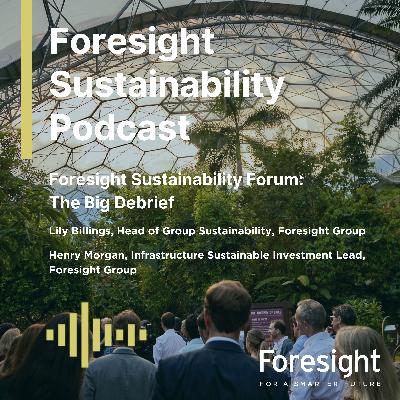
The Foresight Sustainability Forum, held over two days at the Eden Project, brought together leading experts and visionaries to address the fundamental challenges facing our planet and explore innovative solutions to these challenges. The event provided a platform for insightful discussions, thought-provoking panel sessions, and enlightening keynote speeches, all aimed at shaping a more sustainable future for our planet. In this episode, Dan James, Development Director at the Eden Project, Lily Billings, Head of Group Sustainability and Henry Morgan, Infrastructure Sustainable Investment Lead at Foresight unravel some of the key initiatives, thought-provoking discussions, and innovative ideas that emerged from the two days. The podcast is for information purposes only and without limitation, does not constitute an offer, an invitation to offer or a recommendation to engage in any investment activity. Listeners should not construe the content of this podcast as investment advice and no reliance may be placed upon the content. The opinions of speakers are their personal opinions and not necessarily those of their respective companies. Foresight Group LLP is authorised and regulated by the Financial Conduct Authority (FRN 198020). Foresight's registered office is at The Shard, 32 London Bridge Street, London, SE1 9SG.
Hydrogen is increasingly being recognised as a key player in the transition towards a low-carbon future. As a clean energy carrier, it has the potential to decarbonise a wide range of sectors including transportation, industrial processes, and heating. Hydrogen can be produced using renewable energy sources, such as wind or solar, and can be stored and transported as required. Its versatility and flexibility make it a useful alternative to direct electrification, particularly in hard-to-abate sectors such as heavy industry, aviation and shipping. However, scaling up the use of hydrogen requires significant investment in infrastructure and technology, and regulatory support from governments to enable its widespread adoption. In this episode, Joe Davis, Associate Director at Foresight Group and William Mezzullo, Head of Hydrogen at Centrica explore the development of hydrogen as a vital part of the energy transition, what stands in its way, and what needs to be done to realise its full potential. Key Takeaways include: Understanding the importance of the UK government's new suite of policies addressing the drive to net zero. Understanding why a country's hydrogen policy framework is one of the most important factors for informing investment decisions. Addressing whether the UK government is on the right track for supporting increased investment into hydrogen and whether this is competitive with other countries. Understand what is meant by hydrogen blending, and some of the main opportunities and challenges associated with it. William Mezzullo is Head of Hydrogen at Centrica Energy Markets & Trading, and Chair of the Renewable Energy Association's Green Gas & Hydrogen Forum. William is responsible for commercialising hydrogen development opportunities for Centrica. Prior to joining Centrica, he was a Fund Lead at JLEN, a FTSE 250 environmental fund. William has worked in the renewable energy industry since 2010, developing and building commercial-scale green gas anaerobic digestion plants, where he was Head of Projects at Future Biogas, one of the largest anaerobic digestion companies in the UK. He holds a PhD from the University of Bath in bioenergy. Joe Davis is an Associate Director at Foresight Group and a member of the Supervisory Board for HH2E AG. Prior to Foresight Group, Joe was an Investment Manager at Pensions Infrastructure Platform Ltd, and a member of the financial modelling and advisory team at DWPF. Joe has an MSci in physics from Nottingham University and is a CFA Charterholder. Joe Davis [00:00:04] Hello, and welcome to Foresight's Sustainability Podcast, a series that explores the sustainability themes that will play a crucial role in shaping our world in the current period of accelerated change. In this series, we'll be sitting down with industry experts to explore some of the major developments in sustainability related fields, and consider the challenges facing businesses in a new decade of climate action. With these sessions, we aim to inform and promote dialogue around the mainstreaming of sustainability. I'm your host, Joe Davis. I'm an Associate Director in the Infrastructure Investment Team here at Foresight. Today I'm joined by Will Mezzullo. Will is Head of Hydrogen at Centrica. Welcome Will, would you like to begin by telling us why Centrica is so interested in hydrogen, and about your role with the company? Will Mezzullo [00:00:45] Hi Joe. Yeah, thanks very much. And really good to be here and thank you for the invitation. It's always really lovely to speak to you and the Foresight team. So yeah, I look after Centrica's hydrogen activities, across sort of the family of businesses that Centrica owns and looks after. So that's all the way from the whole value chain, from production of energy. So we manage 12 gigawatts of renewables across Europe and we're also building our own, all the way to sort of storing of energy, whether that's in gas or electricity form. We've got batteries, we've got things like rough storage facility where we do store, I think it's the largest sort of gas storage operating facility at the moment in the UK, all the way to transporting it, moving that energy and then optimising and delivering it for our customers. So yeah, our hydrogen activities really span across the whole value chain of energy, and that reflects where our participation is. When we look at hydrogen, we look at it as a tool to help us understand how do I decarbonise that particular part of the value chain, and how does hydrogen help overcome any decarbonisation barriers that we have encountered or the industry has encountered over these number of years?We never see hydrogen as a single silver bullet. I don't think we'd see any renewables as a single silver bullet, and the test of time over the last 15 years is a reflection of that. But we do recognise that hydrogen has a role to play. We also recognise that some roles are more developed than others, and we shouldn't sort of put barriers or close any doors. So yeah, that's what we do in Centrica and our activities around hydrogen. Joe Davis [00:02:10] Yeah, great to talk to you and looking forward to our discussion. Can you tell us about some of the projects that Centrica is currently working on within hydrogen? Will Mezzullo [00:02:19] Yeah, sure. So when Centrica looks at hydrogen and gets involved in different places to participate, I guess it's a reflection of where Centrica sits in terms of the energy value chain. And I have to say I've never worked for a company that's so across the whole value chain of energy, so all the way from sort of producing, from renewables, to taking gas from different parts of the world, to storing it, to moving it around, to then balancing it, optimising it, and then supplying it to customers, both private individuals, residents and commercial customers. And so when we then look at that value chain and we apply hydrogen to it, there's a role that hydrogen can play in all of those areas. And really that is where Centrica is focusing its efforts. It's first of all understanding how can hydrogen help me overcome some of the barriers in that particular value chain and how do I decarbonise that part? And then where can I apply the strength of Centrica and sort of the bits of other parts of Centrica to sort of help develop that part? Because hydrogen is is still incredibly nascent as an energy vector, as a use for an energy. But understanding sort of the benefit it can bring in decarbonisation is key. So it's a bit of a long winded answer to say we've got a number of projects across the whole value chain, and I'm happy to go through in more detail, but really it's important to recognise we don't see one silver bullet, one single silver bullet for hydrogen, but we do see that there is a potential for hydrogen to help play decarbonisation roles in all sectors. Joe Davis [00:03:48] Yeah, it's an interesting perspective, isn't it? I guess because you're able to see all of these different parts of the energy value chain and I think everyone involved in the hydrogen industry is expecting it to play a big role generally, but working out exactly how all of the different pieces of the system fit together is very complex and probably one of the more complex parts of this transition. So Centrica's role, or the breadth of Centrica's activities across the whole value chain is really, really interesting perspective to have. Will Mezzullo [00:04:19] Yeah, agree. I mean, one of the most exciting things that we look at hydrogen is its ability to store, in terawatt hour forms ,you know, serious amount of storage. I think Centrica was one of the first companies in the UK to install batteries, grid connected batteries, and we're very proud of that heritage. But really understanding the the difference between gigawatt hours of storage and terawatt hours of storage. And when you look at it totally makes sense to be able to sort of store large amounts of energy seasonally at the time of the year when you don't need it, store it in the form of hydrogen, and then use it in different parts of the year. On paper, that totally makes sense. And we see things like the Committee of Climate Change making significant reference to long duration energy storage of hydrogen. In practice though, that is quite a complicated process to actually convert, for example, like our rough storage facility, to convert that to hydrogen. To convert all the infrastructure and to make the infrastructure available to take hydrogen, and store hydrogen, and then use that hydrogen for energy. It does take an enormous amount of effort and policy implementation. And then actually this is the sort of, these are the areas that we're focusing on. Joe Davis [00:05:23] Yeah, I guess it's a reflection of the need for that unified transition approach. You know, you can't just have one part of the entire value chain transitioning independently. You need the whole breadth of the chain transitioning together. And I think that energy storage piece is a very good example. You mentioned the policy environment there. In the UK the government announced about a month or so ago a suite of policies that were called Powering Up Britain. I'd be interested in your views on some of these announcements and how they have affected Centrica. Just for some of our listeners who might not know some of the hydrogen specific details. Some of the key headlines to come out of that was in relation to CCUS. This is clearly a massive part of the Government's strategy for decarbonisation with two industrial clusters, one on the east coast of England called East Coast Cluster, and one on the north west of England, called HyNet, forming a big part of the plans to decarbonise industry. The government restated a pot of £20 billion annual funding to help get CCUS off the ground. They also announced the eight projects shortlisted for negotiations as part of track one, of which five are from HyNet and three were from
Accelerating resource consumption, biodiversity loss and climate change are damaging the planet's ability to support life. In order to secure a sustainable future, we must adopt new ways of thinking and addressing complex problems. System thinking represents one of society's best bets for making real progress towards the sustainability transition by viewing all natural and human systems as interdependent. In this episode, Sophie Warren, Sustainability Manager at Foresight Group and Lola Bushnell, Sustainable Futures Strategist at Arup, discuss what is meant by system thinking, and how the Earth's natural and built systems can be designed in a way to co-exist and co-evolve to benefit society and the environment. Key Takeaways include: Understanding what systems thinking is and how can it help us to achieve a sustainable future Understanding how well systems thinking principles are currently integrated within industry Identifying what policies are driving systems thinking Understanding what is meant by regenerative design and the benefit of it Addressing the main barriers to achieving true regenerative design in infrastructure Lola is a Sustainable Futures Strategist at the global design and engineering firm, Arup. Lola sits in the Foresight team, Arup's internal think tank, and is focused on influencing the wider industry toward nature-led, regenerative design practices and systemic decarbonisation strategies that produce net positive outcomes for people and the planet. The podcast is for information purposes only and without limitation, does not constitute an offer, an invitation to offer or a recommendation to engage in any investment activity. Listeners should not construe the content of this podcast as investment advice and no reliance may be placed upon the content. The opinions of speakers are their personal opinions and not necessarily those of their respective companies. Foresight Group LLP is authorised and regulated by the Financial Conduct Authority (FRN 198020). Foresight's registered office is at The Shard, 32 London Bridge Street, London, SE1 9SG. {TRANSCRIPT} Sophie Warren [00:00:04] Welcome to Foresight's sustainability podcast, a series that explores sustainability themes that will play a crucial part in shaping our world in the current period of accelerated change. In this series, we will be sitting down with industry experts to explore some of the major developments in sustainability related fields, and consider the challenges facing businesses in a new decade of climate action. With these sessions, we aim to inform and promote dialogue around the mainstreaming of sustainability. I'm your host, Sophie Warren. I'm the Sustainability Portfolio Manager at Foresight in the Infrastructure Department. And today I'm joined by Lola Bushnell. Lola is a Sustainable Future Strategist, at Arup. Welcome Lola, would you like to begin by introducing yourself? Lola Bushnell [00:00:42] Hi Sophie, thanks so much for having me. Yeah, so I'm coming from Arup, which is a global design firm made up of a breadth of technical specialists working to solve some of the world's most challenging problems. And we range from ecologists to structural engineers to urban planners. And I sit within Foresight, which is essentially our internal think tank, which is focussed on supporting the long term transformation and adaptation of our firm, and that includes the future market opportunities, emerging risks, future skill requirements and the wider transformational needs of our firm. And we have framed the firm around being a sustainable development focussed company. So much of the work that we do is exploring how we can actually build a better world. Sophie Warren [00:01:33] Brilliant, thanks for the intro Lola. So today we're going to look at about systems thinking and how that relates to regenerative design, which the Foresight team at Arup look at. So we're going to go through a number of questions. Firstly, looking at systems thinking, and then heading into more of a regenerative design context. So first of all, I was wondering if you could give us a high level overview of what systems thinking is, and how systems thinking can help us to achieve sustainable future. Lola Bushnell [00:02:03] Yeah, so systems thinking is really about breaking down the silos in our thinking. So looking at the interdependencies within our systems, be those within nature or within the infrastructure and buildings in our cities, essentially to ensure that our design interventions are having the greatest outcome for multiple of beneficiaries and are not causing unintended harm. Sophie Warren [00:02:27] So it's looking at the interrelations of all systems in the global wider context. Lola Bushnell [00:02:34] Yeah, yeah, absolutely. So one way to look at systems thinking is with the Planetary Boundaries framework, which is a framework developed by leading earth systems scientists at the Stockholm Resilience Centre, and it's essentially looking at nine key earth system processes that have tipping points within them, that if past cause runaway consequences. And these systems are related to each other. So that includes the climate system, so CO2, but also the biosphere, the natural capacity to respond to shocks in the system, but also our water systems. So, say if we're looking at our forests, which are sequestering carbon, but they're also releasing water vapour through evapotranspiration, driving our global water cycles, these systems are interdependent. So effectively we need to be looking at them simultaneously, not narrowly, just at carbon or just at water systems. Sophie Warren [00:03:31] Brilliant. And how do you think systems thinking principles is currently integrated into industry and solution-based businesses? Lola Bushnell [00:03:39] Yeah. So the challenge with systems thinking is identifying beneficiaries and specifically quantifying the value that they're getting from a particular intervention. So say with a nature based solution, carbon may be one outcome. You may have someone paying for carbon storage, but if you're planting trees, you're also providing some water regulating services. So say you're mitigating flood risk through the catchment. So identifying who's actually benefiting from that flood risk mitigation can be quite challenging and complex. So for those reasons, we haven't gotten very good at paying for kind of the multiple benefits, or understanding what the best intervention is for the greatest number of beneficiaries. Sophie Warren [00:04:28] And in terms of applying systems thinking principles, it's still quite early stage then I guess. Lola Bushnell [00:04:34] Yes, definitely. Although novel technologies like remote sensing and AI are in the early stages of being able to help us actually model and understand these interactions. Sophie Warren [00:04:46] Yeah, pushing out that knowledge step forward as well, with massive data driven solutions. So the Foresight team at Arup look at integrating systems thinking into the built environment through regenerative design. Can you first start off with telling me what regenerative design is? Lola Bushnell [00:05:03] Yeah. So before that, I think it's helpful to get a bit of a framing of where humans are within our wider earth system. So if you were to put earth's history on a calendar year, first life comes around in March, dinosaurs come around in December and disappeared by Christmas, and humanoids first came around on the 21st of December. And in the last 2 seconds we have become a geophysical force emitting half a trillion tonnes of CO2. And in the last third of a second, around 70% of animal biomass has been extinguished. And then what that means is effectively in the next tenth of a second, what we do will dictate the future of humanity. So that's all to say, we as humans are part of nature, yet we've become very unusual. We've become this really significant geophysical force. And the question then becomes, how can we better participate in this living system that we depend on and that we are a part of? So regenerative design takes a holistic approach in which the built in natural systems are designed to co-exist and co-evolve over time. And that means that they're delivering net positive environmental and social outcomes and ensuring both human and planetary health. Sophie Warren [00:06:23] Brilliant. And what are the key principles of regenerative design that you apply at the Foresight Group? Lola Bushnell [00:06:30] Yeah, so at Foresight, we've kind of simplified things down into these three key elements. The first is nature led design for planetary health, which is about participating and co-evolving as part of nature. And that really is resting on the fact that life has had 3.8 billion years of research and development. And we can look to those solutions to solve some of our challenges. The second is circularity for and with nature, and that's really around ensuring that our human made systems are actually mimicking the circularity that we see in nature. And third is nurturing a just space for humanity, which really focuses on shifting away from narrow economic growth, framing toward planetary health and maximising well-being through progressive targets and environmental justice, and really enabling design that's deeply rooted in the local context for local communities. Sophie Warren [00:07:33] I guess the just transition isn't something that has been well executed thus far in any sort of sustainability solutions. Lola Bushnell [00:07:41] Yeah, that's definitely been a challenge. And something to really emphasise here with regenerative design is that it's not new. We've been doing this for generations. Traditional cultures and indigenous peoples have been living in harmony with nature's cycles for many, many years and we need to listen to how local land is being managed, and learn from and work with people who are the real custodians of their land. Sophie Warren [00:08:12]
Soil is the foundation upon which life is built. Soil puts food on the table, purifies our water, stores vast amounts of the worlds carbon, and protects us against floods and droughts. We are intrinsically linked; when soil's health is at risk, so is our own. In this episode, Lily Billings, Head of Group Sustainability at Foresight Group discusses why soil is so essential to life, and what needs to be done to protect it with Mark Nason, head of professional practice at the Chartered Institute of Ecology and Environmental Management. Key Takeaways include: Understanding what soil actually is and why it's so essential to life Understanding the different ecosystem services that soil provides Addressing some of the key threats facing soil health Understanding what we can do to improve the health of soil Mark Nason is Head of Professional Practice at the Chartered Institute of Ecology and Environmental Management (CIEEM), and has over 25 years of experience in environmental research and education. The podcast is for information purposes only and without limitation, does not constitute an offer, an invitation to offer or a recommendation to engage in any investment activity. Listeners should not construe the content of this podcast as investment advice and no reliance may be placed upon the content. The opinions of speakers are their personal opinions and not necessarily those of their respective companies. Foresight Group LLP is authorised and regulated by the Financial Conduct Authority (FRN 198020). Foresight's registered office is at The Shard, 32 London Bridge Street, London, SE1 9SG. {TRANSCRIPT} Lily Billings [00:00:04] Welcome to Foresight Sustainability Podcast, a series that explores the sustainability themes that will play a crucial part in shaping our world in the current period of accelerated change. In this series, we will be sitting down with industry experts to explore some of the major developments in sustainability related fields, and consider the challenges facing businesses in a new decade of climate action. With these sessions, we aim to inform and promote dialogue around the mainstreaming of sustainability. I'm your host, Lily Billings, and I'm the Head of Sustainability at Foresight Group. I'm responsible for the corporate sustainability strategy, and everything from emissions reporting down to nature recovery and social responsibility. I'm joined today by Mark Mason. Mark is a soil expert and he's here today to talk to us about all things to do with soil and how it relates to carbon and nature recovery as well. So welcome, Mark. Would you like to introduce yourself? Mark Mason [00:01:01] Hello. Yeah, thanks, Lily. So I, well, I've worked in environmental research and education in some shape or form for my whole career, and that's involved lots of teaching, writing new degrees and apprenticeships, and doing research into soils and ecology. And so this month I started a new job as Head of Professional Practice at the Chartered Institute of Ecology and Environmental Management. And so in that role, I'm really excited about it. I'm basically here to support and challenge people working in ecology and environmental management, to be ambitious for themselves and for nature. Lily Billings [00:01:40] Brilliant. Well, we're really happy to have you here today because I think so many of us are starting to realise just how important soil is when we're thinking about how we might tackle climate change and also the impact that nature has experienced over the last few hundred years, really. So is it possible for you to tell us a little bit more about your day to day job? Obviously you've moved recently, but how you get involved with what you do around soils. It would be really interesting to hear what's a normal day look like for you. Mark Mason [00:02:11] Yeah, well, I'm not entirely sure yet, but so basically I'm responsible for helping to evolve the training programme for CIEEM. So we've got about 7000 members who work in ecology and environmental management. So it's a significant responsibility and the world is changing so quickly and we need more people to know more about the environment and to know more about soil. So I'm responsible for thinking about the types of training programmes we need, thinking about the competency frameworks and accreditation so that when people do things there is, we know that they're doing them to a certain standard best practice. And one thing that I'm also really excited about is that I get to carry on working on projects as I have been for a number of years, to try and support new people into the profession. So getting people into good jobs in environmental management and also helping to make sure that it's a rewarding and inclusive environment to work within. Lily Billings [00:03:11] Brilliant. Thank you for explaining some more. And I actually have a question then. So how did it all start? I mean, what first got you interested into the world of soil? Soil is obviously quite a niche subject area, albeit we now realise it's much more important than we ever really realised before. So yeah. What got you interested? Mark Mason [00:03:28] Yeah. So I don't think I started off being that interested in soil, if I'm honest. I've always been really interested in nature and in fact I tell people that one of my earliest memories is playing in the garden with my friends aged three or four, and I have a distinct memory of telling them off because they were getting spiders confused with red spider mites. And that really offended me on some level. I think my interest in soil came a little bit later, so I did an ecology degree and that allowed me to keep my interest quite broad. So I studied everything from fish migration to fern classification, and a small amount of soil science. And then after my degree, I worked briefly as a quality assurance analyst in a lab. So I was looking at testing the equipment that hospitals use to measure levels of drugs in patients blood and urine. And it wasn't really for me. I enjoy lab work, but I wanted to be outside a little bit more. So I applied to work as a technician on a European Union funded project at Bangor University that was looking at experimenting with ways of creating woodland and heather moorland at post-industrial sites, especially on slate quarry waste in Snowdonia. And I was really lucky through that to have the opportunity to register for a PhD alongside my day job. And because the main constraint to establishing biodiverse habitats under those conditions tended to be a lack of soil, I chose to study how soil forms and particularly the relationship between the inputs of plant litter. So for example, when trees dropped their leaves in the autumn, and the formation of the organic matter in the soil, that then happens over time. Lily Billings [00:05:04] Great. I mean, I can see how that would get you hooked, actually. There's a lot yet to understand, I think, for many of us about soil. So I've got a bit of an obscure question for you, which is, so what actually is soil? You know, we've all got an idea of what we think it is, you know, what we can see it. But how do you describe it when you've been teaching students about soil. Mark Mason [00:05:26] It's such a great question because it often flummoxes quite a few people and it's one that I start almost every module or professional training course with just to check where people are at. So bear with me. So soils form over time, and they form from rocks weathering or the movement of sediments from one place to another. And then as life gets a foothold and gets going, we then get an accumulation of organic materials in the soil. And so there's a huge amount of variation in soils in age, determined by the geology and the climate, how much we interfere with them and the biology. And that gives rise to a fantastic diversity of different soils. And we can describe them and classify them, using keys in the same way that we might classify species of grasses. So an average soil, if there's any such thing, is about 50% empty space. And that often surprises people that the biggest single component of soil is actually the space between the stuff and that might contain air or it might contain water, a mixture of the two, and that varies throughout the year. Then you get about 45%, which is the mineral material. And if anyone's ever looked at a soil texture triangle, we often classify that in terms of different sizes of particles like sand, silt and clay. And then the smallest slice of the pie. And this is another thing that really surprises people is the organic matter. So the living organisms and the remains of organisms and stuff that's in the process of decaying can vary quite a lot. But if there's any such thing as an average so that it might be around 5%, but we'd expect that to be lower in a really young soil or degraded agricultural soil, and a lot higher in an older soil, and particularly in peat soils. And I think lots of people who teach soil science, including me, have quite a good way of describing what soil is, and that's to compare it to a good cake or a chocolate brownie. So you've got the sugar, the flour, and the cocoa, and they're a bit like the mineral component of soil. And the very fine silky cocoa is quite analogous to the clay fraction in soil. And in fact, one way of identifying what type of soil you have is to see how silky or gritty it feels, even against your teeth. But that would just be geology though, without the organic matter. So just like in a cake or a brownie, you need something to stick everything together, like the butter or the eggs. And to give that cake a nice crumbly feel. So soil is really similar to that. Just a final progress from that is I like to think of soil as a biological structure. There's a really, really good description of soil in George Monbiots book, Regenesis, talking about how the structure and properties of soil are so transformed by the inf
In this episode, Molly Galloway, Sustainable Investment Associate at Foresight Group discusses the importance of engaging, enabling and empowering people and organisations to work together in the pursuit of social, economic and environmental wellbeing with Guy Battle, CEO of Social Value Portal. Key Takeaways include: Understanding what social value is, and how this differs from the 'S' in ESG Addressing the controversial shelving of the EU's proposed Social Taxonomy Understanding why quantifying social value in financial terms will accelerate capital toward sustainable outcomes Guy Battle is the Chief Executive of Social Value Portal – an online solution that allows organisations to measure and manage the contribution that their organisation and supply chain makes to society. The podcast is for information purposes only and without limitation, does not constitute an offer, an invitation to offer or a recommendation to engage in any investment activity. Listeners should not construe the content of this podcast as investment advice and no reliance may be placed upon the content. The opinions of speakers are their personal opinions and not necessarily those of their respective companies. Foresight Group LLP is authorised and regulated by the Financial Conduct Authority (FRN 198020). Foresight's registered office is at The Shard, 32 London Bridge Street, London, SE1 9SG. {TRANSCRIPT} Molly [00:00:04] Welcome to Foresight Sustainability Podcast, a series that explores the sustainability themes that will play a crucial part in shaping our world in the current period of accelerated change. In this series, we will be sitting down with industry experts to explore some of the major developments in sustainability-related fields and consider the challenges facing businesses in a new decade of climate action. With these sessions, we aim to inform and promote dialogue around the mainstreaming of sustainability. I'm your host, Molly Galloway, I'm a Sustainable Investment Associate in the infrastructure team at Foresight Group, an Infrastructure and Private Equity Investment Manager. Today I'm joined by Guy Battle. Guy is the Chief Executive of the Social Value Portal, an online solution that allows organisations to measure and manage the contribution that their organisation and supply chain makes to society. Welcome Guy, would you like to begin by introducing yourself? Guy [00:00:57] Good afternoon, everybody. Or good morning. My name is Guy Battle, I am the Chief Executive of the Social Value Portal. Molly [00:01:05] Great. Thank you for that. Let's jump right into it then with our first question. So the topic of this podcast is social value, but what do we actually mean by the term social value and what's the difference between social value and the social aspect of ESG, which stands for environmental, social and governance, or sustainability? Guy [00:01:26] There's a lot of jargon, alphabet soup of terms and terminologies and acronyms. So, you got ESG, as you mentioned, environmental, social governance, we've got sustainability, we've got social value, we've got social impact, we've got CSR, which stands for corporate social responsibility. There's so much jargon in this space, but I will try and explain where social value sits in it in simple terms. So if you imagine sustainability as being the overarching definition, overarching term, and that kind of comes from the Brundtland report way back in 1987, that defined sustainability as the social, economic and environmental well-being or impact, if you like. So the first takeaway from all of this is that social value and everything else is all about three elements - social, economic and environment. Within that, you've then got ESG, and ESG grew from a sort of investor analyst, and really ESG is all about risk analysis. What risk sits in your supply chain or in a business you might be investing in with respect to environmental, social and the governance side of things? Next to that, we have social values. So if ESG is about the risk or the downside, social value is all about the upside. So what value does a organisation create or an asset create in terms of social, environmental and economic value created? And that's where social value sits. Now we have the other term, which is social impact, and that is more about the long-term impact. So we have the value created over the short term and then we have the impact created over the longer term by an asset or by a business for society. And within all of that, we've got CSR, corporate social responsibility, which is a kind of subset of social value. So a business that is embracing social value as a way of doing its business will have a CSR program. It'll be thinking about what additional activities can it deliver to the communities that deliver sort of value locally. Molly [00:03:29] Great. Thank you for that. I think within the sustainability space, there are so many different terms and acronyms that get thrown around, so it's really useful just to clarify the differences there. And I think the key point that I took away was that ESG is sort of more about risk mitigation, whereas social value is specifically about the additional value created in terms of social, economic and environmental impacts. Guy [00:03:50] Yeah, that is correct. And it's probably worth just noting, Molly, that there is a piece of legislation because what you might some of your listeners might ask is how come we're all talking about social value? It seems to have come from nowhere. And I would agree it sort of has sort of emerged from nowhere. And the reason is that out of all the terms that I've mentioned, the only term that has a piece of legislation sitting behind it is social value and it's called the Public Services Social Value Act, and it was published in 2012. It became law, if you like, implementable in January 2013. And it is a piece of legislation that's specifically aimed at the public sector and requires them to consider social value in all of their procurement decision making. And as a result of that over the past ten years, it's ten years old now. That term social value has sort of started out in the public sector, but leeched into the private sector where they want to win work with local government and central government. And so they're having to address it now in sort of meaningful terms. Molly [00:04:53] Thank you. That's really interesting. And as the Chief Executive of the Social Value Portal, could you tell us a bit more about what the Social Value Portal is and what its purpose is, and how the Social Value Act sort of plays into that as well. Guy [00:05:07] Yes. So we were set up on the back of the Social Value Act and specifically we've developed an online platform that helps organisations measure their social value. So when you go to an organisation, you ask it, you know, what's your purpose? And prove to me the social good that you do? Well, that's what our business does. We can help measure that. But what's important about the measurement framework that we developed is that it also allows organisations to put a pound sign on it. So we talk about the wider social, environmental and economic benefits, but then we say it is worth X pounds to society. And so that's the big step that we've moved or developed as a business. And if the business is, or the platform is all about helping organisations measure, manage and also report social value. But within that the platform is also used extensively by both government and also private sector organisations to manage their supply chains, so in procurement . So we help manage the procurement process and so people bid through our platform for work or an organisation wanting to maximise the value created by its supply chain might manage its supply chain through the portal as well. And that kind of cuts to our purpose. So our purpose is to maximise social value through all the customers that we are working with, and taking that number, I've set the business a big audacious goal. Call it our bag, big, audacious goal. And it's to unlock £100 billion worth of social value by the end of 2025. We've so far, Molly, delivered £14.5 billion. We are - we've still got a long way to go, but we have started, which is great. Molly [00:06:47] Wow, some big goals there, but I'm sure achievable. So could you tell us a little bit more about, I assume you're talking about the national comms framework there. Could you tell us a little bit more about it perhaps, and sort of how you maybe might expect it to be used in practice? Maybe an example and you mentioned sort of public and private. Which sort of industry does it apply to? Guy [00:07:10] So, yeah, the National TOMs. So we developed the framework, the National Social Value Measurement framework, and it's called the National TOMs because it's structured around a series of themes, outcomes and measures. And there were five themes, the five themes being jobs and skills or creating jobs and skills, the second theme being support for regional or local business. The third theme being supporting our communities, the fourth theme being protecting, regenerating our environment, and the fifth theme being promoting social innovation. Within those themes, we have a series of outcomes. So for instance, outcomes might be more jobs for those who are disadvantaged, or it might be action taken on climate change, or it might be more support for communities. So those are kind of objectives, outcomes. And then of course, what we're trying to do is we need to measure it and put a value to it. So following that more jobs theme for disadvantaged people, different cohorts might be given new opportunities. So long term unemployed people, young people coming out of care, could also be offenders who want to rehabilitate, so we'll count the number of offenders, for instance. And then we will put a value to that to society. So we pick up the fiscal saving to government and the economic be
As corporations set net zero targets, they must demonstrate credible science-based strategies to reduce the carbon footprint of their activities. To do this, many companies are buying carbon credits to offset unavoidable and residual emissions on their decarbonisation journeys. As interim emission reduction targets are approaching, corporate demand for carbon credits is increasing. In response to this, the London Stock Exchange launched the Voluntary Carbon Market ("VCM") in October 2022 to facilitate financing at scale into projects that mitigate climate change and generate carbon credits. The VCM designation will be applied to funds or operating companies that are admitted to the London Stock Exchange's Main Market or AIM and which are intent on investing into climate change mitigation projects that are expected to yield voluntary carbon credits. In this episode Managing Director of Foresight Group LLP ("Foresight") and Co-Lead of Foresight Sustainable Forestry Company Plc, Richard Kelly, discusses the climate challenge we face and the VCM with the CEO of the London Stock Exchange, Julia Hoggett. Key Takeaways include: Understanding what the VCM is and who it is for Addressing the controversial history of carbon credits and the reputational challenges Determining what a quality carbon credit looks like Understanding the future demand and supply issues The podcast is for information purposes only and without limitation, does not constitute an offer, an invitation to offer or a recommendation to engage in any investment activity. Listeners should not construe the content of this podcast as investment advice and no reliance may be placed upon the content. The opinions of speakers are their personal opinions and not necessarily those of their respective companies. Foresight Group LLP is authorised and regulated by the Financial Conduct Authority (FRN 198020). Foresight's registered office is at The Shard, 32 London Bridge Street, London, SE1 9SG. {TRANSCRIPT} Richard: [00:00:05] Hello and welcome to Foresight Sustainability Podcast, a series that explores the sustainability themes that will play a crucial part in shaping our world in the current period of accelerated change. In this series, we will be sitting down with industry experts to explore some of the major developments in sustainability-related fields and consider the challenges facing businesses in a new decade of climate change. With these sessions, we aim to inform and promote dialogue around the mainstreaming of sustainability. My name is Richard Kelly and I'm the host for this episode. I'm a managing director at Foresight Group and I'm also the co-lead and co-founder of Foresight Sustainable Forestry Company, a listed investment company on the London Stock Exchange, FSF The Ticker. We are the first and only listed investment company focused on natural capital. We are also the first and only listed investment company to have received the London Stock Exchanges' voluntary carbon market designation. Today I'm joined by Julia Hoggett. Julia is the CEO of the London Stock Exchange. A warm welcome to you, Julia. Perhaps before we begin with you, perhaps like to give a brief introduction to yourself. Julia: [00:01:18] Yes, thank you. Well, firstly, thank you for having me. It's a delight to be here. So, my background is a varied one. And I would say I am an African development sociologist who had a career in the last 25 years in finance and still hasn't quite figured out what I want to do when I grow up. But I've worked in the capital markets all my career, first as an investment banker, then I ran a funding program for bank, then ran a bank and back to being an investment banker, and then my role before I came to the stock exchange was as a supervisor and a regulator at the Financial Conduct Authority, and most recently I was director of Market Oversight at the FCA before I came to the LSE. Richard: [00:01:50] Fantastic, fantastic journey. Okay, well I have a few questions for you about climate change and perhaps we'll just kick off with - what is your view on the scale of the climate challenge that we currently face? Julia: [00:02:01] It's huge, and I think it's a really important thing to, in a sense be able to say that out loud and to recognise the scale of the challenge, but to use that as a trigger for action rather than inertia. Sometimes I think one of the challenges with the climate crisis is that it feels so big and amorphous and the approaches that we need to take are so vast that it can almost be easier to not think about it. I actually think it's the responsibility of all CEOs of companies to think about it both in terms of directly addressing climate change, but also thinking about what they need to do and can do to be good stewards of their institutions to manage it. But it is an enormous challenge. But I think the nature of the challenge also correlates with the nature of the responsibility we have at the LSE. I always say that our job is as a convenor of capital, it's to bring together those who have capital with those who need capital in service of an objective. And I can't think of a more important objective than the just transition to net zero. And so I think the onus is actually on us to make sure that our pipes and plumbing work in service of doing everything we can to direct capital into the investments that need to take place to achieve the transition that we will have to achieve. Richard: [00:03:09] Absolutely. And in the spirit of that, it's exciting to see that the London Stock Exchange has recently launched the voluntary carbon market, or 'VCM' as it's known. What is the VCM? Who's it for and how is it different? Julia: [00:03:22] Right. How long have you got? This is a bit of a passion project of mine, so I'll try and make the explanation as quick as I can. So, the voluntary carbon markets are the loose term for the markets that generate voluntary carbon credits, and that's actually the thing that's most important. Voluntary carbon credits are credits that represent tonnes of carbon either removed or reduced from the atmosphere as a consequence of the activity taking place. That activity has to be genuinely additive and not economically viable in its own right, and that therefore is something that has been hugely important in the construct of what we've been seeking to do. We have always described the carbon market challenge as a chicken and egg problem, which is that because the value from the investment comes from the value of the credits, then how do people have the confidence to invest in projects that generate voluntary carbon credits unless there is a deep and liquid market for voluntary carbon credits? How do you get a deep liquid market for voluntary carbon credits unless you have an active supply of credits? And an awful lot of exchanges have focused on trading voluntary carbon credits, whereas we have very much focused on how you solve that chicken and egg problem and how you do everything you can to direct capital into investments that will give rise to a voluntary carbon credit. And it is very much designed as a mechanism by which individuals, institutions and corporates that are on their own journey to net zero can have an asset that they can invest in that gives them that ability to get to net zero. And that is one of the remarkable things actually about really engaging with the transition. Value is changing. Understanding of value is changing. You could say it's a proxy ultimately for a carbon price because in some regards it is. But as people commit to science-based targets to get to net zero, then the ability actually to be able to invest in the things that will facilitate you getting there becomes more and more critical. And I think that's where pipes and plumbing and responsibility that we have as a venue comes in, in order to make sure that we've facilitated the mechanism to do that. Richard: [00:05:26] So the key difference I was picking up there was that the LSE focuses on the flow of capital to projects that are creating carbon credits, whereas many others are focused on the trading of credits created. And that seems to be the key difference. Julia: [00:05:40] It is absolutely. It's founded on a philosophical difference, which is the most important thing that we can possibly do is generate a rigorous flow and scale flow of capital into projects that reduce the amount of carbon that is in the atmosphere. That is what gets us to net zero. The trading is a by-product of having done that, but it isn't doing that in its own right. And I have always been fundamentally focused on the fact that stock exchange is doing a real-world job. The capital that is raised every day is in scales and volumes that most people think of as outside of their sense of understanding. But at the end of the day, it goes to building factories, it goes to investments in research, it goes to forestation in your case, that has a direct real-world impact and it produces jobs, employment, wages and livelihoods. And this is just another illustration of a market deliberately focusing on doing that thing. Richard: [00:06:36] I just to pick out another point you made around connecting retail investors, financial institutions and corporates with investment companies who are creating these carbon credits. The last of those buckets - Corporates haven't traditionally invested in investment trusts much today. Do you see a big opportunity there. Julia: [00:06:53] I do. And it is a transition in both sectors, both in terms of the transition to net zero and the psychological and investment transition for these corporates. Let me take a step back. One of the other things that I thought was so important about the structure that we've created, the designation for a voluntary carbon market, for a fund or an operating company that is meeting the requirements and genuinely investing in voluntary carbon credits, is that we also wrap the rest of the structur
Simon Whistler, a Senior Specialist from the Principles for Responsible Investment, joins us to discuss the global uptake in ESG investing and explore some of the factors that are affecting the pace with which ESG is being embraced by the investment world's international community. What you can expect in this episode: An in-depth overview of the uptake of ESG investing explored regionally and in terms of drivers and barriers We explore leadership in this space and consider how advanced investor practices are driving regulatory reform We discuss what movement is taking place in emerging markets and how this is reshaping the conversation around responsible investing The opinions of speakers are their personal opinions and not necessarily those of the company.
Dan Wells, Infrastructure Partner at Foresight Group articulates what is meant by 'sustainability' and shares his views on some of the trends that are set to shape both businesses and, more broadly, society over the course of the coming years. What you can expect in this episode: Language is a key barrier to the wider integration of sustainability considerations into business; we set out key industry terms We explore the role sustainability has played in shaping business agendas We consider the significance of 'sustainability' when addressing grand challenges like climate change, poverty and health equity, that threaten systems and demand cross-sector engagement The on-going health crisis has highlighted the need to approach grand challenges holistically. To ensure long-term industry resilience, sustainability and ESG considerations will need to be mainstreamed into business strategies. The opinions of speakers are their personal opinions and not necessarily those of the company.
As demand for ESG investing spreads across geographies and investor types, the role of the investment manager and their ability to drive change for the future of the planet is in the spotlight now more than ever. In this episode, Hugi Clarke, Partner at Foresight, talks with Simon Holman, Partner at Castlefield, an employee-owned investment and financial advisory group, with a focus on ethical and sustainable investments. The pair discuss the key questions arising around sustainable investment today, and how advisers can be best equipped to help their clients invest with impact, without compromising financial returns. Key Takeaways include: Understanding what ESG means in investment How investors can deliver a greener, fairer future without compromising on financial returns Navigating the risks of greenwashing Addressing some of the issues in the sector including regulation, jargon and reporting The opinions of speakers are their personal opinions and not necessarily those of the company.
In this episode, Natasha Frost, Investment Manager at Foresight, is joined by Rachael Nutter, Director of Nature-Based Solutions at ClimateCare, to explore some of the latest developments in carbon markets, and to provide an introduction for those looking to get to grips with this exciting new field for the first time. ClimateCare is a leading B-Corp which finances and delivers a wide variety of carbon reduction projects across the globe. Today, voluntary carbon markets are experiencing a boom as the wider private sector embarks on a net-zero journey. In this episode, the pair consider carbon credits, the distinction between different carbon markets, and potential challenges and opportunities to future carbon market development. Key Takeaways: What the carbon market is and how it functions A distinction between Voluntary Carbon Markets and the Compliance Market The investment case for carbon credits How the mainstreaming of carbon credits will drive trends in the different carbon markets Some of the risks to the carbon markets The opinions of speakers are their personal opinions and not necessarily those of the company.
Dan Wells, Foresight Infrastructure Partner, talks to social entrepreneur and writer Jeremy Leggett, about the global climate challenge, evolving climate policy in 2021 and his work championing sustainability and more recently rewilding. Jeremy is a leading figure in the global climate movement. He founded Solarcentury and founded and Chairs SolarAid, a charity that builds solar lighting markets in Africa. Jeremy has also written five books that address the energy transition and the pathways to decarbonisation. Jeremy will be joining us at our inaugural Foresight Sustainability Week, hosted in partnership with the Goodwood Estate, later in the year. This episode was recorded in the days leading up to Joe Biden's inauguration. The opinions of speakers are their personal opinions and not necessarily those of the company.
Andrew Norris, the Founder of The Alpha Adviser, a recruiter of leaders in energy and infrastructure, joins the podcast to explore the concept of a 'just transition'. With over 20 years of experience recruiting, he has witnessed the sustainability transition and its impact on working lives close up and gathering pace. What you can expect in this episode: Insight into the often overlooked human impacts of the energy transition, on both labour supply and demand as the market evolves An overview of what it takes to be an active job searcher looking to enter a career in sustainability The opinions of speakers are their personal opinions and not necessarily those of the company.
Julia Dreblow, Founding Director of SRI Services and Fund EcoMarket, joins us to discuss developments within responsible investing, as the movement gains momentum, and explore the rise of greenwashing. What you can expect in this episode: An overview of 'greenwash' and ESG ratings Advice for investors wanting to play an active role in managing their finances and avoid greenwashing We discuss regulation and who is responsible for driving greener standards as the investment landscape evolves The opinions of speakers are their personal opinions and not necessarily those of the company.
Comments


Download from Google Play

Download from App Store
 United States