


 Claim Ownership
Escape Velocity - Where Strategy Meets the Unexpected
Subscribed: 0Played: 2
Subscribe

© Tracey Halvorsen
Description
Escape Velocity is a podcast about growth at the edge—where courage, creativity, and clarity meet change. Hosted by Tracey Halvorsen, CEO of adeo, each episode explores the real stories behind reinvention, leadership, and bold decision-making. Through candid conversations with founders, creatives, and change-makers, we examine the friction before the breakthrough and the mindset shifts required to escape “business as usual.” For those ready for their next brave move.
29 Episodes
Reverse
In this episode of Escape Velocity, Tracey sits down with Adrienne Cooper to explore what it really takes to build organizations where people can do their best work. Adrienne shares her unconventional path from TV news producer to Allstate leader to founder of her own consultancy, and explains how that journey shaped her approach to culture, leadership, and organizational design.They get into mission, vision, and values as practical operating tools, not corporate wallpaper. Adrienne also breaks down how she uses LEGO Serious Play to surface hidden perspectives, create alignment, and make sure every voice in the room is heard. The conversation also tackles flow state, delegation, motivation, neurodivergence, leadership readiness, and why diverse lived experience leads to better problem-solving.They close on the shifting relationship between work and AI, and what human judgment, creativity, and clarity of purpose will matter even more as automation rises. This is a sharp conversation about building companies, teams, and careers with more intention.
Tracey Halvorsen, CEO of adeo, talks with Dayana "Day" Kibilds, VP of Strategy at Ologie and author of Mailed It, about the language problem hiding in plain sight across higher education.Day has worked in-house in admissions and now leads strategy for dozens of institutions worldwide. Together they dig into why financial aid pages read like legal documents (paste yours into the Hemingway app and watch it turn red), how Ologie's work with Amherst College created a home-delivered guide that reached first-gen students nobody else was reaching, and why creative testing almost always kills the boldest work.They also get into the agency-institution dynamic: why schools think they're more unique than they are, why "community" isn't a differentiator, what happens when a president swoops in at the 11th hour, and what the structural future of higher ed looks like as AI reshapes everything.Escape Velocity is hosted by Tracey Halvorsen, CEO of adeo, a creative and digital agency working with higher education and complex growth brands.Link to the book - "Mailed It!"Link to Day's Newsletter: You Ask Day Answers
Your website isn't the thing anymore. Your brand message is. And most companies still have it backwards.Yianni Mathioudakis and Monica Sanchez run DEEO, a two-person design studio that made a gutsy call early on: turn down the wrong clients, say the quiet parts out loud about money, and bet everything on authentic connection over algorithm-chasing content.In this conversation, we get into what's actually changing right now for creative studios and the brands they serve. AI is flooding every platform with content. Google is summarizing your website before anyone clicks on it. And the old playbook of "build a nice website and they will come" is dead.We talk about why brand strategy is becoming the most important investment a company can make. How DEEO rebuilt their entire business development approach after getting ghosted. Why "content for connection, not for the algorithm" became their breakthrough philosophy. And what generative UI could mean for the future of branded web experiences.We also get into the real stuff: how to talk about money with clients without it being weird, why saying no to a big project was the scariest and smartest move they made, and why taste and curation are the irreplaceable human skills in an AI world.Plus a new Escape Velocity tradition: guests now leave a question for the next guest. Yianni and Monica's questions are worth the listen alone.If you run a creative business, work in brand strategy, or care about where design and AI are headed, this one's for you.Topics: brand strategy, creative studio growth, AI and branding, value-based pricing, client red flags, generative UI, web design future, authentic marketing, small agency business development
In this episode of Escape Velocity Podcast, Tracey Halvorsen sits down with Sabrina Depestre, Senior Director of Enrollment Marketing at Maryland Institute College of Art, to explore how creativity, leadership, and resilience actually develop in the real world.This is a conversation about experience design disguised as a career story.From shaping fan experiences at the Miami Heat to modernizing marketing inside higher education, Sabrina reveals how creative strategy works when culture, systems, and human behavior collide. Together, Tracey and Sabrina unpack burnout as a structural issue, not a personal flaw; curiosity as a leadership discipline; and why side projects, portfolio careers, and creative sovereignty matter more than ever in an AI-accelerated world.They also confront the realities facing creative education today—from generative AI to shifting economic models—and why embracing change with ethics, clarity, and evidence beats both fear and hype.This episode is for leaders, creatives, strategists, and educators who want to understand:How creativity functions inside complex systemsWhy experience design is the future of brand and leadershipHow to build resilience without burning everything downWhat it actually means to stay curious in unstable times
What if fear isn’t an obstacle—but a signal?What if doubt isn’t a flaw—but part of the design?In this episode of Escape Velocity, Tracey Halvorsen sits down with entrepreneur, technologist, and author Kris Land, whose book The Infinity Within explores a radical idea: that human life is less a problem to solve and more a game to consciously play.Drawing from near-death experiences, early childhood awakenings, decades of building and exiting companies, and a deep curiosity about consciousness, Kris offers a reframing of fear, doubt, success, and creativity. He argues that fear and doubt are not enemies—they’re mechanisms that keep us engaged in the “game of Earth,” and invitations to remember who we really are beneath the noise.Together, Tracey and Kris explore:Why success doesn’t eliminate fear—and why that mattersHow curiosity and creativity get trained out of us (and how to reclaim them)The difference between survival fear and illusion-based fearWhy silence, presence, and attention are becoming revolutionary actsHow technology, AI, and the coming “singularity” intersect with spirituality and meaningWhat it means to live as if the answers aren’t out there—but already withinThis is not a conversation about doctrine or dogma. It’s an invitation to question assumptions, loosen certainty, and approach life with more play, awareness, and courage. If you’ve ever felt there must be more beneath the surface of achievement, productivity, or distraction—this episode is for you.About the hostTracey Halvorsen is the CEO of adeo, a brand, digital, and communications agency. She is the host of Escape Velocity, a podcast exploring leadership, creativity, technology, and change through deeply human conversations with founders, creatives, and change-makers.
What does it mean to hold space for everything—including the hardest parts?Tracey Halvorsen sits down with Jen Dary—leadership coach, founder of Plucky, and author. Jen has spent decades helping people become better leaders and managers, focusing on human-centered leadership, emotional intelligence, and creating sustainable work cultures. Her debut memoir, "I Believe in Everything," was just was released, and I can't recommend it enough - you can find out more here.In this raw, expansive conversation, Jen shares her experience with brain tumors, medical uncertainty, and what happens when you can't outwork or outthink your way through a crisis. They talk about bigness—not the performative kind, but the kind that comes from holding space for joy and grief, certainty and doubt, control and surrender.Jen and Tracey explore how leadership changes when you stop trying to fix everything; why believing in "everything" isn't naive but necessary; and what it means to build a life and career that doesn't require constant optimization.This episode is for anyone who:- Has faced a crisis that changed how they see leadership and life- Wants to explore what human-centered leadership actually requires- Is tired of productivity culture and looking for something more sustainable- Believes that holding complexity is a skill worth developingTopics explored in this conversation:Brain tumors and medical crisis, leadership through uncertainty, emotional intelligence and human-centered management, productivity culture and burnout, holding space for complexity, grief and joy as coexistent states, building sustainable work cultures, coaching and leadership development.Escape Velocity is hosted by Tracey Halvorsen—artist, strategist, CEO & President of Digital at adeo. Based in Baltimore, Maryland, adeo partners with higher education institutions, cultural organizations, nonprofits, and advocacy groups on brand strategy, digital experience design, and communications rooted in clarity, connection, and human experience. Tracey has led award-winning digital work for major universities, cultural institutions, and complex organizations for over 25 years. Before founding adeo, she co-founded and led Fastspot for two decades as Chief Visionary Officer.Through long-form conversations with designers, developers, strategists, technologists, and leaders, Escape Velocity explores how creativity, leadership, and technology intersect—and how momentum, dialogue, and connection shape work that actually lasts.Learn more about adeo at https://www.helloadeo.comExplore more episodes of Escape Velocity on YouTube, Apple Podcasts, and Spotify.
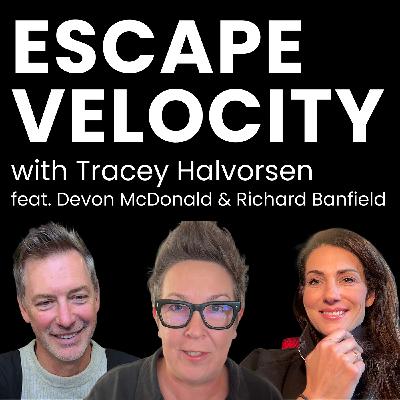
Tracey is joined by Second Harvest’s Richard Banfield and Devon Warwick-McDonald for a candid conversation about what happens when the map of your life dissolves beneath your feet. From personal loss to career upheaval to the quiet ache of disconnection so many feel today, the trio travels through the terrain that leads people to seek change, and why traditional self-help rarely offers real transformation. Richard and Devon share how their retreats intentionally remove certainty, routine, and the old scripts of success to make room for vulnerability, creativity, and genuine human alliance. What emerges is surprising: strangers forming lifelong bonds, new identities taking shape, experiments replacing grand plans, and a renewed sense of possibility. This episode is a reminder that transformation isn’t a program... it’s something ignited in the space between people brave enough to show up as themselves.
How do you make creativity a strategic tool—not a luxury—when resources are limited and expectations are high? In this conversation, Skidmore College’s VP for Communications and Marketing, Elizabeth Stauderman, joins to unpack how she brought the school’s motto, Creative Thought Matters, to life through a full web and brand transformation. We explore why mission must drive strategy, how beauty can ease change, and why liberal-arts thinkers are built for the AI era. Insightful, pragmatic, and deeply relevant for anyone leading creative or communications work in higher education.
In this episode of Escape Velocity, I talk with Sarah Patterson, a Fractional CFO who somehow makes the numbers feel human. Sarah works with creative agencies and consulting firms to bring clarity, confidence, and calm to the financial side of things—the part most of us would rather avoid.We get into what really happens when you stop treating your financials like a necessary evil and start seeing them as a creative tool. We talk about trust, mindset, and how money mirrors the stories we tell ourselves as founders.And then there’s tango. Sarah’s also a Buenos Aires–trained dancer, and she shares how that experience completely reshaped how she thinks about leadership, connection, and flow. Because at the end of the day, financial clarity isn’t just about spreadsheets—it’s about rhythm, trust, and learning to move in sync with change.

What does it take to break free from the gravitational pull of “business as usual” in higher ed marketing? In this episode of Escape Velocity, Tracey Halvorsen sits down with Mallory Willsea—B2B media consultant, AI strategist, and award-winning host of Higher Ed Pulse.Mallory shares how she built and scaled media brands like Higher Ed Live and Enrollify, why she believes leaders should stop waiting for permission and start building their own stage, and what it really takes to adopt AI without falling for hype. Along the way, she and Tracey delve into the realities of trust versus likability in leadership, why time is the biggest barrier to AI adoption, and how small risks can accumulate into big wins—even in tradition-bound institutions.Whether you’re navigating higher ed, rethinking your career, or simply looking for inspiration to take the leap, this conversation will leave you with frameworks, metaphors, and courage to try the things that scare you most.
What does it really mean to lead creative work in a world being reshaped by AI, complexity, and constant change?In this episode, Tracey Halvorsen sits down with Christina Melito, Creative Director at Fifteen4, for an honest, funny, and deeply insightful conversation about what creative leadership actually requires today — from managing stakeholders in regulated industries to operationalizing AI tools without losing your soul.They explore how tension can be a design tool, why client work is often a form of behavioral psychology, and how real change comes not from polishing pixels — but from shifting minds.Plus:– Why AI might be the most liberating thing to happen to creative teams in 20 years– How to make clients feel heard without losing sight of what really matters– What nobody tells you about visual design (spoiler: zooming in 10,000%)– And yes, the return of the lawnmower, microwave baloney, and meat roll-upsThis isn’t just about websites — it’s about transformation.And how brave, curious creatives help make it happen.
In this episode of Escape Velocity, Tracey Halvorsen is joined by Traci Barrett—founder of Navigate the Journey, executive coach, former HGTV founding team member, and author of What If There’s More?. Together, they explore what it means to lead with clarity, navigate burnout, and make brave choices in business and life. From surviving betrayal and recalibrating after setbacks to building teams rooted in honesty and shared values, Traci shares deep wisdom on fear, identity, hope, and finding significance beyond traditional markers of success. This is a must-listen for anyone feeling overwhelmed, off-course, or hungry to realign their ambition with purpose.
In this episode of Escape Velocity, Tracey Halvorsen sits down with Brigid Lawler, a seasoned enrollment strategist with decades of experience navigating the shifting landscape of higher education. From small liberal arts colleges to state institutions, Brigid shares candid insights on what’s broken in traditional recruitment, how schools can tap into their true identity, and why the admissions funnel might need to be flipped on its head.Together, they unpack the myth of one-size-fits-all marketing, explore the real reason students (and their parents) make decisions, and reflect on how small teams can punch above their weight with creative thinking, collaboration, and clarity of mission. If you work in higher ed—or are just trying to make bold decisions inside a cautious system—this conversation will hit home.
In this episode, Tracey sits down with her 17-year-old niece Romy, a rising senior deep in the college search process. From TikTok dorm tours to admissions anxiety, Romy offers a refreshingly honest Gen Z perspective on what matters (and what doesn’t) when evaluating colleges. If you work in higher ed—or just want to understand how this generation thinks—you’ll want to hear this.
In this episode of Escape Velocity, I’m joined by someone I’ve had the privilege of collaborating with on some of the most meaningful projects of my career—Pete Mackey.Pete is the founder of Mackey Strategies, where he helps colleges, universities, and nonprofits find their voice, sharpen their story, and face the future with clarity and confidence. With more than 30 years of experience leading communications for institutions like Amherst College, Bucknell University, the Jack Kent Cooke Foundation, and Science Foundation Ireland, Pete brings a rare combination of strategic leadership, creative insight, and on-the-ground experience building teams and navigating change.We talk about the difference between creating a message and reflecting one, and why deep listening is the most underutilized strategic tool in higher education. We explore the role of creative disruption—not as a threat, but as a necessary force for organizations that want to stay relevant without losing their core identity.We get into the challenges facing higher ed communications teams today—from overthinking and risk aversion to leadership misalignment and message control. Pete reflects on his time as an interim communications leader for multiple institutions, what it takes to re-energize internal teams, and why none of this work sticks without trust and buy-in from the top.We also discuss the growing pressures facing higher education in today’s political climate, the importance of sector-wide advocacy, and why moments of courage—whether on a global stage or within a single institution—can change the trajectory of an organization and the people it serves.It’s a wide-ranging conversation with one of the sharpest thinkers I know, and I’m excited to share it with you.
In this deeply personal and philosophical conversation, Tracey Halvorsen is joined by Richard Banfield—artist, writer, former CEO, widower, parent, and all-around human compass—for a wide-ranging discussion about identity, agency, grief, creativity, and what it means to truly be present in our lives.From confronting midlife reinvention and letting go of society’s need to label and define, to embracing vulnerability and the healing power of art, Richard offers an honest and expansive take on what it means to be a whole human navigating an increasingly complex world. The two discuss the myth of productivity, the seductive danger of perfectionism, and how shame can quietly shape our creative pursuits.They also explore the creative tension between mastery and curiosity, the liberating power of saying “yes,” and how emerging technologies like AI might paradoxically help us reconnect to our humanity. Richard reminds us that our greatest agency lies not in having all the answers, but in showing up—open-hearted and willing—to our own lives.
Before she was a stage 4 ovarian cancer survivor, Tracy Gosson was already a force.As the founding executive director of Live Baltimore, Tracy helped rebrand city living and sparked a movement to bring people back into Baltimore neighborhoods. She later launched Sagesse, Inc., a boutique consultancy that’s helped cities and developers across the country reimagine how place, story, and investment intersect.Then, in 2019, everything stopped. Tracy was diagnosed with stage 4 ovarian cancer—and suddenly, the only thing on the agenda was survival.In this deeply personal episode of Escape Velocity, Tracy shares what it took to get through an aggressive, experimental treatment—and what she learned about herself, her business, and her boundaries in the process.We talk about:• Reinventing your business after reinventing yourself• Getting clear on what (and who) is worth your time• The hard-won wisdom that only shows up after everything falls apartThis is a story about velocity, clarity, and real courage—the kind that only shows up when your life depends on it.
Carl Smith is more than a leader—he’s a community builder, a mentor, and, as I call him, the “daddy of digital agencies.” In this episode, we dig into everything from the evolution of agency life to the promise and peril of AI, the value (and curse) of ego, and why trust and human connection matter more than ever. Carl shares candid stories from his time running an agency, building the Bureau of Digital, and navigating complex relationships in creative teams. It’s funny, heartfelt, and packed with hard-earned wisdom. If you’re building a business, leading a team, or trying to stay sane in a shifting industry—this one’s for you.
In this episode of Escape Velocity, host Tracey Halvorsen sits down with Ashley Budd, higher education marketing expert and co-author of Mailed It!, to discuss how email remains one of the most powerful communication tools—when done right.Ashley shares insights from her book, offering practical strategies and “hacks” for making email more effective in an era of overwhelming digital noise. From the importance of clear subject lines to the role of authenticity, empathy, and logic in building trust, Ashley breaks down the principles that help emails stand out and drive action.The conversation touches on the evolution of email, how AI and automation are shaping inboxes, and why personalization isn’t just about inserting a name—it’s about delivering real value. Ashley also explains the impact of eye-tracking studies on email design, why institutions should embrace a more engaging and even humorous tone, and how a well-planned content strategy can transform audience engagement.If you want to make your emails more impactful, reduce unsubscribe rates, and turn your email program into a relationship-building powerhouse, this episode is a must-listen.🎧 Tune in to Escape Velocity to hear Ashley Budd’s expert take on how to cut through inbox chaos and make email work for you!
In this special episode of Escape Velocity, Tracey Halvorsen sits down with her 10-year-old to dive deep into what it means to be part of Gen Alpha. From rapid-fire fun questions to an in-depth breakdown of Gen Alpha slang, Fin offers an unfiltered, hilarious, and surprisingly insightful take on his generation.With plenty of laughs, wild tangents, and deep Gen Alpha wisdom, this episode is an entertaining ride into the mind of a 10-year-old who knows what’s up.

Comments

Download from Google Play

Download from App Store
 United States