


 Claim Ownership
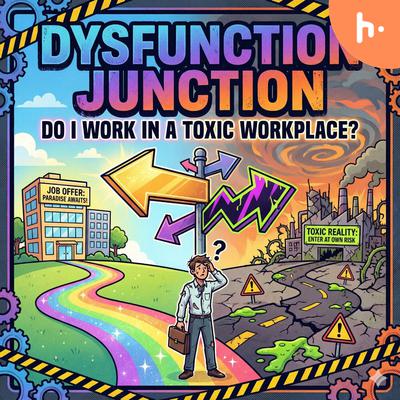
Dysfunction Junction: Do I Work In A Toxic Worplace
Subscribed: 0Played: 2
Subscribe

© Copyright 2025 Hugh Jensen
Description
We've all been there. Suddenly, you start to see signs you work in a toxic workplace.
16 Episodes
Reverse
Executive SummaryThis podcast episode explores the book 'Toxic at Work' by David Gillespie, which examines the biological reality of the 'everyday psychopath' in professional environments. The discussion highlights that roughly 5% of people lack the mirror neurons necessary for empathy, meaning they cannot be coached into better behavior. Unlike serial killers, these individuals are often charming 'organizational arsonists' who use human emotions as levers for manipulation, making them particularly dangerous to team cohesion and corporate culture.Key Takeaways•Approximately 5% of the population are everyday psychopaths who lack the biological capacity for empathy.•The condition is rooted in neuroscience, specifically missing or disconnected mirror neurons that prevent the feeling of others' emotions.•Corporate psychopaths are often highly charming and mimic emotions perfectly to manipulate their way up the corporate ladder.•Traditional HR interventions like empathy training are ineffective because biology cannot be coached; they may even become better manipulators.•It is vital to distinguish between a 'difficult' boss and a psychopath, as the latter views loyalty and guilt merely as tools for exploitation.Segments0:00Introduction to the Everyday Psychopath1:15The Neuroscience of Empathy and Mirror Neurons2:30Why HR Interventions Often Fail3:15The 'Colorblind' Analogy for Emotional Incapacity
Executive SummaryThis episode of the Dialogue Lab explores the core principles of 'Crucial Conversations,' a social science framework for handling high-stakes interactions. Host CoachingToResults explains that a conversation becomes crucial when opinions vary, stakes are high, and emotions run strong. The discussion highlights how biological fight-or-flight responses can sabotage logic, leading to destructive patterns of silence or violence, and emphasizes the importance of maintaining a 'Pool of Shared Meaning' to facilitate better collective decision-making.Key Takeaways•A conversation is defined as 'crucial' when it involves three factors: varying opinions, high stakes, and strong emotions.•Biological stress responses shunt blood away from the brain's reasoning centers, making us 'dumbed down' during critical moments.•Unsafe communication environments lead to two primary destructive behaviors: Silence (withholding meaning) or Violence (forcing meaning).•The 'Pool of Shared Meaning' represents the collective IQ of a conversation; the more information in the pool, the better the final decision.•Effective communication requires recognizing physical cues of stress to prevent reverting to primitive coping mechanisms.Segments0:00Introduction to Crucial Conversations0:45The Three Ingredients of a Crucial Conversation1:52The Biology of High-Stakes Interactions2:30Defining Silence vs. Violence and the Pool of Shared Meaning
Executive SummaryThis podcast episode explores Catherine M. Mattice-Zundel's book 'Navigating a Toxic Workplace For Dummies,' focusing on how the modern workplace has shifted since 2020. It highlights the growing importance of psychological safety and provides a framework to distinguish between normal professional conflict and persistent workplace bullying, which the author identifies as psychological violence.Key Takeaways•Post-pandemic workplace culture has a significantly lower tolerance for abuse, making psychological safety a requirement for organizational health.•Normal workplace conflict is typically isolated, task-oriented, and focused on finding a resolution to a specific problem.•Bullying is defined by repetitive and persistent behavior where the goal is power and control rather than the work itself.•Psychological violence is the term used to describe the intentional dismantling of an employee's confidence and well-being.•A culture becomes systemically toxic when an organization ignores abusive behavior or promotes bullies because they produce resultsSegments00:00Introduction to the post-pandemic shift in workplace culture01:05The critical role of psychological safety in modern organizations02:15Distinguishing between healthy conflict and systemic bullying03:40Defining psychological violence and systemic organizational infection
Executive SummaryThis podcast episode explores the book 'The Bully at Work' by Ruth and Gary Namie, which redefines workplace bullying as a form of systematic, health-harming psychological violence. The discussion covers the motives behind bullying—often rooted in the bully's insecurity regarding a target's competence—and highlights the critical distinction between normal workplace conflict and abusive power imbalances. It also addresses how bullying manifests in modern remote work environments and explains why traditional HR mediation often fails to protect victims.Key Takeaways•Workplace bullying is a systematic campaign of psychological violence and health-harming abuse, not a simple misunderstanding.•Bullies frequently target the most competent and capable employees because they feel threatened by their success.•A key differentiator of bullying is the power imbalance, where the perpetrator uses leverage to control or isolate the target.•Modern bullying in remote work often involves subtle tactics like digital exclusion, such as being 'accidentally' left off email threads or Zoom meetings.•Traditional HR mediation is ineffective for bullying because it is impossible to safely negotiate with an abuser.
Executive SummaryThis podcast episode explores the book 'Rising Above a Toxic Workplace' by Gary Chapman, Dr. Paul White, and Harold Myra. It serves as a survival guide for professionals trapped in poisonous work environments, focusing on how to identify systemic dysfunction such as narcissistic leadership, weaponized communication, and a lack of accountability. The discussion emphasizes that while employees may not be able to change a broken organizational culture, they can take steps to protect their psychological and physical well-being through boundaries, support networks, and strategic exit planning.Key Takeaways•Distinguish between temporary high-pressure periods and chronic, systemic workplace toxicity.•Identify communication red flags where information is withheld or used as a tool for manipulation.•Recognize the characteristics of narcissistic leadership, including a lack of empathy and the demand for constant validation.•Listen to physical warning signs, such as chronic fatigue or 'Sunday night dread,' which indicate a poisonous atmosphere.•Accept that naming the problem is the essential first step toward survival and reclaiming personal well-being.
Executive SummaryThis episode of CoachingToResults dives into 'Toxic Workplace!' by Mitchell Kusy and Elizabeth Holloway, which challenges the common 'bad apple' theory of workplace toxicity. The authors argue that toxicity is a systemic failure rather than just a personality issue, revealing how organizations often protect toxic high-performers due to their technical competence. The discussion explores the 'High-Performer Paradox' and the hidden 'performance tax'—the significant financial and human costs that toxic individuals impose on their teams despite their individual output.Key Takeaways•Toxicity is a systemic failure of organizational soil rather than just an individual personality defect.•Leaders often act as 'toxic protectors,' shielding destructive high-performers because they meet tangible performance metrics.•Technical competence acts as a 'Teflon shield' that prevents accountability for abusive or manipulative behavior.•The perceived productivity of a toxic employee is an illusion known as a 'performance tax' that costs millions in turnover and lost potential.•Organizations must redesign performance metrics to value cultural health and stop measuring only revenue or technical skill.
Executive SummaryThis episode of CoachingToResults explores Robert Sutton's book 'The No Asshole Rule,' focusing on the financial and operational impact of toxic workplace behavior. It introduces the Total Cost of Assholes (TCA) metric, highlighting how bullying leads to high turnover, legal risks, and diminished innovation. The discussion challenges the 'competence excuse' often used to protect high-performing but toxic employees, proving through data that their negative impact often outweighs their individual value.Key Takeaways•Workplace bullying is a systemic operational risk rather than a simple personality conflict.•The Total Cost of Assholes (TCA) framework allows leaders to quantify the financial damage caused by toxic behavior.•High performance does not justify toxic actions, as the resulting costs like turnover and legal fees often negate an employee's value.•Toxicity creates a 'distraction factor' and a 'management tax' that drains organizational productivity and leadership focus.•Fostering a civilized culture is essential for psychological safety and the ability for teams to pitch risky or innovative ideas.
In this episode, we dissect the critical career transitions for mid-life leaders in the landscape of early 2026. We explore the shift from traditional employment to 'Portfolio Leadership' and 'Fractional Roles' amidst the rise of Agentic AI. The discussion covers the financial incentives of pivoting (15-18% salary increases), the widespread burnout driving these decisions (87% of leaders), and the controversial 'Digital Ageism' barrier. We provide actionable strategies for building a 'Personal AI Runway' and utilizing 'Shadow Boards' to secure a high-impact, human-centric role in the new economy.
In this episode, we tackle the increasingly common dilemma of leading within a 'bad fit' organization during the 'Great Gloom' of 2024-2025. We explore the sharp divergence between executive mandates like strict RTO policies and modern human-centric leadership values. The discussion provides strategic frameworks for handling this friction, including 'Cultural Arbitrage' to protect your team and the necessity of a '90-day diagnostic' to determine if a graceful exit is the only viable path.
In this deep-dive episode, we explore the 'Productivity Paradox' of early 2026, revealing why the C-suite often fails to detect toxic leadership until it causes catastrophic damage. We analyze new Harvard research showing how toxic managers mask their destruction with short-term results, the financial reality of the 'invisible exodus' costing businesses $223 billion annually, and the dangerous 'Glassdoor Gap' where misconduct is ignored for top performers. We also discuss the role of retaliation in hiding the truth and provide actionable advice for identifying and removing these liabilities.
Psychological safety and A.I.
Should I stay or should I go?
Do they even know? Do they even care?
It happens slowly, oh so often.
There are many examples....
What are you seeing?
Comments


Download from Google Play

Download from App Store
 United States