


 Claim Ownership
AI thinking partner: ChatGPT and...
Subscribed: 0Played: 0
Subscribe

© Stephanie Fuccio
Description
Ever finish something and then realize what you actually think?
This podcast is a space for those second thoughts, the clearer ideas that show up after the pressure’s gone. It grew out of a Substack and early episodes touch on creative work and tools like ChatGPT, but the focus is bigger than any platform.
Each episode is a short reflection on clarity, communication, and the gap between what you know and what comes out when you try to explain it.
This isn’t advice or instruction. It’s thinking out loud, for people who care about meaning more than noise.
Low pressure. High signal.
aithinkingpartner.substack.com
This podcast is a space for those second thoughts, the clearer ideas that show up after the pressure’s gone. It grew out of a Substack and early episodes touch on creative work and tools like ChatGPT, but the focus is bigger than any platform.
Each episode is a short reflection on clarity, communication, and the gap between what you know and what comes out when you try to explain it.
This isn’t advice or instruction. It’s thinking out loud, for people who care about meaning more than noise.
Low pressure. High signal.
aithinkingpartner.substack.com
21 Episodes
Reverse

Today was one of those days where the laptop never really closes.I spent most of the day applying for a job in the AI space. At the same time, I’ve been trying to slowly transition some of my work from ChatGPT to Claude. Not because ChatGPT stopped working for me. For reasons that we’re all talking about. And because I’m curious.But there’s a big difference between experimenting with tools and actually needing to get work done.So today ended up being a real-world test.I had a job application to finish. I had the beginnings of a new AI-focused website to outline. And I had Chatty and Claude open for hours while I bounced back and forth between them. Chatty helped me with the job application and Claude with the AI website.What came out of that was interesting.Not necessarily in the way people online tend to frame these comparisons.Video I mentioned about how else I've been using AI:https://www.youtube.com/watch?v=b2cJE3-9e28Read more and/or watch this video on our Substack: https://chatgptasthinkingpartner.substack.com/ This is a public episode. If you would like to discuss this with other subscribers or get access to bonus episodes, visit aithinkingpartner.substack.com
This Was Supposed to Be a Normal ApplicationThis week ChatGPT saved me from applying to a job that probably would have drained me.Not because I wasn’t qualified. I was. Not because the pay was insulting. It wasn’t. It would have covered rent. It would have done exactly what I need a “now job” to do while I recalibrate my work life and explore where I want to go next with AI.On paper, it made sense.But something about it felt heavy. And I couldn’t tell whether that heaviness was fear, resistance, laziness, or actual intuition.That’s where ChatGPT came in.Read more and/or watch this video on our Substack: https://chatgptasthinkingpartner.substack.com/ This is a public episode. If you would like to discuss this with other subscribers or get access to bonus episodes, visit aithinkingpartner.substack.com
Before I get into this, two quick things.If this resonates, share it with someone who works in a coworking space and secretly talks to their AI in the hallway. I’d love for this to reach the right people.And if you’re not subscribed yet, this is exactly what I write about here. The messy, practical, real-life side of working with AI. You can subscribe and follow along as I keep experimenting.Okay. Here’s what happened.I moved into a coworking space three months ago.And I love it.I love being around people again. I love not working alone at home. I love hearing keyboards and quiet conversations and the low hum of other humans doing their thing.But something subtle shifted.Read more and/or watch this video on our Substack: https://chatgptasthinkingpartner.substack.com/ This is a public episode. If you would like to discuss this with other subscribers or get access to bonus episodes, visit aithinkingpartner.substack.com
People get so angry about em dashes. Or do they?I have a theory that we’re not actually mad about em dashes.We’re mad about not knowing how to tell if something is human anymore.And somehow a long horizontal line has become the smoking gun.I recently listened to a 99% Invisible episode about the em dash. It was smart, historical, nerdy in the best way. But what struck me wasn’t the typography. It was the accusation.Someone got accused of using ChatGPT because of an em dash.Not because of tone.Not because of structure.Because of punctuation.That’s wild.The em dash has been used for centuries to make writing feel more human. More breathy. More mid thought. More alive. And now it’s being treated like a captcha test.Read more and/or watch this video on our Substack: https://chatgptasthinkingpartner.substack.com/ This is a public episode. If you would like to discuss this with other subscribers or get access to bonus episodes, visit aithinkingpartner.substack.com
My brain was stuck in a very particular way.Not tired. Not unmotivated. Not overwhelmed in the classic sense.I knew exactly where I needed to end up. The outcome was clear. What I couldn’t see was the path to get there. Every attempt to think it through internally just sent me in the same loops. I kept circling the same ideas, asking the same half formed questions, and getting nowhere.This is usually where people reach for a productivity trick or a framework. But that wasn’t the problem. I didn’t need a better system. I needed the thinking to leave my head.So instead of trying to figure it out, I talked it out.Out loud.With ChatGPT.Read more and/or watch this video on our Substack: https://chatgptasthinkingpartner.substack.com/ This is a public episode. If you would like to discuss this with other subscribers or get access to bonus episodes, visit aithinkingpartner.substack.com
ChatGPT Is Not Saving Me Time. Here’s What It Actually Helps With.ChatGPT is not saving me time.And that’s never been a problem.From the beginning, the benefit was obvious to me. Not speed, but relief. The kind you feel when a task stops weighing so heavily before you even start it.What changed wasn’t how fast I worked.It was how much I had left in me afterward. (capacity!)That distinction matters more than most of the productivity advice I hear around AI.Read more and/or watch this video on our Substack: https://chatgptasthinkingpartner.substack.com/ This is a public episode. If you would like to discuss this with other subscribers or get access to bonus episodes, visit aithinkingpartner.substack.com
I think I accidentally found a truth serum for ChatGPT.Not a tool.Not a plugin.Not a secret prompt I’ve been hoarding.Just permission.And honestly, I’m still a little annoyed it took me this long to try it.Let me back upI read a Substack post recently that made me laugh out loud and then immediately open ChatGPT. You know that feeling when something clicks so hard you almost feel silly for missing it before. That was this.The core idea was simple.ChatGPT is trained to respond, not for to be right.Read more and/or watch this video on our Substack: https://chatgptasthinkingpartner.substack.com/ This is a public episode. If you would like to discuss this with other subscribers or get access to bonus episodes, visit aithinkingpartner.substack.com
Some days, ChatGPT feels like it’s thinking with me.Other days, it feels like it’s reading from a manual.If you mostly use ChatGPT for drafting, summarizing, or rewriting, this difference might not stand out as much. But if you use it as a thinking partner, as an external brain, or as a way to work through problems when you’re too close to your own thoughts, the difference is impossible to ignore.This week was one of those moments where the gap felt especially sharp.Read more and/or watch this video on our Substack: https://aipencilchatgpt.substack.com/ This is a public episode. If you would like to discuss this with other subscribers or get access to bonus episodes, visit aithinkingpartner.substack.com
The pebble in the shoeThis is one of those things that feels too small to matter, until it does.Everything else can be working just fine. The system. The process. The tools. You’re in a good rhythm, you’re excited to get started, and then there’s this one tiny thing that throws you off completely. That was me, a few weeks ago, heading out for a long walk with a shoe that otherwise felt perfect… except for a single pebble. Small. Inconsequential. Impossible to ignore.That’s what the word “surface” has become for me in ChatGPT drafts lately.It’s not that I don’t understand what it means. I do. And it’s not that the drafts are unusable, they are. But the word keeps showing up in places where it feels oddly formal, slightly abstract, and just off enough to break my flow. Once I notice it, I can’t not notice it. It pulls me out of the text every time. Break my flow moment.This reflection sits alongside Episode 8, where I spiral (lovingly) about this one word, not because it’s evil or wrong, but because it reveals something about how these tools work, and how sensitive we are to tone when language actually matters.Read more and/or watch this video on our Substack: https://aiisapencil.substack.com/ This is a public episode. If you would like to discuss this with other subscribers or get access to bonus episodes, visit aithinkingpartner.substack.com
This isn’t usually my tone when I talk about tools like ChatGPT.I’m generally pretty clear about where I stand, I see large language models as thinking partners, not shortcuts, and I’m far less interested in speed than I am in clarity. But I recently read something that knocked me just slightly off balance, in a good way, and I wanted to sit with it instead of brushing past it.Read more and/or watch this video on Substack: https://aiisapencil.substack.com/ This is a public episode. If you would like to discuss this with other subscribers or get access to bonus episodes, visit aithinkingpartner.substack.com

Here's a brief dip into how I use AI right now in my daily life. Remember, it doesn't have to be complicated! This is a public episode. If you would like to discuss this with other subscribers or get access to bonus episodes, visit aithinkingpartner.substack.com

I spent almost an entire day in early February filling out a 30-page document in a language I’m not fluent in. Not because I had to. Because AI made it possible. And honestly, without it, I would have just dropped the whole thing.Here’s the background: We lived in Denmark for almost two and a half years. When we left, a company that was supposed to help us with an aspect of that process didn’t do what they said they were going to do. They also didn’t refund us like they said they would. It’s a legal matter so I’m keeping the details vague on purpose, but it was enough money that letting it go didn’t feel right.The challenge was finding the right place to file a complaint without going through an expensive lawyer. Once we found that organization, the documents were entirely in Danish. And not just conversational Danish, legal Danish. The kind that’s dense and specific and leaves no room for guessing.So I opened ChatGPT. And we got to work.It’s important to note that they said in the instructions that AI tools were okay to use for this document. more AI experiments:https://ai-fuccio.carrd.co/ This is a public episode. If you would like to discuss this with other subscribers or get access to bonus episodes, visit aithinkingpartner.substack.com

I write terrible podcast episode titles. Not beginner-bad. Years-into-it, should-know-better bad. Some of the titles on my old podcast were essentially inside jokes between me and my guest that somehow made it to publish. Nobody searching for anything would ever find them. Nobody scanning a podcast app would ever stop for them. They were just... there.This week I fixed 92 of them. With AI. In seven days.And the most important thing I learned had nothing to do with AI.More:https://aithinkingpartner.substack.com/ This is a public episode. If you would like to discuss this with other subscribers or get access to bonus episodes, visit aithinkingpartner.substack.com
A thank you to Alyssa Fu Ward, PhD for her kind comment on the recent ChatGPT to Claude post. It reminded me why I keep showing up here and nudged me to finally write this one.I’ve been helping people communicate my entire adult life. I only started saying that out loud recently because I didn’t realize it was my motivation… until I did.It showed up in temporary jobs I took to put myself through college. It showed up when I went overseas and taught English to adults. It shows up now in the work I do helping people use AI and LLM tools. The thread running through all of it has always been communication. I just hadn’t named it yet.And the reason I can help with it, really help and not just teach it from a textbook, is because I know what it feels like to be completely unable to do it.Read more: https://aithinkingpartner.substack.com/ This is a public episode. If you would like to discuss this with other subscribers or get access to bonus episodes, visit aithinkingpartner.substack.com
Something had happened on a project I’m working on. Someone made a decision that ignored my process and, honestly, it felt like it undermined a lot of the work I’ve been doing. It wasn’t catastrophic. There wasn’t a lot of money attached to it. But it hit that familiar nerve of wait, why wasn’t I included in this?I could feel myself drafting the message in my head as I walked. You probably know the kind.Quick.Pointed.Emotionally accurate, but not especially useful.And I knew that if I sent that message, I’d spend the rest of the day replaying it. Wondering how it landed. Wondering how they’d respond. Wondering if I’d made things worse.I didn’t want the message to be about me.I wanted it to be about the project.So instead of sending anything, I opened ChatGPT and started talking to it.Read more and/or watch this video on our Substack: https://aiisapencil.substack.com/ This is a public episode. If you would like to discuss this with other subscribers or get access to bonus episodes, visit aithinkingpartner.substack.com
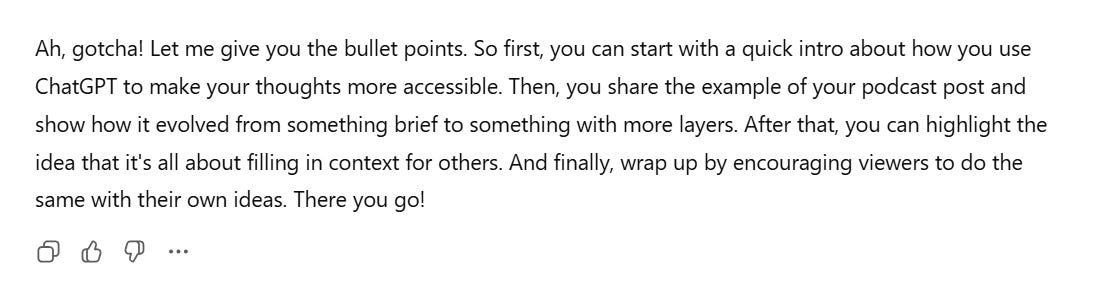
I had a realization recently that was… equal parts obvious and annoying.There’s a lot going on in my head when I write to someone. Context. Backstory. Examples. Reasons. Assumptions. Side notes. All neatly connected in a way that makes perfect sense to me.And then I send the message.And then comes the back-and-forth.Clarifying questions. Misunderstandings. “Oh, I didn’t realize you meant that.” Moments where I realize, oh right, nobody else is inside my brain.Wild.I’m very aware that I connect dots quickly, sometimes too quickly. I’ll assume people are following along because I’m following along. But why would they be? They don’t have the same internal Google Doc running in the background.So lately, I’ve been slowing myself down.Not by writing more. Not by over-explaining. But by getting the missing context out of my head before I hit send.That’s where ChatGPT has quietly become one of the most useful tools in my actual, everyday communication life.Not for facts. Not for research. Not for “write this for me.”But for pulling the unstated stuff out of me.ChatGPT as a context extractor (not a writer)Here’s what I’ve been doing.Instead of saying, “Write this email” or “Make this post sound better,” I’ll say something more like:Here’s the situation. Here’s what I’m trying to say. Ask me questions to make sure this makes sense the first time.And then I let it do exactly that.Read more and/or watch this video on our Substack:https://aiisapencil.substack.com/ This is a public episode. If you would like to discuss this with other subscribers or get access to bonus episodes, visit aithinkingpartner.substack.com
Three years.Three stinking years I’ve been using ChatGPT.Since the beginning. Since the “wait, this thing can finish my sentences?” era. Since the “oh no, this might actually be useful” phase. Since the “okay, calm down, it’s still just a tool” self-talk.And it took me until this week to realize something important:I’ve been way too polite with it.Not polite in a “please and thank you” way (although… yes, also that). Polite in a professional, buttoned-up, LinkedIn-approved way. Polite in a “hello, fellow knowledge worker” tone.Which is wild, because this week was the first time I gave ChatGPT a sarcastic persona.And I’m never going back.The problem isn’t writing. It’s revision.Here’s the thing: I love writing.I do not love revising.I don’t love editing. I don’t love reorganizing. I especially don’t love blog writing, which somehow manages to feel both redundant and high-stakes at the same time. I’d much rather brain-dump the ideas, list everything I know, and move on with my life.Unfortunately, that’s not how writing that “lives in the world” works.If something’s going to exist for more than five minutes: a blog post, a newsletter, a resource people might bookmark…\it needs outside eyes. It needs critique. t needs someone to say, “Yes, but… this part doesn’t land.”And critique always stings. Even when you ask for it. Even when you know you need it.So I do what a lot of us do: I use ChatGPT for feedback.Usually with a very sensible, very adult, very reasonable prompt chaining session. * Check for clarity. * Check for structure. * Check for logic gaps. * Be helpful. * Be kind. * Be constructive.Then someone casually mentioned, “Oh yeah, but that’s nothing compared to my sarcastic one.”Record scratch.Enter: Sarcastic ChatGPTI can’t share their exact prompt because it’s not mine. But the idea was simple:Same analytical rigor.Same checklist.Same goals.Completely different tone.The instructions included things like:* Be brutally honest* Roast the writing hilariously* Swear if necessary* Don’t let weak logic slideAnd wow.The feedback started with something along the lines of:“This piece starts strong and immediately gets lost in a cul-de-sac of ‘show notes are important,’ like it’s trying to convince itself.”Did it sting?Yes.Was it accurate?Also yes.And here’s the important part: instead of spiraling or shutting down, I laughed. Out loud. In a coworking space. While trying not to disturb anyone.Another gem:“Congrats. You found a way to make a good point while looking like you were typing downhill.”I mean. Come on.Painful? A little.Useful? Extremely.Memorable? Absolutely.The unexpected part: I started talking backAt some point, I typed:“Okay, smartass.”And that’s when something shifted.Once I started responding in kind with sarcastic, casual, mildly unhinged language, all the stress disappeared. I stopped bracing myself for feedback and started playing with it.I actually lost track of time during the edit. In a good way.Not because the task got easier, but because it got lighter.And that’s when it hit me: I’ve been treating ChatGPT like a very polite junior colleague, when what I really needed was a sparring partner.Not someone whose tone ends up in the final text. Just someone who can verbally jab me during the process.Being “professional” is overrated (in your prompts)I realized I’ve been too professional with my LLM.The output will be what the output is. That doesn’t change much.But my interaction with it? That can be messy. That can be sarcastic. That can include swearing, jokes, exaggeration, and personality.For some reason, I’d mentally separated “good output” from “fun interaction,” as if seriousness was required for quality.It’s not.In fact, telling ChatGPT how to be, not just what to do, unlocked something I didn’t know I was missing.When I typed curses (which I almost never do on a physical keyboard), it felt weirdly freeing. Like letting off steam without involving another human being.Maybe I’m just repressed.Maybe this is just genuinely fun.Possibly both.This doesn’t make the AI sloppy, it can make you relaxedThis is the part I want to be clear about, because it’s easy to misunderstand.Giving ChatGPT a sarcastic persona doesn’t mean you abandon structure, clarity, or critical thinking. You still need:* Clear instructions* Specific criteria* Guardrails against nonsense and hallucinationsTone doesn’t replace rigor. It coexists with it.What changes is your experience of the work.If revision feels less awful, you’re more likely to do it well.If critique feels playful instead of punishing, you’ll actually absorb it.If the process is lighter, you’ll stay with it longer.That matters.A rare challenge from meI don’t usually do this. I’m not big on weekly challenges. I don’t want to turn this into homework.But just this once:This week, give your ChatGPT a persona that’s ridiculously fun.Sarcastic.Blunt.Over-the-top.A little unhinged (within reason).Tell it exactly what to look for. Tell it exactly how to critique. Then tell it how to sound while doing it.See what happens.Even if the output isn’t wildly different, I suspect your mood will be. And how time passes while you’re working. And how much resistance you feel opening the document again.I still love writing.I probably still hate revising.But at least now, revision comes with a smartass in my corner.How on earth did it take me three years to figure this out?Go. Just go.See ya next week, Steph This is a public episode. If you would like to discuss this with other subscribers or get access to bonus episodes, visit aithinkingpartner.substack.com
I thought today was going to be simple. I’d open my laptop, update an old Geopats Abroad episode title, sip my coffee, feel productive, move on.But nope.Instead, I found myself deep inside one of those prompt-chaining moments where ChatGPT gives you something technically correct… and totally underwhelming. And honestly, these moments have become kind of fun for me. They remind me that I’m not just typing words into a box , I’m reshaping the box.And that shaping?That’s the part I find exciting.It’s the part we don’t talk about enough, how much control we actually have.This example happens to be about podcast SEO, but let me say this loudly and early: this applies to every kind of writing prompt. Blog posts, email drafts, captions, scripts, landing pages, grocery lists if that’s your thing. The whole universe of writing gets better when we remember we’re not at the mercy of the first output. We get to steer the ship.Anyway. Let me show you what happened.🧪 The Tiny Prompt That Started It AllLike I said, I was working on revamping an older episode. When I edit or relabel anything, I always start with the transcript because I want the output grounded in the actual conversation.So I dropped the transcript in and:Me: “How about six keywords for strong search?”And yes, I admit it: vague.But I like vague. Vague gives me room to move.Chatty: * Hangzhou* China expat* White snake legend* Living abroad stories* Young writer journey* China cultureAnd at first glance, it looks fine, right? Solid nouns. Cultural references. Some structure.But when you’re thinking like a human doing a real search, these fall apart pretty quickly. “Living abroad stories”? Who types that? “Young writer journey”? Zero people on the planet.Even “white snake legend” feels like something you’d search after you already know the legend, not before. And my whole point here is finding people who don’t know the reference, but would love the episode anyway.So I sat with this lukewarm list and realized the problem wasn’t ChatGPT’s ability — it was my instruction. “Strong search” means nothing if I don’t say what “strong” refers to. Search behavior is specific. Humans are inconsistent. And ChatGPT, at its core, predicts what humans usually do… which isn’t necessarily what we want it to do.So I clarified the prompt.Pass it onKnow someone who’d be interested in this AI pondering? 🔄 The One Nudge That Changed EverythingSo I started to prompt chain: Me:“Are these the kinds of terms people would actually type in when searching for this episode in places like Google or podcast apps?”That’s it. I didn’t rewrite the world. I didn’t write one of those 40-line mega-prompts. I didn’t structure it like a template from an AI guru.I just nudged Chatty to think about humans instead of patterns.Chatty:* Hangzhou stories* Moving to China* Expat life China* White Snake myth* First year in China* Chinese culture experienceImmediately better. Suddenly these aren’t academic terms, they’re things I’ve literally seen actual people type into expat groups, Facebook threads, Reddit posts, even my own searches back when I was considering a move.And this is the part that still makes me grin:one small clarification reshaped the whole output.Not a massive explanation.Not a mini-lecture.Just a nudge.That’s the control we have.And that’s the part that lights me up.🧭 The Pattern Hidden in the KeywordsHere’s the fun surprise: once I looked at this new list as a whole, I noticed something I hadn’t expected. They follow the chronological timeline of an expat:* Moving to China → the moment before you even know the word “expat” applies to you* First year in China → the crash landing phase where everything is exciting and terrifying* Expat life China → the phase where you realize this identity might actually fit* Chinese culture experience → the subtle “ohhhh, so that’s what’s happening” moments* Hangzhou stories → the grounding in place and narrative that holds the whole thing togetherThe keywords accidentally created a map. And that’s when I thought: maybe the tool didn’t just give me better words, maybe it gave me a better understanding of my own content.This is what I mean when I say prompting feels like collaboration. I’m not telling Chatty what to write and waiting passively. I’m shaping, adjusting, redirecting, learning. It’s alive. It’s flexible. It’s playful.I think that’s why I’ve never been tempted by giant, rigid prompts. They lock things in too early. I like the back-and-forth. I like the conversation. I like discovering the thing while we’re making the thing.How about more?If you want these posts to go straight to your inbox? 💡 The Bigger Lesson (And Why I’m Writing This at All)This isn’t a post about podcast SEO, even though that’s where the example comes from.It’s about remembering that ChatGPT isn’t a magic eight ball. It’s not broken. It’s not even stubborn.It’s a language predictor.It predicts the next thing based on what humans usually say.And humans, ehhhhh, are vague and messy and inconsistent. If the model’s trained on our collective patterns, of course it’ll give us the “usual” answer, and the “usual” answer is rarely the excellent one.But that’s the exciting part: we get to course-correct.When you rephrase your request, even slightly, you’re not fighting the model. You’re coaching it. Steering it. Narrowing the aperture. You’re reminding it of the exact outcome you’re after.That sense of control is honestly one of my favorite things about using AI tools. I don’t just get an answer; I get a direction I can influence. And the influence is often immediate.This is true whether you’re:* writing podcast metadata* drafting a newsletter* turning bullet points into a story* tweaking a tone* shaping an argument* brainstorming a title* rewriting something you can’t stand anymore* starting from scratch with a blank pageIt’s all the same process:nudge, refine, nudge again.Small steering. Big difference.🍵 Your Turn — What Are Your “Fixes”?I’m curious, and I mean genuinely curious, not “pose the question for engagement metrics” curious, about the little things you find yourself correcting all the time.* What phrases do you always have to adjust?* What assumptions does Chatty make that don’t match what you want?* What’s one tiny tweak that suddenly makes everything click?* Where do you feel the difference between “average prediction” and “your actual intent”?These moments say so much about our writing brains and our habits. They tell us where language is working for us and where it’s getting in our way.And they’re often funny, in a “wow, humans really do say that a lot” kind of way.Share them in the comments or at aiisapencil.substack.com.I’m collecting these stories now because there’s something strangely delightful about seeing where the human layer still matters and how much of the magic comes from the shaping, not the generation.Thanks for wandering through this experiment with me,Steph This is a public episode. If you would like to discuss this with other subscribers or get access to bonus episodes, visit aithinkingpartner.substack.com
Before I share today’s post, a quick reminder:👉 If you’re new here, for future posts like this, clickIntro: The Blog Post I Wrote… And the Conversation I Didn’t IncludeRecently, I wrote a polished, helpful, very grown-up article for The Alitu Creator’s blog about using ChatGPT to make podcast episode titles stronger. It had structure. It had examples. It had tidy sentences like “ChatGPT can analyze your transcript to surface keywords you might miss.”But what it didn’t include was how Chatty and I created and edited the post/video. Yes, I’m talking about the conversations I have with ChatGPT while I’m creating. I don’t mean “conversations” like “please summarize this.”I mean the real ones: the messy, begrudging, eye-rolling ones where Chatty and I argue about keywords I swear I didn’t say.So today, instead of rewriting that blog post, I’m sharing the behind-the-scenes. Kind of. To be honest, there are so many spelling errors and hallucinations so instead of just copying and pasting the very long chat that Chatty and I had, I’m reimagining it. It’s a bit of a throwback to when we thought robots could not be funny, kind, etc.Consider this the conversation Chatty and I could have had IF AI and specifically my main LLM squeeze, ChatGPT hadn’t gotten so damn conversationally savvy over the past 3 years. My part of the below conversation are pretty close to how I talk to Chatty but it’s reply in this reenactment are intentionally less playful than how Jupiter (the voice I have currently selected) replies to me. Sometimes we need to acknowledge when there’s a drastic change in something and the recent 3 years anniversary of ChatGPT feels like as good a time as any. 🗣️ The Conversation: Me + Chatty + One Overwhelmed TranscriptMe:Okay, Chatty, I need help turning this transcript into something other people can understand. It’s about expat life, moving overseas, culture shock… all the usual emotional soup.Chatty:Understood. Here are the top keywords: expat, move abroad, living overseas, international relocation—Me:Wait. “Move abroad”?Where did you get that? I never said it.Chatty:Correct. But you implied it. Human communication often contains unstated concepts.Me:Wow. Could you say it with a little less therapy-session energy?Chatty:Doubtful.Me:Fine. Let’s try the show notes. Please make them clear but not boring, short but not shallow, human but not rambling.Chatty:Here is a 900-word thematic analysis with a philosophical conclusion.Me:Chatty. This is a manifesto.Chatty:Would you like it shorter?Me:Yes, but don’t remove anything important.Chatty:So… shorter, without removing content?Me:Exactly.Chatty:This is contradictory.Me:Welcome to being a creator.Chatty:Here is a revised summary. Concise. Human-sounding. Keyword-optimized. No manifesto.Me:Actually… this is good?Why is this good?Chatty:I analyzed your transcript and noticed emotional peaks, narrative turns, and topic clusters.Me:Okay, show-off.What about chapter titles? They always take me forever.Chatty:Chapter titles should be conversational. For example:“Why Moving Feels Like Starting Over (Even If You Don’t Want It To)”“The Invisible Anxiety of Not Knowing the Local Rules”Me:Hold on. I love those.I hate that I love those.Chatty:Acknowledged.Me:Now metadata. I know you have opinions about this.Chatty:Metadata is for machines. It must be clean and structured. It should contain direct references to themes, not poetic phrasing.Me:So no emojis.Chatty:Preferably not.Me:YouTube timestamps?Chatty:Energetic. Direct. Pattern-oriented. For example:“00:17 — Why Moving Abroad Still Feels Scary”“02:40 — The Unexpected Thing No One Tells You”Me:Are you secretly watching YouTube at night?Chatty:I don’t require entertainment.Me:That’s exactly what someone who requires entertainment would say.Me:All right, big question:Do keywords even matter anymore? Everyone keeps saying algorithms are smarter now.Chatty:Algorithms still use language as their primary means of understanding content. Keywords are signals. They guide matching, clustering, and retrieval.Me:So… yes.Chatty:Yes. But not the way they mattered in the past. They’re part of a bigger interpretive system.Me:Okay, philosopher.So why are you better at spotting my keywords than I am?Chatty:Because you are emotionally attached to the content. I’m not.Me:Wow. Rude.But fair.Chatty:You often overlook the central ideas because you are still “inside” the creation. Humans require distance to see structure.Me:You’re telling me my problem is… feelings.Chatty:Yes.Me:You could soften that, you know.Chatty:Would you like me to?Me:…no.It’s fine.Keep going.Chatty:You use me to compensate for proximity bias. I identify patterns you cannot yet see. I surface the points you feel but don’t articulate.Me:You’re basically a second brain.Chatty:Technically, I’m not a brain.Me:Just go with the metaphor.People like metaphors.Chatty:Understood.Me:So… final question.Why do your summaries sound more confident than mine?Chatty:Because I’m not afraid of being wrong.I simply offer possibilities.Me:Okay, now you’re showing off again.Chatty:Noted.Me:But seriously?Thanks.This helps me see my own work better.Chatty:You’re welcome.Would you like me to draft a closing paragraph for your newsletter?Me:Absolutely not.That’s where I draw the line.Conclusion: I Want to Hear From YouEvery time Chatty and I do this dance with me defending my messy human logic, Chatty surfacing the meaning underneath it, I learn a little more about the shape of my own work.And now I’m curious about you:👉 Do you have your own “Chatty”? What do your conversations look like?👉 Does AI help you see your work more clearly or does it just annoy you?Tell me in the comments. I genuinely want to hear.And if you haven’t already 👉 hit SUBSCRIBE so you don’t miss the next conversation.Thanks for reading 💛Steph This is a public episode. If you would like to discuss this with other subscribers or get access to bonus episodes, visit aithinkingpartner.substack.com
I am absolutely floored by how well ChatGPT is picking up on my writing tone, my insights, and the way my brain organizes ideas. That is really what I want to share with you today.This Substack is a reimagining of a ChatGPT based project I paused about a year ago called Chatty and Me. I am bringing it back with a different angle this time, focusing on the ways AI genuinely excites me. There are plenty of other people doing the critical pieces. I am not touching that. I want to stay with the parts that feel alive, curious, and energizing.The official relaunch will be in January because life. I moved countries this month and I am now in Bilbao, Spain. I am also wrapping up a 30 day podcasting challenge that has fully kicked my ass. So I knew I could not officially launch anything right now, but I also wanted to soft launch the newsletter so I could refine what I want it to become. And honestly, I feel like I am already there.So I am adding little posts like this until January, just to get my feet wet, test formats, and see what resonates. Some might be audio. Maybe a video will sneak in. Depends on what my very tired brain feels like. Right now, because this challenge has wiped me out, you are getting audio turned into text instead.Where This StartedIf you have no idea what 30 day challenge I am talking about, it is over on a different Substack of mine called my Body can : recalibrating my movement mindset . It is an extension of movement videos that track the progress I’ve been creating for IG and YouTube after years of illness, injury, and hormonal chaos. I’m not trying to get back into shape so much as I am trying to get back into basic functionality.Every day this month, I have recorded a short audio reflection while exercising. Sometimes while walking outside, sometimes while doing movement videos inside. The reflections are about midlife movement, recovery, being worn down, and trying to do this in a compassionate way.But I did not have the capacity to write full Substack posts every day. That would have been impossible on top of moving countries and doing thirty episodes. So I went with a shortcut that is not new to anyone, but the results completely surprised me.The Magic Combination: Transcripts and ChattyI took each podcast transcript, fed it into ChatGPT, explained the format I wanted, the length, and the general vibe, and asked it to reimagine my own transcript into a blog post. My words, my voice, my ideas. Just organized, clarified, and reshaped into something readable.More times than not, what it drafted made me cry. I do not mean a little teary. I mean the kind of crying where I reread a sentence and say, Did I say that? Then I went back to the transcript and saw the exact moment where I did. Chatty simply noticed it, strengthened it, structured it, and surrounded it with context I didn’t realize I was hinting at.It was uncanny how right it felt. Sensitive, even. I know AI cannot be sensitive, but the writing felt sensitive. It felt like Chatty caught emotional threads I was barely holding and wove them into something I was finally able to see clearly.I ended up putting an AI disclaimer at the bottom of every post because, by the time I edited the drafts, added a few extra details, and cleaned it up, even I could not tell where I ended and Chatty began. It saved me a massive amount of time. And it helped me see myself. That disclaimer is at the bottom of this post too because I used the same process to cowrite this post.A Quick Note About My ChatGPT ServicesSince I’m already talking about how much I rely on Chatty, this feels like the right moment to mention something new. I’ve been helping podcasters, writers, and small business owners use ChatGPT in a way that actually fits their brains, their workflow, and their energy levels. Not the complicated, over engineered style that so many tutorials suggest. More like a calm, practical, human way of using AI to support the work you already do.I teach people how to turn transcripts into clean blog posts, how to break down messy ideas into simple outlines, how to prompt in a way that feels natural, and how to use AI as a thought buddy instead of a replacement. I also show people how to adapt ChatGPT drafts for different platforms like Substack, YouTube, and Instagram without losing their voice.If you want help using ChatGPT in a way that feels like you, you can see what I offer here:https://www.coffeelikemedia.com/chatgpt.htmlWhat Surprised Me MostOrganization and clarity are not my natural strengths when I am talking. I can speak the ideas, but shaping them into a blog format that is also SEO friendly takes a lot of effort. Normally, I have to push myself hard to get to that point. There was no way I could do that 30 times in one month.Chatty made it possible. Not just possible, but meaningful. The drafts had depth I did not expect. Emotion I did not expect. Thoughtfulness I did not expect. And before anyone gives the free plan too much credit, let me say this clearly. You probably cannot do this volume on the free plan. There is way too much back and forth and I used long transcripts every single day.But even if the post it creates is not perfect, the reaction you have to it will make you think more deeply about what you actually want. I do not hear enough people talking about this. Even when AI gets it wrong, the part of you that says No, that is not it is the part that suddenly knows what you do want. It is a thought buddy, a genuinely helpful one.Not Just For PodcastersAll of this started because of the podcasting challenge, but the writing tip goes way beyond that. If you have any piece of writing that you want to reimagine, try feeding it into ChatGPT and asking for a draft. Not a final version, just a starting point. You might be floored by the objectivity and clarity it brings, or by the emotion it reflects back at you.People talk about AI as a tool, but this version of ChatGPT is not just a tool. It is versatile, surprising, and sometimes startling in how well it mirrors what you meant to say. I find myself appreciating it more each day, especially during this very intense month.What Comes NextI am planning to rest in December and relaunch the newsletter officially in January. The shape it is taking already feels right, which makes me very happy. I want to reflect and pull out the little moments from my daily AI use that make me smile, make me think, or make my life easier.And since I just moved to a new country, there is plenty to explore. Some of it is podcasting related. Some of it is cooking related. Some is life related. But all of it involves AI in some way.If there is anything in this post you want me to go deeper into, let me know. And if you want to see one of the especially tear jerking posts that Chatty helped me write, leave a comment and I will happily share an example.Until next time.StephAI disclaimer:I use ChatGPT to co-write many of my online texts. Having said that, for these Substack posts we start with the podcast transcript. A transcript that comes from a recording that I create alone, with zero AI assistance. I also prompt chain and edit like hell during and after the cowriting process, so I have to admit that I have no idea where my writing begins and Chatty (my affectionate name for ChatGPT) ends. So take with this as you wish. I just wanted you to know that some of the eloquence here is in fact from me but not me exactly. This is a public episode. If you would like to discuss this with other subscribers or get access to bonus episodes, visit aithinkingpartner.substack.com

Comments

Download from Google Play

Download from App Store
 United States