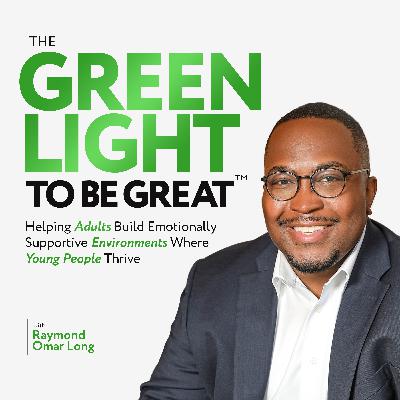
DiscoverThe Green Light to Be Great
The Green Light to Be Great
Claim Ownership

The Green Light to Be Great

Author: Raymond Long

Subscribed: 0Played: 0
Share

Description

Green Light to Be Great™ is a podcast for educators and school leaders who want to create the conditions young people need to thrive.

Hosted by Raymond Long, the show explores how emotional safety, belonging, and belief are built through consistent adult responses—and how aligned adult behavior improves student engagement, behavior, attendance, and readiness to learn.

Drawing on lived experience, evidence-based Social-Emotional Learning (SEL), and conversations with therapists, psychiatrists, and youth-serving leaders, each episode helps educators and leaders recognize unmet emotional needs and respond with clarity and care.

This podcast goes beyond inspiration to focus on building schoolwide social-emotional ecosystems—the shared language, relationships, and systems that move SEL from isolated programs to consistent practice, so students feel seen, safe, and supported across classrooms and schools.

5 Episodes
Reverse
Learn more about Raymond at raymondomarlong.comLearn more about The Green Light to Be Great at longimpact.com/greenlightIn this conversation, Raymond Long discusses the importance of emotional support for young people. He introduces The Green Light to Be Great Framework, which aims to empower youth-serving organizations to create environments where young people feel seen, safe, and supported. He shares personal experiences of overcoming challenges and emphasizes the need for consistent emotional support to help youth thrive.Keywordsyouth empowerment, emotional support, Greenlight framework, social emotional learning, youth development, mentorship, emotional intelligence, youth organizations, support systems, personal growthTakeawaysEvery young person deserves a world where their ability to pursue their passions is not defined by circumstances.Greatness emerges when a young person feels emotionally safe enough to explore and grow.Yellow lights symbolize societal threats that can hinder a young person's journey to greatness.Many young people face yellow and red lights that slow down their progress.The Greenlight framework is designed to help youth-serving organizations provide emotional support.Unmet emotional needs can undermine efforts to pursue greatness.Young people are entering adulthood without the necessary emotional foundations.Pressure in learning environments can impede emotional and social development.Understanding young people's emotional needs is crucial for effective support.The Greenlight Framework aims to create consistent emotional support across organizations.
Learn more about Raymond at raymondomarlong.comLearn more about The Green Light to Be Great at longimpact.com/greenlightKeywordsemotional support, youth development, social emotional learning, childhood experiences, trauma-informed care, growth mindset, wraparound services, two-generation model, behavior change, youth engagementSummaryIn this episode of the Green Light to Be Great podcast, Raymond Long discusses a framework designed to support young people's emotional and social development. He emphasizes the importance of emotional safety and supportive relationships as prerequisites for effective social-emotional learning. The conversation explores various concepts, including positive and adverse childhood experiences, trauma-informed principles, and the significance of a growth mindset. Long advocates for a holistic approach that includes wraparound services and a two-generation model to empower both youth and their families. The episode concludes with a detailed overview of the framework's implementation process and its core levers, aimed at fostering a supportive environment for youth development.TakeawaysEmotional support is foundational for social-emotional learning.The framework is research-informed and customizable.Positive childhood experiences can counteract adverse ones.Trauma-informed principles are essential for youth support.A growth mindset can empower young people to overcome challenges.Wraparound services address the whole child.The two-generation model emphasizes parental education.Behavior change requires safety, trust, and belonging.Youth engagement is crucial for effective implementation.The framework is designed to be practical and culturally responsive.TitlesEmpowering Youth Through Emotional SupportThe Framework for GreatnessSound bites"We want to be proactive.""It's about what you want for yourself.""It's about improving youth outcomes."Chapters00:00 Introduction to the Framework01:17 The Importance of Emotional Support02:44 Shifting Perspectives on Support04:53 Understanding Childhood Experiences07:18 Positive Childhood Experiences09:31 Addressing Adverse Experiences10:29 Proactive Approaches to Trauma11:29 Growth Mindset and Learning Differences12:42 Wraparound Services for Holistic Support15:24 The Two-Generation Model16:44 Behavior Change Principles18:14 Empowering Youth Engagement19:03 Framework for Social Emotional Support20:46 Core Levers of Emotional Support21:46 Building Supportive Environments23:25 Organizational Alignment for Success24:23 Implementation Phases of the Framework27:50 Bringing the Framework to Life30:31 Next Steps for Organizations
Keywordsemotional support, youth development, emotional learning, child abandonment, emotional stunting, parenting, mental health, youth education, emotional intelligence, social supportSummaryThis conversation explores the often-overlooked role of grief in student growth, examining how unrecognized loss can quietly limit emotional development and capacity. The discussion highlights why safe environments are essential for helping young people process grief and continue growing—socially, emotionally, and developmentally.The speakers also reflect on the role adults play in shaping emotional growth, emphasizing that children learn how to process emotions by watching the adults around them. When parents, educators, and caregivers model emotional awareness, regulation, and support, they create the conditions young people need to grieve, adapt, and grow in healthy ways.TakeawaysNot giving a young person the social or emotional support they need is kind of a form of subtle child abandonment.We have a pandemic in the sense of young people being emotionally stunted as they enter into adulthood.Emotional learning requires support; it's not just about curriculum.Children learn emotions by watching adults.Parents need to model healthy emotional behaviors for their children.Emotional stunting can have long-term effects on young people's lives.Supportive environments are crucial for emotional development.The role of parents is vital in teaching emotional intelligence.Healthy emotional expression should be demonstrated by adults.Emotional learning is a continuous process influenced by observation.About Brianna DoddsBrianna Dodds is a licensed Marriage & Family Therapist (LMFT), Certified Trauma Therapist (CTT), dedicated to helping individuals and families navigate the hard and heart-work of healing. Brianna’s work is anchored in the belief that hope shouldn’t just be a concept — it should be a lived experience. Having worked extensively with individuals and families in trauma-focused settings, she specializes in grief, trauma, PTSD, women’s issues, relationship challenges, and more. She weaves clinical expertise with human empathy, guiding her clients toward lasting transformation.About Raymond Omar LongRaymond Omar Long is a mission-driven leader, social impact strategist, speaker, and systems builder whose work centers on helping individuals, organizations, and communities unlock their potential and build sustainable change. As Founder and Lead Impact Strategist of Long Impact Group, he guides mission-driven organizations to strengthen people, systems, and strategy — turning complexity into clarity and vision into tangible, lasting impact. His leadership is rooted in lived experience: overcoming adversity, redefining purpose, and building a life of meaning, discipline, and contribution.Raymond’s journey spans launching youth development initiatives, guiding major nonprofit growth, securing funding, and serving on influential boards and coalitions across Arkansas. He’s been honored as one of Arkansas Business’s 40 Under 40, named among the Arkansas 250 Most Influential Leaders, and recognized for his work in hope-building and community advancement.Whether speaking on leadership, resilience, or social impact. Raymond empowers audiences to believe deeply, lead boldly, and act with purpose — inspiring transformation one voice, one vision, one village at a time.
Ever leave school exhausted—not just from teaching, but from holding everything else your students bring with them?The anxiety.The behavior.The trauma.If you’re a teacher or educator who cares deeply about students but feels overwhelmed by the emotional weight of the job, this episode is for you.In this episode of Green Light to Be Great™, we explore why social-emotional support cannot rest on teachers alone—and why asking one classroom, one counselor, or one program to carry the load is setting everyone up to struggle.Host Raymond Omar Long sits down with Dr. Brandi Yarberry, a double board-certified child and adolescent psychiatrist, to unpack what’s really happening when students walk into school carrying ongoing adversity—and why educators are often left without the tools, clarity, or backup they need.Dr. Yarberry is the founder of New Hope Child Psychiatry Services, where she provides psychiatric evaluations and medication management for children and adolescents. Drawing from her experience working with schools, families, foster care systems, inpatient facilities, and juvenile justice settings, she explains how mental health needs show up in classrooms—often long before a diagnosis or referral exists.Together, they break down how adverse childhood experiences (ACEs) affect student behavior, attention, attendance, and learning—and why positive childhood experiences (PCEs) and consistent adult responses can make a meaningful difference. Rather than framing SEL as “one more thing for teachers to do,” this episode reframes social-emotional support as a schoolwide system—where responsibility is shared, expectations are clear, and collaboration with mental health providers supports teachers instead of overwhelming them.By the end of this episode, you’ll feel less alone, more grounded, and clearer about why support must be built around teachers—not placed on top of them.In this episode, you’ll learn:Why teachers are burning out trying to meet emotional needs without a systemHow ACEs show up in classroom behavior and learningHow PCEs and stable adult relationships help students regulate and engageWhat “holistic care” really means in a school settingWhen mental health assessments, group therapy, and medication management are appropriateWhy collaboration between schools and mental health providers matters for teachersHow schoolwide alignment protects both students and educatorsYou care about your students—but you were never meant to do this alone.This episode offers teachers and educators a compassionate, practical lens for understanding student mental health without carrying it all themselves—and for advocating for systems that actually support the work they do every day.About the FrameworkGreen Light to Be Great™ helps schools build social-emotional ecosystems where emotional support is shared, consistent, and embedded—so teachers can focus on teaching while students experience safety, belonging, and care across the entire school.Connect with Raymond & Long Impact GroupLearn more about The Green Light to Be Great and systems-based solutions for schoolsFollow Long Impact Group on Instagram Follow Long Impact Group on LinkedIn Click here to join our email list and stay informed about upcoming episodes and seasons.
If student behavior keeps escalating despite your trauma-informed initiatives, this episode will challenge where you’re looking for solutions.Referrals are increasing. Teacher stress is climbing. And many districts are investing in social-emotional learning — yet disruption, disengagement, and escalation continue.In this episode, Raymond Omar Long speaks directly to school leaders about a foundational principle that often goes overlooked:Adult regulation shapes student behavior.Students spend nearly 16,000 hours in K–12 classrooms. That means adult tone, interpretation, and consistency are not minor variables — they are structural forces that shape school climate, instructional effectiveness, and long-term outcomes.Drawing heavily from What Happened to You? by Dr. Bruce Perry and Oprah Winfrey - this episode explores:• Why regulation must precede instruction• How trauma and chronic stress impact learning• Why interpretation determines adult response• How consistency builds psychological safety• Why schools function as part of a student’s “therapeutic web”For principals, assistant principals, deans, and district leaders implementing MTSS, strengthening Tier 1 supports, or building trauma-responsive systems in 2026 and beyond, this conversation reframes what sustainable improvement truly requires.Programs don’t regulate students.Adults do.And leadership sets the tone.Keywords:social emotional learning frameworktrauma-informed school leadershipadult regulation in schoolsschoolwide SEL implementationschool climate and culture improvementemotionally supportive classroomsstudent engagement and attendance strategiesACEs-informed educationtrauma-responsive schoolsschoolwide emotional regulation strategieseducator professional development SELwhole child education frameworkAbout The Green Light to Be Great™The Green Light to Be Great™ is a research-informed social-emotional framework designed for schools and youth-serving organizations that strengthens adult practice and emotional support.Rather than relying on isolated SEL programs, the framework focuses on what research consistently shows matters most: how adults respond to students throughout the school day.Grounded in neuroscience, developmental psychology, and social-emotional learning research, the Green Light to Be Great™ Framework helps educators, staff, and leaders build schoolwide emotional ecosystems that support:• Student engagement• Behavior and regulation• Attendance• Belonging• Readiness to learnThe framework translates research into everyday adult practice by creating consistency in emotional support across classrooms, hallways, extracurricular spaces, and leadership structures.About Long Impact GroupLong Impact Group partners with mission-driven human services organizations to deliver integrated social impact solutions that align people, programs, and strategy — from diagnosis through execution — so progress sticks and impact lasts.We don’t solve problems in silos.We take an integrated approach that connects:• Personal growth and leadership transformation• Organizational effectiveness• Program development and design• Implementation supportWe embed ourselves in your mission, align with your values, and work alongside your team to build the infrastructure, culture, and capacity needed for sustainable impact.Learn more at longimpact.com
Comments