


 Claim Ownership
Fat Elephant Podcast
Subscribed: 0Played: 0
Subscribe

© Charlie the Fat Elephant
Description
FatElephant is a value investing research engine built on a single, rigorous premise: Most investment mistakes happen because humans are emotional, but math is not.
www.fatelephnt.com
www.fatelephnt.com
6 Episodes
Reverse

The stock market is betting that AI will kill the software industry. The theory is simple: If an AI agent can “vibe code” a custom CRM for free, why pay Salesforce $1 million a year?In this episode, we debunk the “SaaSpocalypse.” We explore “The Google Paradox”- why the company with the best AI engineers on earth still pays millions to Workday and ServiceNow - and explain why enterprise software isn’t about code, but about liability insurance. Finally, we apply the Elephant Gun deep-value framework to the wreckage of the SaaS sector to find the one company that is actually a buy. This is a public episode. If you would like to discuss this with other subscribers or get access to bonus episodes, visit www.fatelephnt.com
Episode Summary:In this episode, we dive deep into ASML, the obscure Dutch company that has become the most critical node in the global technology supply chain. We explore how ASML built an effective monopoly on Extreme Ultraviolet (EUV) lithography—the technology required to print the world's most advanced microchips. The discussion then pivots to the investment thesis: with a high valuation and sky-high expectations, is ASML stock "priced for perfection"? We analyze the risks, from geopolitical tensions to cyclical earnings, and what the recent 2026 financial results mean for investors.Key Takeaways:The One-Company Supply Chain: ASML is the sole manufacturer of EUV lithography machines. Without these $350M+ machines, companies like TSMC, Nvidia, and Apple cannot produce the cutting-edge chips that power AI, smartphones, and modern data centers.The "Priced for Perfection" Dilemma: ASML trades at a significant premium (high P/E ratio) compared to its peers. The market expects flawless execution and perpetual growth. We discuss how even small earnings misses—like the slight EPS miss in Q4 2025—can trigger outsized stock volatility.The Moat: The episode breaks down the immense technical barriers to entry. ASML's mirrors are the flattest surfaces in the universe, and their supply chain involves thousands of specialized suppliers, making their dominance nearly impossible to replicate.Geopolitics & Risks: ASML is at the center of the US-China chip war. Restrictions on exporting advanced DUV and EUV tools to China pose a long-term revenue risk, challenging the company's growth outlook.Timestamps:00:00 - Intro: Why ASML is the most important tech company you’ve never heard of.04:30 - What is EUV? The physics of printing chips with light.12:15 - The Monopoly: How ASML defeated Nikon and Canon.20:45 - Financial Analysis: Margins, Bookings, and the "Priced for Perfection" valuation.28:30 - The China Factor: Export controls and geopolitical headwinds.35:00 - Conclusion: Is ASML a buy in the current AI gold rush?Companies Mentioned:ASML Holding NV (ASML)Taiwan Semiconductor Manufacturing Co. (TSMC)NvidiaIntelSamsung ElectronicsResources:ASML Official WebsiteASML Q4 & Full Year 2025 Financial Results This is a public episode. If you would like to discuss this with other subscribers or get access to bonus episodes, visit www.fatelephnt.com
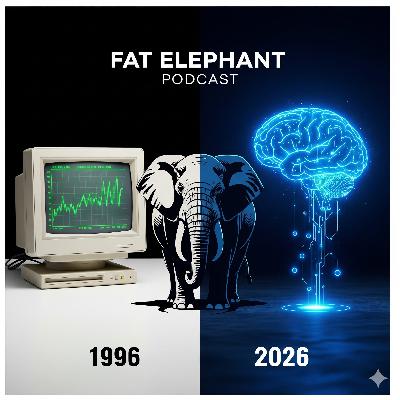
In this episode of Deep Dive, we tackle the trillion-dollar question on every investor’s mind: Is the current AI boom a bubble about to burst, or the foundation of the next industrial revolution?We break down the critical difference between today’s market valuation (27x forward earnings) and the insanity of the Dot-Com peak (100x earnings). Using 1996 as our historical roadmap, we explore the “Infrastructure Phase” of the cycle and project a potential timeline for the next four years—from the “digestion” of 2026 to the potential “melt-up” of 2028.Key Takeaways:* The 27x vs. 100x Reality Check: Why a 27x P/E ratio is expensive but fundamentally different from the 100x ratio seen in March 2000.* The “1996” Analog: We are likely in the “Infrastructure Phase” (building the rails), similar to the internet boom in 1996, rather than the speculative mania of 1999.* Quality of Earnings: Unlike the debt-fueled, unprofitable startups of the dot-com era (Pets.com), today’s AI leaders (Nvidia, Microsoft) are cash-flow giants funded by internal profits.* The “Melt-Up” Timeline: A year-by-year projection suggesting we could see the market double or triple by 2028 if human psychology repeats the “fear of missing out” (FOMO) cycle.* The “Productivity Gap” Risk: The primary danger isn’t a crash, but speed—if AI adoption happens too fast, the timeline could compress, skipping the boom years and jumping straight to the bust.Featured Concepts:* The “Greenspan Moment”: Comparing today’s valuation concerns to Alan Greenspan’s “Irrational Exuberance” speech in 1996, which famously came three years before the actual peak.* PEG Ratio (Price/Earnings-to-Growth): The essential metric investors should watch to see if valuations are detaching from reality (a PEG over 2.0 signals danger).* Price-to-Compute: The potential new “irrational” metric that could replace P/E ratios during the mania phase. This is a public episode. If you would like to discuss this with other subscribers or get access to bonus episodes, visit www.fatelephnt.com

Episode Summary: In this deep-dive episode, we pull the trigger on a rare “Elephant Gun” opportunity: U.S. Bancorp (USB). While the market sees a boring regional bank, we uncover a high-margin technology platform in disguise. We break down why USB’s unique Payment Services division, fortress balance sheet, and massive valuation disconnect make it a prime target for value investors.What We Cover:* The “Elephant Gun” Mandate: What it means to wait for a wonderful business at a cheap price.* The Hidden Gem: Why USB isn’t just a lender—exploring the “Payment Services” division that drives 25% of revenue and creates a sticky competitive moat.* The “Interconnectedness” Web: How USB locks in clients by bundling payments, corporate cards, and lending.* The Valuation Reveal: Crunching the numbers on the 7.8x Price-to-FCF multiple (vs. the 12x historical average) and our Intrinsic Value target of $83.64.* Risk Check: Addressing the Commercial Real Estate (CRE) fears and “Basel III” regulations.Key Data Points:* Current Price: ~$55.00* Intrinsic Value: $83.64 (+52% Upside)* Cash Conversion: $1.56 in FCF for every $1.00 of Net Income* Verdict: ⭐⭐⭐ Prime Target (Buy)Links & Resources:* – See the valuation gap visually.* Read the full “Elephant Gun” Investment Memo on our Substack.* Disclaimer: This episode is for educational purposes only and does not constitute financial advice. Always do your own due diligence. This is a public episode. If you would like to discuss this with other subscribers or get access to bonus episodes, visit www.fatelephnt.com
Amazon is currently spending more on its future than almost any company in history. With $115 billion in annual CapEx flowing into AI infrastructure and a global logistics network powered by the world’s largest private robot fleet, the "Efficiency Flywheel" is spinning faster than ever. In this episode, we quantify the ROI of the AI arms race, analyze the 11.5% operating margin expansion, and reveal the horizontal range chart that shows exactly how much margin of safety you have at today’s prices.* 0:00 – Intro: The 147x P/FCF Trap* 3:15 – The Red Flag Matrix: Amazon’s Quality Score* 6:40 – Explaining “Owner Earnings” vs. Reported Cash Flow* 10:20 – The AI Arms Race: Why the $115B Spend Matters* 14:45 – Robots & Margins: Squeezing the Sponge* 18:30 – Valuation: The 3 Levels of Margin of Safety* 22:10 – Final Verdict: The “Prime Buy” ZonePodcast Categories: Business, Investing, Technology. Keywords: Amazon Stock, AMZN, Value Investing, Warren Buffett, Intrinsic Value, AWS, Artificial Intelligence, Stock Analysis. This is a public episode. If you would like to discuss this with other subscribers or get access to bonus episodes, visit www.fatelephnt.com

Everyone loves a rocket launch, but do the numbers land safely? In this episode, we run Rocket Lab (RKLB) through the rigorous "Elephant Gun" valuation framework. We break down why—despite its incredible engineering moat and "SpaceX 2.0" status—the company’s financials trigger almost every red flag in the book. Plus, we debate the one massive counter-thesis: Is the "SpaceX Halo Effect" enough to ignore the cash burn? This is a public episode. If you would like to discuss this with other subscribers or get access to bonus episodes, visit www.fatelephnt.com
Comments


Download from Google Play

Download from App Store
 United States