


Roots and Shadows: The Real Appalachia Podcast
Subscribed: 2Played: 11
Subscribe


© Kevin Austin | Whisper Creek Studios
Description
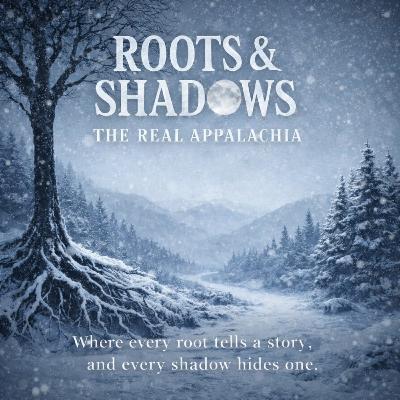
Roots & Shadows: The Real Appalachia is a narrative podcast exploring the hidden history, folklore, and true crime of the Appalachian Mountains. Through careful storytelling and lived perspective, the show examines heritage, identity, and the silence that shaped generations. These are stories of family, faith, prejudice, survival, and truth that is told with respect, depth, and humanity.
Where every root tells a story, and every shadow hides one.
Where every root tells a story, and every shadow hides one.
12 Episodes
Reverse
An old brick house beside Interstate 81 in Seven Mile Ford, Virginia holds nearly two centuries of Appalachian history, mystery, and folklore.From a Wilderness Road tavern and a cave discovery to the unusual life of writer Lucy Crockett, the Preston House carries stories that refuse to disappear.If you drive north on Interstate 81 through Smyth County, Virginia, just before the Seven Mile Ford exit, there’s an old brick house sitting quietly back from the road. Most people pass it without noticing. But for nearly two centuries, that house has carried stories that refuse to disappear.In this episode of Roots & Shadows: The Real Appalachia, host Kevin Austin explores the history and folklore surrounding the Preston House, sometimes called the Herondon House, one of the most intriguing historic homes in Southwest Virginia.Long before the interstate existed, this land sat along the Wilderness Road, one of the most important migration routes in early American history. Settlers heading west into Kentucky and Tennessee passed through this valley with wagons, livestock, and everything they owned. Taverns and inns appeared along the road where weary travelers could rest for the night.According to local tradition, an early log tavern once stood on the very ground where the brick house now sits. Stories passed down around Seven Mile Ford suggest that some travelers who stopped there were never seen again.In 1892, a discovery nearby only deepened the mystery. A small cave was found containing the remains of twenty-one skeletons, including one described as a woman holding a child. While no one ever proved where the bones came from, the discovery became part of the long folklore surrounding the property.The brick house that stands there today was built in 1842 by John Montgomery Preston, part of a prominent Virginia family connected through marriage to Revolutionary War hero William Campbell of nearby Aspenvale. For generations the house served as a gathering place for the Preston family and held an extraordinary collection of historic papers, including letters from George Washington, Thomas Jefferson, James Monroe, and Patrick Henry. Some of these documents were later preserved by the Library of Congress and the Draper Manuscript Collection.But the most unusual chapter in the story of the house may belong to the last woman who lived there.After World War II, the property became home to Lucy Crockett, a writer and illustrator who published nine books between 1939 and 1963. One of her novels, The Magnificent Bastards, was adapted into the 1956 film The Proud and the Profane, starring William Holden and Deborah Kerr.Lucy called the house Herondon, and over the years she became one of the most memorable figures in the area. Locals remember seeing her drive into town in an old military jeep, often carrying a revolver on her hip.In the early 1960s she reportedly sent letters to officials in Washington, including FBI Director J. Edgar Hoover, claiming she had information about a possible threat to the U.S. government. Family members later recalled that federal agents visited the property in 1963 to investigate the letters.Today the future of the old house is uncertain. The property was sold in May 2022 with plans for commercial development nearby, and the fate of the historic structure remains unclear.For now, the old house still stands beside the road near Seven Mile Ford, holding nearly two hundred years of Appalachian history, mystery, and memory.Because in Appalachia, some places don’t just sit beside the road.They collect stories.
In June of 1990, a quiet Appalachian town in southwest Virginia was shaken by a crime that many people here still remember decades later. In the small community of Saltville, nestled in Smyth County, life moved at the steady rhythm familiar to so many mountain towns. Families had lived there for generations. Neighbors knew one another. Children rode bikes through the neighborhoods during long summer evenings while the mountains settled into the quiet sounds of another Appalachian night.But on June 14, 1990, that quiet rhythm was interrupted by a phone call to the Smyth County Sheriff’s Office.The caller didn’t report a crime. They didn’t describe violence or ask for help. They simply suggested that deputies might want to check on a house in town.When officers arrived at the home in Saltville’s Government Plant neighborhood, they walked up the short sidewalk and knocked on the front door.No one answered.What began as a routine welfare check quickly turned into one of the most disturbing crime scenes the community had seen in nearly twenty years. Inside the home, investigators discovered the bodies of 36-year-old Linda and her two daughters, fourteen-year-old Melissa and thirteen-year-old Amanda.The man responsible was Linda’s husband, Mickey Wayne Davidson.In this episode of Roots & Shadows: The Real Appalachia, we take a careful look back at the events surrounding the 1990 Saltville murders — a crime that left an enduring mark on this Appalachian community. Through court records, historical reporting, and conversations with people connected to the case, this episode explores what happened during those two days in June and how the people of Saltville struggled to come to terms with a tragedy that unfolded inside an ordinary home.We examine the anonymous phone call that first brought deputies to the house, the investigation that followed, and the confession that revealed what had happened inside.The story also explores the legal case that followed in Smyth County Circuit Court. After being charged with three counts of capital murder, Davidson chose to plead guilty rather than face a full trial. During sentencing, he refused to present a defense and attempted to waive his automatic appeals, telling the courts he believed he deserved the punishment he received.The case moved through the Virginia court system before ending on October 19, 1995, when Davidson was executed by lethal injection at Greensville Correctional Center.But the impact of what happened in that house in Saltville didn’t end with the court proceedings.In small Appalachian towns, tragedies like this don’t simply fade into history. They become part of the memory of a place, stories shared on front porches, in school hallways, and around kitchen tables where people still remember the victims and the lives they were living before everything changed.The Knock That Went Unanswered is not a story meant to sensationalize violence. It is a reflection on how a quiet Appalachian community responds when tragedy arrives at its doorstep, and how the roots of a place endure long after the shadows have passed.In this episode of Roots & Shadows, we return to Saltville, Virginia, to a quiet neighborhood, a house on a small street, and a knock on the door that went unanswered.
In the mountains of Appalachia, some families carried a name that set them apart. Melungeon.For generations in Southwest Virginia, and East Tennessee Melungeon families lived in the space between racial categories. In court records they were labeled “free persons of color.” In census rolls they were marked inconsistently. As racial classification laws hardened in the late 1700s and early 1800s, identity in the mountains became less about ancestry and more about survival.This episode of Roots & Shadows: The Real Appalachia explores the documented history of the Melungeon's of Appalachia, focusing on communities in Hawkins County, Tennessee, the Vardy settlement, Newman’s Ridge, and parts of Southwest Virginia near the Virginia -Tennessee border. We examine early land grants, tax lists, and voting disputes that show how families navigated changing racial laws in colonial Virginia and early Tennessee statehood.Who were the Melungeons? Were they of mixed European, African, and Native ancestry, as many historians now suggest? Were the long-circulating stories of Portuguese or Turkish descent attempts to claim a safer identity in a society structured by racial hierarchy? Why did so many families settle along isolated Appalachian ridges and hollows where distance offered protection from scrutiny?We walk through documented court cases involving property rights, military service, and challenges to voting eligibility. We explore how miscegenation laws and Virginia’s evolving racial statutes reshaped the legal landscape, forcing families into categories that did not reflect lived reality. The story of the Melungeons is not simply folklore. It is woven into the legal, social, and economic history of Appalachia.This episode also includes insight from Heather Andolina, President of the Melungeon Heritage Association, offering perspective on how Melungeon identity is understood today, how descendants are reclaiming their history, and why careful research matters when separating myth from documented record.The Melungeons were not a mystery tribe hidden in the hills. They were farmers, laborers, Civil War soldiers, church members, and neighbors. They built homes along remote ridges like Newman’s Ridge and in communities like Vardy. Some blended quietly into broader Appalachian society over time. Others carried family stories forward, even when public acknowledgment carried risk.In the twentieth century, scholars revisited the history. In the twenty-first century, DNA ancestry testing reopened conversations many families once avoided. For some descendants, genetic results confirmed oral tradition linking European, African, and Native lines. For others, the results complicated long-held narratives. What remains consistent is that identity in Appalachia has never been simple.This episode explores Melungeon history, Appalachian racial classification laws, Southwest Virginia settlement patterns, Hawkins County court records, the Vardy community, and the enduring question of belonging in a region shaped by both isolation and resilience.Because in these mountains, a name could protect you, define you, or follow you. And sometimes the story of who you are is shaped as much by the laws written about you as by the bloodlines you carry.
In far southwestern Virginia, near the Tennessee border, the small mountain community of Taylors Valley carries one of Washington County’s most enduring ghost stories, the Legend of the Creekfield Woman.Taylors Valley sits just outside Damascus, Virginia, along what is now the Virginia Creeper Trail. Long before hikers and cyclists passed through the valley, the area was shaped by farming communities, Civil War memory, and later the arrival of the Virginia and North Carolina Railroad. It is in that setting that the Creekfield Woman legend took root.Several versions of the story exist. Some speak of hidden treasure buried in the hills. Others mention outlaws passing quietly through the valley. But the version most often repeated in Southwest Virginia ties the legend directly to the American Civil War.According to local tradition, a young woman believed her husband had been killed in battle during the 1860s. News traveled slowly through Appalachian communities at the time. Months passed. Grief settled into daily life. Then, unexpectedly, the husband returned home.What happened next depends on who is telling the story. Some accounts describe a confrontation born of confusion and mistrust. Others suggest tragedy unfolded in a moment of panic. Nearly every version ends the same way. The woman disappears, and her story never resolves publicly. No official record clearly confirms her fate. What remains is oral history.Decades later, when the Virginia and North Carolina Railroad carved its way through Taylors Valley in the late nineteenth century, railroad workers began reporting unusual sightings along the tracks. A woman dressed in white. Long dark hair. A lantern in her hand. Walking the rail line before daylight. Always near the wooded stretches and low water crossings.When the railroad ceased operation and the corridor became the Virginia Creeper Trail, the sightings did not vanish. They shifted. Locals and visitors near Damascus, Virginia have described unexplained encounters near waterfalls and remote sections of the trail. The setting evolved from rail line to recreational path, but the story endured.The Creekfield Woman has become part of Washington County folklore, woven into Appalachian storytelling traditions where history and memory overlap. Unlike documented crimes or industrial disasters, this legend survives through repetition rather than paperwork. It is passed along on porches, at kitchen tables, and beside campfires. Details change. The core image remains.In this episode of Roots and Shadows: The Real Appalachia, we explore the Civil War version of the Creekfield Woman legend and examine how Appalachian folklore grows from real geography. Taylors Valley is a real place. Damascus, Virginia is a real town. The Virginia Creeper Trail follows the path of a documented railroad. The Civil War left lasting scars across Southwest Virginia. Folklore often takes shape where historical uncertainty leaves space.We separate documented regional history from oral tradition and consider why certain stories persist for generations. What makes a Civil War era legend endure in a specific Appalachian valley? Why do sightings attach themselves to railroads, river crossings, and wooded bends in the trail?The Legend of the Creekfield Woman stands at the intersection of Appalachian ghost stories, Civil War memory, and the cultural landscape of Southwest Virginia. It reflects how communities preserve unresolved moments through narrative rather than record.Because in the mountains of Appalachia, not every story ends with documentation. Some remain part of the place itself, carried forward by those who walk the same ground and remember what they were told.🎵 Music Credit“Creekfield Woman” performed by Martha Spencer.Written by Yates Brothers.Used with permission.
In 1989, something changed in Smyth County, Virginia.What began as separate acts of violence slowly started to feel connected. Reports came in from back roads, small communities, and gathering places where people had once felt safe. A convenience store clerk. A fire hall dance. A U.S. Forest Service employee who survived am attack and was able to identify her attacker. Across Southwest Virginia, fear moved quietly through towns that were not accustomed to this kind of crime.By the end of that summer, the name Michael Reeves would become permanently tied to one of the most disturbing criminal cases in the region’s modern history.Investigators in Smyth County and neighboring jurisdictions began comparing timelines, evidence, and witness accounts. What initially appeared to be isolated assaults revealed patterns. Law enforcement agencies coordinated across county lines and into surrounding states as they worked to understand the scope of the crimes.Michael Reeves was ultimately charged in connection with multiple violent offenses, including sexual assaults and homicide. Court proceedings followed. Prosecutors presented evidence. Survivors testified. Families filled the courtroom.Reeves was convicted of one murder and additional violent crimes tied to the 1989 attacks. Not every accusation resulted in a separate trial. Not every family heard a verdict read aloud in court. But the legal record reflects a murder conviction and other serious felony convictions connected to that summer in Southwest Virginia.For many residents of Smyth County, the convictions brought a measure of legal closure. Sentences were handed down. Appeals moved through the system. The case entered the official record of Virginia criminal history.Yet legal closure and community resolution are not always the same thing.Smyth County sits along the Interstate 81 corridor in far Southwest Virginia, near the Tennessee border. In the late 1980s, it was a place where people recognized one another at gas stations and high school ballgames. Violent crime on this scale felt distant, something that happened elsewhere. The events of 1989 challenged that sense of familiarity and safety.This episode of Roots & Shadows: The Real Appalachia examines the Michael Reeves case within its historical and regional context. We look at how investigators connected the crimes, how the courts handled the charges, and what the official outcomes were. We also explore how crime reshapes small Appalachian communities long after the headlines fade.The case involved real victims, real families, and real consequences. It forced a rural mountain county to confront the reality that violence can cross county lines just as easily as highways do. It raised questions about law enforcement coordination, prosecutorial decisions, and the difference between public knowledge and courtroom proof.More than three decades later, the name Michael Reeves remains part of Smyth County’s criminal record. The convictions are documented. The sentences were imposed. But memory lingers differently than paperwork.For those who lived through that summer, it was not defined solely by indictments or sentencing hearings. It was defined by a shift. Doors locked earlier. Parents asked more questions. Familiar roads felt unfamiliar after dark.The summer that carried a shadow did not end when the verdict was read.In this episode, we revisit the 1989 crimes tied to Michael Reeves, the investigation that followed, and the lasting imprint left on Southwest Virginia. We separate confirmed legal outcomes from allegation. We examine what was proven in court and what remains part of the broader historical record.Because in the mountains of Appalachia, crime does not disappear when a case file is closed. It becomes part of the place, part of the conversations that happen quietly, and part of the understanding that even small communities are not immune.
On Christmas Eve, 1924, the town of Saltville, Virginia went to bed expecting morning.What came instead was one of the most devastating industrial disasters in the history of Southwest Virginia.Saltville sits in Smyth County along the North Fork of the Holston River, near the Tennessee border. For generations, the town’s economy depended on salt production and chemical manufacturing. The region’s natural salt deposits made Saltville an industrial center long before the twentieth century. By the 1920s, large chemical operations processed materials that were shipped nationwide, and the town’s identity was closely tied to that industry.Waste from those operations was stored behind large earthen containment structures known as muck dams. These dams held back slurry and industrial byproducts created during chemical processing. They were considered stable. Residents lived and worked below them.Late on December 24, 1924, one of those muck dams failed.The collapse released a surge of industrial waste and water into the valley. In the darkness of Christmas Eve, homes and buildings were struck without warning. Structures were swept from foundations. Families were forced into freezing conditions as debris and floodwater moved through parts of Saltville.By morning, the damage was clear.Rescue efforts began almost immediately. Neighbors searched for survivors in unstable conditions. Workers from the chemical plant joined recovery efforts. Churches and local buildings opened to shelter those displaced. In a small Appalachian community, response began with those closest to the disaster.Official accounts documented multiple fatalities and extensive property loss. Historical sources differ on the precise number of lives lost, but the tragedy marked one of the earliest major industrial waste disasters in Virginia history. Beyond the immediate destruction, the collapse sent contaminated material into the Holston River system, affecting water quality downstream and leaving long-term environmental concerns.Investigations followed the disaster. Questions centered on the construction and maintenance of the muck dam, as well as oversight of industrial waste containment. In the 1920s, regulatory standards were limited compared to modern environmental law. Industrial expansion often moved faster than safety policy, particularly in rural Appalachian communities dependent on manufacturing jobs.Saltville did not disappear after the collapse. The town rebuilt. Chemical production continued for decades. Employment remained vital to Smyth County and surrounding Southwest Virginia communities. The same industry that contributed to the disaster also provided livelihoods for generations of families.That tension became part of Saltville’s story.Over time, environmental awareness increased. Later studies examined contamination tied to historic chemical operations along the Holston River. Remediation efforts addressed lingering effects from earlier decades of industrial activity. But in 1924, the immediate concern was survival and recovery.In this episode of Roots & Shadows: The Real Appalachia, we explore the causes of the Saltville muck dam disaster, the human toll, the rescue efforts, and the long-term impact on Smyth County, Virginia. We examine how industrial growth shaped the Appalachian region and how trust in infrastructure can change overnight.This is not folklore. It is documented Appalachian history rooted in real events, real families, and a real place along the Holston River.Nearly a century later, the events of December 24, 1924 remain part of Saltville’s historical record. The disaster reshaped the valley physically and emotionally. It stands as a reminder that progress in early twentieth century Appalachia carried both promise and risk, and that mountain communities often carried the consequences quietly.Because in these valleys, history does not simply pass. It settles into the land and becomes part of it.
It started the way a lot of things do in the mountains, with long winter nights, too much boredom, and a group of young people looking for something to fill the quiet.What followed wasn’t a jump scare or a campfire story, but a slow unraveling. A Ouija board bought off a store shelf. Questions asked half-jokingly. Answers that came back a little too specific. And a sense that something had been invited into the room long before anyone realized what they were opening.This episode is told as it was shared with me, not as a warning about monsters, but as a warning about curiosity, fixation, and the way attention itself can become a doorway. We hear from those who lived it, and from a pastor who helps frame what happens when fear, belief, and the unseen start overlapping.This is not an endorsement of the occult. It’s a cautionary story about lines that don’t announce themselves until after they’ve been crossed.Because in Appalachia, roots run deep and shadows run long.
The manhunt was over.By mid-1984, all six escapees from Virginia’s death row had been captured. Lem Tuggle Jr., Willie Leroy Jones, Linwood Earl Briley, James Briley, Raymond V. Clark, and Derick Peterson were once again behind bars. The immediate crisis surrounding the escape from Mecklenburg Correctional Center had ended.But in Appalachia, the end of the chase was not the end of the story.The escape of the Mecklenburg Six had exposed weaknesses inside Virginia’s maximum security prison system. Investigations followed. Reviews were conducted. Questions were raised about how six condemned men could overpower guards and move beyond barriers designed to hold forever. In the years that followed, Mecklenburg Correctional Center would lose its role as Virginia’s death row facility. The system shifted. Policies changed.Inside courtrooms across the Commonwealth of Virginia, another process unfolded more slowly.Appeals were filed. Sentences were reviewed. Attorneys argued over procedure, evidence, and constitutional questions tied to capital punishment. For the Briley brothers, Linwood Earl Briley and James Briley, executions would ultimately follow. Willie Leroy Jones was also executed after exhausting his appeals. Raymond V. Clark and Derick Peterson faced their own legal outcomes within Virginia’s capital system.At the center of this final chapter stood Lem Tuggle Jr., the last living member of the Mecklenburg Six.Already convicted of murder in Smyth County, Virginia, Tuggle’s legal path stretched on for years. Court filings moved between state and federal jurisdictions. Death row in Virginia during the 1980s and 1990s operated under intense scrutiny, with evolving standards around appeals and capital punishment. His case became part of that broader legal landscape.For families connected to the original crimes, justice was measured not in headlines but in time. Years passed between conviction and final resolution. Legal arguments unfolded far from the communities most affected. In small Appalachian counties like Smyth County, the weight of those years settled quietly.This episode of Roots & Shadows: The Real Appalachia follows what happened after the Mecklenburg Six were recaptured. We examine the executions that followed, the court battles that defined Virginia’s capital punishment system during that era, and the institutional changes that came after the 1984 death row escape.We also return home to Smyth County, where the story began long before the prison break. For many residents, the escape was only one chapter in a longer narrative that included murder, trial, conviction, and decades of waiting. When justice finally arrived, it did not erase the past. It marked a legal conclusion to events that had reshaped families and relationships.This is not a story about spectacle or notoriety. It is a story about accountability within institutions, about how capital punishment functioned in Virginia during a turbulent period, and about what remains when legal processes stretch across decades.The Mecklenburg Six escape altered prison policy. The executions that followed closed certain chapters. But in Appalachia, history does not reset when the final order is signed.Roots run deep in Smyth County.Shadows run long.And sometimes justice arrives years after the door first failed to hold.
In the days after the May 1984 escape from Mecklenburg Correctional Center, nothing felt settled.Six condemned men had walked off Virginia’s death row. Lem Tuggle Jr., Willie Leroy Jones, Linwood Earl Briley, James Briley, Raymond V. Clark, and Derick Peterson were no longer behind the walls of the Commonwealth’s most secure prison. Their absence immediately triggered one of the largest manhunts in Virginia history.Mecklenburg Correctional Center in Boydton had been considered escape proof. It housed death row inmates and violent offenders serving life sentences. When news broke that the Mecklenburg Six had overpowered guards and breached the facility, the shock moved quickly across the state.Law enforcement agencies mobilized within hours. The Virginia State Police coordinated with local sheriff’s departments, correctional officers, and federal authorities. Roadblocks were established along Interstate 85, U.S. Route 58, and rural highways stretching across Southside and Southwest Virginia. Patrol units canvassed wooded areas and monitored bus stations, rail lines, and major intersections.For communities far from Boydton, the fear still felt immediate. In Smyth County and neighboring Appalachian counties, residents followed radio updates and newspaper bulletins. The names of the escaped inmates were repeated daily. Lem Tuggle Jr. was already known in parts of Southwest Virginia. The presence of his name among the Mecklenburg Six made the story feel closer to home.Rumor filled the gaps between official reports. Sightings were called in from small towns. Unfamiliar vehicles drew attention. Parents adjusted routines. Doors that had long been left unlocked were secured at night.This episode follows the long stretch between certainty and capture, when information lagged behind movement and anxiety did most of the damage. The manhunt was not just about locating fugitives. It was about restoring confidence in a system that had promised permanent confinement.Authorities eventually tracked and recaptured each of the six escaped death row inmates. The arrests occurred in stages, bringing relief as the list shortened. Linwood Earl Briley and James Briley were apprehended. Willie Leroy Jones was returned to custody. Raymond V. Clark and Derick Peterson were located and secured. Lem Tuggle Jr. was also captured, ending his brief time outside prison walls.The escape exposed weaknesses in correctional security and prompted internal reviews within Virginia’s prison system. Procedures were examined. Oversight increased. The Commonwealth faced questions about how six condemned men could leave a maximum security facility in the first place.But beyond policy changes, the emotional imprint remained.In rural Appalachian communities, distance offers a sense of protection. Mecklenburg County sits hours from Smyth County. Yet during those weeks in 1984, geography felt less certain. Highways connected places that once felt separate. The manhunt reminded residents that state lines and county borders do not stop fear from traveling.The Mecklenburg Six escape and the statewide manhunt that followed remain one of the most significant prison breaks in Virginia history. It was a moment when institutional certainty faltered and ordinary routines shifted in response.This episode of Roots & Shadows: The Real Appalachia examines the 1984 death row escape, the coordinated search that followed, and what it felt like to live in Southwest Virginia while six condemned men were unaccounted for.Because sometimes the longest stretch of a story is not the crime itself, but the waiting that follows.
In 1984, the Commonwealth of Virginia believed it had placed its most dangerous men behind walls designed to hold forever.Those walls stood at Mecklenburg Correctional Center, a maximum security prison in Boydton, Virginia, known at the time for housing death row inmates and some of the state’s most violent offenders. It was considered escape proof.On a quiet spring night in May 1984, that promise failed.Six condemned men walked off Virginia’s death row and into the dark.The escape became known as the Mecklenburg Six. The inmates were Lem Tuggle Jr., Willie Leroy Jones, Linwood Earl Briley, James Briley, Raymond V. Clark, and Derick Peterson. All had been sentenced to death for violent crimes committed in Virginia. Together, they carried out one of the most infamous prison escapes in state history.Investigators later determined that the men overpowered guards, exploited security weaknesses, and moved through sections of the prison that were never meant to allow passage. A single breach, a single unlocked path, and a system built on certainty unraveled in hours.By morning, the story spread far beyond Mecklenburg County.For residents in Smyth County, Virginia, and across Southwest Virginia, the fear did not remain inside prison walls. News traveled quickly. Radios carried updates. Roadblocks were established. Law enforcement agencies across Virginia coordinated in one of the largest manhunts the Commonwealth had seen.Back roads that had always felt familiar suddenly felt exposed. Doors that had long been left unlocked were secured. Families paid closer attention to unfamiliar cars moving through the mountains.The escape of the Mecklenburg Six did not last long. All six men were eventually recaptured. But the psychological impact moved faster than the official timeline. The event forced Virginians to confront the reality that even a maximum security death row facility could fail.This episode of Roots & Shadows: The Real Appalachia follows the 1984 escape from Mecklenburg Correctional Center and examines how a single breakdown in security rippled across rural communities. We explore how the escape was carried out, how authorities responded, and what it meant for families living miles away from the prison itself.For Smyth County residents already familiar with the name Lem Tuggle Jr., the escape carried particular weight. The idea that men condemned for murder could move freely, even briefly, through the same highways and mountain roads added another layer to an already difficult history.The Mecklenburg Six escape remains one of the most significant prison breaks in Virginia history. It holds a Guinness Book record. It exposed vulnerabilities in correctional infrastructure, reshaped security protocols, and left a lasting mark on the communities that watched it unfold.This is not simply a prison story. It is a story about trust in institutions, about how certainty can unravel in a single night, and about what it felt like in Southwest Virginia when the shadow returned.The 1984 Mecklenburg Correctional Center escape triggered a statewide manhunt involving the Virginia State Police, local sheriff’s departments, and federal authorities. Roadblocks were set up along Interstate 85, U.S. Route 58, and major corridors leading through Southside and Southwest Virginia. Within weeks, each of the six escaped death row inmates was located and returned to custody. The escape led to internal reviews, security reforms, and increased scrutiny of Virginia’s maximum security prison system.As a reminder, this episode is drawn from public records, court documents, and historical reporting. Where the written record goes quiet, limited details have been carefully dramatized for clarity in storytelling.Roots & Shadows: The Real Appalachia.Where every root tells a story, and every shadow hides one.≈
In the Appalachian Mountains of Southwest Virginia, there are some stories that linger long after the music stops.This first episode of Roots & Shadows: The Real Appalachia begins in Smyth County, Virginia, in the early 1970s. On a Saturday night, a young woman attended a community dance, the kind of gathering common in small Appalachian towns where families knew one another, teenagers stayed out later than they should have, and trust still felt rooted in place.By morning, she never made it home.What followed was a murder investigation that moved through a close-knit mountain community unaccustomed to that level of violence. Rumors spread. Names were whispered. Law enforcement pieced together timelines. Eventually, the investigation led to the arrest and prosecution of Lem Tuggle Jr., a local man whose name would become permanently tied to one of Smyth County’s most painful criminal cases.Court proceedings followed. Evidence was presented. Testimony was heard. Lem Tuggle Jr. was ultimately convicted in connection with the murder. The conviction entered the official record of Virginia criminal history. On paper, the case reached resolution.But this story does not begin or end in a courtroom.In small Appalachian communities, legal closure and emotional closure are not always the same thing. The aftermath unfolded in quieter ways. Families stopped discussing certain names. Conversations shifted when particular subjects surfaced. Generational silence settled in, not because people forgot, but because remembering carried weight.This episode approaches the Lem Tuggle Jr. murder case not to sensationalize violence, but to examine how crime reshapes relationships inside tight rural communities. Smyth County sits along the Interstate 81 corridor in far Southwest Virginia, near the Tennessee border. In the 1970s, it was a place where people recognized cars by sound before they saw them and where community dances were part of the rhythm of life.When violence enters that kind of setting, it does not remain confined to police reports.Told from a personal, firsthand perspective, this episode explores accountability, memory, and the long shadow cast by a single night. It asks what justice looks like when the person convicted is not a stranger passing through, but someone rooted in the same soil. It examines how families navigate loyalty and truth, and how communities learn to carry grief without always addressing it directly.Some details have been handled with care out of respect for those affected. Certain identifying elements are limited intentionally. But the events themselves are real, documented, and part of Smyth County’s history.This is not just a true crime story about Lem Tuggle Jr. It is a story about place. About how a murder conviction can close a legal case while leaving deeper questions inside the community that lived through it.More than fifty years later, the case remains part of local memory in Southwest Virginia. The courthouse record exists. The verdict was read. Yet the emotional landscape of that night still echoes in conversations that happen quietly, and in the understanding that even familiar places can hold difficult truths.In the mountains of Appalachia, justice may arrive in court. Memory arrives later.This is where Roots & Shadows begins.Where every root tells a story, and every shadow hides one.
Roots & Shadows: The Real Appalachia is a narrative podcast exploring true stories from the Appalachian Mountains, stories shaped by place, family, and the things people stop talking about.Drawn from public court records, historical reporting, and word of mouth passed through generations, each episode examines how violence, silence, faith, and memory take root in small communities and how their shadows linger long after.Some names have been changed, and certain details are dramatized for storytelling. What remains is the truth of what happened, and the lives forever changed by it.Where every root tells a story, and every shadow hides one.
Comments


Download from Google Play

Download from App Store
 United States