


 Claim Ownership
The Excellence Imperative
Subscribed: 0Played: 0
Subscribe

© 2026 All rights reserved.
Description
The Excellence Imperative is a leadership podcast for senior leaders who believe results matter—but how those results are achieved matters even more.
Hosted by James Whitmore, the show explores what it truly takes to build organizations that perform consistently, adapt confidently, and endure over time. Grounded in servant leadership and the Shingo Principles, each episode examines the leadership behaviors, cultural habits, and management systems that separate short-term success from sustainable excellence.
Rather than chasing tools, trends, or quick fixes, The Excellence Imperative focuses on principles that shape decision-making, strengthen trust, and create clarity at every level of the organization. Through thoughtful solo reflections and conversations with experienced leaders, the podcast challenges conventional thinking about leadership, accountability, and operational excellence.
This is a space for leaders who want to:
Lead with humility, purpose, and discipline.
Build cultures where people thrive, and results follow.
Translate principles into everyday leadership behavior.
Move beyond initiatives toward excellence that endures.
If you are a senior leader committed to leaving a legacy of principled performance, The Excellence Imperative is your invitation to think differently about what great leadership truly requires.
Hosted by James Whitmore, the show explores what it truly takes to build organizations that perform consistently, adapt confidently, and endure over time. Grounded in servant leadership and the Shingo Principles, each episode examines the leadership behaviors, cultural habits, and management systems that separate short-term success from sustainable excellence.
Rather than chasing tools, trends, or quick fixes, The Excellence Imperative focuses on principles that shape decision-making, strengthen trust, and create clarity at every level of the organization. Through thoughtful solo reflections and conversations with experienced leaders, the podcast challenges conventional thinking about leadership, accountability, and operational excellence.
This is a space for leaders who want to:
Lead with humility, purpose, and discipline.
Build cultures where people thrive, and results follow.
Translate principles into everyday leadership behavior.
Move beyond initiatives toward excellence that endures.
If you are a senior leader committed to leaving a legacy of principled performance, The Excellence Imperative is your invitation to think differently about what great leadership truly requires.
8 Episodes
Reverse
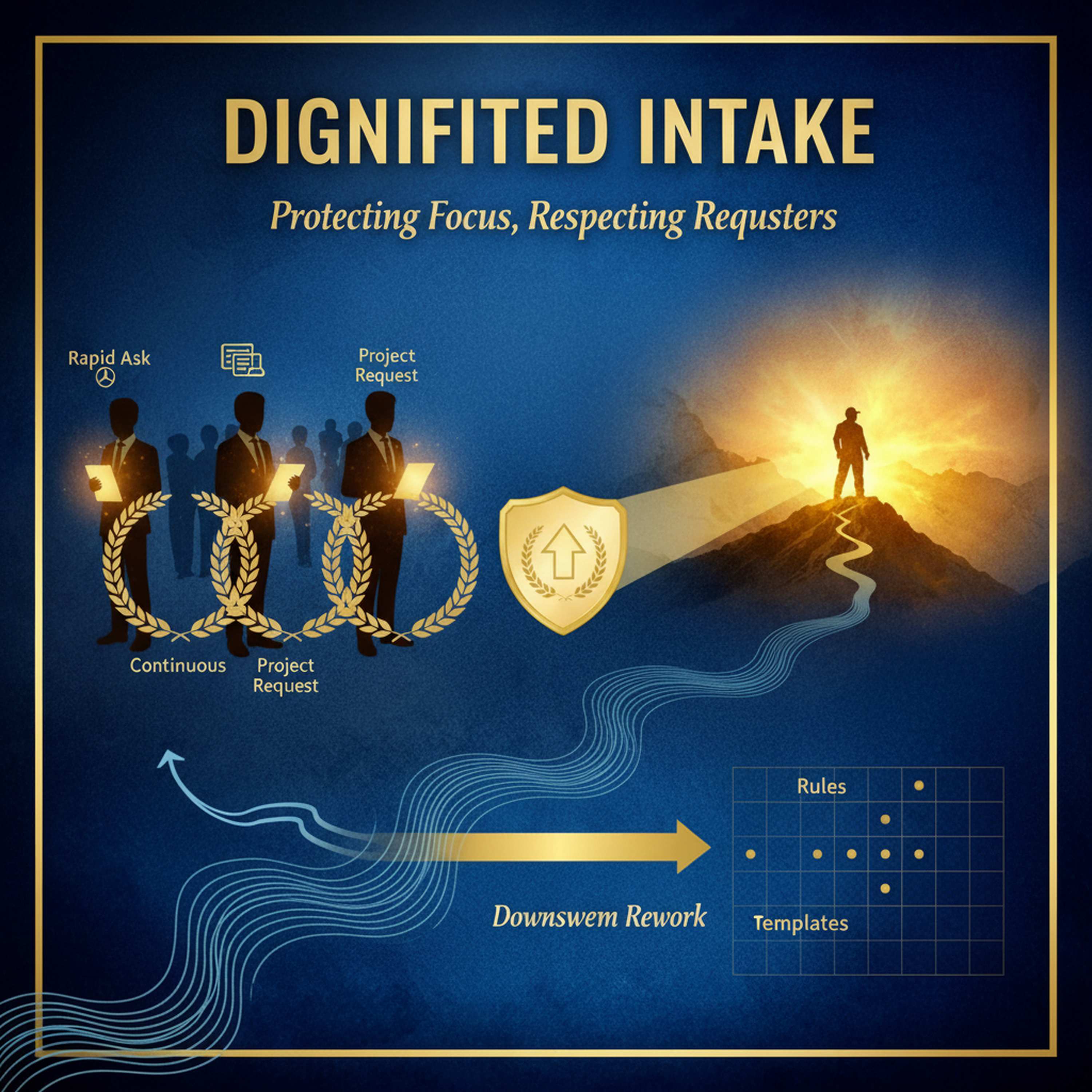
Requests arrive constantly: good ideas, urgent asks, and pet projects that quietly erode team focus. This 30‑minute panel episode treats intake as a leadership design problem, not an admin backlog. Hosts James Whitmore and Mark Ellison convene a head of strategy who redesigned intake governance, a frontline supervisor who rebuilt trust after requests bypassed their team, and a service‑design coach who turned triage into a dignified ritual. After a cold open showing a well‑intentioned request that crashed a delivery, the panel defines three intake archetypes (rapid ask, project request, continuous improvement), demonstrates a one‑page Intake Decision Matrix, and reads a short, dignity‑first request script live. Listeners get a practical 30‑day pilot: choose one intake lane, name a steward, apply time‑boxed decision rules, and measure decision lead time, downstream rework, and requester experience. The episode closes with a clear CTA to subscribe and download the Intake Matrix and request template so leaders can protect capacity without sidelining people.

Translating purpose into everyday decisions is the bridge between strategy and sustainable performance. In this 30‑minute panel James Whitmore and Mark Ellison convene a chief strategy officer who turned a broad purpose statement into operational decision rules, a frontline supervisor who used purpose‑based heuristics to reduce escalation, and a strategy‑deployment coach who mapped purpose to leader routines. After a short vignette showing a misaligned decision that undermined trust, the panel walks a repeatable three‑step method—translate, test, codify—plus artifacts: a Decision‑Boundary Map, a one‑page Purpose‑to‑Decision checklist, and an exception governance template. Practically focused, the conversation unpacks how to create leader heuristics ("If X, then Y"), set steward roles, and run a 30‑day pilot so purpose becomes observable in daily choices rather than corporate wallpaper. Listeners leave with scripts to translate one line of purpose into five daily leader questions, a pilot plan, and the language to protect psychological safety while enforcing decision rules.

Fast decisions can injure people and erode trust. This panel episode reframes the pause as a practical leadership design: an evidence‑driven, time‑boxed stop that surfaces facts, protects people, and clarifies next steps. Hosts James Whitmore and Mark Ellison convene a crisis response lead who built pause protocols, a frontline technician whose 90‑second ritual cut rework, a frontline supervisor, and an organizational psychologist who studies decision cooling. After a cold open and a short live roleplay of the 90‑second script, the conversation defines a simple pause‑trigger matrix and the steward role, unpacks three pause archetypes (micro, tactical, strategic), and walks through mechanics—scripts, communication templates, and steward escalation rules. Listeners get a downloadable one‑page checklist and a steward email template, plus a practical pilot plan (site/shift pilot, key metrics) they can start within two weeks. The episode ends with a live micro‑exercise so listeners practice the script and leave ready to run a measured pilot that preserves accountability while reducing harm.

Organizations either punish every mistake or tolerate recurring failures disguised as ‘learning.’ This panel episode reframes failure as a leadership design problem: create protocols that make it safe to surface problems, fast to stop harm, and disciplined in follow-through. James Whitmore and Mark Ellison convene with a frontline operations leader who redesigned incident response to preserve safety and learning, and a reliability-focused leader who built governance to prevent repeat failures. The conversation defines a simple failure taxonomy (safety, compliance, systemic, capability gap), decision rules for when leaders must intervene versus coach locally, and three practical scripts for initial response, blameless review, and leadership debriefs that preserve dignity while assigning ownership. Listeners leave with a 30-day playbook—taxonomy, escalation matrix, stop‑rules, and metrics to detect true learning—so leaders can turn unavoidable problems into capability gains without eroding accountability or psychological safety.
Senior leaders talk a lot about developing the next generation, yet most programs produce certificates rather than changed behavior. This panel episode reframes leadership development as a work-integrated apprenticeship: carefully designed rotations where rising leaders practice real problems under guided stewardship, learn to make trade-offs, and return with capability that shifts how the system performs. James Whitmore and Mark Ellison convene with a frontline operations leader who launched a rotational apprenticeship and a talent architect who ties rotations to measurable capability. Together they unpack rotation archetypes (problem-rotation, role-swap, embedded mentorship), the leader behaviors that protect learning and delivery, and the governance that prevents apprenticeships from becoming unpaid labor or cosmetic talent theater. Listeners leave with a 30-day pilot plan, scripts for stewarding difficult handoffs, and three metrics to know if the program builds judgment, not just experience.
Organizations drown in well-intentioned improvement efforts that never scale because leaders treat each idea as isolated or confuse activity with impact. This panel episode reframes improvement work as a portfolio-management and leadership discipline: choosing what to invest scarce attention in, what to defer, and what to stop. James Whitmore and Mark Ellison convene with a transformation leader and a frontline manager to expose four pragmatic prioritization lenses—customer impact, capability lift, systemic leverage, and risk of rework—and the leader behaviors that make those lenses real in practice. Through a reality-check case where a promising pilot consumed resources without delivering lasting value, the panel offers governance patterns, simple decision rules, and a two-week experiment leaders can run to declutter their portfolio. Listeners leave with a checklist for ruthless prioritization that preserves psychological safety while increasing strategic focus and execution discipline.
Senior leaders often declare 'we need better decisions' but leave the how to chance. This panel episode reframes decision quality as a leadership design problem: the forums you convene, the governance rules you set, and the conversational mechanics you model create whether decisions produce short-term fixes or stronger capability. James Whitmore and Mark Ellison convene with an experienced operations leader and a systems psychologist to dissect three common forum types—rapid-response, weekly operational, and strategic review—identify the clear escalation rules each needs, and show how question design and role clarity shift meetings from blame to learning. A reality-check case shows how a well-intentioned forum became a bottleneck; the panel then offers concrete scripts, a one-week experiment leaders can run immediately, and a decision-forum checklist to test whether your structures create ownership or diffuse responsibility. Listeners leave with actionable behaviors and meeting designs to make decisions a development tool, not just a control mechanism.
Senior leaders often oscillate between over-controlling and abdicating responsibility. This panel episode examines a principle-based alternative: intentionally designed leader check‑ins—short, regular rituals that create clarity, protect people, and make accountability humane. James Whitmore and Mark Ellison convene with a seasoned operations leader to surface the behaviors, questions, and system design choices that make a 15–30 minute leader routine catalytic rather than performative. Through a frank reality check and a real-world case, the conversation identifies three micro-behaviors leaders can adopt immediately, shows how to surface intended versus actual work, and explains how to guard the cadence from tactical drift. Listeners leave with a practical template for a weekly and daily check‑in, scripts for hard conversations framed by respect, and a simple metric set that signals whether the routine is strengthening capability or undermining trust.
Comments

Download from Google Play

Download from App Store
 United States