


The Well-led Podcast
Subscribed: 1Played: 193
Subscribe

© All rights reserved by WRKdefined
Description
Where professionalism meets imperfection.
The Well-led Podcast invites leaders to explore the space where the need to get results meets the reality of managing people. Discover how to demonstrate care, support, and grace for your team–because the workplace needs human leaders.
Formerly the comfy chairs podcast.
101 Episodes
Reverse
What does it mean to go to work in good humor—especially when the workplace feels heavy or demanding? In this Other Voices episode of The Well-led Podcast, two experienced leadership practitioners reflect on the role of good humor in leadership. They explore how humor is not simply about laughter, but about a mindset leaders bring with them: a balance of perspective, calm, openness, and humanity. Through personal stories and thoughtful frameworks, the contributors describe how leaders can choose steadiness over reactivity, remain hopeful without ignoring reality, and create environments where people feel safe to engage honestly. This episode offers practical insight into why good humor matters for leadership effectiveness and how leaders can cultivate it in everyday work.
The latest companion toolkit, “Leading with Empathy: Practical Techniques for Sustainable Leadership,” is available now. Visit https://www.one23ltd.com/toolkits to request your free copy. When you subscribe, you’ll automatically receive future leadership tools and resources from onetwentythree ltd.
And special thanks to this month’s contributors. Read on to learn more about them.
Jackye Clayton is a writer, podcaster, and HR Tech people leader with 15+ years of experience in talent acquisition, recruiting leadership, and inclusive hiring. She helps leaders and organizations stop guessing and start building high-performing teams with clear, compassionate, and curiosity-driven talent strategies.
Jackye Clayton ♕ - People in Squares | LinkedIn
Jackye Clayton
People Puzzles
Katharine Manning is a speaker, author, and trainer who has spent more than 25 years working at the intersection of trauma and leadership. Her book, The Empathetic Workplace, provides clear direction and support for leaders who want to respond to trauma on the job with compassion, calm, and confidence.
Katharine Manning - Blackbird | LinkedIn
Blackbird
Katharine Manning
Phil Wagar is a seasoned leader with extensive experience in all components of organizational development. He is a master facilitator, specializing in the subjects of leadership, learning, and change, whose strengths lie in ideation, adaptability, and forming deep connections with others.
Phil Wagar | LinkedIn
Key takeaways
Good humor at work is a deliberate mindset, not simply a moment of laughter.
Leaders can choose their emotional posture before entering a meeting or beginning the workday.
Maintaining perspective helps leaders avoid reacting impulsively to everyday frustrations.
A calm and hopeful disposition allows leaders to remain open to feedback and new ideas.
Humor and lightness can make difficult work more manageable without minimizing its seriousness.
When leaders operate without good humor, workplaces can become tense, closed, and overly reactive.
Focusing on purpose and the human impact of work helps sustain a positive leadership mindset.
Cultivating curiosity and learning keeps leaders grounded during challenging situations.
Recognizing the absurd or unexpected aspects of workplace life can help leaders maintain perspective.
Good humor strengthens connection, trust, and resilience within teams.
Timestamps
[0:00:04] – Framing the episode
[0:02:16] – Why good humor at work matters
[0:03:30–0:04:40] – Choosing your stance
[0:05:40–0:06:30] – The cost of humorless leadership
[0:06:30–0:07:09] – Good humor as a leadership competency
[0:07:09–0:09:00] – Volunteering-in-the-rain story
[0:09:00–0:10:16] – Grief, joy, and “grief camp”
[0:10:16–0:13:30] – Definition of good vs. ill humor
[0:13:30–0:19:42] – Four practices for good humor
[0:20:22–end] – Synthesis and call to action
Keywords
leadership humor, good humor at work, leadership mindset, emotional intelligence leadership, workplace culture leadership, leadership emotional regulation, positive leadership habits, workplace perspective and resilience, human leadership, leadership communication

What does it mean to choose your attitude as a leader?
In this episode, you’ll learn how good humor is a leadership skill rooted in choice, mindfulness, and care—not forced positivity. Through personal stories and practical tools, this conversation explores how your mood shapes your team’s experience and how to respond intentionally instead of reacting on autopilot. You’ll walk away with concrete questions and strategies to help you lead with steadiness, awareness, and humanity.
The latest companion toolkit, Leading with Empathy: Practical Techniques for Sustainable Leadership, is available now. Visit https://www.one23ltd.com/toolkits to request your free copy. When you subscribe, you’ll automatically receive future leadership tools and resources from onetwentythree ltd.
Key takeaways
Leaders have a daily choice about their attitude and mood.
Good humor is not about being funny; it is about intentional response.
Your mindset can shape your entire day.
Even in a crisis, you can choose your attitude.
Good humor requires awareness of your influence on others.
Simple self-questions can interrupt reactive behavior.
Engaging your prefrontal cortex helps override fight-or-flight responses.
Toxic positivity damages trust and psychological safety.
Modeling emotional choice empowers your team to do the same.
Good humor balances realism with care, kindness, and accountability.
Timestamps
[0:00:01–0:00:53] – A story about creating family house rules
[0:01:06–0:01:43] – Introducing “good humor” as a leadership skill
[0:01:43–0:02:06] – Welcome to the Well Led Podcast & series context
[0:02:06–0:02:49] – An accident and a decision about attitude
[0:03:08–0:03:52] – Defining “good humor” vs. simple laughter
[0:03:52–0:04:57] – Historical “four humors” explanation
[0:05:33–0:06:46] – Humor and choice-making as leadership skills
[0:06:46–0:08:06] – Managing the “lizard brain” and regaining choice
[0:08:06–0:10:02] – Reflective questions to guide your mood and behavior
[0:08:06–0:09:20] – Reflective questions to guide your mood and behavior
[0:09:20–0:11:10] – Good humor vs. toxic positivity & impact on teams
Keywords
leadership attitude, good humor in leadership, how to choose your mood, emotional regulation for leaders, toxic positivity at work, psychological safety, leadership self-awareness, fight or flight response at work, mindful leadership skills, demonstrating care as a leader
In this episode, you will learn how empathy strengthens accountability and improves performance at work. Kate Johnson explains why empathy is not leniency, how mindset shifts shape leadership behavior, and what empathetic accountability looks like in real workplace moments. You will also hear practical guidance for supporting neurodivergent employees and understanding the Double Empathy Problem, so you can lead diverse teams with clarity, trust, and measurable results.
The companion toolkit, Leading with Empathy: Practical Techniques for Sustainable Leadership, is now available from onetwentythree ltd. The worksheets are designed to help you put these ideas into practice immediately and strengthen your leadership habits. Established subscribers receive this and future leadership toolkits automatically.
Looking to learn a little more about empathy and neurodivergence? Here are a few articles to get you started:
Theory of Mind | Psychology Today
"I Promise I'm Not Trying to Be Inconsiderate" | Psychology Today
The double empathy problem
Key Takeaways
Empathy is the disciplined effort to understand another person’s experience.
Empathy includes both affective empathy (emotional response) and cognitive empathy (perspective taking).
Listening and presence are the foundation of empathetic leadership.
Empathy strengthens accountability rather than weakening it.
Accountability is a support structure, not punishment.
Empathetic accountability combines care with clear expectations.
Mindset shifts directly influence leadership behavior and performance.
Neurodivergent employees may experience and express empathy differently.
The Double Empathy Problem explains barriers between differing lived experiences.
Small, mindful acts of curiosity and clarity drive sustainable leadership results.
Timestamps
[0:00:01] – Defining empathy in leadership
[0:00:26] – Recap of previous weeks on empathy
[0:01:40] – Core empathetic mindsets for leaders
[0:03:05] – Introducing the Leader’s Toolkit
[0:05:42] – Empathy and accountability connection
[0:07:20] – “Empathetic accountability” defined
[0:08:55] – Neurodivergence and empathy
[0:11:35] – The double empathy problem
[0:13:20] – Practical leadership takeaways
[0:15:25] – Closing and preview of next topic
Keywords
leadership empathy, empathetic accountability, empathy and performance, how to hold employees accountable, cognitive empathy, affective empathy, emotional intelligence at work, neurodiversity in leadership, Double Empathy Problem, improving team performance
In this episode, you will learn how to practice empathy as a leadership skill in real workplace situations. Kate Johnson is joined by Katharine Manning, author of The Empathetic Workplace, to explore what empathy actually looks like in action. They discuss how leaders can move beyond good intentions and develop practical behaviors that build trust, strengthen psychological safety, and improve performance. You will walk away with clear steps for responding to employees who are struggling, handling trauma-informed conversations at work, and building a culture where people feel seen, heard, and supported—without lowering standards or sacrificing results.
If this episode prompts you to think more deeply about trust and connection, download the current free Vulnerability and Leadership Toolkit available from onetwentythree ltd. The worksheets are designed to help you put these ideas into practice immediately and strengthen your leadership habits.
Katharine Manning is a speaker, author, and trainer who has spent more than 25 years working at the intersection of trauma and leadership—first as a DOJ attorney advising on responses to crises like the Boston Marathon bombing and the South Carolina AME Church shooting, and now as an expert and thought leader on empathy at work. Her book, The Empathetic Workplace, provides clear direction and support for leaders who want to respond to trauma on the job with compassion, calm, and confidence. Join Katharine’s text list by texting “blackbird” to 833-975-1945 for weekly messages on empathy, leadership, and taking care of ourselves as we take care of others.
Katharine Manning - Blackbird | LinkedIn
Blackbird
Katharine Manning
Key takeaways
Empathy is a striving to understand another person’s experience, not standing in their shoes.
Leadership empathy requires both thought and feeling—cognitive and affective empathy working together.
Listening and acknowledging are the foundation of any empathetic response.
Psychological safety increases when leaders check in regularly with their teams.
Adapting your communication style is part of demonstrating care.
Empathy is a powerful risk management tool because trust fuels transparency.
Most adults have experienced trauma, so leaders should assume someone on their team may be carrying something heavy.
The LASER method (Listen, Acknowledge, Share, Empower, Return) provides a practical framework for responding to trauma disclosures at work.
Modeling vulnerability is different from venting; leaders must maintain healthy boundaries.
Empathy strengthens accountability and performance rather than weakening it.
Timestamps
[0:00:05] Framing the conversation: empathy in the workplace
[0:01:43] Working definitions of empathy and empathetic leadership
[0:04:50] Empathy as a rigorous leadership skill, not a “soft” extra
[0:10:06] Shifting from theory to action: what empathy looks like day‑to‑day
[0:10:40] Practical tool #1: Regular check‑ins and psychological safety
[0:13:28] Practical tool #2: Team “vernacular” (numbers/weather) for honest check‑ins
[0:19:50] Trauma‑informed leadership and the “paper cut vs knife wound” metaphor
[0:26:01] The LASER technique introduced (Listen, Acknowledge, Share, Empower, Return)
[0:32:03] Empathy for self, vulnerability, and the “full cup spills over” idea
[0:40:30] Empathy as a risk‑management tool and closing resources for leaders
Keywords
workplace empathy, empathetic leadership, psychological safety, trauma informed workplace, leadership communication skills, cognitive empathy, affective empathy, accountability and empathy, leadership trust building, LASER method
This episode of The Well-Led Podcast: Other Voices explores what empathy really means in leadership—and why it plays a central role in building trust at work. Rather than treating empathy as a soft skill or personality trait, contributors describe it as a learned practice that requires presence, restraint, and the willingness to sit with discomfort. Through personal stories and professional reflections, this episode helps leaders understand how empathy shows up in real moments and why it changes how people experience leadership.
In this episode, contributors respond to two guiding questions: How do you define empathy? And who taught you to accept empathy from others—and how did that change your leadership? Their answers reveal that empathy is shaped by experience, strengthened through relationships, and essential to creating psychological safety without lowering expectations.
Request your copy of the Vulnerability in Leadership Toolkit.
Guest Information, listed alphabetically
Peggy Mark, Ph.D.
In her role as executive coach and leadership consultant, Peggy leverages her expertise in healthcare leadership, organizational learning, and nursing administration to support executives in discovering their own unique skills as a leader. Peggy is a lifelong student of leadership and organizational change. She finds immense joy in watching others succeed in their leadership journey.
Peggy Mark - Break-Through, LLC | LinkedIn
Utkarsh Narang
Utkarsh is the founder and CEO of IgnitedNeurons, a learning and development consultancy that strives to help its learners build new connections that lead to lasting change. With an extensive background in operations and transformational coaching, he is also the host of the IgnitedNeurons podcast.
Utkarsh Narang - Executive Coach Helping Ambitious Professionals Breakthrough Stuck Careers & Inner Frustration | Ignite Life Method
Ignited Neurons
The IgnitedNeurons Podcast - YouTube
Angela Wale
Angela has a long reputation as an insightful and compassionate professional, leader, and colleague. She currently serves as an executive nurse leader responsible for integrating technology resources with nursing practice, professional development, education and research for a regional health system.
Find Angela on LinkedIn
Key takeaways
Empathy is not about being agreeable, emotional, or soft
Empathy requires presence, not problem-solving
Leaders often need to learn how to receive empathy before offering it
Listening without fixing builds trust and psychological safety
Empathy helps people feel seen, heard, and valued
Empathy does not remove accountability or standards
Slowing down is often the hardest part of empathetic leadership
Leaders model empathy through how they respond to struggle
Trust grows when empathy is consistent, not performative
Empathy strengthens both relationships and results
Timestamps
[0:00:00] – Kate’s introduction to the Well Led Podcast & empathy theme
[0:01:36] – Peggy defines empathy as perspective-taking and compassionate listening
[0:02:40] – Peggy describes her husband teaching her to accept care and vulnerability
[0:05:54] – Utkarsh introduces himself and defines empathy as presence without control or fixing
[0:08:10] – Utkarsh’s coaching moment: being fully seen, silence, and emotional “cracking open”
[0:13:30] – Angela defines empathy as strengthening human connection through validation
[0:18:20] – Angela’s leadership example: resisting the urge to fix and asking how to best support
Keywords
empathy in leadership, building trust at work, empathetic leadership, psychological safety, leadership presence, human-centered leadership, leadership vulnerability, trust at work, emotional intelligence leadership, other voices podcast
This episode introduces empathy as a core leadership competency and the second essential practice for demonstrating care. Building on the foundation of vulnerability, these Notes on Leading Well explain what empathy is, how it works in the human brain, and why leaders who practice empathy are better equipped to build trust, communicate clearly, and lead people through change.
Listeners will gain a practical understanding of affective and cognitive empathy and how intentional perspective-taking improves employee well-being and organizational effectiveness.
Additional resources to explore:
PBS Learning Media: Mirror Neurons
Mirror Neurons and the Neuroscience of Empathy
The neurons that shaped civilization | VS Ramachandran
Empathy Definition | What Is Empathy
Does Your Manager Feel Your Pain?
Empathy Quiz | Greater Good
Key takeaways
Empathy is the effort to understand others
Vulnerability creates the conditions for empathy
Empathy is a leadership competency, not a trait
Affective empathy is feeling with others
Cognitive empathy is perspective-taking
Empathy is rooted in human biology
Empathy strengthens trust at work
Perspective-taking improves leadership decisions
Empathy supports well-being and performance
Empathy becomes care when put into action
Timestamps
[0:00:00] – Introduction to the Well Led Podcast & leadership premise
[0:00:35] – Recap: Vulnerability as a leadership competency
[0:01:27] – Vulnerability as relational and needing sustainability
[0:02:45] – Transition to second competency: Empathy
[0:03:39] – Working definition of empathy + two forms (affective & cognitive)
[0:04:22] – Affective empathy: “feelings about others’ feelings”
[0:05:20] – Cognitive empathy: perspective-taking & To Kill a Mockingbird example
[0:06:34] – Mirror neurons and the biology of empathy
[0:08:35] – What empathy does at work & impact on trust and change
[0:10:25] – Practicing empathy: observation exercise in a public space
Keywords
empathy in leadership
leading with empathy
empathy at work
leadership competencies
demonstrating care
vulnerability and empathy
perspective taking leadership
human centered leadership
employee well-being
psychological safety
In this episode, you will learn how vulnerability strengthens leadership effectiveness. Rather than treating vulnerability as oversharing or weakness, this lesson clarifies it as a leadership competency grounded in judgment, boundaries, and self-awareness. We translate vulnerability into observable behaviors leaders can practice immediately, outlining what it can look like in day-to-day leadership. You will leave with concrete behaviors you can apply immediately, along with strategies for managing the emotional cost of leading openly without burning out.
Download the one-page resource: Leading with Vulnerability without Burning Out
Key takeaways
Vulnerability is a leadership competency that requires choice and intention
Withholding vulnerability increases silence, self-protection, and disengagement on teams
Leaders can show vulnerability by owning mistakes, admitting limits, and sharing context
Thoughtful vulnerability strengthens credibility rather than undermining competence
Boundaries, judgment, and timing are essential to practicing vulnerability well
Leaders can demonstrate humanity without emotional dumping or loss of authority
Vulnerability carries a cost and requires attention to energy and burnout
Debriefing, decompression, and reflection help leaders sustain vulnerable leadership
Timestamps
[0:00:00] - Introduction: Vulnerability as Daily Leadership Practice
[0:01:30] - Vulnerability Cultivates Team Trust & Collaboration
[0:02:35] - Review of Previous Episodes & Need for Observable Behaviors
[0:03:30] - Listing Human Characteristics Leaders Face
[0:05:00] - Examples: Owning Emotions and Managing Illness
[0:06:40] - Tenderness Toward Teams During Difficult Times
[0:08:00] - Concrete Ways to Model Vulnerability (Mistakes, Ignorance)
[0:09:30] - Accepting Feedback and Building Diverse Teams
[0:11:52] - Managing Costs: Debriefing, Decompression, Reflection
[0:14:56] - Final Takeaways & Next Topic Preview (Empathy)
Keywords
vulnerability and leadership
leadership effectiveness
leadership competence
psychological safety
trust at work
human leadership
leadership behaviors
self-aware leadership
workplace culture
emotional intelligence
In this episode, Kate Johnson and Peggy Mark explore vulnerability as an intentional leadership choice rather than a personality trait. Listeners will learn how openness, self-awareness, and authenticity create trust, strengthen human connection, and support healthier workplace cultures. Through personal stories and practical reflection, the conversation reframes vulnerability as bravery and a critical skill for leaders who want to lead well.
Key takeaways:
Why vulnerability is a conscious leadership decision
How openness builds trust and credibility
The role of self-awareness in effective leadership
Why vulnerability is not the same as weakness
How admitting mistakes strengthens leadership presence
The impact of authenticity on workplace culture
Navigating conflict without losing compassion
Balancing strength and softness as a leader
How vulnerability supports learning and growth
What brave leadership looks like in practice
Timestamps:
[0:00:05] Introduction to Podcast & Guest
[0:01:16] Defining Vulnerability in Leadership
[0:03:12] Self-Awareness and Leadership Starting Point
[0:05:44] Peggy’s Personal Journey to Vulnerability
[0:09:41] Affirmation of Positive Leadership Impact
[0:09:53] Story: Vulnerability During Emotional Crisis
[0:12:07] Creating Safe Spaces & Two-Way Vulnerability
[0:20:18] Balancing Vulnerability vs. Over-Sharing
[0:29:06] Fear, Boundaries, and Unpredictable Outcomes
[0:35:21] Leadership Success Story from Emergency Department
Keywords:
vulnerability in leadership, leadership authenticity, leadership trust, human-centered leadership, self-awareness at work, brave leadership, workplace culture, psychological safety, leadership growth, effective leadership
In this episode, leaders will learn why vulnerability is not a weakness but a critical leadership skill. The conversation explores how openness, honesty, and the willingness to share both successes and failures directly influence trust, psychological safety, and team performance. Listeners will gain practical insight into how vulnerable leadership improves communication, strengthens relationships, and creates environments where people feel safe to contribute fully.
Special thanks to Kim Rohrer for sharing her time and insights this week. Kim is a storyteller and connector who has dedicated her career to creating values-driven corporate cultures and innovative approaches to HR. Founder of Patchwork Portfolio, she blends her expertise and creativity to help leaders communicate with employees, customers, and communities. She shares her insights and experiences at icaretoomuch.substack.com
You can connect with her on LinkedIn here: https://www.linkedin.com/in/kimrohrer/
And explore her business website here: https://www.patchworkportfolio.com/
Key Takeaways:• Why leaders often resist vulnerability and how that resistance affects teams• Why employees are more engaged when leaders are open and honest• What Gallup research reveals about engagement and communication• How vulnerability supports innovation and creativity• The role of vulnerability in authentic leadership
Timestamps:
[0:00:03] - Podcast Introduction & Theme Overview
[0:00:50] - Explanation of 'Other Voices' Segment
[0:01:46] - Gallup Research on Leadership & Vulnerability
[0:02:20] - Importance of Humanity in Leadership
[0:03:26] - Kim Rohr’s Introduction
[0:04:00] - Reluctance of Leaders to Show Vulnerability
[0:05:20] - Impact of Hiding Failures/Challenges at Work
[0:06:41] - Summary of Kim’s Perspective: Vulnerability’s Role in Team Dynamics
[0:06:48] - Four Inspirational Quotes on Vulnerability
[0:09:01] - Podcast Closing and Next Episode Preview
Keywords:
vulnerability in leadership, leadership trust, psychological safety, employee engagement, authentic leadership, workplace trust, leadership communication, Gallup research, innovation at work, human-centered leadership

Looking ahead: The comfy chairs becomes The Well-Led Podcast
In this final episode of the year, Kate returns with a clear, simple update about the show’s evolution. On January 6th, the comfy chairs will officially relaunch as The Well-Led Podcast, beginning a year-long journey focused on the four essential domains of leadership: Demonstrating Care, Providing Support, Leading with Grace, and Staying Focused on Action.
Kate revisits what’s changing, what remains steady, and why this new structure matters. Listeners will hear about the monthly theme model, the “Notes on Leading Well” format, and the practical tools that will anchor each week. She also previews January’s theme—vulnerability—and how it sets the tone for leading well in the months ahead.
This episode closes the chapter on one season of the podcast and gently opens the door to what’s next. It’s a moment of gratitude, clarity, and optimism for leaders who want to step into the new year with intention.
Culture Keepers: A conversation about managing versus leading.
In this conversation, Kate sits down with Layci Nelson, founder of the Transcend Leadership Collective, to explore a deceptively simple question with big implications: What’s the real difference between managing and leading?
Together, they unpack why effective leadership isn’t about choosing one or the other—it’s about integrating both. Layci emphasizes that leaders need fluency in two domains: the operational competence that keeps work moving and the visionary clarity that keeps people aligned and inspired.
They dig into the value of understanding project management basics, paying attention to the details that shape team experience, and staying close enough to the work to remove friction meaningfully. Layci also shares a compelling story of a CEO who transformed his leadership approach by reconnecting with his employees—ultimately improving alignment, engagement, and satisfaction across the organization.
The conversation also returns to core values: how they anchor decision-making, guide behavior, and keep leaders steady when things speed up, slow down, or veer unexpectedly.
Connect with Layci on LinkedIn
Learn more about her business
Listen to the Confessions of a Terrible Leader podcast
www.one23ltd.com
https://www.instagram.com/one23ltd/
Music by Geoff Harvey from Pixabay
Revisit & enjoy: Early, direct, and well-structured conversations
As we near the end of the year, we’re resurfacing one of the most practical and personal conversations we’ve shared on the comfy chairs. In this rerun, Kate sits down with her dad, Charlie—a leader with decades of experience in higher education, the military, and church governance—to talk about why early, direct, and kind confrontation is one of the most underrated leadership skills.
This episode explores:
Why confrontation isn’t the same as conflict—and why waiting almost always makes things worse
How leaders can prevent conflict by addressing issues early and with clarity
The role of feedback, decision-making, and lifelong learning in building healthy teams
Why love—phileo, connection, shared purpose—is at the heart of great leadership
If you’re avoiding a hard conversation (or carrying one into the new year), this episode is a steady reminder that clarity and kindness aren’t opposites—they’re partners.
Additional resources mentioned during our conversation:
The Fearless Organization, by Amy Edmondson
The 5 Dysfunctions of a Team, by Patrick Lencioni
The Sum of All Fears, by Tom Clancy
www.one23ltd.com
https://www.instagram.com/one23ltd/
Music by Geoff Harvey from Pixabay
Revisit & enjoy: Making sense of leadership, management, and the feedback we’d rather avoid
As we wind down the year, we’re resurfacing one of the most downloaded comfyHQ episodes—a listener favorite about three things leaders wrestle with all the time: feedback, the leadership/management divide, and the workplace words we toss around without checking for shared meaning.
In this rerun, we explore:
How to respond to feedback you don’t agree with (and why “thank you” is still the best first move)
Why separating “leadership” from “management” can limit our growth, and what changes when we see them as two sides of the same role
Six Big Idea words—mission, vision, culture, and more—that shape how we work, but often mean different things to different people
If you’re navigating end-of-year reviews or gearing up for planning season, this episode offers a practical reset: clearer language, steadier leadership, and a healthier way to think about feedback.
Music by Geoff Harvey from Pixabay

In this special update, Kate shares an important announcement about the future of the podcast. Beginning in January 2026, the comfy chairs will officially become The Well-Led Podcast—a show dedicated to helping leaders stay grounded, self-aware, and effective in the moments where professionalism meets imperfection.
Kate walks through what’s changing, what’s staying the same, and why now is the right time to transition into a more intentional, structured model. She also introduces the new monthly and quarterly format, a year-long leadership curriculum, and an expanded set of voices and conversations.
Plus: exciting news about the show joining the WRKdefined Podcast Network in 2026.
Pull Them Close: A Conversation about Grief
As we move into the holiday season—a time that can amplify both joy and tenderness—we’re revisiting one of our most meaningful conversations on the comfy chairs. In this encore episode, host Kate Johnson welcomes Justin Clifford, CEO of Bereave, for a heartfelt exploration of how workplaces can better support employees navigating grief and loss.
Together, Kate and Justin unpack the critical role of compassionate bereavement practices—especially during a season when grief can feel sharper, and the need for understanding grows. Justin shares actionable insights for managers and leaders, from building empathy through intentional training to crafting inclusive policies that honor the diverse realities of modern families.
This revisit also highlights the transformative power of vulnerability in leadership. Justin underscores the importance of modeling self-care and creating spaces where employees feel seen and supported through life’s hardest seasons. He offers tools and resources to help organizations build cultures of care—reminding us that supporting grief at work isn’t simply about resilience; it’s about honoring our shared humanity.
Connect with Justin on LinkedIn: https://www.linkedin.com/in/justinclifford2/
Learn more about Bereave: https://www.bereave.io/
Additional resources mentioned during our conversation:
Liesel Mertes, empathy coaching: https://www.lieselmertes.com/
A single platform for practical support resources and tools: https://www.supportnow.org/
Family support for estate and other matters after the death of a loved one: https://www.full-circlecare.com/
Supporting employees after the loss of a child: https://www.hopeworkshere.com/
Employee leave management platform: https://www.cocoon.com/
Got something on your mind? A tricky situation at work? A leadership topic you’re curious about? Share your questions here: https://www.one23ltd.com/comfyhq
www.one23ltd.com
https://www.instagram.com/one23ltd/
Inviting Input: A conversation about co-creating the workplace.
In this conversation, Kate sits down with Patrick Farran, PhD—co-founder and CEO of Ad Lucem Group—to explore the leadership practices that help teams move from compliance to genuine engagement. Patrick introduces appreciative inquiry as a strengths-based discipline built on better questions: ones that draw out what’s already working and create the conditions for more of it.
Together, Kate and Patrick unpack why purpose matters so deeply in leadership (and what happens when leaders drift away from it), how co-creation honors human dignity, and why people support what they help build. They swap practical examples—from job crafting to “input windows” during times of change—and name the tension leaders often feel between offering clarity and inviting shared ownership.
Patrick also offers a preview of his forthcoming book, The Intentional Executive, including the research behind it and the frameworks leaders can use to practice purpose-driven, strengths-aligned leadership.
Connect with Patrick on LinkedIn
Learn more about his business
Check out early information about The Intentional Executive
Additional resources and researchers mentioned during our conversation:
Dr. Marjolein Lips-Wiersma
Dr. Amy Wrzesniewski
Dr. Amy Edmondson
Dr. Viktor Frankl
Got something on your mind? A tricky situation at work? A leadership topic you’re curious about? Share your questions here: https://www.one23ltd.com/comfyhq
www.one23ltd.com
https://www.instagram.com/one23ltd/
Music by Geoff Harvey from Pixabay
We're making another visit to the comfy chairs archive with this episode, where Kate is joined by a very special guest, her husband, Nate.
Kate and Nate explore the practical considerations of high-reliability organizations and what we can all learn from a balanced approach to excellence and understanding.
Got something on your mind? A tricky situation at work? A leadership topic you’re curious about? Share your questions here: https://www.one23ltd.com/comfyhq
www.one23ltd.com
https://www.instagram.com/one23ltd/
Music by Geoff Harvey from Pixabay
You own it: A conversation about career growth.
In this episode of the comfy chairs, Kate Johnson sits down with Jamie Chambron, Chief Coach at the Career Agility System, to talk about what it really means to own your career. From portfolio careers to personal branding, Kate and Jamie unpack how professionals can approach their work with intention and curiosity—especially in a changing, unpredictable market.
They explore the co-created nature of employment, the role of values in decision-making, and why assessments like StrengthsFinder and DISC can help you understand your unique value. Whether you’re just starting out, deeply tenured, or in the middle of a career pivot, this conversation is a practical, empowering reminder: your career is an investment, not an inheritance.
Listen if you’re curious about:
How to build a career that reflects your values and strengths
Practical ways to market your skills and accomplishments
Balancing ambition with authenticity and self-care
Connect with Jaime on LinkedIn.
Learn more about Career Agility System™️.
Got something on your mind? A tricky situation at work? A leadership topic you’re curious about? Share your questions here: https://www.one23ltd.com/comfyhq
www.one23ltd.com
https://www.instagram.com/one23ltd/
Music by Geoff Harvey from Pixabay
Join us for a trip in the Way-back Machine! We're headed to where and when it all started for the comfy chairs. Enjoy this “Tuesday Time Capsule” replay of Episode One: Please don’t take away my superhero cape!
Kate's colleague and friend, Angela Wale, joined her for the inaugural recording to talk about some timeless leadership topics. Whether you want to learn more about responsibility, delegation, accountability, imposter syndrome, or compassion, this episode has it all.
Have a listen and then consider taking one of the following little actions to enhance your leadership practice:
Reflect on the distinction between accountability and responsibility, and how to strike the right balance as a leader.
Identify opportunities to delegate more effectively, while still providing coaching and support.
Continue having open and vulnerable conversations with trusted colleagues to support personal and professional growth.
Have a question for comfyHQ? Share your questions.
Subscribe to the “as easy as” newsletter from onetwentythree ltd.
www.one23ltd.com
https://www.instagram.com/one23ltd/
Music by Geoff Harvey from Pixabay
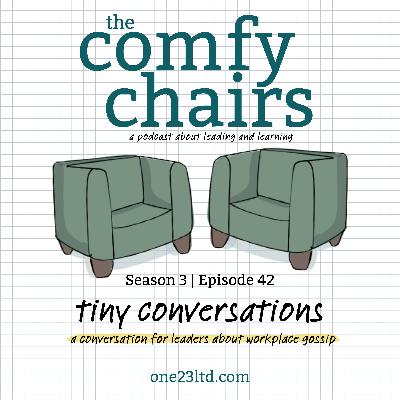
Tiny conversations: A conversation about workplace gossip.
Workplace gossip has a reputation problem — but what if we’ve been looking at it all wrong?
In this episode of the comfy chairs, Kate Johnson sits down with Rebecca Taylor, co-founder of SkillCycle and host of HR Confessions, to explore the nuance behind “tiny conversations.” They define gossip, unpack its role in shaping culture, and discuss how leaders can use it as a powerful source of insight rather than just a source of frustration.
Together, they look at how power, proximity, and trust influence what people say behind closed doors — and how leaders can respond with empathy, not ego.
Connect with Rebecca on LinkedIn.
Follow SkillCycle on LinkedIn and visit their website to learn more.
And be sure to listen to the HR Confessions podcast!
Books and other resources we mentioned:
You Didn’t Hear This from Me, by Kelsey McKinney
Normal Gossip podcast
Got something on your mind? A tricky situation at work? A leadership topic you’re curious about? Share your questions here: https://www.one23ltd.com/comfyhq
www.one23ltd.com
https://www.instagram.com/one23ltd/
Music by Geoff Harvey from Pixabay
These notes contain affiliate links to Bookshop.org, a site dedicated to supporting independent bookstores. As an affiliate, I will earn a small commission if you click through and make a purchase.

Comments

Download from Google Play

Download from App Store
 United States