


 Claim Ownership
Bright Way Zen
Subscribed: 2Played: 18
Subscribe

© 2025
Description
Bright Way Zen is a Zen community in Portland OR, USA, and worldwide via our "Cloud Zendo" (Zoom). This podcast includes talks and classes by our teacher, Rev. Domyo Burk, (Zen Studies Podcast) and by Sangha members and visiting teachers. If you like this, please consider joining us at brightwayzen.org!
36 Episodes
Reverse
Sōtō Zen, among religions, uniquely presents as a path of practice. There are many different ways to manifest your Bodhisattva vows along this path at Bright Way Zen, which include: Jukai, Zaike Tokudo, Shuso, etc. This is, in a way, a koan of Sōtō Zen practice - if there is nothing to attain, and nothing to achieve, then why do there seem to be goals?

In this weeks precept discussion, Sangha member Gathel leads a discussion on the Precept of Not Misusing Sexuality.
Domyo and Sangha continue the conversation about this fascinating Dōgen sutra, specifically section 2-2: East Mountains Walking in the Water. In the dream of Sansuikyo, what could be the meaning of "mountains", "walking", "sentient vs. insentient", or "incomprehensibility as a false notion"?
In the foruth week of our annual precept study, Sangha member Dan leads a discussion on the Precept of Do Not Steal. Honour The Gift Not Yet Given.
Mountains walking, a stone woman giving birth in the night...what could these things mean? This sutra might be best read as poetry, or like a dream. Domyo and Sangha members continue reading from this fascicle and consider which passages resonate most for each of us.
In this episode our Sangha member Erica discusses the third precept in our precept study, Do Not Kill. Cultivate and Encourage Life.
In the second week of our Precept Study our Sangha member Eric discusses the Three Pure Precepts.
Many Dōgen writings (as well as other Ch'an and Zen writings), although poetic, can seem vague and obscure. However, they can communicate the truth deeply and be quite profound through study. Domyo and Sangha members begin to read from and discuss this fascicle and its meaning.
Given the daunting volume and diversity of Buddhist texts available to read - where does one even begin? How does it all fit together and interrelate? Our teacher gives an overview of the major Buddhist sects as illustrated in a complex and colorful lineage tree graphic, and by pointing out foundational sutras and key Soto Zen texts, to better orient and encourage us to study the Dharma.
This episode marks the first talk in our 12 week series on the precepts. In this first talk is led by our senior student Coral as she guides us through the Precepts as practice in our lineage, the The refuges and the karma verse.
The Bodhisattva Avalokiteshvara/Kanzeon is beloved for their omniscient, compassionate awareness to the cries of the world. Keeping them in mind, Sangha members name aloud some of what we are bearing witness to in today's world. How do we remain aware and open-hearted to the state of things, while staying committed to our Bodhisattva vow to liberate all beings? How can we bear witness even though there may be nothing we can do?
Sangha As The Next Buddha
Particularly in Soto Zen, our central practice of Shikantaza - just sitting - the method of no-method - can be challenging. How can we steer away from dullness, dreaminess, and scattered thoughts? Luckily there are many ways in which we can stay more engaged and wholehearted in our Zazen. Domyo and Sangha members share helpful thoughts, tips, and methods.
In this episode Domyo continues a discussion around Zen practice and our relationship to the natural world.
Social relationships can be very challenging to our practice. It's common for people to feel a sense of lack, rejection or inadequacy. How can we stay connected to one another and feel mutual acceptance and belonging? It starts with realizing everyone around you is suffering, and meeting them where they are - acknowledging their own inherent goodness and value, with a sense of responsibility and compassion for them as if they were our only child. When we adopt the attitudes of a Buddha, we transform ourselves and the world.

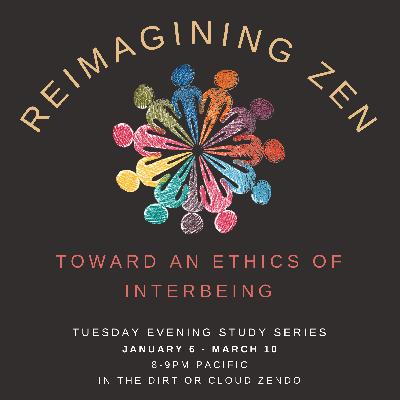
In this class discussion Domyo leads the class through exercises to help us re-imagine our relationship to the natural world focusing on excerpts from David Hinton's writing "Wild Mind, Wild Earth: Our Place in the Sixth Extinction" as well as images and metaphors taken from Dogen's Mountains and Waters Sutra.
This chant is recited daily in Soto Zen monasteries and temples around the world - there are only a handful of Buddhist scriptures we honor in that way. Our teacher clarifies its meaning, line by line. Why is it so important? How does it relate to our Bodhisattva Vows? This teaching is about how relative and absolute aspects of reality aren't really separate.
Based on finding a potential new Zendo property, plus the recently successful fundraising effort, Domyo describes our shared vision and the role of trust through the eyes of Dharma. Sangha members express their feelings of community support, connection and gratitude as we navigate toward owning a place where we can go - "where everybody knows your name."
Pamela Ayo Yetunde writes in Casting Indra's Net: Fostering Spiritual Kinship and Community: "Mobbery is a process that centers on anger, energy, and power—it is the aggregation of personal anger into a collective anger that develops a power far beyond that of individuals. Mobbery entails using the energy of anger to find people who are angry about the same things you're angry about, then together harnessing this anger in ways that place blame on others. By taking no responsibility for soothing one's own anger and projecting blame collectively onto groups identified as "other," a new shared reality is created and allowed to harden. The more that angry people gather and strengthen one another, the more their sense of power intensifies. Those identified as others are vilified and attacked, and this is repeated over and over again. This dynamic builds momentum while demonstrating how the power of anger can be exerted on others and how such acts can be interpreted as victories."
In a Koan from Hongzhi's Book of Serenity, two Dharma brothers engage in a conversation. As one sweeps the ground, the other challenges him, observing: "Too Busy!" This feeling of "busyness" is a state that is relatable to many of us. In this talk, Sangha members share what characterizes busyness, and also what characterizes activity without a sense of busyness. How can we be still even in the midst of all of our commitments, activities, and challenges?

Comments

Download from Google Play

Download from App Store
 United States