


EHA Unplugged
Subscribed: 35Played: 1,460
Subscribe

© European Hematology Association
Description
In these EHA-produced podcasts, experts share with you their hematology knowledge and stories. With "EHA Unplugged" we would like to give you the opportunity to unplug from your computer screen, while still learning, by listening to interviews, clinical cases, monologues, and more.
196 Episodes
Reverse
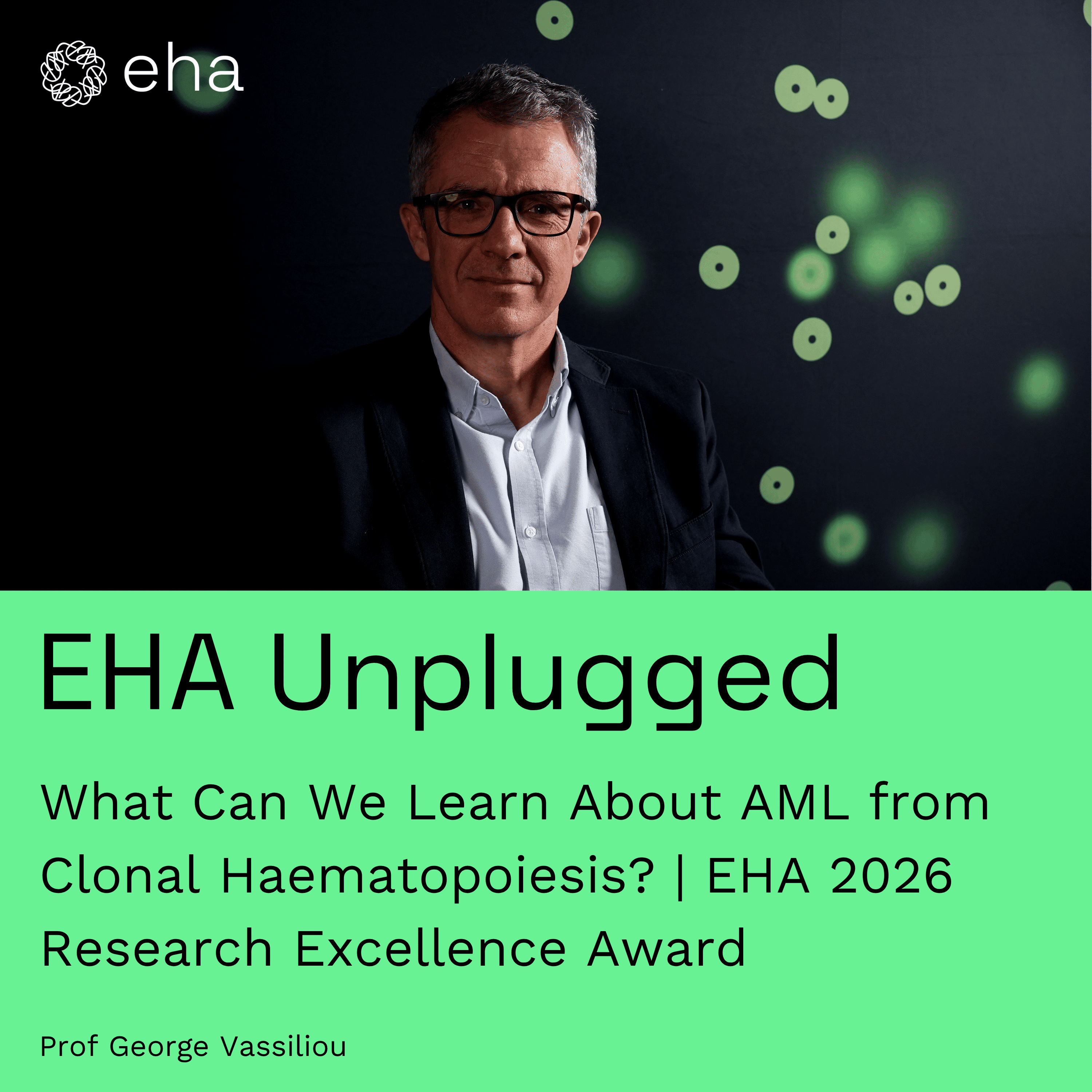
In this episode, Prof George Vassiliou, recipient of the 2026 EHA Research Excellence Award, discusses how his research has advanced our understanding of clonal haematopoiesis and its relationship to acute myeloid leukaemia (AML). He explains how blood stem cells evolve over time, why specific driver mutations promote clonal expansion, and how genetic profiles can help identify individuals at low, intermediate, or high risk of developing myeloid malignancies. The discussion also explores efforts to translate these discoveries into clinical prevention strategies. Prof Vassiliou highlights emerging risk prediction models, the development of clinics focused on clonal haematopoiesis, and ongoing work to evaluate low-toxicity interventions that could reduce disease progression. He also examines the links between clonal haematopoiesis, cardiovascular disease, immune ageing, and age-related health outcomes, offering insights into the future of early detection and preventive approaches in haematology. Listen now for perspectives on how understanding clonal haematopoiesis may help reshape the prevention of AML and other age-related diseases. Guest: Prof George Vassiliou, Department of Haematology and Cambridge Stem Cell Institute, University of Cambridge, Cambridge, United Kingdom Host: Isabel Olivera-Martínez, PhD, EHA Medical Writer Learn More What did you think of this podcast? Share your opinions with us in this short feedback survey.Provide Feedback Would you like to explore more eLearning or podcasts? Please visit the EHA Campus.https://ehaedu.org/Campus Subscribe, share, and review this podcast to be able to address topics you enjoy and like to listen to.Follow EHA on Instagram: https://www.instagram.com/EHA_Hematology/Facebook: https://e-h-a.link/facebookLinkedIn: https://www.linkedin.com/company/eha/Email us: [email protected] to receive the EHA Educational Updates via https://eha.news/subscribe

In this episode, EHA 2026 Lifetime Achievement Award recipient Prof Claire Harrison reflects on a career dedicated to advancing the understanding and management of myeloproliferative neoplasms (MPNs). She reviews the major scientific and clinical developments she has witnessed over more than two decades, including the discovery of JAK2, MPL and CALR mutations, the evolution of diagnostic criteria, and the emergence of targeted therapies for MPNs. The discussion explores landmark studies that helped shape current clinical practice, including PT-1, COMFORT-II and MAJIC-PV, as well as the growing role of patient advocacy in driving research and improving care. Prof Harrison also looks ahead to the next generation of therapies, including CALR-targeted immune approaches and combination treatment strategies, while highlighting the challenges and opportunities that remain for patients with MPNs. Listen now for insights from one of the leading figures in the field.Guest: Prof Claire Harrison Guy’s and St. Thomas’ NHS Foundation Trust, London, United Kingdom Host: Isabel Olivera-Martínez, PhD, EHA Medical Writer Learn More What did you think of this podcast? Share your opinions with us in this short feedback survey.Provide Feedback Would you like to explore more eLearning or podcasts? Please visit the EHA Campus.https://ehaedu.org/Campus Subscribe, share, and review this podcast to be able to address topics you enjoy and like to listen to.Follow EHA on Instagram: https://www.instagram.com/EHA_Hematology/Facebook: https://e-h-a.link/facebookLinkedIn: https://www.linkedin.com/company/eha/Email us: [email protected] to receive the EHA Educational Updates via https://eha.news/subscribe

In this episode, Dr Annalisa Ruggeri discusses how registry data are helping clinicians better understand, monitor and manage CAR T-related toxicities. She explains how insights from more than 16,000 patients recorded in the European Bone Marrow Transplant Registry (EBMT), have helped improve early toxicities such as cytokine release syndrome (CRS) and ICANS awareness and management as well as helped recognise and address longer-term effects. She further explores the growing understanding of immune effector cell-associated hematotoxicity (ICAHT) and the importance of risk prediction and early intervention. Dr Ruggeri also discusses emerging safety questions as CAR T use expands, including secondary malignancies, long-term immune effects, and fertility outcomes. She highlights encouraging registry findings showing that fertility recovery and successful pregnancies are possible after CAR T therapy, offering renewed hope for patients seeking to return to normal life following treatment. Listen now for valuable insights into how registries, collaboration and long-term follow-up are helping improve cellular therapy.Guest: Dr Annalisa Ruggeri Haematology and Bone Marrow Transplant Unit, IRCCS San Raffaele Scientific Institute, Milan, Italy Chair of the Cellular Therapy and Immunobiology Working Party (Education Portfolio), EBMTHost: Leah DeLeon Learn More What did you think of this podcast? Share your opinions with us in this short feedback survey.Provide Feedback Would you like to explore more eLearning or podcasts? Please visit the EHA Campus.https://ehaedu.org/Campus Subscribe, share, and review this podcast to be able to address topics you enjoy and like to listen to.Follow EHA on Instagram: https://www.instagram.com/EHA_Hematology/Facebook: https://e-h-a.link/facebookLinkedIn: https://www.linkedin.com/company/eha/Email us: [email protected] to receive the EHA Educational Updates via https://eha.news/subscribe

In the final episode of our mini-series celebrating the 10th anniversary of the Young EHA Research Meeting (YERM), we explore how the meeting acts as a powerful launching pad for scientific careers. We talk to 2018 YERM speakers Dr. Lorena Arranz and Dr. Mattias Carlsten to hear about their experiences presenting their research at YERM. Looking back on their journeys, they share valuable advice and lessons learned at YERM to help guide today's early-career researchers.Guests: Dr Mattias Carlsten, Karolinska Institutet and Karolinska University Hospital, Sweden Dr. Lorena Arranz, University of Oslo and Oslo University Hospital, Oslo, Norway Host: Rhiannon Newman, MSc, University of Helsinki and Young EHA committee Learn More What did you think of this podcast? Share your opinions with us in this short feedback survey.Provide Feedback Would you like to explore more eLearning or podcasts? Please visit the EHA Campus.https://ehaedu.org/Campus Subscribe, share, and review this podcast to be able to address topics you enjoy and like to listen to.Follow EHA on Instagram: https://www.instagram.com/EHA_Hematology/Facebook: https://e-h-a.link/facebookLinkedIn: https://www.linkedin.com/company/eha/Email us: [email protected] to receive the EHA Educational Updates via https://eha.news/subscribe

Welcome to our mini-series celebrating the 10th anniversary of the Young EHA Research Meeting (YERM) with an introduction to its history and mission. We sit down with co-founder Prof Ruud Delwel and current organizer Prof Marlies Vanden Bempt to discuss how YERM is tailored to empower early-career researchers. Together, we reflect on a decade of growth and share their vision for the future of YERM. Guests: Prof Ruud Delwel, Erasmus Medical Centre, The NetherlandsProf Marlies Vanden Bempt, KU Leuven, BelgiumHost: Rhiannon Newman, MSc, University of Helsinki and Young EHA committeeLearn MoreWhat did you think of this podcast? Share your opinions with us in this short feedback survey.Provide FeedbackWould you like to explore more eLearning or podcasts? Please visit the EHA Campus.https://ehaedu.org/CampusSubscribe, share, and review this podcast to be able to address topics you enjoy and like to listen to.Follow EHA on Instagram: https://www.instagram.com/EHA_Hematology/Facebook: https://e-h-a.link/facebookLinkedIn: https://www.linkedin.com/company/eha/Email us: [email protected] to receive the EHA Educational Updates via https://eha.news/subscribe

Comments

Download from Google Play

Download from App Store
 United States