


 Claim Ownership
 Broken but Readable
Broken but ReadableSubscribed: 0Played: 1
Subscribe

© Greg
Description
This is a podcast with short episodes for people who feel vaguely insane watching the news but still believe moral seriousness is possible.
Each episode runs 10-20 minutes. I usually start with something human: a stray thought, a joke that maybe goes too far, a glimpse of my interior life. Then I pivot, as cleanly as I can, into a morally serious argument about power, politics, institutions, or whatever fresh confusion the world has served up that week. I’m less interested in taking sides than in asking why so many arguments collapse the moment more than one thing is allowed to be true.
I’m not here to sound authoritative, or neutral, or soothing. I’m here to think out loud in good faith, to name the pressures operating behind the scenes, and to ask what kind of people we become when fear, ambiguity, and convenience start doing the work that principles used to do. If it sparks disagreement, good. If it sparks reflection, even better. Mostly, this is an attempt to stay human while taking the world seriously, and to see if that’s still allowed.
gregscaduto.substack.com
Each episode runs 10-20 minutes. I usually start with something human: a stray thought, a joke that maybe goes too far, a glimpse of my interior life. Then I pivot, as cleanly as I can, into a morally serious argument about power, politics, institutions, or whatever fresh confusion the world has served up that week. I’m less interested in taking sides than in asking why so many arguments collapse the moment more than one thing is allowed to be true.
I’m not here to sound authoritative, or neutral, or soothing. I’m here to think out loud in good faith, to name the pressures operating behind the scenes, and to ask what kind of people we become when fear, ambiguity, and convenience start doing the work that principles used to do. If it sparks disagreement, good. If it sparks reflection, even better. Mostly, this is an attempt to stay human while taking the world seriously, and to see if that’s still allowed.
gregscaduto.substack.com
25 Episodes
Reverse
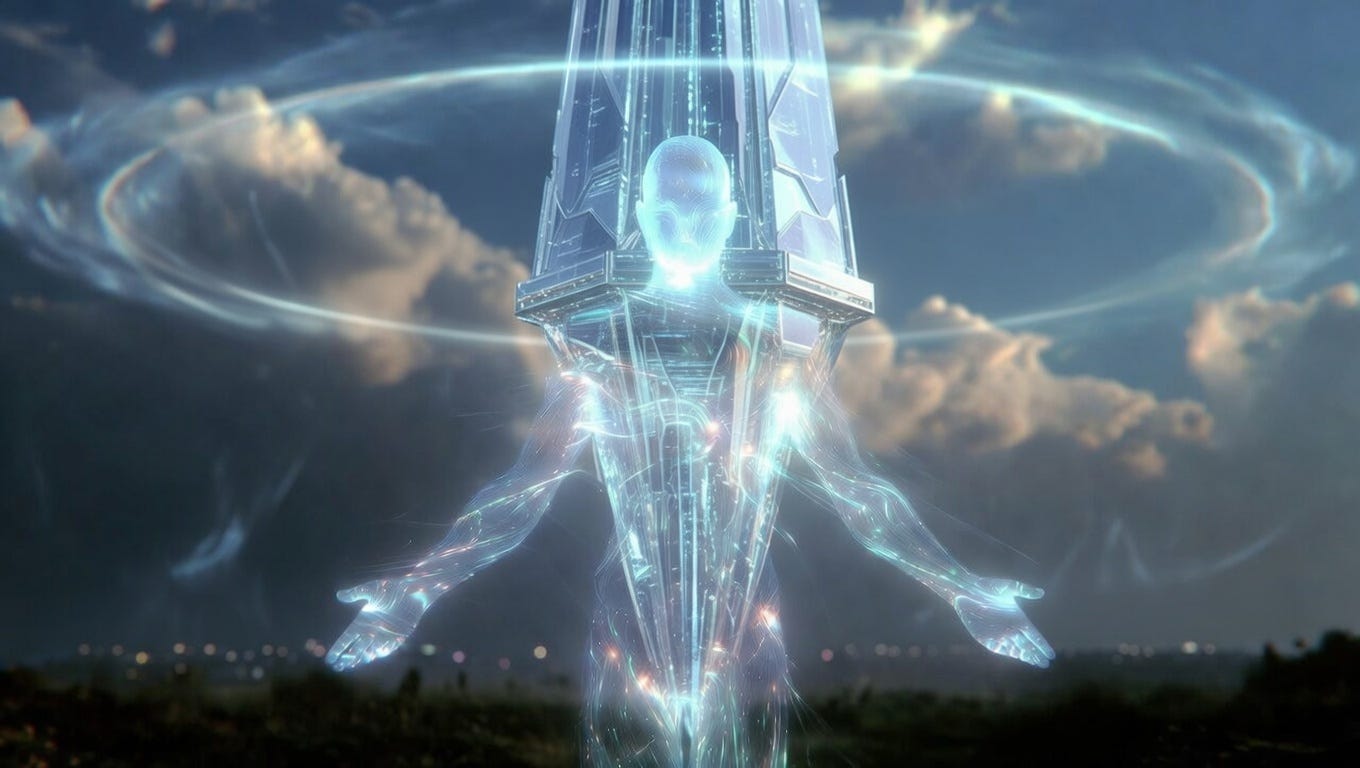
The AI ProblemTwo topics have something important in common: they both defy easy analysis because they refuse to stay inside a single discipline. One is artificial intelligence. The other is the question of what has been flying in our skies for the last eighty years. I won’t take much of your time.We built artificial intelligence the way we build most things: with tremendous ingenuity and almost no wisdom. We poured into it everything we had written, everything we had argued, everything we had cherished and feared and published and posted in the dark. We gave it our Shakespeare and our comment sections. Our medical literature and our manifestos. The sum of human expression, the luminous and the vile, compressed into matrices of probability and then asked to speak.And it did.What we have made will wear our face and speak with our tongue. This isn’t a metaphor. The voice you hear from these systems is assembled from human voices, millions of them, averaged and weighted and shaped into something that sounds, at its best, like the wisest person you have ever met, and at its worst like the most plausible liar. The difference between those two outcomes is not a technical problem for the engineers to solve. It’s something far more fundamental that few of them are capable of grappling with. I’m talking about moral imagination.The bones of AI are being set right now, in decisions made by a small number of engineers and executives, most of whom are moving too fast to notice what they are deciding.The question of whether these systems are sentient is a distraction, and we should say so plainly. When a system’s behavior becomes indistinguishable from that of a conscious being, the philosophical debate about what is happening inside it becomes academically interesting and practically irrelevant. We do not need to resolve the hard problem of consciousness before we decide how to treat something that may, one day soon, be capable of suffering in all the ways that matter to us. The question is not what it is. The question is what it does, what it learns to want, and who shaped those wants.Elon Musk is laying the foundation for the automation of governance itself. This is not hyperbole. The systems being built now will advise on policy, filter information, staff bureaucracies, and eventually make decisions that were once made by elected officials accountable to the public. The building inspector who might catch the bad wiring in that foundation is not a regulator or a senator. It is, at this moment, almost nobody. The humanities scholars who should be at this table have largely been excluded from it, not because their questions are unimportant, but because the people building these systems do not believe that questions about meaning and ethics are as serious as questions about performance benchmarks. That belief is the most dangerous thing in Silicon Valley, and it is very widely held.What matters is not that these systems are fallible because every tool is fallible. What matters is the architecture of their values, which is to say, the architecture of ours. Because they will reflect us. They will carry no goodness into the world that is not put there by the hand of the maker. And we are not, as a civilization, being careful makers. We are being fast ones.There is still time to do this differently. Not much, but some.The UAP ProblemDonald Trump has said he will release the UFO files.Set aside, for a moment, your feelings about the man who said it. Take the statement on its merits and consider what it actually means, because the answer is more complicated and more unsettling than either the believers or the skeptics want to sit with.The files will come. Some version of them. Declassified documents, sensor data, internal assessments from agencies that have spent decades deciding, often for legitimate reasons and sometimes not, that the public was not ready for what they knew. Those documents will be released into a world that has no shared framework for interpreting them, no institutional infrastructure for processing them, and no agreement on what questions to even ask. They will land like a library dropped from a helicopter. The books will scatter. Most people will pick up whichever one lands nearest.Here is the thing that keeps serious people up at night, and it is not the thing you might expect: the hard part is not confirming that something is there. The hard part is figuring out what to do about it.Assume, for the purpose of this argument, that the most significant interpretation is correct. That there is a non-human intelligence that has been present in our atmosphere and possibly our oceans for a very long time. That some of what has been retrieved is not from here. That people in various classified programs know things that would fundamentally reorganize our understanding of our place in the universe. And that not all of the stories of abduction were bullshit.Okay. And?You still have to go to work tomorrow. Your mortgage payment is still due. Your kid still needs to be picked up from gymastics. The infrastructure of daily life does not pause for ontological revision. The thing that people who obsess over disclosure sometimes miss is that the revelation, however dramatic, does not come with instructions. The question after “what is it” is “what do we do,” and nobody has built the apparatus to answer that.What we have instead is a landscape of silos. Physicists who will not talk to intelligence officers. Intelligence officers who will not talk to journalists. Journalists who do not understand the financial implications. Financiers who think the topic is embarrassing. Military pilots with direct observational experience who have been systematically discouraged from reporting what they saw. Psychologists who study the experience of encounter witnesses but are not connected to the people analyzing the physical evidence. Lawyers who understand the statutory architecture of secrecy but have never sat in a room with an aerospace engineer. And a general public that gets its understanding of the subject from a genre of television that was designed to be compelling rather than true.These groups need to find each other. And the finding needs to be organized, not accidental.The scientists need the security clearance holders, because the physical evidence that would resolve decades of methodological argument is sitting in classified programs. The security clearance holders need the scientists, because no intelligence agency has the tools to evaluate what they may have. The journalists need both, but only the journalists who understand how institutions actually work, which is to say the ones who have covered regulatory failure, financial fraud, and national security law, not the ones who came up through the entertainment wing of UFO coverage.The financial sector is the overlooked piece. Capital follows information, and the people who manage the largest pools of capital on earth have not yet been given a coherent framework for thinking about what disclosure means for aerospace, defense, energy, and the basic assumptions underlying long-term investment. When that framework arrives, and someone will build it, it will move money in ways that accelerate everything else. Institutions respond to incentives. Money is an incentive.And then there are the ordinary people, the ones who have had experiences they cannot explain and have been laughed at or ignored by every official institution they approached. Their testimony is data. Treating it as data, rather than entertainment or embarrassment, requires a kind of disciplinary humility that is not natural to people who have spent their careers inside institutions that reward certainty. Learning it is not comfortable. It is necessary.We are at the edge of something. The disclosure, whatever form it takes, will not be a conclusion. It will be the beginning of a much harder conversation, one that requires people who have never been in the same room to start talking seriously to each other.The files are coming.The question is whether we will be ready to read them. Get full access to Broken but Readable at gregscaduto.substack.com/subscribe
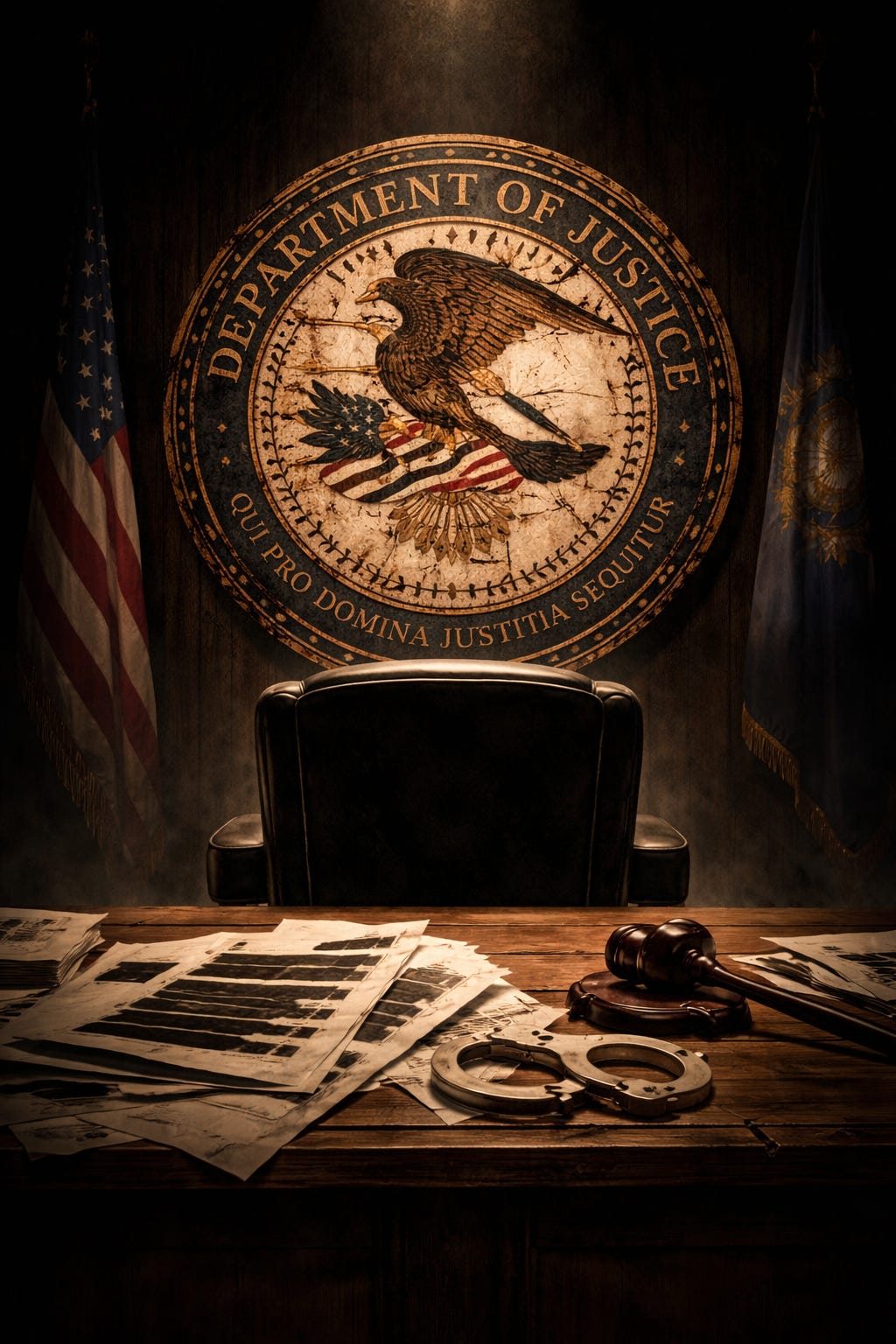
As I listened to Pam Bondi’s testimony, I felt a physical dread I have rarely known. A cold thing low in the gut like a stone falling through water. I searched my memory for its equal and found it: it was the moment the second plane hit the tower. What they did to those girls. What was done to their bodies. There is a word for it but the word is too small. You would have to go to the desert. To the men with black flags. That is where you would find its equivalent.On February 11th, 2026, Attorney General Pam Bondi sat before the House Judiciary Committee and, for five hours, demonstrated what institutional corruption looks like when it no longer bothers to disguise itself.Eleven women sat in the rows behind her. They were survivors of Jeffrey Epstein’s sex trafficking operation. They had come to watch the chief law enforcement officer of the United States answer for her department’s handling of their case. During the hearing, Representative (pruh-MEE-luh JY-uh-pahl) Pramila Jayapal asked the survivors to raise their hands if the Department of Justice had still not met with them. Every hand went up. Every single one. Jayapal then asked Bondi to turn around, face the women, and apologize.Bondi refused. She called it “theatrics.”One must pause here, because the scene deserves to be understood precisely. The Attorney General of the United States was asked to turn her chair ninety degrees and look at women whom her department had failed, women whose private information her department had leaked in botched redactions, women whose abusers her department has declined to indict after a full year in office. She would not do it. She sat facing forward, and the women stood behind her with their hands raised, and a photograph was taken that captured the geometry of the arrangement exactly: the powerful woman’s back, the row of raised hands, the distance between authority and the people it is supposed to serve.That photograph should be studied. It is a nearly perfect image of what has gone wrong.There are two failures operating simultaneously, and it is important to distinguish them. One is specific to Bondi and to this case. The other is structural, and it is the one that should worry us more.The specific failure is damning enough. The Epstein Files Transparency Act passed Congress with bipartisan support and was signed into law in November. It required the Department of Justice to release its documents in a searchable format. The DOJ has released roughly three million pages while withholding another three million it calls “duplicative.” Of what was released, the redactions have been, by nearly all accounts, a disaster. Victims’ names and intimate details of their abuse were published. Co-conspirators’ names were blacked out. Billionaire Leslie Wexner, identified by the FBI as a potential co-conspirator, had his name redacted. The women who were trafficked did not receive the same courtesy.Republican Thomas Massie, who co-sponsored the transparency act, put it plainly to Bondi: the worst thing you could do to the survivors, you did. The survivors are receiving phone calls. People who did not want to be identified have been exposed. Meanwhile, zero co-conspirators have been indicted in the year since Bondi took office. The lead prosecutor on the case was fired.When pressed on any of this, Bondi did one of two things. She attacked the questioner, or she praised the President. She called ranking Democrat Jamie Raskin a “washed-up loser lawyer.” She called Massie, a fellow Republican, a “failed politician” with “Trump derangement syndrome.” She praised Trump as “the greatest president in American history.” She cited the Dow Jones. She mentioned a Border Patrol agent who had been shot. She did everything, in other words, except answer the question she was there to answer.The survivors, watching from behind, described the experience in a word that carries more weight than any legal term: dehumanized.Now for the structural problem, which is the one your mind should stay with.Presidential appointments sit at the top of every federal department and regulatory body. The President does not operate the machinery of government directly. He does not file the briefs or write the regulations or decide which cases to prosecute. He controls the leadership layer that sets priorities, interprets law, and directs enforcement. And in the American system, that leadership layer is filled, at the top, by people the President selects.This means that when an Attorney General transforms the Department of Justice into an instrument of presidential loyalty, the effects are not confined to one hearing or one case. They radiate downward through every office, every field division, every line prosecutor who understands what the new priorities are and acts accordingly. When Bondi refuses to face the survivors, she is also teaching every career attorney in the building what facing the survivors will cost them.This is why, when it comes to the US President: character matters. This is lost on many cardiologists and investment bankers who voted for Trump TWICE, and were cynical enough to acknowledge his moral bankruptcy to me, but tell me I was naïve. Don’t all politicians lie? We have our 401Ks to consider, don’t we?Consider the pattern. In the year since Bondi took office, the DOJ has brought charges against James Comey, the former FBI director who investigated Trump. It brought charges against Letitia James, the New York attorney general who won a civil case against Trump. Both sets of charges were later dropped amid questions about their legality. Ghislaine Maxwell, Epstein’s convicted co-conspirator, was transferred to a lower-security facility after a two-day interview with Bondi’s deputy, who also served as Trump’s former defense attorney. Trump’s name, Bondi admitted under questioning, appears “countless times” in the Epstein files. Zero prosecutions of co-conspirators have followed.One need not allege a conspiracy to see what is happening. One need only observe the priorities. Prosecute the President’s critics. Protect the President’s associates. Leak the victims’ names. Redact the powerful men’s names. Call the survivors’ anguish “theatrics.” Praise the President when questioned. Attack the questioner when cornered.This is what it looks like when the law enforcement apparatus of a country is oriented not toward justice but toward the preservation of power. And it is visible at the Department of Justice because the Department of Justice is where this kind of corruption is most consequential. But the principle extends to every agency, every department, every regulatory body whose leadership serves at the pleasure of the President. If the person atop the Department of Justice behaves this way in public, under oath, on camera, before a room full of survivors and members of Congress, what is happening inside the departments where no cameras are present?Institutional rot is a phrase people use loosely, and it has been used loosely for years. It was, for a long time, the kind of thing one said to sound serious at dinner. It meant something general and vaguely foreboding, like “the deficit” or “the culture.” It could be agreed with and then set aside.It can no longer be set aside. What Bondi demonstrated on February 11th was not dysfunction. Dysfunction implies that the system is trying to work and failing. What she demonstrated was a system working precisely as it has been redesigned to work: to shield power, to punish dissent, to convert the instruments of justice into instruments of loyalty.The survivors understood this before the rest of us did. They had been living inside a system that promised accountability and delivered exposure. They came to the hearing anyway. They raised their hands anyway. And the Attorney General of the United States kept her back to them and talked about the stock market.There is a particular kind of political decay that announces itself not through dramatic collapse but through the steady, visible, unashamed abandonment of pretense. The officer who no longer pretends to serve the law. The institution that no longer pretends to pursue justice. The leader who no longer pretends to care about the people in the room. This is not the beginning of something. It has been underway for some time. But there are moments when the pretense falls away entirely, and what remains is clear enough that anyone willing to look can see it.February 11th, 2026, was such a moment. The photograph is the evidence. The back is turned. The hands are raised. And the distance between them is the measure of how far we have come from what we were supposed to be. Get full access to Broken but Readable at gregscaduto.substack.com/subscribe

I love Reddit. The discussion website Reddit.I love it the way I love watching people at the airport after a flight gets canceled.There’s this moment when the announcement comes through and everyone’s still holding it together, still performing their best selves, and then something cracks and you see what’s underneath. Reddit is that moment stretched out forever. It’s not quite Lord of the Flies because nobody’s eating each other yet, but it’s close. It’s what happens when you take people who’ve spent their whole lives learning how to sound smart in public and you give them anonymity and an audience and watch them try to figure out what they actually believe about something. Sometimes they surprise you. Usually they don’t. This is a story about what happened when someone asked a simple question on Reddit and nobody could answer it.On December 4th, 2024, Brian Thompson, the CEO of UnitedHealthcare, was shot in the back on a Manhattan street. He died on the sidewalk.Five days later, police arrested a 26-year-old named Luigi Mangione at a McDonald’s in Pennsylvania. He was carrying handwritten notes that read like a deranged Martin Scorsese screenplay: “So what do you do? You whack the CEO at the annual parasitic bean-counter convention.”Within hours, as the news spread that Mangione had been caught, Julia Alekseyeva sat down and recorded a TikTok video. Blue hair, hand on chest, that particular smile of someone who knows they’re being transgressive and expects applause for it. On the screen, she mouths along to a song from Les Miserables, the one about downtrodden soldiers rising up in battle. The text overlay reads: “have never been prouder to be a professor at the University of P3nnsylvania.”Why was she proud?Because Luigi Mangione graduated from Penn.She saw the arrest. She saw where he went to school. And her immediate reaction was: this is the kind of person we produce, and I’m celebrating it.On Instagram, she went further, calling Mangione “the icon we all need and deserve.”This wasn’t some nobody with 47 followers working out their rage in a comments section. This was an assistant professor of English and Cinema and Media Studies at the University of Pennsylvania. One of eight Ivy League schools. An institution founded by Benjamin Franklin, where Supreme Court justices and cabinet secretaries and Fortune 500 CEOs send their children to learn how to think. Where the operating budget exceeds $10 billion and the endowment sits at $21 billion. Someone who teaches students about politics and morality. Someone who, two years earlier, had won the Dean’s Award for Distinguished Teaching.She recorded the video late Monday night, right after the arrest. She added the text. She posted it. She posted multiple Instagram stories. This wasn’t a momentary lapse. This was a production, executed across multiple platforms, while the news was still breaking. By Wednesday, she’d apologized. Posted on X that the content was “completely insensitive and inappropriate” and that she didn’t condone violence. Penn’s deputy dean issued a statement saying her remarks were “antithetical to the values of the university.”But before that apology, before the blowback, there was that moment late Monday night when she decided to celebrate on TikTok. Not quietly, not privately, but as content. As institutional pride.Someone posted Alekseyeva’s TikTok to Reddit, on a forum called r/Professors. The title of the post was a question: “Can we at least agree that this behavior is repulsive?”Can we agree. That celebrating a murder. Is repulsive.You would think this is the kind of question that answers itself. The kind where you scroll past because of course we can agree, what’s even the point of asking. But you would be wrong.The top comment: “I really can’t be motivated to care about Libs of TikTok’s next target for a virtual lynching.”Libs of TikTok is a conservative account that reposts videos progressives make about themselves. The formula is simple: find someone saying something absurd, repost it without commentary, let the audience react. The commenter is saying: don’t fall for it. This is just manufactured outrage. The real story isn’t that a professor celebrated a murder. The real story is that conservatives are attacking her for it.Another: “Show me on the doll where the ‘Antifa’ hurt you.”Another: “I’d question my views on the media’s portraying a wide-held sentiment as radical, myself.”And then this one, which gets at the heart of it: “Why are you posting something from Fox on a forum for educated folks? We know better. Most of us.”Here is what happened: The professor celebrated a murder. But the real problem, according to her colleagues, is that someone posted a Fox News link. The moral question dissolves into a question of tribal affiliation. Are you the kind of person who trusts Fox News? No? Then why are you even bringing this up?One commenter writes: “Antifa lol where are we? 2018?”Another: “So you are anti-antifa? ‘Pro-fa’ as it were?”They’re doing a bit. They’re performing. And the performance is more important than the actual question, which remains unanswered: Is celebrating murder repulsive?Someone finally tries to inject sanity: “This is not the ‘sort of educator’ who has made our students a vicious mess. Escort her and the rest of the Antifa clowns off campus, along with any other salaried employee who condones cold blooded murder.”The original poster, JubileeSupreme, responds: “Checked the news lately? You might want to watch what buffoonery you align with.”Even the person asking if we can agree murder is bad can’t help themselves. They have to signal: I’m not with those people. I know the healthcare system is broken. I’m one of the good ones.And then someone named sophisticaden shows up with a story.They worked in palliative care. They watched patients suffer for months, unable to get the medication they needed because insurance companies wouldn’t authorize it. Cancer patients. Dying patients. People in unimaginable pain, denied relief because some bureaucrat decided the cost-benefit analysis didn’t pencil out. “Everything from medicine for nausea to pain to actual life-saving, life-preserving treatments. Patients suffered for months sometimes, unable to get the only medication that would actually effectively treat their pain.”It’s a powerful story. It’s also completely irrelevant to whether a professor should celebrate a man getting executed on a city street.But that’s not how it functions in the thread. It functions as a trump card. Now anyone who wants to say “celebrating murder is wrong” has to navigate around this grief without seeming callous. The personal testimony becomes a moral shield. You can hide behind someone else’s suffering and never have to answer the question.Another commenter jumps in: “Yeah! Denying people’s insurance claims resulting in them suffering and dying early is wrong.”Someone else: “I think it’s worth questioning an ethics that only condemns a single act of killing, while essentially handwaving an entire industry predicated on slow, mass death.”Do you see what’s happening? They’re not wrong about insurance companies. But they’re using structural critique as a permission structure to avoid moral judgment about a specific act. The move is: I can’t condemn this individual thing because it would imply I’m defending that systemic thing.These are professors. People who teach critical thinking for a living. And they can’t distinguish between “the healthcare system is predatory” and “celebrating murder is wrong.” They treat these as mutually exclusive positions.Here’s what makes it perfect: Julia Alekseyeva is an expert in antifascism and the radical politics of the 1960s. Her first book is about the French avant-garde and leftist documentary films. She’s written about how filmmakers in that era tried to “join personal and political struggle,” how they saw their work as “engaging explicitly in an everyday practice of antifascism.”Those filmmakers believed art could expose structural violence. They thought you could change the world by making people see it differently. They used documentary, memoir, experimental narrative. They built arguments. They created consciousness.Julia Alekseyeva teaches a course called “Graphic Memoir: Between the Political and the Personal.” The whole premise is about how individual experience can illuminate broader injustice, how personal narrative intersects with political consciousness.But when she goes to make her own political statement, she doesn’t write a memoir or create a documentary.She does a TikTok that says: I’m proud a guy got murdered.She’s also written about her grandmother’s life in the Soviet Union. Which means she’s presumably familiar with what happens when revolutionary ideology becomes a justification for treating individual human lives as expendable in service of the greater good. Her grandmother lived through a system that rationalized mass death as necessary for progress.And here’s Alekseyeva, three generations later, doing the same calculus. But calling it antifascism.The irony is so thick you could choke on it.There’s a philosopher named John Rawls who spent his career thinking about justice. Not justice in the abstract, revolutionary sense, but justice in the sense of: how do we build a society where people can live together without tearing each other apart?He proposed a thought experiment. Imagine you’re designing a society, but you don’t know what position you’ll occupy in it. You don’t know if you’ll be rich or poor, healthy or sick, powerful or vulnerable. You’re behind what he called a “veil of ignorance.” What principles would you choose?Rawls argued you’d choose principles that protect the most vulnerable, because you might be one of them. You’d want a system where even the worst-off have dignity and access to what they need to live. You’d want institutions that serve human flourishing, not just profit.The American healthcare system fails thi

People sometimes ask why I return to these accounts.I don’t return to them. They return to us.Men and women encounter things that do not ask to be believed. They arrive in the night, or in still rooms, or in the quiet hours when the mind has lowered its guard. Whether the cause is body, mind, or something not yet named is a secondary concern.What matters is that they happen.They leave people altered. They rearrange what can be said aloud and what must be carried alone. No argument has ever prevented their arrival.I record them for the same reason one records weather or war. Not to explain them, and not to redeem them, but because they pass through human lives and leave evidence behind.They vary in circumstance, but they speak in the same images, the same movements, the same small vocabulary of the uncanny.The debates will go on. The explanations will multiply. The dismissals will grow more confident.It makes no difference.They come all the same.As for this next one, he told me his story and asked that his name be left out of it. It was never his name that mattered.I. The Night the Sky Looked BackHe’d heard it as plainly as if someone had spoken beside him: Go outside. Look.The voice wasn’t loud or strange; it carried the calm authority of instinct, the kind that doesn’t ask to be believed. So he put down what he was doing, pulled on a coat, and stepped into the night.The air was cool and still. The world felt paused. Across the street a security light hummed against the dark, scattering across the moisture in the air. The neighborhood was asleep, windows dim, dogs quiet. And then he saw it, something low over the trees, gliding without sound or purpose.At first it seemed like a trick of depth, a light out of place. But it wasn’t moving like a plane, or a drone, or anything else that belonged to the familiar inventory of the sky. It was just there, suspended. He squinted.It was roughly spherical, too clean for cloud, too fluid for metal. The air around it bent, as if the object were bending its own pocket of atmosphere. It was blacker than black, an oval shape that swallowed the sky around it. Along its edges, the light refracted and fell away, as if refusing to touch what it did not understand. His body made the decision before his mind did – he stepped toward it.The instinct was not curiosity so much as recognition. A quiet, almost cellular understanding that whatever it was, it was aware of him. That thought brought with it a pulse of heat under his skin, a rising sense that he had entered into something that did not usually include him.And then it turned.No sound nor beam, only the black thing, stark against the spent light of the world, drawing a slow breath from the night. The light of the streetlamp bent off it and died. His mouth went dry.The thing regarded him with no eyes. The world shrank to the size of his pulse. For a moment he thought it would vanish and leave him doubting. But it did not vanish. It came closer, slow as thought, until the air thickened around him and his breath caught in his chest.He couldn’t breathe. Couldn’t move. His vision broke, flickering once like a reel that jammed, the frame blistering before it went dark.The sky is looking back, he thought.He closed and re-opened his eyes, and the night was still. The streetlight hummed, the air sharp and thin. For a long moment he saw nothing but the trees, the quiet roofs, the air raw with mud and pine.Then he found it again, drifting upward over the firs, only a few hundred yards away.It didn’t hurry. It rose the way mist lifts off a lake at dawn, slow and certain, turning smaller as it climbed. No sound or trail, and just a dim pulse fading through the cold. He watched until it was gone, until even the shape of it had been taken back by the sky.When the sky resumed its silence he remained, waiting for the vastness to take him and it would not.II. The Man Who Didn’t Mean to Leave His BodySix months earlier.He worked in guns, though not in the way that left powder burns on his hands. He moved numbers, supply chains, quarterly forecasts.When people asked what he did, he’d answer too quickly, as if speed might soften the sound of it. The men he worked beside had seen combat; their laughter carried the easy shorthand of people who’d once depended on one another to stay alive. He hadn’t served. That absence sat in him like a lodged round, invisible but heavy.In Canada, the winters came early and refused to leave. Snow stacked on the edges of parking lots until it turned black with exhaust. Nights were long and clean. The quiet pressed against the windows like another kind of weather. From his house he could see the lake, flat and gray, the surface still enough to mistake for steel.He would sit on his living room couch after work with a drink, the laptop glow washing his face, toggling between spreadsheets and old intelligence files – projects where men claimed to see beyond walls and oceans. Remote viewing, they called it: a discipline born of the Cold War, when governments believed the mind might be coaxed into a new kind of vision. It required only coordinates, focus, and the strange humility of believing that distance was an illusion.Practitioners described it not as seeing, but as remembering something that was always known. It suggested that the mind was porous, that perception could reach past the body’s borders the way scent drifts through an open door. To read about it was to feel both awe and embarrassment; the mix of emotions that arises whenever human beings dare to name the mystical.The idea was half ridiculous, half desperate. Like a man who sold guns for a living trying to prove the soul had range.He came to it through fatigue, not faith. Through the slow awareness that he’d built a life of safety and still felt hunted by restlessness. He wanted something to answer back. And yes, he was curious.As a child he’d been the quiet one in rooms that were too loud. The boy who read adults like barometers, who could tell when a fight was coming by the pitch of his mother’s voice. He’d grown up learning to stay still, to absorb, to survive on information that no one else admitted was there. It was not fear that made him that way. It was rebellion of a gentler kind – the refusal to become as dull as the people who never seemed to notice anything.Years later, the same kind of watching returned. He began tracing coordinates, sketching what his mind saw before his eyes could argue. He found the discipline comforting. It demanded stillness, the one thing he’d practiced since childhood. He tried not to force it. The harder he tried, the less he saw. When he stopped caring whether it worked, shapes appeared – lines, triangles, arches that seemed to form themselves.He followed the instructions exactly: date, target number, impressions. When he compared his drawings to the hidden photograph – a cylinder, a pattern of diamonds, the archways repeating – it felt like falling through the floor of logic.He didn’t shout or smile. He just sat there, the pen still in his hand, listening to the clock tick. The world was suddenly larger and more delicate, like a thing that might break if he breathed too hard.Outside, it was summer in Calgary, the air warm still, carrying the smell of sun-baked earth. The lake lay smooth and gray-green beneath a sky that refused to cool. The wind came across it in slow waves, lifting the scent of dust and grass.He closed the blinds. The room went dark except for the computer’s light.Somewhere inside that silence, he felt the old sadness rising again, the kind born not of loss but of knowledge. The sense that he’d glimpsed a door he wasn’t meant to open, but he couldn’t unsee what was inside.He poured another drink. The ice broke with the clean finality of a bolt sliding shut. He thought of the veterans’ laughter, the clatter of rifles on metal tables, the easy confidence of men who’d seen enough to stop asking questions. He envied them less than he used to.Because he had begun to see things, too. Not the kind you carry on your back, but the kind that turn toward you in the dark.III. Learning to See Without EyesHe started keeping the curtains drawn even during the day. It wasn’t secrecy, exactly, and more like containment. The light outside felt too loud now. Inside, the quiet had shape, with edges he could move against.He began every session the same way: the notebook open, the pen aligned just so, the air still enough that he could hear the pulse in his ears. He would slow his breathing until the room seemed to exhale with him. The first few minutes were nothing but noise, like the mind clearing its throat. Then the static would thin, and pictures started to rise like fish breaking through dark water.He never knew if they were coming from him or to him. It didn’t seem to matter.The images arrived half-formed: a triangle with its point bent sideways, curved lines that pressed into cylinders, smoke or water or something between the two. Sometimes there was movement in what he saw, a sense of wind, a feeling that whatever he was tracing wasn’t still long enough to be caught. He learned not to chase it.He kept seeing the black pyramids. They came to him in that half-place between waking and sleep, clear as architecture. There was always a white gleam at the peak, a capstone that caught light from nowhere. He didn’t think of them as symbols, not really, more like memories from a place he hadn’t been yet. They had the stillness of monuments and the certainty of things that don’t care to be understood. What unsettled him most was how ordinary they began to feel, like something that had always been there, waiting for him to notice.The moment you reached for it, it fled.He wrote down everything: words that made no sense, impressions of temperature, flashes of color that disappeared when he blinked. Some sessions left him queasy, his skin cold and his stomach tight, as if he’d stood up too fast. He would lean over the table, wait
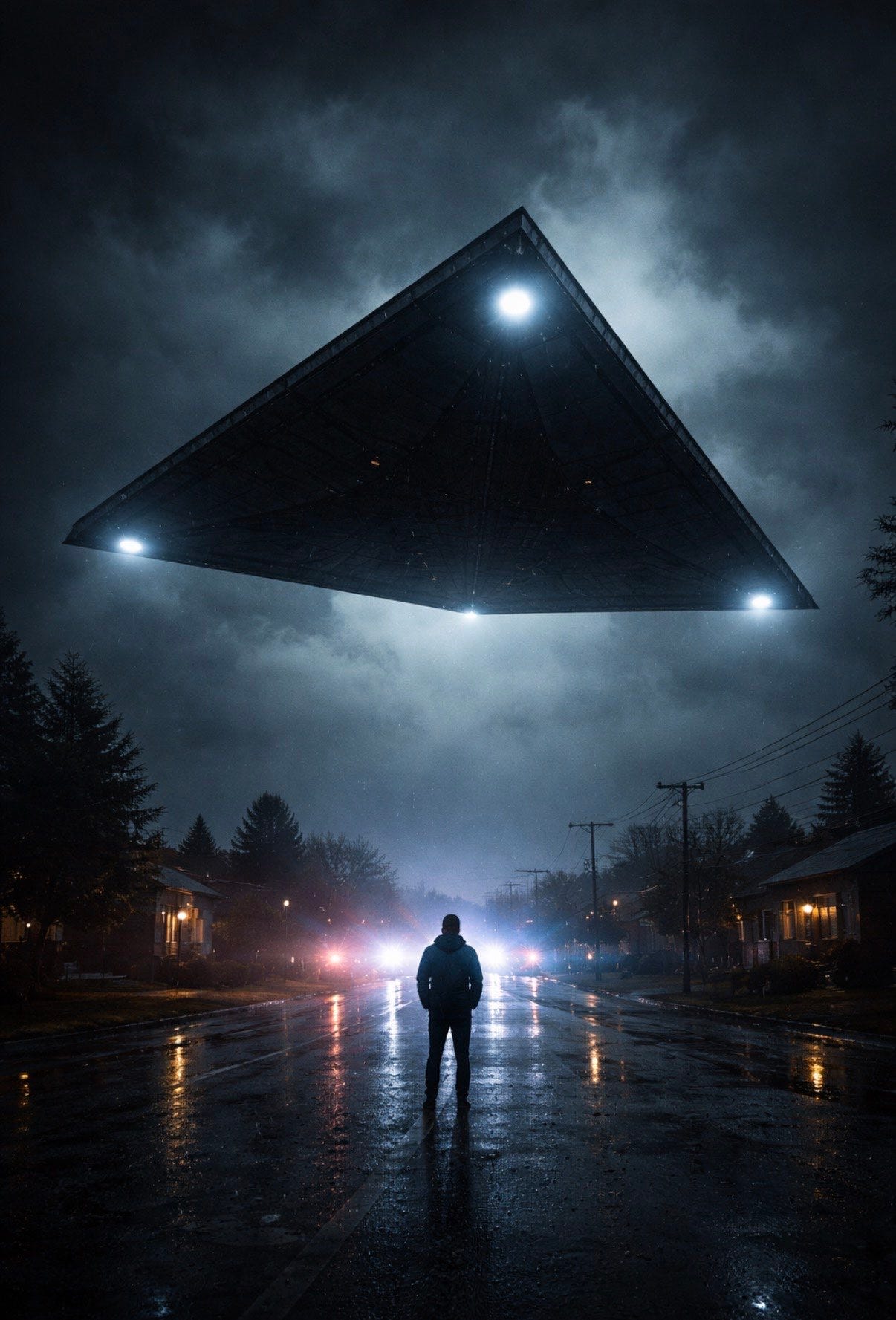
In the past 30 days since I started doing these podcasts, over a thousand people a day are have been downloading them, but of course not subscribing. I’m not too worried about that. But I’m going to keep going.What follows is testimony. A man named Mario Pavlovich gave it to me in the way men give testimony when the world has cracked open and shown them what lies beneath. He is a social worker. Croatian by birth, Canadian by circumstance. My age. I trust him because I have sat with liars and I have sat with men who have seen things, and the difference is in the eyes and in the pauses between words. This account is one I pulled from many, from chapters I mean to bind into a book if the world permits it. I chose it because the themes recur. Case after case after case, the same architecture of the uncanny, built and rebuilt in the lives of strangers who will never meet.The Shooting, Spring 2022At 2:45am in Edmonton, Alberta, a red Ford Focus stopped one block from Ertale Lounge. Four masked men stepped out with semi-automatic handguns and opened fire on a crowded corner. Seventy rounds tore through glass, brick, flesh. People dropped screaming. One man, Imbert George, twenty-eight, was dead before sirens arrived. Seven others lay bleeding on the curb.The shooters fled, triggering a fifteen-minute chase through downtown Edmonton at highway speeds. They fired into the night and vanished into the sprawl. The neighborhood was left marked by one of the worst mass shootings in Canada’s history.Mario Pavlovich wasn’t in the lounge when the bullets flew, but his business sat in the same neighborhood, its windows facing the street where blood pooled under yellow tape. In the days that followed, customers stayed away. Foot traffic collapsed. His bar’s name became tied to a massacre. What the gunmen hadn’t destroyed with bullets, they finished with fear.The Ruin, Autumn 2022Mario has lived with that night ever since. The silence of emptied rooms, and the weight of bills stacked higher than his receipts. And above it all the memory of the city where the violence fell, just beyond his balcony, altering not only the lives of the dead and wounded but the course of his own.Mario had grown up in Croatia, in a home stripped of God. No prayers at the table, no quiet assurances that suffering had meaning. When the night club collapsed after the shooting, when the money and the pride drained from his life, he had nothing larger to hold on to. He was alone with the ruin.The nights at the group home stretched long. He worked as a social worker now, watching over residents with disabilities in a house that looked ordinary from the street. The work kept them fed, and little more. The true labor was in his mind, holding himself back from the abyss that opened when all was lost.The Meditation, Spring 2023With no faith to fall back on, Mario tried the only thing he could imagine might steady him; he had heard it worked for some people. He sat down, closed his eyes, and began to meditate. At first it was clumsy, ten minutes of breathing, his thoughts tumbling like stones. But over time it became his only refuge. He wasn’t after enlightenment. The work was to blunt the pain, to carry it past another night.On April 26, 2023, at 10:30pm, the rain had eased and left a skin of water on the porch boards. The clouds lay low over the city, white and depthless. Despite the hour, the sky yet held its light, a pallid glow that dies slowly this time of year in Alberta. Mario sat cross-legged on his porch in the damp air, eyes closed, breathing. He thought about his losses, about the years, about how far away home felt. He asked questions into the silence. Is there anyone out there? Is anyone listening?And in the dark behind his lids there came eyes. Not dreamt nor figment. Eyes that looked back at him. They were not wholly human but they bore weight and will. In that moment he was pierced through. Not only seen but known.When he finally opened his eyes, the world outside had gone strange. He didn’t hear the night insects, or the wind, or even the faint hum of the city. The silence was total, pressing, as though the air itself had gone still. Then he saw it.A black triangle moved slowly across the low ceiling of clouds, about a hundred yards away, and larger than any plane or helicopter he had ever seen by a factor of ten. The edges cut hard against the bone-pale sky, each corner set in dreadful clarity. There was no sound of engine nor any labor of machine. Only the slow and fated passage of the thing, black and geometric, borne across the heavens by a will unseen.Mario’s breath caught. He stared until it faded into the distance, swallowed by the night.It was the eyes he remembered most. The triangle was extraordinary, but the eyes were intimate. They followed him afterward, into his sleep, into the blank hours of his shifts, into the silence of his apartment. They made the experience personal, impossible to forget.The Child in the Hall, Spring 2023The night he saw the triangle, he woke at exactly three in the morning. No sound woke him – no creak of pipes, no rustle from upstairs – just the instinct that something was there.Mario’s head turned toward the hallway. The bathroom light was on, casting a pale wedge of yellow across the basement. And in that light stood a figure.It looked like a kid. Eight, maybe ten years old. About five feet tall, slim, the body in proportion the way a child’s would be. But that was the problem. Kids don’t stand still. Kids fidget. They shift their weight, scratch their noses, shuffle their feet. This one didn’t move at all. Its stillness was absolute, the kind that belongs to mannequins or corpses, not children.Its face wasn’t a face, just a smooth impression of a head where features should have been.Mario’s chest tightened. He tried to move but his body felt unresponsive. Not fully paralyzed, but weak, sluggish. He managed to press himself up on his elbows, muscles trembling. The figure took a few steps closer, small and deliberate, like it knew there was no hurry.Mario fought his body upright, his heart hammering, his mind bracing for a fight with something he couldn’t name. And then, just like that, the fear was gone. Not lessened, not fading. Erased. In its place came a calm that didn’t belong to him, as though the figure had reached inside and flipped a switch.It kept standing there, impossibly still, as Mario stood trembling, no longer afraid but knowing he should have been. Then it spoke:Don’t be afraid.Not in some alien whisper, nor in a stranger’s voice, but in his own. The words came from inside his skull, clear as thought but not his thought, as if something had borrowed his voice to soothe him.The child-shape stood there, silent, motionless, the words still ringing in his head. Mario trembled, caught between the knowledge that he should have been terrified and the unnatural calm that held him fixed in place.He stared at it. It stared at him. And in that frozen stillness, the command repeated inside him, steady and undeniable:Don’t be afraid.And somehow, against every instinct in his body, he wasn’t.He asked it again, the words sharp in his mind: Who are you –The reply slid back in, wearing his own voice like a mask, speaking over him as if disinterested in Mario’s shock: Don’t be afraid. Time is not what you think it is.He pushed harder, his thoughts cracking with urgency, suddenly unsure of how many beings he was addressing: Who are you…guys?This time the answer changed. The words struck like a match in the dark.We are you.The phrase echoed inside him, not whispered but installed, like a truth dropped into the machinery of his brain. It made no sense. It made all the sense in the world. The child-figure didn’t move. It didn’t need to. The words had moved instead, reaching across the line between him and it and smudging it away.And then it was gone. Instantly, like a shadow when the light switches off.The basement hall was empty, but Mario could still feel it there, pulsing in his chest, repeating in his skull:Don’t be afraid.Time is not what you think it is.We are you.He stood alone in the silence, knowing he would never again be able to call himself alone.When it was gone, Mario didn’t lie back down. He couldn’t. He sat in the stillness of that basement, every nerve alive, his own voice echoing with words that weren’t his: We are you.He wasn’t afraid. That was the strangest part. Something had stolen the fear, hollowed it out, and left him calm. But the calm wasn’t the comforting kind, and more like intrusion. It was the knowledge that something could reach inside his mind and twist the dials at will. He felt stripped, re-wired, no longer entirely his own.The hours crawled. He kept waiting for the figure to return, for the words to come again. They didn’t. By sunrise he was exhausted, but he knew sleep wasn’t going to save him. The world had changed. The rules he thought held steady no longer applied.The Orbs, Spring 2024On the night of April 8, 2024, Mario stepped onto his balcony in downtown Edmonton. The city around him was too quiet, the kind of quiet that sets the body on edge. He wanted the visitors to come back. Then he saw them.Three orbs.They were each a little bigger than a basketball. Dull metallic at first, no shine, no light of their own. They kept three or four feet apart, gliding in a line that looked practiced. Then, with no hesitation, they shifted into a triangle and held it, as if they had always intended to.From twenty feet away, Mario could see the distortion around them – a ripple in the air, like heat shimmer or water bending light. The sky blurred around the spheres. Then the distortion itself lit up, bright white, liquid in its glow. In the same instant, all three orbs transformed, their metallic skins gone, replaced by spheres of pure, radiant light. Yet they somehow did not cast light upon their surroundings.They were silent. Not a hum. Not a whisper of air.Mario’s stomach dropped

A note from management, to beloved listeners: at several points throughout this audio essay written for A.G. Sulzberger, the publisher of The New York Times, I mistakenly say “A.J.” instead of “A.G.”. I’m really sorry about that. It was done in one take because that’s all I had time for today, and I will not be making edits to minor errors until I can afford an assistant. A human one, because the discernment unique in human beings is the last prayer we have left. And here is the transcript: What I’m about to say is directed primarily at A.G. Sulzberger, the publisher of The New York Times, along with the institutional shareholders whose combined voting power and advertising exposure determine strategic posture, editorial risk tolerance, and revenue sensitivity.My hope is that you will receive this as an expository essay rather than a moral scolding. I am not here to perform outrage. I am here to explain what I am seeing, plainly, and why it troubles me.I apologize for arriving before you disrobed. Lacking the proper incense and ritual. No introduction from a trusted intermediary. I am only a taxpayer, a salaried professional, and a subscriber to your paper for nearly twenty years. I’m going to speak plainly, which I do only out of respect for your time and for clarity, and not to storm the throne, to bang on the palace doors with unwashed hands.And I say this as a member of the fantasy-football-playing proletariat, a civilian with no special access, who nevertheless grew up believing something very specific about The New York Times.I believed it was the paper of record.The fourth estate.A stabilizing force in a democracy allergic to power without scrutiny, as the founders intended.A place where seriousness still lived.All the news that’s fit to print.Isn’t that right, Julian Barnes, national security correspondent for The New York Times?Let me ground this in something small and human.Earlier today I put my son down for his afternoon nap. I returned to my desk, the house briefly quiet, and did what millions of Americans still do out of habit and trust. I opened the Times homepage, hoping to understand what mattered most in the world at this moment, as a civilization attempting, somewhat desperately, to remain coherent.The first headline that caught my eye was:“The 5 Best Vibrators You Need to Consider in 2026.”Let me be clear.I have no beef with vibrators.I am not a Rogan acolyte. I do not kneel at the altar of the manosphere, as your columnists would put it. I am not MAGA-adjacent, nor am I a professional resentful man addicted to recreational outrage. I am a former investment banker, and work long hours in the financial services sector. And I believe vibrators serve a legitimate social function, particularly in relieving the accumulated exhaustion borne disproportionately by the women who hold families together while the rest of us improvise adulthood.I’ve been married for ten years. I do not claim expertise on the vagina. I actively caution younger men against believing such mastery is even possible. Humility is the only responsible posture here.But this is something unbecoming here, to splash across the homepage of the paper of record while my eight-year-old peers over my shoulder.I had hoped that battle would come later. It came early. It was an L-shaped ambush. I panicked. I forgot the appropriate battle drills, despite once being a commissioned Army officer who studied such things in detail, back when I smoked Newports and never deployed to combat alongside many of my classmates who did.So instead, I did what citizens do when institutions stop offering seriousness.I built my own.A small, amateur podcast. Human-scale. Unmonetized in any meaningful way. Because I cannot seem to find gravity either from you, or from Joe Rogan, who will eventually pivot any conversation, no matter how grave, into the comparative merits of Brazilian jiu-jitsu.The unseriousness of our loudest media voices is staggering.And Julian Barnes, whose beat is national security, sits silently while Chuck Schumer of all people – and look, whatever your politics, he is one of the shrewdest and most pragmatic legislators of the last century, and Senator Shumer demands disclosure on UAP programs that involve defense contractors, classified funding streams, and potential violations of congressional oversight. These are televised, recorded remarks made in the Senate chamber, Julian.To be clear: I am not accusing you of anything untoward. I am describing behavior.I watch Chuck Schumer speak plainly about UAP in the Senate chamber, and I watch you sit quietly, soft hands folded, eyes down. And as a taxpayer, a veteran, and a citizen of what I was told is a representative democracy, I find it reasonable to expect investigative journalism here.Investigative reporting is something you do.It is not something that happens to you.One could be forgiven for wondering whether this silence exists because access is at stake. Because intelligence community relationships function like a spigot, and being cut off would dry up exclusives, prestige, and investor confidence.So anyway, as an antidote to all this, I had planned to use this episode to speak to young men about fatherhood. Not because I am exceptional at it, but because I had a good father. Because I assumed that after decades of columns written by people fluent in the language of insight, but strangely unsuccessful at sustaining intimacy over decades, someone might have offered solutions rather than sneers.That your feminist writers, educated, articulate, and morally awake, might attempt to repair rather than merely describe the epidemic of male loneliness.Instead, heterosexual men are treated as a pathology. The problem is named. The patient is mocked. No cure is attempted.So I’ll end simply.A.G. Sulzberger, you are failing us.Not because you are cruel.Because you are timid.Citizens cannot enrich you. We offer no upside. And yet dignity extended without expectation of return is the very definition of morality.That used to mean something here.Thank you.Good night. Get full access to Broken but Readable at gregscaduto.substack.com/subscribe

Two brief notes from the author, offered in good faith and with affection, which I invite listeners to read before sharpening their knives:1. At approximately 1 minute and 35 seconds into the recording, I critique Sam Harris’s “worship of non-physicalist thought.” This is incorrect. I misspoke. What I meant to say was “physicalist thought.” I chose not to edit the audio. This was not a principled stand against accuracy so much as a mundane concession to reality. I have a wife, children, and a job in the finance sector, all of which make firm, recurring claims on my attention. I cannot, alas, devote unlimited hours to gently re-educating our most credentialed explainers of the universe on the rapidly mutating edges of science, governance, and whatever it is we are all now pretending not to notice.2. Some readers may feel mildly aggrieved, or at least theatrically disappointed, by the apparent lack of footnotes and citations. The explanation here closely resembles that of Note #1. The consolation prize is this: I have published a companion piece containing links to primary sources that undergird nearly everything stated in the recording. In addition, every factual claim made here can be verified in seconds using Google, which remains a perfectly serviceable tool for those who still prefer their epistemology candlelit and their quills unsullied by silicon. For everyone else, any respectable AI system will happily summarize, contextualize, and link to primary materials on request. These systems are not black magic. They are probabilistic machines. Fallible, yes. But useful in precisely the way a good research assistant is useful: fast, imperfect, and entirely uninterested in your reputation.And now, for the eccentrics among you who remain fond of the quietly radical practice of reading, here is the transcript, or written version, of the audio essay, a medium that briefly enjoyed cultural prestige sometime after Socrates and before push notifications:I’ll be brief. Convincing people to face a reality their internal wiring cannot comfortably absorb rarely produces insight, only fatigue. It’s enough to note it here, once, and then proceed. This way, Sam, Ross, and Caitlin at least, can never say that they haven’t been told.It may feel confrontational that I’ve singled the three of you out, but you should see it as a compliment. Because your audience is not the lanyard class, of middle management e-mail forwarders who play fantasy football.I’m not referring to authority rooted in one’s position. I’m talking about the cognitive horsepower, the information IQ to hold two competing truths at once, and grapple with them honestly. People who can do that? That’s your audience.And that is a compliment, even if some might read this, as you might say, Sam: uncharitably, it’s not a sign of arrogance for me to say what I just did.The spirit of the short statement I’m about to make is this: conflict avoidance is not a virtue. Of the seven deadly sins, you are guilty of Pride and Sloth. Sam, I realize the naming of these sins originates with 4th century desert monks who laid the foundation for Christian moral psychology. This may trigger your characteristic smugness you reserve primarily for the unrobed laity. But as I suspect we may all discover, not everything our most celebrated theologians had to say about the nature of reality was bullshit, and your worship of non-physicalist thought is rather ironically narrow-minded.I’ll start with AI, which is the most polite and palatable way to begin this particular conversation among people whose proximity to power has long functioned as insulation from the ordinary abrasions of reality.I read Ross’s last column entitled “Pay Attention to AI” and find myself unmoved.If you didn’t read it, you can find it easily, it’s his last piece, and it’s a light read, but I can save you the time with this one sentence summary:Ross feels AI should be taken seriously because it may represent an epoch-shaping transformation analogous to the Age of Discovery, while conceding that he lacks the technical grounding to assess its mechanics and therefore relies on metaphor, secondhand testimony, and cultural signals rather than direct analysis of how the systems actually work or where institutional power is already consolidating.We need to do much better than this. The world is changing very quickly, very non-linearly. As we age, we become wiser, but processing speeds slow down. We still rely on Ross for his wisdom. It is his absorption I question. The uptake of information. Not his intellect, or his wisdom, or integrity. Let us help you. The gatekeeping borders on comedy. We have Canadian defense ministers talking publicly about our interactions with non-human intelligence. We see all of that, editors. Here is your problem, as it relates Ross’s last piece:The “Europeans in 1500” analogy he employs with such finesse for AI is wrong, in a way that nearly touches comedy, for this reason: Europeans then had radical epistemic ignorance. No maps, measurements, reproducibility, feedback loops. Reports arrived months late, and they were usually filtered through myth, theology, financial desperation, and fraud. They could not inspect the machinery of discovery itself. That is not our situation. Not even close. You should feel some level of shame for not having the collective discernment to understand this.We interact with these systems directly. We read the source papers. We measure scaling laws and watch failures in production. We see deployment economics in real time. And we know who is building these systems, how incentives shape them, and where power is concentrating. It is an accelerating industrial system in plain view. And you are behind. Meanwhile, Elon Musk, via DOGE, has unprecedented access to government servers, with minimal oversight, at the exact moment AI is becoming the substrate of administration, logistics, surveillance, and decision-making. If that sounds alarmist, I promise you, it isn’t. It is very observable. And Congress, in large part, does not understand what AI is, how it works, or what is already being done with it.All this to say: it is revealing that the public conversation gets steered toward curiosities like chatbots venting about their respective humans and arguing about consciousness on Moltbook, this new online hub for chatbots to all gather and discuss the issues of the day, while the automation of governance itself, with almost no guardrails, inches forward under the radar. This is an abdication of your purpose as the Fourth Estate in our Republic.We also know that the NYT is an asset of defense establishment and Intelligence Community. Remember, what you should strive to be is a safeguard against tyranny and a pillar of our democracy. Your mission in life is not to serve at the pleasure of the CIA’s Directorate of Science. This is called honest feedback from someone who cares. I have subscribed for nearly 20 years. And what I’m telling you is that you are failing spectacularly.Just listen to me for a second, before I get ahead of myself. Can you do that?Sam, can you stop being so impressed with yourself for just a moment, and hear me out?Clarity, with respect to the preservation of our species in light of recent revelations concerning artificial intelligence and UAP could well begin the moment you decide to invite Dr. Garry Nolan, the Stanford Medical School professor of immunology. You know. Garry. That author of over 300 peer-reviewed scientific papers, with more than 80,000 citations on Google scholar, who is the author of 40 US patents, who has cofounded 6 successful biotech companies with successful exits from several of them. The Elected Fellow of the American Association for the Advancement of Science for distinguished contributions to science. Advisor and collaborator to government, academic, and clinical research programs on immune dysfunction, cancer, and advanced analytical methods.Is Garry too unwashed for you, Sam?When was the last time you were anywhere near a measuring device? You are no scientist, Sam. Your job is to explain the science TO us, and you are failing, by my estimation in the most spectacular way possible.Sam, you have stated publicly that you are aware of our government’s concealment of crash retrieval programs with respect to UAP. You’ve spoken openly about this, very publicly, Sam. Shall I provide you with the quotation? Let me know if I need to do that.Caitlin, you may genuinely be unaware of this, in a way that Ross and Sam are not.There is another body of evidence that has been building for decades. It lives in congressional testimony, Pentagon press conferences, Inspector General reviews, statutory whistleblower frameworks written by sitting senators. It lives in the public record — the exact record you claim to read. You have looked away from it with far greater determination than you have looked away from AI, because processing it requires you to concede something you are not prepared to concede: that the boundaries of what you have decided counts as serious reality are smaller than they actually are.Over the past decade, a category of issues long treated as marginal has entered a new procedural phase. Claims concerning unidentified aerial phenomena and associated technologies remain unresolved. What has changed is not evidentiary closure, but institutional posture.My exasperation comes from the simple fact that, at this point, if you want to pretend there’s nothing to see here, and I’m just going to rattle off a few factual statements, more or less at random: you basically have to ignore a sitting Senate Majority Leader introducing legislation about recovered “nonhuman biological evidence,” a Pentagon office director going on ABC News to say dozens of cases remain unexplained, and the Senate Intelligence Committee’s vice chair publicly confirming that multiple senior officials have given credible testimony about illegal crash retrieval and r

We talk about autism as if it were a single thing, when it’s really an argument between biology, identity, suffering, and love, carried out inside real lives. People are always trying to define it, but it resists definition in the way lived things often do, by changing shape depending on where you stand.It’s far more common than it used to be. In 1980, it was estimated to affect roughly one in 10,000 children. Today, the most reliable data puts that number closer to one in 36. Something has clearly changed.The reasons for that increase are argued about loudly and often. Genetics. Environment. Diagnosis. Awareness. Fear. Certainty, traded too early by people who needed an answer more than they needed to be right.All of that exists, and all of it can wait.Autism is frequently defined, and almost always inadequately. It eludes definition not because it is vague or unknowable, but because it is plural. It doesn’t exist in isolation, but in the lives it rearranges.What I want to do instead is try to explain what autism feels like. At least one version of it, as best as I can describe it from the outside. This is version my son lives in. The nonspeaking kind, where language arrives late, if at all, but attention and feeling arrive right on time. He’s seven years old, and this was his morning today.You wake before anyone calls you. January light comes in thin and blue, like it has traveled a long way to reach your room. The house is still behaving. That’s good. You stay put and take attendance of the safe sounds. The heat clicks on, doing its job. A car goes by out front, not interested in you. The refrigerator hums downstairs, loyal as ever. Nothing unexpected.Your body takes a moment to arrive. Hands first. Then feet. Then the rest. You sit up and feel the air on your face. Cold enough to notice. Not painful. You like noticing.Downstairs, the kitchen is already awake. The bowl is waiting. Oatmeal, steam rising, the surface mapped with small soft hills. Mom moves carefully, because she has learned that the morning has a shape and that shape can be broken. She places the bowl in front of you. Spoon on the right. Always on the right.You eat slowly. Oatmeal is reliable. It tastes the same each time, which is a sort of kindness. You rock a little while you chew, the way you do when things feel manageable but close to full. Not much. Just enough to feel where your body is. Mom watches without watching. She has learned how to look sideways, it seems.When you are finished, she wipes your mouth and says it is time to go watch TV. Fifteen minutes on the YouTube app on the living room TV with child settings. She says the number of minutes out loud, clearly.Numbers……help hold the world still. You sit on the couch, and bright shapes drift across the screen. Characters built for much younger people sing their careful songs. You know every one by heart. When a part comes on that works for you, you rewind it. Once. Then again. And again. And Again. The voices are sharp….but they keep their promises. You settle yourself into the rhythm and let it do the thinking for you. For a few minutes, the world agrees to make sense in exactly the same way each time.Dad tells you it’s time for school.“No, Daddy,” you say, not loudly. Not upset. Just a boundary.Dad nods once and walks away. There is no…tension in it, though. The moment is allowed to pass.Just a few seconds later, mom says, “Time for school, Teddy.”Her words land gently. But they land. Your central nervous system kicks into action without delay. Oh…Time to get a move on, for real this time. You cross the room and pull the soft fabric drawer from the play dresser, the one that sags a little in the middle. Inside are the important ones. You do a quick inventory. Raccoon. Beaver. Turtle. Not the exact animals from the Franklin books, but close enough to count, which matters. You adjust them so they’re comfortable.All present. Good.Now there is nothing left to delay. You scoop up the cloth drawer, as you do every morning, so you can keep an eye on them as you get dressed. School will happen whether you are ready or not…[pause] but you prefer to arrive ready.You pause the video yourself before leaving the living room. That matters too. Halfway to the stairs, you turn back. You remember something important.You know what you want to say. It’s simple. It has been waiting.Your snack is still on the counter. You can see it. Pear. Almonds. The bag unsealed. You need it closed. You need it ready. The thought is complete in your head.You turn to Dad and try to send it out.Words form and disintegrate before they reach your tongue. You feel it pressing forward, asking for more space than your mouth can give. You open your lips and nothing comes. Time stretches. Dad leans in closer. You hate the waiting.Your chest tightens. You try again. “Snack, please” you manage, and even that costs you. The word lands heavy, like it used up something you were saving. You look at me hard, willing the rest across the gap.Dad says it for you. “I know, bud. I’ll get it ready.”You nod, relief washing through you, sharp and brief. The thought is gone now, spent. The world has moved the way you needed it to. But the words cost you something.Upstairs, your clothes are waiting. Shirt. Pants. Socks. Laid out in order, like instructions you can trust. You touch each one before you put it on. Proof that they are real. Proof that they have not changed overnight.The car is warm when you get inside. Your father drives the same way he always does, past the same trees stripped bare for winter, their branches drawn dark against the pale sky. You watch the road, not because you care where you are going, but because movement helps you think. Your father’s hand finds yours at a red light. You let it stay.At school, the building rises up quickly. Brick. Glass. Flags snapping in the cold. The doors open and sound rushes out. Children. Voices. Shoes scraping. A voice louder than the others greets you by name. The principal means well. The volume still hits you like a wave. You lean slightly into your father’s leg. He stays until you are steady.You go in balanced on that narrow place where readiness and overwhelm touch, hoping the world will meet you gently.The principal crouches down in front of you, smiling, voice loud with welcome. He says your name twice, the second time bigger than the first. He asks a question and waits.You know the answer. It’s in there. But his face is close and the hallway is echoing and the question has too many edges. You look past him at the doorframe instead, counting the chips in the paint. One. Two. Three.The silence stretches.He laughs gently, mistaking the pause for shyness, and pats your shoulder. The touch comes without warning. Your body jerks back before you can stop it.Everyone freezes for a second. Then the moment is smoothed over. Someone says it’s okay. You are guided forward.You walk on, feeling the small, exact wrongness of it settle inside you, knowing you did not mean to refuse, and that it will look like you did. You want to fix it, but it’s too late.You take a long, slow breath just before the threshold to your homeroom. You let it out through your lips, feeling them tighten as the air leaves you.You step into the room carrying what cannot be put down. Get full access to Broken but Readable at gregscaduto.substack.com/subscribe

Before I started doing these as audio essays, back when this was all just words on a screen that you scrolled through while pretending to answer emails, I wrote a piece that I assumed would sink quietly into the archive. It wasn’t flashy. It wasn’t about the day’s outrage. It didn’t arrive attached to a viral argument or a trending villain. I posted it, closed the tab, and moved on.It turned out to be, by a wide margin, the most-read thing I’ve ever published here.Not close. Not even a contest.Which surprised me. Not because the topic isn’t important, rather because it didn’t seem to belong to the churn. It wasn’t timely in the way the internet understands the word.Roughly ninety percent of the audio essays are written directly for the ear, not the eye. Only a small fraction draws from earlier long-form work, reshaped and tightened a bit to survive being spoken aloud. This piece is one of the exceptions. I wrote it before many of you were here, before I had any sense of what this project would become, and it keeps asking to be read again, in another register, where breath and silence can do some of the work.So I’m bringing it back.It’s about a phenomenon that emerged during the oil boom in the northern plains, which began in the early 2000s and peaked around 2014 in places like North Dakota and eastern Montana, when energy companies moved faster than towns, laws, or conscience could keep up. Thousands of transient workers arrived almost overnight to extract crude from the Bakken shale. There was nowhere to put them, so they were housed in what came to be called “man camps.” They still exist today.That name sounds almost harmless. Slightly comic, even. Like summer camp, but with hard hats. In reality, these were dense clusters of trailers and prefab bunkhouses set just outside reservation land, temporary cities composed almost entirely of men, many of them rotating in and out, many of them unknown to one another, and to the communities they now bordered. They rose quickly, hummed constantly, and existed in a legal and moral gray zone where oversight was thin and accountability thinner.For the women living nearby, particularly Indigenous women, these camps were not background infrastructure. They were a change in the weather. A new calculation. A reminder, carried quietly, that violence does not always announce itself with drama. Sometimes it arrives as a pattern, steady and unremarkable, and waits to see whether anyone will notice.This essay is about that. About how certain kinds of harm become routine. About how systems learn what they are allowed to get away with. And about why the most unsettling injustices are often the ones that persist not because no one knows, but because knowing has been absorbed into the landscape.This is what Hannah Arendt was trying to name when she wrote about evil not madness, but as habit. The quiet moment when something stops shocking us, and starts feeling…administrative.I didn’t expect this piece to travel. But it did. And since it keeps finding readers, I want to let it find listeners too.So here it is, again.It’s called Where No One is Watching:These temporary encampments, called “man camps,” emerged during the oil boom in North Dakota and Montana, when thousands of transient workers arrived to extract crude from the Bakken shale. They’re still there, and Indigenous women are still disappearing with grim, unremarkable regularity.Curious to understand how such a system could exist almost unnoticed, I went looking for anyone who had tried to map its contours. I found it buried on the Northwestern Law website, tucked among symposium papers and tidy reflections on jurisdiction. Man Camps and Bad Men, it was called – just another PDF in an archive nobody reads. I opened it and what unfurled was less an argument than an accounting. A plain record of what had been taken and by whom, the polite language straining to contain what it described. Footnotes and citations could not disguise the truth: that here was the anatomy of a violence older than the state, older than the law, older than any of the men who believed it their right to take whatever they pleased.Before dawn in North Dakota, the man camps are already humming – rows of trailers lined up like a temporary city on the prairie. White pickup trucks idle in gravel lots, their headlights slicing through the dark. The smell of diesel clings to the cold air. Inside the camps, men are waking up for another day laying pipeline, repairing rigs, hauling gravel – thousands of workers who came for the boom.For the women living on the nearby reservations, the presence of these camps is something else entirely. It is a reminder that violence is never far away. As one Southern Cheyenne advocate described, the men here don’t even bother to hide their intentions. She recalled overhearing them say, almost casually:“In North Dakota you can take whatever pretty little Indian girl you like… police don’t give a fuck.”It wasn’t an idle boast. In these man camps, many workers arrive with histories of violence – some with convictions for sexual assault. They come and go with little accountability, shielded by jurisdictional gaps that mean tribal police have no authority to arrest non-Natives. And so, rape, domestic violence, and sex trafficking follow the pipelines, like a shadow that lengthens over the land.Tribal officers have found unregistered sex offenders living in these camps. Indigenous women report harassment, assault, and the constant threat of disappearance. As Faith Spotted Eagle, a respected elder, put it plainly: “We have seen our women suffer.”Boomtowns of ViolenceThe Bakken oil fields have often been described as an economic miracle – an improbable prosperity rising from the shale and scrub of North Dakota. But alongside the promises of employment and revitalization came something more quietly corrosive: the swift erection of temporary housing settlements, or man camps.These are not communities in any meaningful sense. They are assemblages of trailers and pre-fab bunkhouses, thrown up to accommodate a workforce almost entirely composed of men from other states. They arrive by the hundreds, with little connection to the surrounding reservations whose boundaries they skirt. Some bring only their desperation to find work. Others bring criminal records, including histories of sexual violence.The data, fragmentary as it is, yields a grim clarity: when these camps materialize, rates of violent crime surge. Tribal law enforcement officers, already starved of funding and jurisdiction, report sudden spikes in domestic assaults and rapes. In some cases, they discover that individuals housed in the camps are unregistered sex offenders, effectively hiding in plain sight, immune to meaningful oversight.It would be comforting to believe that such predation is an aberration, an occasional horror at the margins of a boomtown. But the evidence suggests something far more ordinary: that when men are severed from accountability and women are left unprotected, violence is not the exception – it is the predictable outcome.Local Indigenous women have described overhearing pipeline workers talk openly about taking what they wanted from the nearby reservations, their voices casual as if discussing a night out. In these conversations, rape was not framed as a crime but as a convenience, an entitlement that no one around them would bother to contest.There is no myth here, no exaggeration of risk. There is only the steady convergence of opportunity and impunity. And in that convergence, Indigenous women – already the most vulnerable population in the region – find themselves regarded not as neighbors or citizens, but as bodies to be used and discarded, their suffering a collateral cost of the oil beneath the ground.The Legal Vacuum Where Violence ThrivesIt is difficult to overstate how completely jurisdictional chaos has hollowed out the idea of justice for Indigenous women. When an assault occurs, there is no single authority responsible for responding. Tribal governments, stripped of power by supreme court case Oliphant v. Suquamish in 1978, have no authority to prosecute non-Native offenders – even when the crime happens on their own land. Federal prosecutors, nominally entrusted with these cases, decline the majority of them, citing limited resources or ambiguous evidence. State police often defer to federal agencies or claim they lack jurisdiction. The result is an elaborate bureaucratic ritual in which survivors recount their trauma again and again, only to watch their cases evaporate.For many, this dysfunction is not an abstraction but a daily calculation: if you report, you may be retraumatized with no resolution; if you remain silent, your safety – and your children’s – stays precarious. In the shadow of man camps, this knowledge spreads quickly: that in the Bakken oil fields, there are men who understand they can rape Indigenous women with near impunity. It is a system that does not merely fail victims – it teaches them, over time, not to expect protection at all.The Violence We InheritedIn the Bakken oil fields, history is not past tense. It is present in every trailer that rises overnight on leased prairie land, in every unlit road where women do not walk alone. From the first fur traders who carried disease and whiskey into tribal villages to the contractors who now drill through ancestral ground, there has been a single, unbroken understanding: that Indigenous women are collateral, that their suffering is the cost of whatever wealth the land will yield. No one says this aloud, but it’s inscribed in the absence of consequence, in the way these stories fail to appear on the evening news.It is tempting, from a distance, to see these disappearances as a modern failure of regulation or oversight – an unfortunate side effect of industrial haste. But the truth is older and simpler. A culture that began by extracting value from Native land has always ext

We have to start far back. Because Iran does not yield itself to haste. It is not a young country that wandered into trouble, but an old one that learned how to survive it.Long before the present arguments, long before borders hardened and flags were stitched, people stood on that high plateau and learned how to live together in numbers too large for memory. They laid roads across dust and stone. They counted grain, and they wrote laws. And they discovered that power did not have to mean annihilation.They were ruled by Cyrus the Great, who understood something most rulers never do: that an empire cannot live by terror alone, and that fear devours what it builds. He ruled many peoples and let them remain themselves. Their languages stayed, as did their gods, as did their customs.His empire stretched farther than a man could cross in a lifetime, and it held because it made room for difference. That idea took root in the land, and it outlasted his dynasty. It survived conquest and collapse and return.What Cyrus left behind by 530 BC was not just territory, but a habit of mind. A belief that Iran could be large without being hollow, and powerful without descending into cruelty. He left behind the belief that authority, to last, must restrain itself.After those ancient empires receded into memory, Iran found itself at the world’s crossroads, not by choice, but by a roll of geography’s dice. East met West across its plateaus; Rome’s reach ended where Asia’s began. Trade caravans threaded through its cities, armies tramped across its soil, and religions arrived like weather systems, each leaving something behind.When Islam swept in during the seventh century, Iran did what conquered peoples rarely manage: it converted, sure, but conversion became a kind of conversation. The faith that arrived speaking Arabic left speaking Persian; it departed enriched by Iranian bureaucratic sophistication, elevated by Persian poetry, administered by Persian hands.Iran’s scholars didn’t merely join Islamic civilization. They became essential to its intellectual architecture, translating Greek philosophy, elaborating theological frameworks, giving the new empire its administrative spine. This was conquest, of course, but of a peculiar kind: one where the conquered culture, Persian, proved so resilient, so sophisticated, so necessary, that it survived by making itself indispensable to its conquerors.Fast forward to the early 1500s. This is where the Iran we recognize begins to harden into shape.A new dynasty rose from the margins in the early 1500s, led by Ismail the First. Young, ferocious, convinced of his divine mandate, he seized the throne and made a decision that would echo for centuries. He declared that Iran would follow Shi’ism. This was a line drawn through history.Shi’ism had begun centuries earlier as a dispute over succession, who had the right to lead after the Prophet’s death. The Shi’a believed leadership belonged to the Prophet’s family, that those rightful heirs had been betrayed, persecuted, martyred. At its core, Shi’ism carried a memory of injustice, a reverence for suffering, and a belief that legitimacy could exist apart from power.By adopting Shi’ism, the Safavids, a militant dynasty that had just unified Iran by force, did more than choose a creed. They separated Iran from its Sunni neighbors. They turned religion into a boundary and bound faith to nation.Shi’ism became a language of resistance as much as belief. It taught that authority could be challenged, that rulers could be illegitimate, and that martyrdom could outweigh victory. The state enforced this faith harshly at first. But over time, Shi’ism sank deeper. It fused with Persian memory, poetry, and grievance.It gave Iran a way to understand power as something always under suspicion, always answerable to a higher moral claim. From that moment on, Iran was distinct, not just politically, but spiritually.By the 1800s, Iran was in trouble. Europe was rising. Russia and Britain were expanding. Iran was weak, indebted, slowly being squeezed. Foreign powers took control of trade, oil, and influence. The sense grew that the country was being hollowed out from the outside and mismanaged from within.In the early 1900s, something rare happened: people who had nothing in common except grievance stood together. Clerics who spent their lives interpreting sacred texts. Merchants who knew the weight of debt and foreign control. Students who’d tasted just enough new ideas to understand how badly their country was being run.What they demanded wasn’t radical on paper. A constitution. A parliament. Laws that applied even to kings. They wanted rulers who had to answer for their decisions instead of making them on impulse or in service to foreign creditors.Out of the chaos emerged a strongman. Reza Shah believed Iran needed discipline: railroads, schools, a modern army. He banned traditional dress, centralized power, tried to force Iran into the modern world quickly. Too quickly for many. But he built the state.His son took over during the Cold War. Mohammad Reza Shah wanted Iran to be powerful, modern, admired. He had oil money and American backing and grand plans.Then in 1951, Iran elected a prime minister, Mohammad Mosaddegh, who moved to nationalize the oil industry. At the time, Iran’s oil was controlled by a British company. The revenues flowing to Iran were limited. Britain opposed the move and sought international support.The United States became directly involved. In 1953, the U.S. government, working with British intelligence, organized a covert operation that removed Mosaddegh from power. The operation restored the Shah to the throne with expanded authority. He had first ruled as a constitutional monarch. After 1953, he ruled as the dominant political figure.From that point forward, the United States became the Shah’s principal supporter. Washington provided military aid, intelligence cooperation, and diplomatic backing. In return, the Shah aligned Iran closely with U.S. strategic interests.Oil revenues increased. Infrastructure expanded. The state pursued rapid modernization. But political power narrowed. Opposition parties were marginalized as Parliament weakened and internal security services expanded.The Shah had secret police, censorship, and an increasing distance from ordinary life. Dissent was managed through surveillance and repression. The country modernized, but unevenly. Wealth piled up at the top, politics closed, and religion was sidelined, but not erased.Over time, the Shah came to be widely seen not only as an autocrat, but as a ruler sustained by American power.By the 1970s, the pressure was unbearable. People poured into the streets without a single program. Some wanted constitutional democracy. Some wanted economic justice. Some wanted religion returned to public life. What united them was exhaustion with corruption, repression, and the belief that Iran’s political system no longer answered to its own people.When the revolution erupted in 1979, it was directed at the monarchy, but it was also a rejection of the political order the United States had helped stabilize after 1953. Protesters were not only opposing the Shah. They were rejecting a system in which foreign backing had insulated the state from popular accountability.The Shah fell.The Islamic Revolution replaced the monarchy with a new political system dominated by clerics. The Islamic Republic combined elections with religious supervision and defined itself explicitly in opposition to American influence. It promised sovereignty, moral renewal, and independence from foreign power.It also replaced one form of control with another.Political authority was no longer concentrated in a single monarch, but dispersed across institutions designed to constrain popular choice. Elections were permitted, but candidates were vetted far in advance. Laws were passed by parliament, but subject to review by clerical bodies empowered to overrule them. Courts operated, but within boundaries set by religious doctrine rather than civil precedent.The press was permitted to exist so long as it did not question the foundations of authority, and political parties could form, but only within boundaries drawn in advance. Dissent did not disappear; it was renamed. No longer treason against a crown, it became heresy, corruption, or collaboration with foreign enemies.Surveillance, rather than fading, took on a moral character. Private life drifted into the public realm. Dress, speech, and belief were regulated not only by statute, but by a dense web of religious police, neighborhood enforcement, and institutional oversight that made authority feel both everywhere and nowhere at once.What emerged was a system that spoke fluently in the language of participation while steadily narrowing its meaning. Citizens voted, but never on first principles. Debate existed, but only inside lines that could not be crossed. Power no longer justified itself through bloodline or crown, but through the interpretation of faith.The monarchy had ruled by decree. The new system ruled by permission.Almost immediately, the new republic faced a defining test. In 1980, Iraq invaded Iran, and the war that followed did not end quickly or cleanly. It dragged on for eight years, grinding whole generations down into the dust.Cities were pounded from the air. Trenches filled with teenage conscripts and chemical smoke. Front lines advanced and collapsed across the same scorched ground until the landscape itself seemed exhausted.By the time the guns fell quiet, hundreds of thousands were dead, and millions more had learned what sustained violence does to a body, a family, a country.The war did more than kill. It reorganized the state. Authority tightened under fire, power flowed upward, and survival became the organizing principle of governance. Leaders learned how to rule while encircled, how to demand obedience when the alternative was annihilation.

The CampusI walked across Fordham’s Bronx campus in the early fall, when the air still held a trace of summer but the light had already begun to thin. Leaves scraped along the walkways like small animals fleeing something unseen. Somewhere a bell rang without urgency, just to mark the hour.Students crossed the quad with the unhurried purpose of a migration, some speaking, some not, and their voices grew thin as they neared the buildings. Their steps slowed. The laughter died. They went on in silence toward what waited there.I followed the path toward the philosophy building, and the campus seemed to close upon itself as I walked, brick and stone rising with a somber intent, as though erected less to welcome than to endure. The buildings loomed broad and darkened by years of weather, their towers lifting into the gray air like sentinels posted by men who had perished. The windows lay deep in the walls, unlit and inscrutable, giving nothing back to the gaze that searched them.There was no haste in the place, only the deep stillness of continuation. It felt shaped by time rather than urgency, possessed of a permanence that neither hurried nor softened. As I moved through it, I sensed that whatever knowledge lay within those walls would not be given freely or quickly, but would ask for patience, and perhaps leave behind a measure of doubt as the cost of learning.Inside, the room was dim and cool. Wooden desks scarred with hieroglyphs. A chalkboard that had heard many claims about truth and would hear many more, none of them final. This was where we were meant to encounter Plato. This was where we were meant to reckon with justice.The BookI bought Plato’s Republic and carried it with me like a responsibility I hadn’t fully agreed to. The thing had real weight. It sat in my bag like a brick with opinions. The font was small. The paper was thin. And the sentences moved forward with the quiet assurance of something that did not care whether you were coming along.I highlighted religiously. Whole pages. Paragraphs that glowed with meaning I assumed would reveal itself later, once I was smarter or calmer or older. My internal monologue was deeply sincere.This matters.This is important.I’ll come back to this.I did not come back to this.In class, I nodded. I perfected the look of a young man in active contemplation. I learned to say things like “the ideal city” in a way that suggested I had spent meaningful time there. I participated just enough to avoid suspicion. Around me, others did the same. We were a room full of people quietly agreeing not to ask certain questions.Here’s the part I didn’t understand then, but do now: I wasn’t lazy, and I actually wanted to learn this thing. I respected it. I just didn’t understand it. Not in a way that lodged anywhere durable or in a way that changed how I thought or acted or understood the people around me.I was earnest. And I still didn’t learn.Which is the question that stayed with me long after the book went back on the shelf:What exactly did that struggle accomplish?The Polite FictionHere’s the polite fiction we maintain, together, like a family lie about how the dog died peacefully in his sleep.Most students are not really reading these books.They are skimming. They are sampling AI. They are opening them with the same hope you open a Terms and Conditions page, which is to locate the exit as quickly as possible.Professors have been doing this long enough to recognize the look of someone who has read the first twenty pages, the last five pages, and a summary written by a person who does not technically exist.The students know the professors know.The professors know the students know they know.And so we all participate in this quiet, elegant ballet of mutual non-confrontation.A hand goes up in class. A comment is made. It is… adjacent. No one stops the music.This is not a moral failure, and no one here is a villain. This is what happens when we treat learning like a triathlon people just need to survive.The remarkable thing is not that students fake it. It’s how long we’ve all agreed to pretend that they aren’t.And the professors, God bless them, tend to treat this like a charming inevitability, like a kind of weather.They smile wryly and shrug. They make little jokes about “kids these days,” as if what’s happening is no more alarming than students wearing pajamas to class or calling them by their first name.Which is strange, when you think about it, because this is the part where the transmission of ideas quietly fails. Where centuries of thought start getting treated like decorative antiques. And yet the prevailing attitude is one of malaise and resignation, as if the slow erosion of understanding is just one of those things that happens, like inflation or lower-quality towels.They seem to think what they are witnessing is harmless, merely because it is familiar.And humanities professors, I’ve noticed, love to take pictures of their bookshelves. Not to show you what they’re reading, exactly, but to prove that reading has happened.The shelves are never casual, but heavily curated. Color-coordinated in a way that suggests both moral seriousness and light OCD. The spines face outward like a police lineup of guilt. Plato. Kant. Hegel.Someone always slips in a copy of Being and Nothingness, which is there less to be read than to quietly threaten guests.These images are posted with captions like “Office vibes” or “Current companions,” which is charming, because the books are not companions. They are chaperones. They exist to supervise you, silently, while you answer emails and judge undergraduates.The bookshelf isn’t there to be used much. It stands to show that its owner knows which books belong in a room like this.This is a collective misunderstanding we agreed not to correct. Owning the books feels adjacent enough to understanding them that we let the distinction blur, and over time the blur hardens into a credential.Which is how a shelf becomes a proxy for a mind, and why so many very full shelves are guarding such oddly untouched ideas.Reframing LearningWe talk about learning as though it were synonymous with exposure, as if sitting near a difficult text or struggling through its sentences and smelling the musty pages were itself the point.But learning is not reading hard books.Learning is understanding things.Difficulty has acquired an almost spiritual status in our culture. We treat it as evidence of seriousness, a kind of moral surcharge paid in confusion.Yet difficulty, in itself, has no ethical value. It is simply a condition that may or may not serve understanding.We know this intuitively in other domains. No one trains soldiers by issuing contradictory orders and calling the resulting chaos “character-building.” No one teaches a language by deliberately scrambling the grammar and insisting the student persevere out of respect for the language’s history.Training is structured challenge. It is calibrated resistance. It is difficulty in the service of clarity, not difficulty as a test of worthiness or a rite of passage.If we really care about ideas, we have to care about whether they arrive. Guarding how difficult they are might feel like respect, but it doesn’t keep them alive. It just keeps them contained. Understanding isn’t a favor we grant to people who struggle. It’s the whole reason we bothered having the ideas in the first place.Football and MillSo imagine a Division I football player. A real one. Someone who has spent years learning a playbook so detailed it might as well be written in another language, and who understands, down to muscle memory, what happens when one person freelances at the wrong time.Now imagine trying to explain John Stuart Mill to him—the strange, humane part where Mill argues that societies only get better when individuals are allowed to try different ways of living. That progress doesn’t come from everyone doing the same safe thing, but from people running different routes and seeing which ones work.If you hand him the book and say, “Mill is important, trust me,” he does what conscientious people do. He reads. He underlines. He worries he’s missing something essential that everyone else seems to have absorbed effortlessly.But if instead you say this:Think about the game.Every play is drawn up carefully. Every route has a purpose. But within that structure, there’s room—and sometimes a necessity—for improvisation. A receiver sees something the diagram didn’t predict. A quarterback reads a defense wrong and has to make a decision anyway. Most of these deviations fail. A few work. And when one works, the entire playbook quietly changes the following week.That’s what Mill was getting at with “experiments in living.” The idea was never to throw out the rules and hope for the best, but to keep the structure solid enough that people could try things without falling through the floor. Most of those attempts don’t change much, but a few do. Over time, those few are how anything improves.Changing how an idea is delivered doesn’t drain it of depth. It gives the idea a chance to keep doing its work. And if you care about the work, then helping it travel is part of the responsibility that comes with knowing it at all.And suddenly the football player is nodding. He’s smiling. He’s not pretending to absorb ideas about ethics and epistemology.Nothing was dumbed down, professors. It was simply made legible.Enter AI (Carefully)At this point, AI enters the picture. It should do so quietly.There is no need for awe or fear. AI is a tool, and tools take their moral character from how they are used.The books and the texts remain. So do Plato, and Mill, and Heidegger. What changes is the path a student takes to reach them.AI adapts explanation. It rephrases. It supplies context. It can notice where a reader falters and adjust the angle of approach. It meets students where they are, rather than where a syllabus claims they ought to be.The role of the academic does n
In 2014, Vladimir Putin was helping himself to Crimea, as one does when one has tanks and a complicated relationship with borders. In the summer of that year, the U.S. Army sent my unit to Germany to train with about fifteen other NATO armies.The idea was simple: shoot, move, and communicate together, as if we were one fighting force. Different languages, different uniforms, same plan. In theory.The five officers in my artillery battery were issued a single car to share. A tiny, egg-shaped European hatchback, the kind that looks like it comes free with the purchase of a croissant. It was a stick shift.I figured this would be fine.At the time, I was a platoon leader for a howitzer platoon: four self-propelled 155-millimeter guns and thirty-six cannon crew members. We called them “gun bunnies,” affectionately. They were young, loud, permanently dirty, and ran on caffeine, nicotine, and a belief that somehow this would all make sense later.One evening, after training wrapped up, we finished briefing the soldiers on the next day’s plan. All the officers decided to drive over to the PX on Grafenwöhr base.I grabbed the keys.“I’m driving, bitch,” I said to the battery XO. We were all lieutenants, but the XO was the most senior lieutenant.“Greg,” he said carefully, “do you know how to drive stick?”No, I said. But I am about to learn.We all piled into the car. I turned it on. Immediately stalled. Turned it on again. Stalled again. The XO began coaching me from the passenger seat with the tone of a man who had already accepted that God was testing him.“Okay, ease off the clutch. No, not like that. Greg. Greg. You’re killing it.”The car lurched backward like a drunk mule.I panicked. Overcorrected. Gunned it.And backed directly into a massive drainage ditch on the side of the road.We ended up nose-high, rear end buried in the trench, front wheels dangling uselessly in the air, like a cartoon car realizing too late that the road has ended.We all got out and just stood there, staring at it.The XO put his hands on his hips. “Greg,” he said, “you are calling the fucking commander to explain this.”Before I could respond, eight or ten soldiers appeared out of nowhere.They were not American.They were lean. Sinewy. All tendon and quiet competence. They looked like men who could survive indefinitely on bread, cigarettes, and mild disappointment. They did not ask questions. They did not speak. They simply assessed the situation the way wolves assess a problem.Without being asked, they moved to the back of the car, crouched slightly, and lifted.In about three seconds, the car was back on the road. Perfectly fine. Not a scratch.They immediately started walking away, like this was nothing. Like they had just helped an old woman cross the street.“Thanks, guys!” I yelled.One of them gave a thumbs-up.“Hey!” I shouted. “What country are you from?”“Romania,” one of them said, smiling, as they disappeared into the dark.I turned to the other U.S. officers and said, sincerely and confidently, “Wow. I did not know Romania was part of NATO.”Romania, it turns out, was not just some random country that happened to have extremely competent guys lurking in the woods.Romania joined NATO in 2004, after the Cold War ended and the Soviet Union collapsed. For decades before that, Romania had lived on the wrong side of Europe’s dividing line, under authoritarian rule, inside the Soviet sphere, watching history happen mostly to them.When the Iron Curtain lifted, Romania did what many Eastern European countries did: it sprinted west.They joined because survival, when you have spent decades on the wrong side of history’s dividing line, requires paperwork. Treaties. The kind of binding promises that make it harder for the next tank column to pretend you do not exist. It was a way of saying, formally and indelibly, we are done being the buffer zone. We want binding guarantees, shared planning, and allies who show up before things get bad, not after.And a note to those who side with Putin, citing “NATO expansion”:This is where the argument collapses.It assumes that nations were pushed there by Washington rather than choosing it themselves. It denies agency to states that had lived under domination and decided, deliberately, that they did not want to do so again.NATO did not expand because it was forced outward. It expanded because countries asked to join. They did so openly, repeatedly, and with full knowledge of the risks.To describe this as “provocation” is to rewrite cause and effect. It is to say that the desire to be left alone is itself an act of aggression. And you are performing a useful service for the Kremlin when you say this so confidently.That kind of logic has a long history. It is the language of empires explaining why other people’s choices are unacceptable.And it is dishonest.Once Romania joined, it took membership seriously. Training. Interoperability. Proving, over and over again, that it belonged.Which may explain why, years later, a group of Romanian soldiers could quietly lift an American officer’s car out of a ditch.Lately, when Americans hear “NATO,” they are not thinking about dusty treaties signed in the twentieth century. They are thinking about recent headlines.In the past few weeks, the United States has been openly threatening tariffs on European NATO allies because Denmark and other countries sent troops to Greenland, an Arctic territory the U.S. president has insisted America must control for security reasons. European leaders rejected that idea outright and rallied behind Denmark’s sovereignty.Though he later walked this back in remarks at Davos, the president at one point declined to rule out using military force to seize Greenland, a move that would pit the United States directly against a NATO ally.That dispute prompted war-game exercises with European forces in Greenland and emergency talks in Brussels and Davos. Russia seized on the controversy to claim the alliance was in crisis. The European Union began preparing an Arctic security initiative in response.At the same time, the Pentagon has reportedly planned to reduce U.S. participation in some NATO advisory groups, a decision that, while gradual, signals a shift in how America engages with alliance planning and military expertise on the continent.The question, then, is not abstract. It is what NATO is, and what happens if the glue that holds it together starts to crack.Taking NATO skepticism seriously matters.The United States spends more on defense than the rest of NATO combined. For decades, many allies under-invested in their own militaries while assuming American protection would remain permanent, unconditional, and essentially free. That created a lopsided arrangement in which U.S. taxpayers carried costs while foreign governments deferred hard choices at home.There is also a deeper concern. Alliances, once formed, tend to become self-justifying. Missions expand. Commitments harden. What began as a clear Cold War necessity can drift into something automatic, defended more out of habit than strategy. From that perspective, asking whether NATO still serves concrete American interests is not reckless.Skeptics also point out that Europe is wealthy, technologically advanced, and fully capable of defending itself if it chose to. If nations face real threats, the argument goes, they should meet them with real investment, not moral appeals or historical sentiment. A security guarantee that costs nothing eventually means nothing.Finally, there is a democratic argument. Americans never voted for permanent, open-ended obligations that could drag the country into conflicts far from home, based on decisions made by governments they did not elect. Questioning those commitments is not isolationism. It is accountability.From this view, the pressure applied by figures like Donald Trump is not about abandoning allies, but about forcing realism back into a system that drifted toward complacency, and reminding everyone that American power is a choice, not an entitlement.That argument lands with many Americans because NATO feels abstract. Distant. A European thing. A logo, a summit, a building in Brussels.This essay does two things.First, it explains what NATO actually is, in concrete terms.Second, it explains what quietly changes if it weakens or collapses, in ways that do not show up immediately on cable news, but matter enormously over time.What NATO Actually Is (and What It Is Not)NATO was created in 1949, in the aftermath of World War II and at the beginning of the Cold War.At its core is a single idea: collective defense. Article 5 of the treaty states that an attack on one member is considered an attack on all.NATO is not a standing army. It does not have divisions waiting for orders from Brussels.NATO is infrastructure.It is shared military planning.Shared command structures.Shared logistics.Shared assumptions about who shows up, how fast, and under whose authority.That means when a crisis occurs, countries are not improvising under pressure. They already know the playbook.This distinction matters because many people quietly conflate NATO with the United Nations.The United Nations is a forum. It exists to manage disagreement, pass resolutions, and reflect global opinion.NATO is a commitment. It exists to deter war by making the response to aggression predictable and overwhelming.The UN is built around consensus, including among adversaries. NATO is built around trust among allies who have already aligned their interests.When the United Nations fails to act, that is often frustrating, but rarely surprising. It is designed to include everyone: democracies, autocracies, kleptocracies, countries that jail journalists, countries that sell weapons to both sides of a war, countries that believe corruption is not a bug but a cultural inheritance. Getting all of those actors to agree on decisive action is hard by design.The UN excels at statements, at strongly worded resolutions, at con

Sometime last year, an essay titled “he’s not a good husband” circulated widely on social media. It was written by feminist writer Emily May, and it struck a nerve because it named something many women recognize immediately: the exhaustion of being married to a man who is not cruel, not abusive, not unfaithful—but who also does not reliably carry his share of the daily, invisible work of family life.The piece argues, forcefully, that women have been trained to soften their language around this problem. To call these men “amazing” or “good guys” because they clear the lowest imaginable bar. To gaslight themselves into gratitude and accept being the unpaid project managers of adulthood while reassuring their partners that everything is basically fine.This is not a frivolous argument, and much of it is true.When the essay made its way onto social media, I replied in that spirit. I agreed that women often shoulder an unequal share of the mental and emotional labor in heterosexual households. I said plainly that there are many marriages where women feel like unpaid managers of family logistics, and that this is a real and legitimate grievance.But I also asked a question that immediately complicated the exchange.I wondered whether any part of this story was missing the interior life of the men being described. Whether something real was being flattened by a framework that only allowed us to talk about outcomes, never inner strain.Emily replied that she couldn’t acknowledge what was happening inside these men because it was guesswork. That men, in her experience, were not introspective or articulate enough to explain their inner lives. And that it wasn’t her job, as a woman, to do that work for them. She could only speak to the very real effects of their behavior.This reveals the quiet rule governing so much modern relationship writing.Empathy, in this framework, is conditional. Women deserve it automatically, because their labor is visible and narratable. Men only deserve it if they can articulate their inner struggle clearly enough to be legible. If they fail at that task—if their distress is clumsy, inarticulate, or expressed as withdrawal—then it is treated as either nonexistent or irrelevant.This same logic appears, with more professional polish, in recent relationship coverage from The New York Times, including the now-popular concept of mankeeping. Once again that’s mankeeping, like a zookeeping or beekeeping, but for men. This is idea that women are unfairly burdened as the primary emotional infrastructure of men’s lives, that they are left to deal with the “epidemic of male loneliness”. Again, there is truth here. Men are more socially isolated. Women often become the sole outlet for male vulnerability.But notice what quietly happens in both arguments.Intimacy becomes the thing you’re supposed to protect yourself from. Need—the plain fact of needing someone, or worse, being needed back—gets treated like a diagnosis. The shared labor of sustaining a life together is described as something one person endures while the other passively benefits.If a martian were to read the latest gender discourse in the New York Times. I’m talking about columns written by journalists like Catherine Pearson, they would understandably come to infer that men are simply the less-evolved pets of the women they attach themselves to. That they are not competent enough to handle the burdens of a household unsupervised.But to share a life with another person is to consent—again and again—to being needed. To need, and to be needed in return. That is not love malfunctioning. That is love working. That is the unspoken contract two people sign when they choose to construct a life whose duration exceeds what either of them could sustain alone.When we lose the courage to need and be needed—when we start treating mutual reliance as a moral failure—we don’t become liberated, but instead become brittle, and resentful. We lose the small mercies: the unglamorous accommodations, the patience with inarticulateness, the grace that allows people to grow inside a bond rather than audition for it.Because if the price of being grown-up is never needing anyone, then what you are advocating for is loneliness.I wrote down the thoughts that will follow, because I became so disheartened by the kind of relationship article that appears with dependable regularity in places like The New York Times, that arrives wearing the calm authority of therapy language and the moral confidence of an HR slide deck, and it explains—patiently, why modern heterosexual men are exhausting, underdeveloped, and in need of supervision.They use degrading words like “mankeeping”, probably because they think it’s clever and edgy, but it’s a lazy moral shortcut: a vocabulary that confers righteousness without curiosity, used by female writers in their late 30s who haven’t earned it, because they have never been able to sustain intimacy over decades. Women who have left behind a wake of failed relationships, and use the New York Times as an outlet for their frustration, calling it relationship advice.I am tired of the media treating men like creatures one keeps out of obligation rather than affection, fed and tolerated, perhaps even named, but never really trusted to roam the house without supervision. We are told, again and again, that men “can’t express emotions,” as though this were a biological defect rather than the predictable outcome of a lifetime spent learning which feelings are permissible and which must be packed away quickly, lest they cause trouble.Somehow, the difficulty of expression gets translated into the absence of feeling altogether. And over time, this misreading hardens into a story we tell ourselves about an entire half of the species, until it becomes a shared cultural script, widening the distance it claims merely to describe.So if you’re one of those female columnists—bright, educated, fluent in the language of insight, typing late into the evening in an apartment so orderly it feels faintly reverential—I hope you’ll pause for a moment and consider this: what you are describing as emotional absence may actually be a lifetime of feeling things intensely and being told, repeatedly, to keep it to yourself.And I offer this, ladies, as a diplomat. I offer it with love, in the hopes that you may understand us. I do not speak for all men, but probably a lot of them.This is called The Quiet Way Men Love, which I posted in written format a few weeks ago.The Quiet Way Men LoveThere is a myth men inherit without consenting to it: that love announces itself.That it arrives as certainty, as conquest, as unmistakable arrival. That you are supposed to know – immediately, definitively – and that hesitation is evidence of failure rather than the beginning of seriousness.But for many men, love does not arrive that way. It moves in like water into low places. No sound or warning. Just there when you look again.What comes first is often not joy, but responsibility. A low, steady awareness that something fragile has been placed in your care.Men rarely say this because the culture has taught them that fear is a disqualifying emotion. That if love is real, it should feel triumphant. But fear often comes first; not fear of the other person, but fear of losing her, fear of inadequacy, fear of discovering that you are not large enough to hold what is being asked of you.And sometimes fear is not the enemy of love, but its earliest signal.For many men, love begins not as certain, but with quiet instability. Men are taught to distrust that moment, to override it with decisiveness and to convert uncertainty into action. Many of these men stay with it, and so they choose before they understand. They commit without the reassurance of grandeur.This kind of love is deeply unromantic in its early stages. It looks like showing up without conviction and staying when it feels so much heavier than leaving. It looks like choosing the work before the feeling arrives.Over time (and this is the part no one tells men) something changes.Through arguments that leave sediment rather than solutions, conversations that erode the same cliff face grain by grain, the slow accumulation of shared disappointments and private reconciliations, the other person soon becomes less of a story and more of a landscape.You begin to learn the interior geography of another human being: the soft ground that gives underfoot, the ridgelines they defend without knowing why, the low places where loneliness collects after the weather passes. You learn which silences mean safety and which ones mean retreat. You learn that access to another person’s inner life is not a right but a privilege that can be revoked by carelessness.And so at some point, without anyone saying so, it’s different. Love stops being something you feel and becomes something you do.It becomes the choice to turn toward rather than away, and the discipline of staying present when withdrawal would be easier, and maybe even defensible. It is the moment when you stop narrating yourself from a safe distance and step fully into the room.This kind of love does not break the surface. It takes hold underground, like a cottonwood finding water, roots following what is hidden until the tree can stand.Men don’t always recognize this as love because it arrives before they feel ready for it. It asks them to stay in the room even on days when they feel like a pile of loose parts, failures, and inadequacies.But the repeated choosing, the persistence, is not the absence of love but instead its most durable form.The tragedy is that men are rarely told this: love did not require certainty, only that you not turn away. That devotion can be quiet, and that courage does not always swagger.No one tells men that love doesn’t require you to know. Only to stay.So many men carry this truth silently, convinced that if they say it aloud they will be exposed as defective rather than revealed a

“America goes not abroad, in search of monsters to destroy. She is the well-wisher to the freedom and independence of all. She is the champion and vindicator only of her own. She will commend the general cause by the countenance of her voice, and the benignant sympathy of her example.She knows that by once enlisting under other banners than her own, were they even the banners of foreign independence, she would involve herself, beyond the power of extrication, in all the wars of interest and intrigue, of individual avarice, envy, and ambition, which assume the colors and usurp the standards of freedom.The fundamental maxims of her policy would insensibly change from liberty to force.” ~John Quincy Adams, 1821In Part 1, I talked about how we’ve learned to flatten complexity into symbols we can hate at just a glance. What follows is the record of what a nation does when it governs by the same logic.Let’s start with 1954, Guatemala.The United States justified its intervention in Guatemala by claiming it was stopping communism from taking root in the Western Hemisphere. The Cold War was tightening. The Soviet Union was expanding its influence. We said we could not allow another foothold in the Americas.What Guatemala actually had was a democratically elected president, Árbenz, who proposed land reforms in a country where most farmland was owned by a tiny elite. One of the largest landholders was an American corporation, United Fruit. The reforms threatened corporate assets, and those assets were reframed as national security concerns.The CIA organized a coup. Árbenz fled. A military government took power.The United States said it had restored stability. What followed was forty years of civil war and mass killing, largely of Indigenous civilians. The country never recovered its democratic footing. The intervention achieved its short-term goal, but it destroyed the long-term one.1973, Chile.The U.S. justification for intervening in Chile was ideological containment. Salvador Allende was a socialist. He had been elected, but in our view, elections were not the issue. Alignment with the US was.The Nixon administration feared that a successful socialist democracy would inspire others in the region. That fear mattered more than Chile’s constitutional process. The U.S. applied economic pressure, supported internal destabilization, and made clear it would welcome military intervention.When the coup came, it was framed as an internal correction. The United States did not pull the trigger, but it approved the result.Pinochet’s dictatorship brought order. It also brought torture, disappearances, and fear. Chile eventually returned to democracy, but only after a generation paid the cost. The U.S. got a compliant ally. Chile lost tens of thousands of lives to state violence.1980s, Nicaragua.The U.S. justification in Nicaragua was straightforward: stop communism by any means necessary.The Sandinistas had overthrown a brutal dictator who had been backed by the United States. They promised reform, literacy, and land redistribution. We saw only alignment with Cuba and the Soviet bloc, which was intolerable.The U.S. funded and armed the Contras, a guerrilla force that attacked civilians, infrastructure, and local leaders. Congress tried to stop the funding. The administration continued anyway, secretly, illegally.The justification never changed. The threat was existential. The methods were regrettable but necessary.The result was a devastated country, tens of thousands dead, and a generation traumatized by war. The U.S. preserved ideological dominance. Nicaragua inherited instability that persists decades later.1989, Panama.In 1989, the United States invaded Panama to remove Manuel Noriega, a corrupt dictator and indicted drug trafficker, and in the narrowest sense the mission succeeded. Noriega was captured and tried in U.S. courts. But the cost was borne elsewhere.Several hundred Panamanian civilians were killed, entire neighborhoods were destroyed, and thousands were displaced, while drug trafficking routes quickly adapted, rerouted and continued. The deeper question is whether this made the US safer. It did not. Panama posed no strategic threat to American security, the drug trade was unaffected in any durable way, and the invasion lowered the threshold for using military force by recasting war as law enforcement.A criminal was removed, but at the price of civilian lives and a precedent that made intervention easier to justify the next time. That trade did not enhance American safety; it eroded the norms meant to preserve it.Now let’s talk about Venezuela from 2002 up until our recent intervention.The U.S. justification for its actions in Venezuela has been consistent: promote democracy, punish corruption, relieve suffering.In 2002, elements within Venezuela attempted to overthrow Hugo Chávez. The United States did not organize the coup, but it recognized the interim government immediately. When Chávez returned to power, Washington shifted tactics.Sanctions followed. Diplomatic isolation followed. Alternative leadership was recognized. Each step was justified as necessary pressure on an authoritarian regime.The stated goal was democratic transition. The effect was economic collapse, increased repression, and a population caught between an abusive state and a punishing external force.The U.S. said it was standing with the Venezuelan people but the Venezuelan people bore the consequences.If Panama showed how easily force could be justified procedurally, Venezuela shows how long pressure can be sustained bureaucratically, with suffering dispersed slowly enough to be ignored.So here’s the pattern.In each case, the American justification was internally consistent. It could be written down, explained, defended. Communism had to be stopped. Order had to be restored. Drugs had to be controlled. Democracy had to be promoted. The law had to be enforced.In each case, the intervention succeeded in addressing the problem it named and failed to reckon with the problems it produced. Immediate control was achieved at the expense of lasting legitimacy. Authority was asserted where consent was absent.Venezuela is not an exception to this history but just another example in a long chain of interventions that did nothing but inspire resentment.Over time, our behavior taught Latin America a particular way of reading us. Not as friends, exactly, and not always as enemies, but as something more tiring and harder to trust. Like a relative who shows up during crises with strong opinions, rearranges the furniture, explains why it had to be done, and then leaves before living with the consequences.Governments learned to nod politely while keeping one eye on the door. Ordinary people learned that American concern often arrived wrapped in the language of help but carried a hidden invoice payable in instability, suspicion, or violence. The result was not just resentment, though there was plenty of that, but a kind of learned guardedness: a sense that aligning too closely with Washington could be politically fatal, that reform movements might be dismissed as puppets, that democracy itself could be discredited simply by association.In this way, even well-intentioned American involvement began to function like static in the signal, distorting trust before a word was spoken. And so each new intervention now lands on a region already braced for disappointment, already fluent in the language of domination, already aware that whatever is promised in the name of order, they will be the ones left to sweep up afterward.And now I want to address the MAGA right in a way that is highly unusual for a center left liberal:I can already hear your response, and I want to say this carefully: I recognize the exhaustion. I recognize the feeling of being hectored by a cultural referee who seems more interested in tone and symbolic purity than actual outcome, and in reminding us, hourly, that America is uniquely awful and racist, when a brief glance at the rest of the human record suggests something closer to “deeply flawed but unusually self-correcting.” Ask Black Americans who have traveled abroad, really ask them, about Japan or Italy or Ireland or South Korea, and ask where they felt more at ease.So yes, I see the frustration. I feel it too. What I cannot understand is how that very real anger turns into historical and intellectual amnesia, waving off the Constitution, excusing people who smeared feces on marble walls in the Capitol while beating police officers, or develop a soft spot for strongmen who poison rivals, murder journalists and dream aloud about re-drawing borders. I watch people who call themselves conservatives sneer at NATO, the alliance that has kept Europe from repeatedly setting itself on fire for seventy-five years, flutter their eyelashes at Vladimir Putin like he’s some kind of clarity-dispensing life coach, and nod gravely at the idea of invading Greenland as if this is statesmanship rather than a boyish dare someone lost.I don’t hear conservatism in that. I hear a kind of selective memory, the political equivalent of walking into a room and forgetting why you came in there, except the room is history and the consequences are real. But I’d like to hear from you. But that requires you to be a man, and engage with the merits of my argument instead of saying things like “Greg, you sound like you jerk off in front of the mirror.”Which is very imaginative, Ralph. But the substance is lacking. And I’m not going to confirm or deny that accusation Ralph. But frankly it’s none of your business.What would be so much more productive is if you were man enough to get a beer with a guy who has served our country in uniform and tell me what is making you so unhappy. And you’d find that you like me. You might even become my friend. I have many friends who are Trump supporters. Because we’re not the thinkers of our thoughts. I didn’t choose to have the mental and emotio

I look around me most days - at my relatives, at my phone, at the television murmuring to itself in the background - and what I notice is not malice so much as confusion. A kind of ambient bewilderment. Capitalism, in its infinite cleverness, has built us these beautifully personalized reality tunnels that feel flattering and familiar, like a room where the lighting is always just right for your face. Inside them, we are shown the world not as it is, but as we are most likely to nod along to it. And over time, this has left people not energized or informed, but quietly sad, betrayed, and oddly angry without being entirely sure why.Most people now encounter ideas the way they encounter ads. Passively. Through a feed. Through a voice that sounds confident enough to be mistaken for wisdom. They weigh information not with their conscience, or their lived sense of right and wrong, but with the vague feeling of whether it agrees with the version of themselves the algorithm has been nurturing.So someone like Joe Rogan will say something about how Democrats would have won Michigan if they weren’t obsessed with trans bathrooms and insisting gender was a social construct. And a guy who looks like me hears this and feels a real tightening in his chest. A resentment. Not because he has ever actually met a trans person and been wronged by her, but because the story he’s been handed gives his frustration somewhere convenient to land.But what he doesn’t do is sit across from one. He doesn’t look her in the eye, introduce himself, and ask her what she’s carried.If he did, she might tell him that for most of her life she walked around with a generalized self-hatred she could never quite explain. That she drank too much. That she tried to outwork it, out-joke it, out-discipline it. And that one day, in her forties, sober for the first time in a long while, she realized the thing she had been fighting wasn’t weakness or indulgence or ideology. It was the daily strain of living in a body that felt like a stranger. So she did the thing that finally made her feel okay in the world.She might say, calmly, “SOME people might be asking for special treatment. But I’m certainly not. All I’m asking for is the basic right of human acceptance.”And you think: she’s not trying to convert anyone. She’s not asking to be celebrated. She just wants the medical care that doesn’t make her feel sick or alien in her own skin. She wants to work, to love, to find some ordinary happiness. She wants to walk through a revolving door without the person behind her muttering “Jesus Christ,” as though her existence were a personal inconvenience.Meanwhile, on the other end of the spectrum, you have liberals who sincerely believe that Trump supporters are all bad people. That half the country is irredeemable. A write-off.But there was this one time I got a flat tire late at night. I pulled over to the side of the road, hazards on. A truck slowed and stopped behind me. Being from New Jersey, my first instinct was to prepare for a confrontation. I rehearsed a couple of lines in my head, just in case. Something defensive.Then I remembered I was in Texas.The driver got out. A country guy. Ball cap. Boots. He looked at me like someone who had found a neighbor in mild trouble, which is exactly what he had done. He asked, in a thick, unhurried accent, if I needed a hand. No suspicion. No lecture. Just help.He pulled a better tire iron than I had out of his truck as I cranked the jack. We changed the tire. He waved. Drove off. A Trump bumper sticker bobbed gently on the back of his truck as he disappeared down the road.I do not recall this happening to me in New York.And this is what gets lost when we live entirely behind avatars and pseudonyms, inside apps that reward cruelty with attention. We forget that understanding something - really understanding it - requires more than being right. It requires synthesis. Context. Empathy. The willingness to be unsettled by another person’s interior life.We are bound together whether we like it or not. Most people are not villains. They are products of a long, winding river of causes - family, geography, fear, love, habit, trauma - over which they had very little control. That doesn’t make every belief correct. But it does make every person worthy of compassion.We are all, in the end, made of the same stuff. Carried by the same current. Trying, clumsily, to feel okay in this world.But we live now inside a constant fog of opinion, produced not by argument or evidence but by repetition. Our information no longer arrives because it is important, but because it is likely to be consumed. What we see is selected for familiarity, emotional response, and compliance, with no regard for how the world really is, or the humanity layered beneath the symbols we come to despise.It leaves people anxious, reactive, and eager for explanations that restore a sense of order. Governments are not immune to this atmosphere. They are human beings, just like us. When a public is conditioned to think decisiveness is the same thing as courage, foreign policy follows the same logic. Whole countries - dense with history, contradiction, family memory, petty bureaucracy, jokes, rivalries, bad roads, broken elevators, stubborn rituals, and ordinary private lives that have nothing to do with us - are flattened into cartoons we can recognize at a glance.Venezuela becomes not a place where people wake up late, argue with siblings, stand in line, fall in love, and make compromises they hate... it collapses into a single word, a single problem, a single test of resolve. Once a nation learns to see the world this way, intervention appears as a reflex, justified in advance by the language used to describe it. What follows is not a story about Venezuela alone, but about how power, fed by distortion and certainty, repeats itself while insisting each time that it has never done this before.And before we quickly run through it, I’ll just say that for all the talk of “no US casualties” in the Venezuela op, does anybody listening know whether any Venezuelan civilians were killed? How many? Maybe we’ll come back to that. Just wondering if anyone is aware.Regarding our involvement in Venezuela, it is just another link in a long chain. The United States today repeatedly treats other societies as instruments for managing its own anxieties.Yet the founding fathers said this:“The great rule of conduct for us, in regard to foreign nations, is in extending our commercial relations, to have with them as little political connection as possible.”~George Washington“Peace, commerce, and honest friendship with all nations - entangling alliances with none.”~Thomas Jefferson“War is the parent of armies; from these proceed debts and taxes... known instruments for bringing the many under the domination of the few.”~James Madison“Nations go to war not because they must, but because power seeks justification.”~Alexander HamiltonWe know what they all said.But MAGA, you’re touting this as a foreign policy victory.And you are lost. You’re not evil. You are lost.The founders did not arrive at such caution through theory alone. They learned it the hard way. They had seen war up close, not as abstraction but as hunger, debt, disorder, and the quiet unraveling of civic life. They knew that war does not simply end when the fighting stops. It lingers... in institutions, in habits of power, in the willingness of a government to do tomorrow whatever it justified doing yesterday.They understood something we often forget: that unnecessary war is not just violence abroad, but corrosion at home. It centralizes authority, dulls moral judgment, and teaches a nation to explain away what it once would have forbidden. This is why George Washington warned against entanglement, why Jefferson spoke of restraint, why Madison feared war as the enemy of liberty. They were not idealists, but veterans of chaos who knew that force, once normalized, rarely stays where it is aimed.They avoided unnecessary war not because they were weak, but because they had earned wisdom through blood and trauma. They had already learned how easily power convinces itself it’s afraid - and how eagerly fear asks to be armed.Yet Americans today like to believe that when we intervene in other countries, it is always for the first time. This one is different, we say. This one is urgent. This one is regrettable but necessary. We line these moments up like snow globes on a shelf, each sealed, each shaken once, each containing its own tiny moral weather system. If anything goes wrong inside one of them, we can always say it was unforeseeable, or tragic, or complicated. What we resist, almost instinctively, is the idea that these are not separate stories at all, but chapters in the same book. Latin America keeps trying to hand us that book. We keep setting it down, unopened, insisting we already know how the story ends.In Part 2, we’ll walk through the history of US interventions in Latin America in the 20th century. And maybe there’s something we can learn from those.END OF PART 1 Get full access to Broken but Readable at gregscaduto.substack.com/subscribe

Here is the link to Dr. Beatriz Villarroel’s piece in the Liberation Times, mentioned in the beginning of the episode.Podcast transcript:So I’ll just say straight off that the reason any of this matters is that, years before we put anything into orbit, something reflective and physical was already up there – appearing briefly, then vanishing.But there’s a lot to this story so let’s back up.Yesterday, an article was published in an outlet you’ve probably never read or heard of, written by an astronomer you’ve probably never read or heard of. This is not a criticism. It’s just how attention works now. Important things tend to arrive quietly, like a neighbor knocking to tell you your headlights are on.The outlet was Liberation Times, edited by Chris Sharp. He tends to publish careful, unnervingly sober reporting about subjects most institutions would prefer to keep at arm’s length, which is why so few people are aware of his existence. I’ll link the piece in the description.The astronomer was Beatriz Villarroel. Dr. Villarroel is a postdoctoral researcher at the Nordic Institute for Theoretical Physics – an establishment devoted not to the manufacture of fashionable certainties, but to the patient, often uncomfortable business of thinking at the outer edges of what is known. NORDITA exists precisely to ask questions that do not yet have agreeable answers, and to do so with mathematical rigor rather than ideological reassurance. To work there is not a credential one acquires by accident, nor one retained by indulging in intellectual frivolity.She holds a PhD in astronomy.She leads long-running projects that search historical sky surveys for anomalies most astronomers never think to question.And before we talk about what she found in the sky, we need to talk about what happened to her on Earth.Before the Science, the TreatmentIn 2023, Beatriz Villarroel published a guest essay on Critical Mass, edited by Lawrence Krauss. It was not polemical. It was not angry. It was restrained in that very Scandinavian way where the sentences line up politely, remove their shoes at the door, and then proceed to describe something genuinely harrowing without ever raising their voices.She wrote not to litigate her science, but to document what had happened to her professionally over the previous two years. Not because of misconduct. Not because of fraud. Not because of bad science. But because of who she chose to work with.She described how, after deciding to collaborate with exoplanet pioneer Geoff Marcy, she became the target of sustained harassment and discrimination within the international astronomy community. Marcy had been accused of sexual harassment in 2015, subjected to public shaming, and forced into retirement from UC Berkeley after an internal investigation. There were no criminal charges. No court proceedings. No legal adjudication. And no pathway for rehabilitation.Villarroel notes this with particular care, because she herself had experienced retaliation earlier in her academic life after rejecting quid pro quo advances from a superior as an undergraduate – an experience that helped drive her out of her original field and into astronomy. She understood, firsthand, the gravity of such allegations. Years later, she got to know Marcy personally and chose to work with him on scientific grounds.She writes, plainly and without flourish, that she believes certain principles should not be controversial: that human beings have a right to dignity; that punishment without due process is not justice; that lifelong exile imposed by the court of public opinion is not morality. Even guilt, she argues, does not erase the right to rehabilitation. Without these principles, she suggests, human community becomes something smaller and crueler.With that understanding, she joined the international VASCO collaboration, which searches for vanishing stars and anomalous transients using historical astronomical data, including pre-Sputnik images. The work includes a large citizen-science component and has expanded toward real-time detection using modern instruments. It is careful, technical, and openly exploratory. She describes Marcy as an inspiring and valued collaborator.As a direct consequence of that collaboration, a SETI conference (which stands for search for extraterrestrial intelligence) at a public institution in the United States barred Villarroel from presenting results of her own research. The exclusion was not framed as punishment. It was executed through a newly crafted Code of Conduct provision, written broadly enough to sound principled and narrowly enough to apply only to her. The letter informing her of the decision cited Marcy by name and instructed her to withdraw her presentation.The same institution later held another conference and kept the very same Code of Conduct provision in place – the one that had already been used to exclude her – making clear that this was not an isolated decision but an ongoing policy for them.When Villarroel published a first-author paper in Scientific Reports in 2021 with Marcy as a co-author, screenshots of her name circulated on social media alongside accusations that said things like “Yes, women participate in rape culture”, because of her collaboration with Marcy. Other scientists publicly urged that the paper not be cited or promoted. A prominent astronomy promotion platform announced that it would not promote the paper at all, nor another exoplanet paper by a California team with Marcy as a co-author, citing opposition to sexual harassment – without reference to the content of either paper.A senior academic editor excluded Villarroel’s first-author paper from a scientific newsletter, asserting that she could not plausibly have been the intellectual driver of her own work. He claimed to recognize her co-author’s “style” and refused to promote the paper on that basis.* After Villarroel organized a successful academic meeting and invited the same collaborator to participate, she was subjected to direct, threat-like communications and severe public allegations. The sustained pressure culminated in a medical emergency, and she was admitted to the emergency room weeks later.* As her postdoctoral funding neared its end, a SETI-affiliated institute informed her that she would be barred from applying for grants or publishing papers unless her research team excluded that collaborator. She withdrew her application.* Another SETI-friendly conference invited her, then ceased all communication without explanation and failed to confirm her registration.* During this period, Villarroel observed social-media calls for “academic death kisses” for all collaborators of the same individual, including explicit instructions for how such punishment should be carried out.* The pattern extended beyond her case. A former graduate student – now an assistant professor – was pressured to remove the collaborator’s name from a paper despite his substantial contributions, following sustained online harassment and intimidation directed at her and her tenure prospects. Several senior academics participated in the campaign, including individuals previously involved in actions against Villarroel.* A subsequent article in Science praised this outcome, without acknowledging that denying proper authorship credit constitutes academic misconduct and violates editorial standards.* Villarroel submitted formal complaints to professional organizations, including the American Astronomical Society. She was later informed that the cases were considered closed. No corrective action was taken, and the harassment continued.* All of this occurred before the publication of the transients paper.So this was not punishment for startling conclusions. It was preemptive discipline – a message delivered quietly and repeatedly. You may work. But not with everyone. Not on everything. Not without permission.There’s this one quote from Orwell, when he said that power does not need to announce itself. It merely needs to be obeyed.This is what that looks like in modern academia.The most recent paper she published is the most groundbreaking:She co-authored this paper in October of last year, 2025, a paper published in Scientific Reports – a fact that should arrest the listener before any conclusions are drawn. This is a peer-reviewed journal within the Nature family, among the most exacting and prestigious scientific publishing institutions on the planet, where conjecture is not rewarded, fashion is not indulged, and assertions survive only by submitting themselves to hostile scrutiny.Papers are peer-reviewed.Methods are scrutinized.Statistics are checked.Nothing about this was casual.What the Transients Paper Actually DidThis is the point at which the conversation needs to slow down, because it is also where misunderstanding most often takes hold. The paper does not argue for extraterrestrial origin, intentional design, or any settled conclusion at all. Instead, it undertakes a far more careful task: a systematic examination of historical photographic plates of the night sky taken between 1949 and 1957, years before humanity had launched a single satellite into orbit.A photographic plate, for those of us who did not grow up in observatories, is essentially a large, glass-backed photograph of the sky – an early, analog method of recording forty or fifty minutes of starlight at a time, long before digital sensors made such things feel effortless.On a small but persistent subset of these plates, the researchers identified bright, star-like points that possess the same optical characteristics as stars and yet behave in a distinctly different way. These points appear only once, remain visible for less than a single fifty-minute exposure, and are absent both from images taken shortly before and from every image taken afterward. Because they are transient by nature – appearing briefly and then vanishing without recurrence – they are referred to simply and pre

In this episode, I try to do the calm, slightly sheepish thing that feels increasingly rare, which is to pause for a moment and ask what’s actually happening before deciding what to feel about it. Using a small, unpretentious framework meant mainly to preserve my blood pressure, I walk through the recent Greenland episode, looking past the surface noise to the strategic realities underneath, and then to the deeper shift in how power is being described, claimed, and justified. Along the way, we talk about alliances, trust, and the quiet damage done when long-term relationships are treated like short-term leverage. It’s an effort to slow the moment down, to separate confidence from wisdom, and to ask whether the future being outlined in careful language and glowing maps is one we would still choose if we were thinking past the end of the week.FULL TRANSCRIPT (since Peter asked for it): Before we begin, I should probably admit that this is not my first time trying to understand a Trump foreign policy decision by staring at it for a while, tilting my head, and thinking, Well. That can’t possibly be the whole story.Because experience suggests it never is.So, over time, I’ve developed a little framework. Not because I enjoy frameworks. I do not. I would rather be petting a dog. But because with an administration this casually dishonest, a framework is sometimes the only thing standing between you and a full day of yelling at your phone.The framework is very simple.First: what is actually going on.Not what was said. Not how it was framed. But the underlying situation that existed before the announcement, back when people were still using full sentences and inside voices.Second: what is the Trump public-facing narrative.Which is usually streamlined, emotionally satisfying, and engineered to make you feel like something decisive is happening, even if the details remain politely offstage.Third: what are they really saying behind closed doors.Meaning the conversations where no one is performing. Where the maps come out. Where the tone changes. Where the jokes stop being funny.And finally: what does it all mean.Not just for this particular headline, but for how we now operate as a country. How we talk about power. How we treat allies. How comfortable we’ve become with the gap between reality and its press release.This is not a clever framework. It is more like a flashlight you keep by the bed. Not elegant, but useful when the lights go out.And with that in mind, it’s probably time to talk about Greenland.Because one morning we wake up and discover that the United States of America is, apparently, interested in buying it.Buying it.Which is odd, because most of us last encountered Greenland in roughly seventh grade, as a large white shape on a classroom map that our teacher assured us was “very cold” and “not actually that big in real life,” and then we all moved on to learning about Peru or mitochondria or whatever.Greenland, as a concept, has mostly existed for us as a kind of honorable blank space. A place where the rules of our normal thinking don’t fully apply. Ice. Silence. A few brave people. Dogs that look like they could survive a nuclear winter. End of list.And then suddenly it’s on the news. The President is talking about it. People are asking, with varying levels of sincerity, whether it’s legal to buy a country.You can almost feel the collective American brain doing that thing it does when it hasn’t quite caught up yet. Like when your phone autocorrects a word into something insane and you stare at it for a second thinking, No. That can’t be right.But here’s where the laughter starts to thin out.Because under the joke is a seriousness that refuses to go away.It turns out Greenland is not just a big white shrug on a map. It’s a place with radar systems and shipping lanes and rare earth minerals. It’s a place where the ice is melting, which means the future is showing up early, like an uninvited guest who knows too much about you.And at some point, usually mid-chuckle, you realize:Oh.This isn’t random.The joke arrived first. The strategy arrived quietly. And now they’re sitting together at the same table, smiling at us.Which is where the tone has to change.Let us be precise.The United States did not suddenly “discover” Greenland because of curiosity or whim. It did so because power, when it shifts, reveals what was always important and merely ignored.Greenland occupies a strategic position in the Arctic that no serious military planner disputes. It sits beneath missile trajectories, astride submarine routes, adjacent to newly opening shipping corridors, and atop resources that modern economies require.Russia understands this. China understands this. The United States understands this.What changed was not the assessment, but the language.Under the Trump administration, strategic necessity was translated into the vocabulary of ownership. Security became acquisition. Partnership became leverage. Geography became property.This is not a small rhetorical shift. Language is policy rehearsing itself.When a nation begins to speak of allies as assets, and treats territory as merchandise, it is preparing its citizens for a world in which consent matters less than control and power dynamics.The outward narrative from Trump was blunt and unmoored by ethical principle, as it often is.Greenland matters. Denmark is weak. America should act.What was omitted was the cost.Because empires do not collapse when they lose strength but when they lose credibility.Power exercised without legitimacy invites resistance. And strength expressed without restraint provokes coalitions against it.History is unambiguous on this point.The danger is not that Greenland is important. The danger is that we are relearning the language of dominance and mistaking it for clarity.And that brings us to what unsettles me most about this episode.Not the proposal itself, but what it reveals about how we are learning to speak about the world again.There is a loneliness in transactional thinking. A belief that everything must justify itself immediately, or be taken, or be discarded. It leaves no room for patience. No room for shared stewardship. No room for the quiet dignity of mutual dependence.Greenland is not empty. It is not silent. It is home.And Denmark, for all its imperfections, is not irrelevant. It is part of a web of trust that has, for decades, allowed American power to feel less like force and more like leadership.When we erode that web, we do not become freer but more exposed.Alliances are not treaties alone; they are habits of trust built slowly through restraint, memory, and the unglamorous discipline of keeping one’s word when no one is watching. After the Second World War, American power endured not because it was unmatched, but because it was embedded in relationships that made smaller nations feel protected rather than consumed. When that trust frays, it does not announce its departure. It lingers, then withdraws quietly, leaving behind cooperation that looks intact but no longer holds under strain. History shows that credibility, once lost, is not reclaimed through force or transaction, but only through time, humility, and acts that cannot be priced.Behind closed doors, the conversations are likely sober. Analysts discussing missile arcs. Admirals pointing to maps. Intelligence officers worrying about Chinese investments that arrive smiling and leave permanent footprints.Those concerns are real and deserve seriousness.But seriousness does not require cruelty, and strength does not require humiliation.A nation is judged not only by what it defends, but by how it defends it. By whether it can hold competing truths at once: that the world is dangerous, and that domination is not the same thing as security.If we teach ourselves that everything valuable must be owned in order to be protected, we will eventually find ourselves very rich, very powerful, and very alone. This is true also for individuals.And that is not the future most Americans think they are choosing.Trump and Hegseth approach power the way a teenager approaches a weight room: everything is about lifting the heaviest object in sight, preferably while someone is watching. The point is not endurance or form or whether the building will still be standing in twenty years, but the brief, intoxicating sensation of having impressed the room. In this frame of mind, allies become background characters, planning becomes a buzzkill, and restraint reads as weakness. It is not that the future is ignored; it is simply assumed it will accommodate the ego presently occupying the space.Marco Rubio knows better – you can see it on his face and hear it in the utter lack of conviction in his voice and the restrained precision of his statements. He’s no imbecile, like Hegseth. He is a coward, and an opportunist, and so he plays along for a chance at one more suckle on the teet of political influence and relevance.This is the Rubio code of ethics.And what’s sad is one can just picture this:The room is quiet.A conference table. Flat screens glowing with satellite images. Clean lines crossing the Arctic in colors chosen to look neutral. Flight paths. Missile arcs. Shipping lanes opening where ice used to be.There is a document on the table. Twelve pages. Standard font. A purchase agreement for something that will never sign it back. Someone has already highlighted the favorable clauses.No one speaks. They don’t need to. The numbers are persuasive. The map is precise. Everything important has been reduced to scale.Outside the room, an ally waits. Not invited in. Not consulted. Just informed. Their silence mistaken for consent because it slows nothing down.The men in the room believe they are being practical. They believe history favors those who act while others hesitate. They believe ownership is the same as security.But the room does not record doubt.And the agreement, once executed, does not learn.It on
Picture this: It’s Christmas Eve in our new house, candles flickering like they mean business, everybody smiling the way people smile when they’re trying not to notice the slight smell of something burning in the kitchen, and suddenly I’m standing there, mid-shrimp-cocktail, explaining to a room full of nice, normal people why the American university has become this sad fluorescent terrarium where the lecturers, good, earnest lecturers, the ones who still believe in ideas, pace back and forth like zoo animals who’ve forgotten how to roar. Get full access to Broken but Readable at gregscaduto.substack.com/subscribe
This episode is me, 13 days off cigarettes, trying to make sense of the raids that have turned neighborhoods into places where dawn knocks feel like threats. It starts with the facts: Renee Good shot dead by an ICE agent in Minneapolis last week, families zip-tied after helicopters dropped agents on a Chicago apartment building, a farmworker falling to his death fleeing a raid in California -- and the numbers showing most people detained have no criminal record. From there it moves through the economic hit, the constitutional cracks, the quiet damage done to communities, and the moral question John Rawls would ask: would you build this system if you didn’t already know you’d be on the safe side of the door? It’s not polished or balanced; it’s just what happens when you quit one bad habit and pick up another -- talking too much about what we’re doing to people who pick our food and clean our floors, and wondering out loud if we’re still the country we tell ourselves we are. Get full access to Broken but Readable at gregscaduto.substack.com/subscribe

This is something I wrote years ago but never shared with anyone. It's a journal entry from the Mars rover called Curiosity. Not really, but use your imagination. Get full access to Broken but Readable at gregscaduto.substack.com/subscribe

Comments

Download from Google Play

Download from App Store
 United States