DiscoverThe Impact Files
The Impact Files
Claim Ownership

The Impact Files

Author: Ned Wells

Subscribed: 1Played: 5
Share

Description

Each episode of The Impact Files podcast explores the personal stories and leadership challenges behind meeting a business’s near-term financial needs, while creating lasting wellbeing for people and planet.

We examine the roles that marketing, media and communications play in shaping trust, demand and impact.

Our objective is to provide insight and encouragement for business leaders on a purpose-led journey, showing how financial performance can be aligned with long-term sustainability.

Hosted by Ned Wells alongside a sustainability expert co-host, each episode features one guest: an experienced decision-maker in either a ‘green brand’ – founded as purpose-led – or an ‘amber brand’ – not founded as purposeful but now on the journey.

6 Episodes
Reverse
Meet Tom Cox, founder and MD of Decent Energy, and host of People Planet Pint in Cambridge.Tom’s idea is simple: if you want people to live more sustainably, make it easy and make it affordable.Decent Energy’s platform cuts carbon and saves users money. And Decent Energy only gets paid when customers do.Tom explains their first product, Shîfter - software that helps households optimise when they use and store electricity, based on half-hourly shifts in UK energy prices and grid carbon intensity.We explore Decent Energy’s risk-reward model: no savings, no fee. Trust sits at the heart of it, backed by full transparency about what the software does and why.You’ll also hear about:Why “green tariffs” don’t remove the importance of when you use energyHow Decent Energy measures impact - money saved and CO₂ avoided, tracked against changing baselinesThe unexpectedly hard part: producing a bill that clearly proves the savingsEarly traction with councils, and why inverter integrations matterThe roadmap ahead: Shîfter; Flex̃er (flexibility markets with cash payouts); Switcher (tariff recommendations based on real usage); and, longer term, peer-to-peer energy tradingTom’s one piece of advice for sustainability-focused start-ups:Make sure the sustainability business case is watertight. Whatever your mission, it still has to be commercially viable - because saving money is a message everyone understands.Tom’s 10-year vision:A shift towards hyper-local energy systems, where communities intelligently balance their own demand using rooftop solar, batteries and smart software. Less strain on the grid. Lower carbon. Lower bills. And a model that avoids the grid congestion already seen in parts of Europe.Find out more at decentenergy.io, and try Power Hour - a simple tool showing the cheapest and lowest-carbon time to use electricity.
“Sustainability is about running a business well”Meet Ali Peck, Head of Communications and Engagement at a net-zero committed pension fund.We hear how an £8bn public sector pension fund, responsible for around 100,000 members, thinks about climate change not as a moral add-on, but as a material financial risk. Flooding, heat, supply chains, stranded assets – if investments aren’t resilient, pensions aren’t either.We explore the fund’s net zero commitment, and why fiduciary duty now means actively understanding and managing climate risk in portfolios that span everything from global equities to UK infrastructure.Ali gives a rare behind-the-scenes view of how a small communications team operates at serious scale – covering the full marketing mix, being deliberately vocal, and using transparency to influence asset managers, suppliers, and even other city pension funds around the world.We also get into the realities of reporting: imperfect data, evolving frameworks, and the challenge of explaining complex investment decisions in plain English – without slipping into greenwashing or going quiet.The conversation widens to divestment versus engagement, the limits of “just pulling out”, and why LPFA has also committed real capital to climate solutions – backing renewables, infrastructure, and technologies that support the transition.Finally, Ali shares a grounded take on sustainability inside large systems: real change comes from working both inside and outside the system, using transparency, pressure, and persistence – and from engaging employees, members, and partners rather than relying on top-down declarations.A thoughtful, practical episode on influence, money, risk – and how communications can be used to drive change where it really counts.
Meet Emma Wellstead, founder of Warwick Events and genius organiser of B Corp’s Louder Than Words festival, which pretty much took over my home town of Oxford for two days in 2024. I volunteered there and it was a highlight of my professional year – brilliantly organised and with an eye to detail and sustainability that’s rarely seen at corporate events.In this episode we discuss Emma’s personal journey, her philosophy of designing events around people, place and emotion, and her B Corp journey. We also explore a challenge many event professionals will recognise: that few people notice when events work well, which makes it hard to prove value.Emma offers a practical critique of waste in the events industry, from single-use “sustainable” materials (is a bamboo fork really better than a reusable metal one?) to habits that are rarely questioned (does your event really need merch, or a branded backdrop?). She shows how questioning these defaults can save money and create better events with fewer materials, less clutter, and a more human experience.She’s also fascinating on the importance of using local suppliers, as a way of reducing emissions and keeping money flowing into local communities rather than faceless supply chains.Emma introduces Eventkind, her newly launched community for events managers – created in response to burnout, loneliness, and the lack of practical peer support in the sector. We finish by touching on Eventkind’s longer-term ambition: giving a collective voice to the doers in the industry and helping drive meaningful change from the ground up.Contact Emma at emma@warwickevents.co.ukFind out more about Warwick Events here: https://warwickevents.co.uk/ Learn about EventKind here: https://www.eventkind.org/ 
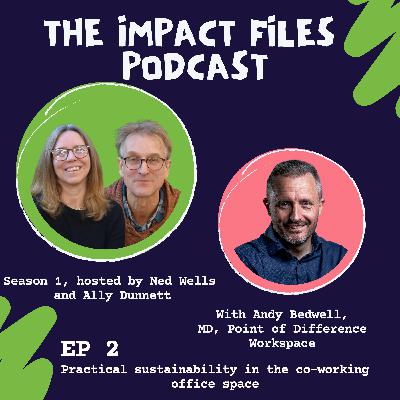
Meet Andy Bedwell, owner and MD of Point of Difference Workspace, the boutique office and co-working business behind some of the nicest places to work in Bicester and beyond. From serviced offices to shared housing, Andy’s built a business that cares about people, place and long-term value.We discuss Andy’s journey from consultancy into property, and how he’s grown the business while deliberately keeping it local, human and design-led.We dig into the realities of making office space more sustainable – from LEDs, insulation and waste contracts to carpet recycling, bat boxes, beehives and bee-friendly planting. We also explore why Andy decided not to go down the B Corp route, and the importance of telling honest sustainability stories without overclaiming.Andy’s 10-year vision for the sector? For it to become a bit like the brewing industry - good quality local operators, connected to their communities and suppliers, although he fears it’ll be mopped up by bigger corporate entities, standardised and with costs driven out.And his one piece of advice for businesses juggling impact and profit? “Understand your landscape. Make a plan. Get on with it. Pick the first thing, do it, then move to the next. It’s not much more complicated than that.”Contact Andy at andy@pointofdifference.co.uk, and visit https://pointofdifference.co.uk/
Welcome to the first episode of The Impact Files - conversations with leaders balancing purpose and profit. In this short episode you’ll hear how the podcast came about and the types of guests we chat with: business leaders working to meet near-term financial needs while creating lasting wellbeing for people and planet.You’ll also meet Season One co-host Ally Dunnett. Ally’s a sustainability consultant with experience in deforestation legislation, responsible sourcing, and an interest in optimising the life of wood products through reuse, repair and recycle. 
Trailer.

Trailer.

2026-01-1402:01

Can businesses balance their short-term financial needs with positive long-term impact on people and planet?And what's the role of marketing, media and communications in all of this? I'm on a mission to find out by talking to business leaders who are balancing purpose and profit.I'm Ned Wells and this is the Impact Files podcast. Join me as I chat with leaders from across business, exploring their personal stories and the leadership challenges of balancing purpose and profit.Here's a flavour of what's coming up in season one.
Comments 
loading