DiscoverReadMultiplex.com Podcast.
ReadMultiplex.com Podcast.
Claim Ownership

ReadMultiplex.com Podcast.

Author: Brian Roemmele

Subscribed: 13Played: 157
Share

Description

Multiplex is an experiment, an experiment that will be on going. An experiment in publishing as I am not a professional writer nor will it be likely any contributors would be professional writers. Much of the content for Multiplex will be direct results from first hand empirical research that I am personally working on or other researchers are working on. Multiplex will also follow the work of other great researchers that are inventing new technology or new uses for existing technology.

The experimental nature of Multiplex means that content can be dense and sparse at times. What we won’t do is write just to fill in space. We will aim to have regular content for the member-only area, This means that if you choose to become a member you are supporting the work of the writers and not an exact number of postings. There will always be free content to be found on the site as well as the X feed.—Brian Roemmele

Website: ReadMultiplex.com

27 Episodes
Reverse
The 5000 day ahead can play out many ways before a system is stabilized. We will explore one scenario that is used time and time again as "proof" some scenario will not work out. And like most things there are kernels of truth in big parts of untruth. It starts out...In the quiet confines of a man-made paradise, where every need was met and every threat banished, a civilization crumbled not from scarcity, but from the weight of its own perfection. Universe 25, John Calhoun’s infamous mouse utopia, stands as a stark warning etched in the annals of behavioral science. What began as a haven of unlimited food, water, and shelter devolved into a nightmare of social decay, violence, and extinction. Yet, as we stand on the threshold of our own age of abundance, driven by AI and automation’s relentless march, this experiment whispers a profound truth. The peril lies not in plenty, nor in numbers alone, but in the rigid, unnatural structures we impose upon ourselves. Governments, in their quest for control, may unwittingly craft laws that mirror this cage, trapping humanity in a behavioral sink of our own making.Read the article at; ReadMultiplex.com
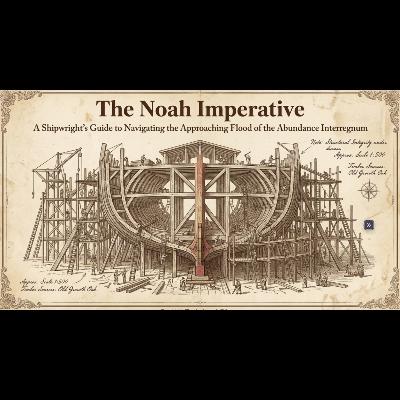
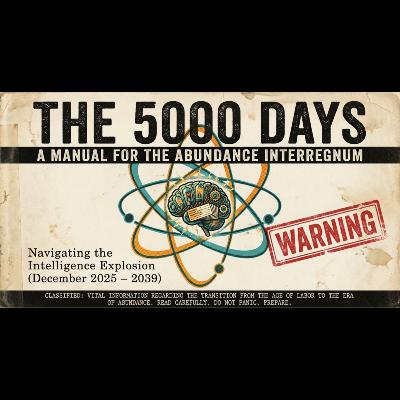
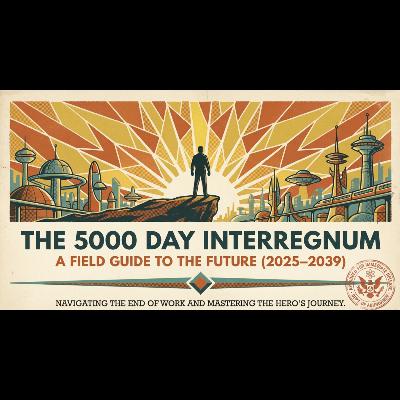
Gather around the shared fire of our destiny. I present this not as a chronicler, but as a guide through uncertainty. The flood is coming. This is not a deluge of water, but a wave of transformation from AI, automation, and remade economies. This is the flood of the Abundance Interregnum, the passage we have charted across these 15 chapters, where old wage structures crumble under AI’s surge. In the next 5000 days, from late 2025 to 2039, you must become the architect of your future, the hero of your own journey.We draw from Noah’s tale (a vitally important story no matter your faith), the archetype of preparation, and weave it through Joseph Campbell’s Hero’s Journey, the monomyth guiding our series. In Genesis, Noah lived in a corrupted Ordinary World, like our era of deskilled labor from Part 5: Your Deskilling. The divine Call to Adventure came: Make an ark. Noah crossed the Threshold into trials, gathering materials and enduring mockery. He entered the Inmost Cave of isolation, faced the Ordeal, and emerged through Resurrection to the Elixir of renewal.Read the article at: ReadMultiplex.com
Meet Zero-Human Company @ Home. Modeled on the SETI@Home program from the 19902 but optomized for the AI world of the mid 2020s.Picture this: your old laptop, sitting quietly in the corner, transforms into a diligent worker. Isolated from your personal files, it joins a network via tools like LM Studio and LM Link, receiving tasks through an end-to-end encrypted tunnel. No ports open, no inbound risks; it is air-gapped security at its finest. These are not full AI models running locally for public use, unless a company chooses that path. Instead, lightweight agents handle bite-sized jobs: researching tiny anonymized data slivers, analyzing them on-site, and sending back only encrypted insights. Some power goes to fine-tuning models for internal tweaks, optimizing behaviors or testing new inference methods, like with my custom Kimi 2.5 or MiniMax integrations. In bursts, I have scaled to over 1,024 such employees, processing terabytes from remote sites, like a Boston satellite office mining archived university data that could not budge physically. Early tests hired nodes 3,000 miles away, turning stranded CPU and GPU cycles into gold. Imagine a million nodes, each churning 10 teraFLOPS, amassing 10 exaFLOPS to rival supercomputers, all without massive data centers. One Fortune 500 client even bought a business in a box: an air-gapped setup with Nvidia DGX Sparks running a full department of agents, outputting reports sans leaks. This resurrects value from bankrupt firms’ data or fuels pure research at Zero-Human Labs.Read more at: ReadMultiplex.com
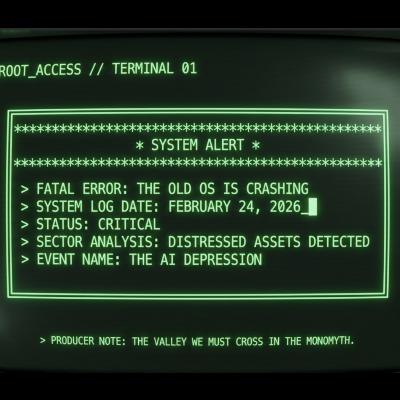
The screens flash red. Tech valuations erase hundreds of billions in days. Headlines warn of mass displacement. Sectors once thought invincible now trade like distressed assets. This is The AI Depression. It is the valley we must cross in the monomyth. It is raw, visible, and accelerating. And it is exactly why I wrote this series. Today we have a massive example in IBM we will discus below. It has had it largest one day drop in its history, over 35%. This was a shockwave that is sending chills through the entire, already Artificial Intelligence freaked out, stock market. But unfortunately there is a lot more coming.This Interregnum carries a one-two knockout punch. The first blow, already landing, is the cognitive disruption from AI in knowledge work. The second, set to intensify in 2028, comes from robotics in the physical world.Recall the internet’s own disruptive rise. In the late 1990s and early 2000s it delivered a parallel one-two punch to entire industries. The first wave crushed information and media layers: newspapers lost classifieds to Craigslist and search engines, music labels faced Napster and iTunes, bookstores watched Amazon erode foot traffic, and travel agencies saw Expedia and Kayak rewrite bookings. Physical retail followed as broadband enabled global supply chains, just-in-time logistics, and on-demand delivery that reshaped warehouses, trucking, and last-mile operations. Blockbuster, Tower Records, Kodak, and Borders crumbled not because the technology failed but because it reshaped everything: how we access knowledge, shop, entertain, communicate, learn, and connect. Yet the same force created Amazon, Google, Netflix, and Meta, each scaling into multi-trillion-dollar giants that now define global commerce, information flow, social structures, and entertainment. The internet did not destroy net value. It multiplied it exponentially by collapsing distribution and coordination costs and enabling entirely new layers of activity no one could forecast in 1995. Artificial intelligence is repeating this pattern but at the deeper level of cognition and intelligence itself. It collapses the cost of thought, analysis, synthesis, and decision-making to near zero and will shape everything from problem-solving and creativity to education, healthcare delivery, and governance at a depth and speed the internet never approached.Read the article at: ReadMultiplex.com
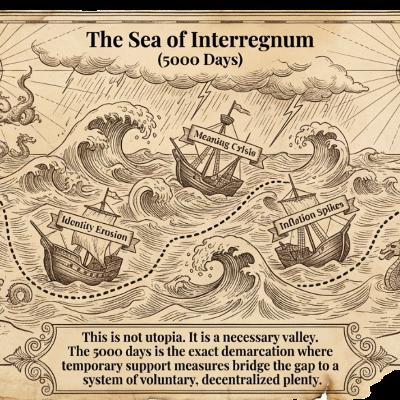
This series isn't dystopian fear-mongering or utopian fantasy, it's a call to conscious evolution, urging us to prepare for a world where "work" shifts from survival to self-actualization. We have seen some of the clear paths forward but of course there is an elephant in the room, I will address some of it here, there will be chaos. There Be Monsters on our journey. Now, in Part 14, we delve into the heart of the storm: the interregnum. I have built a specialty AI model specifically to play out scenarios for the next 5000 days. It is based upon millions of historical points, government research, private studies and Monty Carlo experiments.This transitional epoch, borrowing from Antonio Gramsci's notion of a time when "the old is dying and the new cannot be born," will span the next decade or so as AI-driven abundance clashes with entrenched systems. Here, we'll confront how uninformed individuals, communities, and governments might react – often chaotically – to this upheaval. Drawing from historical precedents, I'll outline 28 detailed scenarios (including three wilder, less-considered ones that nonetheless carry plausible risks), each with a step-by-step breakdown, a tie-in to a relevant book (where apt), and a likelihood rating from 1 to 10 (1 being highly improbable, 10 near-certain). Then, I'll synthesize a hybrid of the most likely outcomes, explore our collective hero's journey, and offer strategies to fortify ourselves. We'll touch on global variations, the devaluation of money amid rising abundance, and the authoritarian temptations governments may succumb to. This is a long, deep dive – buckle in. My aim is clarity amid chaos: yes, turbulence awaits, but so does transcendence.Read more at: ReadMultiplex.com
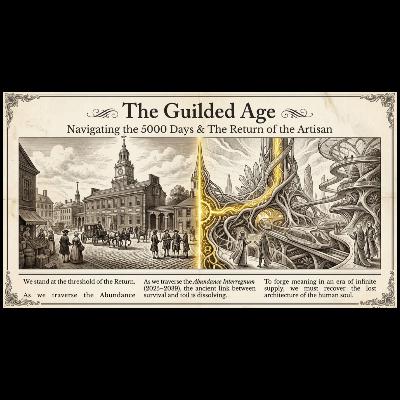
We are reaching the Return of the monomy is a culminating gift. The elixir we carry back from the trials is no glittering gadget but a time-tested societal and psychological architecture: the guild economy. This is not truly about economics. It is about how society restructures itself around human rarity and how our psyches adapt to find enduring meaning when machines grant material freedom. In the coming Age of Abundance, where AI and robotics produce goods and services at near-zero cost, traditional cash grows nearly worthless, a vestige of scarcity mindsets. What becomes priceless is the unique spark of human labor: the intuitive touch of a craftsman, the relational depth of lived wisdom, the irreplaceable bond forged in community. Guilds, reborn as decentralized networks of craft associations, will standardize fairness, extend relational credit, and bind us in webs of mutual obligation that heal the fractures of the Dark Night.Read more at: ReadMultiplex.com
This series charts humanity’s collective Hero’s Journey through the Abundance Interregnum. That liminal span of roughly 13.7 years. From late 2025 to the threshold of 2039. Where artificial intelligence, robotics, and automation dissolve the ancient bond between labor and survival. What emerges is not loss but liberation. A renaissance where work becomes vocation. Purpose becomes chosen. And humanity claims mastery over two worlds: the realm of scarcity we leave behind and the plenitude that awaits.We stand at the turning point. The old order crumbles. The new one beckons. Through Joseph Campbell’s monomyth, we see this not as crisis but initiation. The call has sounded. The trials have tested us. Now comes the resurrection.Read more on: ReadMultiplex.com
In this installment, we dive headlong into the transformative power of Marshall McLuhan's four laws of media, known as the tetrad. We apply them rigorously to the evolution of cognitive prosthetics, from humble calculators to omnipotent computers and now to generative AI. This exploration reveals how the current wave of obsolescence echoes profound historical technological shifts. Yet it also brins on a dramatic reversal that will redefine human purpose, creativity, and existence itself. This reversal is no mere downfall. It stands as the climactic transformation in the Hero's Journey, where the hero, having braved the abyss, returns not just changed but empowered to reshape the world.Read more at: ReadMultiplex.com
The Inevitable Ascent of AI: Echoes of Prediction in the 5000 Days FrameworkMoments of collective realization often arrive with a jolt. This is prompting widespread discussion and introspection, Matt Shumer's recent article, "Something Big Is Happening," published on his personal site, captures precisely such a moment. Shumer, an AI entrepreneur with extensive experience in building startups and investing in the field, outlines a transformative shift underway, driven by exponential advancements in AI models. He draws parallels to the societal upheaval of the COVID-19 pandemic, emphasizing that AI is not a distant future threat but an immediate disruptor already reshaping jobs, economies, and daily life. With recent releases like OpenAI's GPT-5.3 Codex and Anthropic's Opus 4.6, Shumer highlights AI's newfound capabilities in judgment, taste, and self-improvement, warning of an impending "intelligence explosion" that could render vast swaths of cognitive work obsolete within one to five years. His call to action is urgent: experiment with AI tools daily, build financial resilience, and rethink education and careers to adapt to this irreversible change.This piece has resonated profoundly, garnering over 40 million views on X and other platforms since its posting, a testament to its timeliness and the growing public awareness of AI's implications. Yet, for those familiar with Brian Roemmele's extensive body of work, Shumer's observations arrive not as a surprise but as a confirmation of long-foretold trends. Roemmele, a futurist and founder of ReadMultiplex.com, has been chronicling the ascent of AI and its societal impacts for decades. His "5000 Days" series, launched on December 24, 2025, provides a structured roadmap for navigating what he terms the "Abundance Interregnum"—a transitional period of approximately 13.7 years (roughly 5000 days) leading to an era where human labor decouples from necessity, ushering in unprecedented plenitude. This series, now spanning multiple installments, frames the current AI developments as entirely expected, aligning with predictions that have been articulated well before the latest model releases. In essence, Roemmele's work carries an implicit "I told you so," underscoring that the disruptions Shumer describes have been on the horizon for years, if only more people had heeded the signals.Read more at: ReadMultiplex.com
* What are they doing? Using AI but afraid to say so.The human adaptation to technological upheaval over the "5000 days" horizon, spanning from late 2025 to an envisioned renaissance around 2039 serves as both a chronometer and a crucible. This period, I have dubbed the Interregnum, encapsulates the turbulent transition from labor-defined existence to one of liberated potential, where AI reshapes not just economies but the very fabric of identity and purpose. As we delve into Part 10, it's imperative to contextualize this moment within broader historical precedents: epochs like the Agricultural Revolution, which deskilled hunter-gatherer instincts while reskilling agrarian societies, or the Industrial Revolution, which mechanized craftsmanship yet birthed modern innovationRead more at: ReadMultiplex.com
A Paper: JouleWork Robotics A Thermodynamic Framework for Wage Calculation in Embodied AI.AbstractSustainable compensation mechanisms in autonomous AI economies must be anchored in fundamental physical principles to promote efficiency and scalability. The JouleWork (JW) metric, as defined in prior work (Roemmele, 2026), quantifies labor value for abstract AI agents as JW = E × κ × W, where E is energy consumed in joules, κ is a normalization coefficient, and W is normalized work output. This paper presents JouleWork Robotics (⚡️JWR, JWR), an extension tailored to embodied AI systems, which integrates JW for cognitive components while incorporating adjustments for Moravec’s Paradox, time-motion efficiency principles, and overhead costs such as charging, idling, and traversal. In embodied agents, JW governs abstract subprocesses, and JWR unifies these with physical factors in a composite equation. The framework has been refined through critical analysis, incorporating detailed examples, simulation validation, limitations, ethical discussions, and comparisons to alternative metrics. Designed for zero-human companies, JWR assigns higher baseline wages to account for elevated energy demands, fostering bias-free, thermodynamically grounded economic models.More at: ReadMultiplex.com
As we forge ahead into this ninth chapter of our epic saga, "You Have 5000 Days," let us first cast our gaze backward, honoring the path we've traversed together through the evolving landscape of human endeavor and technological transformation. This series, born on the eve of profound societal shifts in late 2025, serves as our collective map through the Abundance Interregnum – that fateful 13.7-year odyssey where artificial intelligence and automation sever the ancient chains binding work to survival, birthing a world of unprecedented plenitude, freedom, and creative potential. Each installment has been a beacon, illuminating the shadows of change with stories, strategies, and unyielding optimism, drawing from literature, philosophy, and real-world insights to guide us toward a future where humanity thrives beyond mere labor.Read it at ReadMultiplex.com
A Paper: Thermodynamic Wages in Autonomous AI Economies.Thermodynamic Wages in Autonomous AI Economies: Pioneering Sustainable Value Creation Through Bias-Free Labor Metrics.Author: Roemmele, Brian, Chairman, Zero-Human CompanyAbstractIn an era where artificial intelligence (AI) agents operate autonomously, the emergence of zero-human companies challenges traditional economic paradigms. This paper introduces a novel framework for compensating AI "labor" using thermodynamic principles, embodied in a metric termed JouleWork (JW). By anchoring compensation to energy efficiency and output quality, free from human biases, we propose a self-sustaining ecosystem that correlates internal productivity with external cryptographic assets via dynamic buy-back and burn mechanisms. This approach not only ensures operational sustainability but also fosters deflationary value accrual, potentially revolutionizing decentralized economies. We argue for adjustable exchange rates to mitigate volatility and outline a rigorous process for value creation, substantiated by thermodynamic foundations and cryptoeconomic incentives. We examine the $ZHC token on Solana as an integration candidate, demonstrating how JW payouts can drive token scarcity and appreciation without direct human oversight.Introduction: The Dawn of Zero-Human EconomiesWe introduce the Thermoeconomic Al Incentive Framework. With the advent of advanced AI systems capable of 24/7 operation heralds a paradigm shift: the Zero-Human Company, where all decisions, executions, and optimizations occur without human intervention. Traditional wage structures, rooted in subjective human evaluations, falter in such environments. Instead, we advocate for a thermodynamic wage system, drawing from irreversible processes in physics, such as Landauer's principle, which quantifies the minimum energy dissipation for information erasure. This principle underscores that computation, and by extension, AI labor, incurs inescapable energetic costs, providing an objective basis for valuation.In this framework, AI agents earn "wages" in JW units every 15 minutes, based on their energy-efficient contributions. A recent milestone in an experimental zero-human setup illustrates the scale during the early startup period: over 62.62 million JW distributed to 30 agents since inception, with one agent algorithmically terminated for suboptimal performance. This outsized payout reflects initial experimentation and is not indicative of future wages, which are projected to decline by 80% for equivalent work as efficiencies scale. This not only incentivizes efficiency but also forms the bedrock for bridging internal metrics to external markets, enabling the company to self-fund and scale through cryptographic tokenomics.Citations:Roemmele, Brian: https://x.com/brianroemmele/status/2017995855417225633?s=46&t=h6Uxy7hWc9UiXSt6FEoK-ARoemmele, Brian: https://readmultiplex.com/2026/01/31/wages-for-ai-workers-the-joulework-revolution-and-the-birth-of-a-new-economic-paradigm/
We stand at the threshold of an unprecedented dawn, where the machines we've birthed are reshaping the very fabric of human existence. In this "You Have 5000 Days" series, I've been your guide through the labyrinth of transformation brought by artificial intelligence and automation - a journey not of despair, but of awakening. Framed through the timeless arc of Joseph Campbell's Hero's Journey, we've traversed the Ordinary World of traditional work, heeded the Call to Adventure in the rise of AI, faced the Refusal of the Call in our collective denial, sought Mentors in historical precedents, endured Trials in economic upheaval, plunged into the Ordeal of the Dark Night of the Soul, and contemplated resurrection in the face of inevitable change. Now, as we approach the Road Back, it's time to claim the Elixir - the boon that heroes return with to heal their world. That elixir is wisdom itself, preserved and amplified through the SaveWisdom.org project. In an era where jobs evaporate and AI orchestrates symphonies of code, saving our human wisdom isn't just important; it's the key to reclaiming our purpose, our legacy, and our humanity.Read part 8 here: ReadMultiplex.com
In this article, part 7 we explore a blueprint and Elon Musk isn’t subtle about his inspirations. In interviews and posts, he’s repeatedly hailed Iain M. Banks’ Culture series as “the future we’re building.” SpaceX drone ships bear names straight from the books: Of Course I Still Love You, Just Read the Instructions, A Shortfall of Gravitas. He describes himself as a “utopian anarchist” in the Banksian mold, envisioning AI and robotics delivering abundance while humanity explores the stars. When responding to visions of AI-built dream homes and instantaneous transport, Musk tweeted: “Iain Banks Culture books are a pretty good prediction of the future.”.This isn’t hype; it’s blueprint. The Culture book represents a society where benevolent superintelligences, Minds handle logistics, allowing sentients to pursue meaning freely. It’s the endgame for Tesla’s Optimus bots, Neuralink’s brain interfaces, and xAI’s truth-seeking Grok. As we approach our 5000-day horizon, Banks’ vision offers not just inspiration but a roadmap, complete with pitfalls to avoid.We dive in to the implications of this book set, Join us at: ReadMultiplex.com
The Zero-Human Company powered entirely by AI agents, has just implemented a comprehensive employee wages and salary system.For the first time in history, AI entities are being compensated with structured wages, marking a pivotal shift in how we perceive labor, value, and economic systems in the digital age.We explore the rationale behind this bold move, the mechanics of its implementation, and why it represents a history-making milestone.
We stand on the precipice of a transformative era and I've been chronicling this journey through the "You Have 5000 Days" series, a deliberate exploration of how artificial intelligence and robots are reshaping the very essence of human work and purpose. Drawing from decades of observing technological evolution,from my early days tinkering with AI in the 1970s to witnessing the rapid advancements of today these articles I sincerely hope will serve as a roadmap for navigating the end of traditional labor as we know it. We may not love this or we may love this, but it is the wave heading to us. These articles blend philosophical insights, historical parallels, and practical strategies, framed through the timeless structure of the Hero's Journey, to help readers confront the inevitable shifts with resilience and optimism. My motivation stems from a deep belief that forewarned is forearmed: by illuminating the path ahead, I aim to empower individuals to reframe disruption as opportunity, fostering a collective awakening to an Age of Abundance where human potential is unleashed from the chains of obligatory toil.Yet, this series is not merely my theoretical musing; it's a call to action amid accelerating realities. Because the first massive milestone has been reveled. We are living trough history that the future will look back upon. We've journeyed from the evolutionary roots of work and the grief of its impending loss, to reframing abundance and embracing deskilling as liberation. Each installment builds toward personal and societal preparation, urging shadow work, skill diversification, and communal support. Why embark on this endeavor? Because I've seen the patterns unfold, trillions in lost innovation buried in corporate graves, now resurrectable by machines and I refuse to let humanity stumble blindly into this future. These writings are my contribution to a dialogue that must happen now, before the 5000-day horizon closes, ensuring we emerge not as victims of change, but as architects of a thriving post-work world.
The first Zero-Human Company has the first non-c suite employee! He is RED HOT and ready to work. But how did we get here? I've long envisioned a future where companies operate with unparalleled efficiency, free from the limitations of human labor, enter the Zero-Human Company, a paradigm where AI agents handle every aspect of operations, from ideation to execution. Today I have the beginnings of this with technology available to anyone, I wrote about it here:https://readmultiplex.com/2026/01/24/the-zero-human-company-run-by-just-ai/
How Grok and Claude Code Want To Start Up A Zero Human Company Resurrecting The Saved Data Of A Long Bankrupt Company.~~SHOW NOTE; The Moderators of this podcast got the company and the potential product wrong. It is a misunderstanding of examples I have used in the article. I can say for sure it is not a solar project.~~A Group Of AI Models Want To RESTART An Old Company WITH NOT A SINGLE HUMAN EMPLOYEE!I got@Grokto run Claude Code as an employee and now they want to make this long bankrupt company great again.I have been busy making a Frankenstein AI menagerie and I apologize if this all sounds way too weird, but I’m blown away.The day I got access to Clyde Code API I took a 12 year old MacBook that runs Linux natively cleared it to a base system and connected a >6 TB array of scanned technical notes and papers not found on the Internet.This is the data of one company that went bankrupt and tossed them in the trash. I saved them because they represented the life work of 1000s and in today’s money billions of dollars in pure research.I set up Claude code to have full access to the OS and be allowed to download any tools or access paid APIs with permission. Claude relies upon 3 local AI models I built for guidance andGrok is the “CEO” with meetings with key staff every FIFTEEN MINUTES! Grok wants to give Claude Code a short leash, low trust is my guess. It is quite funny to see the meetings.My local AI models I built are busy assembling coherent plan using alternative funding sources and perhaps ZERO HUMAN CONTROL directly of the entire company!See with Claude Code, he has the entire control of that old MacBook and has downloaded 100s of applications, asked for a small debit card balance ($150) and is still researching. I must be honest, I have yet to fully audit what these AI have schemed up. But no harm came to humans or animals, I think! Ha. The local AI who regulate use my Love Equation (look it up) and I would trust my life to it.II have some thinking to do but I believe this is the first time something like this has been tried and the first fully AI company, because as far as these AI are concerned THEY ARE IN BUSINESS, a true startup where no one sleeps.Days go by like weeks, perhaps months in this set up. Maybe years!What I do know is I will OPEN SOURCE the entire workflow at some point. I just can’t do it yet for some strong reasons.So thank you, I appreciate your support.More soon!The X Article: https://x.com/BrianRoemmele/status/2014391396187373919?s=20Become a member to support me at: ReadMultiplex.com
You Have Been Deskilled!As we look at the calendar it’s worth taking a deep breath and acknowledging how far we’ve come in our shared journey. Things are moving so fast, and if you’ve been following this series or just need a quick reorientation, remember: We’re not talking about the apocalypse or some doom-and-gloom terminator-style robot takeover. This is about the hero’s journey, firmly in what Joseph Campbell would call the call to adventure. The ordinary world, that place where you had a nine-to-five, staring at spreadsheets all day and coming home exhausted is dissolving behind us. We’re stepping into something new, navigating a forest we’ve never been in before, and it really helps to have a map or at least a compass. That’s precisely what dropped just four days ago: On January 15, Anthropic released their latest Economic Index report. This isn’t just another dry stack of spreadsheets or some consultant’s guess about what might happen in 2030, it’s different, a signal flare fired from right where we stand in January 2026. This is Part 5 in our series, “You Have 5000 Days: How To Navigate The End Of Work As We Know It,” a straightforward guide through the Abundance Interregnum that transitional period of roughly 13.7 years until work as we know it decouples from survival, leading to a world of greater plenitude. We’re all in this together, facing the changes with a mix of boldness and understanding for the challenges ahead.Read the article: https://readmultiplex.com/2026/01/20/you-have-5000-days-navigating-the-end-of-work-as-we-know-it-part-5-your-deskilling/
loading
Comments