


 Claim Ownership
Ship Faster With AI
Subscribed: 0Played: 2
Subscribe

© Morgan Page
Description
Welcome to Ship Faster With AI — the channel for developers, game creators, and indie hackers who want to actually ship projects, not just talk about AI.
Here you’ll learn how to:
Use AI to build apps, games, and tools faster
Turn ideas into shipped products using real workflows
Combine AI with full-stack & game development
Avoid AI hype and focus on what actually works
No fluff. No theory-only content.
Just practical, developer-tested ways to ship faster with AI.
Want to build games with AI, join my skool community here:
https://www.skool.com/ai-craft/about?utm_source=podcast&utm_medium=cta
Here you’ll learn how to:
Use AI to build apps, games, and tools faster
Turn ideas into shipped products using real workflows
Combine AI with full-stack & game development
Avoid AI hype and focus on what actually works
No fluff. No theory-only content.
Just practical, developer-tested ways to ship faster with AI.
Want to build games with AI, join my skool community here:
https://www.skool.com/ai-craft/about?utm_source=podcast&utm_medium=cta
5 Episodes
Reverse
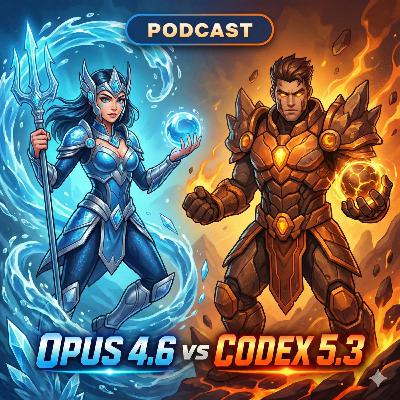
Sponsored by AI Craft - Build Games with AIExplore the transformative capabilities of Claude Opus 4.6, a next-generation AI model from Anthropic that marks a significant leap in autonomous agentic workflows. A primary focus is the model's ability to coordinate multi-agent teams that collaborate in parallel to solve complex problems, such as building functional software or managing engineering departments. Technical upgrades, including a one-million-token context window and enhanced reasoning benchmarks, allow the AI to maintain a deep, holistic understanding of massive datasets and codebases. Practical applications for non-coders are highlighted, ranging from creating "personal software" and complex financial models to executing precise trading strategies with integrated backtesting engines.

Claude Code and OpenCode are leading terminal-based AI agents. Claude Code offers a polished, stable experience optimized for Anthropic’s models (Opus, Sonnet) via a subsidized subscription,. While it recently added Ollama support, it excels within its native ecosystem,.In contrast, OpenCode is open-source, offering "bring your own key" flexibility for diverse models (including OpenAI),. However, accessing Anthropic models in OpenCode is significantly costlier via API since Anthropic restricted third-party access to their subsidized subscription plans,.Both tools share core agentic features like planning modes, MCP support, and skills, though configuration files differ slightly,. Reviewers often favor Claude Code for superior flow and stability ("the Apple of CLIs"), while OpenCode is preferred for model agnostic flexibility and transparency,,.
Clawdebot is a revolutionary, open-source AI personal assistant designed to operate as a continuous digital employee. It functions as an autonomous agent capable of controlling a computer, managing emails, and executing complex coding tasks through simple messaging apps like Telegram or Discord. These sources detail how users can set up the software on local devices, such as a Mac Mini, or via virtual private servers to ensure isolated security. The technology is lauded for its persistent memory and proactive nature, often performing helpful actions like summarizing news or drafting newsletters without being prompted. While users highlight its potential to enable one-person billion-dollar businesses, they also caution about the high API token costs and the ethical implications of such rapid automation. Ultimately, the tool represents a shift towards agentic AI that bridges the gap between static chatbots and fully functional digital workers.
In this episode, we explore the "fire" currently sweeping the developer community following Anthropic's sudden crackdown on third-party access to its Claude models. We dive into why the AI giant is implementing strict technical safeguards to block tools like Open Code from using Claude Pro and Max subscriptions, a move critics describe as building a "walled garden" to enforce vendor lock-in.The discussion highlights the growing "platform antagonism" in the industry, including reports of xAI employees being banned for using the Cursor editor and the perceived hypocrisy of Anthropic's own Agent SDK. While Anthropic moves to "stop the bleeding" of subsidized tokens and protect its ecosystem, competitors like OpenAI, Google, GLM, and Minimax are taking the opposite approach by facilitating access to their models within open-source environments.Finally, we look at the rise of alternative "intelligence layers", specifically how developers are using Anti-gravity and Open Code to bypass these new restrictions and maintain their workflow. Is this a justifiable business decision to prevent financial loss, or a "petty" move that burns developer goodwill?.Analogy:Imagine a prestigious private library that suddenly decides you are only allowed to read its books while sitting in their specific, uncomfortable wooden chairs. Meanwhile, every other library in town is not only letting you take the books home but is also offering you a free cup of coffee just for stopping by.

These sources introduce advanced orchestration frameworks designed to enhance the capabilities of Claude Code for independent developers. The first source highlights GSD, a system that combats context rot by breaking complex projects into granular, atomic tasks handled by fresh sub-agents. This method ensures high-quality output through a rigorous spec-driven development process and consistent verification checkpoints. Meanwhile, the second source showcases the Ralph Wiggum plugin, which transforms the tool into an autonomous agent capable of working for hours without human intervention. By utilizing logic loops and strict success criteria, this plugin allows for the creation of intricate applications through a single prompt. Together, these tools represent a new "meta" in AI-assisted coding, offering structured scaffolding and increased productivity for building sophisticated software.
Comments


Download from Google Play

Download from App Store
 United States