


 Claim Ownership
Science Counterpunch
Subscribed: 1Played: 2
Subscribe

© Philipp Markolin, PhD
Description
Welcome to Science Counterpunch, a short, punchy brand for a YouTube‑first podcast that combines hard evidence, frontline scientist testimony, and rapid rebuttal clips to expose anti‑science influencers and actors while centering science and experts who’ve been targeted.
www.protagonist-science.com
www.protagonist-science.com
19 Episodes
Reverse
Ancient aliens. Lost Ice Age civilizations. Atlantis hidden under the pyramids.Pseudo-archaeology is having a moment—and it’s not just harmless fun.In this episode of Science Counterpunch, we step into the ring with archaeologist Flint Dibble and science YouTuber Kayleigh Dunning to break down how conspiracy history took over the internet—and what it takes to fight back.We talk about the rise of viral pseudo-history pushed by figures like Graham Hancock, why “secret knowledge” narratives spread so easily online, and how social media incentives reward myths over evidence.But this isn’t just about bad history. It’s about anti-intellectualism, harassment campaigns against scholars, and the growing gap between academic knowledge and public discourse.So how do you push back?By stepping into the arena. By meeting audiences where they are. And by showing that our human history is far richer than grifter fantasies want to make you believe.Science Counterpunch is a punchy YouTube-first podcast that exists to defend the Enlightenment in an age of information warfare. We expose merchants of doubt, amplify experts under attack, and arm you with the tools to spot anti-science rhetoric before it spreads.Evidence matters. Reason isn’t optional. Let’s counterpunch.Push back on disinformation and help amplify the voices of scientists under attack - share this episode.Find the full playlist of Science Counterpunch here.Follow, like and subscribe to Sam´s YouTube channel to watch the video recording and not miss any upcoming episode. Any thoughts and feedback? Let us know in the comments!Subscribe for free to receive updates on my work and join the fight for an evidence-based worldview. This is a public episode. If you would like to discuss this with other subscribers or get access to bonus episodes, visit www.protagonist-science.com
You can’t fact-check your way out of a system designed to amplify lies.This week on Science Counterpunch, we’re joined by cognitive psychologist Stephan Lewandowsky to dissect the machinery of modern disinformation. We explore why falsehoods leave a cognitive footprint — and why even highly educated people can fall for propaganda and reason themselves into nonsense.We dig into:* The psychology of “sticky” misinformation* Why intelligence isn’t immunity* How social media architecture supercharges conspiracy thinking* What the EU’s Digital Services Act gets right about platform power* Why democracy depends on “epistemic integrity”* And what scholars can do when autocracy pressures academiaDemocracy runs on shared facts, so what happens when those facts are systematically undermined?We take a hard look at how cognition, algorithms, and power collide — and what it will take to defend reality.Science Counterpunch is a punchy YouTube-first podcast that exists to defend the Enlightenment in an age of information warfare. We expose merchants of doubt, amplify experts under attack, and arm you with the tools to spot anti-science rhetoric before it spreads.Evidence matters. Reason isn’t optional. Let’s counterpunch.Push back on disinformation and help amplify the voices of scientists under attack - share this episode.Find the full playlist of Science Counterpunch here.Follow, like and subscribe to Sam´s YouTube channel to watch the video recording and not miss any upcoming episode. Any thoughts and feedback? Let us know in the comments!Subscribe for free to receive updates on my work and join the fight for an evidence-based worldview. This is a public episode. If you would like to discuss this with other subscribers or get access to bonus episodes, visit www.protagonist-science.com
Protest isn’t radical. Silence is.This week on Science Counterpunch, we’re joined by Colette Delawalla, clinical psychology PhD candidate and founder of Stand Up for Science, for a furious, clear-eyed breakdown of how American science is being dismantled in real time—and why scientists can’t afford to stay “above politics” anymore.From mass purges at federal agencies and frozen clinical trials to banned words lists and regime-sanctioned pseudoscience, Colette lays out how the Trump administration has turned science into a political weapon. This isn’t abstract policy debate: patients lose hope, researchers lose careers, and the public loses protection.We dig into how a single act of defiance—“f**k it, let’s protest”—sparked the first mass mobilization against Trump 2.0, why appeasement by legacy science institutions is a dead end, and what actually works when democracy and evidence are under coordinated attack. Along the way, we talk whistleblowers, organizing under pressure, why “science is apolitical” is a myth, and why bringing white papers to a political war guarantees defeat.This episode is about harvesting anger productively, taking up more responsibility, and drawing lines.If science is a public good, defending it means showing up—and saying no.No neutrality. No appeasement.Just resistance, strategy, and a counterpunch.Science Counterpunch is a punchy YouTube-first podcast that exists to defend the Enlightenment in an age of information warfare. We expose merchants of doubt, amplify experts under attack, and arm you with the tools to spot anti-science rhetoric before it spreads.Evidence matters. Reason isn’t optional. Let’s counterpunch.Push back on disinformation and help amplify the voices of scientists under attack - share this episode.Find the full playlist of Science Counterpunch here.Follow, like and subscribe to Sam´s YouTube channel to watch the video recording and not miss any upcoming episode. Any thoughts and feedback? Let us know in the comments! This is a public episode. If you would like to discuss this with other subscribers or get access to bonus episodes, visit www.protagonist-science.com

This week on Science Counterpunch, we step into the ring with one of the most uncompromising voices in online science communication: Dave Farina, better known as the creator of Professor Dave Explains.Dave joins Sam Gregson and Philipp Markolin for a no-holds-barred conversation about the modern pseudoscience economy: how misinformation spreads, why it pays so well, and how grifters, influencers, and political actors exploit distrust in science for profit and power. From antivax propaganda and flat-earth cults to billionaire-backed “anti-establishment” narratives, we break down how the science denial ecosystem works—and why it’s more dangerous than ever.We dig into Dave’s famously combative style of debunking, the ethics and effectiveness of punching back hard, and whether politeness has quietly helped misinformation go mainstream. Along the way, we talk burnout, audience capture, cult dynamics, algorithmic incentives, and why factual discourse so often loses to flashy lies online.Most importantly, this episode asks a hard question for scientists and communicators alike: if science denial is now institutionalized, what does fighting back actually require—and who needs to get into the trenches?No false balance. No kid gloves. Just evidence, context, and a right hook straight to pseudoscience.Science Counterpunch is a punchy YouTube-first podcast that exists to defend the Enlightenment in an age of information warfare. We expose merchants of doubt, amplify experts under attack, and arm you with the tools to spot anti-science rhetoric before it spreads.Evidence matters. Reason isn’t optional. Let’s counterpunch.Push back on disinformation and help amplify the voices of scientists under attack - share this episode.Find the full playlist of Science Counterpunch here.Follow, like and subscribe to Sam´s YouTube channel to watch the video recording and not miss any upcoming episode. Any thoughts and feedback? Let us know in the comments! This is a public episode. If you would like to discuss this with other subscribers or get access to bonus episodes, visit www.protagonist-science.com
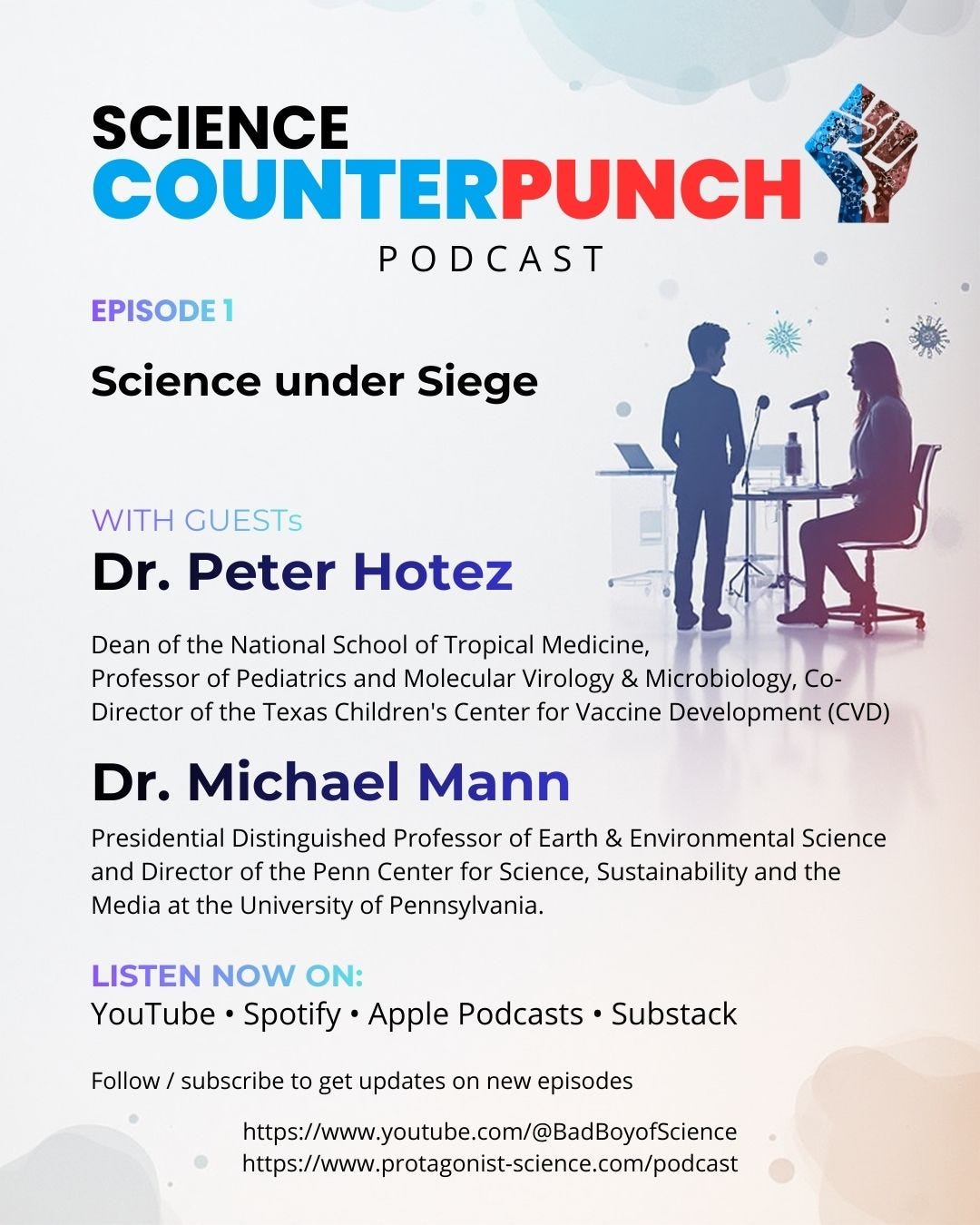
What do vaccines and climate science have in common? The same political actors, media ecosystems, and financial interests have worked to discredit both.In this inaugural episode of Science Counterpunch, Dr. Peter Hotez and Dr. Michael Mann go head-to-head with the modern anti-science machine—petrostates, plutocrats, propagandists, performative media, wellness grifters, and the platforms amplifying them.We break down the tactics: gaslighting, false balance, “freedom” rhetoric, debate traps, and the weaponization of uncertainty. More importantly, we ask what it costs when societies can no longer agree on basic facts.This is frontline testimony from scientists who’ve taken the hits—and refused to stay quiet.If you care about science, public discourse, or the future of evidence-based policymaking, this is one to listen to.Science Counterpunch is a punchy YouTube-first podcast that exists to defend the Enlightenment in an age of information warfare. We expose merchants of doubt, amplify experts under attack, and arm you with the tools to spot anti-science rhetoric before it spreads.Evidence matters. Reason isn’t optional. Let’s counterpunch.Push back on disinformation and help amplify the voices of scientists under attack - share this episode.Find the full playlist of Science Counterpunch here.Follow, like and subscribe to Sam´s YouTube channel to watch the video recording and not miss any upcoming episode. Any thoughts and feedback? Let us know in the comments! This is a public episode. If you would like to discuss this with other subscribers or get access to bonus episodes, visit www.protagonist-science.com
Note: This is a freely accessible serialized version of Lab Leak Fever. Audio voiceover was AI generated for accessibility. Find an overview of all chapters here or consult the book website for further information.“Murderer! Murderer! Smug murderer!” The threatening calls from an unknown conspiracy theorist followed Peter Daszak down the seemingly endless hallway of the US Capitol building. Some of his detractors were trying to get him rattled—any reaction, really—holding their phones to his face so they could blast it out to their followers. Also there: Emily Kopp, working for the anti-biotechnology activist group USRTK. She was chastising Peter for causing trillions in damages to the US, following behind him with a professional camera team recording her monologue. This would potentially be good footage for her next attack piece or possibly a movie. After countless books, op-eds, podcasts, and YouTube videos, the lab leak conspiracy genre was lacking a big-screen cinematic experience; rumors about its production had been circulating for months now.Peter knew it would get bad the moment US Republicans took control of the House in 2022. They had been campaigning as the party of accountability and oversight. A false promise. In reality, they wanted to direct the emotional energy of voters for political gain, whitewashing President Trump’s pandemic failings by using scientists as scapegoats. They also wanted to use the spectacle of public witch trials as campaign events—the offline version of the omnipresent pile-ons from social media. The agitated online mobs had called feverishly for a party that would exert revenge for the trauma of the pandemic, and Republicans were keen to ensure that it was the scientists and their democratic opponents at the other end of that particular pitchfork.Many pseudo-events had led up to this moment for Peter, from the White Coat Waste Project, using Matt Gaetz and Marco Rubio to cascade awareness of his WIV grant towards an irascible Trump, resulting in its unlawful cancellation on live television. The USRTK playbook included decontextualizing Peter’s emails to give ammunition to conspiracy theorists, while the relentless media onslaught about gain-of-function research stoked a moral panic. Then, the “leak” of DRASTIC’s re-interpreted DEFUSE proposal, the supposed blueprint for creating the pandemic virus. Katherine Eban’s hit pieces cast him and Shi Zhengli as the main villains. All of these were an avalanche of events, in addition to his supposed arrangement with Anthony Fauci as the “kingmaker” of grant funding and the many virologists in cahoots circling the wagon.Simultaneously, virus hunting had been demonized as well. Myths about the supposed dangers of discovering viruses were powered by biosafety activists, catastrophizing influencers, and sponsored in considerable part by the cryptocurrency fraudster and effective altruism fanatic Sam Bankman-Fried, who donated millions to various media outlets to write scary existential risk stories about virology. EcoHealth Alliance’s mission was recast as creating the conditions for biological warfare, treated by some commentators as the equivalent of nuclear testing. The utility of virus discovery for research and pandemic prevention was ridiculed. Even Republican senators missed no opportunity to blast Peter regularly in the Daily Mail and New York Post for uploading something as innocuous as a short video of a bat eating a banana. Each time he made the news, allegations against him would be recycled and refreshed in people’s memories. No matter what Peter Daszak did or did not do, no matter if he spoke up or withdrew, the drumbeat continued.The media landscape about him was a bizarre mixture of directed fan fiction and choose-your-own-adventure stories, with multiple co-created narratives about Peter, his role, and his supposed fault mixing, converging, and spinning into ever-new reasons to hate him. His supposed villainy was entertainment at this point, and the third act of his story arc was already prewritten.“Get your popcorn ready, folks,” the House Select Subcommittee on the Coronavirus Pandemic (HSSCP) led by Republican Representative Brad Wenstrup tweeted in June 2023. They all had big plans for the lab origin myth. In early 2023, they were laying out a path for the public shaming of scientists, first and foremost Peter Daszak, his colleague David Morens at the NIAID, and including Dr. Anthony Fauci. The HSSCP and the House Committee on Oversight and Accountability (HCOA) were the main tools for those ambitions.On November 14, 2023, behind closed doors, they pestered Peter with questions for over nine hours. “It is clear that they take it as a fact that we did reckless gain-of-function research,” Peter told me at the time, despite the NIH disagreeing. They also constantly hammered him about his role in the WHO mission and the supposed NIH-sponsored gain-of-function experiment The Intercept had homed in on. And, of course, the DEFUSE proposal, or more accurately, the distorted media version of it. His lawyers had advised him to not argue and contest the many false interpretations of technical details; he would come off as adversarial, and the politicians would blame their scientific ignorance and confusion on him. Rather, he should keep it simple and reiterate that this experiment was not gain-of-function based on the NIH definition and that the DEFUSE proposal was never funded, nor was the work ever conducted. He tried to stick to the advice, but he could not prevent himself from clarifying why certain technical allegations were just false and nonsensical. After the arduous interview, he left uncertain of what would happen next.Then, radio silence.Sometime in March 2024, Peter naively thought that he might not be called in for a public hearing. The vibe had seemingly moved on; the HSSCP was focusing their efforts on giving anti-vaxxers a platform, chastising school closures, lockdown measures, and issuing a subpoena to former New York Governor Andrew Cuomo “to answer for these deadly policy failures.” The usual political clown shows in a heated election year. The rewriting efforts of Trump-era policy failures had apparently shifted towards blaming the Democrats. Perhaps the lab leak narrative was just not that interesting or useful anymore after four years? Some virologists expressed the same feeling; the story was an old and tired trope at this point.They would be wrong.Shortly after Trump defeated Nikki Haley in the primary campaign, thereby securing the presidential nomination of the Republican Party again, the winds shifted quickly. His enablers in Congress focused on getting him elected, mobilizing voters anew. With Trump’s chances of winning the White House against an aging Joe Biden looking increasingly promising, they needed to create momentum for the next Republican policy agenda—an agenda that became known as Project 2025.Briefly, Project 2025 is the brainchild of the Heritage Foundation and other right-wing think tanks. The 922-page conservative policy magnum opus and “mandate for leadership” set out to radically transform the US. It aims to remove a lot of checks and balances necessary for a democratic society, bestowing the executive with unilateral power to implement their agenda and replacing tens of thousands of apolitical bureaucratic positions with pre-screened MAGA loyalists, including in the Department of Justice and scientific institutions such as the NIH, FDA, or CDC. Public health measures and climate action would be virtually impossible under the new regime. It would strip influence and independence from scientific bodies such as the CDC and NOAA (National Oceanic and Atmospheric Administration) and bring them under tight political control. Similar plans have been laid out to remove FDA drug approvals for reproductive health care. Project 2025 is an all-out political assault on US science and institutions. Scientific American quoted Rachel Cleetus, policy director of the Climate and Energy program at the nonpartisan Union of Concerned Scientists, about the Project 2025 agenda: “The independence of science is being attacked across the board in this document.”Such a radical anti-science policy agenda needs many motivated rationalizations to convince ordinary conservative Americans (who remain overall supportive of science) of its appropriateness. The HSSCP and other congressional committees were ideally positioned to create the right pseudo-events for that purpose. Any epic drama starts with a great villain, and the lab leak myth had just the right story ingredients to give politicians what they needed.The HSSCP announced Daszak’s public hearing on social media on April 4, 2024:🚨BREAKING🚨EcoHealth Alliance President Dr. Peter Daszak will testify at a public hearing on May 1, 2024.Dr. Daszak must answer questions about COVID-19 origins, dangerous gain-of-function research, and his relationship with the Wuhan Institute of Virology in China.They claimed that “Dr. Daszak and his colleagues at the Wuhan Institute of Virology used taxpayer dollars to fund dangerous gain-of-function research” and that “mounting evidence continues to show that COVID likely originated from a Wuhan lab.” They urged Peter to come to clarify his statements, insinuating he had “directly contradict[ed] previously uncovered evidence about his relationship with the Wuhan Institute of Virology & his oversight of gain-of-function research.” Throughout April, the HSCCP would ramp up their attacks along the same line. Familiarity. Repetition. What they were missing was novelty. So, what’s the twist this time?The online absurdity reached a tragic peak when scientifically illiterate House representatives started to impose their ignorant interpretation of the DEFUSE proposal upon Peter’s supposed intention, alleging nothing less but a thought crime about a proposal that was never funded and work that was never conducted.Lying to Congress is
Note: This is a freely accessible serialized version of Lab Leak Fever. Audio voiceover was AI generated for accessibility. Find an overview of all chapters here or consult the book website for further information.On March 4, 2023, while doing unrelated research, Dr. Florence Débarre randomly came across a new set of FASTQ files (a text file of nucleotide base sequences) on the GISAID database. Curious, she started investigating. Less than two weeks later, another viral information cascade would ignite the lab leak media universe ablaze again. This time, instead of the usual manufactured pseudo-events and trope-laden stories, a highly relevant scientific discovery supercharged its velocity and exploded in virality. A panic set in within the lab leak community; they were losing control over their viral narrative.Like Stuart Neil, Alex Crits-Christoph, Michael Worobey, and many others, Dr. Florence Débarre, a French theoretician in evolutionary biology, had started out being very open to lab-leak ideas, lauding the efforts and engaging regularly with DRASTIC, Alina Chan, Jesse Bloom, and other lab leak proponents for much of 2021 after the theory went mainstream. She wrote that it is “actually good scientific practice to explore different hypotheses” in response to criticism of Bloom et al.’s Science letter, the one that caused so much grief between Mike Worobey and Kristian Andersen.Florence, an extremely careful and meticulous researcher, had the habit of following up on certain lab leak ideas with investigative rigor. For example, she clarified with a web activity monitoring website that Shi Zhengli’s database of viral sequences “was not suspiciously taken down in September” to hide any sequences. It turns out the database first came online in April of the same year and never worked very well, dropping offline sporadically for months. It remained somewhat accessible until Feb. 2020, when hacking attempts finally stopped WIV researchers from putting it back online for fear of manipulation. Just as Shi Zhengli explained and Jane Qiu reported.Over the years, Florence has single-handedly cleared up about two dozen such falsehoods that the lab leak conspiracy myth cottage industry had made into the lore if my cursory counting is correct. She calls these fact-checks “niche threads” on Twitter, but they dismantled, debunked, and destroyed many lab leak talking points, like death by a thousand cuts.“The lab leak hypothesis survives in part because of poor fact-checking in the media,” she tweeted to explain why she followed up on all these circumstantial niche talking points. However, Florence did not have it out just for lab leakers; the zoonati would face the same type of scrutiny. Peter Daszak, for example, told me that Florence wrote to him countless times to fact-check statements he made in the past, asking whether he had supportive evidence and similar. He wasn’t alone; when Florence wants to get to the bottom of something, she becomes very tenacious and will not stop until she separates fact from fiction.For that, she has earned the respect of fellow debunkers and scientists and, unsurprisingly, has become another arch-villain to the lab leak community. This is because lab leak ideas and talking points tended to fall apart under her scrutiny, while points raised in favor of zoonotic spillover tended to hold up. Reality, on average, is easier to substantiate than made-up fiction. For her independent efforts, the female researcher has been not only severely harassed, smeared, and discredited like the rest of the zoonati she is now lumped in with but also encountered despicable misogynistic insults, stalking, and threats of violence. A high price for somebody who is an extremely private person by nature and avoids the spotlight.When Florence realized in early March 2023 that the new GSAID files she found were metagenomic data from environmental samples of the Huanan seafood market, which Chinese authors from Dr. George Gao’s CDC team had uploaded, she reached out to the Huanan market paper authors around Mike Worobey and Kristian Andersen. They, in turn, immediately started frantically downloading the data, which was about 500GB.“I was pretty convinced that we will probably never see these data,” Dr. Alex Crits-Christoph stated, describing his take on these hectic days and the drama that would follow. “But I have been thinking for over a year what we could do with it if they were ever published,” he laughed about how quickly he reacted. He was the fastest to look at the data. On the same day Florence had reached out, Alex downloaded the metagenomics sequencing data and pretty much worked through the night, looking first at the samples taken from the one corner of the western market where the wildlife stalls had been identified. “I found a full mitochondrial genome of a raccoon dog.” He remembered his excitement over the discovery. “And later that night, I remember bamboo rat and civet popped out as well.” Just as Mike Worobey and his market coauthors had predicted, wild mammals had been at the market, leaving their genetic footprint behind. So, what animals were possibly at the market in late 2019? “The first approach was the mapping to a few possible hosts, quick to see what is in there,” Alex recounted. They wanted to satisfy their curiosity.The next day, Prof. Eddie Holmes contacted a Chinese scientist, one of the few who tried to keep information channels open. To protect the scientist’s identity, let’s call the person Chen. Chen, whom Eddie described as someone “I trust completely” had previously told him that these metagenomics data had been messy, and they sequenced it multiple times. While not being part of the Chinese CDC, Chen had some insights into the sequencing data created for George Gao’s team. Eddie, opening his emails for me, explained how his first intuition was to talk to Chen and tell him that they saw the data uploaded on GISAID. Chen responded very quickly:Dear Eddie,Yes, George [Gao] has asked his colleagues to upload these data. In fact, some of these samples have been sequenced twice or even multiple times. [They] have uploaded all these data, including both SARS-CoV-2 positive and negative samples from the market. You can ask a group member to analyze them independently. I am happy to help if you have any questions.Best wishes,[Chen]That reply had been encouraging to Eddie; Chinese scientists were finally able to share some crucial market data from the preprint they published in 2022. A bit later, Eddie excitedly shared in another email to Chen that they had already found raccoon dog DNA in the environmental samples:As I’m sure you know, [the] most striking observation - which is of huge importance - is the high abundance of raccoon dog DNA/RNA. [...] So, we can now place susceptible animals exactly at the scene at the right time.He received no response from Chen after that. None of them did. Alex Crits-Christoph, Mike Worobey, and Kristian Andersen would all write to George Gao and his coauthors about the data, wanting to talk to them and open a collaboration. But radio silence.Unease set in with the international scientists. Suddenly, “and this was on like day three,” Alex described breathlessly, “the data disappeared from GISAID.” The Chinese authors, or somebody on their behalf, must have asked GISAID to pull it. “That really was pretty spooky, I think. We don’t know exactly what the heck was going through everybody’s mind.”Everybody tried again desperately to contact George Gao, William Liu, and others who had collected the data. They offered to work together on the analysis. However, the Chinese researchers were no longer willing—or able—to reply. Eddie, Kristian, and Mike thought something had to be done to get the data back online. They contacted WHO, which promptly engaged in a quiet meeting with the Chinese CDC about their meta-transcriptomics data.On 12 March 2023, some of us met with WHO and some members of SAGO (the WHO-convened Scientific Advisory Group for the Origins of Novel Pathogens) to discuss our observations. On 14 March 2023, the WHO convened a meeting with SAGO where some of us and representatives from CCDC presented our respective results. [...] This meeting constituted one of several efforts to establish a collaborative relationship with our colleagues at CCDC to share data and findings as rapidly as possible. We acknowledge that these circumstances are unusual.A summary by the authors would be made later. Meanwhile, led by Dr. Florence Débarre, all coauthors were busy analyzing the data and compiling a report for WHO. In another blow, they were all locked out of the GISAID database, which accused them of having breached the terms of use. A scary development.It was right around this time when journalists learned about the existence of these data and the upcoming report. Alex Crits-Christoph assumed that a member of SAGO leaked the information to journalists, but details remain murky. The press, in turn, started circling the scientists, smelling a scoop. Some asked for comments directly. The cat was out of the bag; many other press requests followed, and some of the scientists felt they had to give some statements.When the science writer Katherine Wu from The Atlantic reached out to Alex soon after, he tried to keep his statements general but explained candidly the rough outline of what happened. What they downloaded, what they analyzed, and that a raccoon dog was one of the species they found. He told Katherine Wu that she would be able to see more details in the report they are preparing, which was expected to come out soon.Katherine replied that she was going to publish her story before the report came out. “Oh my God,” Alex recalled. “The rest of the conversation was me telling her that this is a horrible idea.” But according to Alex, the reporter did not want to wait; she “was convinced it was all about the scoop.” In the attention economy, she was under pre
Note: This is a freely accessible serialized version of Lab Leak Fever. Audio voiceover was AI generated for accessibility. Find an overview of all chapters here or consult the book website for further information.“I was always the ‘zoonati’ they could talk to.” Professor Stuart Neil, a virologist from King’s College London, chuckled about his perceived diplomatic role for DRASTIC and some other lab leak proponents. “I intrinsically thought this was an interesting story,” he said, remembering how he became intrigued by various ideas of how SARS-CoV-2 could have come about via a research-related accident ever since the Mojiang miner story blew up in the summer of 2020. Scientists are not averse to discussing controversial ideas; quite the opposite, many are attracted by them. Stuart came across some of the online figures who promoted it, and he thought there “were some people of good faith in this grouping.” He still believes they “were at some point,” but now laments that ultimately, even polite discussion and good faith engagements were made impossible by the emergent group dynamics of increasingly radical believers. “Gradually, that all got poisoned.”Open inquiry and exchange are as important in science as in a democratic society. When my sci-comm colleague Sam and I first interviewed him in November 2021, Stuart had advised us to “avoid people that think they have all the answers.” He was curious about new developments and cautious about drawing hard conclusions. In many ways, his attitude was a good sounding board for some of the more creative lab leak proponents to test their ever-new speculations, at least in the early years.Stuart’s open attitude in this controversy is representative of the free-for-all, evidence-driven approach characteristic of most scientists. He does not care who makes the argument as long as they bring the evidence to back it up. This was always the power and promise of the internet: to prevent group thinking and empower unusual voices to be heard where traditionally they would not get the chance. Stuart enjoyed entertaining alternative scenarios and engaging in good-faith speculations. He might have often been a bit rough on others and undiplomatic when it comes to nonsense, but he would acknowledge if they had made a solid point. Of course, like the rest of us, he migrated between amusement, bewilderment, and eye-rolling about the quality of popular discussion on the topic.However, as the scientific evidence continued to stack up against any type of research-related accident and uncertainty about what wild theories could still be entertained in good faith shrank, the fronts hardened beyond repair. Building bridges to reach lab leak believers became impossible. Eventually, even scientists who had previously established good rapport ended up being considered enemies by the lab leak camp. Soon enough, he found his safety threatened, his private communications FOIA’d, and even his kindergarten-age kids were stalked and doxxed. All for the simple sin of following the evidence.I reached out to Stuart because I felt it was time to tackle the most misunderstood and polarizing element in the whole origin controversy: the infamous furin cleavage site (FCS). What is known, what is still unknown, and what we can learn from it.The FCS is a short amino acid motif in the spike protein that is recognized by furin-like proteases, which are cutting enzymes. It is a dramatic functional element for those various factions captured by the idea that SARS-CoV-2 was somehow created in a lab. It is alleged to be the pandemic’s secret sauce. A trigger that was artificially inserted to turn an ordinary bat virus into the pandemic blight pathogen we have today.Indeed, the FCS is critical in SARS-CoV-2; it increases virality and is required for efficient human-to-human transmission. Yet, it’s almost a mythological force in popular discourse that is entirely based on two misconceptions.First, there is the common misunderstanding that the alleged introduction of a single genetic element has the power to create a pandemic pathogen. Second, and perhaps more importantly, there is deliberate deception about how likely it is that nature or human engineering came up with the nucleotides insertion that led to the FCS we observe in SARS-CoV-2.We are going to have to get a bit technical to address both points. But it will be incredibly worth it to understand, so bear with us.As a molecular virologist, Prof. Stuart Neil was well-positioned to talk intelligently about the nuances of this topic; his research lab focuses on host-encoded antiviral mechanisms, and he has investigated the role of the FCS in that context. Viruses need to constantly adapt to beat immune systems since immune systems tend to evolve to beat back viruses. Stuart’s lab studied how “this evolutionary arms race plays out in the context of HIV1 envelope proteins, so the spike equivalent,” and he elaborated on where he traditionally came from before SARS-CoV-2 entered the scene.The vast majority of enveloped viruses need membrane fusion with a host cell to enter it, which can happen directly at the outside cell wall or after being ingested in a big bubble, also known as endocytosis. Either way, the viral proteins responsible for entering host cells need some help from the host environment.“In general, a lot of them are activated by having a protease cleavage site midway,” meaning our own protein scissors do the deed for the virus. The virology professor used both hands to illustrate how a cleavage site usually liberates a hydrophobic (water-insoluble) part of SARS-CoV-2’s spike protein. This part “burrows itself into the nearest target cell membrane.” Imagine a harpoon ready to fire as soon as the gun ports are opened. In fact, talking about a single spike protein is a bit imprecise because, on the virus surface, three spike proteins are always intertwined, forming a type of trillium flower with three such spring-loaded harpoons that are ready to shoot once liberated by a protease cut. The activating cuts by a human protease prime the viral proteins to launch their invasion into a new cell. But where does this activation happen?For many viruses, the most important part of that cutting activity often happens after the virus is already attached to the host receptor, which would be the human transmembrane protein known as ACE2 for SARS-CoV-2. Once the SARS-CoV-2 virion is bound to ACE2 on the outside of a new cell, a human protease called TMPRSS2, a molecular cutter also embedded in the host cell membrane, activates the bound viral spike proteins via multiple cuts. Then the membrane fusion starts.That’s one way. However, there is another option. For some viruses, such as HIV1 or H5N1 influenza, activating cleavage of their invader proteins can happen even before they leave the production factory, so to speak. Their most critical cutting steps predominantly occur still inside a currently infected host cell, where the next fleet of virions is assembled to start a new invasion.In this “pre-cleaved” scenario, the viral battleships come out, guns blazing and ready to attack. Stuart explained how that could be quite consequential for cell invasion:Not only is the virus going out into the space and then getting activated and breathed out, it’s [also] being able to come out very rapidly and infect the next-door cell, or come out the back end of the cell, and that sort of... makes it go bang straight through that epithelial way.Unfortunately for us, Stuart acknowledged, coronaviruses “live in this happy medium, where they can deal with both [activation scenarios], and that was always a worry.”Coronaviruses can get both pre-cleaved in the factory or cleaved directly at a new host cell’s door. Even worse, Stuart said, “They can be very promiscuous about what protease they allow to do that.” This is where the FCS comes into play. Furin is a protease that sits inside a cellular compartment called the Golgi apparatus, basically the very last station of protein production where assembled proteins get various modifications, such as sugar shields (glycosylation). Having an FCS motif would allow SARS-CoV-2 to get pre-cleaved in the host cell, right on the way out.Why that works so well for SARS-CoV2 is not completely understood and was largely unpredictable beforehand. Virology is complex. However, what we have since learned is that pre-cleavage of spike proteins by furin does two very specific things to SARS-CoV-2. First, it opens up the structure of the trimeric spike protein, which makes it a lot less stable in its 3D configuration but allows for better epitope binding to its host receptor, ACE2. Second, it primes the TMPRSS2 cutting work, making this specific route of viral cell entry through direct membrane fusion faster and favored over alternative entry routes.This matters because it is not only the availability of host cell receptors that define what tissues in our body are most susceptible to a specific virus but also the concentration of activating proteases in the cellular environment. Higher ACE2 and TMPRSS2 co-expression are found in respiratory tissues. These tissues would find themselves especially vulnerable to spike proteins that were pre-cleaved by furin proteases.Think of the whole thing as an efficiency hack. Pre-cleavage favors TMPRSS2-expressing respiratory cells and enhances virion entry via the direct membrane fusion route, ripping open the host cell membranes to deposit the viral cargo inside. The increased fusogenicity at the outer cell membrane has the additional benefit of dodging some intracellular antiviral defense mechanisms that would come into play via endosomal entry, such as virions being chewed up, sliced apart, or boiled in acid inside the endosome. This efficiency hack overwhelmingly favors respiratory tropism and circumvents some of our innate host defense. The end result of the tiny FCS motif in the spike protein of SARS-CoV-2, throug
Note: This is a freely accessible serialized version of Lab Leak Fever. Audio voiceover was AI generated for accessibility. Find an overview of all chapters here or consult the book website for further information.“Disgusting,” he said, ripping me out of my thoughts. He showed me a meme where Zhengli’s head had been photoshopped onto a bat, her face distorted with an open mouth to reveal vampire's teeth, and the whole frame colored in blood red. I shuddered involuntarily. The dehumanization was not subtle. “I really hate what they did with her ears here; it makes her look evil,” Peter Daszak continued with another meme. The haunted British-born zoologist and I sat on a couch in a remote house near Chiang Mai, Northern Thailand, towards the end of 2022. He had pulled up his laptop to show me some of the circulating memes about the “Batwoman” and himself. Indeed, in that cartoonish pop-art picture, the warm Chinese researcher looked like a supervillain, with pointy ears covered by tape, holding bats and releasing a poison virus into the world.Both Peter and Zhengli have found themselves in the middle of a global media firestorm for over two years now; their decades-long work on coronaviruses has become a vital focus of global attention. Speculations and conspiracy myths about their lives and personas had become a cultural phenomenon, and online memes about them were widespread. These visual statements were sometimes artful, sometimes funny, often tasteless, and always closer to propaganda than reality. Peter had saved hundreds of them on his laptop. He pulled up one of the earlier ones, showing him sitting in a chair with Chinese President Xi Jinping in his lap, who was dressed like a stripper and wearing a tinfoil hat. “You can´t help but laugh at some of these, even when you were the one being made a fool of.” Amongst the countless unflattering, libelous, and grotesque depictions, what seemed to bother him the most were the ones fat-shaming him. “That is just tasteless.” He got annoyed. His face had gotten some color back, at least; he had been pale the previous two days. I was still getting to know the zoologist on that trip to Thailand, trying to understand who he was.Until the middle of 2022, Peter Daszak was just a random name for me that I would not have been able to put a face to. I came into the origin discourse in the summer of 2021 after Nicholas Wade’s article rubbed me the wrong way. My science-communication colleague Sam Gregson, a former CERN particle physicist from the UK, wanted to do a podcast about the lab leak hypothesis that we both believed credible and underexplored at the time, as our media ecosystem had told us. We invited DRASTIC member and conspiratorial blogger Yuri Deigin, who already had some internet fame on the topic, to have a friendly chat about the scientific evidence for a lab leak. In parallel, I was writing an article for my blog, trying to make sense of the arguments brought forward in the Nicholas Wade piece, and ending up learning much more about the topic.My writing process includes a lot of reading, and after getting some overview articles on the topic, I usually look into the scientific literature to see what the underlying data for these claims are. I guess this is where my concerns began. I could not find any evidence in the scientific literature that would substantiate any aspect of the various arguments I had read on the supposed “engineered” nature of SARS-CoV-2. On the contrary, many of the oddities that Nicholas Wade or Yuri raised were, in fact, perfectly explainable by available knowledge and scientific papers on the topic. On top of that, I had been working in experimental labs for over 10 years. From CRISPR to Gateway cloning to Gibson assembly, I had hands-on experience with all of these different genetic engineering techniques, partly to construct viral vectors that we used as a delivery method for genetic cargo. So, while not a virologist, I certainly understood the genetic engineering arguments brought forward by lab leak proponents were just plainly naive to outright false. As a science communicator, I thought, “Why not clear up some of these popular misconceptions?” After a few weeks of researching and writing, my blog article was titled “Explained: The hard evidence why SARS-CoV-2 was not engineered,” specifically addressing the RBD and the furin cleavage site, that unusual llama in the supposed flock of viral sheep.That article came out a day before our scheduled podcast with Yuri Deigin, which put me in a position to push back against some of the naive assertions our guest brought forward. Maybe it was this combination of events, or some vocal messages on Twitter being more assertive about SARS-CoV-2 not being engineered, that somehow put me in the crosshairs of the often-faceless lab leak community on Twitter. By this point, I had written dozens of science communication blogs for over five years, but not once had I gotten a hateful comment for it. Now my timeline was overflowing with insults, from the idea that I was a gullible loser, a “sheeple for the official narrative,” all the way to being a shill for EcoHealth Alliance, big pharma, or even China. Certainly not a pleasant experience.I guess instinctively, people deal in different ways when having their honesty and character questioned in public. Some might ignore or disengage; others might feel the desire to correct the public record. I learned about myself that I tended to fall into the latter camp, getting more vocal about what I believed to be the reality of the situation. So, I argued more, wrote more, and investigated the topic more. Sam and I soon interviewed King’s College professor Stuart Neil, a virologist and actual expert who seemed to have some healthy and nuanced takes on the origin controversy—what was known and what was uncertain. Thinking Sam and I might clarify the misunderstandings with more evidence, other in-depth expert conversations would follow. Angela Rasmussen, Kristian Andersen, Michael Worobey, Alice Hughes, Eddie Holmes, and others. With every new piece of content we put out, the scientific picture became clearer, yet the animosity against us only increased.Soon, I noticed—with a mixture of fascination, curiosity, and horror—how we were not alone. There was a pattern. Anytime a new voice would speak up publicly in favor of a natural origin explanation or just for evidence-based assessment of the science, a dedicated group of lab leak influencers and activists would get involved, trying to shut them down or convert them to their cause. If they failed to do so, the lab leak community leaders would start to maliciously quote-tweet—a Twitter-specific way of highlighting someone else’s tweet—with a misleading, discrediting, or ridiculing comment. These quote-tweets, often marked with specific hashtags such as #lableak or #originsofcovid, served as a beacon for their followers to join in the “conversation” with the new voice. They would reinforce the disparaging comment by adding their own insult, thus amplifying it again, over and over. Often, these behaviors would result in so-called “dogpiles” or ”pile-ons”, an argument or attack by a large group of people against one person. Being on the receiving end of such a pile-on can be a disorienting experience because, all of a sudden, a bunch of random people want to fight you like an enemy based solely on an out-of-context tweet or a flippant comment, as well as the less-than-charitable interpretation from the lab leak influencer who highlighted it.Most friends and ordinary people of the target would miss these pile-ons because these did not play out in the feed of the scientists they might follow but in the feed and community of the quote-tweeter, i.e., the lab leak influencer. Only the scientists targeted saw the full spectrum of abuse, while most of the public, not sharing this particular niche ecosystem, would be none the wiser to what had occurred. Scientists and journalists, especially those with only a few hundred followers, would be mostly helpless against the malicious narratives created about them in the lab leak community. They had nobody to speak up or defend their character because nobody even saw what was happening to them. They had no course of action because speaking up for themselves just created more activity, more harassment, and more abuse in the opposing community. Many contemporary scientists went through this “treatment” a few times before deciding it wasn’t worth the hassle, leaving the social media platform entirely. Eddie Holmes and Kristian Andersen deleted their accounts. Others became very selective and self-censored, not speaking out publicly about this toxic topic anymore. The exodus of reasonable voices on the topic, in turn, ceded even more discourse space to the activists. On top of that, the shrinking rational voices remaining in the conversation just became bigger targets for activist communities that seemed to relish in the act of verbally abusing their “enemies” together on a daily basis. A little community ritual, often unprompted by any specific action or offense. Every single day, they just looked for somebody to fight and hate for hours on end. Because of these asymmetric bullying dynamics, even a relatively small science blogger—too stubborn or maybe even too truculent to be silenced by these mob tactics—would suddenly gain a much larger role in the minds of conspiracy theorists. I’ve lost count of the number of pile-ons my words have caused over the years.Peter Daszak pulled up the next meme, this time showing both him and me together, arranged in a weird, convoluted homage to “The Godfather” movie. It portrayed Dr. Anthony Fauci as the “godfather of gain-of-function research,” Shi Zhengli as the “cook,” and some prominent scientists like Peter Daszak, Kristian Andersen, Angela Rasmussen, and Stuart Neil as the “lieutenants” of the alleged “research crime cartel.” At the bottom, t
Note: This is a freely accessible serialized version of Lab Leak Fever. Audio voiceover was AI generated for accessibility. Find an overview of all chapters here or consult the book website for further information.Independent and interdisciplinary science is important. When evolutionary virologist Michael Worobey, a professor at the University of Arizona, got involved in the search for the origins of COVID-19, he had no idea what he got himself into. With a “soft spot for wild theories,” at least according to a former colleague, and a track record of tackling hotly debated theories around dangerous viruses, the renowned scientist is a force to be reckoned with. NPR even called him the Sherlock Holmes of origin investigations for his work on identifying the origin of HIV by hunting for chimpanzee samples in Kisangani, Eastern Congo. A dangerous trip where Mike developed a life-threatening infection after he injured himself and where his mentor, Bill Hamilton, contracted malaria. Only one of them survived. Yet it was critically important work. Mike’s field sampling and phylogenetic analysis, together with that of Prof. Beatrice Hahn, was instrumental in debunking the widely propagated notion that HIV came about from a contaminated polio vaccine trial in the 1950s. They discovered that HIV had its origin decades earlier, before the turn of the 20th century, and was spawned by at least four separate human-chimpanzee contacts that seeded the outbreak near Kinshasa (called Leopoldville in colonial times) and would spread for decades before it was recognized scientifically in the 80s by making people sick in Los Angeles in the US. Based on Worobey’s data, they reasoned that somewhere around 1910, HIV-1 emerged in humans during a period of rapid urbanization and demographic change (Leopoldville was the largest city in the region at that time) and thus was a “likely destination for a newly emerging infection.”In a 2022 podcast conversation with Kristian Andersen, the YouTube science communicator Sam Gregson, and myself, Mike recalled how he had been frustrated by the inconclusiveness of the WHO mission report. The WHO mission opened more questions about the origins that it answered, or at least that had been his impression given the media environment. “I never had a moment where I thought the furin cleavage site needed a non-natural explanation… As an evolutionary biologist, evolution can certainly deal with that pretty aptly,” he explained where he came from. “What was a bit of a curveball to me is that quote here: ‘Market authorities have confirmed that no illegal trade in wildlife had been found’” he elaborated on a different occasion, explaining why he grew hesitant about the market hypothesis.At the time, he was unaware of the struggles the WHO mission had in getting their Chinese counterparts to admit to wildlife being sold at the market. “I have been amongst the most open scientists to this idea that at least some form [of] a lab incident, maybe even with a virus that has not been characterized by the lab, could have infected someone,” Mike Worobey admitted. “So, I sort of initiated this fateful letter in Science magazine.” Mike reached out to virologist Jesse Bloom, a well-known lab leak proponent on the origin question, to organize the letter titled “Investigate the origins of COVID-19” to the journal Science (published in May 2021). They, along with 16 other authors, such as Alina Chan, Ralph Baric, and David Relman were arguing for giving the lab leak theory a “proper” investigation that should be objective, transparent, data-driven, and “subject to independent oversight.” The letter to Science made a lot of waves internationally and contributed to the vibe shift that legitimized the lab leak theory, ultimately prompting the Biden administration to start their 90-day intelligence investigation.Despite giving the impulse, Mike was not involved in drafting the wording of this letter, which came out way more accusatory of China, specifically Shi Zhengli, than he was comfortable with and retrospectively regretted. “That letter then took on a life of its own,” he recalled. All he wanted was to give the origin investigation another look. “I was pretty naive about how that letter would land,” he said with chagrin. “I should not have been and regret the tone.” Politics aside, Mike was a man of his word and no-nonsense scientific rigor. Evidence mattered to him, not political implications. The lab leak community was energized by believing scientists of such a caliber were now on “their side.” Mike was celebrated as a hero. However, soon enough, his work would become a target of their ire, and he would be cast as the greatest traitor to their cause.Like any good scientist worth their salt, Mike set out to poke holes into the natural origin hypothesis, starting by trying to falsify the outbreak association with the Huanan seafood market in Wuhan. Wuhan is a huge place, one-and-a-half times the size of the five boroughs of New York City. “It has a whole lot of places where you might notice the first cluster of a respiratory infection,” he said. “Think about all the places where it could have emerged if it did not start at the Huanan market. We have to think about what are the chances it would pop up there?” That would be a remarkable coincidence indeed. If one were to make the case for a lab leak, that wildlife market and the early patients associated with it had to be explained somehow. Was the market maybe just an amplifier event? Did the Chinese authorities just look there preferentially but not in other places in Wuhan? How did the doctors decide which patients to test for COVID-19? If market affiliation was a criterion for testing patients, then maybe the patient association with it would be a mere mirage, something called ascertainment bias.These are all scenarios that could potentially explain why the case epidemiology looked like the virus came from the market when, in fact, it might have come from somewhere else entirely. After all, in the wake of SARS, China had set up an early warning and reporting system for detecting unknown viral diseases, which kicked in on January 3rd. This system might have led to an undue focus on the Huanan market. “There is, however, a way to step back to a period before any such bias could have crept in, by considering what happened in the hospitals that first pieced together that a new viral outbreak was underway,” Mike would state in his paper titled “Dissecting the early COVID-19 cases in Wuhan,” published in Science in late 2021.“I was focused, largely by myself in my basement, for month after month after month at what is going on in Wuhan spatially,” Mike explained how he spent his summer of 2021. Not only did he analyze the WHO mission report and all the scientific papers in Western and Chinese journals, he was also “reading news reports [and] digging of the web archive [for] some of these reports that had gone out by Chinese public health officials before the national authorities even knew the pandemic.” In the quiet of his isolation, following up on every single patient’s history and how, when, and where they were diagnosed, he reconstructed what happened.On December 27, Dr. Zhang Jixian, a clinician and respiratory specialist at the Hubei Provincial Hospital of Integrated Chinese and Western Medicine (HPHICWM) near the Huanan market, noticed characteristic lesions in CT scans of the lungs of two pneumonia patients that reminded her of something she had seen almost two decades ago. The patients were a couple brought in by their son, who looked “ostensibly healthy.” Nevertheless, she asked him to also do a CT scan, and sure enough, his lungs were full of lesions as well. Lesions she had seen before—with SARS. “At that point, she figured it was probably related to SARS and that it was transmissible to humans because it had infected all three members of the family,” Mike explained.She also realized that patients could be potentially asymptomatic, running around and spewing the virus all over the place. From that point forward, she paid attention, and while the initial three patients did not have an association with the Hunan market, the next four patients who came to her hospital with the same symptoms all worked at the market. “At that point, on December 29th, she and the administration of her hospital got in touch with municipal and provincial health authorities.” The hospital administrators called other hospitals that were not close to the Huanan market for pneumonia of unknown etiology patients; it turned out that most of their patients were also linked with the market. The Hubei Provincial Hospital “identified both the outbreak and the Huanan Market connection and passed on these fully formed discoveries to district, municipal, and provincial public health officials by 29 December,” he concluded. They were not the only ones. Mike would write in his paper:A notably similar situation unfolded at Wuhan Central Hospital. On 18 December, Ai Fen, director of the emergency department, encountered her first unexplained pneumonia patient, a 65-year-old man who had become ill on either 13 or 15 December. Unbeknownst to Ai at the time, the patient was a delivery man at Huanan Market. [...] By 28 December, Wuhan Central Hospital had identified seven cases, of which four turned out to be linked to Huanan Market. Notably, these seven cases, like those at HPHICWM, were ascertained before epidemiologic investigations concerning Huanan Market commenced on 29 December.These findings are important because they highlight how the unknown pneumonia cases before the 29th of December were independently picked up by various hospitals. The market link became known only after, thus dispelling any notion of “ascertainment bias” being responsible for the diagnosis or discovery of SARS-CoV-2 patients. So, while Mike had set out to disprove the market theory, he dramatically strengthened its case. Many
Note: This is a freely accessible serialized version of Lab Leak Fever. Audio voiceover was AI generated for accessibility. Find an overview of all chapters here or consult the book website for further information.A river of black drew a line through the darkening sky. Above the silver and gold ornaments on the pagoda’s crimson roofs at Wat Khao Chong Pran, the river flow turned southeast towards the fields. Rationally, I knew that the cave housed around two and a half million horseshoe bats, but observing a seemingly never-ending flood of hectic creatures fly out for more than forty-five minutes, I realized that I never truly appreciated just how many bats share the world with us.How little did we know about them? Physiologically, bats are extraordinary; they can speed up their metabolism 16 times, creating immense heat that would denature our proteins and fry our cells. A bat’s heart can beat up to 1,000 beats per minute, but it can also slow down to 6 beats per minute during torpor, a type of short-term hibernation. During a nighttime flight, its body temperature can rise to 42°C (107.6°F). Some species tend to live up to 40 years in vast, dense, and diverse colonies, which makes them uniquely suited as hosts to almost all viral families that befall mammals. However, bats do not appear to get visibly sick, and scientists cannot tell their age past adolescence. They have unique immune systems, which we do not yet understand, that do not overreact to viral infections.There are around 1,500 described bat species that have emerged from their last common ancestor over 60 million years ago. Because they are the only flying mammals, we conceptualize them all together under the umbrella term “bats,” as we do with “fish” in the sea. But based on genetic diversity, that simplification is rarely adequate. It feels like the equivalent of lumping giraffes and cows together with dolphins and whales, all of which diverged from a shared common Artiodactyla—even-toed ungulate—ancestor about fifty million years ago. It’s hard to justify thinking of them as the same, so why do we do it for bats?It is not an exaggeration to claim that bats come in almost all sizes, shapes, and forms, from the thumb-sized Craseonycteris thonglongyai—also known as the bumblebee bat, weighing just 1.5 grams and holding the title of smallest mammal on earth—to various majestic flying foxes with wing spans of over 6 feet, close to two meters. Some fruit bats look almost like dog puppies you’d want to cuddle and take home, while others might appear as if they’ve escaped from a horror movie production.The black river of horseshoe bats over my head would probably come closer to the latter for most people. We humans tend to be afraid of what we do not understand. These horseshoe bats are smaller insectivores (insect-eating bats) who get their name from the weird horseshoe-shaped disfigurement where their nose should be. Intuitively, we humans find them rather ugly—I was no exception, at least at first. I think this is partly because we assume their faces are weirdly deformed, like a fully cleft palate, rather than what they truly are: optimized. Horseshoe bats belong to a group of bats that echolocate—send out and receive sonar waves—primarily through their nostrils. Other bats rely primarily on their mouths. These varied shapes and forms in the middle of their faces, however, have intricate functionality for shaping their calls, impacting not only orientation but also their feeding and social lives, too.Given their enormous diversity, maybe it is not a surprise that bats exist in almost all variations of social structures, from eremites who don’t want to bother with others to ones who live in small family groups, villages, or even multicultural megacities. Some like to mingle with other bat species, while others are territorial and of the “get off my lawn” persuasion, with threatening grunts, fletching teeth, and all. These horseshoe bats flying overhead were not only mixing and mingling cosmopolitans; they are also the species we know today to most prominently carry SARS-related coronaviruses, close viral cousins of both SARS-CoV-1 and SARS-CoV-2 that have caused havoc in our human world.Does this imply that an ancestor of SARS-CoV-2 came from bats, too? Most scientists believe so. Yet ordinary bat viruses usually do not infect humans or transmit well between humans, and they are certainly unable to cause a pandemic. Something seems to be missing from our understanding, and I believe the intricate social lives of bats might hold the first valuable clue. But to get there, we have to understand some rather technical details of what makes SARS-CoV-2 so extraordinary in the first place.Since its emergence, it has been a confusing virus for a lot of reasons. First, a novel virus is very infectious to humans and spreads effectively between them via the respiratory route. Second, it does not cause severe disease in every patient, is sometimes asymptomatic, and is subsequently hard to track. Third, side-by-side comparisons to known SARS-related viruses seem to show that the SARS-CoV-2 virus is a chimera. It has some parts with very high genetic similarity to other bat coronaviruses and other parts with low genetic similarity. On top of that, the virus has smaller but important genetic oddities, such as a novel human ACE2-receptor binding domain (RBD) and what looks like an insertion of a polybasic cleavage motif in its spike protein gene. In humans, this polybasic motif gets recognized by a protein-cutting enzyme named furin; that’s why it is better known today as the “furin cleavage site,” or FCS for short. Especially the chimeric genome, the occurrence of an FCS, and the seemingly “human-adapted RBD” gave researchers a hard time wrapping their heads around the novel virus in early 2020. Almost nobody had seen this combination of oddities before, albeit Eddie reminded me later that HKU1, a betacoronavirus from animals, also had an FCS and spread quickly among human. But SARS-CoV-2 was odd enough that even experienced virologists such as Kristian Andersen, Robert Garry, and Eddie Holmes would be driven to sound the alarm of suspicion in the murky weeks of early 2020. So, what chance did mere citizens have to make sense of the genetic intricacies of this confusing virus or assess what they mean by its origin? Especially when there is so much misleading information about them.“It’s like a cow with deer’s head, rabbit’s ear, and monkey hands,” the bioweapon influencer Scarlett had dramatically announced these confusing features of the virus to Fox News anchor Tucker Carlson and his millions of listeners. A very false abstraction, sure, but with a kernel of truth. SARS-CoV-2 was a genetic chimera, as best scientists could tell. Its genome was made up of separate parts, like a mosaic. As the pandemic went into full swing, multiple man-made theories of varied quality were advanced on how SARS-CoV-2—and its odd genome—possibly came to be. From bioweapon development to gain-of-function research, construction from Shi Zhengli’s RaTG13 bat virus or de-novo genetic engineering to the alleged introduction of HIV sequences, from serial passage through human cells or “humanized” mice to arcane vaccine experiments, many asserted that some type of human manipulation was necessary to explain how this dangerous patchwork virus of high and low sequence similarities to other coronaviruses came about. The virus simply looked stitched together. Some of these early Frankenstein virus narratives still resonate today in public discourse and the halls of Congress. What unholy forces shaped SARS-CoV-2 into the pandemic pathogen that plagued the world? Was reckless gain-of-function research on its bat cousins indeed the culprit, or are Nicholson Baker’s “flask monsters” a mirage conjured up by fretful imagination?As the geopolitical stalemate provoked by elites ground the international search for the origin of the pandemic to a halt, investigative journalists in the US pursued a more human-centered agenda. Believing they were on the trail of something monstrous—a potential gain-of-function virus cover-up at the highest levels—they put “Big Virology” and its government funders under the microscope. Especially the NIH, the NIAID, and its head, Dr. Anthony Fauci, as well as Peter Daszak, EcoHealth Alliance, and their collaboration with WIV—all long marked as targets by conspiracy theorists and anti-science activists—would find their every word questioned, their emails, communications, documents, and records FOIA’d, leaked, demanded by Congress, or otherwise requested.Leading the charge among them was The Intercept, a news organization covering national security, government secrets, politics, and international affairs founded by journalists that NSA (US National Security Agency) whistleblower Edward Snowden leaked his documents to. Distrustful of the government, The Intercept released documents of a 2014 research grant named “Understanding the Risk of Bat Coronavirus Emergence” in early September 2021, claiming it provided evidence that the NIH and EcoHealth Alliance had funded dangerous gain-of-function research in Wuhan in the past. It was a dramatic allegation, given that Dr. Anthony Fauci had just had a heated exchange with Senator Rand Paul in Congress, who accused the head of NIAID of “financing gain-of-function research” in Wuhan. The Intercept reported that during this multi-year project, Peter Daszak and Shi Zhengli had worked to:Examine the risk of future coronavirus (CoV) emergence from wildlife using in-depth field investigations across the human-wildlife interface in China, molecular characterization of novel CoVs and host receptor binding domain genes, mathematical models of transmission and evolution, and in vitro and in vivo laboratory studies of host range.These experiments—especially the last part, some of the in vitro (using cell culture) and in vivo (using model animal
Note: This is a freely accessible serialized version of Lab Leak Fever. Audio voiceover was AI generated for accessibility. Find an overview of all chapters here or consult the book website for further information.Heavy breaths followed a claustrophobic chase around the hotel room. Peter Daszak was doing his workout run from the showers through the bedroom to the antechamber and back, again and again and again. The Chinese hosts in Wuhan had placed him in quarantine for two weeks, and the pressure, isolation, and restrictions were difficult to deal with at times. He was an outdoor person. Twice daily, a team in full hazmat gear would knock on his door to take his temperature. “It really makes you feel dirty. Contagious,” he remembered thinking. He was not the only one.Marion Koopmans was two rooms away. “It was amazing; they were so strict. I really thought, ‘Okay, this is how plague victims must have felt.’ You really felt like contaminated waste, almost.” She showed me photos she’d taken at the time. “It’s dystopia; they have made a plastic corridor for us.” Plastic sheeting completely covered the hallway from top to bottom. They were sampled as per instructions: 5-second swabs and not a millisecond less. Everyone was suited up except them. Warning signs and restriction bands were everywhere. China had been COVID-free for months. She just hoped she would not get a fever from anything else because it was not clear what would happen if she did. And yet, they, along with eight other international experts, were finally there, where it all happened. “We had been asked before to be quiet about where we would go before,” she laughed, “then we landed in China and had an escort everywhere and a charade of media following us.”Peter Daszak and Marion Koopmans were two obvious scientists to reach out to when the WHO was assembling a mission to Wuhan in January 2021. Peter, the British zoologist, and head of the non-profit EcoHealth Alliance, had worked for decades on understanding viral spillover from bats, identified the origin of SARS with Shi Zhengli from WIV, and worked together with various emergent disease collaborators all over the world. He would be on the WHO’s animal and environment working group, trying to make sense of what happened at the Huanan market.I did not particularly want to serve. It irritated me. My big grant was canceled by Trump, and we went through months and months of misery. And I thought, “Why the hell should I help WHO? Doing the work that we should be doing for them?” That just seemed cruel, and then I am asked to volunteer for them?On the phone, he told Peter Karim Ben Embarek, who had assembled the mission, that he didn’t want to do it. On top of that, his participation would invite terrible political attacks on the WHO. Embarek just replied, “What’s new?” The WHO has been under attack on a daily basis; he naively believed it wouldn’t matter. Then, the WHO mission chief reiterated the enormous significance this work would have for the world. After some back and forth, Peter said that he would be available to the group, but he did not want to do fieldwork. “Ben said okay, but he did not take this as an answer; he kind of treated me like I was on the team.” Peter shrugged at how he ended up on the mission. The WHO team knew what they were doing and why they wanted him. “They wanted access to Chinese scientists, not just [because of] the lab issue, but because George Gao and the Wuhan Institute of Virology were investigating the outbreak… so the WHO needed somebody close to them.” Reports suggested that Beijing had indicated he would be a good person to have on the team. As best I can tell from Embarek’s comments, the suggestion came from Shi Zhengli herself. “It’s obvious if you got a researcher who you’ve been working with for 20 years who has not ripped you off, who had been honest with them,” Peter explained the likely rationale. It is worth retelling how Peter came to be on the WHO team because many conspiracy theorists claim that he inserted himself purposefully to aid in a possible cover-up. His email records with Ben Embarek tell a much different story: one of hesitation and duty. Until October, he still did not want to go to Wuhan.It was only on our first call when I saw the list that I had to begin to consider it. Fabian Leendertz was there, and a bunch of other people I had heard about. It was a very impressive team. Marion Koopmans was there too, and she is fantastic.After that first video call, he decided to commit to the mission.In the end, you just get carried over by the feeling of duty. This is what a scientist is supposed to do. If the outbreak of a global pandemic happens to be from a virus family you have been working on for years in the place you have been working, probably from the animals you have been working with, of course you should be sitting on that committee, trying to do everything you can.The Dutch virologist Marion Koopmans, who was scanning me with a gazing look behind sharp spectacles and white, spiky hair as she listened in on our conversation, agreed with that sentiment. She has investigated countless outbreaks in her career. She had started with noroviruses, hepatitis A virus, bird flu, and arboviruses. During the Ebola outbreak in West Africa, she was responsible for the deployment of mobile laboratories in Liberia and Sierra Leone. One would be hard-pressed to find anyone more knowledgeable and experienced to study novel outbreaks. She was very quick and to the point. “Every virus, and with it every outbreak, is different,” she explained. However, “with every spillover, you have a couple of key questions.” Hospital records, patient samples, and molecular and sampling data tend to be spread out over multiple locations, times, and people. Her job was to make sense of it. For her, the WHO reaching out and wanting her on the team was “the honor of a lifetime.” She did not hesitate to say yes.“I was leading the molecular epidemiology interaction. That collaboration actually was nice." She lauded her team and the Chinese collaborators. They basically had to figure out, from all the available data, which person, which genomic sequence, and what time. Putting that puzzle into place was challenging. The team made recommendations for analysis, and the Chinese side actually had scientists performing the work in real-time. “I think this group was maybe the least political because what you could do with genomics was not clear yet,” she laughed wholeheartedly. Indeed, the early epidemiologically linked sequences her team helped to establish and verify would hold incredibly important clues to the virus’s origin.She was not a fan of the simple narrative that took hold that the Chinese were not sharing data with them. “Yes, there can be more transparency, but look at all that was shared.” She continued, “It was remarkable. There were no agreements in place. If somebody came to us and said, ‘Give us all your hospital and patient data,’ there is no way this would work.” Yet, as she says, the Chinese scientists tried hard to make much of it work.That does not mean everything went smoothly, either. The WHO mission had two delegations: one of international scientists and one of Chinese scientists. The latter was constantly monitored and assisted by members of State Security, Foreign Affairs, and translators. “It was clear it is going to be this China-style process—you have these meetings where there is the director’s director, the director, the subdirector, and blah-blah—and everybody has to say something, and only then can you get to business.” Marion rolled her eyes. Working day and night analyzing data and being on group calls and meetings while in quarantine had been a strain, but their schedule afterward would not be much easier. The first two days out of quarantine, January 29th and 30th, they visited the Xinhua Hospital to interview doctors and staff and learn about patients.There was the obligatory political visit to the “Anti-Epidemic Exhibition Hall,” a memorial to the “heroic” actions of Chinese authorities in defeating the virus in Wuhan. Like in my interview with George Gao from the Chinese CDC, their Chinese hosts felt it was incredibly important to stress to foreigners how well they handled the outbreak. Peter Daszak showed me some footage he shot with his phone, and it was every bit as red communist propaganda as one might imagine. Life-size statues of doctors in various poses, heroic background music, and testimonies running on screens about the greatness of the leaders winning the war against the virus. Not exactly subtle. However, he still found it to be “really moving.” That was the point. The Chinese authorities wanted to convince the WHO mission, as well as the world, of a different perspective on the outbreak. Not of failure, blame, and death, but of heroic strife, folk bravery, and overcoming the odds. China had been COVID-free for many months, while the US and other countries were suffocated by the virus. Doesn’t that show Chinese superiority?Any hubris that they might have signaled fell short of reality when the WHO team arrived at the next stop.On January 31, 2021, more than a year after the outbreak emerged from there, the WHO mission finally visited the Huanan seafood market. “You walk into a dark hall; it is smelly. It still had white patches of disinfectant powder. It was eerie, like ground zero.” Marion Koopmans lent me her eyes for this visit. She found it really impressive to be there. “There were these assumptions that, oh, this was a very modern market… This idea went out the window fast,” she elaborated.“This was a wet market like any other I have ever been to,” Peter Daszak concurred. It had a mix of seafood, vegetables, restaurants, and live animals, all “stacked on top of each other; cages, freezers, [and] tools to move or process animals.” It was not that different from many other wet markets in China and Southeast Asia. Dominic Dw
Note: This is a freely accessible serialized version of Lab Leak Fever. Audio voiceover was AI generated for accessibility. Find an overview of all chapters here or consult the book website for further information.“They got a police escort to get us shoe shopping, and I basically wore a wedding dress… There are even photos in Pakistani newspapers… and I just thought, if I can give a talk wearing this, I can give a talk in anything.” Alice Hughes laughed wholeheartedly while I shook my head in giddy disbelief. It was a good day, which we both needed. She vividly recalled how she was culturally ambushed by her hosts on a day she was supposed to teach a course about spatial ecology in Pakistan in 2012. They needed her to put on a blue sari robe and traditional women’s shoes, which they could not find for her size anywhere in the city, despite chaperoning her through six shoe shops with a full police escort. This only came up because I had asked the renowned bat huntress about the most uncomfortable situation she had ever been in. She offered me this anecdote as an answer, which was telling in more ways than one.Dressed in worn-out hiking shoes, a light jean shirt, and carrying a massive backpack, the 38-year-old professor sitting in front of me looked slightly out of place for a posh cafe in Zurich. She was a member of the university faculty in Hong Kong, and she has done her best to break any stereotypes one might have about ivory tower academics and women in academia. Her name appears in over 190 publications at the time of writing, and her resume is much closer to that of an accomplished male peer at the end of his career than someone her age. She is an adventurer, a world traveler, and a force to be reckoned with. At 17, she was the only one in her group to not get sick in the Peruvian rainforest. Drug traffickers had held her at gunpoint in Paraguay on the Brazilian border when she was 21. She had ventured too far while exploring; her colleagues had already filed an international missing person’s report. All alone, without knowing a word of Portuguese, she somehow talked her way out of it. At 23, her PhD was not spent behind a desk but was colored by visiting some of the remotest places in Southeast Asia. Climbing through picturesque mountain ridges plastered by checkered corn fields in Vietnam, traversing untouched lakes in Malaysia by rowboat, venturing deep into tiny caves in Thailand, or wading through rainforest creeks in southern China, her every day seemed like a nature documentary if it weren’t for dramatic motorcycle accidents, horrible falls in caves, and broken bones on remote islands while fending off angry snakes in her bed.However, exploring hundreds of meters deep into low-oxygen caves, where some others never return, is her favorite way to spend her time. “Oh, remember the Thai cave where teenage football players got trapped by a flood that saw even a trained Navy Seal rescue diver die? Yeah, I was there too, kilometers deep.” She laughed again at my panicked expression. I would not be comfortable venturing into those narrow pits of darkness. Yet when I asked her about ever feeling some dread or panic on her trips, only the “Blue Sari Incident” came to her mind. Alice might not have worn a dress for the many years since (I quote: “I’m more comfortable in FieldKit even if it’s been soaked in cave water”), but she has explored hundreds of caves, captured thousands of bats, studied their ecosystems in more than a dozen countries, and continues to teach courses for students all over the world.She lived for discovering new species of bats, fungi, lizards, or cave spiders, snakes, and scorpions; protocoling glow worms hanging from the walls and undescribed flying squirrels from the jungle; sometimes petting the occasional red panda; or investigating trafficked animals like pangolins, moonrats, muntjacs, raccoon dogs, and civets. Even mapping karst geography, local ecology and recording climate parameters were part of her routine. There was simply nothing about the natural world that didn’t fascinate her, and that made her incredibly knowledgeable. It is impossible to come away from a conversation with her without knowing some new and fascinating animal trivia that one must vow to read up on more. She delighted at the thought of being in places few humans have ever set foot in before. At times, her career seems much closer to an Indiana Jones-style adventure revamp than what one might picture as the dry academic research of an ecologist. “You know, my father wanted me to get married and be a homemaker since I was three,” Alice recalled, followed by some joshing around. “You might see me squeeze through a lot of narrow spots, but fitting in the narrow box of convention is the one tight spot I cannot accommodate.” It was a hilarious and carefree afternoon, a welcome distraction from her grim last few years.After we sat down near the Zurich lakeside with ducks and swans gathering at our feet in hopes of a snack, I got her on a more serious note. Since she was eight, she wanted to be a conservationist. Listening to David Attenborough, Gerald Durrell, and other nature documentaries growing up in Great Britain, she remembered crying as a child about deforestation and habitat loss, about the unsustainable way we treated our planet. She lifted her hair behind her neck to pull up a modest necklace—a medallion with an extinct dodo on it, a sign of the Durrell Wildlife Conservation Trust—that she received as a child. She has been wearing it ever since, a reminder and talisman of her childhood pledge to save as much of the world as she could. We are all idealistic and naive when we are young, but as we grow older, most of us seem to forget or give up. Alice appeared to have found another way via science. “People see idealism as something to grow out of, rather than finding a pragmatic way forward where you can instrumentalize elements of it.” For her, saving the planet starts with truly observing it in all its detail, diversity, and vastness: the beautiful and the curious, the dangerous and the unconventional, the boring, the nerdy, and the slimy. She was in the business of understanding and saving ecosystems, not just token species that capture our attention. That’s what gets her up in the morning. That’s why she ventures into the wild, equipped with a geolocation device, a laptop, and whatever specialized gear she might need for the expedition or sampling, from basics like lights and ropes to diving gear, harp nets, field lab equipment, and what one of my friends would call a “bat Shazam”—a custom-made recording device that captures the echolocation sounds and frequencies from bats. Every bat species makes its own unique sounds. Usually, she has to listen with her bat shazam to what species are around before she can get research funding and a permit from the authorities to sample them.Before the pandemic, she had finally found a place that would not get boring, even a second home, in Xishuangbanna—a large botanical garden and national park in the tropical Yunnan region of southern China. A biodiverse paradise nestled between green mountains with now-turquoise rivers cut out of the karst over the ages. A place of life and Chinese folk legends, and a hotbed for scientific collaborations. She was leading a team of 18 scientists, half of whom were bat researchers. She was a stable pillar of the small research community; her students loved her and came to her for advice. As one of the few female professors, she would also be a trailblazer and confidant for talented women in a male-dominated environment. Her publications often drew the jealousy of male peers, but her success and work ethic made her untouchable; many students from all over the world wanted to learn from her. And yet, one day, she had to leave it all behind.By the end of 2021, she left as quietly as she could, crossing the border by foot to Hong Kong because it was less controlled than the airports. She would not have made it out otherwise. She left with just a single piece of luggage and a backpack full of 34 hard drives loaded with her research data. She held her breath when she passed the last checkpoint—in China, moving has been severely limited—and finally crossed the border to a still-free Hong Kong. Her exit was planned in secret, with a new job already lined up, her official resignation timed to hand in right after the defense of her last PhD students, and leaving her open grants and tons of money behind at the institute so as to not ruffle any feathers and to ensure the jobs of the team she left behind. “It was hard. I had a successful group. I was really proud of my students. It just wasn’t safe anymore,” she told me soberly, but I could tell how much this place and its people had meant to her. Students were shell-shocked; one cried for six hours, and others tried to physically hold on to her, preventing her from leaving. But she had to go.Alice had been under surveillance by the Security Bureau for months. She did not know exactly how long, but it was likely before she and her group were baselessly arrested on a regular field trip to a cave on her institute’s grounds earlier that year, despite having the necessary permits to sample there. It was not the first encounter with the police, either. Starting around the middle of 2020, when her team was first taken to the local police station for questioning, it had become increasingly impossible to do her work. Authorities did not want her sampling bats there. Soon after, a regulation was passed that prohibited foreigners from conducting any field work or bat surveillance. But even before that, authorities would make up rules as to why her permits were suddenly invalid. “You never knew where it came from. Did they make it up? Or was it their bosses? Or the bosses of their bosses?” Towards the end of 2020, reporting by the Associated Press about her research sparked another escalation. It led th
Note: This is a freely accessible serialized version of Lab Leak Fever. Audio voiceover was AI generated for accessibility. Find an overview of all chapters here or consult the book website for further information.I got interested in the lab origin controversy at an odd time in my life. After having spent a decade in biological labs for my research, I gradually developed an interest in systemic approaches to understanding biology. There are just too many moving pieces in a biological system to capture all, or even just the most relevant, causative molecular mechanisms of complex phenomena like cancer resistance. I always found analyzing genes one by one dissatisfying. I felt it would be more useful to find the right framework to explain what the larger rules, regularities, and limitations of their interactions might be. Towards the end of my PhD studies, I had done proteomics, metabolomics, and transcriptomics—the trifecta of despair when a project is not going well, some might joke—trying to understand my organoid model system. Imagine long, dry Excel lists with thousands of gene names, with some value and some statistical power behind them. But systems biology is about creating big data sets and analyzing them to discover informative, larger patterns. As biology transforms into information science, large quantitative methods have become more prominent. Data became destiny.Accordingly, for my postdoc, I switched fields towards bioinformatics, learned how to code, and had the lucky opportunity to spend a few years in a machine learning lab to satisfy my curiosity. It was a personally enriching, albeit academically only semi-successful, period of my career. My experience, however, became handy later. When I decided to leave academia during the pandemic with vague ideas of writing about science for a living instead of, say, coding or pipetting, my dissatisfaction with not understanding the larger forces shaping the complex systems we are part of never really left me. Looking back, I must have sent over half a million of my words out on Twitter alone, the majority of them after being sucked into the man-made controversy. Originally in favor of lab leak speculations, I was getting all too familiar with the various contrarian scientists, conspiratorial actors, and conniving opportunists that thrived on this topic. Who had a point and who was making things up? Yet again, it seemed like there were just too many moving pieces to understand what was going on. Once more, I found myself curious about the larger forces—in this case, the complex dynamics within social media—that seemed to produce certain collective confusions in our public discourse. A different, more systemic approach was needed to bring them into the right frame. What caught my curiosity was the rise of the influencer economy.“When I had the first thousand followers, I thought it was crazy that so many people wanted to hear from me,” Professor Angela Rasmussen (she prefers Angie) recalled the early days of her rise on Twitter. Today, the outspoken and sharp-tongued virologist is known for not taking b******t from anyone. Whether it is incompetent politicians, abusive contrarians, self-serving pundits, or out-of-touch institutions, if they make public declarations that go against what she knows the evidence to be, she is unwilling to let it slide. “The public deserves good information.” She is as sure of this today as she was in the early days of the pandemic. This simple conviction would lead her to become one of the most popular—and most harassed—virologists on Twitter, as well as a prominent figure in interviews, news reports, and articles. She admits she hasn’t always been confrontational, but it was a necessary skill she had to unfortunately learn to be listened to and to move up the ranks in a male-dominated academic environment.Scientifically, the professor was occupying herself not so much with viruses per se as with their host's response to them. This dates back to her PhD, when she attempted to change a rhinovirus to infect mice with a mild flu. Researchers lacked any model systems to study these viruses plaguing the human upper respiratory tract. The project was mostly a struggle; it turned out that her rhinovirus was just not well suited for its new host and had a really hard time surmounting the animals’ basic immune responses to make them sick. After her seemingly endless uphill battle—speaking from experience, that is almost any PhD project—her curiosity about how much the host plays a role in infection and disease progression was ignited. Over the subsequent years, she has studied the host's varied responses to more and more dangerous viruses. Why do some patients with hepatitis C virus infection develop carcinomas rapidly, while for most others it is a slow process? Why was MERS, another zoonotic coronavirus, self-limiting and transient in Rhesus macaques but somehow causing deadly disease in humans? Why are some mice susceptible to a mouse-adapted Ebola virus, whereas others are resistant? What genetic factors decide which host gets to live or die?While considered niche questions at the time, when the Ebola outbreak hit western Africa in 2013–2014, scientific interest in this topic suddenly spiked. Editors at the prestigious journal Science—who had first rejected her work identifying genetic factors responsible for Ebola susceptibility—came back and begged her to send them the manuscript again. An outbreak had suddenly made her findings highly relevant, putting Angie’s work on the map. “I still tell my students that getting published in the big journals is often luck; my Ebola paper would not have been any worse if published in PLOS Pathogens instead of Science magazine,” she explained. Unfortunately, these lucky events have become almost necessary to make it in the competitive world of science. It’s publish or perish. For Angie, the visibility of her Ebola work in a prestigious journal gave her enough wind in her sails to study a whole range of other virus-host interactions, from Lujo to Lassa to ultimately SARS-CoV-2. But with the latter, a whole different kind of exposure was soon to befall her.In January 2020, she had less than a hundred followers on Twitter. She only started tweeting more frequently about the new virus (still called nCoV2019 at the time) when sensationalist headlines tended to run with a story before the evidence was in because it annoyed her. “I have been critical of journalists & armchair scientists who have been stoking #nCoV2019 panic,” she wrote at the end of January 2020 before highlighting some bad scientific takes that upset her. She bumped heads publicly with Pulitzer Prize-winning science writer Laurie Garrett and especially the mono-dramatic Harvard epidemiologist Dr. Eric-Feigl Ding, who painted a very stark picture of how bad this pandemic would turn out. Both cared more about getting the message out and jolting people into action than getting all the details straight. In contrast, Angie tended to be on the cautious side, not willing to step beyond the evidence—maybe even be too conservative about it. Science is a slow process, and even dramatic results usually require replication, contextualization, and further follow-ups. Angie was a cooler head, if you will, but one that had very little patience for dramatic announcements about inaccurate R0 numbers or freakouts about asymptomatic cases. Her smackdowns (strong-worded rebuttals) of Dr. Feigl-Ding’s sensationalist tweets, coupled with her “matter-of-fact” expert explainers, quickly found a receptive and thankful audience. She would gain over 1,000 followers in the second week of February 2020.Her public spats soon increased as interest in the ins and outs of virology spiked, and the politicization of the pandemic gained momentum. The following week, she gained over 1,500 followers, mostly because of her response to US Senator Tom Cotton’s bioweapon fearmongering, which she followed up with a long bioweapon debunk. The next week, things escalated further. There was the CDC coronavirus test disaster under Robert Redfield. The coronavirus task force from the White House supposedly led Vice President Mike Pence got constantly bombarded by Trump himself. Then Jared Kushner, the president’s son-in-law, being put in charge of a second controversial coronavirus task force, caused unnecessary public confusion about the information coming from the Trump administration. Angie was on a roll, a voice of seeming sanity, and people noticed. She gained over 6,200 followers that week alone, and at least five thousand more every week after. She was present and constantly available for expert commentary, and soon, mainstream journalists would start asking her for perspectives, too. By the end of March, hundreds of thousands had read her take on a viral mask figure that had made the rounds online, gaining her 8,500 followers that week.Then April came, and with it, the Trump administration’s dire need to deflect from their failures by blaming China. Washington Post writer Josh Rogin claimed to have uncovered an old diplomatic cable that warned about biosafety issues in Wuhan, trying to breathe life into Trump’s allegations. Angie answered with a popular “distraction” meme; the caption ridiculed how political journalists would rather go for some vague diplomatic cable to drum up bioweapon fears instead of considering published scientific work from virologists that this was not an engineered virus. She was not a fan of the bioweapon conspiracy myth or the Trump administration’s malicious blame games. Certainly not while citizens were dying and leadership, not distraction, was needed. She also vocally supported Anthony Fauci against the politicization of the pandemic response by GOP operatives. The US was failing in its response to the pandemic because of political incompetence, much to the frustration of many scientists at the time. When White House economic advisor Kevin H
Note: This is a freely accessible serialized version of Lab Leak Fever. Audio voiceover was AI generated for accessibility. Find an overview of all chapters here or consult the book website for further information.The hollow sound of our footsteps echoed through the boundless darkness; a solemn silence had befallen us, like in a temple. Our cave guide held up a single old gas lamp, the only source of light. The flickering flame instilled the unmoving stone walls and pillars with life. Salt crystal veins grew over some walls, pure white, like frozen spiderwebs on a frosty graveyard. Ducking down and crawling through a narrow passage, we entered an underground dome. The constrained light did its best to fight back the darkness, with shadows seemingly chasing, encircling, and reaching for us. Bizarre shapes and figures carved from rock, resembling dogs and cat-like canines, chased us along our way. Some other formations evoked memories of lush forests, candle wax, and mossy grass, petrified here for immortality. Who or what could have created these shapes that played a trick on my eyes? For centuries, these rock formations were subject to interpretation by the locals. Like us, they would see in them animals and plants, contemporary objects, even spirits or stories. Elephants, lotuses, passion fruit, a candle, and a hermit shooting fire out of his eyes were among the objects they perceived. Clearly, what our guide stated as a matter of fact, or whatever elements others had perceived in the past, would not necessarily be intuitive to us. These figments were haunting yet oddly bewitching; the scars in the rocks were the perfect vehicle for the scars in our minds: tortured figures, painful convolutions, death, and decay.A jovial mechanical skeleton that stood at the entrance to Chiang Dao Cave, shaking and waving hands at tourists, rushed back into my mind. “It’s a reminder that we should laugh at death,” Peter Daszak said, pointing out its purpose. He had seen similar things all over Thailand, especially at cave entries. There was, of course, a cultural history. Ajahn Mun, a monk credited with forming the Kammaṭṭhāna, or the Thai forest tradition of Buddhism that subsequently spread throughout Thailand, was known to seek out secluded places in the wilds to mediate. The reclusiveness of caves was meant to help eliminate the defilements in the mind, develop detachment from material things, and thus deepen Buddhist practice. He is said to have attained anāgāmi — the breakage of being reborn into the human world — after meditating for three years in the Sarika Cave in Ratchaburi, not too dissimilar from Chiang Dao. At first, the local villagers wouldn’t take Ajahn Mun to the cave because of a local legend. They believed a terrestrial deva (a spirit or deity) was occupying the cave and killing intruders. This was supported by serial accounts of monks stricken with fatal illnesses after residing in the cave. And indeed, on the fourth night of staying there, Ajahn Mun would fall sick to the point of passing blood. No herbal medication would help; only surrendering to the Buddhist path would save him, so the retelling goes. Many myths contain a kernel of truth, and the occurrence of a mysterious illness befalling humans in caves is certainly not unheard of. In fact, these stories are usually what motivate scientists like Peter Daszak and others to investigate caves in the first place. But not today. We were trying to understand a different enigma, one no less worthy of investigation.¨What is the reason we tend to perceive patterns that are not real? It is a question that has fascinated me for a long time, because much of our behavior comes down to our quick inferences, not careful analysis.§In early February 2020, a WeChat message appeared:The novel 2019 coronavirus is nature punishing the human race for keeping uncivilized living habits. I, Shi Zhengli, swear on my life that it has nothing to do with our laboratory. …I advise those who believe and spread rumors from harmful media sources, as well as those who believe the unreliable so-called academic analysis of Indian scholars, to shut their stinking mouths.The Chinese bat researcher Shi Zhengli, who I will get to know as a very kind and polite person, finally had enough. She was at the end of her wit. Not only had she become known as the “Batwoman,” she had also become the target of conspiracy theorists, hate mobs, foreigners, and fellow countrymen alike just a week prior to posting this message. Her instinct was to fight rumors. Her mistake? She was too honest at the wrong time. Both now and a week earlier.When the dramatic lockdown in Wuhan on January 23 drew worldwide attention to the outbreak, few outside of science realized another remarkable event on the same day. Zhengli and her team had uploaded a scientific publication to a preprint server. It was their own analysis of the new viral genome, compared to other SARS-related coronaviruses her lab had specialized in. Fifteen years of trying to figure out where SARS came from had yielded a sizable collection of bat samples for analysis. From thousands of samples, mostly bat saliva, urine, or poo, they would extract RNA — the less stable little brother of DNA — and send it to sequencing over the years. Their goal, like a DNA test we humans might do today, was to catalog the wider SARS-related viral family. With most samples, they could only look for a mere fingerprint of the degraded viral genomes, as most viral particles would be chewed up by enzymes, inactivated, or otherwise rendered dysfunctional in these samples. Naturally, they also wanted to have complete viruses. Shi Zhengli’s lab continuously attempted to isolate intact virus particles from some of these samples to grow and study them in the lab. But even after a decade of hard work, all they ever managed to isolate and grow were three bat viruses, all related to SARS. Virus isolation was incredibly challenging work. Other groups, in the US and elsewhere, had gone years without ever isolating bat viruses for cultivation. Cataloging these fingerprint sequences, even whole genomes, was much easier.That is why Zhengli had hundreds of cataloged samples in the lab database by the time she went to look for family members of the novel coronavirus in Wuhan. She found a cousin. Formerly annotated as Sample 4991, collected from an old copper mine shaft seven years prior, the sequences would be re-christened and given the proper virus name of RaTG13: Ra for the bat species, Rhinolophus affinis; TG for Tongguan, the town where it was found in Southern China; and the number 13 for the year of its discovery. Collected from bats in 2013, this cousin exhibited up to 96% similarity to the new virus, making a compelling case that SARS-CoV-2 came from bats. She rushed to get the results published, and by January 23, she would upload the manuscript on a preprint server to give the world early access to her findings. A preprint server — an online repository without peer review — provides an early view of new analyses before they are submitted to scientific journals for thorough quality control checks. This mostly ensures that trivial and basic mistakes, sloppy science, or unsound and unscientific ideas are challenged before final publication.During the pandemic, many researchers used preprint servers to quickly share new analyses with the wider community, but it also led to many half-baked ideas getting undue publicity. For example, on January 17th, a preprint implied that SARS-CoV-2 might have come from snakes, animals not really associated with CoVs in the first place. Zhengli’s paper, outlining a likely bat origin, was much more credible, and it was immediately taken up for peer review and published in the journal Nature on February 3rd. However, by the time it was published, Zhengli was already under fire.We mentioned last chapter that on January 30th, a group of Indian researchers used the RaTG13 sequence from Zhengli’s preprint to conduct a trivial peptide analysis, the equivalent of a Google search for amino acid motifs. They reported finding an “uncanny similarity” to HIV, the virus that causes AIDS. Their preprint — which was never peer-reviewed and later withdrawn for its mistakes — would explode into the info sphere mere hours after it was announced on social media.I was curious what made this innocuous preprint from Indian researchers, none of them with any expertise in coronaviruses or overall virology, go viral?One of the answers is timing; the other goes by the name of Eric Feigl-Ding and the social media dynamics of rumors. The first of many COVID-influencers, the Harvard-educated epidemiologist had a sense for the sensational — to “move fast and break things,” as McGill University would later characterize his modus operandi. He believes that many academics are too reluctant to speak out and wait too long for an abundance of evidence before making public statements. He is certainly cut from a different cloth. Opening his viral tweet in all caps, a tweet that would reach millions, he wrote:“HOLY MOTHER OF GOD — the new coronavirus is a 3.8!!! How bad is that reproductive R0 value? It is thermonuclear pandemic level bad — never seen an actual virality coefficient outside of Twitter in my entire career. I’m not exaggerating…”But he was doing precisely that. The problem is not only that Feigl-Ding is “clickbaity”, but that he also communicates facts not always accurately. The R0 calculation he was referencing had already been estimated downward to 2–2.5 before he shouted it into the world. He also claimed the new virus was eight times more infectious than SARS, which was not accurate. Later, he would claim that kids had the same risk of dying as the elderly. Another blunder, unsupported by data. “I was just trying to get people to turn their heads, not necessarily to listen to me… I’m not a messiah. I do not have the perfect messaging. Clearly, my delivery was not per
Note: This is a freely accessible serialized version of Lab Leak Fever. Audio voiceover was AI generated for accessibility. Find an overview of all chapters here or consult the book website for further information.“Without a harmonious and stable environment, how can there be a home where people can live and work happily?” Xi Jinping's words on New Year’s Eve in 2019 were intended to reign in pro-democracy protests in Hong Kong. For months, the city has been in a renewed battle for its soul against the oppressive and subversive influence of the Chinese Communist Party (CCP). Tens of thousands, if not hundreds of thousands, were expected to march again on January 1, 2020. The goal was to maintain political pressure after a landslide victory of pro-democracy candidates in district court elections weeks prior. Six thousand police officers were deployed to deal with potential unrest—the wrong signal to send, given previous escalations and excessive police brutality. “Safety concerns” led to the cancellation of the midnight fireworks despite months of planning. The next day, a peaceful protest with families, kids, and the elderly, often dressed up in costumes, quickly escalated into violence, tear gas, and mass arrests. The police blamed some radical student agitators who had hijacked the march. Maybe it was inevitable; tensions had been high for months. Universities and their students were front and center of the recent civil rights movement, and the police claimed these institutions had become “weapon factories.” As a result, sieges and raids on universities have become part of campus life over the last few months.The last thing the exasperated Jasnah Kholin (pseudonym) needed at the time was “one more f*****g thing to worry” about. The unfiltered coronavirus researcher (who swore like a sailor) now uses a pseudonym to hide her real identity for safety reasons (I promised her that I would omit any details that she felt would compromise her safety). She, like many others, had been at these protests for civil rights and experienced firsthand how they were squashed by the police, often with force. Once, the young academic had a pepper ball barely miss her face that would certainly have knocked her out. Another time, the police came to pick her up, and she was in prison for weeks before they let her go. Wrongfully suspected or not, she was among the lucky few who got out uncharged because there was no evidence to place her at the scene. It’s not surprising she had an innate distrust of the Chinese authorities, who were more and more entrenched in Hong Kong, her only home.When she heard about the pneumonia outbreak in Wuhan around New Year's on ProMED-mail, an internet service supported by volunteers that tracks unusual health events, she immediately started screenshotting and saving every bit of information that was coming out of Wuhan: every pdf, every Weibo message, every picture, all kinds of vital info. Because of Chinese censorship, information can sometimes be lost within minutes of appearing online. What foresight! “Oh, I am very familiar with how information works in China,” she would later explain to me. In any crisis, Chinese authorities shut down the information flow to try to control the narrative. This is not unusual; it happens for things big and small, important or insignificant. This approach might even help to contain false and harmful rumors during a crisis. However, it also creates a layer of obfuscation and political spin that can make it challenging to assert pertinent facts with any confidence. For example, consider how dangerous the virus was and how it spread. In the very beginning, the Chinese authorities claimed that the virus was barely, or not at all, transmissible human-to-human in an attempt to not cause panic, a claim that was still being repeated by the World Health Organization (WHO) on January 14th.Jasnah Kholin and her academic colleagues in Hong Kong did not believe any of it. They had been burned before. On January 4th, Jasnah caught wind of a concerning story on Weibo (Chinese Twitter) about an infected father who had not gone to the Huanan market. Chinese censors deleted it within the hour. Yet for her, already gathering as much from rumors, the specifics of this story were the final indication of human-to-human transmission, vehemently denied by Chinese authorities until weeks later. Many other coronavirus experts were just as suspicious as her, including SARS-veterans Yuen Kwok-Yung, a giant among Hong Kong's infectious disease experts, and Leo Poon, who developed the first PCR diagnostic for SARS in 2003. They all independently read the signs on the wall and raised the alarm in Hong Kong about the human spread. “SARS was a generational trauma for Hong Kong; this was not our first f*****g rodeo,” Jasnah kept cursing. According to her, SARS-1 had also been much closer to a pandemic than people commonly realize. However, all of them knew this and did everything they could to make the rest of Hong Kong take this seriously.Most likely, their actions at the time helped the city avoid the worst. By any measure, Hong Kong's early and harsh response has been a success story. With the high uncertainty and unclear messaging from mainland China, it fell mostly to outbreak professionals and coronavirus academics like Jasnah to exert caution and inform society. Speed is everything in emerging outbreaks; the longer it takes to mount collective action, the worse it usually gets. Because of their warnings, both the population and Hong Kong’s chief executive would take the threat seriously and implement strict pandemic prevention protocols. From the first to the fourth wave, Hong Kongers succeeded where most of the world would fail; they suppressed community transmission of the virus.Yet not everybody was happy. Pro-democracy protests saw their momentum decline under new restrictions. They were especially concerned about the ubiquitous use of contact tracing and digital surveillance, which they feared would be a new and powerful tool in the hands of the police. In the following months, civil rights protests were canceled, and the CCP exerted even more political pressure on Hong Kong. Stuck between a rock and a hard place, Jasnah, like many in the wider Chinese diaspora, wished that somebody would blow the lid off this thing in those early days. Why did the CCP initially deny the obvious human-to-human spread? Why the silencing of doctors? Did the communist party really think they could hush up the severity of the outbreak? When will the world wake up about the Chinese government? Somewhat ironically, the tumultuous cultural and political moment, along with this appropriately placed mistrust, made the Chinese diaspora, especially Hong Kong, very susceptible to a different type of viral spread.Since December 30, when the outbreak of pneumonia of unknown etiology became official, sporadic voices both on Chinese and Western social media have put the connection of WIV’s biosafety level 4 (BSL-4) laboratory into public spaces, albeit in the context that they had the capacity and expertise there to handle the outbreak. The positive connotation did not last long. Within five days, this information would be presented by a pro-civil rights protester in Hong Kong to suggest quite a different connection. A tweet from the time, still visible today, reads:My guess is China has ordered an attack on Hong Kong with bio-weapons to stop the continuous protests. Like in 2003, the CCP assisted the outbreak of SARS in HK to pave the way for #CEPA. You can't underestimate how evil this regime is. #BioweaponOthers echoed the idea, highlighting the particular timing right after the New Year’s protests that ended in violence. While none of these rumors gained any wide-reaching traction, they symbolized both fear and suspicion about the CCP and what they would or would not do. Suspicion was warranted. Independent information from Wuhan was hard to come by. And ordinary people would never get the full story.Many of the early outbreak threads come together in one person, Dr. Gao Fu, known in the West as Dr. George Gao, director of the Chinese Center for Disease Control and Prevention (CCDC). Within China, public health authorities like the CCDC had mostly independent community-level, state-level, and federal offices, and George was sitting at the top node where all data would cascade towards, in many ways, the highest public health position in the land, only below the communist party’s National Health Commission. Dr. Gao rarely gave interviews, and every time he did, he would be investigated by authorities. The Associated Press learned of three such instances. When I managed to get an interview, it was a random Sunday afternoon. He was still in the office, working alongside his personal assistant. He kept running out of our interview on and off, dictating instructions in Chinese under his breath, sometimes even while I was directly talking to him.Originally a veterinarian, George went to Oxford for a PhD and postdoc in Virology. After that, he went to Harvard for a few years, then back to Oxford as a group leader, before returning to China and starting his meteoric rise. From the Chinese Academy of Science to heading National Key Laboratories, working on the ground in the 2014 Ebola outbreak in Sierra Leone (his role was described as “heroic” by the US National Academy of Science), and all the way to becoming the Director of the Chinese CDC. By any measure, Dr. Gao is an incredibly successful scientist and possibly an equally skilled political tactician.Most of our conversation was not about the questions I asked but a mixture of highlighting the work he has done, the papers he has published, the awards he has achieved, and overall, how great China did. “I have been on the frontline from the very beginning for the vaccine development in China, and also, I have some original publications for antibody development,”
Note: This is a freely accessible serialized version of Lab Leak Fever. Audio voiceover was AI generated for accessibility. Find an overview of all chapters here or consult the book website for further information.A disturbingly dry cough broke the silence of the Malaysian night; the pigs resting under the mango trees had been uneasy that day. Loud, whooping breaths filled the backyards of small farmhouses. Pig farming had been a family business in the villages of Bukit Pelandok and Sikamat, and for the Foochow Chinese, it was a source of pride and good income. While most Malay are Muslim and not permitted to touch pigs, for Mr. Yap, handling these animals would feed his family of five, the youngest just three years old. The pork supply chain had recently exploded into a huge industry in Malaysia, employing thousands and lifting many more out of poverty. Within the lush and dense green vegetation, small streets connected scattered farmhouses, and the many small pig operations that originally started in backyards kept expanding, requiring more space and cultivation of the land.Mr. Yap’s days were humid and hot, but the nights were pleasant, and he would often sit outside until the tropical sunset. A brighter and more hopeful future lay ahead for the immigrant family. He had felt a bit tired the last few days, and then he developed a fever on that fateful Monday in March 1999. A week later, he fell into a mysterious coma, never to wake up again. He would not be the only one.“My father died of Nipah virus,” Wee Chee revealed timidly. “So did my uncle.”Mr. Yap’s then-three-year-old daughter was sitting in front of me 23 years later. She was tall with straight hair, and her large round glasses amplified her intelligent mocha eyes, exuding curiosity. She was a young researcher on her journey to earn a PhD in virology at one of the best labs in Singapore. “I don’t remember him; I was too young.” Her soft voice and casual tone were in stark contrast to the severity of the revelation about her father. I felt a bit uneasy interrogating her about the painful past, but I needed to understand what drove her to be out here with the other virus hunters.“The authorities first thought it was Japanese encephalitis,” she explained, a virus transmitted by mosquitoes. The year before, after the first unusual encephalitis casualties in 1998, the pig farmers in Malaysia received vaccinations. Despite taking mosquito protection measures, the outbreak continued unabated, and the death toll skyrocketed. Something did not add up. Although some of the initial patients demonstrated cross-reactivity with Japanese encephalitis antibodies in serological assays, indicating their recent exposure to the virus, not all patients tested positive. Some would even get sick after being vaccinated against the Japanese encephalitis virus. These cases were attributed to an ineffective vaccine — something almost unheard of. Confused, the department heads were more concerned with confirming Japanese encephalitis through PCR tests rather than challenging their assumptions. In the meantime, the authorities would continue with their prevention measures, even telling the pig farmers it was safe to keep working. Wee Chee’s father trusted them despite knowing his pigs had died too.However, Dr. Kaw Bing Chua, a tenacious local scientist had developed a hunch that it was a new virus that caused the disease, jumping over from pigs to farmers. With a subtle tone of admiration in her voice, Wee Chee briefly recounted his history. He would isolate the virus from the cerebrospinal fluid of patients and attempt to cultivate it not only in insect cell lines, as is indicated for the Japanese encephalitis virus, but also in human, canine, pig, and monkey cell lines available at the University Malaya Medical Center. He discovered that the isolated virus would not only grow in various cell lines but also show a cytopathic effect — the infected cells looked rugged and sick under a microscope, quite similar to syncytial virus infection, a respiratory pathogen. Excited, he raised the alarm, but his supervisor initially attributed his findings to contamination. He had to keep pushing. Time was working against them, as a new wave was killing more farmers. With the help of the CDC in the US, he eventually figured out that the suspected new virus was of the paramyxoviridae family.“Paramyxoviridae,” a word that rolled off Wee Chee’s tongue easily. Even today, I mess up sometimes. It meant that the new virus, later named Nipah, was part of the same larger family as measles, mumps, and many parainfluenza cold viruses causing bronchitis or pneumonia. This insight had dramatic significance. The control measures against a paramyxovirus are completely different from the mosquito-transmitted Japanese encephalitis virus. The authorities had to switch tactics, which they did after a short review process.Unfortunately, the necessary policy change would come too late for Mr. Yap, who was infected just two days prior to that recognition. Two freaking days. A sinking feeling entered my gut. “If actions would have followed immediately…” Wee Chee ended her thought mid-sentence. I understood. Nothing was to be gained from what-ifs anymore. The history of emergent diseases is often one of cruel timing and unlucky circumstances. Mr. Yap was among the last of the farmers to become infected before the pigs were finally identified as the intermediate culprits spreading the disease to humans. Pig farms were shut down, over a million pigs were culled, and a half-billion-dollar industry crashed overnight. While “what happened” was eventually figured out and the outbreak stopped, the victims and impacted families were often left with no answer as to “why did it happen?”. Why did Nipah appear in Malaysian pigs, and when and where did it appear? Why did nobody see it coming? And, perhaps most crucially, could it happen again?Disease outbreaks are almost always shrouded in mysteries and uncertainties. The true origin story and transmission route of the Nipah virus, a pathogen that can lurk in fruit for days, was only worked out conclusively years later. Leading the effort were the talented scientific teams of Dr. Linfa Wang from Duke-NUS Medical School in Singapore and non-profit organization EcoHealth Alliance, headed by the zoologist Peter Daszak. This was a whole decade before their research into pandemic outbreaks would become controversial. It was long before the global spotlight fell on them and their close collaborator Shi Zhengli from the Wuhan Institute of Virology (WIV). Back then, they had found that pig farms had not only extended into local fruit bat territory, but also the plantation of fruit carrying trees like Mango trees around the farms had attracted bats. While feasting, some of the bats ended up contaminating the tree fruits with their saliva full of Nipah virus. Their leftovers or half-eaten pieces would fall to the ground, where they would remain infectious for days. Some of these contaminated fruits were snuffed up and eaten by the pigs.Given the factory farming environment, the unlucky farm animals would become infected, even intermediate reservoirs of Nipah. Usually, such an outbreak in animals would burn itself out. Adult pigs would be culled, die off, or gradually develop immunity. Yet Peter Daszak’s team could show through epidemiological modeling that it was the young piglets, coupled with the rapid breeding and selling practices of farmers, that provided fresh immune-naive hosts to sustain the outbreak. Protected by Nipah antibodies from their immune mother sows while being raised, the moment these piglets got weaned off to be sold to other farms, they could become infected by Nipah. The Foochow farmers, who bought those piglets to raise them for their backyard businesses, would gradually spread the outbreak to other provinces. Like Mr. Yap, most of them would eventually contract the infection, and four out of ten would meet an untimely demise. Over a hundred farmers died in the Malaysian Nipah outbreak, and, over the course of nine months, the disease had spread all the way to neighboring Singapore.While a scientific explanation can provide closure, the threat is far from gone. Wee Chee was here with Linfa Wang’s team. Today, the Nipah virus is monitored in multiple countries in Southeast Asia where Pteropus fruit bats, also known as flying foxes, roost. The virus’s persistent danger and high case fatality rate (40–70%) have led to its classification as a Biosafety Level 4 pathogen. With good reason. Since 1998 and 1999 in Malaysia, several Nipah outbreaks have occurred in India and Bangladesh, with the majority caused by direct zoonotic spillovers from infected bat reservoirs to humans via contaminated fruits or tree sap. In 2011, 35 out of 40 infected people died after drinking contaminated palm tree sap (imagine something akin to maple syrup), which resulted in a local ban on fresh sap. But enforcement has been difficult to this day. Many Bangladeshi villagers, who are Muslim and don’t drink alcohol, prefer drinking the fresh sap over the safer fermented wine.Education has been identified as a barrier to prevention, with only about 5% of villagers ever hearing about the Nipah virus and only 1 in 3 saying they are aware that raw sap can transmit diseases. But education is not the only barrier. A study showed that even villagers who had heard about the risk of raw sap were just as likely to drink sap as those who were not aware of the potential danger. Despite the deadly precedents, the threat just does not seem real enough to local residents to change their behavior. As outsiders, we are often quick to condemn, or we might shake our heads in incredulity. But as a science communicator, this did not surprise me. It is not uncommon for cultural practices and lived experiences to trump abstract scientific knowledge. It’s the norm everywhere around the world. It’s a human universa
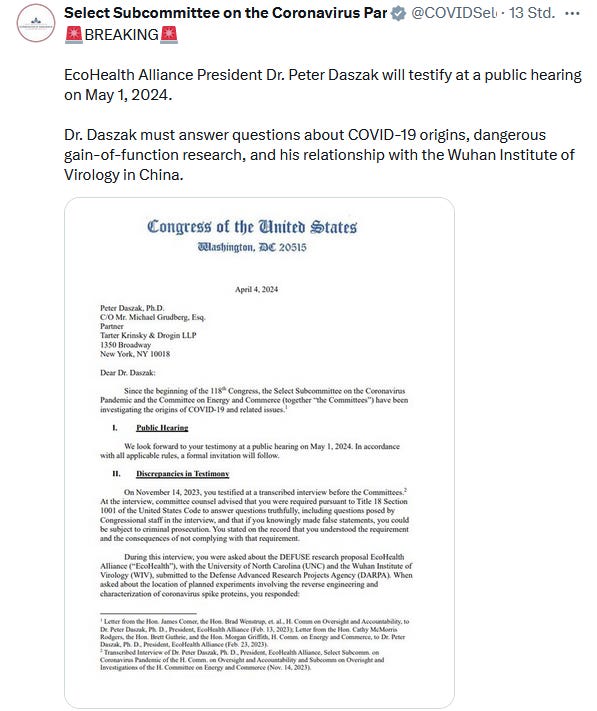
With the GOP ramping up voter manipulation efforts for the general election, the “gain-of-function lab leak” myth is back in full swingYesterday, the GOP-led House Select Subcommittee on the Coronavirus Pandemic announced in a grandstanding letter the public interrogation of Dr. Peter Daszak, President of the non-profit organization EcoHealth Alliance.This announcement is the second one this week, following an earlier such proclamation addressing the editors-in-chief of the flagship scientific journals Nature, Science, and TheLancet.The announcements were coordinated with multiple right-leaning news outlets such as Fox News and the Washington Times, who had long articles lined up the moment the announcement went public. Further such announcements of public interrogations are expected, ultimately leading to the GOP-led public haranguing of Dr. Anthony Fauci, who will likely be required to testify in early summer.The origin controversy is political and polarizing. The “gain-of-function lab leak” myth is emotionally powerful; it stokes fears about reckless, unaccountable, and mad scientists who performed arcane experiments that led to a deadly chimeric pathogen causing the pandemic. A flask monster. The myth is also hopeful; it offers the illusion that if only somebody can stop them, we will be spared another tragedy like COVID-19. And who would not want to vote for the politicians who promise to hold these mad scientists accountable? Right?These efforts from the GOP are part of a larger media manipulation and voter mobilization strategy for the upcoming general election.Yet these upcoming battles over the origin controversy are not just about a handful of scientists and public health officials, they are a sign that science and an evidence-based worldview as a whole have come under pressure this election season.While Trump is consolidating power and acquiring old allies in the media, disinformation researchers and journalists who track manipulation campaigns have similarly been harassed, discredited, and smeared by elected representatives and their client propagandists.As the NYT apt headline writers put it: Trump’s allies are winning the war over disinformation.“... Half of politics is "image-making", the other half is the art of making people believe the image” ― Hannah Arendt, Crises of the Republic: Lying in Politics, Civil Disobedience, On Violence, and Thoughts on Politics and RevolutionIn the presence of so much manipulation and power, standing up for an evidence-based worldview is as much a duty as an act of courage.Science is an important guardrail of democracy because of its unique ability and role to solve informational conflicts and dispel false myths. That puts it in confrontation with usurping politics that aim to rewrite reality to fit ideology.I am not an important person, I have no insights to give into what best to do in politics, nor do I command the attention of large audiences. But the small thing I can do is to address the “gain-of-function lab leak” myth the best I know how. With science, curiosity, and an appreciation for the vastness of our complex world.This is where you will find me putting my effort in the near future.See you next week with the release of my big article titled: Treacherous Ancestry, a phylogeographic hunt for the ghosts of SARS-COV-2Cheers,PhilippUpdate April 12: Here is the full article now This is a public episode. If you would like to discuss this with other subscribers or get access to bonus episodes, visit www.protagonist-science.com
The lab leak hypothesis is dead, but the lab leak myth will never die.A new paper makes the rounds in the media by claiming a risk assessment score sheet can determine the "unnatural" nature of the COVID-19 outbreak in Wuhan. A stark contrast to the scientific consensus on zoonotic spillover. Over the years, we have seen many such probabilistic, Bayesian, or “common sense” analyses from various sources and all of them were of dubious quality and distributed by dubious actors with a very limited grasp of scientific evidence. However, this does not mean that alternative methods for looking at a problem can not add valuable insights. Will a risk assessment questionnaire finally offer something new? A hard look at the facts? A real conceptual contribution to the scientific literature? Or is it going to be what I tend to call a “meme paper”, abusing the format of a scientific article to launder unsubstantiated opinions and influence public perception? To answer this question, I invited two fantastic guests for a scientific discussion: Prof. Alice Hughes, a conservation biologist, bat huntress, and directly involved in the scientific search for the origins of SARS-CoV-2. She has published multiple papers of critical importance on the topic and continues to research with her team at the University of Hong Kong. Dr. Sam Gregson is a former CERN physicist, scicomm YouTuber, and bad statistics debunker. He has monitored bad actors and sensationalist claims on the origin topic while giving renowned experts room to lay out the scientific case for a zoonotic origin of the pandemic. If you see somebody reference this new paper as strong evidence for a lab leak, please share our video discussion to correct the record. Thank you!PS: If you have not gotten enough about this topic, I also was interviewed this week by the journalist Walker Bragman asking about the status of the origin controversy. I think this was a very nice conversation and some meta-discussion about the forces driving the lab leak myth, despite it having no evidence behind it.Thanks for reading The Protagonist Future! Subscribe for free to receive new posts and support my science communication work. This is a public episode. If you would like to discuss this with other subscribers or get access to bonus episodes, visit www.protagonist-science.com
Comments


Download from Google Play

Download from App Store
 United States