


 Claim Ownership
The Non-Psychiatrist’s Guide to Lifestyle Psychiatry
Subscribed: 0Played: 0
Subscribe

© Dr Mike Trott
Description
Hosted by Dr Mike Trott, a non-psychiatrist researcher working in psychiatric epidemiology and clinical trials, each episode breaks down the latest research in lifestyle psychiatry — including physical activity, sedentary behaviour, sleep, diet, and related interventions — with a focus on what the evidence actually shows.
Episodes are deliberately brief and focused. You will hear clear explanations of new studies, discussion of hot topics and contested ideas, and practical implications for clinical practice and mental health research.
Episodes are deliberately brief and focused. You will hear clear explanations of new studies, discussion of hot topics and contested ideas, and practical implications for clinical practice and mental health research.
7 Episodes
Reverse

In this episode, we turn to one of the most important – and often overlooked – drivers of premature mortality in severe mental illness: smoking.We explore why smoking is so prevalent in this group, including the neurobiological “self-medication” hypothesis, cognitive effects of nicotine, and the role of social and structural factors within mental health systems. We also examine the evidence on whether quitting worsens mental health (it doesn’t), and review what actually works for smoking cessation in people with psychosis.

BMI is everywhere in healthcare — but how useful is it for judging health at the individual level, especially in people with severe mental illness?In this episode we explore why BMI performs reasonably well for population surveillance but often fails to capture individual cardio-metabolic risk, especially for people with severe mental illness. Links to papers: https://www.newscientist.com/article/2513596-your-bmi-cant-tell-you-much-about-your-health-heres-what-can/https://www.thelancet.com/journals/landia/article/PIIS2213-8587(24)00316-4/fulltext
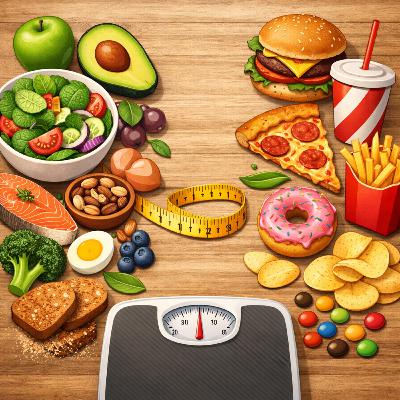
In this episode, we take a broader, more realistic look at diet in severe mental illness — from what the data actually say about diet quality and mental health, to the structural and cognitive barriers that shape food choices.
Sleep disturbance is almost universal in mental illness—but it’s still routinely treated as a secondary symptom. In this episode of The Non-Psychiatrist’s Guide to Lifestyle Psychiatry, we take a deep dive into sleep as a core, and potentially modifiable, factor in mental health.Links to articles mentioned in the pod: https://doi.org/10.1016/S2215-0366(20)30136-Xhttps://doi.org/10.1176/appi.ajp.2008.08010098https://www.nature.com/articles/s41398-020-0694-0

In this short episode of The Non-Psychiatrist’s Guide to Lifestyle Psychiatry, I explain the difference between physical activity, exercise, and sedentary behaviour — and why they are not interchangeable.I discuss why you can meet exercise guidelines and still sit too much, how sedentary behaviour has independent links to mental health, and why reducing sitting time may be a more realistic first step than structured exercise for many people.The focus is on reframing movement as a continuum, not an all-or-nothing target.
In this episode of The Non-Psychiatrist’s Guide to Lifestyle Psychiatry, I discuss a major new paper published in The Lancet looking at how much physical activity is needed for meaningful health benefits.https://www.thelancet.com/journals/lancet/article/PIIS0140-6736(25)02219-6/abstract

This is The Non-Psychiatrist’s Guide to Lifestyle Psychiatry — short, evidence-based episodes on how everyday behaviours shape mental health. I’m Dr Mike Trott, and in each episode I break down the latest research, hot topics, and practical implications, with no hype and no wellness slogans.Music track: A Positive Direction by AylexSource: https://freetouse.com/musicFree Vlog Music Without Copyright SE
Comments

Download from Google Play

Download from App Store
 United States