


What Does It Profit Podcast
Subscribed: 31,315Played: 126,054
Subscribe

Description
What does it profit a man to gain the whole world and lose his soul? Spoiler alert: Nothing.
This bible verse has endured over the centuries as a reminder that we can't put our price tag on what matters most. Yet, time and again, businesses have put profits above all -- leading our world to the brink of a climate catastrophe, an inequality crisis, and the greatest extinction of other creatures since the dinosaurs (except this time, the meteor is us).
Can we align growing returns with the greater good? Former investment banker turned business ethicist Dr. Dawn Carpenter believes we can -- and that figuring out how just might save the world.
In What Does It Profit, Dawn talks with the world's leading thinkers and researchers, entrepreneurs and executives, exploring the most innovative ways we can reconcile capitalism's demand for profit with the long term well-being of people and the planet. From socially responsible investing to conscious consumerism to business ethics in this age of extremes, Dawn is your guide to the cutting-edge ideas and experiments driving the purpose-driven business revolution. What Does It Profit?
This bible verse has endured over the centuries as a reminder that we can't put our price tag on what matters most. Yet, time and again, businesses have put profits above all -- leading our world to the brink of a climate catastrophe, an inequality crisis, and the greatest extinction of other creatures since the dinosaurs (except this time, the meteor is us).
Can we align growing returns with the greater good? Former investment banker turned business ethicist Dr. Dawn Carpenter believes we can -- and that figuring out how just might save the world.
In What Does It Profit, Dawn talks with the world's leading thinkers and researchers, entrepreneurs and executives, exploring the most innovative ways we can reconcile capitalism's demand for profit with the long term well-being of people and the planet. From socially responsible investing to conscious consumerism to business ethics in this age of extremes, Dawn is your guide to the cutting-edge ideas and experiments driving the purpose-driven business revolution. What Does It Profit?
63 Episodes
Reverse
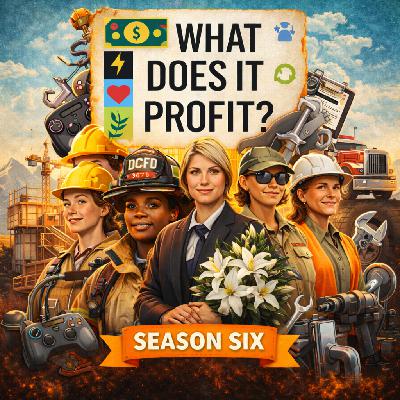
In Season 6 of What Does It Profit?, Dr. Dawn Carpenter goes inside industries where women are still underestimated and often unwelcome to explore how they are reshaping the meaning and structure of work. In this episode, we meet Judaline Cassidy, a master plumber, union leader, and founder of Tools & Tiaras, a nonprofit that introduces girls to welding, carpentry, plumbing, and the power of the skilled trades. Judaline was one of the only women in her plumbing program in Trinidad. She later broke barriers within New York's unions. Along the way, she developed a simple conviction that guides her work today: Jobs do not have genders. With every pipe she fits and every workshop she leads, Judaline is doing more than repairing infrastructure. She is challenging assumptions about who belongs in the trades and who gets to build the future. Through Tools & Tiaras, she is creating pathways for girls to see technical skill as strength, economic independence as attainable, and the trades as dignified, essential work. This episode explores what happens when women claim space in skilled labor and how expanding access strengthens the entire economy. Because when more people are invited to build, we all benefit from what gets built.
Less than 10% of truck drivers are women. The open road has long been seen as a man's world. But that is changing. In 2012, Jess Graham left an abusive relationship and enrolled in CDL training within days. Weeks later, she was licensed and on the road with her ten-year-old daughter, living together in the cab of a truck. For Jess, trucking was not just a job. It was a path to stability, speed, and self-determination. Every mile out there is different from your last mile. That's a new opportunity. In 2019, she bought her own truck, a 1995 Freightliner known as the Black Widow. Ownership shifted the journey from survival to entrepreneurship. This episode explores trucking as an economic ladder, a lifestyle, and a test of endurance. It asks what it profits us when women claim space in industries that keep the economy moving. Because sometimes the road is not just about freight. It is about freedom.
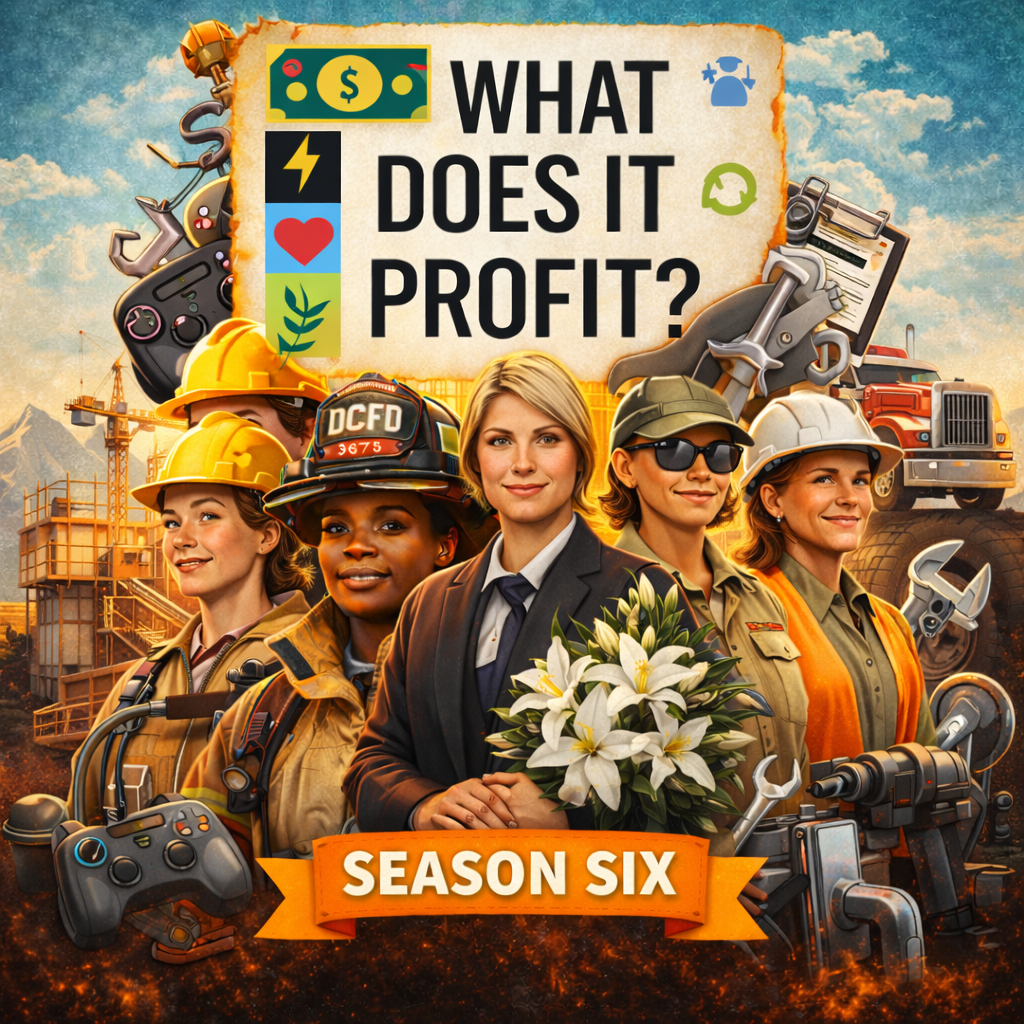
What happens when women enter one of the most dangerous, male-dominated professions... and change it from the inside? In this episode of What Does It Profit, Dr. Dawn Carpenter goes from D.C. firehouses to wildfire lines to meet the women fighting fire with fire. At Camp Spark in Washington, D.C., Lieutenant Roshawnda Drake is building a pipeline for the next generation of women firefighters. Out West, Lou Bean, Heidi Leib, and Ashley Nalley are reshaping wildfire response and prescribed burning, often in systems never designed with them in mind. Together, they show how women are reshaping the fire service and why a more inclusive culture can save lives.

Women have always worked. But when women entered the U.S. labor force in large numbers during the 1970s, equal pay did not follow. In this episode of What Does It Profit?, Dr. Dawn Carpenter explores the history of women's labor rights—from the rise of the Nine to Five movement to the equal pay fight led by Lilly Ledbetter. Through organizing, unions, and the law, women challenged workplaces that relied on their labor while undervaluing their work. Featuring labor historian Lane Windham and the cultural legacy behind 9 to 5, this episode examines why wage gaps persist, why voice still matters, and what economic justice requires when essential work goes unpaid—or underpaid. Because the laws exist. The gaps remain. And when women do essential work without equal pay, the question endures: What does it profit?

This season on What Does It Profit, host Dr. Dawn Carpenter steps into the worlds where women are least expected—and often least welcomed. From firehouses to funeral homes, construction sites to game design studios, meet the women breaking barriers and reshaping the meaning of work itself. Their stories reveal courage, solidarity, and the power to build a more inclusive future of work. Subscribe now to hear how these women are redefining what's possible—and what's profitable—for us all. Connect with us on LinkedIn to join the What Does It Profit community and keep the conversation going.
This episode explores the resurgence of black lung disease among coal miners, particularly due to toxic silica dust exposure. We revisit the Season 3 story of Joe and Elizabeth Opyoke, highlighting the dangers miners face. Cecil Roberts, President of the United Mine Workers of America, discusses the preventability of black lung disease and the need for stricter regulations on silica dust. Recent federal regulations aim to limit silica exposure, but enforcement remains a challenge. The episode emphasizes the importance of prioritizing miners' health over profit and the ongoing fight for their safety in the coal mining industry.
This episode we take listeners back to the Triangle Shirtwaist Factory fire of 1911. This was one of the deadliest industrial tragedies in U.S. history, claiming 147 lives due to locked exit doors and inadequate safety measures. This tragedy sparked significant reforms, including the establishment of OSHA and mandatory safety regulations. Historian Hasia Diner shares that the fire changed public perception about workers' rights, leading to increased support for unions. Journalist Kim Kelly emphasizes that the fire's legacy continues to inspire workers to organize and advocate for safer working conditions. The event remains a powerful reminder of the importance of worker safety.
In the Season 5 premiere of What Does It Profit, we explore the pressing issue of worker safety at Dollar General. Our journey begins with a bus trip to Nashville, where employees from nine states rally for fair pay and improved safety conditions. The episode highlights alarming safety violations, including blocked fire exits and inadequate staffing, which have led to numerous injuries and fatalities. We hear from workers and experts advocating for change, emphasizing the need for accountability in a company that continues to expand despite these issues. Join us as we uncover the realities of workplace safety in retail.
To our long-time listeners... welcome back. To those who have just found us, we are the podcast that examines the social and moral value of business. In the 5th season of What Does It Profit, we grapple with what it means to feel safe at work. We talk to historians and workforce safety experts, but most importantly we talk to workers themselves. From the surviving family members of those who died in the Triangle Shirtwaist factory fire in NYC to the brave Thomas Cook Airlines pilot who refused to fly fatigued... we learn what it means to be safe at work. Subscribe now so you don't miss what we learn from sex workers, costumed theme park characters, mine workers, retail sales workers and warehouse workers at some of the country's most well-known companies.
In the final episode of the fourth season of the What Does It Profit? Podcast, Dr. Dawn explores the impacts of artificial intelligence on religion . Dr. Dawn speaks to Josh Franklin, a rabbi at the Jewish Center of the Hamptons in New York, who used the chatbot ChatGPT to help write one of his sermons. Rabbi Franklin tells us his thoughts on how he hopes AI can be used as a tool for people to become more spiritual. We also hear from Mark Graves, a researcher and director with the organization AI and Faith, and Dr. Damien Patrick Williams, an assistant professor of philosophy and data science at the University of North Carolina at Charlotte. Both Graves and Williams see AI as a tool that can alter the way people engage with faith. As we navigate this new frontier brought on by the rise of AI, we should continue to ask: In the work that we do, and the investments that we make, what does it profit? WDIP is powered by the Solidarity Economy Workshop at Georgetown University. Engage with us on LinkedIn. We'd love to get to know you. Thanks for listening!
On this episode of the What Does It Profit? podcast, hitch a ride along with Dr. Dawn as she explores the potential impacts of artificial intelligence on public transportation in the U.S. In this episode, we hear first from Bill Domanico, a retired New York Metropolitan Transportation Authority (MTA) driver, who talks about the ways technology changed during his career. We then turn to Barry Wilson and Anthony Garland with the Amalgamated Transit Union Local 689, which represents DC's Washington Metropolitan Area Transit Authority (WMATA) employees. Wilson and Garland explain how the union is trying to rein in AI and protect jobs. WDIP is powered by the Solidarity Economy Workshop at Georgetown University. Engage with us on LinkedIn. We'd love to get to know you. Thanks for listening!
In this unexpected mini-episode, Dr. Dawn pivots from our regular programming to reflect on President Biden's sweeping executive order on AI. The executive order, passed on October 30, 2023, is the Biden Administration's attempt to reconcile tech companies' demand for profit and unchecked innovation while ensuring the public trust of Americans given the rapid rise of AI in just the past year. To better understand the executive order, Dr. Dawn speaks to Ben Winters, the Electronic Privacy Information Center's (EPIC) Senior Counsel, who also leads EPIC's AI and Human Rights Project. Winters delves into the details of the executive order, ultimately reaching the conclusion that while the order is overall promising, its effectiveness depends on how well it will be enforced by individual government agencies. Dr. Dawn then turns to former Congressman Jerry McNerney, who guided several congressional actions that brought to bear the rising importance of AI. With regard to Biden's executive order, McNerney believes that the executive order's emphasis on establishing standards on the use of AI will encourage good behavior in the tech industry. McNerney then discusses some of his work after leaving Congress, work which is primarily focused on understanding the challenges AI could pose in next year's presidential election. While the Biden Administration has begun to set precedents on AI regulation, the government alone cannot do all of this work. As you listen along to what this executive order means for the future, we encourage you to ask yourself: In the work we do, in the things we buy, in the investments we make, what does it profit? WDIP is powered by the Solidarity Economy Workshop at Georgetown University. Engage with us on LinkedIn. We'd love to get to know you. Thanks for listening!
In this episode, Dr. Dawn examines the newest addition to the construction industry's toolbox: AI technology. In this episode, we learn that AI is like a double-edged sword: While AI technology certainly threatens jobs in the construction industry, it's also ushering in a new era of efficiency and safety. We begin this episode in conversation with Bella McCann, the president of the woman-owned and Washington, D.C.-based construction company, Cann Construction. McCann takes us to a renovation site to provide a look at how new technologies make on-site work more efficient and safer for workers. We also hear from Jim Urtz, the national apprenticeship director with the Laborers' International Union of North America (LIUNA), on what the adoption of AI means for the future of jobs in construction. While Urtz has concerns about the potential of technology to replace people, he also details how AI technology can improve working conditions in a high-risk industry and widen the scope of employment opportunities for younger generations in an industry traditionally viewed as one only for the strongest of men. The adoption of AI technology in the construction industry encourages us to ask the question: In the work we do, in the things we buy, in the investments we make, what does it profit? WDIP is powered by the Solidarity Economy Workshop at Georgetown University. Engage with us on LinkedIn. We'd love to get to know you. Thanks for listening!
In this episode, Dr. Dawn heads straight into the scene of the action, Paramount Studios in Hollywood, where writers and actors are fighting an existential battle that stems in large part from AI. We look beyond the glitzy Hollywood sets to learn more about how AI threatens the livelihoods of creatives in an industry where most struggle to even make ends meet. We set the stage for what feels like a David and Goliath story as we spotlight the battles writers and actors have been fighting against studio executives and producers in conjunction with the rise of disruptive technologies, like AI. We spotlight what those battles are as we delve into the fears various members of the entertainment industry have about AI, and why those fears helped catalyze a historic Writer's Guild of America (WGA) and the Screen Actors Guild - American Federation of Television and Radio Artists (SAG-AFTRA) double strike. We begin this episode with the WGA. After nearly 150 days of striking, some writers have returned to work. In late September, the WGA reached a tentative deal with studio executives, a deal which imposes guardrails on AI's ability to create written content and be used as source material. Actors, though, haven't had the same success yet. We speak to Towanda Underdue, an actor, writer, and producer, as well as a lead negotiator for SAG-AFTRA, to learn why. Underdue details the myriad of ways AI can further disrupt the art of acting in light of the role streaming services have had undervaluing actors. We also hear from set designer Blair Barnet who shares her concerns about how AI will alter the fabric of what entertainment is built on: the creative human experience. While we outline these various battles, these battles are inextricably intertwined. This episode brings to light how creatives are fighting to protect the humans who work in entertainment, and the humanity of the entertainment industry itself. WDIP is powered by the Solidarity Economy Workshop at Georgetown University. Engage with us on LinkedIn. We'd love to get to know you. Thanks for listening!
Welcome to Season 4. In this kick-off episode, we travel with Dr. Dawn to the hometown of tech, San Francisco. We start the season this way because we feel that it's important to start in the real world before we venture into the virtual one. Dr. Dawn shares her observations of fear, hope, and heart. Special thanks in this episode to the Faithful Fools, the quirky souls in the Tenderloin who remind us all to keep it real. WDIP is powered by the Solidarity Economy Workshop at Georgetown University. Engage with us on LinkedIn. We'd love to get to know you. Thanks for listening!
Welcome to Season 4 of What Does It Profit. In this season, we're bringing you six stories about the hottest topic on the planet-- artificial intelligence (AI). Wanting to see firsthand what all the hype is about, Dr. Dawn packs up the WDIP production team and heads to Silicon Valley. In Season 4, we connect the dots between AI and the social and moral value of economic life. We dive into the impacts of AI in the entertainment industry, corporate management, public transportation, engineering, financial services, and religion. And in classic WDIP style, we are always asking the question-- in the work that we do, the things that we buy, and the investments that we make… What Does It Profit? >> Subscribe on your favorite app and follow and engage with us on LinkedIn. What Does It Profit is powered by the Solidarity Economy Workshop at Georgetown University.
In this episode, Dr. Dawn wraps up Season 3 by sliding into home plate. She takes us on a journey inside professional baseball. We hear the incredible story of how an inspiring group of athletes, allied with social justice advocates, finally took a stand to demand that the work of minor league baseball players was worth a living wage. Remarkably, and without much fanfare outside the world of baseball, a collective bargaining agreement was reached between the minor leaguers and Major League Baseball this Spring. As a service to those who have not heard the story, we bring you three of the key players that made it all happen. We meet Garrett Broshuis, the San Francisco minor league pitcher who later went on to become the leading trial lawyer guiding the campaign for justice for the players. We then are introduced the legendary activist Bill Fletcher, Jr. who could sniff out injustice with his eyes closed. As the story progresses, we also meet Harry Marino. Harry is a former minor leaguer who went on to later become not only a high-powered attorney but also the Executive Director of the organizing campaign set up by Bill. Where did Harry go after that-- to the Major League Baseball Players Association to become the Assistant General Counsel responsible for leading the bargaining unit set up for the minor leaguers. There a many stories in this story, and we urge you to read more. We think a few of the best stories about all of this can be found in the Nation and the Athletic. Our hats go off to those amazing journalists. We also want to applaud the bravery of Tony Clark of the Major League Baseball Players Association who stepped up when the time was right. Respect. What a beautiful story of solidarity. This episode marks the end of Season 3. If you have been listening, this season was all about "place" and the idea that you can make change right where you are. Next up, WDIP Summer School. We will be releasing mini-episodes throughout the summer introducing some of the ideas behind the stories we tell. Stay tuned for Season 4 coming this Fall where we will explore the impact of artificial intelligence (AI) in the worlds of work and wealth. __________ What Does It Profit is powered by the Solidary Economy Workshop at Georgetown University. Our host and executive producer is Dr. Dawn Carpenter. Our senior producer is Jordan Gass-Poore', and our engineer and sound designer is Mark Bush. Music for WDIP was composed by Nick Pennington. Season 3 researchers and assistant producers are Sofia Chen, Hannah Woodford, Andy Feng, and JasperAI. Our intern is Abby Trepacz. Special thanks on this episode goes to guest researcher Jim Humphreys who knows more about baseball than anyone on the WDIP production team.
In this episode, Dr. Dawn takes us on a trip to find her roots in rural North Carolina. She is the granddaughter of an orphan who worked in the NC textile mills in the 1940s. Without much to go on, Dr. Dawn leans on insights from James Benton, author of Fraying Fabric, and Jimmy Warlick, historian and documentarian of the Workers' Legacy Project to fill in the gaps. Dr. Dawn gives us the context of the industrial past only to introduce us to the inspiring efforts of a new generation of North Carolinians. In this episode, we meet Material Return, a worker co-op that has created a profitable and sustainable way to deal with textile waste. We visit the factory and learn all about the concept of circularity. Material Return is powered by the Industrial Commons, a nonprofit organization working to incubate and support co-ops like this in Morganton, North Carolina. These tireless entrepreneurs are using the lessons of the time-tested co-op ecosystems of Europe to imagine a way to develop working-class wealth right here at home. Dr. Dawn leaves us with her reflection on the past and hopes for the future as she drives back north to the studio in Washington, DC. The first exit on the way is the Henry River Mill Village, the location where Hollywood filmmakers crafted the dystopian community featured in the Hunger Games. A warning. In the rearview– Morganton, an inspiration. __________ Check out Project Repat to learn more about the cool things you can do with your old t-shirts while helping Material Return. What Does It Profit is powered by the Solidary Economy Workshop at Georgetown University. Our host and executive producer is Dr. Dawn Carpenter. Our senior producer is Jordan Gass-Poore', and our engineer and sound designer is Mark Bush. Music for WDIP was composed by Nick Pennington. Season 3 researchers and assistant producers are Sofia Chen, Hannah Woodford, Andy Feng, and JasperAI. Our intern is Abby Trepacz.
In this episode, we are headed to West Virginia to flip the script on what we know about the energy business in the heart of coal country. We introduce you to a new type of energy and a new type of business. Meet Solar Holler, the "benefit corporation" that addresses some of the toughest economic issues in West Virginia. Joseph "Joe" and Elizabeth Opoke are father-and-daughter descendants of miners who came to Marion County, WV in the turn of the 20th century. Their immigrant kin came from Hungary to work in the West Virginia coal mines. Family is important in a place like West Virginia. Joe and Elizabeth tell us about what the coal industry has meant to West Virginia and what headwinds are faced when trying to imagine a new kind of economy and a safer and healthier way of life. One of those creative West Virginia dreamers facing these challenges is Dan Conant, the founder and CEO of Solar Holler. Dan uses the tool of a benefit corporation to create a business that seeks profit while at its core focusing on its social purpose. Dan's vision for the social purpose of Solar Holler is creating (1) affordable energy and (2) facilitating good-paying career jobs that are safe for workers and protect West Virginia's natural environment. Dan tells the rough and rocky story of how Solar Holler made this happen. This episode will inspire us all to find new ways to "power our lives." Learn more about benefit corporations: https://en.wikipedia.org/wiki/Benefit_corporations and about Solar Holler: https://www.solarholler.com/ What Does It Profit is powered by the Solidary Economy Workshop at Georgetown University. Our host and executive producer is Dr. Dawn Carpenter. Our senior producer is Jordan Gass-Poore', and our engineer and sound designer is Mark Bush. Music for WDIP was composed by Nick Pennington. Season 3 researchers and assistant producers are Sofia Chen, Hannah Woodford, and Andy Feng. Our intern is Abby Trepacz. Special thanks on this episode to our friends at Heartland Capital Strategies: https://www.heartlandnetwork.org/
In this episode, we head to Crete, Nebraska, America's heartland, in our quest to gain insight into the human cost of the meat we eat. We tell the extraordinary story of the "Children of Smithfield," the adult children of meatpacking workers at Smithfield Foods who stood up to Big Meat, the governor, and others in positions of power and authority to proclaim that their parents were not "expendable." These brave children stood up to meat producers whose callus and irresponsible response to COVID-19 was unacceptable. We then introduce you to the exploitive use of child labor in these same plants. This is a story that at first is sad, but then it is a source of frustration and anger. The meat industry in the US and around the world is extremely powerful and stands to continue to profit from the labor of some of the most vulnerable. Meatpacking is one of the most dangerous jobs in our economy, and the true cost of meat is not the price printed on the label. What Does It Profit is powered by the Solidarity Economy Workshop at Georgetown University.


Download from Google Play

Download from App Store
 United States
This host interrupts her guest before he can finish a complete thought. I can't even finish this episode.
reward volunteers... hmmm
@3:39: It is inaccurate to say that the purpose of companies to date has been to maximize shareholder profits. That's a historically ignorant statement, given that the justifications for charters, limited liability, incorporation, etc. were historically rooted in the public interest. In fact, such concessions were, for centuries, typically limited in duration and reviewed for renewals based on the public interest. Her framing wrongly poses the current (relatively recent) status as the default, which matters not just for public rhetoric, but also for legal interpretations. The guest sounds like yet another ignorant twit who says more than she knows and acts as if "history" is whatever she can lazily recall from her personal experience.
It's ironic to start a podcast apologizing for mispronunciations and then immediately move to misappropriations and misuses (e.g., "honing in", penultimate). It's especially ironic after recently hearing the host frame her role as didactic, going so far as to suggest that her podcasts present homework to listeners. I think perhaps she over-estimates her education and credibility.
What a bunch of white-washed, shallow-minded, naive garbage served up by an uncritical host. E.g., people shouldn't worry about Citizens United because companies worry about their public reputations. Are you kidding?!
I found this discussion shallow, ill informed, and unidimensional. E.g., there was no discussion of historical bases of granting charters (especially that they be in the public interest), historical limitations on corporate status (e.g., time limits), the logic of limited liability (and commensurate justifications and obligations), etc. As usual, the interview questions were fawning and uncritical.
@29:50: I guess in a business school, correlation = causation and a broad license to over-interpret results. Why test a hypothesis when you can instead call a conjecture a conclusion?
Why is this woman laudable? She makes money when bad businesses fail, but she doesn't cause or instigate those downfalls. As she noted, she has a financial interest in their failure, so any publicity might be viewed as the short version of a pump and dump. She's just a gambler. She isn't doing anything to bring justice. In fact, when she covers her shorts, she's providing the market for a fallen stock. Without buyers like her, it would crash further. If she were really praise-worthy, she'd be a financial journalist, an enforcement investigator, etc. As it is, she makes money on market *inefficiencies*--i.e., when she gambles with information she has but others do not. So, what's the point? The quality of thought on this podcast is somewhat lacking, seemingly blinded by a desire to tell stories that fit a certain narrative, which happens to be mostly fictional.
This guy definitely sounds like someone educated in India. Once he starts talking, he has to say every opinion he has without taking a breath, lest any other kid in the room start talking and steal the spotlight... in the context of 1 million kids for every opportunity. Not much content evident behind the deepities, platitudes, and humble-brags, though. Typical strategically vacuous CSR/ ESG "have your cake and eat it too... topped with self-righteousness." This is feel-good story-telling with all the intellectual rigor one expects from a business school.
You're mispronouncing her name. "Ch" is pronounced in Italian as "k" is pronounced in English.
Great great GREAT podcast. Its super detailed and sooo informative. Great for people looking to gain more knowledge on business and so many other things!
it's about time chevron amoung the many other earthly polluters be held responsible for greed and continuous destroying our planet ,restitution seems like right place to start,eventhough,it's going to take a whole lot more than just paying off some countries to clean up our planet home,thanks to all the folks fighting for this our home ,let's keep fighting,✌