


What Does It Profit Podcast
Subscribed: 31,292Played: 127,697
Subscribe

Description
What does it profit a man to gain the whole world and lose his soul? Spoiler alert: Nothing.
This bible verse has endured over the centuries as a reminder that we can't put our price tag on what matters most. Yet, time and again, businesses have put profits above all -- leading our world to the brink of a climate catastrophe, an inequality crisis, and the greatest extinction of other creatures since the dinosaurs (except this time, the meteor is us).
Can we align growing returns with the greater good? Former investment banker turned business ethicist Dr. Dawn Carpenter believes we can -- and that figuring out how just might save the world.
In What Does It Profit, Dawn talks with the world's leading thinkers and researchers, entrepreneurs and executives, exploring the most innovative ways we can reconcile capitalism's demand for profit with the long term well-being of people and the planet. From socially responsible investing to conscious consumerism to business ethics in this age of extremes, Dawn is your guide to the cutting-edge ideas and experiments driving the purpose-driven business revolution. What Does It Profit?
67 Episodes
Reverse

For most of human history, women cared for the dead. They prepared bodies and guided families through grief. Then death became a business, and women were pushed out. In this episode of What Does It Profit?, Dr. Dawn Carpenter brings you inside the death care industry with Doris Amen and Alexandra Mosca, two New York funeral directors who have spent decades working with the dead and bereaved in an industry that once told them they didn't belong. Today, women make up just 15 to 20 percent of funeral directors. The numbers are still small, but they are growing. Women aren't just entering the profession. They're reclaiming their role in death work and reshaping what it looks like.

In this episode of What Does It Profit?, Dr. Dawn Carpenter explores what happens when a business begins with a simple question. Where do people go to belong? More women are starting businesses than ever before. Yet ownership does not always mean access. Women still face barriers to capital, growth, and recognition. In spaces like game store ownership, those gaps are even more visible. Whitney Wolfe did not set out to become an entrepreneur. She set out to create a place where people could gather, connect, and feel at ease. That idea became Last Place on Earth, a Brooklyn game store that opened just as the world shut down. Through uncertainty and reinvention, she built a thriving community. Then she did it again with Third Place from the Sun. This is a story about more than games. It is about how connection creates value. It is about building spaces where people are invited in, not kept out. Because the strongest businesses are not only places where people spend. They are places where people belong.
A board game may look simple. A set of pieces. A set of rules. A way to win. But every game is a system. It teaches us what to value, how to compete, and what success looks like. In this episode of What Does It Profit?, we follow the unexpected journey of Elizabeth Hargrave, a health policy consultant turned award-winning game designer, whose hit board game Wingspan reshaped an entire industry. What began as a simple idea, a game about birds, became one of the most successful and celebrated board games of all time, selling over two million copies and opening the door for more women in game design. But this story is about more than one game. It's about who gets to design systems and whose ideas shape the rules we all live by. In an industry where women create fewer than one percent of games, Hargrave's success signals both how far we have come and how far we still have to go. From early pioneers like Elizabeth Magie, the creator of The Landlord's Game (the anti-capitalist precursor to Monopoly), to today's emerging designers, women have always been part of this story, even when they were written out of it. This episode asks a deeper question at the heart of work and economic life: not just who plays the game, but who designs it. Because when new voices shape the rules, the game itself begins to change.
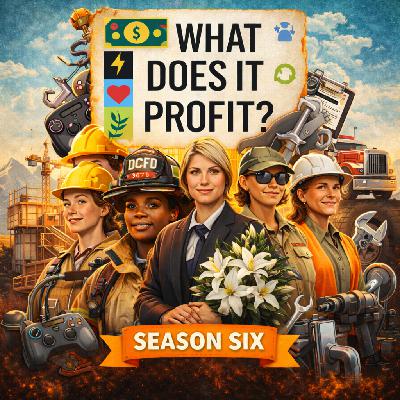
In Season 6 of What Does It Profit?, Dr. Dawn Carpenter explores dignity at work by stepping inside industries where women are still underestimated and often unwelcome. In this episode, we meet Aine O'Dwyer, a civil engineer and the CEO of Enovate Engineering. Raised on a dairy farm in Ireland, Aine learned early the value of discipline, perseverance, and hard work. Those lessons carried her across the Atlantic to the New Jersey Institute of Technology, where she pursued civil engineering while playing college basketball. Engineering classrooms were still overwhelmingly male, but Aine was undeterred. She built a career from the ground up, beginning as a field engineer and eventually leading major infrastructure projects across the New York region. Today, her firm helps design and manage the construction of bridges and other critical structures. For Aine, the work is more than technical. Every bridge represents a system carefully designed to endure. But the bridges she builds are not only made of steel and concrete. They are also bridges of confidence and opportunity for the next generation of women entering engineering. Aine's story reminds us that economic life is not just about what we build, but about who gets to build it. Because the structures that shape our world are not only physical, they are moral as well. And every one of them raises the same question: What does it profit?
In Season 6 of What Does It Profit?, Dr. Dawn Carpenter goes inside industries where women are still underestimated and often unwelcome to explore how they are reshaping the meaning and structure of work. In this episode, we meet Judaline Cassidy, a master plumber, union leader, and founder of Tools & Tiaras, a nonprofit that introduces girls to welding, carpentry, plumbing, and the power of the skilled trades. Judaline was one of the only women in her plumbing program in Trinidad. She later broke barriers within New York's unions. Along the way, she developed a simple conviction that guides her work today: Jobs do not have genders. With every pipe she fits and every workshop she leads, Judaline is doing more than repairing infrastructure. She is challenging assumptions about who belongs in the trades and who gets to build the future. Through Tools & Tiaras, she is creating pathways for girls to see technical skill as strength, economic independence as attainable, and the trades as dignified, essential work. This episode explores what happens when women claim space in skilled labor and how expanding access strengthens the entire economy. Because when more people are invited to build, we all benefit from what gets built.

Comments

Download from Google Play

Download from App Store
 United States