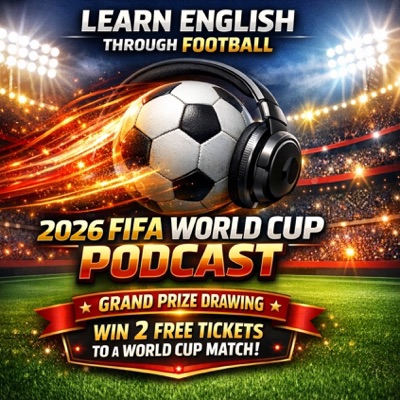
Hey everyone, welcome back to Learn English Through Football. I’m Jake. And I’m Maria. Today we’re doing something fun and, honestly, super useful for your English… we’re talking about the 2026 FIFA World Cup. Yeah… and we’re not just chatting for fun. We’re using the World Cup to learn everyday English, football vocabulary, and a few phrases you can use in real conversations. Exactly. And don’t worry if you’re not, like, a hardcore football expert. If you can say “goal” and “wow,” you’re already halfway there. True. So, quick overview: the 2026 World Cup is a big one because it’s hosted in three countries… the United States, Canada, and Mexico. Three hosts. That’s a great English phrase, by the way: “co-hosts” or “joint hosts.” You can say, “The tournament is co-hosted by…” Nice. And another major thing… the tournament is bigger than before. More teams. Right, it’s expanding. So the phrase “to expand” means to get bigger. Like, “The World Cup is expanding to include more teams.” And you can also say “an expanded tournament.” That’s a common adjective form. Okay, so let’s make this practical. Imagine you’re talking with a friend and you want to bring this up. You could say, “Did you hear the 2026 World Cup is being held in North America?” Or more casual: “Hey, did you know the next World Cup is in the US, Canada, and Mexico?” Yeah. “Did you know…” is such an easy conversation starter. Let’s do some key vocabulary. First one: “host city.” That’s a city where matches are played. And you might hear “venue” too. A venue is the place where an event happens, like a stadium. So you can say, “This stadium is a World Cup venue.” Exactly. And when you talk about stadiums, another common word is “capacity.” Like, “That stadium has a huge capacity,” meaning it can hold a lot of people. Capacity is a great word. Not just for sports. You can say, “This room is at full capacity,” like… it’s totally full. So, Maria, if you were planning a trip for the World Cup, what would you say in English? Like, a normal sentence. Hmm… I’d say, “I’m thinking of traveling for the World Cup, but I need to plan my budget.” Budget. Super important word. Your budget is basically the money plan, right? Right. Like, how much you can afford. Another travel phrase: “book a flight,” “book a hotel.” And if prices are too high, you can say, “It’s out of my budget.” That phrase is really common. Yes. Also, you’ll hear people say “I’m saving up.” That means you’re putting money aside over time. Okay, now football English. Let’s start with the basics: “match” and “game.” In football, people often say “match.” Americans might say “game” more. True, but both are understood. You can say, “Did you watch the match?” or “Did you watch the game?” Then there’s “group stage.” That’s the early part where teams play in groups. And after that you get into the “knockout stage,” where, basically, if you lose… you’re out. That phrase “you’re out” is nice and informal. Like, “They lost, so they’re out of the tournament.” Or “They got knocked out.” That’s a super common football phrase. Let’s practice a few reactions you can say while watching. Like when something surprising happens… Oh, easy. “No way!” Or “You’re kidding!” Or if you’re shocked… “I can’t believe it.” And if somebody scores an amazing goal: “What a goal!” Or more dramatic: “That was insane.” Now, let’s talk about predictions. People love predicting the winner. Yeah, and it’s a great way to practice future language. You can say, “I think Brazil will win,” or “I’m pretty sure France is going to go far.” “Go far” means they’ll reach later rounds, maybe semifinals or final. So if you say, “They’ll go far,” you mean they’ll do well. Also, “favorites.” Like, “They’re one of the favorites.” That means many people think they have a strong chance to win. Right. And the opposite could be “underdog.” That’s a team people don’t expect to win… but they might surprise everyone. I love underdog stories. And by the way, “an underdog story” is used outside sports too. Like someone starting with disadvantages and then succeeding. Now let’s do a quick mini-roleplay. You’re at work or school, and someone asks you about the World Cup. Maria, ask me a question. Okay… Jake, are you excited about the 2026 World Cup? Uh, yeah, totally. I’m especially excited because it’s in North America. I feel like the atmosphere is going to be crazy. Nice. “Atmosphere” means the feeling in the stadium or in the city—like the energy. Yeah. And then you could ask, “What teams are you supporting?” And you can answer, “I’m supporting…” or “I’m rooting for…” which is a great phrase. “I’m rooting for Mexico,” for example. “Rooting for” is super natural. If you want to sound even more casual, you can say, “I’m backing them,” like, “I’m backing Argentina this time.” Okay but… if your team loses, what do you say? Honestly? I’d probably say, “Ugh, we played so badly.” Or, “We choked.” That’s informal, but people say it. It means you failed under pressure. Yeah, but careful with that one—only use it in casual situations. True. Another safer one is, “We didn’t show up today.” Not literally… it means the team didn’t perform. Okay, pronunciation check moment. People say “tournament” in different ways, but a clear way is… “TOUR-nuh-ment.” Tournament. And “stadium.” Not “stay-dee-um”… it’s more like “STAY-dee-um.” Stadium. Now, I want to shift to something cultural. Because having three host countries means… lots of travel, different cities, different foods, languages, accents. Yes! And for English learners, it’s interesting because you’ll hear different English accents… especially in the US and Canada. Even within the US, accents vary a lot. Totally. And you might hear football called “soccer” in the US and Canada. That’s important. Let’s teach that clearly: In many countries, it’s “football.” In the US, a lot of people say “soccer” to avoid confusion with American football. So if you’re in the US and you say “football,” people might think you mean NFL. Exactly. But during the World Cup, honestly, you can say either and people will get it from context… usually. Another useful phrase: “I’m going to watch it at a sports bar.” Sports bar is a common place people go to watch matches. Or “watch party.” Like, “We’re having a watch party for the opening match.” Opening match—good phrase. That’s the first match of the tournament. And the “final” is the last match, the championship game. You can also say “the final match.” Let’s talk about common verbs in football English. “Score,” obviously. “They scored in the second half.” “Assist” is another one. If you pass the ball and your teammate scores… you assisted the goal. And “save,” for goalkeepers. “What a save!” Also “miss.” Like, “He missed the penalty.” Ah—penalty. That’s a big World Cup word. A penalty kick is a shot taken from the penalty spot after a foul in the box. And “foul” is when a player does something illegal, like tripping, pushing, pulling… stuff like that. Then you’ve got “yellow card” and “red card.” Yellow is a warning. Red means you’re sent off… you have to leave the field. “Sent off” is a perfect phrase for English learners. You can say, “He got sent off for a bad tackle.” Okay Maria, quick debate. What do you think is harder for English learners: learning vocabulary or… speaking confidently? Speaking confidently. 100 percent. Because you can know the words, but then you’re like… uh… how do I say this without sounding weird? Yes. And the World Cup helps because it gives you easy conversation topics. You don’t have to invent topics—you can just react to what’s happening. Exactly. Like, you can literally say, “Did you see that?” and point at the screen… and boom, you’re having a conversation. And if you want to keep the conversation going, you can ask follow-up questions. Like, “Who do you think will win?” or “What do you think of their coach?” Coach is a good word. Some people also say “manager,” especially in British English. Football manager. And tactics—another word. If a team defends a lot, you could say, “They’re playing very defensively.” Or if they attack a lot: “They’re playing really aggressively,” or “They’re pushing forward.” Pushing forward—nice. That’s a phrase you can use in life too. Like, “We’re pushing forward with the project.” Okay, now let’s do a small listening-style practice. We’ll say a casual line, and you can repeat after us later. Ready? “I’m not gonna lie, that team looks really strong this year.” Good. “I’m not gonna lie” means you’re being honest. Very casual. Another one: “They’re fun to watch, but their defense is shaky.” Shaky means not stable, not reliable. Like, a shaky defense makes mistakes. Next: “If they keep playing like this, they’ll get punished.” In football, “get punished” often means the other team will score because of your mistakes. Okay, one more: “That referee is being so inconsistent.” Inconsistent means not the same each time. Like, calling a foul sometimes but not other times. Now… a common World Cup topic: pressure. Players feel pressure, fans feel pressure. Yes. You can say, “It’s a high-pressure match.” Or “They handled the pressure really well.” And “handle” means manage. Handle the pressure. Handle a situation. Also, “nerves.” Like, “The players looked nervous,” or “He had nerves during the penalty.” Let’s zoom out. The 2026 World Cup is going to be huge for fans because… it’s more games, more teams, more places to visit. And more chances for casual fans to get into it. Because with more matches, you’re like, “Oh, there’s always something on.” Which brings up another phrase: “to follow the tournament.” That means you keep up with it, you watch results, you watch highlights. Highlights—great word. If you don’t have time to watch the full match, you watch the highlights. The best moments. And if you miss something, you can say, “I missed the match, but I saw the highlights.” Or, “I caught the second half.” That means you watched the second half


 Claim Ownership


 United States