


 Claim Ownership
 Crime: Reconstructed Podcast
Crime: Reconstructed PodcastSubscribed: 11Played: 90
Subscribe

© Morgan Wright
Description
An intelligence-driven Substack examining unsolved crimes, investigative failure, and how truth emerges when cases are reconstructed from evidence and first principles.
crimereconstructed.substack.com
crimereconstructed.substack.com
27 Episodes
Reverse
🎙 Crime: Reconstructed — Morning UpdateWeek 1: The Binary Collapse ModelEpisode OverviewEvery investigative theory makes promises.If a crime was committed for a specific objective, the behavior required to accomplish that objective should leave signals in the physical environment. Those signals may not be obvious at first glance, but they should exist.In today’s Systems Stress Test, we examine the burglary hypothesis from a First Principles perspective. If theft was the primary objective of an offender, what patterns should investigators expect to see? What behavioral and environmental signals should exist at the scene?Rather than debating narrative possibilities, this episode focuses on structural expectations — the predictable patterns that theft-driven crimes tend to produce.What We Examine* The operational logic of theft-driven crimes* Why burglars almost always leave search patterns* The types of items typically prioritized in property crimes* How time compression shapes burglar behavior* Why exit patterns matter when property removal is the objective* The difference between narrative reasoning and structural analysisExpected Signals of a Theft ObjectiveIf theft was the central goal, investigators should expect to see several observable patterns:Search BehaviorDrawers, cabinets, and storage spaces disturbed as the offender searches for valuables.Item PrioritizationHigh-value, low-weight items removed — jewelry, cash, portable electronics.Time CompressionEvidence of rapid movement through the environment rather than prolonged activity.Clear Exit PatternsIndicators that property was removed and transported out of the scene.Key Structural Questions* Does the environment reflect a search for valuables?* Were obvious high-value items taken or ignored?* Does the timeline suggest hurried entry and exit?* Is there evidence that property was actually removed from the scene?* Do the observed patterns align with theft behavior — or contradict it?Why This MattersNarratives can make almost any theory sound plausible. But investigations are not solved by plausibility alone. They require consistency between behavior, environment, and objective.A systems stress test forces a theory to answer a simple question:If this explanation were correct, what would we expect to see?When those expected signals fail to appear, the theory must either adapt — or collapse.Part of the Binary Collapse SeriesThis episode continues Week 1 of the Binary Collapse Model series, where we are systematically testing the burglary hypothesis from multiple angles.Earlier this week we examined physical constraints and audited the phrase “crime of opportunity.” Today we pressure-tested the theft objective itself.Tomorrow, we move closer to the collapse point by examining the unresolved tension between competing models.Two explanations cannot survive the same constraints forever.Subscribe for daily First Principles briefings and weekly deep-dive reconstructions.Crime is not clarified through narrative — it is reconstructed through structure. This is a public episode. If you would like to discuss this with other subscribers or get access to bonus episodes, visit crimereconstructed.substack.com
🎙 Crime: Reconstructed — Morning UpdateWeek 1: The Binary Collapse ModelEpisode Title: Crime of Opportunity — What Does That Actually Mean?Episode OverviewIn today’s Assumption Audit, we examine one of the most common early-stage labels in criminal investigations:“This appears to be a crime of opportunity.”The phrase sounds neutral. It sounds cautious. But structurally, it embeds assumptions about intent, randomness, and preparation that are rarely examined in real time.This episode does not speculate about suspects or motive. Instead, it applies a First Principles lens to the language itself — separating timing from preparation, randomness from targeting, and spontaneity from infrastructure.Before “opportunity” hardens into narrative, we ask what must be true for it to hold.What We Break Down* The operational difference between timing and preparation* Why “opportunity” does not eliminate planning* The assumption of randomness — and how it can mislead* Encountered opportunity vs. created opportunity* The infrastructure question in escalation cases* What a truly spontaneous crime would look like under constraintKey Structural Questions* What evidence demonstrates lack of preparation?* Did the offender possess control or transport capability before acting?* Was vulnerability accidental — or predictable?* Does the scene reflect improvisation or control?* Are we mistaking absence of evidence for absence of targeting?Why This MattersLanguage shapes investigation.When shorthand phrases are accepted without structural testing, they can quietly direct analytical focus and limit alternative models. “Crime of opportunity” is not a conclusion — it is a hypothesis about timing and intent.Intent must align with capability.Capability must align with physical constraint.This episode continues Week 1 of the Binary Collapse Model series, building toward Thursday’s full structural comparison of competing models.We are not collapsing the binary yet.We are auditing the assumptions before we do.Subscribe for daily First Principles briefings and weekly strategic deep dives.Crime is not clarified by narrative — it is reconstructed through structure. This is a public episode. If you would like to discuss this with other subscribers or get access to bonus episodes, visit crimereconstructed.substack.com
🎙 Crime: Reconstructed — Morning UpdateWeek 1: The Binary Collapse ModelEpisode Title: When Theft Becomes KidnappingEpisode OverviewIn today’s Constraint Monday briefing, we examine a phrase that appears frequently in disappearance cases:“The burglary went wrong.”It sounds plausible. It feels intuitive. But does it survive physical scrutiny?This episode does not speculate about motive or identity. Instead, it applies First Principles analysis to a structural question:What must be physically true for a burglary to become an abduction?Burglary and kidnapping are not adjacent crimes. They are distinct operational missions with different objectives, logistics, and risk profiles. Before we accept escalation as explanation, we must test whether the mechanics support it.This episode defines the physical constraints that must exist for that transformation to be possible.What We Examine* The operational difference between a property objective and a control objective* Why proximity is necessary but not sufficient* The requirement for sustained control capacity* Transport feasibility and exit corridor integrity* Whether panic realistically produces organized removal* The hidden assumptions embedded in the phrase “crime of opportunity”Key Structural Questions* Did the offender have the capability to restrain and move a person before entry?* Was there logistical preparation for transport?* Does the scene reflect chaos consistent with escalation?* Was there sufficient time and physical freedom to execute removal?* If the infrastructure for abduction existed, was this ever truly a burglary?Why This MattersNarratives compress complexity.Constraint analysis restores structure.When categories blur — burglary and abduction treated as interchangeable — investigative clarity suffers. The purpose of this episode is not to resolve a case, but to define the physical boundaries within which any theory must operate.Physics precedes narrative.Capability precedes escalation.This Week in the Binary Collapse SeriesThis episode begins Week 1 of our Binary Collapse Model series. Throughout the week, we will:* Audit assumptions embedded in media framing* Stress-test escalation theories* Build toward a full structural comparison on Thursday’s 1-hour masterclassThe question remains open:Was this a burglary that escalated under constraint —or was it never a burglary at all?We’re not collapsing the binary yet.We’re defining what must be true before we do.Subscribe for daily First Principles briefings and Thursday strategic deep dives.Crime is not solved by narrative. It is reconstructed through structure. This is a public episode. If you would like to discuss this with other subscribers or get access to bonus episodes, visit crimereconstructed.substack.com

🎯 Episode FocusWhen do investigations stop being mechanical inquiries and start becoming stories?This episode explores the structural moment where narrative replaces constraint — and how that shift undermines objectivity.🧭 The Core FrameworkEvery investigation should be grounded in irreducible components:Entry – How did contact occur?Control – How was dominance established or maintained?Egress – How did the offender exit without interception?If a hypothesis cannot survive these mechanics, it does not survive scrutiny.🔍 Key Themes Discussed1. Narrative DriftHow incomplete data invites coherence-building — and how the human brain fills gaps prematurely.2. Confirmation as ComfortWhy investigators (and the public) unconsciously defend emerging storylines — even without bad intent.3. Anomalies and Narrative GravityHow minor irregularities accumulate disproportionate importance over time.4. Motive vs. MechanismWhy “why” questions must come after “how” questions.5. Premature ClosureThe institutional and cognitive pressures that lock investigations into fragile narratives.🧠 First Principles SafeguardsTo prevent drift:Separate primary evidence from secondary interpretation.Identify embedded assumptions in working theories.Ask: If this assumption is false, what collapses?Stress-test hypotheses against physics, timing, and risk.Remove preferred suspects and rebuild mechanically.Truth survives stress. Stories do not.🔒 The DisciplineInvestigations are not designed to feel satisfying.They are designed to withstand pressure.If a case theory feels smooth, coherent, and emotionally complete — it may be fragile.The safeguard is constraint.📌 Closing ReminderStop asking what you believe.Start asking what must be true.Entry.Control.Egress. This is a public episode. If you would like to discuss this with other subscribers or get access to bonus episodes, visit crimereconstructed.substack.com
Pete Forcelli is the author of The Deadly Path, a former Special Agent in Charge at ATF, and an expert on home invasions, having worked over 300 cases between New York, Phoenix, and Miami.Pete and I dive deep into tactics for home invasions and apply them to the Guthrie case.Thank you Terry Hankenson, NEAL E CADORETTE, Al Rosson, Jasraj, Tracy, and many others for tuning into my live video! Join me for my next live video in the app. This is a public episode. If you would like to discuss this with other subscribers or get access to bonus episodes, visit crimereconstructed.substack.com
I talked with Aaron Graham, a former DEA agent who lived in Tucson. He had a $500,000 bounty placed on him by the cartel. We analyzed aspects of the Nancy Guthrie case and explored if the cartels could really be involved.We broke down:–How cartels operate cross-border–Their business model and KRE (kidnapping, ransom, extortion)–An undercover operation near Nancy Guthrie's houseMake sure to subscribe:Crime: Reconstructed - Rebuilding Cases From First PrinciplesSubstack | Podcast | YouTube | X | Insta | Facebook This is a public episode. If you would like to discuss this with other subscribers or get access to bonus episodes, visit crimereconstructed.substack.com
This is a public episode. If you would like to discuss this with other subscribers or get access to bonus episodes, visit crimereconstructed.substack.com
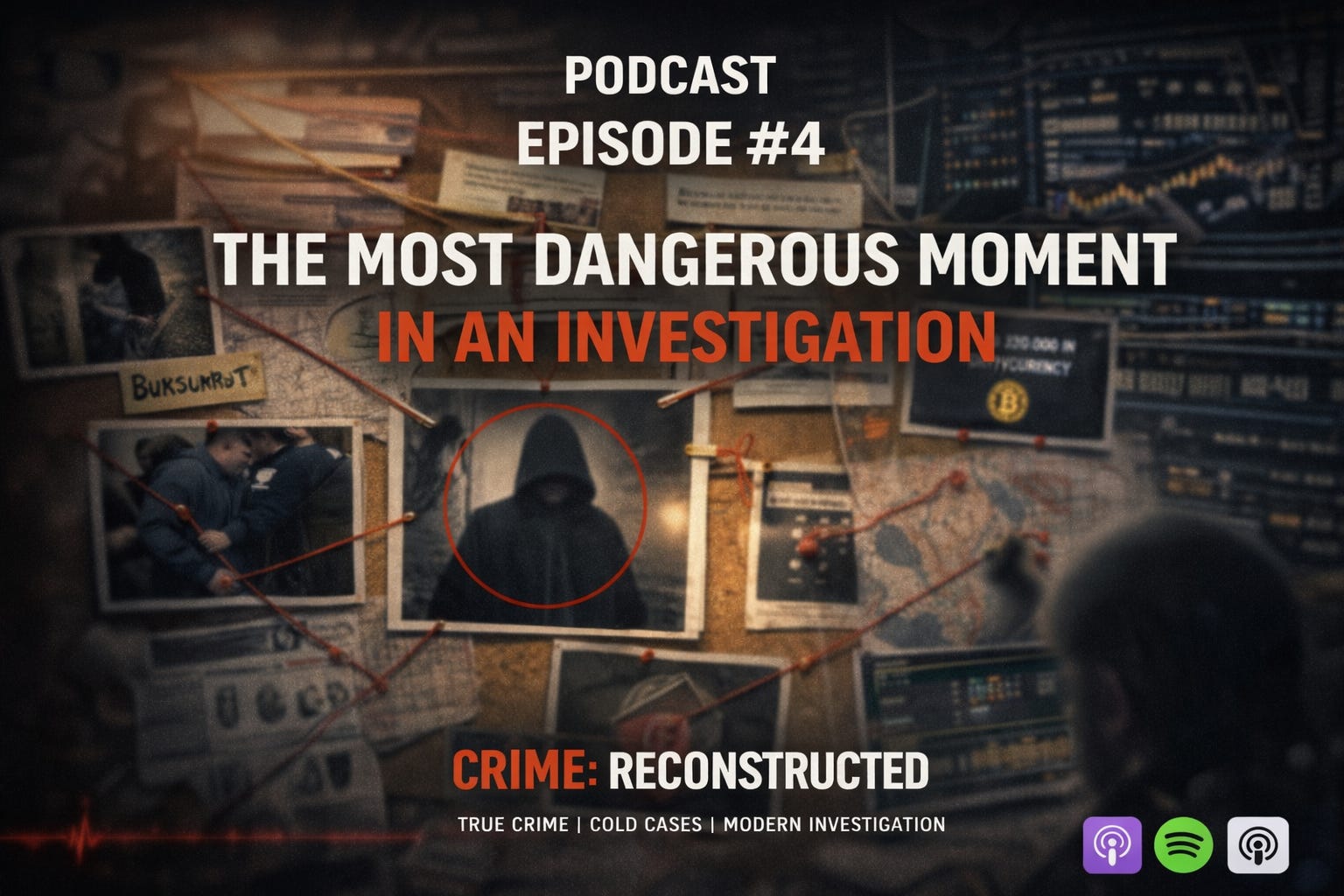
Every investigation has a breaking point.It isn’t the arrival of the first patrol unit.It isn’t the execution of a search warrant.It isn’t even the public detention of a suspect.The most dangerous moment in any investigation is the instant a theory feels right.In this episode of Crime: Reconstructed, Morgan Wright examines how premature coherence reshapes evidence, narrows hypothesis space too early, and quietly distorts outcomes. Using structural elements from the Nancy Guthrie case — the reported burglary, electronic ransom communication, cryptocurrency demand, detentions, and surveillance imagery — this episode dissects how narrative gravity forms and why disciplined constraint-mapping is essential.From a First Principles perspective, investigations are not stories. They are physics problems.This episode covers:- Why evidence is inert — and interpretation is active- The three distortions that follow early theory adoption- The danger of binary collapse (“burglary gone wrong” vs. “never a burglary”)- How ransom communications function as strategic artifacts- Why detentions create the illusion of confirmation- How informational entropy accelerates narrative driftThe tape goes up quickly.The truth takes longer.And the most dangerous moment is when certainty arrives too soon.Key Concepts Covered- First Principles investigation methodology- Constraint mapping (physical, temporal, behavioral, technological)- Confirmation bias in high-profile cases- Informational entropy- Hypothesis discipline- Narrative smoothing This is a public episode. If you would like to discuss this with other subscribers or get access to bonus episodes, visit crimereconstructed.substack.com
This is a public episode. If you would like to discuss this with other subscribers or get access to bonus episodes, visit crimereconstructed.substack.com
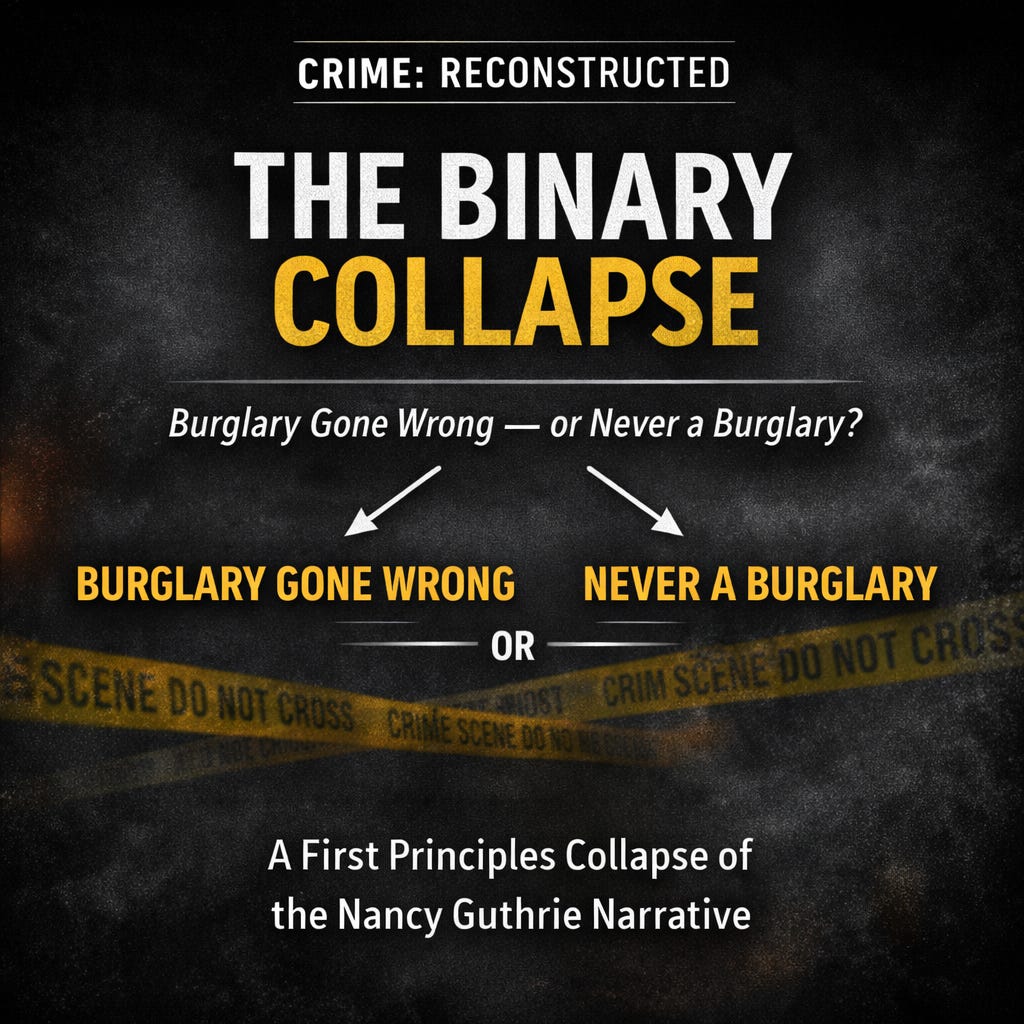
Maybe it was a burglary.Maybe it was an abduction.Maybe it was both.But burglary and abduction do not optimize for the same objectives. One prioritizes speed and invisibility. The other requires control and sustained exposure.In this episode, we apply a First Principles framework to collapse the Nancy Guthrie case into a clean structural binary:Either this was a genuine burglary that escalated unexpectedly…—or—It was never a burglary at all.The discriminator variable is simple but decisive:Was removal reactive — or operational?We examine risk delta, behavioral optimization, escalation mechanics, and why hybrid narratives weaken investigative clarity.Because once you decide which model you are in, the suspect pool changes.The forensic priorities change.And the direction of the case changes.This is not speculation.It’s structural compatibility testing.What We Cover• Why burglary and abduction are behaviorally incompatible• The risk delta between escape and removal• The mechanics of reactive escalation• The signals of operational control• Why hybrid explanations dilute investigative discipline• The single variable that collapses the narrativeKey QuestionWas Nancy’s removal improvised under stress — or integrated into an operational plan?That answer determines whether burglary is motive… or misdirection. This is a public episode. If you would like to discuss this with other subscribers or get access to bonus episodes, visit crimereconstructed.substack.com
This is a public episode. If you would like to discuss this with other subscribers or get access to bonus episodes, visit crimereconstructed.substack.com
This is a public episode. If you would like to discuss this with other subscribers or get access to bonus episodes, visit crimereconstructed.substack.com
This is a public episode. If you would like to discuss this with other subscribers or get access to bonus episodes, visit crimereconstructed.substack.com
This is a public episode. If you would like to discuss this with other subscribers or get access to bonus episodes, visit crimereconstructed.substack.com
This is a public episode. If you would like to discuss this with other subscribers or get access to bonus episodes, visit crimereconstructed.substack.com
This is a public episode. If you would like to discuss this with other subscribers or get access to bonus episodes, visit crimereconstructed.substack.com
This is a public episode. If you would like to discuss this with other subscribers or get access to bonus episodes, visit crimereconstructed.substack.com
This is a public episode. If you would like to discuss this with other subscribers or get access to bonus episodes, visit crimereconstructed.substack.com
This is a public episode. If you would like to discuss this with other subscribers or get access to bonus episodes, visit crimereconstructed.substack.com
This is a public episode. If you would like to discuss this with other subscribers or get access to bonus episodes, visit crimereconstructed.substack.com

Comments

Download from Google Play

Download from App Store
 United States