


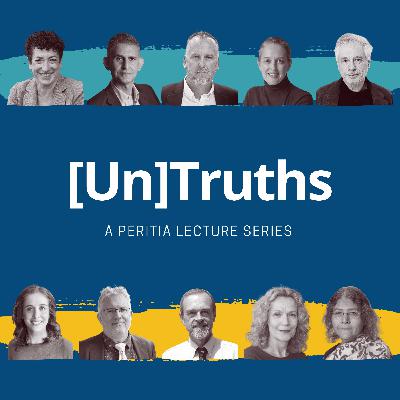
![[Un]Truths: Trust in an Age of Disinformation - A PERITIA Lecture Series](https://is1-ssl.mzstatic.com/image/thumb/Podcasts116/v4/65/f2/e3/65f2e3e0-38fa-ba70-4a2c-c5205f7269cd/mza_17283695049261409894.jpg/400x400bb.jpg "[Un]Truths: Trust in an Age of Disinformation - A PERITIA Lecture Series")
 Claim Ownership
[Un]Truths: Trust in an Age of Disinformation - A PERITIA Lecture Series
Subscribed: 1Played: 0
Subscribe

© Shane Bergin | Shaun and Maurice
Description
These are recordings of the PERITIA lecture series, [Un]Truths: Trust in an Age of Disinformation, exploring the ideas of trust and truth. Prominent philosophers and academics from Europe and the United States come together to present their latest research on trust in science, disinformation, vaccine hesitancy, conspiracy theories, trustworthy science, truth and democracy, and trust and cognitive science. Podcast produced by Shaun & Maurice.
11 Episodes
Reverse
Expert advice is needed to make decisions across the spectrum of public policy, from health, safety and environment to the management of the economy and national security. Yet phenomena such as climate skepticism and vaccine hesitancy indicate that all is not well in the relations between publics and experts in contemporary democracies. An abundance of scientific knowledge seems in many instances to have generated persistent controversies over technical claims and widespread disregard for expertise, even when there is strong consensus on what science says. This state of affairs suggests that the determinants of public trust lie not in the strength of the evidence as commonly understood, but in the efficacy of the institutions that societies rely on to translate expert knowledge into policy actions.
This lecture draws on comparative analyses of expert decision-making across democratic societies to argue that trust is a function of commitments to modes of evidence-making and public reason that are foundational to political cultures. Trust in expertise is a political achievement and cannot be short-circuited by epistemic fiat. It follows that the remedy for breakdowns in trust lies in the repair of the institutions charged with persuading publics that a claimed state of knowledge does indeed support proposed forms of public action.
This podcast has received funding from the European Union’s Horizon 2020 research and innovation programme under grant agreement No 870883. The information and opinions are those of the authors and do not necessarily reflect the opinion of the European Commission.
The talk examines the concept of knowledge resistance from a philosophical point of view. Knowledge resistance involves ignorance, but not all ignorance involves knowledge resistance. While ordinary ignorance can be overcome by supplying information, evidence, it is distinctive of knowledge resistant ignorance that supplying information does not help since the evidence is resisted. At a first approximation, then, knowledge resistance involves resisting available evidence. However, this characterization needs to be unpacked to be of any use. How is the notion of resistance to be understood and which are the psychological mechanisms involved? To what extent does knowledge resistance involve irrationality? And what does it mean for evidence to be available?
This podcast has received funding from the European Union’s Horizon 2020 research and innovation programme under grant agreement No 870883. The information and opinions are those of the authors and do not necessarily reflect the opinion of the European Commission.
For the better part of four decades, national leaders and their citizens have been warned that human activities are causing our planet to heat up – and that, if we do not change our ways, our descendants will have to cope with a harsh – possibly uninhabitable – environment. Despite repeated messages, very little has been done. Even when there are apparent successes, as with the 2015 Paris agreement, the targets set for reduction in emission of greenhouse gases have been inadequate. Since then, very few of the signatories are pursuing trajectories that will allow them to come close to attaining the goals to which they have committed themselves.
Climate action has been sporadic, and far too slow. Why? The obvious answer: distrust of the science. Yet, even in places where the scientific findings have been accepted, and even as skepticism is waning, the response remains sluggish. I suggest two main causes. First, current inequalities, within and between nations, generate a four-sided dilemma (or quadrilemma). Besides the impact on future generations, many nations and many people reasonably fear that their own futures will be devastated by the kinds of action proposed, unless serious efforts are made to protect and aid them – and they do not expect those efforts to be made. Second, the probabilistic character of the decision problem, coupled to our ignorance of the crucial probabilities (both now and in the foreseeable future), fosters the illusion that the safest course is not to modify the status quo.
The lecture will present the predicament, explain the two main causes of inaction, and offer some proposals for making progress. The best hope for a remedy would be to organize a world-wide venture in deliberative democracy, in which the quadrilemma was systematically confronted, and attempts were made to satisfy all constituencies. It is almost certain that any solution will not only have to revive democracy at the most fundamental level, and also mitigate the character of contemporary global capitalism.
This podcast has received funding from the European Union’s Horizon 2020 research and innovation programme under grant agreement No 870883. The information and opinions are those of the authors and do not necessarily reflect the opinion of the European Commission.
Democracy is under threat around the world including in Europe. How does the online information landscape contribute to that threat? Everyone talks about misinformation online, but what is really happening? Are citizens really drenched in misinformation and are they affected by it? Do social media really polarize societies? And if so, is regulation the answer?
Answers to those questions require an understanding of how people process information online and how their vulnerabilities might be exploited. I propose that there are several systematic pressure points between online architectures and human cognition. I highlight two pressure points that may engender a threat to democracy:
First, your attention online is worth money—a lot of money—to advertisers, and so the online economy is optimized to attract and capture your attention. Platforms make money while you hang around to consume more information. The quality of that information is of little concern to the platforms.
Second, virtually everything you see on the internet is curated by algorithms (e.g., the newsfeed on Facebook or Twitter). These algorithms are designed by platforms without public accountability or auditing, with the primary intent of keeping you engaged longer. Thus, if extremist and conspiratorial content can keep you engaged longer, then there is an incentive for platforms to show you that content.
Those pressure points can imperil our democracy when people are being radicalized or are presented with misinformation not because they want to, but because platforms are making money by facilitating it. Only through understanding of those pressure points between how humans think and how information is presented online can we hope to change anything.
I review the space of available solutions, focusing on the notion of “inoculation”, which involves providing people with the skills to avoid being misled by low-quality information.
This podcast has received funding from the European Union’s Horizon 2020 research and innovation programme under grant agreement No 870883. The information and opinions are those of the authors and do not necessarily reflect the opinion of the European Commission.
Because vaccine hesitancy has been framed as a problem of public misunderstanding of science, vaccine outreach has focused on educating the misguided publics. Where efforts to change vaccine attitudes have failed, cynicism has bred the harsher view that the publics are anti-science and anti-expertise. Yet research into science and the publics lends strong support to the view that public attitudes regarding scientific claims turn crucially on epistemic trust rather than familiarity with science itself. It follows that it is poor trust in the expert sources that engender vaccine hesitancy. This consideration redraws the lines of responsibility, where vaccine hesitancy signals a problem with scientific governance rather than a problem with the wayward publics. In order to improve vaccine communications, we should focus on building that trust rather than educating the misinformed publics or puzzling over the moral and epistemic failings of the publics. Doing this does not discount that public health agencies have the science on their sides. It does mean recognizing that the best science is not enough to ensure public uptake of health recommendations.
This podcast has received funding from the European Union’s Horizon 2020 research and innovation programme under grant agreement No 870883. The information and opinions are those of the authors and do not necessarily reflect the opinion of the European Commission.
Some philosophers have argued that humans trust one another automatically; others have argued that they only trust people whom they have reasons to believe are trustworthy. I argue that humans are simultaneously trustful and vigilant. To be vigilant is not to distrust, it is to spontaneously adjust one’s trust in the sources and the contents of communicated information.
Argumentation is a means to overcome the limits of trust. An audience who does not trust the good faith or the competence of a communicator may still be convinced by arguments the soundness of which can be assessed independently of their source. When, however, the arguments in support of some conclusion that would not be accepted on trust cannot be properly assessed by the audience—as happens commonly when experts speak—arguments can still be used not to convince but to impress, seduce, or intimidate the audience.
This podcast has received funding from the European Union’s Horizon 2020 research and innovation programme under grant agreement No 870883. The information and opinions are those of the authors and do not necessarily reflect the opinion of the European Commission.
One of the most challenging aspects of science advice for policy is building a framework for trust in such advice. Although science advice is not determinative of good policy, science advising is crucial for making good policy. But in order for advice to have its helpful effect, it has to be trusted. What should ground that trust? The bases for trust in science in general are to be found in 1) the nature of expertise, 2) the social structure of science, and 3) scientists having the right values. For the science advisor, these aspects of general trust in science are complicated by the special obligations the science advisor has to the scientific community, their advisees, and the public in democratic systems. Yet the nature of these obligations, if understood properly, should further enhance the general account of trust for science in the case of the science advisor. Such an understanding also moves us past the ideal of the “independent science advisor” to a fuller picture of the set of obligations that makes science advice reliable.
This podcast has received funding from the European Union’s Horizon 2020 research and innovation programme under grant agreement No 870883. The information and opinions are those of the authors and do not necessarily reflect the opinion of the European Commission.
Truth and politics, as Arendt noted, always seem to be at war with one another. But if so, truth has been on the losing side recently, particularly in democratic societies around the globe. Against this background, we’ll explore two questions: First, what does it mean for truth to be a particularly democratic value? And second, what are the greatest threats to that value?
This podcast has received funding from the European Union’s Horizon 2020 research and innovation programme under grant agreement No 870883. The information and opinions are those of the authors and do not necessarily reflect the opinion of the European Commission.
9/11 was an inside job. The Holocaust is a myth promoted to serve Jewish interests. The shootings at Sandy Hook Elementary School were a false flag operation. Climate change is a hoax perpetrated by the Chinese government.
These are all conspiracy theories. A glance online or at bestseller lists reveals how popular some of them are. Even if there is plenty of evidence to disprove them, people persist in propagating them. Why? Philosopher Quassim Cassam explains how conspiracy theories are different from ordinary theories about conspiracies. He argues that conspiracy theories are forms of propaganda and their function is to promote a political agenda. Although conspiracy theories are sometimes defended on the grounds that they uncover evidence of bad behaviour by political leaders, they do much more harm than good, with some resulting in the deaths of large numbers of people.
There can be no clearer indication that something has gone wrong with our intellectual and political culture than the fact that conspiracy theories have become mainstream. When they are dangerous, we cannot afford to ignore them. At the same time, refuting them by rational argument is difficult because conspiracy theorists discount or reject evidence that disproves their theories. As conspiracy theories are so often smokescreens for political ends, we need to come up with political as well as intellectual responses if we are to have any hope of defeating them.
This podcast has received funding from the European Union’s Horizon 2020 research and innovation programme under grant agreement No 870883. The information and opinions are those of the authors and do not necessarily reflect the opinion of the European Commission.
Do doctors really know what they are talking about when they tell us vaccines are safe? Should we take climate experts at their word when they warn us about the perils of global warming? Why should we trust science when our own politicians don't? In this landmark book, Naomi Oreskes offers a bold and compelling defense of science, revealing why the social character of scientific knowledge is its greatest strength―and the greatest reason we can trust it.
Tracing the history and philosophy of science from the late nineteenth century to today, Oreskes explains that, contrary to popular belief, there is no single scientific method. Rather, the trustworthiness of scientific claims derives from the social process by which they are rigorously vetted. This process is not perfect―nothing ever is when humans are involved―but she draws vital lessons from cases where scientists got it wrong. Oreskes shows how consensus is a crucial indicator of when a scientific matter has been settled, and when the knowledge produced is likely to be trustworthy.
Based on the Tanner Lectures on Human Values at Princeton University, this timely and provocative book features critical responses by climate experts Ottmar Edenhofer and Martin Kowarsch, political scientist Jon Krosnick, philosopher of science Marc Lange, and science historian Susan Lindee, as well as a foreword by political theorist Stephen Macedo.
This podcast has received funding from the European Union’s Horizon 2020 research and innovation programme under grant agreement No 870883. The information and opinions are those of the authors and do not necessarily reflect the opinion of the European Commission.
Truth and trust are becoming contentious topics for science and democracy. Conspiracy theories disrupt political elections, disinformation campaigns target scientific consensus around climate change and vaccines, and anti-elite populism overshadows public debates. In the midst of a pandemic, citizens find themselves asking quintessential philosophical questions: what truth is, whom we can trust, or how we should trust.
The PERITIA Lectures [Un]Truths: Trust in an Age of Disinformation delve into these phenomena to explore the concept of trust and truth in light of current events. Prominent philosophers and academics from Europe and the United States come together to present their latest research on trust in science, disinformation, vaccine hesitancy, conspiracy theories, trustworthy science, truth and democracy, and trust and cognitive science.
This lecture series has received funding from the European Union’s Horizon 2020 research and innovation programme under grant agreement No 870883. The information and opinions are those of the authors and do not necessarily reflect the opinion of the European Commission.
Comments

Download from Google Play

Download from App Store
 United States